Blogs
|
© 2009 Michael Mandiberg, Flickr | CC-BY-SA | via Wylio
From discipline-and-punish to a culture of prevention is the headline of an article from The Notebook in Philadelphia about a school that’s implementing the Positive Behavioral Interventions and Supports (PBIS) system.
Here’s how it begins:
For Amy Williams, principal of the William Dick Elementary School in North Philadelphia, it had to rank among the strangest frantic parent calls she had ever received.
"He’s crying because I washed his pants," the mother of a 4th-grade boy told her.
Unfortunately, the pants had contained the boy’s wad of "Cat Cash," play money handed out by teachers at the school to reward good behavior by individual students and whole classes.
For the students, collecting the Cat Cash — named for the school mascot, the panther — may be a game, trading the cash for goodies ranging from stuffed animals to class trips.
I’m really not that familiar with PBIS, though my impression is that extrinsic incentives like "Cat Cash" is a major part of it.
It will be no surprise to regular readers that I’m not a fan of this kind of system, since I’ve written a zillion posts and three books about the negative impacts of extrinsic motivation.
I’m not going to recite the research and reasoning that backs-up my position here — those links will take you to all of that.
However, I also want to repeat, as I’ve written before, that doesn’t mean I believe that extrinsic motivation can never play a role in classroom management. In fact, the most effective — by far — system that I have found to regain control of an out-of-control class is one that used just about the most common incentive system in classrooms today — points.
I wrote a very popular post, and a book chapter about it. You can read my piece titled Have You Ever Taught A Class That Got "Out Of Control"?
So, yes, using points or "cash" can be very effective in the short-term with a class, but if you want to teach long-term Social Emotional Learning Skills, I believe that having an exit strategy (which you can read about in that post) is absolutely critical.
Notice that I said "with a class." On occasion, I might have a individual student who is facing so many challenges that he/she appears immune to every strategy I know of to help create the conditions for his/her self-motivation. In those very rare instances, I will use extrinsic incentives. Almost without fail, other students recognize that student’s specific challenges, and there are no complaints about favoritism.
I’d be interested in hearing from readers more familiar with PBIS than I am — are extrinsic motivators as central to that strategy as the article seems to say? Am I being too judgmental?
Larry Ferlazzo
.
Blog
.
<span class='date ' tip=''><i class='icon-time'></i> Jul 16, 2015 06:28am</span>
|
|
Every month I make a few short lists highlighting my choices of the best resources I through (and learned from) Twitter, but didn’t necessarily include them in posts here on my blog.
I’ve already shared in earlier posts several new resources I found on Twitter — and where I gave credit to those from whom I learned about them. Those are not included again in post.
If you don’t use Twitter, you can also check-out all of my "tweets" on Twitter profile page.
You might also be interested in The Best Tweets Of 2014 — So Far and The Best Tweets Of 2014 — Part Two.
[View the story "June’s (2015) Best Tweets — Part One" on Storify]
Larry Ferlazzo
.
Blog
.
<span class='date ' tip=''><i class='icon-time'></i> Jul 16, 2015 06:28am</span>
|
|
Another day, another annual mid-year "Best" list (you can find all 1,400 Best lists here).
You might also be interested in:
The Best Videos For Educators In 2014 - Part Two
The Best Videos For Educators In 2014 - So Far
The "All-Time" Best Videos For Educators
The Best Videos For Educators In 2013 - Part Two
The Best Videos For Educators In 2012 — Part Two
The Best Videos For Educators In 2012 — Part One
The Best Videos For Educators In 2011
Part Two Of The Best Videos For Educators — 2010
The Ten Best Videos For Educators — 2010
And you might also want to see The Best Funny Videos Showing The Importance Of Being Bilingual — Part One ; The Best Videos Illustrating Qualities Of A Successful Language Learner ; The Best Video Clips Demonstrating "Grit"; and The Best Fun Videos About Books & Reading.
You might also want to check out The Best Video Collections For Educators ; The Best Video Clips On Goal-Setting — Help Me Find More ; The Best Movie Scenes, Stories, & Quotations About "Transfer Of Learning" - Help Me Find More! ; The Best Funny Videos To Help Teach Grammar - Help Me Find More ; The Best Videos About The Famous "Trolley Problem" and The Best Videos For Teaching & Learning About Figurative Language.
Here are my choices for The Best Videos For Educators In 2015 - So Far (some may have been produced prior to this year, but are just new to me):
Here’s a video and article about turning a Van Gogh painting to 3D. I think it would be useful in a Theory of Knowledge discussion of perception and art…:
Here’s a great one on a "Growth Mindset," which I’ve added to The Best Resources On Helping Our Students Develop A "Growth Mindset":
Vox shared this very useful video. I’m adding it to A Collection Of Useful Posts, Articles & Videos On Race & Racism - Help Me Find More.
John Spencer shared this great video on Twitter.
In addition to just being fun to watch, English Language Learners could watch it and then describe what they saw happening….:
Learning about Plato’s Allegory of the Cave is a key lesson in most IB Theory of Knowledge courses, and I’ve also been able to integrate it into my English Language Learner classes, too.
You can see many of the resources I use in the classroom, including student-made videos of modern parable versions, at our class blog.
Today, TED-Ed released a lesson and accompanying video that will be a nice addition.
John Lewis was interviewed by Jon Stewart on The Daily Show. Here’s the extended interview (there may be something wrong with the show’s embed code. If you can’t see it here, go directly to the Daily Show site):
The Daily Show
Daily Show Full Episodes, More Daily Show Videos, Comedy Central Full Episodes
I’m adding it to The Best Resources For Teaching About Selma.
I’ve previously shared about a group called PERTS from Stanford, which is working on growth mindset and other SEL issues.
They’ve now published short videos on topics that would be useful in the classroom, and have a site that they are expanding to helped interested educators connect. In addition, that same site has good resources on helping students learn from mistakes and providing students effective feedback.
Here is just one of the videos on the site. I know I’ll be using a number of their resources in my classroom:
I’ve previously written posts about Dan Pink’s great National Geographic series, Crowd Control.
You can now watch forty-one short clips from the show on National Geographic’s YouTube Channel.
Here’s one sample:
They’re excellent for use in many lessons, particularly for IB Theory of Knowledge when we study human sciences.
I’ve previously posted about studies showing that physical movement can help second (or third) language learning (you can see those posts at The Best Resources On Students Using Gestures & Physical Movement To Help With Learning).
Here’s a video on that research:
The question, "Was Mathematics invented or discovered?" is discussed in almost every IB Theory of Knowledge class.
I’ve previously posted about a a TED-Ed video on this topic that I didn’t think was a very good one.
The World Science Festival has just published a much better video responding to this question, and which I’ll definitely be using in class:
This video from The SciShow on YouTube is about the Nobel Prize for medicine given to the developer of the lobotomy.
It’s of particular interest to me since my Uncle was one of a number of immigrant children from low-income families who were diagnosed with so-called behavior disorders and lobotomized. This practice took place in the 1940’s. He was institutionalized for the rest of his life following the procedure. I have vivid memories of his visits to us — from the moment he entered our home he was always looking at his watch concerned about getting back to the hospital on time.
Here’s an intriguing video from BuzzFeed. Thanks to Open Culture for the tip:
I’m adding this video to The Best Videos Illustrating Qualities Of A Successful Language Learner.
It definitely demonstrates perseverance…
Neil deGrasse Tyson explains the meaning of life to a six-year-old:
Three years ago, the PBS News Hour did an excellent segment on self-control (I originally posted about it at Here’s A Video On Self-Control I’m Showing My Students First Thing Next Week).
They recently did another very good one, focusing on the Marshmallow Test - you can see the transcript here.
My only critique of it is a line that is always infuriating to me when people talk about charter schools. The segment mentions that the KIPP school students are selected by lottery and suggests that makes them comparable to students in other public schools. However, it doesn’t mention the fact that families who are particularly invested in their children’s education are ones who would go through the effort of registering and participating in a lottery, which makes blanket comparisons to students in other schools invalid. Of course, I also have other concerns about KIPP’s "character education" program.
Nevertheless, it’s a very good segment that I’ll be showing in class. I’m adding this post to The Best Posts About Helping Students Develop Their Capacity For Self-Control.
There’s a great CBS News video of college football star Malcolm Mitchell’s love reading on The Best Videos For Educators In 2014 - Part Two list (you can also find it at The Best Videos & Articles Where Athletes Explain How Reading & Writing Well Has Helped Their Career).
Then I found a second video sharing his story at Jackie Gerstein’s "Best" list of videos.
Check it out:
I’ve previously shared Sesame Street videos that have been emphasizing Social Emotional Learning Skills like self-control, and you can see them all at The Best Posts About Helping Students Develop Their Capacity For Self-Control (of course, earlier this week Cookie Monster also decided he was tired of delaying self-gratification).
They published a new one that models a classic self-control strategy:
Professor and researcher Carol Dweck gave a TEDx Talk shared by TED titled "The power of believing that you can improve."
I’ve embedded it below, but you can also see it on the TED site at the previous link. That site also has a written transcript of her comments.
Here’s an excerpt:
I was also struck by this passage:
"…we can actually change students’ mindsets. In one study, we taught them that every time they push out of their comfort zone to learn something new and difficult, the neurons in their brain can form new, stronger connections, and over time they can get smarter. Look what happened: in this study, students who were not taught this growth mindset continued to show declining grades over this difficult school transition, but those who were taught this lesson showed a sharp rebound in their grades."
That’s certainly been our experience after teacher Dweck-inspired lessons you can find at The Best Resources For Showing Students That They Make Their Brain Stronger By Learning.
Daniel Coyle shared this video on Twitter. I’m adding it to The Best Resources For Showing Students That They Make Their Brain Stronger By Learning:
Bob Greenberg, who has created an extraordinary collections of short video talks by educators from around the world (see Brainwaves Video Anthology Is A Great Collection Of Short Videos Of & For Educators), came to our school and videotaped me talking about how to help student motivate themselves.
Though I talked for longer than I had planned (the video lasts twelve minutes), I think it came out pretty well and people might find it useful.
And, of course, check out all of the other videos in Bob’s collection.
Larry Ferlazzo
.
Blog
.
<span class='date ' tip=''><i class='icon-time'></i> Jul 16, 2015 06:28am</span>
|
|
Skype has now opened-up its web-based version to everyone.
In order to be able to use it for voice or video calling, however, you still have to download a plugin. Much to my surprise, however, my school computer, which has a zillion restrictions on what can and cannot be downloaded, let me do it.
This can come in quite handy now for teachers whose districts restrict software downloads, and could make it easier for class conversations with authors, other classes, etc.
You can read more about it at this Tech Crunch post.
I’m adding this info to The Best Online Tools For Real-Time Collaboration.
Larry Ferlazzo
.
Blog
.
<span class='date ' tip=''><i class='icon-time'></i> Jul 16, 2015 06:27am</span>
|
|
© 2009 US Department of Education, Flickr | CC-BY | via Wylio
Over the next day or two, I’ll be publishing a post over at Education Week Teacher with advice on creating student digital portfolios (it’s now been published, and you can see it here).
I thought it would be useful to share a beginning list of resources here:
First, you might find these previous "Best" lists useful (I’ve just updated them):
The Best Places Where Students Can Write Online
The Best Ways For Students Or Teachers To Create A Website
I’ve previously posted several times about how much I love the Shadow Puppet app — there isn’t anything out there that’s an easier tool for creating a quick audio-narrated slideshow. It’s perfect for English Language Learners. Recently, the company behind Shadow Puppet has just released another new and free educational app that looks like it could be very useful. It’s called Seesaw, and basically lets students easily create digital portfolios that can be shared with teachers and parents. It’s free for teachers and students, and has a free and paid version for parents.
5 Free Tools For Making Digital Portfolios is from Edudemic.
4 Free Web Tools for Student Portfolios is from Edutopia.
5 Good Options for Creating Digital Portfolios is from Richard Byrne.
Larry Ferlazzo
.
Blog
.
<span class='date ' tip=''><i class='icon-time'></i> Jul 16, 2015 06:27am</span>
|
|
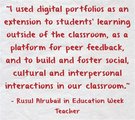
Ways To Help Students Develop Digital Portfolios is the title of my latest Education Week Teacher column.
Several educators - Rusul Alrubail, Michael Fisher, Frank Serafina, Kristin Ziemke, Kate Muhtaris, Jeb Schenck, and Joe Rommel - share suggestions on how to effectively utilize digital portfolios with students.
Here are some excerpts:
Larry Ferlazzo
.
Blog
.
<span class='date ' tip=''><i class='icon-time'></i> Jul 16, 2015 06:27am</span>
|
|
There’s a big new movie coming out in September titled "Everest."
Here’s how it’s described:
Inspired by the incredible events surrounding an attempt to reach the summit of the world’s highest mountain, Everest documents the awe-inspiring journey of two different expeditions challenged beyond their limits by one of the fiercest snowstorms ever encountered by mankind. Their mettle tested by the harshest elements found on the planet, the climbers will face nearly impossible obstacles as a lifelong obsession becomes a breathtaking struggle for survival. The epic adventure stars Jason Clarke, Josh Brolin, John Hawkes, Robin Wright, Michael Kelly, Sam Worthington, Keira Knightley, Emily Watson and Jake Gyllenhaal.
Based on what it says on its website, the movie’s producers are also working to raise funds to help Nepal recover from the recent earthquakes. I hope that’s true.
As I’ve mentioned many times, Everest is a major unit in our ninth-grade English curriculum.
I’m adding this trailer to The Best Sites For Learning About Mount Everest:
Larry Ferlazzo
.
Blog
.
<span class='date ' tip=''><i class='icon-time'></i> Jul 16, 2015 06:27am</span>
|
|
I write many posts about recent research studies and how they can relate practically to the classroom. In fact, I post a regular feature called Research Studies of the Week. In addition, I write individual posts about studies I feel are particularly relevant to my work as a teacher.
This is the latest in my continue series of mid-year "Best" lists.
You can see all my 1,400 "Best" lists here.
You might also be interested in:
My Best Posts On New Research Studies In 2014 - Part Two
My Best Posts On New Research Studies In 2014 - So Far
My Best Posts On New Research Studies In 2013 - Part Two
My Best Posts On New Research Studies In 2013 — So Far
My Best Posts On New Research Studies In 2012 — So Far
My Best Posts On New Research Studies In 2011
Hare are My Best Posts On New Research Studies In 2015 - So Far:
If You Haven’t Read It Already, "The Teaching & Learning Toolkit" Should Probably Be On Your Summer Reading List
Quote Of The Day: "Do" Is Better Than "Don’t"
Study Finds That Rewards For School Attendance Make Things Worse
Measurement Matters….Maybe Not So Much
The Limits To The Power Of A Growth Mindset (& The Dangers When We Don’t Recognize Them)
Nothing New In New "Top 20 Principles from Psychology for Teaching," But Still Very Useful
New Study Shows That Teaching About "Growth Mindset" Works At Large Scale - Or Does It?
Three Useful Growth Mindset Resources
What Are The School Implications Of New Chetty Study On Geographical Mobility?
Useful Tweets On Ed Research From #rEDNY
This Looks Like A Pretty Important Stanford Report On Social Emotional Learning
Deliberate Practice Redux
Quote Of The Day: "Poorer children ‘have smaller brains’, researchers say"
Quote Of The Day: "A scientific look at the art of teacher talk"
Quote Of The Day: "Asking Advice Makes a Good Impression" & Its Connection To The Classroom
Quote Of The Day: The Importance Of Displaying Student Work
Quote Of The Day: "Zero-tolerance school drug policies only make drug use worse"
Quote Of The Day: The Need For More Teachers Of Color
Quote Of The Day: Active Learning Equals More Student Motivation
Yet Another Study Finds Constructivism Tends To Work Better Than Direct Instruction
Statistic Of The Day: Teachers Need To Feel Like They Are Learning, Too
Great Summary Of Research On Developing Creativity
Important New Study: No Child Left Behind Hurts Long-Term Student Success
Excellent Review Of Writing Instruction Research
Second Quote Of The Day: Learning A Second Language "Increases The Size Of Your Brain"
Quote Of The Day: Research Supports Independent Reading
No Surprise In This Study: Language Learners Retain Vocabulary Better When Connected To Gestures & Images
Statistic Of The Day: New Study Finds That Money Matters For Schools
Study Finds That Bilingualism Supports A Growth Mindset
No, The "Cone Of Experience" Is Not "Research-Based" & Yes, Some People Debunking It Have Way Too Much Time On Their Hands
Statistic Of The Day: New Scholastic Study On Reading
New Study Finds Value In Social Emotional Learning
Study Suggests It’s Time To Put Up Pictures Of Mountains On My Classroom Wall
The Best Research On Why Some Students Ask For More Or Less Help Than Others
Quote Of The Day: Fast Food Bad For Student Brains
Study: Conscientiousness + Curiosity = Academic Success
"Should students discover their own math lessons?"
"Grit" Runs Amok In The New York Times
Larry Ferlazzo
.
Blog
.
<span class='date ' tip=''><i class='icon-time'></i> Jul 16, 2015 06:27am</span>
|
|
© 2009 Jinx!, Flickr | CC-BY-SA | via Wylio
"Knowledge Questions" are a key element of International Baccalaureate Theory of Knowledge classes. And they can be tricky, both for teachers and students, who have to develop ones throughout the course and particularly for their Oral Presentation.
I’ve previously posted about this challenge at The Best Posts On Teaching TOK "Knowledge Questions."
This past year, I tried to refine and simplify how I taught students to develop them, and here’s my simple explanation:
Knowledge questions combine a Way of Knowing with an Area of Knowledge, are open-ended, and use Theory of Knowledge vocabulary. They should also refer to justification in some way (evidence, beliefs) either implicitly or explicitly.
Then, students reviewed these materials:
Knowledge claims and knowledge questions
Knowledge Questions in International Baccalaureate Subjects
It seemed to work well. How can I make it better?
Larry Ferlazzo
.
Blog
.
<span class='date ' tip=''><i class='icon-time'></i> Jul 16, 2015 06:26am</span>
|
|
Here’s one more in my series of mid-year "Best" lists (you can see all 1,400 of the lists here).
You might also be interested in these previous posts:
The Best Social Studies Sites Of 2014 — Part Two
The Best Social Studies Sites Of 2014 — So Far
The "All-Time" Best Social Studies Sites
The Best Social Studies Sites Of 2013 - Part Two
The Best Social Studies Sites Of 2013 - So Far
All My 2013 "The Best…" Lists (So Far) Related To Social Studies In One Place
The Best Social Studies Sites Of 2012 — Part Two
The Best Social Studies Sites Of 2012 — Part One
The Best Social Studies Sites Of 2011
The Best "The Best…" Lists Related To Social Studies — 2010
The Best Social Studies Websites — 2010
The Best Social Studies Websites — 2009
The Best Social Studies Websites — 2008
The Best Social Studies Websites — 2007
Here are my choices for The Best Social Studies Sites Of 2015 — So Far:
Our World Of Data is a pretty amazing collection of interactive infographics by University of Oxford researcher Max Roser.
I’ve completed updated my U.S. History Class Blog for English Language Learners. It follows the chapter sequence found in Steck-Vaughn’s "America’s Story" textbook, but certainly the sequence would be useful for any U.S. History class.
And here’s our World History Class Blog. It has what I think are the most accessible online resources out there to English Language Learners. Though it specifically follows the chapters in our textbook, Access World History by Great Source (by the way, thanks to Mary Ann Zehr for originally sharing it with me), it pretty much follows the chronology of events that most World History textbooks use.
Channel 4 in the UK has created a 4NewsWall which is a wall of news-related GIFs that connect to summaries about the topic. The GIFs are sized based on their popularity.
The Associated Press has a series of twenty-six short videos describing the forces behind multiple natural disasters.
Vimeo has a great collection of videos in their travel category, and many would be great for Geography classes — assuming Vimeo isn’t blocked by your District’s content filter.
Scaling Everest is a very neat new interactive from The Washington Post.
Wow, you’ve got to check out this interactive map of 6400 languages from around the world. It’s called Langscape, and is from the University of Maryland.
The Problem With History Classes is a thought-provoking article in The Atlantic. It’s perfect for IB Theory of Knowledge teachers, as well as history educators.
Paul Krugman wrote a great column headlined Knowledge Isn’t Power.
Teaching Tolerance is offering a free documentary on the Selma-to-Montgomery march — a perfect follow-up to watching the Oscar-nominated "Selma" film.
Global Trend Tracker shows you the top ten search terms being used in each country around the world. I have a couple of other similar tools on The "All-Time" Best Places To Find The Most Popular (& Useful) Resources For Educators list. One slight advantage that Global Trend Tracker might have over them is that it’s a bit more visual.
Some Were Neighbors: Collaboration and Complicity in the Holocaust," is a new and impressive interactive online exhibition from U.S. Holocaust Memorial Museum.
"What If?" Projects From My Theory Of Knowledge Class
With The Appropriate Background Knowledge, This Could Be A Good MLK Writing Prompt
What the World Will Speak in 2115 is a recent article in The Wall Street Journal.
Eat: The Story Of Food is an impressive interactive from National Geographic. It examines the history, health and future of food with what appears to be an almost endless supply of multimedia features.
Travel By Drone has thousands of videos from around the world that have been made through the use of drones. They’re searchable by geography through a search box, and they are also pins on a map. I learned about it through an article in The New York Times, Seeing the World By Drone.
Here are Social Studies-related "Best" lists I’ve posted over the last six months:
The Best Resources For Teaching About Selma
The Best "Sound Maps" & Webcams For Teaching Geography
Useful Resources For Teaching About #FreddieGray
The Best Classroom Resources On The Potential Iran Nuclear Deal
The Best Resources For The World Day Of Social Justice
The Best Sites For Learning About Susan B. Anthony
The Best Ways To Teach About The Paris Massacre - Please Contribute More
The Best Resources For International Migrants Day
Larry Ferlazzo
.
Blog
.
<span class='date ' tip=''><i class='icon-time'></i> Jul 16, 2015 06:26am</span>
|