Blogs
|
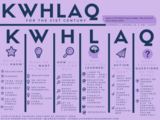
In 2011, I wrote a blog post, titled Upgrade your KWL Chart to the 21st Century. It described how I learned about a new version of the traditional KWL (What do I Know, What do I Want to know and what have I Learned) via Chic Foote as it snuck in an "H"(How will I find out). That "H" seemed to make the increased importance of the information literacy visible. I ended up on Maggie Hos-McGrane’s blog, which, according to John Barell’s book Why are School Buses always Yellow?, added yet two other abbreviations ("A"- What action will I take and "Q"-What further Questions do I have?) to make up a KWHLAQ acronym.
The blog post included the visual chart below, which seemed to have made it the most popular blog post searched for and shared on Langwitches of all times. That seemed to demand an update to the visual after 4 years. I have used the chart consistently over the last few years as a framework to upgrade FOR the 21st century in lesson planning, professional development workshops, coaching and working directly with students and teachers. An essential component of sharing, as a teacher, is the knowledge that one’s work has an impact on other teachers and students, who most likely one will never meet. It is even more gratifying reading of the excellent work others have done:
Simple question: What Action will you take? by Denise Krebs
Step-by-Step Directions for Creating Passion Projects in Our Classroom by Paul Solarz
I have also used the KWHLAQ chart as one framework to promote Reflection as Part of the Learning Process, Not as an Add-on. In the following visual below I share ideas of how to embed the KWHLAQ framework in analog and digital activities. I am continuing to be intrigued by John Barell’s original inquiry strategy, how to use to bring awareness and experience opportunities for modern learning skills and literacies. Since Project Zero’s Visible Thinking Routines have been playing an integral part of my continuous work of Documenting4Learning, is was an easy connection to bring in the routines as a strategy in the KWHLAQ flow.
The new visual below is intended to give teachers and students more choices of make their thinking and learning visible using the following platforms, activities, tools, Visible Thinking Routines as an option or starting off point. The suggestions include tools and platforms that are specifically suited to connect, collaborate, communicate and create, 21st century style, one’s process and make it easier to amplify and to document4learning. The framework is based on
REFLECTION being an integral part of the learning process
the understanding that through technology tools our access to INFORMATION has exponentially expanded as well
our ability to take ACTION beyond affecting people we are able to reach face to face
that technology tools allow us to express and communicate in OTHER FORMS of media beyond words and text
What do you think? What other platforms, tools and activities would you include and organize according to the KWHLAQ chart? Let’s crowdsource more resources for the use of KWHLAQ for the 21st Century!
Silvia Rosenthal Tolisano
.
Blog
.
<span class='date ' tip=''><i class='icon-time'></i> Jul 16, 2015 06:29am</span>
|
|
As part of C.M Rubin’s monthly series in the Huffington post: The Global Search for Education: Our Top 12 Global Teacher Blogs, this is my third contribution. This month we are answering the following prompt: What are the best ways a teacher can demonstrate leadership in the classroom?
I started to poke a little around to get a better handle on the popular notion of WHAT leadership was perceived as:
I found a definition on Google:
I conducted a Google image search:
I got hundreds of quotes and points of view WHAT leadership is by searching for the #leadership hashtag on Twitter.
"Leadership is action, not a position" by Donald McGannon
I also looked at the results of an image search on Google and got visuals of how the concept of leadership might be represented. [ Oddly, the images below almost always portrait a leader who is somehow different (bigger size, different color, in a different position or pointing with a finger to something that has to be done]
Taking these popular notions, quotes, points of view and visuals into account: How does leadership look like in the classroom? What are the best ways a teacher can demonstrate leadership in the classroom?
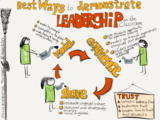
In the classroom, as a teacher, it boils down to a "Leadership Flow" for me, not one best way or another. That flow could be accomplished with the following four components:
Model
Experience
Share
Trust
Model:
A leader in the classroom models the type of behavior and learning they want to see and encourage in their students. They are transparent in their own learning process, they do not hide mistakes or failures, their make their thinking, learning and process visible for others to reconstruct and follow. Leaders model by example not by " Do as I say".
Experience:
A leader in the classroom gives students the opportunities to experience the learning. Leaders in the classroom don’t skip steps because it is easier, less time consuming and possibly more convenient. By the same token, leaders are ready to experience and embrace new situations, new skills, new learning opportunities alongside their students. Leaders put themselves in the position of learners and don’t continue to only draw on experiences from another lifetime (when they were young or from a pre-technology world). Leaders encourage, value, support and celebrate "sticking your neck out" in order to experience new paths.
Share:
A leader celebrates, highlights and shares their classroom learning community’s accomplishments. The leader takes on the responsibility of documenting and strategically amplifying through a variety of venues. This can range from face to face in-school sharing opportunities to district, national or international conferences as well as online social network platforms (Ex. blogs, Twitter, Pinterest, Diigo)
Trust:
A leader in the classroom is always working on establishing and strengthening trust as an integral component of that leadership flow. Trust is the component that "lubricates" the movement of the flow. Leaders always seek and take advantage of opportunities to gain trust but also learn to trust their students.
Silvia Rosenthal Tolisano
.
Blog
.
<span class='date ' tip=''><i class='icon-time'></i> Jul 16, 2015 06:29am</span>
|
|
I read the book " The Diary of Anne Frank" as an eleven year old and was inspired to begin writing my own diary, which I have continued for over 30 years. I am convinced that Anne’s diary was one of the triggers that made me a documenter. I was able to fulfill a lifelong goal to visit the Anne Frank House in Amsterdam this past week. The actual house, Anne and her family hid for over two years from the Nazis is now a museum.
I am reflecting on my visit to the museum through the lens of an educator who believes in:
the power of writing via blogging as a teaching and learning tool
documentation for learning of and from our experiences
the imperative of sharing and connecting to contribute to a global perspectives.
The museum allows people to walk into the tiny rooms of the "secret annex" and "feel" the fear always present of being discovered, how to survive, the worries how and when the war will end, family dynamics and interactions. The list goes on.
The Anne Frank House is a museum where visitors are given the opportunity to personally envision what happened on this very spot.
Anne’s father, Otto Frank, specifically requested that the rooms were to be kept empty to symbolize the void left by all who were taken and never returned. There are pictures in each room ( I believe from 1999) when the rooms were recreated WITH furniture for demonstration purposes only.
The stairs leading up to the secret annex
The bookcase concealing the entry door to the secret annex
Sprinkled throughout the museum are quotes from Anne’s diary, video interviews of the survivors and their memories. One wonders, how the survivors were able to cope and continue life after the war.
One of the quotes I heard (I believe it was from Otto Frank, Anne’s father), struck me specifically since we were traveling with my children and granddaughter.
(quoted by memory):
"…all her would-have-beens… are our opportunities…"
I could not help myself to make connections of Anne’s determination to write, the diary, the museum and the profound impact her words still have to visitors of the house and readers of the book. I continue to ask myself about the importance of documenting with an audience in mind and the moral imperative to "preserve"(through different media) our lives, thoughts and ideas for future generations to LEARN from.
From the Anne Frank Organization we learn that Anne and the other people in hiding thought similarly.
On March 28, 1944, the people in hiding hear a special news report on the Dutch sender broadcasting from London, Radio Oranje (Radio Orange). Dutch Cabinet Minister Bolkestein announces that diaries and other important documents will be gathered when the war ends, as a record of what happened to the Dutch people during World War Two and to be preserved for future generations. The people in hiding immediately think of Anne’s diary.
In some shape or form, Anne Frank’s diary put me on the path so many years ago to journaling and decades later to blogging and documenting for learning. The diary, a journal, that allowed Anne to express her inner feelings and thoughts and cope with her terrifying situation is in contrast to the Anne, her family knew. Her father said after reading his daughter’s dairy:
For me, it was a revelation. There, was revealed a completely different Anne to the child that I had lost. I had no idea of the depths of her thoughts and feelings.
Otto acknowledges that:
When you write in such a profound manner and share your thoughts and innermost feelings, the impact on the world can be robust.
What lessons can we learn and what parallels can we draw when thinking of Anne Frank as a writer? The Anne Frank Organization dedicates a section of their website to this question.
"The nicest part is being able to write down all my thoughts and feelings, otherwise I‘d absolutely suffocate."
I wonder, what the world would have lost, if the diary and loose papers would have been lost or Anne’s father would have decided to not publish them?
I also often wonder about Anne’s sister Margot. She wrote a diary as well. What happened to it? Was it lost? We know so little of Margot. She was there alongside her sister. Why did she not "survive" in the minds of her readers from around the world. What we learn from her, is only THROUGH Anne. What was her inner voice like? What did she stand for?
In light of Anne Frank, maybe we can look at blogging, snapchatting or instagramming for learning from yet other angles:
writing, even when you are in "hiding", with an audience in mind
writing as a form of "surviving" (on an emotional as well as physical level, when our time on this earth is over)
importance of sharing one’s voice with the world… for the world to learn about our perspectives
reflect, create, connect, publish and share
documenting, even mundane (to us) situations, routines, thoughts, ideas (see Obvious to You, Amazing to Others by Derek Sivers)
write about one’s experiences, accomplishments, ideas or taking photos of oneself (selfies) might/should not be seen as "bragging" or narcissistic, but as a way to document our lives, redefine what beauty means to us, NOT though the eyes of a middle man (ex. publishing company or an editor, or the more economically advantaged crust of society, nor the fashion magazines)
we all know that history was written by the victors. What about the other side to the story? What about the experiences of the loser’s side? What about the voices of the silent ones, the forgotten ones, the less privileged ones? What is our morale responsibility of sharing our voices and experiences?
the imperative to never forget
our responsibility to pass on knowledge and teach future generations
I think Anne Frank would have become an amazing blogger, if she would have lived to see the age of self-publishing.
…and I remember…. "her would-have-beens… are our opportunities…"
Silvia Rosenthal Tolisano
.
Blog
.
<span class='date ' tip=''><i class='icon-time'></i> Jul 16, 2015 06:29am</span>
|
|
Why Technology Alone Won’t Fix Schools is a good article published today at The Atlantic.
Here’s an excerpt:
I’m adding it to The Best Posts & Articles Highlighting Why We Need To Be Very Careful Around Ed Tech.
Larry Ferlazzo
.
Blog
.
<span class='date ' tip=''><i class='icon-time'></i> Jul 16, 2015 06:29am</span>
|
|
As regular readers know, it’s time for me to begin posting my mid-year "The Best…." lists. There are over 1,400 regularly updated lists now. You can see them all here.
As usual, in order to make this list, a site had to be:
* accessible to English Language Learners and non-tech savvy users.
* free-of-charge.
* appropriate for classroom use.
* completely browser-based with no download required (however, I’ve begun to make exceptions for special mobile apps).
Some sites I’m including this year are primarily geared towards teachers creating content for classroom use, but could also easily be used by students.
It’s possible that a few of these sites began earlier than this year, but, if so, I’m including them in this list because they were "new to me" in 2015.
You might want to visit previous editions, as well as The "All-Time" Best Web 2.0 Applications For Education; The "All-Time" Best Ways To Create Online Content Easily & Quickly and The "All-Time" Best 2.0 Tools For Beginning English Language Learners.
You might also want to see my recent ASCD Educational Leadership article, Apps, Apps Everywhere: Are Any Good, You Think?
The Best Tools For Creating "Word Frequency Charts" For Books, Articles & Movies is a new Web 2.0-related "Best" list I published this year.
The Best Web 2.0 Applications For Education In 2014
The Best Web 2.0 Applications For Education In 2013
The Best Web 2.0 Applications For Education In 2012
The Best Web 2.0 Applications For Education In 2011
The Best Web 2.0 Applications For Education — 2010
The Best Web 2.0 Applications For Education — 2009
The Best Web 2.0 Applications For Education — 2008
The Best Web 2.0 Applications For Education — 2007
I don’t rank my mid-year lists, but do place them in order of preference in my end-of-year lists (though I did add three of them to my All-Time Best list - Quizizz, Edueto, and the StoryCorps app). Just because a tool is on this mid-year list does not mean it will make the cut for the year-end version.
Feel free to let me know if you think I’m leaving any tools out.
Here are my twenty-sixt choices for The Best Web 2.0 Applications For Education In 2015- So Far (not ranked in any order):
I’ve written about Russel Tarr’s site ClassTools many times, including featuring it in a post titled This Is The Best Web 2.0 Site For ELLs & May Be The Best One For All Students. He recently released another tool to join the many he has already. It’s called the Breaking News Generator!. Students can create a screenshot of a newscast with a news crawler at the bottom. Like his other tools, it’s free and simple to use.
Quizizz, which is free, lets you access tons of previously-created learning "quizzes" and also lets you create your own. Once you as the teacher joins, which takes seconds, you pick a quiz; are given a code for a virtual room; then give the code to your students, who just log in with the code and a nickname (they don’t have to register with the site). When all your students are set, you click "start game." You see the leader board as do the students as they’re progressing through the quiz. In a number of ways, it’s similar to Kahoot. However, the key advantage that Quizizz seems to have over Kahoot is that with Quizizz, students see the questions, answers, and their leaderboard on their devise. With Kahoot (and please correct me if I’m wrong), students’ devices only show the answers and they have to look at an overhead to see the questions. In antiquated computer labs like the ones at our school (and, I suspect, at many others), we don’t have the capability of projecting a screen for students to see it. I’ve added Quizizz to my All-Time Best list.
Deekit is a new tool for collaboratively creating online whiteboards.It’s similar to other whiteboard tools on The Best Online Tools For Real-Time Collaboration list, though it does appear to have more bells and whistles. It’s free — at least, for now — and you can read more about it atTechCrunch.
Parapara Animation is a cool new Mozilla tool. It’s a super-easy way to draw animations. You can read more about it at Richard Byrne’s blog.
Edueto has got to be one of the best Web 2.0 sites of the year, and perhaps the most useful one for teachers and students. And it’s free. Teachers can create exercises in any of the forms listed in the above screenshot and assign them to a virtual class they create. Students can do the activity and teachers can track their progress. You can also access a library of exercises created by other teachers that you can assign "as is" to students or edit. The exercises are very easy to create, and each has a short instructional video (I have to say that I wish the videos didn’t move quite so fast, though). One of the particularly important features it has, unlike some quasi-similar automatic activity creators out there is that, for example, teachers can strategically place the blanks to be filled in the "gap-fill" exercise, instead of just having an algorithm choose them. I’ve added Edueto to my All-Time Best list.
Hypothes.is is a neat-looking online tool to annotate webpages.
Imgur, the wildly-popular photo and GIF-sharing site, has now made it easy to embed the resources they have on blogs and websites, and the embed coded includes automatic attribution. You can read more about it at this TechCrunch post.
Classmint is like a super Flashcard site.
Render Forest is an online video-maker. You can learn more about it from The ASIDE Blog.
Meeting Words is online tool for creating documents collaboratively. You can read more about it at Richard Byrne’s blog.
Russel Tarr unveiled yet another new feature at his ClassTools site that lets users create a "3D Gallery" with captions.
Anyone who’s every listened to NPR is probably familiar with StoryCorps, and I’ve published several posts sharing their resources. They recently unveiled a new free mobile app at the TED Conference that allows anyone to record an interview with anyone and upload it their new site, StoryCorps.me. They have both iPhone and Android versions, and they’re great! The app provides multiple suggestions for questions, depending on who you are interviewing (you can also add your own). It’s a perfect tool for having students interview their parents, grandparents or other older family members (which also makes it easy to ensure students have parental consent — by the way, their policy states users must be over 13). It’s super-simple to use. Of course, classmates could also interview others, as long as teachers had parental permission. I’ve added this app to my All-Time Best list.
I have a lengthy list of free tools at The Best Tools For Creating Visually Attractive Quotations For Online Sharing. Here’s a new addition to that list: Live Luv Create .You can use many of their stock images or use your own, and then add text. The two negatives to the site are, one, even though it’s free, you do have to register with it. Most of the other tools on my list let you create quotes without requiring registration. The other problem is that though it provides an embed code when you first create your image, unless you grab it then there doesn’t appear to be any way to find it again.
Five Thirty Eight wrote an extensive article about a new free Google Chrome Extension called Draftback. It allows you to see the entire writing process unfold for any Google Doc. In other words, every mistake, correction, revision, etc. — either in the "realtime" it took or in a "speeded-up" time. You can then easily embed the created "Draftback." I’m not sure if it’s just a cool toy that people will use once to try it out, or a tool that could be very effective in teaching writing to students.
Firefox has unveiled "Hello," a video-calling system that is built into its browser. No registration is necessary. All you have to do is easily "create a conversation," name it, and send the url link to the person with whom you want to talk. You can also create a contact list. They can use other browsers, like Chrome, and still use the link to the video call. Unfortunately, it appears to me that you can’t have group video chatrooms — in other words, it appears that you can just have two computers using the url address.
Trello is another free tool that teachers and students can use to create online corkboards/bulletin boards (like Padlet and other sites on The Best Online Virtual "Corkboards" (or "Bulletin Boards")list).
Prezi, the incredibly popular (though, to me, still rather discomforting to look at) presentation tool, has unveiled an iPhone app called Nutshell.
Presentate is a new tool for creating online presentations. It looks nice, but you have to register for its beta. I received my invitation fairly quickly. I’m not convinced the world needs yet another online presentation site, but I’ll still add it to The Best Ways To Create Online Slideshows.
Thematic is another tool for creating slideshows. I like it a little better than Presentate, and it’s now open to the public. You can learn more about it at Richard Byrne’s blog. I’m adding it to that same "Best" list.
Speaking of online slideshow tool, here are two more:
One is Bunkr. Last May they unveiled a "new" Bunkr, which was a big improvement. Recently, they supposedly unveiled a new Bunkr which has been completely redesigned. You can read a wayover-the-top review of it at TechCrunch. It is worth a look, though.
Sway is Microsoft’s new online slideshow tool.
Here’s another new online game from Russel Tarr’s ClassTools site: It’s called Connect Fours and is based on a BBC game show that I’ve posted about previously in "Only Connect" Is A Great Game For The Classroom. As I wrote then, the concept of the game was great was for English Language Learners, but the online BBC game itself was too advanced for them. I had suggested, though, that it would be easy for students and teachers to create their own versions with paper and pencil, and I’ve done that numerous times in my classes. Thankfully, though, Russel has now created a super-easy version that teachers and students can use to make their own online without having to register. In the game, there are sixteen squares with words on each one. The player needs to use the words to create four categories of four words each. It’s a great game that helps develop the higher-order thinking skill of categorization.
Russel Tarr has yet another new online game called Dustbin. Students can very easily create a game — without registering — that requires players to categorize words. Categorization is a higher-ordering thinking skill, and I’m always on the look-out for interactives that have that requirement.
I’ve previously posted several times about how much I love the Shadow Puppet app — there isn’t anything out there that’s an easier tool for creating a quick audio-narrated slideshow. It’s perfect for English Language Learners. Today, the company behind Shadow Puppet has just released another new and free educational app that looks like it could be very useful. It’s called Seesaw, and basically lets students easily create digital portfolios that can be shared with teachers and parents. It’s free for teachers and students, and has a free and paid version for parents.
There’s the the new Public Domain Project, which offers a growing number of tens of thousands of images and clips that can be used freely.
Hstry is a nice new online too for creating timelines. Richard Byrne wrote a post about it, and I’d suggest just you visit his blog to learn more. As he points out, one of the particularly nice features of this free tool is that teachers can create virtual classrooms for their students.
Let me know what you think!
Larry Ferlazzo
.
Blog
.
<span class='date ' tip=''><i class='icon-time'></i> Jul 16, 2015 06:29am</span>
|
|
The Fallen Of World II is both a video and an interactive.
The video is described as:
An animated data-driven documentary about war and peace, The Fallen of World War II looks at the human cost of the second World War and sizes up the numbers to other wars in history, including trends in recent conflicts.
I’m adding it to The Best Online Resources For Teaching & Learning About World War II (Part Two).
The Fallen of World War II from Neil Halloran on Vimeo.
Larry Ferlazzo
.
Blog
.
<span class='date ' tip=''><i class='icon-time'></i> Jul 16, 2015 06:28am</span>
|
|
It’s going to take me a long time to dig into the numerous studies and statistics cited (and linked to) by Thomas Edsall in his lengthy NY Times Op-Ed today headlined How Do We Get More People to Have Good Lives?
He looks at income equality, Social Emotional Learning Skills, pre-school education — just to name a few topics he covers.
Here’s a short excerpt from it:
For now, I’m just adding it to The Best Social Emotional Learning (SEL) Resources.
Larry Ferlazzo
.
Blog
.
<span class='date ' tip=''><i class='icon-time'></i> Jul 16, 2015 06:28am</span>
|
|
I have pinned over 12,000 visual resources on my Pinterest Boards, and over 7,000 of them are ones I haven’t shared here on my blog or on Twitter.
You might find some of them useful…
Larry Ferlazzo
.
Blog
.
<span class='date ' tip=''><i class='icon-time'></i> Jul 16, 2015 06:28am</span>
|
|
The Nevada legislature has just approved a bill letting parents take their child from a public school and use taxpayer money to pay tuition at a private or religious school - or even for homeschooling.
Here’s an excerpt from a Washington Post article about the new law, headlined The ultimate in school choice or school as a commodity?
Ed Week also has an article on it, School Vouchers for All? Nevada Law Breaks New Ground.
The law is sure to be challenged in court and, with luck, it will be overturned. The new law could be a very dangerous precedent that could encourage other states to try the same thing.
You can read more about why this kind of voucher programs is so dangerous at The Best Resources For Learning Why School Vouchers Are A Bad Idea (& Other Commentaries On "Choice").
Nevada Association of School Boards also has an excellent analysis of these kinds of voucher initiatives.
Larry Ferlazzo
.
Blog
.
<span class='date ' tip=''><i class='icon-time'></i> Jul 16, 2015 06:28am</span>
|
|
I’d be interested in hearing from people who are more familiar with language acquisition research than I am about the info described in this video:
Larry Ferlazzo
.
Blog
.
<span class='date ' tip=''><i class='icon-time'></i> Jul 16, 2015 06:28am</span>
|