Blogs
|
How can I make it even MORE visible that sharing our work as educators is one of the critical components of the "learning revolution"?
Sharing means amplification. Amplification means spreading good practices, reaching more people and connecting beyond our own limitations of zip codes and language barriers. I have written and tweeted over and over again about the need and benefits of sharing among educators for educations and learning.
3 Reasons Why You Should Share and 3 Things You can Do to Start Sharing
Crowdsourcing Answers to: What Is Your Reason For Not Sharing As An Educator?
The Now Literacies Through the Lens of Sharing
Sharing and Amplification Ripple Effect
Sharing- Creative Commons- Collaboration- Amplification
The Power and Amplified Reach of Sharing
It’s All About Sharing & Collaborating
Amazing Stories of Sharing
Sharing in Education- Is it Changing?
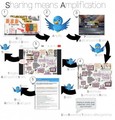
Let’s use one example and make the "share flow" visible:
In May 2014, I shared a blog post titled Building Content Knowledge: Collaborate and Curate. Embedded in the blog post is a video I had created as a documentation of Mark Engstrom‘s approach to his geography class.
Beth Holland tweeted in March 2015 a link to a presentation she gave at ASCD, where she used the video as an example.
I mulled over Beth’s presentation for a few days and chose to sketchnote my takeaway ,which I shared on my blog in April 2015.
Beth, in turn, build upon my work and used the image as a Thinglink, which adds hotspots to the still image with annotations, links, embedded videos,etc.
Kath Murdoch blogged on Justwondering and called the "share flow", I am talking about
"domino style".
I was reading an interesting post from @langwitches in which she refers to @brholland’s slideshow from a recent ASCD conference. In true domino style, Beth’s post got Silvia thinking and blogging and Silvia’s post got me thinking and blogging!
All of this work was inspired and continued to grow, remixed and built upon because of the initial act of sharing!
What have you shared lately? How have you benefited lately because someone else took the time to share? How have your students benefited due to the generosity of another educator?
Silvia Rosenthal Tolisano
.
Blog
.
<span class='date ' tip=''><i class='icon-time'></i> Jul 16, 2015 06:34am</span>
|
|
My work in formalizing Documenting4Learning is moving forward. In good old fashion, regarding practicing what one preaches, I am documenting my journey:
Learning to Document FOR Learning and Sharing
Copyright and Backchanneling in the Music Classroom
Unpacking a Twitter Conference Feed
Professional Development Model: Documenting4Learning
Tools that Facilitate Documenting
Documenting FOR Learning
My exploration got started with my own change and heightened layer of learning as a direct result of documenting. The continued action research, is fueled by my firm believe that sharing is a crucial component of our work as educators and the "learning revolution"
Sharing means amplification. Amplification means spreading good practices, reaching more people and connecting beyond our own limitations of zip codes and language barriers.
Interested in learning more about how to use documenting4learning as:
the glue that will connect your school’s professional development initiatives together
build capacity among your teachers to make their learning visible
communicate, collaborate and connect among professional educators
action steps to use data to inform teaching
supportive skills to implement and grow e-portfolios
re-think teacher observations in your school
creation of institutional memory
Contact me to learn about my onsite and virtual consulting & coaching services. Now is the time to think about next school year. I am taking on a limited number of schools in the highly successful blended coaching model based on Documenting4Learning.
Silvia Rosenthal Tolisano
.
Blog
.
<span class='date ' tip=''><i class='icon-time'></i> Jul 16, 2015 06:34am</span>
|
|
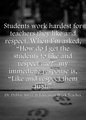
Q & A Collections: Classroom Management Advice is my latest Education Week Teacher column.
Links to all classroom management posts from the past four years can be found there.
Here’s an excerpt from one of them:
I’m adding it to The Best Posts On Classroom Management.
Larry Ferlazzo
.
Blog
.
<span class='date ' tip=''><i class='icon-time'></i> Jul 16, 2015 06:34am</span>
|
|
Join me at ASCD Connect 21 Summer Camp: August 6-8, 2015
The first ASCD Connect 21 Summer Camp
Becoming a 21st Century Teacher, Leader and School
You will create a personalized professional learning experience!
August 6-8, 2015 at the Gaylord Conference Center -greater DC area
TAKE A LOOK: http://connect.curriculum21.com
Silvia Rosenthal Tolisano
.
Blog
.
<span class='date ' tip=''><i class='icon-time'></i> Jul 16, 2015 06:34am</span>
|
|
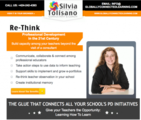
NOW is the time to think about this summer and next school year’s Professional Development for your School.
The world we live in requires schools to address new kinds of literacies in addition to the basic one because we are in the middle of an enormous change of the culture of teaching and learning.
Contact me to learn about my onsite and virtual consulting & coaching services.
I am taking on a limited number of schools for the school year 2015-2016 in the highly successful blended coaching model based on Documenting4Learning.
Demands of New Forms of Professional Development in a New World
Schools are struggling to keep up with the demands of curriculum design and upgrades to prepare students for modern skills and emerging literacies.Professional Development needs to offer opportunities for teachers to transform these experiences and redefine their own learning and in consequence their teaching.
The teacher must see himself/herself as a learner, since he/she is on uncharted territory as well in our ever changing (digital) world. Key competencies and literacies, such as global, media, network, information literacy and digital citizenship amplify our traditional notion and expectation of basic literacy in education. In addition to the traditional content knowledge we are expected to teach/learn in schools, we must include learning how to learn.
Self-Propelled Professional Development
Sharing means amplification and amplification means spreading good practices, reaching more people and connecting beyond our own limitations of zip codes and language barriers.
The PD model relies heavily on self-propelled, self-directed and self motivated professional learners to put new learning practices into action, document, reflect, receive feedback, and keep redefining learning in and out of the classroom. Participants will be building a learning network, share their practices, successes and failures to benefit the school community, including parents, colleagues and students.
Get Started in Creating a Self-Nourishing Learning Community at your School!
Contact me to learn about my onsite and virtual consulting & coaching services.
I am taking on a limited number of schools for the school year 2015-2016 in the highly successful blended coaching model based on Documenting4Learning.
Silvia Rosenthal Tolisano
.
Blog
.
<span class='date ' tip=''><i class='icon-time'></i> Jul 16, 2015 06:33am</span>
|
|
I am excited to share the following Professional Development opportunity for educators and schools in New Zealand.
Helix Consulting from New Zealand is excited to be able to offer a unique opportunity to schools during the September school break. Silvia Tolisano is well known internationally for the coaching and mentoring of educators in authentic, relevant approaches to modern learning.
Join us for 2 days of hands on practical learning that can be directly transferred to classroom and school environments.
September 29 & 30, 2015
Auckland, New Zealand
Don’t miss out on this special offer that ends on May 31st!
Register your interest
or
email admin@helix.ac.nz
We look forward to sharing deep purposeful learning in a welcoming, supportive professional environment.
Silvia Rosenthal Tolisano
.
Blog
.
<span class='date ' tip=''><i class='icon-time'></i> Jul 16, 2015 06:32am</span>
|
|
Below you will see a slide deck, I shared with an Elementary School during a webinar a few weeks ago addressing challenges and examples of globally connected learning.
Upgrade Curriculum Through Globally Connected Learning from Silvia Rosenthal Tolisano
Silvia Rosenthal Tolisano
.
Blog
.
<span class='date ' tip=''><i class='icon-time'></i> Jul 16, 2015 06:31am</span>
|
|
Pinterest has the reputation of being the social network platform of women. There are hundreds of boards that fit the typical cliché of teenie girls with movie star crushes, women in their twenties and thirties obsessed with their future wedding dresses, bored housewives decorating their fictitious mansions, shopaholics who pin their dream wardrobes. Probably all true, but just as with any other social network platform, there is another side to Pinterest, if you are willing to give it a try, dig deeper, experiment and are willing to become a pioneer of trying things that no one has tried before.
Pinterest is a platform to keep in mind for the future. It is growing, it is evolving, it is being innovative (from the inside… the company… (How Pinterest is trying to appeal more to men, Pinterest Acquires Image Recognition And Visual Search Startup VisualGraph ) but also from its users who are finding new and innovative ways HOW to use and for WHAT to use this visual social bookmarking services (10 Creative Ways to use Pinterest, 12 most strategic ways to use Pinterest for Marketing)
I recently conducted a webinar with a group of teachers in Argentina. We touched upon the following points:
take advantage of a bookmarklet by installing a button in your browser (desktop or mobile device) to make pinning easier
one can pin images (connected to links/URL on the web)
one can also upload images directly from the computer (without a connection to a web address)
the organization and curation on Pinterest is achieved via boards one can create with a theme, topic, subject or other strategic connection between the images in mind
one can find new images on the web to add to one’s boards or
re-pin images from within the platform and re-organize them in one’s own boards, connected and presenting them according to your own way of curation
we add value to our pins by adding a brief description to the image or the link it might take us to. This description could be a summary, a perspective, a point of view, etc.
it is possible to create boards that are private (only you and chosen members can see and contribute), open (for everyone to view and pin) or collaborative by inviting other members to contribute to the same board
Like all social network platforms, every user has to experiment and learn for themselves in what way the platform would be useful to them to continue learning, connecting and growing in their profession
Don’t underestimate the power of Pinterest. I am NOT a power user of Pinterest, nevertheless the platform is driving traffic to my blog. As you can see in the statistics table of my blog below, Pinterest comes in 5th place of the top referrers… without really doing much on the platform. The only connection I see, is that the Langwitches blog is "ripe" for pinning on Pinterest, since I include at least one visual in EVERY post, which might encourage pinners to pin away.
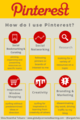
Pinterest is the only platform I have chosen to semi-merge my professional and personal identities. I do not mix personal writing on Langwitches or share my personal life with family and friends on Twitter. I also have two distinct facebook accounts (professionally and personal) While I am not a power user of Pinterest (I am foremost a blogger and on Twitter), I have identified the following ways of using Pinterest for my purposes.
Social Bookmarking and Curation
Social Networking
Research
Window Shopping
Creativity
Branding & Marketing
And for the Spanish speakers among the readers, here is a "pinnable" visual en español for you
An area, I am keen to explore further is to see HOW to use Pinterest with students. If you have used Pinterest with students or are also interested in exploring further, please join the conversation.
Silvia Rosenthal Tolisano
.
Blog
.
<span class='date ' tip=''><i class='icon-time'></i> Jul 16, 2015 06:29am</span>
|
|
Social Media has given educators the opportunity for self-directed, collaborative and connected learning. Network literacy , according to Eric Hellweg, requires a basic understanding of network technology, intelligence, capabilities and the ability of crafting one’s own network identity.
So, how do you bring the benefits of social media to a conference without making the conference ABOUT social media or technology? How do you share the basics of connecting and learning collaboratively with attendees who are newbies?
The question is how do you bring social media to a conference (?) where:
most attendees and presenters might have heard of social media like Twitter, Facebook, Instagram and Pinterest
maybe 30 % have an account in one of the platforms
at best less than 5% or conference participants are active and fluent on these platforms
The BIG idea behind bringing social media to a(ny) conference is to bring awareness to social networking for (and as) professional development, opportunities to practice these skills & literacies and create a culture of sharing best practices and collaboration! How do we make it visible to newbies that it is NOT about technology, but about learning, sharing and connecting that learning?
I have been wrestling with the issue "It is NOT about technology"/ It IS about Technology for a while ( Never Was About Technology?- Time to Focus on Learning?, Take the Technology out of the Equation) and of course, it is not about the technology (it is about learning), but I am observing more and more educators , who are not comfortable with nor technology literate, are being left out of/ behind LEARNING opportunities.
How do we bring these learning opportunities to more educators?
I have reflected about the use of social media at conferences frequently:
Unpacking a Twitter Conference Feed
Student Voices: Using Social Media to Share Your Passion and Affect Change in the World
Covering and Documenting a Conference via Social Media
Note- Taking Learnflow of a Conference Workshop
New Forms of Learning: How to Participate in a Conference 2.0 Style?
How can conference organizers prepare for a conference and to be able to give attendees the opportunity to PARTICIPATE and EXPERIENCE the power of collaborative learning. For crowdsourcing, collaborative note taking and documentation from a variety of perspectives and locations, you NEED, well, a variety of people to contribute. It is imperative to not turn the conference into a conference about technology and social media, but make sure that the focus and emphasis stays on learning as we are using technology as an amplification and redefinition tool.
I have brainstormed steps in order to facilitate a "Watch- Do- Learn" approach.
Pre-Conference: Bring awareness to social media as a learning tool, introduce conference attendees to social media and networking and make further resources to learn more about social media available
Organized Twitter Chat or webinar
Creation of a Twitter account upon conference registration
Social Media resources available
Presenters and keynote speakers briefed and prepared to embed Social Media reminders into sessions
During the Conference: Give attendees hands-on experience, reflection and sharing time
Help Desk
Breakout Session
Tidbit sessions
Built-in reflection time
Mixed Cohort/ Social Media Team (Students/Teachers)
Presenters embed Social Media awareness and practice time
Backchannel Display: Strategic Location
Post-Conference: Reflective, connected, collaborative and networked
Reflective blog posts contributed to a central blog hub
Debriefing organized via Twitter chat or conference hashtag
Local coaching to connect and amplify learning when conference participants return to their home schools
What are some of your approaches/ideas to bringing social media for/as learning to conferences without making the conference about social media and technology?
Silvia Rosenthal Tolisano
.
Blog
.
<span class='date ' tip=''><i class='icon-time'></i> Jul 16, 2015 06:29am</span>
|
|
I am fascinated how the social media platform Snapchat is bringing global awareness to its users! I noticed specific cities appearing for 24 hours on the app:
In small tidbits
in a collaborative manner (users at a specific geographic location are invited to submit a few seconds of their "perception" of what life in their city looks like)
raising interest to immediately watch it by making it available for a limited time (reminded me of the Beanie Baby craze of introducing and retiring certain animals to make people run for the stores and increasing value)
Since then I have seen on Twitter
and on blogs,
people gearing up to showcase their city. What types of tidbits should be included? How to best shine the light on their favorite:
activities
food traditions
how to get around their city
landmarks and famous sites
language and colloquialism
wild life
leisure time
festivals/celbrations
traditions
street music
sports
The city to be showcased becomes an event on a certain day and allows people who have their geolocation enabled to submit their snapchats for inclusion in the city’s life story (For details: How to Post to Our Stories)
So far the cities, like Manchester, UK, Barcelona, Spain, Nairobi, Kenya, Buenos Aires, Argentina, Los Angeles, USA among others have been officially "snapchatted" and curated. For a complete list of cities and events that have been showcased, take a look at What is on Snapchat Stories Today?
Today on June 5th, Brisbane, Australia was featured:
Below are some reactions to the Brisbane Snapchat story of today (and a couple of other twitter reactions to Snapchat Life Event Stories ) in terms of global awareness. Also, remember that over 70% of their users are under the age of 25)
The idea of using the social media platform, where the under 25 crowd already hangs out (their turf) and finding a way to "feed them tidbits" of global awareness ("hey there is life outside your backyard" or thinking and discussing critically what stereotypes, misconceptions about a city/country are) is note worthy. I am wondering how to bring this into the classroom. With older students you could directly go into Snapchat to look and react to the City Life Event. For youunger students, I am thinking of the possibilities of using an app like 1 Second Everyday to capture short video clips to tell a story of awareness, learning and sharing.
I would love for Snapchat to give their users to create their OWN events and invite collaborators to contribute to these event stories. Think about the possibilities for field trips, exchange programs, collaborative units of inquiry (transportation, immigration, how do living things adapt to survive?, etc.). Can you imagine the global collaboration possibilities and the critical thinking and "NOW" literacies involved to make decisions of what, how and where to capture in order to tell and share "the story"?
How do you imagine using the concept of event/story feature on Snapchat with your students?
More interesting articles about Snapchat:
Snapchat, Twitter and Instagram posts show a different side to life in Saudi Arabia
Snapchat’s ‘Our Story’ Events Are a Captivating Experiment
Silvia Rosenthal Tolisano
.
Blog
.
<span class='date ' tip=''><i class='icon-time'></i> Jul 16, 2015 06:29am</span>
|