Blogs
|
I am with Mark Oelhert this morning in his all day workshop about the tools of the Social Learning Landscape. Mark's focus is to look at social media tools, their impact on an organisation's culture. When Tim Orielly coined the term Web 2.0, he talked about a break in the way we do business. The catch is that you can use social media and Web 2.0 (or 3.0 or X.0 for that matter) in a very Web 1.0 fashion. Mark's in a world of huge scale and classrooms don't scale for him. When Mark came up with the idea of ACQipedia - their community wiki, the first questions that come up are hilarious, "What's the management and approval process for the articles that come up on this system?". The end result of this was that the process they wanted to have became just too heavy for them to manage. So it's quite pointless to use new tools in an old fashion.We're looking at Mark's social media implementation at Defense Acquisition University and while the tools don't look like they're the best designed from a visual standpoint - they definitely look quite awesome from a utility perspective. There's a stackoverflow style Ask a Professor app that allows people to ask questions, get answers and then give people ways to vote on answers and comment on them. Someone in the room also mentioned chacha as a social QnA app. Mark's also deploying SocialText, an enterprise grade social media platform and now that starts to look like what I'd like to see in the enterprise social media space. A cool thing Mark mentions -- social media is not about the tools, it's about the people. The tools are a really small part of the entire big picture and wikis, blogs, microsharing only enable the humans involved. I've written about this - do check it out! "Do you hear that sound ....? That is the sound of inevitability..." That's a Matrix slide Mark has talking about the fact that social media is defining the inevitable capatibilities that enterprise tools will need to have in the next year or so. "We tend to overestimate the effect of technology in the short run and underestimate the effect in the long run." - Roy Amara. I'm stunned to see a Department of Defense portal (screenshot above) which is a social media hub that faces out to Flickr, Facebook and what not. The chairman of the Joint Chiefs of Staff, Admiral Mullens has a social media strategy. The words at the heart of this strategy are Engage, Align, Drive, Expand. It's about time the enterprise woke up and smelt the coffee.What is social media"Web 2.0 is the business revolution in the computer industry caused by the move to the internet as a a platform, and an attempt to understand the rules for success on that new platform" - Tim OriellyHere are some characteristics you're likely to notice with social media implementations in the enterprise:They largely use existing technology.Web 2.0 technology is not culturally new when we introduce it.This generation of enterprise software is driven by a consumerisation of the enterprise. These products come to the commercial public for testing and refinement before entering the enterprise.I like Mark's quote - very similar to mine "Think big, start small and move fast!".Image from Kathy SierraThe main barriers for social media implementations are around Fear, Control and Trust, not cost, technology or anything else you'll imagine. Fear takes a fantastic idea, tacks on risk management and makes it an awful product at the end. There's an opportunity cost attached to not doing it though. What's the cost of not collaborating, not finding new business, not knowing what your customers are saying or not knowing how your people really feel? At some point incremental change will only take you so far and you need to make revolutionary change.Control is a strange thing. You're already toast if you have email and phones. The wikileaks fiasco happened just because of a little CD writer. Control is an illusion, because regardless of what you do, bad people will do bad things. What you want is an opportunity to see this in the open so you can actually do something about it. We need to move from control to influence using conversations, storytelling, retrospection and integration. Remember, more eyeballs looking means that you have a greater opportunity to engage and monitor what's going on. "The opposite of imposed structure is not chaos... the opposite of an imposed structure is an emergent structure, one that forms over a time based on the interactions of a lot of people" - Andrew McAfeeTrust - the question is simple. If you've hired people, why wouldn't you trust them? And the fact is that if you trust people, they'll do what they can to keep your brand and to make your efforts a success. And btw, you'll know who the assholes are quite soon as well! Just because you can't see what people are saying that doesn't necessarily mean that they aren't actually saying it. Once it's out there, you'll know how to manage it - the USAF has thought it out, so should you.People resist change when it's insufficiently explained to them. "We participate, therefore we are." - John Seely Brown. Mark advises us to think about wrapping context around your people, not just content - that' why he desists giving contact information and instead gives out social information about himself!Post Tea Break SectionFirst things first - Mark's Social Learning Camp linoit board is your guide to all the resources and case studies that we shared here. I'll catalogue what I like under the social learning tag on my Delicious bookmarks. At this point Mark's showing a SocialText demo from the DAU, which isn't very interesting to me because I've seen it before, but I understand that it maybe cool for the group here. Mark does mention that people's time is a zero-sum game. If you're adding social media, it's got to make something else easier. Does it cut down email by 50%? We also need to remember that a vibrant subject matter network eliminates the bottleneck of individual subject matter experts. It's about the connections not the collections.Mark also mentions that it's not information overload, it's filter failure! Social media needs to integrate into work and build context around people's work so it doesn't become the EXTRA thing to do.Mark's also mentions Kongregate - 35000 people actively engaging on the site at 11:15 on a Tuesday morning seems like an awesome community! It's a site to just play and make games, and there's mystery and curiosity that drives the participation. The problem with traditional course design is that it gives away the mystery right at the beginning! We need to think about social contexts to courses. The Kongregate games have competition built in, a chat that's in the context of the game and pulls people into participating because they want to achieve something by the end of it. This is what goes into the realm of reputation systems on your Enterprise 2.0 implementation. This is a way to drive people's behaviour, just as I'm proud to be #3 at this point on the DevLearn Dr. StrangeLearn game! So for example, if you could put your product or maybe your course into the open and if there was an incentive for people to provide feedback, how quickly would you think your product will improve? In fact, that's the basis on which products like Rypple can change your company's feedback culture if you create the right reasons for people to participate. Now the incentives (this is a bad word in many places), will vary across places -- you've got to find what works for your organisation. That said, you need to find the reasons why people will want to engage and will be interested. We need to think about the social context around learning content!All this said, you can't learn to swim by sitting on the shore. You need to be in social media to understand the phenomenon. I can say this for a fact that after some years of blogging and my presence on twitter I now have acquaintances and people I can lean on all across the world. I've had people saying hello to me just because they follow my blog! Speaking of twitter, Mark introduces the oneforty.com website that gives you all the cool tools that work with this wonderful service.Post Lunch - How do you Get Started?We need to understand that Web 2.0 is a set of tools, social media is a different way of working. There are several ways to get started and Mark seems to be aiming at a checklist for this:You could work on improving your knowledge, skills, etc.You could work on filtering the huge amount of content that we see on the web everyday - curation or filtering is the word.You could work on establishing, building your authenticity and identity.On an organisational level you could look at several different goals:Increasing sales.Breaking down silos.It's not a bad idea to start by just defining what social media, web 2.0 and enterprise 2.0 really mean. Outlining the benefits is a good idea!There are a bunch of strategies to consider:How are you going drive this. Bottom up? Top Down?How are your permissions going to work?How are you going to increase awareness and educate people? How will you manage change?How are you going to avoid walled gardens?Last Segment - Wrapping up the LandscapeDuring this segment, we had Kelly Young from Humana showcase their Social Text implementation (they call it Buzz), which has rich profiles, microsharing, wikis and all of the coolness going on. What is really cool is Hive -- an app they've built to indicate individual reputation on the system. This is cool because it's an interesting visual representation of an individual's community. The visual just shows how healthy someone's beehive is given how many people they're connected to, how they're contributing, etc.Mark's now just showing some interesting tools - Quora for example is a cool social QnA tool like stackoverflow. Moving onto other tools such as Mindmeister for collaborative mindmapping and Netvibes for personalisation. What I really found interesting is this diagram on designing social interfaces and this infographic on social media in business and the market share of different tools. Mark is quite upset (understandably so) about the lack of focus on personalisation given how much progress has happened with this concept on the public internet. The elearning debate for example is a place where the industry is getting together to discuss a whole bunch of issues. I would have been disappointed if Mark didn't mention delicious - it's my favourite social bookmarking tool and part of my PKM approach. Mark didn't disappoint me by the way! I'm all for the democratisation of content creation and tools like Rome can help you do that. A tool like hotseat , enables collaborative discussion in and out of the classroom. It's a great way of making the classroom social where computers and mobile phones are encouraged and fits the mindset I updated about some days back. Bloomfire's an awesome social LMS. Curatr's another tool on similar lines, as is Simversity and Schoology. Academic Earth gives you the opportunity to listen to world class lectures online, comment on them and rate them. It's been an interesting day with Mark, he's truly knowledgeable in this space and knows heaps more than most people and has the credibility of doing this in a very very large organisation. He also thinks beyond the surface of the tools, so he's thinking and guiding people in the right direction. I do think this day could have been heaps better as a workshop because that's what I expected. But then again, I think I soaked in a lot just by virtue of his presence, so thank you. None of the material was new, but Mark's affirmations helped me realise that I think right about this.© Sumeet Moghe, 2009
Sumeet Moghe
.
Blog
.
<span class='date ' tip=''><i class='icon-time'></i> Jul 20, 2015 10:48am</span>
|
|
If someone would have told me at the beginning of 2011 that the last three months of the year would have been sheer madness without me no longer of control of things and trying, barely, to keep up with it all, including a massive round of business travelling, I would have told them they would be just plain crazy. No way it was going to happen! No way I would go ahead and tolerate such run-over of one’s work and personal life without trying to do something about it. Ha! Guess life has always been having its own agenda and the only thing we can ever do is probably to try to adjust, be flexible enough, react on time, and take things as they come, hoping the damage would be somewhat limited. Well, that’s probably what I have been doing all of this time lately. And I seem to have survived. Barely. Today it’s my last working day of the year, before I embark on a massive detox, unwinding, relaxing and chilling couple of weeks of a much deserved vacation, if I may add, where I just basically don’t even know where and how to start!! Seriously. Just crazy!
Did you notice the last time I created a blog post over here was on 11/11/11 to treasure the living memory of one of those loving creatures one learns to love, appreciate and live with in unconditional terms over the course of the years? By the way, many thanks to all of those folks who have kindly shared their comments and experiences. Even today it’s still helping a lot! Thanks for that, everyone!
And did you notice the last time I put together another article before that one? Yes, it was another month in between! See what I meant when I talked about losing control of everything around you and put together the automatic pilot just to try to catch up with things hoping it won’t hurt too much?!? Gosh, exactly! I know some folks out there would relate to that feeling as well… Not enjoyable at all, for certain, but what an adrenaline rush, eh?
Anyway, I am back to my usual, regular blogging activities. You may be wondering I may be a bit too insane attempting to pick up my blogging mojo again, while on vacation, but the true thing is that I have missed it. I really have! Yes, you are probably not going to believe it, but not having blogged on a regular basis, like I usually do, over the last couple of months has certainly had an impact on something I never thought I would miss so much till I eventually bumped into it again: writing!
I have gone rusty with my own writing. I hardly recognise my blogging style anymore; putting together these few words in much longer sentences than 140 characters, or a couple of paragraphs here and there, is proving to be a challenge. A good one, for sure, but it just feels weird! That’s why I need to come back to the blog and write and pick up my blogging mojo once again, before I decide to give up on it and move on to other things. I just owe it so much to it that I feel is part of me, an integral part, actually, so you can imagine how tough it’s been in the last couple of months to be exposed to hundreds and hundreds of ideas, thoughts, experiences, very interesting readings and many other wonderful conversations and not being able to prioritise good enough to talk and blog about them.
I need to get started again. It’s probably going to be like a re-birth. A new beginning. A new start where I may also need to work a bit extra hard to recover my Google juice, as well, because it’s almost gone and I guess I just can’t neglect my business card any longer. And while I thought it was going to be a tougher challenge for me to pick up my blogging again, I must confess that it hasn’t been the case. More than anything else, because of a good number of rather inspiring blog posts that I have bumped into as of late, offering plenty of really good advice and additional reflections and helpful insights as to why blogging still is one of the most powerful personal branding tools out there. Check out, for instance, the blog entries put together by Om Malik, Brain Clark, Dan Frommer, Tracy Gold, Arkarthick, Garth O’Brien, Lisa Barone, and, of course, the always inspiring Darren Rowse for some great articles that would surely help you convince anyone that blogging is here to stay as it is thriving nowadays more than ever!
So, I am back! And talking about new beginnings, somewhat new fresh starts, I thought I would get back to blogging today giving folks an opportunity to learn what happened after Fosca’s passing away. There have been many many reasons that have prevented me from blogging in the recent weeks and over the course of time I will be sharing further insights on each and everyone of those, but one that, for sure, has had an impact for yours truly during the course of November and beginning of December was that rather painful experience of seeing a tender, loving and caring pet moving on. Till something else happens…
Allow me to introduce you folks to Boira ("Fog" in catalan); the latest addition to the family! A male belgian shepherd dog (Groenendael) that has quickly captured the hearts and minds of the entire household and to no remedy. He is a bit over a year old now, so you can imagine what that entails. Indeed, lots and lots of physical activity all around! In fact, he’s been one of those other reasons why not just blogging, but also being online has had a bit of a hit in my own social presence out there. And I can imagine you know why. Having such an energetic pet in the house can be quite demanding and rather exhausting, and, even more so, lots of great fun! It’s taking me a bit over a month to eventually manage to take some good, decent pictures that I could share along over here, despite taking him out for long walks day in day out. He’s just as temperamental as Fosca was, but equally charming and amazingly smart. So much so, it’s scary some times what he gets to learn doing by just observing and performing once!
It’s been lots of good fun. You folks should see the state of our roof; I probably should take a picture or two and share it across, but right now it looks, literally, like a war zone. The plants we used to have there, the sprinkler and hose to water them, and a bunch of other things are now history. All destroyed, all bitten to no end, all gone! So imagine what he’s done inside the house!
Like I said, it’s been lots of good fun. And still having a blast with him. A few folks who cared to comment privately on the loss of Fosca mentioning how getting another pet relatively soon to heal the pain gradually were just spot on. She is still very much missed every single day that goes by, but Boira quickly comes up to remind everyone that what matters now is the present, right that moment he wants to live with each and everyone of us. To remind me, as well, in this case, that as wonderful as the Social Web is, it doesn’t help him get out for a walk, of getting fed, of getting lots of attention and playful moments. He just cares about now and if you don’t pay enough attention, he will just move on. So excuse me for a second, while I get the leash, and we go out for a lovely walk to enjoy the beginning of, I am sure, a wonderful holiday!
(Thanks much, everyone, for sticking around throughout all of this time, too, and stay tuned for more blog posts to come along in the next few hours … I am not going anywhere and I surely plan to catch up! But with a twist … or two … You will see shortly. It’s good to be back!)
Luis Suarez
.
Blog
.
<span class='date ' tip=''><i class='icon-time'></i> Jul 20, 2015 10:48am</span>
|
|
I'm sitting here at the keynote by John Seely Brown (JSB) and am I excited to hear him speak this morning. I picked up his recent book, the Power of Pull for my Kindle and each time I've picked it up for a reading burst, I've struggled to put it down. This is a packed house at this point and we haven't even gotten close to being started. We'll have to go through good old Brent Schlenker's conference kick off and then we have the opportunity to hear the man himself. JSB's keynote is about small moves, smartly made can set big things in motion. John wants to talk about a derivative of the power of pull - a new culture of training in a world of constant change. The ideas are around learning on demand, pull not push and the arc of life learning.The PreambleJohn believes that the old institutions aren't hacking it very well and nor are schools. Something has to give. For a long time the 20th century infrastructure was about scalable efficiency. The idea was to be predictable, hierarchical, controlling, process centric and variance free. This factory model made it's way into education with a predictable curriculum and a one size fits all approach. The 21st century has changed the game completely. The infrastructure is driven by the continual advances in computing, storage and bandwidth. There's no stability in sight. The S curve of the 20th century is now evolving into a rapidly punctuated exponential curve, with little blips that are s-curves in themselves. In a world of increasingly rapid change, the half life of a given skill is constantly shrinking and the predictability of future needs is increasingly less certain. We're having to move from stocks to flows. This means we move from protecting knowledge assets to participating in knowledge flows. This means that our learning strategy moves to having a strong tacit component as against a hoarding mindset of stocking knowledge.We have a crisis of imagination. We need to embrace change, not fear it. We have an explosion of data that's almost incomprehensible. We're creating a lot of information everyday more in every two days than we did from the dawn of man to 2003. In a world of constant change we need to prepare our workorce to deal with this chance. We need to rethink how we learn and deal with the tacit knowledge. We need to think about what we need to learn and how new media is changing the came in fundamental ways. This is where we build a resilient mindset, with an ability to change, adapt, reconceptualise and engage in deep listening with humility. The mantra is - "If I aint learning, it aint fun." We have to create a context where people thrive on change and learning instead of fleeing from it. The Stories - Hard EvidenceJSB is going to tell us about an encounter that helped him shape his thinking. These are stories that have helped him see amazing learning with the help of new media. I love these stories because they're straight from the book. The first story is about a bunch of surfing kids in Maui. No champion surfers ever came from Maui. This story is about Dusty Payne, a kid who wanted to be a hardcore professional surfer. Despite his dad dissuading him, Dusty wanted to put Maui on the surfing map. Dusty found four peers in the same age group and decided to build a scheme of collaboration - the likes of which the world has never seen. Dusty was the first junior champion ever in Maui and came up with a new genre - aerial surfing. Dusty's video of his surfing exploits is pretty darn awesome. This guy is the real deal, as JSB illustrates. Anywhere Dusty goes these days, there are professionals shooting videos of him or getting photographers. He is so incredible that in one of his shots he makes more than what his dad makes in a year. He deals with real estate, and is hugely successful. The serendipity of this is that Dusty is JSB's neighbour when he stays in Maui. The learning community is so strong that all five kids in the group are now world champion level atheletes in the surfing arena. Here are some things they did in their learning community:They are willing to keep failing because they knew they could learn from failure.They collectively analysed each frame of videos of the best surfers across the world.The used video camera to capture and analyse their own moves. They deconstruct their own technique by watching each frame of their work on the beach.They pulled ideas from various sports - windsurfing, skateboarding, mountain biking, motorcross, etc. The cool stuff is they've taken ideas from different domains and applied them to their own domain. They've understood the idea of 'spikes', where they've travelled to the expertise hotspots for surfing across the world to learn their trade. Now they're a bit of a spike in themselves.This is an example of deep collaborative learning with each other. They are people that are passionate about a trade and they chase extreme performance with a deep questing disposition. They learn themselves from the things that others are doing around them. They have a commitment to indwelling -- they soak up the world around them.The second story JSB has is about WOW - The World of Warcraft. It's a massively multi-player online role-playing game (MMORPG). There's a reason we need to care. This is the first domain where we've discovered a place where we don't have diminishing returns, we have exponentially increasing returns. The sense of joint collective activity is pretty awesome as one of the TWU students pointed as well. The core of the game is really more the social life on the edge of the game. The edge is often called a knowledge economy. WOW is way too complicated to play without complex analysis tools and dashboards, but these dashboards are tailored to each player to measure their own performance and are a key to their mastery at the game. This is quite curious -- don't managers develop dashboards to look at their people? This is obviously a game changing way to self-reflect. The cool thing that goes is after action reviews -- this is very in tune with the Agile Retrospectives idea. This is an example of blending the tacit and the cognitive. This is collective indwelling and reflection. While they marinate and learn in a social context, they also reflect together when they're done, so they can learn from each other. This is the way grandmasters learn -- they practice with peers and then reflect on what they did. This is the way hackers practice their trade.There's an incredibly rich knowledge economy around this game. On a typical night there are about 10-15000 new ideas coming up about the game. There are blizzard forums, databases, blogs, wikis, videos and what not. The way people absorb all of this is that guilds (player teams) self-organise into being a knowledge refining community to work together, curate content and then collectively learn amongst themselves. This is the idea of a personal learning network (PLN) IMO.The Levels of PullWe need to think about three ways of pulling learning:Access: The ability to find, learn and connect with people, products and knowledge to address unanticipated needs that hit us in the face! I have a problem, I search, I find, I learn, I'm happy.Attract: This is where we need to find something that we don't even know that we need to know. This is where Google fails and that's why I don't like it much for social learning in the enterprise, because it doesn't support serendipitous learning. This is where we get out of our comfort zone and get to expose ourselves to weird but interesting ideas.Achieve: This is where we pull out of each of us and our institutions our full potential. We need to harnessing network effects where the more people that participate, the more the global returns."Accessing and attracting have little value unless they are coupled with a third set of practices that focus on driving performance rapidly to new levels. These practices involve participation in, and sometimes orchestration of, something we call "creation spaces"—environments that effectively integrate teams within a broader learning ecology so that performance improvement accelerates as more participants join." - John Seely BrownThe purpose of the 21st century firm is to build talent. As we learn from others, they learn from us -- this accelerates bootstrapping in an ecosystem. The reason we join a firm today is because we get to learn faster than we would learn by ourselves. This is why people join Google or ThoughtWorks for that matter. HR/ Training shouldn't be an add on - we need to get a seat a the table and find a way to influence business through learning. Otherwise we and our organisations don't stand a fighting chance.© Sumeet Moghe, 2009
Sumeet Moghe
.
Blog
.
<span class='date ' tip=''><i class='icon-time'></i> Jul 20, 2015 10:48am</span>
|
|
While everyone else out there on the Internet Blogosphere gets busy blogging away their predictions for 2012 around the world of Social (And whatever other word you would want to insert right after!), Technology, the Internet and whatever else you can think of, like it seems to be happening in a rampant fashion year after year even to the point of getting people a bit tired of it all, I think I am going to spare you folks with this blog entry on my own predictions for next year and I am going to concentrate instead, perhaps, on putting together a blog post where I could reflect on what’s happened in 2011 and how that will shape up my overall personal experience for everything social.
Like I have mentioned in a previous blog post, the last 3 months have been perhaps a bit too hectic both at work and on a personal level, but that doesn’t mean that I haven’t had enough time to go and reflect on a few things and, most importantly, on how I feel about the overall Social Web and the Internet / Technology in general. Now, originally, I thought about putting together a massively long entry over here, but then I realise it may have well been a bit too tiring and exhausting going through it in a single go. So I have decided to split it up in a number of articles where I will also try to hint along how I will be re-shaping up my own Social Web strategy, specially, after the last few months where I have been more away from it than attached to it and somehow it’s helped me get a clearer vision of where I would want to go and where I feel things will go. Will there be convergent paths, you think? Hummm. Maybe. May be not. Let’s see.
During the course of 2011 I have embarked on a whole bunch of business travelling. A lot more than in 2010, for sure! And not just to present, attend or participate in various different conference events, but also, the vast majority to go and visit IBM customers to share the experiences of what a socially integrated enterprise is all about. You could say that my favourite topic du jour all along has been The Social Enterprise. And still going strong, if I look into what lies ahead for 2012 where that travelling agenda is going to be even more hectic! But more on that shortly…
A couple of folks though from my closer social networks keep wondering how I do it. Where do I get all of that energy and extra effort to never get tired of it and continue to move along. To be honest with you, I hate travelling. I have been travelling for most of my life, and, definitely, for most of my business life and biz travelling is no longer what it used to be. Quite the opposite! It’s no longer a pleasure, but a big drain on everyone. And perhaps on a separate blog post I will share how I really feel about business travelling altogether and what I would like to see change for upcoming years to bring back that pleasurable experience. I know a few of you would consider that impossible to achieve, but may be not. We shall see. I don’t think it’d be that difficult to just change a few things and make a big difference …
Anyway, the main reason why I never get tired of travelling is because it gives me an opportunity to do two things on a more or less regular basis; two things I was not aware of till I eventually fully experienced them this year plentiful. First, I love people! I have met so many wonderful folks this year, good old friends, and plenty new ones, who have surely make up for all of that hassle and burden of travelling, that it’s become an entire new experience where constant learning, collaboration and open knowledge sharing has happened at such deep levels that some of those conversations are still spinning in my head shaping up a lot of what I use to take the world for. Human beings were designed to be around other human beings, to socialise face to face, to learn by simply being around one another, to be challenged in healthy dialogue by those folks who always want to improve things, who want to make things better, who want to work smarter, who want to really create and leave behind an impact for which they would be remembered. It’s their legacy. Our legacy. They are the optimists, the outrageous, the heretics, the free radicals, the rebels at work who are constantly looking up for each other wanting to create and spark that energy, that brilliant idea, that can certainly change the world as we know it.
And throughout 2011 I had the huge opportunity to meet, and learn!, from a whole bunch of them! And big time! So much so that plenty of those conversations have certainly changed the way I view things, both at work, and in my private life. The best part of it is that they have also helped me learn about something very important; the second thing I mentioned above earlier on. The Social Web. Yes, we all know it from before. We all realise how critical and paramount the world of the Social Web has become not just for businesses, but also for all of our societies. For ourselves. If anything, because of a single, and rather simple, reason: the amplifying effect of our physical relationships and mutual bonds.
The Social Web is a wonderful thing! It’s changed my life and probably the lives of millions of people out there as well, but the main reason why that’s happening is not because of the unprecedented penetration and broadband reach it’s been enjoying in our society, touching every single aspect of our lives, but more because it’s helped us become even more connected than ever before. It’s helped amplify our relationships, our friendships, our reach, our connectedness, our common conscious (and unconscious) knowledge to such deeper levels that there is no way back. And probably there shouldn’t be, because all of this interconnectedness is helping us out to become better humans to our own abilities and expertise.
Throughout 2011 I have had the great opportunity to experience that; to realise that while the Web is there, there are many many more important things, specially, when that Internet access is patchy and you have got that unique opportunity to meet up, face to face, that huge amount of talent, and smart people, who you could never get tired of learning from. In the past I used to neglect that to a certain level and in the last few months, definitely, the last three, that being disconnected from the online world on a rather regular basis has helped me scratch that urge of meeting up people face to face and start a conversation and converse no matter for how long. And, boy, has that made a difference?!?! The amplifying effect from the Social Web kicks in fully after you have met those people and exchanged a few ideas, you come back home and you realise you want to keep the dialogue going. And with all of these social tools at our fingertips, it’s never been easier. Quite the opposite.
There used to be a time, in my last 10 years of having been exposed to and involved with social networking and social software, where every time I would go and meet new people, specially, at customer events, workshops, seminars and whatever else, to talk about The Social Enterprise, I used to resort to those lovely, rather informative, perhaps a bit overwhelming short video clips that tried to explain the impact of Social Media in our world. Pretty much like a la Did You Know? fashion. The latest one I have bumped into is this fantastic 2 minute and 45 seconds YouTube video clip under the suggestive heading of "The World of Social Media 2011":
For those folks who are rather familiar with Social Media, they probably wouldn’t learn much about it from just watching it. However, it’s worth while. It will help provide you with an opportunity to discover how the Social Web has moved way and beyond the tech world and dived in, big time, in every person’s life, whether tech savvy or not. It’s become so pervasive throughout the world that in all of my biz travelling this year I didn’t have a need to use these sort of videos any longer. The conversation has stepped up. Everyone knows about the Social Web. Even folks who not so long ago were technophobes and who, right now, are in full discovery mode trying to figure out how to best make use of it for their work, as well as their personal lives.
What’s my conclusion from all of this? Well, as a starting point, one gets to realise that social networking has been there way before the Internet came into existence a few decades back. That personal (business) relationships, when carried out, nurtured and cultivated face to face, are as good as it gets. That the Social Web is not a substitute for those physical relationships but an augmentation factor that no-one can, or should, ignore to make them even better and more trustworthy. That eventually, the Social Web is unstoppable at this point in time and that those businesses that are still blocking the access to social networking sites, or the whole conversation around Social, are just missing a huge and an unprecedented opportunity to shape-up and redefine themselves to become even profitable, sustainable, caring, nurturing, purposeful and meaningful businesses. The Workplace of the Future. Our future.
Now, who dares to ignore and neglect that in 2012? Any takers? I hope not, but if you are let me share a couple of final words with you: Good Luck! (You are going to need it … )
PS. I am sure you may have noticed how at the beginning of this blog post I have included a whole bunch of links to blog entries and articles about some of the most interesting readings I have bumped into around those 2012 predictions and for some of them I may be touching base on them and for some others I think they would be relevant to see how far they may have set the stage into what lies ahead … Hope you folks enjoy reading them just as much as I did while putting together this blog entry.
Luis Suarez
.
Blog
.
<span class='date ' tip=''><i class='icon-time'></i> Jul 20, 2015 10:48am</span>
|
|
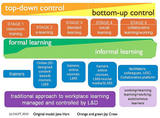
I've just scrambled into Jane Hart's session about the state of learning in the workplace today. This is a guide in soundbites and images and is a way to summarise the excellent guide on Jane's website that a lot of us have already seen. I'm a self-confessed fan of the incredible thinking that the Internet Time Alliance put out, so I am sitting through the session even though I already comprehend the material.The traditional approach to workplace learning has been about managing and controlling the learning experience, keeping it really top down. There are 10 factors that are shaping the new era of workplace learning.The 10 Factors1. Recognition that informal learning is a key part of workplace learning In Jay's words, it's not all about classes and courses. "Informal learners usually set their own learning objectives. They learn when they feel a need to know. The proof of their learning is their ability to do something they could not do before". As Harold Jarche says, "Work is learning, learning work." The big folly of a lot of thinking is that several people are talking about formalising informal learning and they're just missing the point because then it doesn't remain informal anymore. As you may remember from one of my recent blogposts, Charles Jennings is a big proponent of the 70-20-10 thinking.2. There are deficiencies in the formal learning modelMost formal learning is content heavy and interaction poor. It provides little opportunity for practice in context and for reflection. In other words, a large amount of formal learning is a cost rather than a benefit. There's an inherent inertia in formal learning approaches. It takes time and effort to design, develop and deliver learning content. Speed-to-competence is always a compromise.3. Social media is having a big impact in the workplaceJane runs an activity to evaluate the top 100 tools for learning each year and this year, the top 9 tools are all social tools, which shows a huge impact of social media to drive learning. This is a huge shift which we need to be aware of and catch up with.4. Increasing consumerisation of ITEnterprise systems are lagging behind, so people are using their own tools and devices. L&D isn't quick to respond to people's needs so people just help themselves. Individuals easily use familiar tools and they have their ways to circumvent ways to block their access to such resources.5. Merging of personal, working and learning toolsThe usual criticism of a lot of social media is that these aren't learning tools. This is the coolness of the phenomenon, where work, learning and personal life are converging in a very special way.6. Individuals are doing their own thingPeople are going to Google, Wikipedia, YouTube, Twitter and Facebook to tap into their social network to learn whether you have an LMS or not. Since the L&D department isn't as fast and the knowledge is out their, people are learning outside the learning department. So there is the top down training that exists, but there's the larger share of the pie which is about working and learning where things are really bottom up where people are using social media to learn with each other.The idea is to avoid the word "learning" and to move towards "working smarter". "The only people who can own social learning are the individuals who thmeselves are learning each day from one another, based on the work and in the flow of work." - Marcia Conner7. Autonomy has a powerful effect on individual performance and attitudeThe opposite of autonomy is control. We need to give people autonomy to manage their own learning, because that leads to total engagement. 8. Today's learning systems are not appropriate for the new era of workplace learning. There's a huge problem with the current (or really the past) era of learning systems. The Great LMS Debate has thrown a lot of light on this issue. We need to integrate learning into work instead of putting it away in a system where it becomes nothing more than an information refrigerator. We need to find a way to integrate learning into our collaboration platforms. 9. The changing learning landscape is part of a much wider changing business environmentWe need a new paradigm for getting things done and for empowering a new breed of employee that does not function well in a heirarchal top down, highly controlled environment - Michael Lascette. Clark Quinn has talked about this here. 10. Senior decision makers think there's a need for change in L&DMost leadership respondents have mentioned that their L&D function is slow to respond, that they're stuck in business as usual and that they lack confidence in their L&D strategy. The fact is that if your CEO doesn't believe you make a difference, there will be a time you'll get cut one way or the other.We need a shiftThe ITA has been talking a lot about the shift to collaborative learning in the workplace as you'll notice from the above diagram. Jane is giving out three practical steps towards the new era of workplace learning:We need to encourage people and support individuals and teams to address their own learning and performance problems. We need to let go, give up control and move into creating the context for learning instead of having a huge focus purely on content. An easy way to do this is to ensure that we don't ban social media in the enterprise. Jane has an article about why you shouldn't ban social media - she has 10 reasons for you! People are doing their own thing to learn anyways, so blocking them means blocking their growth.Provide performance consulting services. We need to do training only when we've addressed other barriers to performance. The tools are secondary to the purpose that you're approaching. Harold Jarche has written an awesome article about how you need to approach problems with a consulting mindset than with a training mindset. Only a lack of skills and knowledge warrants training. We need to provide advice on appropriate tools and systems. To move from a point of top down control to a point of bottom up control, we need a way to be able to facilitate it through technology. We need an LMS to do the formal stuff, but we need to focus on the 70% and 20% of the 70-20-10 pie to ensure we're making the biggest impact.This is a pretty cool wrap up of the stuff the ITA often talks about. Liked the summary and the fact that most of the alliance was around. It was fun meeting Jane and Harold in person for the first time.© Sumeet Moghe, 2009
Sumeet Moghe
.
Blog
.
<span class='date ' tip=''><i class='icon-time'></i> Jul 20, 2015 10:48am</span>
|
|
It’s rather interesting to see the kinds of conversations that one gets to embark on in the offline social networking world while on a couple of week vacation break (By the way, hope everyone had a wonderful Christmas time, as well as a Happy, rather Prosperous and very Healthy New Year 2012!!). It’s even more interesting when some of those conversations have been going on around what we have done and learned in 2011 and right off it all turns into personal reflections for what’s happened throughout the year. Just like in the virtual world, I guess, like I am doing with this series of blog posts. So continuing further with that set, just the other day one of my offline good friends asked me what I thought was a rather interesting twist, which would be a good intro for this article as well. He asked me what was the biggest disappointment I experienced in the past year that I could have done without. My short answer: Technology. The long answer: here is why.
Technology is a wonderful thing, don’t get me wrong, there is no doubt about it. I am sure we all agree with that statement. It’s helping shape up and change radically all aspects of our society as well as the corporate world. It’s helping us understand how we can keep striving successfully for the ultimate goal for every knowledge worker out there: work smarter, not necessarily harder. It’s essentially helping change who we are and what we do. Yet, some times it’s utterly disappointing to see how far we are from what we all know we could have at this age in 2011.
This year we are about to finish has been an incredibly hectic and exciting year with plenty of amazing happenings and unforgettable events altogether. For me, it’s been one of the busiest and most fruitful, too! With plenty of business travelling and frenzy at work one learns to build a certain level of expectations that you would want to see met, so you can keep up being rather productive and effective, which is what matters at the end of the day. Specially, nowadays: effectiveness continues to beat efficiency any and every time. But it looks like we are another year onwards and we are not there just yet. Let’s see it with the most crippling example I can think of, based on my own first hand experiences …
If anything, 2011 has been the Year of Mobile. And, finally, if I may add that, too, myself! But has it really been that way? Well, in my experience, it hasn’t. Another year gone by and another big disappointment, because we keep suffering from the very same problem we have been having for the last 5 years, when we were first commenting on the huge opportunity for the mobile world to disrupt everything around us. We keep seeing a good amount of tremendously powerful reports and insights on why every year we seem to be experiencing the year of mobile and yet, it just doesn’t happen. At least, in 2011 with yours truly.
Yes, I do have a smartphone (An iPhone 4S which I love to bits, too!); yes, I do have an iPad (My favourite tablet by far and for a great number of reasons that I have recently picked up, once again, on my Google Plus profile, but more on that shortly…); and yes, I do have a MacBook Air, which is as light as you probably could get nowadays with heavy computing tasks. Yes, in short, you could say that I’m a fully empowered mobile worker. I work from home most of my time; I travel quite a bit to conference events, summits, customer meetings, workshops, seminars, etc. etc. I work quite often at airports, at hotels and various other locations. Work is me, I’m work. I am a road warrior, too, I suppose, with a clear mission: work happens around me. It’s no longer a physical location, but more of a state of mind. So my expectations have become rather high when I want technology to work just like I want it to. Alas, it just doesn’t happen. It keeps failing time and time again, which is rather disappointing, to say the least, if not too frustrating altogether most of the time.
Over the course of the year, and as I keep living "A World Without Email", I have had a growing and continued need to stay connected for as long as I possibly could. Living on the Social Web does that to you; you need to be constantly connected. Social networking tools do not understand the concept of working offline, apparently, or so it seems, so you expect that technology will come up to the rescue, yet, it keeps failing. Why?, you may be wondering, right?, since we are just about to finish another "Year of Mobile"? Well, hardware wise I would probably venture we are there and pretty nicely: with smartphones and tablets taking the enterprise by storm it’s no surprise how keen and very much willing knowledge workers are to even bring in their own devices at work. Yet, we keep failing to deliver at one key issue that most people keep ignoring time and time again and not even sure why: Connectivity. Or, better said, lack of reliable, scalable and sustainable connectivity. The telcos. The (mobile) carriers.
I am not sure about you, folks, but that has been *THE* major challenge for me for 2011. Trying to stay connected, while on the road, to keep being productive with the Social Web. Time and time again, while attending & presenting at conference events, for instance, access to the Social Web has been rather patchy, whether through free wi-fi hotspots, or even paying for the connection it hasn’t worked the way I would have wanted it to. In fact, while I’m writing this blog entry I am realising one of the various reasons why there have been long periods of silence on this blog, and various other social networking sites, was just, basically, because I was not connected to the Web or because it was just so slow that it was rather unbearable to try to get anything done. Ever tried connecting to the Web from your hotel room, whether on a free wi-fi or paying up to 22€ per day to just reach out to the Web? Yes, exactly!, that is what I mean! A complete waste of time, energy and effort just increasing the levels of frustration more and more by the day. I still find it quite amazing what a huge business opportunity there is out there and yet no-one seems to want to pick it up accordingly.
But you may be wondering, hang on for a minute. Both your iPhone 4S and iPad are 3G enabled; and you also have got a 3G modem you can use for the MacBook Air; doesn’t that help out a bit? Well, not really. Yes, I do have that extra kind of connectivity, but, once again, it hasn’t delivered really much. As a starting point, as soon as I leave Spain, which is when most of my business travelling kicks in, I’m out of 3G coverage, as well as good use of the 3G modem, since I don’t want to incur in the ridiculously high costs of international roaming, which, to a certain point, are starting to become a joke, on all of us, poor end-users (even on the literal sense, too!).
So that leaves me out to use the 3G and the 3G Modem while in Spain, right? Yes, but the results are equally disastrous. Every month I’m paying about 120€ to 130€ (Yes, I know, very pricey!) just to stay connected and while one expects to be able to make it, the reality is that 3G coverage and broadband penetration in this country has got a lot to be desired for. For many times I have been travelling to mainland Spain, to rather big cities, right in the city center, and yet the 3G connection is incredibly poor. Knowing that the Social Web is just out there, waiting for you, and yet you can no longer reach it as you would have liked can surely be a rather disappointing experience and what a complete turnoff!
Yet, it looks like no-one is doing much to try to improve things where I feel should be much improved. Stop us, end-users, to keep being ripped off time and time again by telcos and whatever other mobile carriers, for very poor connectivity, while paying huge costs for it. No wonder I have been rather frustrated throughout the year with regards to how little I have remained hooked up to the Social Web over the course of time. I keep wondering when will the European Union start coming along to protect our rights to information and staying connected without having to pay through our noses and fight the good fight. It’s starting to become a far too frustrating experience altogether, so when I bump into rather interesting and enlightening short video clips like "Mobile Year in Review 2011" one cannot but have a chuckle or two thinking how, unless things change drastically with our current telcos and their abusive policies, we will keep longing for that "Year of Mobile" to kick in at some point in time in the next 5 to 10 years. Right now, it’s not even there, by far!
Ohhh, and that’s not all of it, on my next blog post I will share with you folks Part II of why technology has been the biggest disappointment for yours truly for 2011. And this time around social technologies themselves. Then there will be a final follow-up article where I will share further insights on what I plan to do in 2012 and beyond to try to tame that frustration and attempt to get the most of what it is still a rather poor experience of interacting with technology and the Social Web. It’s going to be a revolution, for sure, but one where I am no longer willing to pay through my nose for it, even if that means changing radically what the Social Web experience has been like for yours truly in the last 10 years … I think it’s a good time now to make a stand and take back what has always belonged to us. The Web and the use we make of it.
Luis Suarez
.
Blog
.
<span class='date ' tip=''><i class='icon-time'></i> Jul 20, 2015 10:48am</span>
|
|
Brain fried in a nice way -- that's what I'll say about my DevLearn 2010 experience so far. It isn't as if the sessions have blown me away, but the fact that I've had so much resonant thinking around me that I feel I'm learning more from just having a strong community of practitioners around me. When I enjoy things I usually feel mentally energised and physically I feel really tired. My back hurts right now, so I must be enjoying things right now. I have my session coming up in 90 minutes, but before that the live blogger in me needs to cover the second keynote of the day. Byron Reeves is presenting Total Engagement, a talk about what he's written about in his book on games and virtual worlds. I'm amazed that the room isn't as packed as it was in the morning. Byron Reeves is a professor at Stanford and is a thoughtleader in the field of interactive learning. Brent promises heaps of practical examples, so this should be pretty darn awesome.The topic of gamification is pretty hot right now. Google seems to return 62,100 results at this moment, so that is as hot as you can define hot to be.Real Stories Byron starts off the session with some stories about real people.The first person is Nick, 23 years old, BS in computer science and instead of doing training signs up at rangefinders and starts off by creating an avatar to play a game. This is pretty awesome for Nick, because he needs to identify suspects at the underground station and as he does this, he learns, picks up points and advances in the game. In fact, Nick's boss tells him that he can stop playing when he reaches Level 17 and that's when he's done with his training. The catch is that Level 17 is a real live video feed from the station - real bad guys to cope up with. This throws away the manual completely and helps individuals build real competence.Byron now shows an IBM virtual world where there are 9 people sitting in a virtual world, meeting in their avatars and discussing the future of the company. They are actually doing work in the context of the gaming/ virtual world that we just saw.19000 Cisco people met for a virtual conference in a virtual world, complete with games, saving $90 million. While people may not have liked the games as much as going to Vegas, it's still $90 million saved. Leaderboards, game interfaces and what not complete the entire experience.Microsoft has to do language reviews for their software. They just made this into a game, where the act of getting some work done got people up on a leaderboard in an alternate reality. Agile software development - there's already a lot of wisdom about using virtual worlds in that space. Byron is now showing us a Stanford game called Power House - a game to learn about energy saving. It helps people see their actual home energy use with Google Powermeter and use the real savings resulting from that knowledge to move their scores up!At Target the checkout clerk plays a game where if the clerk can scan an item quickly they get points on this game. Based on their scores, they compete for prizes and the fantasy league that's running at the back makes people sometimes work even longer than they usually do.What's Hard about Work?Byron brings up a story about a fictional character called Ted. Ted is looking for purpose and engagement, but is in repetitive and dull work. He needs to collaborate and cooperate on multiple teams in a decentralised organisation. He's trying to do his work in a slow, legacy bound environment which is risk averse, and crowded with information. The tools he gets to work are UGLY.On the other hand another person finds engagement in sophisticated play. He's getting constant feedback in what he's doing with a role on a team. He collaborates with diverse teammates across the world - "I don't win unless we win." This person (maybe playing World of Warcraft) plays in environments with speed, risk tolerance, transparency, analytics, fair competition, and a meritocracy.Some of the most interesting software we see these days is in the gamification space.7 Reasons Why this will WorkThe key for us to find a way to justify these reasons to ourselves and to our businesses:1. Games are big: Farmville is a huge example of that. This is stuff that we can make fairly quickly and at relatively low costs and this has huge impacts. 12M people in WOW, several in Farmville, this is a huge user base. The average age of people doing this is 33 years, who are working full time. 25% have kids. $85k is the average household income -- that's middle class. So this isn't the teenager in the basement. People are playing about 25 hours a week and the oldest play the most about 40+ hours a big.2. A new gamer generation is emerging: Byron and his team asked IBM and their people about their gaming habits. A lot of the leaders of some gaming guilds responded to this survey. 50% say that games have improved their leadership in the real world. 75% say that MMOs should be applied to enhance leadership for global companies. This is consistent with what Sherry Jin said at ThoughtWorks. The generation believes:competition is funfailure doesn't hurtrisk is part of the gamefeedback is best when it's immediatetrial and error is the best planbosses and rules are less importantgroup action is common3. The ingredients are known: You can look through the popular games and there are some recipes for success. Firstly self representation is important. People have the ability to customise their avatars in SecondLife and World of Warcraft for example. There's a story that you're part of. There's regular feedback that tells you how you're doing. There's transparency and there's an economy which you can actually trade for real money. You can look through the book for more of this.4. A new science of fun: Byron is showing us two green dots on the screen where there are just two dots on the screen where you need to follow another dot as closely as possible. When people feel they're playing with a person, it activates the part of the brain for self-other connectedness. As against this when people feel they're playing a computer, this activates only the visual part of the brain. When we play another human being, our heart beats 10 times faster than usual. This is primitive engagement that actually makes us human and helps us keep building our ability to collaborate and engage socially with people.5. Gamers are used to working: This notion of an exact distinction between work and life, serious and not and personal and professional is wrong. We have to get to an age of convergence. Byron shows us an incredibly complex medical game where doctors pay $15 a month to improve their diagnosis skills through gaming. This is work but it's fun too.6. Changing ideas about play: Play is really important and it's not the opposite of work as some people may think. Byron tells us about Mark who wants to review notes from his sophomore calculus class. Mark wanted to find a way to do something really cool with a subject that he struggled with. He had an absolute blast playing with this bit of knowledge that he wasn't really good at. This is not the opposite of work. Playful contests are the essence of culture. Play allows us to rehearsse and learn; it determines social identity and facilitates our imagination.7. Engagement matters: Byron's visited several companies that are thinking about what's hard about work today. Workers aren't engaged enough and if you really care about retaining the most passionate people you hire then you need to find ways to engage them. He shows us an example of workers in a healthcare context. A game called Puzzle Pirates which is an MMORPG where people have to solve tetris like puzzles in a group. Byron's idea was to take this game to the healthcare context by just swap out the puzzles and replace this with real work. 50-70% of these people leave every year. It's a very stressful job and that is not very engaging. The cost of that churn is huge, and there's a cost of doing nothing. OTOH if the organisation can bring in the values of collaboration, teamwork and fun into the workplace to engage their workforce through a game based workplace, they can actually reduce that churn and focus more on business results. Engagement is good business and it affects turnover, accuracy, efficiency, absenteeism, health, self efficacy, leadership, collaboration, innovation and what not. It's the kind of thing that can make a CEO do cartwheels in the hallway.Dangers of the ApproachThere are pitfalls we need to be aware of. Powerful also means dangerous:avatar mistakesanti-social narrativesrepetitive streessemployment and HR issuesmistakes that alter people's reputationsabridgement of privacyByron reminds us to think of the risks when coming up with any sort of proposal that we come with in this space. In summary, the confusion of learning and working is useful, the engagement they create has business value and the gamification phenomenon is steadily increasing. So we need to stay alive to it and ensure we're smelling the coffee. This has been an awesome keynote and I'm so sorry that I'm having to run out just because my session's up next. Thank you Byron and thanks Brent for getting us such a fabulous keynote speaker. I have no opportunity to listen to questions and ask some of my own. It's a shame!© Sumeet Moghe, 2009
Sumeet Moghe
.
Blog
.
<span class='date ' tip=''><i class='icon-time'></i> Jul 20, 2015 10:48am</span>
|
|
In a rather thought-provoking blog post shared a few days back, my good friend, the always insightful, Alan Lepofsky ventured to put together what could well be some very interesting predictions for 2012 with a slight twist that I am sure is going to provoke lots of healthy dialogue as we start moving into the new year. Of particular and relevant interest to this article I am putting together over here in this blog would be item #1 on "The Social Buzz Wears Off" where Alan comes to share this rather shocking, perhaps, too harsh statement: "2012 will be the year employees start hating social software". Goodness! So soon?!?! I mean, we have only been having social software tools for merely 15 years and we are already starting to hate them, as end-users? Boy, look at email, it’s taken nearly 40 years to reach that kind of negative sentiment altogether and we are already claiming the Social Web will be reaching that same status that soon? Really? Well, I am afraid Alan is right, although I wouldn’t call it a prediction for 2012, but more a reality of today, 2011: the current state with all things social. Welcome to the Age of Effectiveness!
I am not sure what you folks would think about Alan’s thoughts in this area, but I think he pretty much nails it with a growing sentiment that plenty of us, knowledge Web workers, have been pondering about for a long while now and which another good friend of mine, Greg Lowe, put together beautifully in a rather inspiring tweet earlier on in the week:
Will 2012 be the year I settle for a single Social Network? I think so. FB, Twitter & G+. I’ll be scrutinizing for effecitveness.
— Greg Lowe (@Greg2dot0) December 27, 2011
Effectiveness, that’s all the rage coming along for 2012, and beyond, with regards to our overall user experience with social networking tools, whether inside, or outside of the firewall. Long gone are the days and the times when wasting time getting the Social Web to work for us was all what we were busy with during our working hours, as well as plenty of our private time. As we move into 2012 it looks like most of us are now ready to claim that we, knowledge workers, should no longer go around social software, but, instead, the latter should work around us, or, more specifically, what we would want to achieve, whether internally, or externally.
Why effectiveness? Well, for several reasons, but I would probably think that one of the strongest cases is to look for ways to fine tune our overall user experience with social at a time where we are now getting exposed to more data, information and knowledge than ever before, and we would want to get a grasp of what’s happening around us without having to focus much more on technology. We are already starting to see how technology is perceived as a means, as a tool, to achieve a goal, no longer an end on its own and we are probably owing that shift of focus of our attention to smartphones and tablets (Specially, Android, iPhone & iPad devices) where technology does no longer take as much preeminence, but instead, our overall user experience does. So, over time, we are becoming more and more demanding with our over social experiences and, as such, that’s where we are realising that we still have got a long long way ahead of us to make it work around & for us, instead of against us, which, funny enough, seems to have been my own experience in the last 12 months.
Greg mentions on that succinct tweet how he will be looking forward to potentially settle down on a single social networking site for 2012 and beyond to stay focused, which seems to be, and rightly so, the focus of attention nowadays for plenty of people, if I may add so myself. And that’s a good thing! Because right along with focus we have another concept I have grown rather fond of during the course of this year: purpose (Or purposeful). And whether most of those social networking sites and enterprise social software solutions would admit and acknowledge or realise about it or not, next year we, social software end-users, are going to become a whole lot more demanding with where our focus will be going (Or should be going), as well as for what purpose.
That shift has already started with yours truly, as I have come to ponder and muse about in this "Reflections from 2011" series of blog posts, where if I was previously blogging about how technology in general was one of my major disappointments from the year, the Social Web is not far behind. And that’s something that I find very worrying. Not because of what’s happened in this past year, but for what’s continuing to happen in the new year and that we seem to be doing very little about to avoid making the same mistakes. But perhaps we should see it with a couple of examples, so that you folks can see what I mean …
Earlier on this year, I put together a blog post where I talked about "The Big Three - How to Handle Your Fragmented Social Life". In it, I mentioned how I may not be capable of settling down into a single social networking site to allow me get the most out of the Social Web, whether internal or external. So, instead, I decided to stick around with what I still call nowadays "The Big Three": the three major social networking solutions I have learned to treasure and nurture over the course of time to reach the stage where I can no longer live without them, both on a personal and work levels. You know how it goes. Social software grows on you the more you use it, not because of the social technologies in place themselves, but more because of how they keep helping you manage to stay connected with those people who you care the most for and have learned to trust over the course of time a great deal thanks to that continuous social friction. Yes, the main purpose, if you want to call it that way, for social software, still today: connecting people to people and connecting people to content.
Yet, that overall user experience for myself with those big three (IBM Connections, Twitter and Google Plus) has been less than ideal to the point where I have been struggling more than succeeding on adjusting their ways of working to my ways of working and getting things done. Whether it may be related to their native features, or, better said, the lack of them, or whether the deployment has been everything but smooth, one has come to realise that in order to care for those social tools you love and heart quite a bit, there are some growing pains to put up with along the way. However, that doesn’t mean that those growing pains should be there for good. Quite the opposite. As we are about to enter a new year, we are all probably going to become a lot more demanding, like I was mentioning before, not just to kill off and terminate those pain points, but participate actively in helping re-design that overall user experience to the point where I’m starting to believe that those social networking sites that listen to their end-users the most and learn from them would be the ones that will be succeeding eventually. And big time!
One thing that we should not forget, and this is something that I kept telling the customers I have visited during 2011, is that, as a vendor of both your products and services, the group of people who would always know your own products much much better than you will always ever do, or dream of, would be your customers. Not only because they are using your solutions out of the box with the intended purpose you decided upon from the beginning, but also because those very same customers are the ones who are taking to the extreme your products, hacking away new behaviours, new ways of doing things, pushing the limits of how far they can go with your solutions to help them achieve what they want and not what you want. So those vendors that get to understand that and fully embrace it are the ones that are going to win us back all the way and for a long long while!
Take, for instance, Twitter. If you have been following this blog for a long while now, you would acknowledge the kind of love / hate relationship I have been having with that social networking site for years. I have loved it quite a few times, but I have also loathed many many more. Over the course of time, the user experience has deteriorated so bad, including its third party, or even their own, Twitter Apps that I have been on the brink of giving up on it altogether and never walk back several times. Yet, I’m still there. Why? Because of the connections I have nurtured and cultivated over the course of time, of course, because of the continuous and rampant learning curve one gets exposed to, because of the wonderful and magical serendipity it provides, but, above all, because after a long wait, there is finally a Twitter App that has helped me recover back the user experience I once had with Nambu. And that is Janetter. Perhaps the best Twitter desktop client out there at the moment. At least, for me, the one that has helped me love Twitter again. Why? Because it provides me with a purpose to shape up my focus on where I want it to be. Not where Twitter wants it to be, regardless of what they say or do. Something that before wasn’t happening.
Take another example: Google Plus. The social networking site that plenty of people want to see dead, but that just recently reached the 62 million users mark, which I guess is not too shabby for a walking dead social networking platform, don’t you think? Anyway, like I was saying, to me Plus has become the favourite place to host lengthier conversations that perhaps have got a better place than in Twitter or your own blog. It’s become for me my favourite deep thinking learning place on the stuff I am really passionate about. The overall Web browser experience is amazing; the amount of features put together where Google is bringing Google to Plus at a rather rampant pace is unprecedented. The reach it’s starting to have is one to none (i.e. In the last several months I have been having plenty of customers finding my Plus Profile before anything else… including my own blog!!). Yet the mobile experience has got a lot to be desired for. Yes, I know, there are Android as well as iPhone Apps and they are pretty nifty, but still somehow I think we all know and realise we could do a whole lot more with them. Most of the times they feel like we are just scratching the surface of what we could do with them.
We need to have a better mobile user experience for Google Plus. We need to have better options and feature sets that allow us to bring back that focus and purpose with this social software tool. And to make things even better we finally need a good iPad App that provides that unique experience we all know we can have. And should have, if they would want us to keep using it in the next few months…
You see? This is what I mean with the state of the Social Web. I am sure plenty of you folks could share lots of similar experiences with other social networking tools, like Facebook, LinkedIn, Slideshare, and whatever other mobile social tools, etc. etc. Both focus and purpose are back in the game for the new year. They are the new black! To the point, where seeing how hectic and incredibly busy 2012 looks ahead of its starting time so far, I fear that I would be having very very little time to waste trying to adjust, for the zillionth time, to their needs and wants, versus them trying to adjust to my / our own. If The Big Three, at least, for me, don’t step up and move forward to improve my overall user experience the way I would want to, I guess it will be a good time for me to focus back on where the real social networking activities will be happening from here onwards; that special place we all know we can always shape up to meet our needs and wants and achieve most of what we want: real life.
Luis Suarez
.
Blog
.
<span class='date ' tip=''><i class='icon-time'></i> Jul 20, 2015 10:47am</span>
|
|
The second day of DevLearn 2010 and I'm absolutely thrilled that I came here. I must say this is my favourite conference in the whole world. Spending the evening with ThoughtLeaders like Aaron Silvers and Kevin Thorn and meeting the who's who of the L&D space has just completely rocked my world. This morning will be just another extension to this wonderful learning experience. I'm attending Thornton May's keynote - The New Know. This talk is based on his really interesting book (which I haven't read yet) on analytics powered of innovation. Thornton looks like a really impressive guy - comes in a suit with a bow tie. Seems to be his style because all his photos have him wearing that kind of stuff. He's calling this the post industrial campfire - whatever this means! The challenges we face are real, they're serious and they're many. We will not meet them in a short span of time. A few things we need to know about Thornton - he's not an astronomer, mathematician or a geographer in the second century who believes the world revolves around him. He's not the sage on the stage either. He believes that this is about us, not him and that's a good lesson for all of us -- it's not about us, it's the people we serve. Thornton also claims to be a futurist. When he says this people dismiss him and then challenge him to do something truly futuristic. He's genetically engineered for travel. He's short, and he likes airline food! He's ridiculously well travelled and is amazingly well connected and loves taking business cards. He claims to be to pathologically observant - his mother was a spy, who was good at everything but parenting. He did learn from his mother - your network will keep you safe. He IS absolutely brutally honest. Anyways, his idea is to get our barking dogs excited about what's coming next.For the past two years, Thornton's been on a journey. In every major geoprgraphical market and every vertical he's been asking questions:What do you know?What do need to know? How do you get to know?Because we live in a web 2.0 world, because this is not a lecture, this is not a holiday and because all of us are smarter than one of us -- we'll do a set of exercises. Exercise: Which historical moment closely resembles very closely the situation that we find ourselves in today? Thornton's gotten everyone chatting and he's prancing around this huge room! What? Isn't this a keynote? This guy is redefining what keynote addresses are all about. He is the true naked presenter. Anyways, Thornton mentions that as educators we need to be great pattern recognisers. The pattern we see is that the moment Thornton allowed us to speak, the energy level of the room went up. As educators, we need to give the mike up. Thornton is running to the back of the room to give the mike up to one of the back benchers and the back bencher says she has no clue what situation resembles the situation of today. Another person is saying that this is an age where we're trying to forcefit solutions to mobilelearning as we did with elearning back in the day. Another person says that this is like the time we invented the printing press which triggered an information revolution. The next person says this is like the switch from horses to motorcars. There are quite a few others who're talking about the printing press. Another group said plastics and the space race. Someone says it's like the American revolution and my group thought it's like the Industrial Revolution. Lot's of great answers all around. This is nothing like any keynote I've ever seen. Thornton is rocking it!So what patterns did we notice? There seems to be some sort of catalyst for change; there's power change happening. A lot of other people have answered this kind of situation and they've responded with:Pearl HarbourDay 30 of the BlitzThe Day after HiroshimaLewis and Clark after day 400 of their tripJoan of Arc at the stakeCivil WarThe Cambrian ExplosionThe key is that we're at a major inflection point. Exercise: When your CxO hears the phrase elearning, what's the first thing that leaps to their mind? Here come the answers:elearning will make email look like a rounding errorit should be learning minus the 'e', it should just be learningit will make them look cool and cuttingwhat's the cost?how about the security?increase saleshow does it impact the network?can we save cost by letting go of the field instructors?i want to see something different from what we've seenlet's test it out for 6 months before you use itThornton talks about 'mental models'. Mental models are important, they can be functional, dysfunctional and should be monitored, managed and sometimes updgraded. There are four kinds of people when driving change in the organisation:Hi Resources/ Hi Agreement: ChampionsHi Resources/ Low Agreement:BlockersLow Resources/Low Agreement: SquidsLow Resources/ High Agreement: AlliesBlockers are the people who we need to manage. We need to work with CEOs to think about:CompetitionRevenuesChanging LandscapeFranchiseesExecutionRiskExercise 3: Three ways we think the world three years from now is going to differ from the world we live in today. Here come the answers:information will be freegames and learning will find convergenceglobal shift - will happenglobal learning and collaborationpeople with learn Mandarin and Hindiconfusion as command and control disappearsworking remotely and from homepeople can keep wearing headphones at workthe mobile device will replace the computerwe'll be far more social -- moving to being community managers than learning managersmobile is going to have a lot of impactwe might see more simulationswe might see more interactive worldsthe death of the LMS maybeecommerce and communicationQuite a few answers -- I'm too tired to type everything. Thornton takes a lot of your energy - this guy is energiser bunny on steroids. "May-san ware-ware mondai ga arimasu yo!" - quote from May. This is a Japanese quote that means, "Mr May, we have a problem -- yaay!" Now technology doesn't last forever, we can't keep getting enamoured by it. The next is going to be different from now. We as humans are going to have trouble keeping up. In the Industrial age and the later industrial age, major change happened every 50-20 years, now in this age we have change every 5 years! There's a new world, new problems, new behaviours. The pace of change is accelerating the pace of change for various piece parts of the world we live in is not uniform. A macro trend we need to understand is desyncrhonisation. We need to connect our ability to collect data and our ability to process it. "Information is not learning - some assembly is required." Google gives us thousands of results - 2 million results about "too much information"! In 15 years, we might be able to IP address every molecule in the universe. We're talking about information overload - this is not a bug, it's a feature. There's nothing we cannot know and we're the path to that knowledge. The only thing that'll become obsolete next - ignorance. In the future we'll be expected to know. We're known by the mistakes we make and bad calls are making us study high-tech references. We're going to have instant replay for every managerial decisions. Is elearning under-Caesared? When Caesar got kidnapped, he asked his pirate kidnappers to double the ransom. We shouldn't undervalue ourselves. May ends off with a picture of a dog strapped to rocket and asks us when we light that rocket, will we have a happy puppy!© Sumeet Moghe, 2009
Sumeet Moghe
.
Blog
.
<span class='date ' tip=''><i class='icon-time'></i> Jul 20, 2015 10:47am</span>
|
|
I am exhausted, but I am also really looking forward to this keynote by the incredible Marcia Conner. You might have read my recent review of her book - The New Social Learning. If you haven't picked up the book yet, please do; it's an absolute must read for every learning professional in this world. In fact, I'll go to the extent that if you're an executive, a manager or just another knowledge worker, you should still pick up this book to redefine how people are learning. On a sidenote, the keynote is running late and I think it's because there are so many awesome stages going on right outside, such as the Mobile Learning Jam and the Social Learning Jam. Marcia's been working in the learning space for a long, long time and if you're one of her tweeps then you'll know what I'm talking about. She's encouraging people to make #dl10 a trending topic on twitter. That may be tough, but I'm sure with how good she is she'll get her fair share of traffic.Social Learning is not a New Thing We have 5 billion mobile subscribers in the world - 7 in 10 adults worldwide. 96% of people under 30 are on a social network. 9 out of 10 adults trust recommendations from friends and virtual strangers than any other source. The world is changing, but just not in our organisations. Marcia makes everyone stand up and then says that if any of our organisations are ready, then we can sit down. Looking at how many people are still standing, I can see a huge problem. That said, this is an indication that there are cool things happening across the world and if you have a problem, you're not alone.Barnett Helzberg from a simple, personal love story came up with an entire campaign based on just one line - I am loved. This campaign has moved onto twitter as a viral marketing event on the #iamloved tag. The hashtag has a great followership and this an organisation that knows how to connect with their people. Helzberg has discovered that they can find pearls amidst sand unlike ever before. Change grows in unlikely corners. From being focussed on education, they focussed on how people learn.This is not the same as being always social, not the same as running an LMS and not the same as informal learning. Marcia wrestles with Jay Cross about this quite a bit. This is not specifically elearning - but again your mileage may vary, your definition may vary. Social media is technology used to engage three or more people. Three, because something magical happens when communication moves beyond being a back and forth on a two way street. Social learning is participating is participating with others to make sense of new ideas. Social learning theory has been around for years - Lance Dublin talked about this in his session too. It's about participating with others and engaging others to make meaning. What's new is how powerfully they work together.Here's another example from Marcia. This is about Telus. Imagine you're on top of a telephone pole and you believe something's not right. Since you believe something's wrong, you go back to your truck, videotape the entire situation and then take upload that video with two clicks of a video to your intranet called the Telus Exchange. People look at it and very quickly you have advice in 40 seconds on how you can deal with the situation. This is a real situation - four responses coming back in 40 seconds is quite amazing, huh? This is truly social. Technology - The New Social Learning Enabler"Technology changes, but humans don't." - Deb SchultzTechnology isn't core to this message and they enable our natural social nature. Social media has several categories:Social Networks/ Online CommunitiesMedia SharingMicrosharingLiving Content - the overall category including collaborative documents and wikis.Virual Immersive EnvironmentsThere are several other technologies:bookmarkingtaggingetcComing up with one more story and my favourite one. Most organisations lock down social media because they think their information is very secret. Mayo Clinic has staff that gets 400 beeps on their pagers each minute. This is irritating if you're a patient they're taking cared of . So it seems like a good thing to shut this down. So they decide to use social media to control the flow of information to see it when they want to. They are using microsharing to create these regular updates. This kind of stuff is greatly improving performance of the medical staff and in general it improves knowledge sharing, fosters learning, provides more informal learning opportunities, improves communication, finds resources more easily, boosts collaboration, builds organisational relationships.By answering the question of "What are you doing now", "What needs your attention NOW" and "What do you need to know NOW?" and "Are you available?" gives us several opportunities to create serendipitous, on-demand and embedded learning in the enterprise. The pity is that proper enterprise social software companies aren't in this conference.The last example is Delloitte. They are the largest professional services practice worldwide and they wanted to ensure that they could be the best, progressive workplace they could be. They came up with an online community called D Street (on the lines of a Main Street) and this has now become a virtual organisational water cooler. They use D-Street as a core component of their corporate university and is a huge part of their organisational infrastructure. What can we doThe fact is that it's not too late to get started. You may not be the innovator, or early adopter, but you can still be part of the majority that's catching up. At Humana, social media is completely blocked out but people still use their iPhones to chat on Twitter. People are using social media whether you like it or not. People are using it whether we like it or not - we need to harness this conversation. Each of us know a little bit about how people learn. We are in an amazing position to make change in our organisation. You may think that your organisations are strange, but you have chance to make change. This is the chance to get over it. We need to be leading this revolution. A lot of organisations want to be like cheetahs; that's one option because you could be an early adopter. But then again there are the crocodiles, you learn, you absorb and then you swallow the water-buffalo when it comes by. Luck is when opportunity meets preparation and that's how a crocodile works. Can you pick up social media skills and be like the 'slow' yet effective crocodile. Together, we are better.It's simple - we can make quick status updates, share, repeat stuff that people say. It gives you the practice and the learning of a crocodile. Check it out, give it a go -- DevLearn is a great way to learn as are social forums like #lrnchat. We need to get clear, get informed and get talking and get started. Marcia wants us to promise that even if we aren't the cheetahs, we need to promise we'll be the crocodiles. I think that's something everyone can promise to do this. In a year's time, I'm pretty sure we'll see heaps more people being part of the social learning phenomenon! This has been a simple, powerful presentation -- Thornton May is a tough act to follow and Marcia's done a great job. I really liked how she's made the case for social learning and tried to inspire people to get started with bringing in social learning to their lives and their organisations. Marcia's got a really great personality for someone who's a self-confessed introvert and I think I have heaps to learn from her as a speaker and an ideator in this space. Again, this is not new information, but her style was so persuasive that I loved her talk. Great job!© Sumeet Moghe, 2009
Sumeet Moghe
.
Blog
.
<span class='date ' tip=''><i class='icon-time'></i> Jul 20, 2015 10:47am</span>
|