Blogs
|
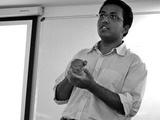
Two weeks back my friend, colleague and naturalist, Chirdeep Shetty presented a really vivid Pecha-Kucha talk called "The Truth about Tigers". It was a particularly inspiring talk - in fact, Chirdeep is my latest new hero for the passion that and connection that he spoke with that day. Chirdeep's talk and a few other such presentations that I've seen in recent months have made me think about the importance of infusing passion into our speaking and to heighten the sense of connection between us and our topics. In today's blogpost, I want to highlight my observations about this craft.
Presenting Naked - The words of the "Zen Master"
Garrey Reynolds' upcoming book, "The Naked Presenter" has to be one of my most awaited book on the subject of presentation skills. A few years back Garr blogged about making your next presentation 'naked'. His inspiration was the Japanese culture of community baths. A few weeks prior, he also spoke at Duarte Design about presenting naked - an obvious lead up to his book, but pretty awesome all the same. While the metaphor is a bit disconcerting to start with, it's a very strong message once you start thinking about it. The idea, as per Garr - "to soak with others in your in-group is to freely expose everything and communicate the naked truth." The 'naked truth' isn't always the sweetest pill to swallow as we learnt in Chirdeep's talk, where he wasn't afraid one bit, to expose the brutal methods that poachers use to kill our national animal.
Chirdeep has spent months at some of our most famous forests and has even followed a tiger on foot. His knowledge and love for the big cat showed as he educated us about the animal, it's prey, it's behaviour, it's endangered status, and the reasons why we should do our best to save this magnificent animal. It's easy with Chirdeep's exposure, to try and impress the audience with your knowledge - instead, Chirdeep chose to tell an honest story that was inspiring, informative, persuasive and motivational. I'm so inspired just listening to Chirdeep that I'm undertaking an arduos two-week big cat trail in the heat of summer 2011 just to see these animals in their natural habitat. Maybe then, I can speak about them as eloquently as Mr. Shetty does.
Pictures and Stories - Natural Connections
Some of the high-points of Chirdeep's talk were the images he showed and stories that he told. Most of the pictures on his slides were his own. When explaining the behaviour of the cats, he mentioned the solitary and territorial nature of the tigers - in that fact, this picture is a rare contrast and highlights one of the beautiful moments of wildlife photography. As Chirdeep told us his story as a naturalist and supported it with pictures of his own, it created an extremely strong connection to the topic for us. For Chirdeep, it created a strong, natural connection for him as well. It wasn't a topic that he was talking about anymore, it was his passion! The fact that the words just rolled of his tongue, showed how deeply he understood the topic, and the stories and pictures made the topic more personable.
I've mentioned this in a previous blogpost - stock imagery is great, but nothing beats a high-quality photograph that you took yourself. The dynamism of amateur photography completely surpasses the polished and therefore staged look of stock photography. In a similar manner, facts and figures about a topic are informative, but nothing tugs at the heart more than a real, true to life story!
How can you bring in Passion and a Natural Connection to your talk?
When I speak about the topic of presentations, I often mention a few key things to ensure when you're delivering a talk. I'll try to list them out here.
Think of what excites you about your topic: Don't do a talk because you have to. Do it because you want to and genuinely believe. If you don't feel strongly about a topic, then don't present - send an email or create a rich document. You'll save your audience the trouble.Show, don't tell: If you look at one of the most effective speakers of our time - Steve Jobs always has a flair for showing things instead of just telling us about them. Take a look at his talks in 1984 and after his return in 1998 and 1999 and his more recent Macbook Air introduction, you'll realise that he likes to touch and feel what he's talking about. Now Chirdeep couldn't have brought a real tiger into the room, but he brought in what was closest - pictures from his time in the forest.
Tell stories, don't give information: In 2005, Stanford saw a different side of Steve Jobs. This wasn't the 'naked' keynote speaker in a turtle neck. This was a man back from cancer, standing at a lectern and delivering a commencement address. While the setting wasn't particularly awe-inspiring, the speech was a lesson in earnest story telling. Steve Jobs' message to the graduates was to go and pursue their dreams, regardless of how foolish they may seem. He started his address saying, "Today, I want to tell you three stories from my life. That's it - no big deal." That's exactly what the talk was about - three stories about his life that made him the success he is today. Back in the day he couldn't have connected the dots forward, but looking back, everything makes sense. He ended the talk with his now popular message, "Stay hungry, stay foolish." The message has stuck with me for the last five years, because of the power of Jobs' storytelling. I'm sure all of us can make messages stick if we told stories with similar conviction.The state of "No mind": One of my vivid Hollywood memories is a scene from The Last Samurai. In the scene, Tom Cruise keeps faltering when he spars using the Samurai sword and Shin Koyamada comes from the audience asking him to blur our everything that he's thinking about to get into the state of 'no mind'. I believe that's a particularly useful lesson for presenters. We can obsess about each detail when we prepare and design our talks. But as we step on stage, we need to shut our mind to the million distractions and prompts and focus on having fun and connecting with our audience. Yes, you may occasionally falter and yes there'll be the odd mess up. Take it in your stride and continue to have fun. If you don't show it, often your audience will not notice it. And if they do notice it, your best bet to carry on unhindered is if they're having fun. They can't have fun if you aren't, can they?The topic of presentations is something really close to my heart and I love thinking and continually practicing the craft. I'm particularly inspired by earnest, honest and 'naked' presenters and I'm sure that happens to you too. Are there some tips you'd like to share about today's topic? I'd love to hear from you, so please drop your nuggets of wisdom onto the comments section of this post. In fact, feel free also to drop in any feedback you may have for this article. I'm doing my best to get back to a regular schedule, so your commentary will be worth it's weight it gold!© Sumeet Moghe, 2009
Sumeet Moghe
.
Blog
.
<span class='date ' tip=''><i class='icon-time'></i> Jul 20, 2015 10:50am</span>
|
|
If you have been reading this blog for a little while now, you may remember how there have been numerous ocassions where I have discussed how I am one of those folks who doesn’t really buy into both the whole generations or digital divide arguments. Gen-Yers, Gen-Xers, Baby Boomers, etc. etc., to me, are all part of the knowledge workforce and, if anything, instead of talking about different generations at work, I always tend to think that it is mostly about embracing and facilitating different working styles within the workforce. But what happens when each and everyone of those work styles don’t have a meaning, nor a purpose, for what they usually do? Well, we have got a crisis. A crisis of meaning.
That’s the main premise that Roger Martin, Dean at Rotman School, talks about at the Big Think Web site under a thought-provoking, and rather evocative, short video clip under the title "The Crisis of Meaning in the Millennial Workforce", which lasts for nearly three minutes and which I would strongly encourage you all to have a look in order to find out a bit more on the state of things within today’s corporate environment, which surely would sound as a key issue of why we are potentially going through the current turmoil with this financial crisis.
Now, Roger talks about that crisis of meaning for the younger knowledge workers, i.e. that generation of millenials. But, like I mentioned at the beginning of this blog entry, I don’t think it’s just a problem with millennials themselves, but more with the knowledge workforce in general, and with each and everyone of those working styles I mentioned above. So if you go ahead and scratch the word millennials and, instead, you put there Gen-Xers or Baby Boomers, or whatever else, you would still obtain a very similar result: an urge for each of those working styles to define a larger purpose or meaning for what each and everyone of us do in our day to day work.
We could probably say that one of the common themes permeating throughout the short video clip is that one of employee motivation, engagement, or participation in today’s corporate environment; or the lack of, better said, something that seems to be a rather popular topic at the moment, and which I will be covering shortly as well in a separate blog entry, as it really heated up a fantastic conversation over in Google Plus earlier on in the week on corporate culture(s).
But here is a good definition of that lack of motivation from the general workforce that Roger mentions in that video:
""Okay, so let me get this straight. I’m supposed to come to work for you and work every day with the singular goal of maximizing the value of faceless, nameless people who can blow us off in a nanosecond if they had a bad hair day? Am I right thus far?" The truthful answer is, yes. And the millenials are just saying, "Like, you got to be kidding me. Seriously?"
Like I said, scratch millennials and insert there whatever other moniker and it would still be spot on! Employee engagement and motivation are really two hot topics within the workplace at the moment. They always have been and will probably be. But perhaps that’s because we may have been looking into this crisis of meaning issue from the wrong end and we could probably very much need to apply some fresh thinking that would help us address the issue in a much more profound way to finally find that solution for it. And in this case, I do believe that Dave Pullin (Wish I could find the right Dave Pullin links to point you to him, but alas I couldn’t find them out just yet…) pretty much nails it as to put on the table what the real issue is at hand and what we, each and everyone of us!, could do to address it and fix it for those younger generations who have already started to enter the workplace. To quote:
"You have the problem 100% backwards. It is NOT "How do we motivate people to devote their existence to the interests of business", it should be "how do we motivate business to devote their existence to people".
Business has become the problem.
People want jobs but no business regards itself as having an obligation or objective to create jobs. People want rewarding jobs but business wants to pay the least they can get away with. People want fulfilling jobs but business couldn’t care less whether jobs are fulfilling.
People want healthcare, but we have HealthDontCare Businesses that want profit but couldn’t care less about people’s health. People want as much health care as they can afford, or to be healthy at the least cost, but we have Health "Insurance" businesses whose objective is to maximize the cost and minimize the healthcare" [Emphasis mine]
Etymologically speaking, some people say that crisis means change, decision, choice, judgement, etc. Well, perhaps we do need to go through this crisis of meaning to really evaluate, once again, whether knowledge workers need to adjust to business or whether the business needs to adjust to knowledge workers. Something tells me, deep inside, whether we would want to admit it or not, everyone, that we already know the answer to it. We probably have already made up our own minds, but thing is, the challenge here is, is it *the* right decision, *the* right choice?
Dave, once again, reminds us of what it may well be all about with a final brilliant sentence, extracted from the above comment, that I thought was worth while quoting over here as well:
"Business is an artifact invented by humans for a purpose. But now it is humans that must serve the purpose of the artifact"
Something tells me that it’s probably a good time now to remember, and to reflect, about where our real place at work is at the moment and where it should well be. Somehow, I think we all know the answer already, don’t we?
Have a good one everyone!
Luis Suarez
.
Blog
.
<span class='date ' tip=''><i class='icon-time'></i> Jul 20, 2015 10:49am</span>
|
|
For the last few days I've been reading Marcia Conner and Tony Bingham's book - The New Social Learning. It's an intriguing read, with several interesting case studies from organisations that are using social media to advance their business goals. Replete with heaps of evidence from the real world, the book is one that I recommend to anyone making a career in L&D. While I was reading the book on my Kindle, I was possessed to share all the wonderful insights I was getting from the book. It felt natural to tell my friends and connections about this awesome book. As I've posted stuff to my network, I've realised how being social is inherent to not just my personality, but also to everyone of us. We've always been social learners, and modern social media is just helping our natural tendencies. From the time of cave paintings to the modern age of of microsharing via Twitter, our way of learning and sharing hasn't changed -- only the landscape is different. In today's blog post, I want to share some of my thoughts about building a social learning culture in your organisation.Think Big, Start Small and IteratePeople are social in many different ways and depending on the goal they need a different social paradigm to communicate. I think of this as the way people play a game of Mafia when they are in a party, try karaoke at a bar and just sit around and have a nice little chat when over an intimate dinner. In a similar manner, your social learning infrastructure isn't complete with just an online forum or mailing list. One of the reasons I found Marcia and Tony's book really interesting is that they've looked at the social learning phenomenon from various angles, ranging from media sharing via channels like YouTube and going to immersive environments such as Second Life. When people want to share a stream of consciousness, they can use a Twitter style microblog - mimicing a constantly abuzz watercooler in the pantry. When they want to reach out to other practitioners they use communities of practice - much like special interest groups of yesteryear. When they want to work together, they use collaborative tools such as Google Apps and when they want to build their collective intelligence they use a wiki such as MediaWiki to build that together.Some common pitfalls with social learning implementations is to either implement narrowly or to over engineer! The key here, is to work as startups do -- think big, start small and iterate from there. It's important to have a vision of the various ways you see people interacting. At the same time it's important to start with small, high impact rollouts, iterating constantly towards the final goal. One of the highlights of my talk at DevLearn will be around how ThoughtWorks has iterated over the last decade or so, to come up with a learning infrastructure that meets our organisational needs.Don't just think TechnologyIf you follow this blog, then you may have read one of my older posts about social learning patterns that are not technology dependent. The key to remember that social learning is not entirely about the technology that enables it. The beauty of technology is that it helps transcend geographies. That said being social is hardly dependent on technology alone. It depends on the culture you create and the opportunities they get each day to learn in a social context. In that blogpost, I've outlined seven patterns to facilitate social learning in the enterprise without an over-reliance on technology:Reface your team spaces to encourage conversations, sharing and collaborative problem-solving.Try brown bag lunches where people can share the latest and greatest that they've learnt about in recent days.Try Pecha-Kucha nghts to provide people a forum to share their ideas in a fun way, in a short amount of time.Open Space conferences can be a light-weight mechanism for people to pull learning in a group setting.Offsites are a great way to socialise and learn from a large number of people with varying expertise.Bar Camps and similar unconferences are an excellent way to self-organise learning amongst large groups.Internal Conferences could be your way to have people share good practices in a contextualised setting for learning.I'm sure you'll have several more ideas about social learning without technology, so feel free to drop in your thoughts in the comments section of this post.Find the Evangelists, Ignore the Bozos, Respond to the CriticsSocial learning strategies are nothing without the people behind the scenes. Nothing that you do is likely to be everything to everyone. It's important to seek out the people that believe in the power of the social media approach to not just evangelise the methods but also to community manage in the initial stages. It's a huge mistake to believe that if you put usable tools in place, adoption will follow. It's crucial to get the people most excited about your approach, behind the initiative. Guy Kawasaki, in The Art of Innovation advises us to not let the bozos grind us down. The idea is to understand that you can't make everyone happy and there'll be those who will tell you it can't be done. For starters at least, it's important to ignore them and move on. If your ideas are good enough, the evangelists will help you win and adoption will follow. That being said, your critics (not the bozos) are the ones telling you they care for your success. So respond to your critics' concerns over time - don't pressure yourself to do it all in one go, but commit yourself to addressing their concerns. Critics can often be opinion leaders too - so winning them over is a way to get a new evangelist!Todays post is inspired by Marcia and Tony's new book and I strongly recommend you pick up a copy. The amount of research the two authors have done is quite amazing and is well worth your reading time. I'll leave you at just that and remind you to catch me up if you bump into me at DevLearn 2010 in two weeks. Some news about that - I'm facilitating two Breakfast Bytes in addition to my concurrent session:Thursday, Nov 4, 2010: Social Learning Patterns in the EnterpriseFriday, Nov 5, 2010: Vampires, Werewolves and Silver Bullets - Understanding and Dealing with the Myths of e-LearningJoin me at those - I'm really looking forward to learning socially from you!© Sumeet Moghe, 2009
Sumeet Moghe
.
Blog
.
<span class='date ' tip=''><i class='icon-time'></i> Jul 20, 2015 10:49am</span>
|
|
A couple of years back the folks over at oDesk put together a rather interesting and insightful YouTube video clip around The Future of Work, which lasts for a little bit over 6 minutes, that surely is worth while going through, specially, the last minute and a half, as it would remind plenty of people how close it is to the well known series of the "Did You Know?" videos. The clip comes to ponder about the future of work and how social computing tools are helping redefine the current workplace as we know it. Two years later, it looks like pretty much all of the main key messages from that video, still resonate quite a bit, thus making us all wonder whether things haven’t changed that much after all. You would expect that they may well have, but have they really?
Well, I am not sure what you would think about, whether we have shifted gears and moved one step further, perhaps two, from where we were in 2009, but I strongly believe that we surely have made some giant leaps into embracing, and adopting social networking tools as one of the most powerful methods to help redefine how work gets done nowadays. However, if there is anything clear coming out from back then and into today, after watching that video clip, is that a few of the annotations made during that six minute long clip are eventually a reality just two years later, in 2011, if not even further! Let’s have a look with some examples:
Priceless quotes like "Project teams at work are beginning to resemble movie production teams", or "Although home is still the most common location, millions of virtual team members work from just about anywhere", or "Employers will have access to a larger and more skilled workforce", or even "Individuals will have more freedom and power than ever before" (One of my favourite quotes, by the way!), come to confirm, quite clearly, how we may be living through a time in which the future of work is a whole lot more transparent, flat, competitive, and on demand than ever before thanks to that emergence of social networking tools that we have mentioned above already and that are taking the business environment by storm.
And when talking about competitiveness we should probably not forget about high performing teams either. And how they themselves, when making use of social software tools, keep augmenting, even more, their already high performing working methods, to the point where the time finding the right experts has now gone down from several hours a week, to perhaps just 5 to 10 minutes. Or how the time to search AND find the right information at the right time has been also improved dramatically helping those high performing teams reach new levels of engagement, responsiveness and collaborative, as well as innovative, interactions by their own urge to keep up cultivating and nurturing those personal business relationships that they have been building over time.
However, we should not forget that what businesses out there would be the most interested in at the moment would be what my good friend Dr. Anne Marie McEwan calls Value Creation that she has blogged about earlier on today under the suggestive title "High-Performance Work Systems". How it is all about efficiency and effectiveness (Whether amongst individuals or between groups, i.e. teams, networks and / or communities), about embarking on a constant learning curve that never ceases to stop, as it provides an open window into meaningful, motivating and engaging work. Some really good stuff in there!
In a way, it reminds me of another blog post I put together a couple of months back of how this helping redefine the future of (meaningful) work AND of the workplace, is also helping redefine the role of the Knowledge Worker him/herself, which just recently, a couple of days ago, my good friend, Harold Jarche beautifully reflected on as well into re-shaping up "The new knowledge worker", one who seems to breathe plenty of critical thinking and a rather empowering inner urge to want to make things right or as Thomas Stewart would say: "A knowledge worker is someone who gets to decide what he or she does each morning". With a purpose, if I may add.
Mind you though, Harold pretty much nails it as well when he comes to conclude that not all of the work is done. As much as those high performing teams, networks and communities are dictating how work happens around them and their networked structures, there is still a larger population of knowledge workers we cannot afford neglecting, nor ignore, and leave behind, just because they haven’t embarked on embracing social networks as part of their game. It will be, indeed, our role to lead and help facilitate those folks come on board as well, at the their own pace, at their own time, i.e. when they feel it’s the right one, with their own rules, with enough preparation to make it work for them and their needs. And somehow, like I have already been hinting out there on one of my recent Google Plus posts, I suspect that the glue part of the organisation that’s going to have a paramount role, if not far too critical to fail altogether in provoking such outrageously optimistic change into bringing some sensemaking to truly realise The Social Enterprise vision, would be Human Resources, our good old HR organisation(s); as the one and only, Marcia Conner, described really nicely in a recent article over at FastCompany under the heading "Now that people finally matter to businesses, HR is the next big thing".
It surely is! In fact, it’s been all along! Even more, from a Social Enterprise perspective, it’s perhaps the final frontier for all of us, knowledge (networked) workers, out there to claim that our work is now done!
Alas, we are not there just yet. Still plenty of work to be done! So we better roll up our sleeves and keep driving innovation further into meaningful work to help shape up the future of the workplace, our workplace: networked, more trustworthy, transparent, engaged, open and nimbler, in short, empowering altogether for ALL of us. Not just a few.
Luis Suarez
.
Blog
.
<span class='date ' tip=''><i class='icon-time'></i> Jul 20, 2015 10:49am</span>
|
|
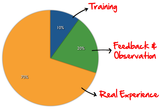
Can I say how excited I am to be at this webinar with Charles Jennings? As a big fan of Jay Cross' idea about workscaping and as someone who's put this idea into action, this is definitely a topic very close to my heart. I don't know what Charles' agenda is, but if it's about the way work and learning are synonymous, I'm sure he'll strike a chord with me. These are my liveblogged notes from the webinar, totally unplugged -- so I promise to keep it as honest and real as I possibly can.So what does Charles want to talk about? What are the key challenges that organisations face today? Change is increasing everyday and we need to keep emowering our workforce to keep up with change and keep building their capabilities. We don't do training right - we, in fact do it very inefficiently. Charles is going to present a model on experiential learning that really works and hopefully he'll share some empirical evidence for this as well. Nom, nom, very exciting.Charles asks us to think about some of our most significant learning experiences and to think of where they occured. For me most of my learning happened at work. Charles has picked up my favourite example to explain experiential learning. I use the example of how we learn to ride a bike - we got bare minimum instruction, but we learnt from experience, failure and reflection. We didn't real a manual or go through detailed training -- we just did it and learned!"Learning is all about action. It's not about storing stuff in your head." - Charles JenningsThe Trouble with current Formal Learning ApproachesMuch of formal learning is content rich and interaction-poor. We learn to know but we hardly learn to do. I called this the phenomenon of growing the knowing flab vs building the doing muscle. This is the big problem with formal learning programs in organisations these days -- if there's a best practice, content rich training works. OTOH for most knowledge workers, it's an interaction rich approach that's crucial, because it prepares us to face complicated and complex problem domains and thereby deal with novel and emergent practice.Most away from work training and learning leads to the phenomenon of the forgetting curve, because instruction out of context leaves nothing for workplace performers to remember and apply what they've been "told".Most of the participants like to get involved and try things out. They like to have dialogue and discussion. They like presentations which are organised according the logic of how they work and learn. They like to experience how things work. This is amble evidence that proves that people like to learn through interaction, working with others and real experience.Real Adult LearningHumans like other animals learn through experience, practice, conversation and reflection. Real adult learning is about acquiring new ideas from experience and retaining them as memories. Instead of structuring learning around content, we need to structure them around creating learning experiences.Charles is now introducing the 70:20:10 model from the Princeton University which says that we learn 10% from training, 20% through observation and 70% through real experience. This is a model, not a recipe, but has significant evidence about this.70:20:10 is a framework for thinking outside classes, courses and curricula. Most organisations spend their money on the formal training curriculum, where the bulk of the budget should ideally go to helping people learn from experience. A lot of the evidence comes from the initial assertions by Jay Cross and then from studies by Capital Works , Education Development Center at Massachusetts, US Bureau of Labour Statistics and Institute of Research for Learning. Charles will give us more evidence and studies later.Incorporating 70-20-10 in Value Based Learning StrategyFirst things first, this is only a model and not a silver bullet. The percentages are only indicative. So Charles recommends that we don't get hung up on the numbers and focus on the context because implementations will vary with the problem on hand. "Informal learning is generally more effective, less expensive and better received than it's formal counterpart" - Jay CrossThis is quite understandable, given that you're very very unlikely to see behaviour change through classroom sessions. OTOH, this is extremely likely to happen with the constant "interventions" that informal learning creates for us. Most managers say that they learn through informal chats with colleagues, search engines like google and through trial and error. This is some real research from Good Practice. Charles mentions that thinking 70-20-10 requires a mindshift and cultural change whereby we can, as learning consultants help our organisations understand and be aware of the opportunities we need to create in the workplace people to pick up and hone the skills they need to grow. This means working with businesses to create sizeable investments in informal learning, getting managers involved and development driven performance management.Charles also suggests that we include 70-20-10 thinking in the competency framework of various job families. This is something we've tried to implement via the concept of learning paths. Charles suggests through that we go a step forward where we list out recommendations in each area of the 70-20-10 model for each role to seek out their development through experience, observation & feedback and formal learning.The Role of ManagersManagers are strongly involved in the development of their people. Not just Charles and I, Esther Derby says so too. Managers have the most impact in terms professional development and the mindset of "let's throw them to the trainers", takes away a lot of responsibility from leaders. The corporate leadership council has research that says that people who work with managers that are committed to developing them, outperform those with less involved managers. (I think that's what I saw, though I could be a bit wrong)Working with team member through learning logs, coaching regular feedback, and goal setting are crucial skills for managers.L&D's Readiness for 70-20-10The focus of L&D has to change:Moving from maintaining catalogues of courses, etc to managing workscapes.Moving from designing and developing materials to supporting learning experiences in the workplace.Moving from a course centric approach to a performance centric role.Moving from predominantly classroom and elearning driven approaches to a multi-channel, multi-modality approach.Finally we need to move from a learning focussed approach to a performance and productivity focus.Great stuff from Charles, I really liked the stuff he's mentioned and this resonates with my own approach in L&D. Thank you!© Sumeet Moghe, 2009
Sumeet Moghe
.
Blog
.
<span class='date ' tip=''><i class='icon-time'></i> Jul 20, 2015 10:49am</span>
|
|
Continuing further with that series of blog posts on meaningful and smarter work and how it is helping the corporate world redesign the future of the workplace to make it much more networked, interconnected, open, egalitarian, non-hiearchical, unstructured, porous, chaotic, trustworthy, engaging, transparent, agile, dynamic, empowering and whatever else you would want to add further up (Phew!) to realise the Social Enterprise dream, I thought I would go ahead and share a bit of special entry today where we can keep talking about it, although it’s not going to be me the one doing the talk, but one of the folks I have long admired and from whom I have learned tremendously over the course of years in the areas of Knowledge Management, Communities (Of Practice, a.k.a. CoPs), Complexity, Enterprise 2.0 and Social Computing. Of course, I am talking about the one and only: John Tropea, whose blog posts, tweets, plussings and tumblrs are always highly recommended reads and a must-subscribe, too!, in case you may not have done so just yet. You should. It’s worth every minute of your time.
Take, for instance, this particularly rich and very insightful conversation over at Google Plus, on the topic of Corporate Culture and whether we can exert some influence in changing it, or not, through social networking, collaboration and open knowledge sharing, all of it as a result of a follow-up conversation from a brilliant blog post that originated from my good friend Jack Vinson under "Culture is nebulous, focus on what you can change". In it, John gets to share quite an amazing array of insightful comments, along with helpful links that surely help understand how changing the corporate culture of an organisation is definitely not as easy as one would expect. Plenty of food for thought for those internal social computing evangelists out there who feel they are on to another league trying to shift gears and change their corporate culture as they know it to start living social. Well, perhaps it is not as easy as what we have been told all along… Worth while a read, for sure!
However, the main purpose why i wanted to put together this blog post in the first place was to continue making that connection between previous blog entries on redesigning the Future of the Workplace that you folks have read over here lately, and in plenty of other places, I am sure, and build further up on it pointing you folks to what I think is probably one of the best blog entries you will read this year in 2011 around that very same subject. It surely has moved pretty quickly into my Top 3 favourite articles that I am definitely going to keep coming back over and over again to digest all of those hidden gems that keep coming up every time I read through it. Already done with my third reading of the post since it was first aired out yesterday and still learning new insights!
Go and have a look into John’s latest take on how wild ducks, trust agents and intrapreneurs are continuing to take the corporate world by storm gathering informally in groups, whether teams, networks or communities, amongst several others (John mentions a few of them as well!) to carry out that meaningful, smarter work that they themselves feel rather passionate about in the first place! Work, by the way, that’s not mandated from top-down, i.e. the strict organisational structure(s) we have all gotten so used to over the course of decades, but work that has been defined by those groups themselves, just because they share a common affinity, a bunch of free time and a passion to carry it out. Yes, something like finally being capable of freeing up the human batteries within each organisation, as in freeing up those free radicals that know why, what and who they network with in the first place, what John calls freelancing in the corporate world and which more and more seems to help define how work gets done nowadays, where the center of gravity, or power of decision, has been lowered down more than ever before and where being more agile, open, transparent, engaged, empowered, and networked seems to have set up the new rules of the workplace. And it is starting to look like it’s here to stay, too!
Indeed, not going to expand much further on this blog entry itself, since I’m sure you will be enjoying John’s article plenty more. It’s a long, extensive, brilliantly covered and rather comprehensive read on what that new freelance corporate work looks like and how we have already started the transition to it. In "The future of work is to freelance within an organisation - choose your task, assemble to work, then dissolve" you will see how there are plenty of numerous references to other thought leaders in this space and what they have been thinking about this particular topic for a little while now. And while it may look a bit overwhelming as you go through it, you will notice (As my good friend Jon Husband also mentioned in a comment) how there is some very nice momentum building up around it by multiple thought leaders and that can only mean that the shift towards that work model may have gotten started already and John has managed to capture it beautifully into one of those blog articles that would surely have a permanent home in our hearts, and brains!, for those of us who would want to see the Social Enterprise dream come true. And the sooner, the better!
Hope you enjoy reading through it, and from here onwards I just wanted to share a special Thanks! with John for having put together such amount of hard work in assembling all of those great insights and share them across in that outstanding, must-read, brilliant blog post. He’s done us all a huge favour and I can see the day where we will look back into that article as the seminal work that consolidated what a good bunch of us have been saying for a while now as well…
Intrapreneurship is here to stay! Are you ready, finally, to embrace it?
Luis Suarez
.
Blog
.
<span class='date ' tip=''><i class='icon-time'></i> Jul 20, 2015 10:49am</span>
|
|
Paul Trueman is posing a few challenging questions to us today:How do you get learning buy-in? How do you ensure that individuals want to learn, that managers give them the time to learn and that executives give you the budget to make it happen?Paul says it takes more than just smooth marketing talk to make this work for you and today he'll tell us about how we can influence stakeholders and make our L&D abilities visible. Very interesting, and something I really need to learn. Do remember, these are unedited, live-blogged notes.Paul's in the middle of some interesting research that I guess leads to this talk. Paul does a whole heap of work, ranging from internal consulting to good old, face to face training. Paul is starting off asking what our biggest concerns are about promoting our L&D departments. Here are some of the responses we saw:MindsetsBudgetsBalancing quality and valueTailoring content to demandGetting mangement to understand where we're coming fromResistance to changeGetting management to understand the value of investing in learningGiven some of those responses Paul's moving into the agenda for his presentation.How can we promote learning and development as a beneficial investment?What are the key drivers for different stakeholders?How can we articulate the value learning and development adds to the business?How do we communicate the benefits to learners?A background of Paul's Case StudyPaul's work is with his company, Eaga Plc. Eaga is a Newcastle company, partner owned since 2007. They have about 4500 partners and they manage the government's warm front scheme and the BBC digital switchover scheme. Their culture is about empowering people, ensuring they look out for new ideas and to find new ways of delivering services in an innovative fashion. The culture sounds like what most companies claim to be like, and what ThoughtWorks is like! The Eaga people development team has 22 people and currently invest 2 million GBP in training each year. They have heaps of face to face delivery with the support of their LMS. They seem to have a strong set of values focussing on embracing change and continuous improvement. That's a win for the L&D team because people are keen to keep improving and they don't have to drag people into initiatives and embracing change helps them to keep turning around soon to respond to the organisation's changing skill needs.Promoting L&DPaul and his team promote L&D by conducting an annual partner engagement survey. Eaga has also has five key divisions with a key L&D partner assigned to work with each division. They support all their partners with additional academic funding options. They fund 50% of any external courses if that is relevant to their business.They listen to their internal customers and take training evaluation very seriously. They also ensure that each partner has a personal development plan with the support of their line managers, L&D and HR.Managing StakeholdersEach partner wants skills development and career growth. So if the L&D teams don't invest in training approaches, this pushes the partners back. Paul's showing us several quotes and testimonials from his partners proving his point.Paul also mentions that his department level stakeholders are looking for ways to make their groups more efficient. Again, he's showing us several testimonials from the managers that show their satisfaction.Senior level management wants to know their skills base to be able to make effective business decisions on partner allocation. Paul and his team need to keep the senior management informed about this current state of the world so they can use this information to decide how they'll drive the business.The key that Paul is trying to drive is that we need to go from the value that each individual stakeholder's looking for and communicate in a language that makes sense for them. I thought Paul's messages were quite simple and very common-sensical though I didn't get heaps out of it. In any case, you are welcome to carry on this discussion with Paul on his email address. It takes heaps to come out and tell your story, so I congratulate Paul on that! And btw, if you wanted to learn about more influence patterns, please do look through Mary Lynn Manns' work in this area.© Sumeet Moghe, 2009
Sumeet Moghe
.
Blog
.
<span class='date ' tip=''><i class='icon-time'></i> Jul 20, 2015 10:49am</span>
|
|
As a result of John Tropea’s wonderful blog post from yesterday, which I have blogged about over here, there has been also quite an interesting and rather refreshing conversation developing on the side over at Google Plus around the topics of business processes, BRP (Barely Repeatable Processes), the role of traditional hierarchies and structures in today’s work environment while mixing and mingling with a networked organisation and where learning fits in there altogether. Some fascinating stuff in there, for sure! And one of the various reasons why I keep digging quite a bit G+ over other social networking sites. The depth of the conversations has been like no other so far! And it’s thanks to those conversations themselves how one keeps bumping into golden nuggets like the one shared yesterday by Dennis Callahan on that very same thread around "The Future of Work".
Yes, indeed, you may have noticed how the last few blog posts have continued to raise my interest around the topic of The Future of Work and how social networking and social computing tools are helping redefine how we view and interact at work within a corporate environment to make it much more open, transparent, trustworthy, networked, meaningful. Well, it looks like that interest keeps growing further, specially, after going through that fantastic article put together by Dennis where he has shared 19 different very enlightening and educational resources on The Future of Work, ranging from links to other insightful blog entries, to short video clips, presentations, etc. etc. Quite a goldmine on its own right there, for sure!
However, from all of those resources mentioned by him, and which I would strongly recommend you all go through them, since they will be worth while your time, specially, if you are interested in this topic as well, there is one in particular that I thought I would expand further on it for a bit. More than anything else, because of how much it resonated with how I view work myself, but, perhaps much more importantly, because of how well it describes the current work I have been doing myself, and a whole bunch of other people!, for the last few years. And still going strong…
Time and time again I keep getting asked what my work day as a KMer, Community Builder and Social Computing Evangelist looks like, specially, while working at a large IT corporation that has been there, alive and kicking, for the last 100 years and counting… At times, it presents a bit of a challenge in itself, since I guess it’s pretty tough to try to describe what you are passionate about in an eloquent manner; too many things to cover in such a short time!; basically, that stuff you know you could talk for ages and ages yourself and never get tired of it. Yes, I guess that passion for what you do will describe it quite nicely at this stage. Well, T.A. McCann, founder of Gist.com, just did that beautifully for me over a couple of minutes in a short interview under the suggestive title of "The Future of Work Is Now", which he himself blogged about over here.
It’s a priceless gem, for certain! I can tell you that! If we have been talking for a little bit now about The Future of the Workplace, about what meaningful, networked, freelanced, intrapreneurial (corporate) work is all about, T.A. McCann pretty much nails it on that short interview. I just couldn’t put it in much better words than what he did. If not, judge for yourselves:
Mind-blowing, isn’t it? Who would have thought that in that future of work concepts like multiple jobs across a working lifetime, having fun @ work, work life balance no longer there, retirement would no longer exist, do your best effort at all times, connecting and reaching out to others who share a common passion on a particular topic / goal with you, learning as a key driver of working together effectively, etc. etc. would be helping redefine how we view AND live our workplace(s). And all of that thanks to the emergence of social networking tools within the enterprise and beyond! Not too bad, right?
I am not sure what you folks would think, probably that I am a dreamer or someone trying to live to the fullest an unrealistic, utopian business world that will never see the light, specially in today’s working environment. Perhaps too optimistic, too outrageously excited and eager for what’s to come. Well, may be. May be not. Who knows. The reality is that’s the current work environment I have been living, experiencing AND enjoying for the last couple of years, and I know for certain I am not the only one going through this, so I doubt it would be a dream any longer. More of an ever-growing reality, rather. It’s probably just a matter for us, knowledge workers, to define how we would want to make it work for ourselves; basically, have knowledge workers create and define their ideal job role(s) and get down to business.
After all, remember, "Individuals will have more freedom and power than ever before."
Luis Suarez
.
Blog
.
<span class='date ' tip=''><i class='icon-time'></i> Jul 20, 2015 10:49am</span>
|
|
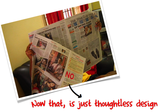
This morning, the Times of India newspaper was an ad-fest. Someone on the newspaper design team had decided that providing a page that was just a third of the original paper size would be a clever way of introducing a large advertisement before readers even saw the front page. Sounds like a great idea - preserve the sanctity of the front page, and still sell a costly front page ad that readers see first up. Turns out, they're not as smart as they think they are. No one on the Times design team seems to have thought once about the importance of function with form. People read newspapers sitting in their living rooms, in a train or at an airport and they need the convenience to hold the paper open, just as you see me do in the photograph. A page that's just a third of original width means that I can't hold my newspaper open without the inconvenience of one of the sheets continuously falling off. This is annoying; and Times, you've got to know how much I hate you for designing a paper with such little intelligence.Then again, a lot of us tend to design beautifully without much emphasis on utility. In fact, we do it so often that it's unfair to call it design -- it's merely decoration. When I take this mistake to the realms of presentation design, this makes us create presentations that are either peppered with decorative information or decorative visuals. Simplicity however, doesn't need decoration. Simple presentation design demands that we make our idea easy to understand, visually clear and without confusion. In today's blog post, I want to discuss a few ideas that can help you create high-impact, simple presentations that'll make your message stick with your audience. I can't say I always do all of what I'm writing, but I can say for sure that if I did this more often, I'd be a much better speaker by the end of it.Crafting an "Easy to Understand" Message"Making the simple complicated is commonplace; but making the complicated awesomely simple - now that's creativity." - Charles MingusPeople often confuse simplicity with being simplistic or dumbing down your message. You can do no bigger disservice to your topic if you're trying to dumb it down for an intelligent audience. You want to let your topic be as complex as it really is, but your true creativity stems from being able to make it easy for others to understand. A couple of weeks back a colleague and I were talking about the rule of three in presentations. The rule of three is a simple theory that exists from the days of Aristotle and his book Rhetoric. The premise is quite simple, people comprehend, remember and enjoy information that comes in a group of three. There are several examples of this:The Three Musketeers, Goldilocks and the Three Bears, Three blind Mice and the Three Stooges are all symbols in popular culture and literature that are memorable and stick in your head from the first time you see them.Several popular quotes and figures of speech incorporate the rule of three. "Friends, Romans, Countrymen..." from Shakespeare or "The father, son and the holy spirit." of the Holy Trinity and "Lies, damned lies and statistics." from Benjamin Disraeli are all great examples we all remember and quote till today.You'll notice that filmmakers structure their movie scripts in a similar manner. Love stories start with how a boy meets a girl and then how their relationship faces some trouble and then how everything works out in the end. In tragedies, I guess everyone dies at the end! On the other hand, thrillers begin with a low-key scene setting, a high tension drama, and then a fast paced closure. Comedies too, follow the rule of three.The 70-20-10 rule of learning, the 90-9-1 rule of online communities and Guy Kawasaki's 10-20-30 rule of presentations are memorable lessons in contemporary business. You hear them once, you don't forget them because of the way they use the rule of three.I could keep giving you examples till I convince you, but I guess I'll rest my case here. The rule of three is a simple idea to apply to your presentations, so you can tell an effective story. Here are some ideas for you to chew on:Consider structuring your presentation with three clear sections. Here are two examples: Problem, Solution and The Way Forward (when presenting a plan);or Current State, How we got here and Lessons Learned (when presenting a review);Think of the three key things you'd like your audience to remember at the end of your presentation. Keep reinforcing those three key messages with examples, anecdotes and exercises in your presentation.When you're teaching introduce no more than three critical tools that your students can use. If you're presenting case studies, present no more than three distinct examples.The rule of three creates a lot of discipline with presentation design. Remember, if all you had to do was convey facts, then an email conveys facts much better than anything else. We know from experience though that people need persuasion. And if you want to persuade with your presentation, remember that storytelling trumps a fact-showcase each time. For some more excellent ideas on how you can tell an memorable story with your presentation, take a look through Scott Schwertly's Storytelling 101slidecast on Slideshare.Design for Visual ClarityPeople who say they "can't think visually" are liars and I don't mean to offend anyone when I say this. We are hardwired to thinking visually and there's enough research from Dan Roam's book that'll help you believe me. If you're one of those people though, think back to when you were a kid. If someone asked you if you could draw, when you were in kindergarten, what would you say? My guess is, you'd say yes. What happened in all these years? Ah! You got an education! And our education has taught us about 1000 word essays, bullet pointed slides and the need for verbose documentation. It's never too late to reach back to the natural, visual thinker amongst us and think of expressing ideas with simple images. And don't do it because I say so on this blog, do it because John Medina in his landmark book Brain Rules says that "vision trumps all other senses". If you hear a piece of information, three days later an average person is likely to remember only 10% of it. Add a relevant image and recall jumps to 65%. Now if that's something you want for your presentation, then you need to design visually -- you have no choice!"Pictures beat text...because reading is so inefficient for us. We have to identify certain features in the letters to be able to read them. That takes time." - Dr MedinaThe good news is that being visual is real easy. You were a kid once (hopefully), so you have the natural tools to be able to visualise things. Stock photography and cheap digital cameras make the availability of high quality imagery a breeze. Add to that tools like Dan Roam's visual thinking codex, and you'll realise how powerful circles, boxes and arrows can be. Take a look at his simple napkin sketches breaking down the US healthcare problem, and you'll see what I'm saying.A word of caution while I say this though -- the computer is only a bicycle for our minds. It can help you polish your idea if you have a good one, but it can't help you come up with the idea itself. Coming up with your ideas at the computer is the biggest presentation smell I can possibly think of. The computer is not only a source of several distractions, when you prepare at your computer you're forcing yourself to multi-task between coming up with your idea and representing it. You're thinking of the kind of image you want, and then you go to search it and then you decide it needs modifications and then you get sucked in and at the same time you're thinking about the order of your slides -- you get the idea, don't you? It's a mental mess. Take time away from your computer. Get some coffee, find a quiet place and plan analog (not digital). Sketch ideas on a notebook, draw out your slide details on index cards or storyboard using stickies. Get involved with your storyline so you have a visual connection with your concept. You'll see that this'll help you design your slides much faster as well! And guess what, by now you'll be so involved with your story that even if there's a catastrophe and your projector stops working you'll be able to tell your story with ease."If the presentation matters, you need time off the grid to prepare." - Garr ReynoldsShowcase an Uncluttered MindWhen I present about presenting or help others craft their presentations, I always mention that what you don't say is far more important than what you do say. When we know something about a topic, we want to say all we can about it. This is natural, and I believe this is a result of a speaker's passion for her topic. The problem is, that human brains aren't hardwired to remember as much in a short timeframe. Do remember that presentations are more about selling and exciting than about educating. If you wanted to teach someone something, you perhaps need to spend some time with that person in a real world context. On the other hand, if you can craft an exciting presentation, you'll encourage people to go out there and explore the topic for themselves. So the decision for you is: do you want overwhelm your audience with all that you've learnt about your topic from a decade's experience OR would you rather sell your topic so well, that you compel them to go learn more? The choice in my opinion, is quite simple - retain the signal, eliminate the noise!I like to take the idea of unclutteredness to a slide level as well. Each slide needs to anchor just one key thought, not more. Don't try to cram everything into one slide! Extra slides don't cost money and depending on your presentation style you could need 10 or 100 slides for a 30 minute talk. Keep your visuals clear, minimise the decoration and focus only on the one message the slide aims for. In fact, I'll go to the extent of suggesting you ditch your corporate template because it gives you the visual clutter you don't want -- the logo, the page numbers, the decoration on top and the bottom. Anything that doesn't add to your message doesn't deserve to be on your slides.I hope some of these ideas help you design a more powerful presentation the next time you're at it. In a subsequent blogpost, I want to deal with presentation stage fright and what you could possibly do to overcome it. I can't promise when that'll come up; you'll just have to wait and watch. If you want it sooner than later, drop a line in the comments section and let me know. Speaking of comments, do remember that your comments are quite valuable to me. So don't be shy to tell me what you thought of this blogpost. I'd love to hear from you.BTW, if you're at DevLearn next week, do make an effort to bump into me. I'm on twitter and if you're around I'd love to catch up with you. I look forward to meeting as many of my small reader base as I can, at what promises to be an awesome conference!© Sumeet Moghe, 2009
Sumeet Moghe
.
Blog
.
<span class='date ' tip=''><i class='icon-time'></i> Jul 20, 2015 10:49am</span>
|
|
It’s hard to believe the last time that I had a chance to drop by over here in this blog to create another entry was a bit over a month ago! My goodness! Where did the time really go over the last few weeks? It looks like the world just decided to spin over and over at double the speed, not allowing us to catch breath and move on nicely with the flow. I bet a bunch of you folks thought I had given up on blogging altogether (once again, after this long hiatus!) and move elsewhere. Well, not really. In fact, if you have been hanging out there on the various social networks that I use on a regular basis you would notice how during that period of time things have been relatively quiet from yours truly. Not because I may be suffering from some kind of social fatigue, but mostly because this time around real life, that parallel world we are all immersed in, decided to make a stand and have a whole lot more prevalence during these last few weeks dictating what yours truly would be doing here and there. The truth is though that things are starting to slow down a bit again, and it is therefore time for me to come back to my usual regular blogging, where I need to do some serious catch-up with what’s been happening in multiple fronts… But, hey, it’s good to come back! Always!
Anyway, I am sure at this point in time you may be wondering about what I have been up to in the last few weeks, right? So I thought I would just try to cover some of the things I have been involved with in that time, so you can have a good glimpse as to why it took me so long to come back to the blog and pick up again my blogging mojo. Well, as a starting point, work has continued to increase quite a bit, as we are approaching year end and I am sure most of you folks would understand what I mean with that. So I have been ramping up a bunch of customer meetings and workshops talking about "The Social Enterprise", and, as usual, learning quite a bit about it from other people’s experiences. I am hoping in upcoming blog posts to talk about those experiences and also perhaps share some of the materials I have been using in those events.
Those customer meetings and workshops meant I had to do quite a bit of business travelling during that time as well, to combine it all with a good bunch of conferences that I have participated in the last 3 weeks, where I travelled to 5 different cities in 5 different countries. To name: Paris, Brussels, Frankfurt, Zurich and Madrid. So you can imagine how hectic things have been in that front. But this time around things have been a whole lot worse, because during those business trips I didn’t manage to stay connected for long periods of time or, at least, for as long as I would have hoped for, something that towards the end of it all really started bugging me big time, but that’s perhaps the topic of another blog post later on…
For now, suffice to say that it wasn’t a pleasant experience, quite the opposite, so, eventually, I needed to have some time off, to chill out, unwind, recharge my batteries and come back in full force. But, once again, life had a big surprise for yours truly that has surely managed to keep me quiet on the Social Web out there for a while, because I didn’t feel it was the right time, and it’s actually this blog post that I am putting together today the one that marks the time where I feel I need to talk about something that has left a big mark in my personal life and that as soon as I share what it is all about there would be a bunch of you folks who could relate to it as well pretty much.
If you have been following this blog for a good while now you would notice how early next year it will be 8 years since I moved to Gran Canaria, where I currently live and work. I cannot believe it’s been that long, to be honest, but I guess that time flies when you are having good fun! Anyway, when I came over here I ended up being part of a family: Fosca’s family.
Fosca was a black (with a white patch across her chest) flat-coated retriever that surely managed to receive me really well into her family without making much noise, without barking too much either, not even a single complain of having lost some of the attention from others, but showing, from day one that I met her, an unprecedented affection for yours truly that translated into one of those relationships that you know is going to leave a mark for good. Time and time again I used to tweet that I would be going out for a long walk, or a good run, with the dog… Well, that dog was Fosca. Numerous and countless hours were spent together. I became, indeed, part of her family. She was already 5 years old when I met her and it felt like I knew her forever. Her shiny and attentive brown eyes were something to die for! You could never say "No!" to her with those looks she knew how to use them on your to turn around whatever you were going to say… That’s how she was! Always having plenty of time to dedicate to you, to take you for a walk or two, to make you run for a while to keep you in shape, to share plenty of that affection without even asking anything in return. Just like being part of the family from the beginning!
The thing is that in the last year and half things weren’t that well for her; she had to go through a number of operations to remove a couple of tumours and eventually on October 27th 2011, she decided that enough was enough and she needed to move on. So she left us. I would probably never forget the look in her face the day that we took her to the vet. There she was, as lively, agile, playful, charming and entertaining as ever, jumping back and forth, waving her tail without remedy, just as if nothing really happened and she was ready to go for another long walk. Except that was the last time that we would ever see her alive. A very sad day. A few very sad days eventually ever since. Last thing that we wanted for her would be that she would suffer a rather slow and painful last few weeks of her treasured life. So one of the toughest decisions I have ever come across myself in my life had to be done. There was no way back. But being the amazing creature that she is she managed to have the rest of the family sorted out on her way out.
They say that there aren’t any coincidences in life, and probably there aren’t. Things happen for a reason and all of the events from that morning certainly confirmed that she was right all along. She needed to find a way for us to move on with our lives, after the wonderful years we had together, and she managed to make it happen in one of the most natural ways you can ever imagine. Serendipity, once again, doing its magic, but with a purpose this time around. Help us move along from our pain of having lost a dear friend for good, only to realise that she will be in our hearts for the rest of our lives!
So you can imagine by now how tough it’s been for yours truly to eventually sit down and write about this stuff. It’s something that I am not used to. You probably even never will get used to it. Not that I would want to either! Days have gone by and I still can’t get used to it. I can’t help but think about all of those little precious moments we enjoyed together with the rest of family and the huge amount of joy and tender love and affection she had for everyone! Experiences like the one we have been going through in the last few days are something that I would probably not wish it to anyone who has got a dear pet sitting right next to them as they read these few words. Please allow me to ask you all to go and give them a big hug and a stroke here and there and think of Fosca. Just like we do every single day. It’s been tough, indeed, even as I write this, I just can’t help stopping every so often to clear my watery eyes. But, like she would have wanted, life goes on and as such we also need to keep moving on. Like I mentioned above, she is a part of us, she will always be in our hearts and our fondest memories; she will be pretty much irreplaceable, but she would have wanted us to carry on knowing that at some point we will probably be meeting up again. For now we know she is in a better place, perhaps playing with other dogs, and enjoying the odd bone here and there, and having a blast, enjoying a new life, whatever and wherever that may well be…
Now you know why I have been quiet on the blogging front for a while. Now you know why I found it very hard to sit down, start writing about her and share with you a glimpse of what she was like and what she meant for the rest of the family. She was rather temperamental, always difficult to catch up on a snapshot, whatever the angle, whatever the scenario, but over the course of the last 8 years we did manage to take a few pictures of her and to close off this blog entry I thought I would share some of them over here, just like I did on my Google Plus profile on the day it happened, as a way to treasure and honour her friendship and companionship, her loyalty to the whole family, the numerous precious memories that will remain for a long while with all of us and that we lived together over time. In short, here are some pictures of Fosca, our dear and beloved pet that passed away on October 27th…
Rest in peace, our dear Fosca! And thanks ever so much for changing our lives the way you did and for making us better people as a result of it! You will never be forgotten. Not now, not tomorrow, not ever!
Fosca (1998 - 2011) - R.I.P.
Luis Suarez
.
Blog
.
<span class='date ' tip=''><i class='icon-time'></i> Jul 20, 2015 10:48am</span>
|