Blogs
|
A few days back my good friend Jack Vinson posted a rather interesting and thought-provoking blog post that would be incredibly relevant for all of those folks who happen to be rather active in various different social networking sites and who may be facing such a common problem as well. Under Fragmented social life he comes to question our inability to re-find good, relevant content because our interactions are just so fragmented and distributed out there in various social networks nowadays that we just can’t remember anymore where we may have shared this piece, or that one, and with whom. A real problem, indeed, if you are active in multiple social tools. Jack’s worry used to be my own as well up to no long ago, till I, finally, decided to settle down on The Big Three. Fragmentation is no longer an issue anymore for me, but rather quite an advantage! And here is why …
A few years back, I was attending a Knowledge Management conference event where one of the keynote speakers was the one and only Dave Snowden, one of the folks I have learned the most over the course of the years around KM, Narrative and Complexity, amongst several other topics. Well, on that keynote he shared something that at the time I wasn’t really conscious about its potential implications, but, in due course, it’s proved to be rather accurate time and time again. And that’s the fact that we, human beings, seem to operate much better when our world is fragmented, when we think of fragmentation, or in fragments, rather than when presented with a whole. In short, our brains seem to process information and knowledge much better in small fragments than with the whole picture.
That’s why, to me, it makes perfect sense to think about how various different social networking sites like Delicious, Flickr or Instagram, for instance, have been so successful all along. They do one thing (Share and store links, share and store pictures, respectively) and they do it well. Rather well. Thinking and reacting in fragments does make perfect sense. Fragmentation surely has got a place in how we interact with social networking tools. But what happens when that fragmentation goes out of proportion and it is just too difficult to manage by trying to figure out where both things and people are eventually? Somehow I suspect a new problem has emerged. Fragmentation getting out of control is probably something that not many of us would want to be facing at this point in time. We are already far too busy and rather hectic having to figure it all out already, don’t you think?
And I know that in most cases, most of you folks out there are thinking about the well known Social Media Fatigue phenomenon that a whole bunch of different people have been writing about for a little while now. Well, I don’t think it’s actually a problem with that social media fatigue per se, as Mitch Joel puts it nicely under "The Social Media Fatigue Myth", but more with our inability to keep up with far too many social tools when things explode exponentially and we keep spreading thinner and thinner than ever, yet we keep bumping into the same social networks, but in different social settings. I am sure most of us could relate to that context, and, eventually, I think that’s also where Jack was aiming at with that original blog entry. How do we make sense out of it all and still remain sane when we have got more and more social networking tools coming along by the day?
Well, since most of those social tools haven’t done a proper job, or they haven’t delivered just yet as you would have expected, to provide us with a unified user experience to re-find successfully that content we are interested in, despite the fragmentation I guess it’s probably a good time for us all to re-think our very own strategy with regards to where we would want to be, whom with, and what kind of conversations we would want to carry out.
Like I have said above already, this problem of fragmentation and not being capable of finding not just the content I would need, but also the experts behind it, used to worry me quite a bit as well, more than anything else, because of that growing feeling of having spread far too thin at times. Till something called Google Plus came along and it made me re-think my whole involvement with the Social Web. Why would we need to follow the same people, all over the place, if they all keep sharing the same stuff regardless of where they are time and time again? Shouldn’t it be good enough to be exposed just that one time and move on? Are we just too afraid we are not being heard in multiple venues and that’s why we keep sharing the same stuff in plenty more? Why would we need to keep up maintaining our social presence in a particular social networking tool if we ourselves don’t see, nor find the value? Yes, indeed, lots of really valid questions and I am sure you may have plenty more out there! Like if I would delete my Facebook account would that mean I am less social now and may have lost my social mojo? Like if folks don’t interact with you directly does it mean they don’t interact with others and they stop living social?
Too many questions, indeed, and perhaps too few answers along the way, too! What I do know though is that, thanks to Google Plus, I eventually had to stop for a minute, re-think about how I would want to make use of it, and question the validity of all the various social computing tools I have been using for a while out there on the Internet and perhaps try to put a stop at that fragmentation at a level I would still feel comfortable with handling. An exercise that, in my opinion, has allowed me to ponder whether I really need to be there or not, whether I need to keep following the same folks all over the place, whether I can start letting things go and watch how many of those things would really come back to me over time as part of that well known Social Flow.
An exercise though that I can certainly recommend everyone to go through! Thanks to it I have now finally decided on The Big Three and, all of a sudden, that false sense of fatigue, of not finding what I am looking for, of not knowing who the experts would be is now a thing of the past. Still the fragmentation is there. Still having a blast with it. So, what’s The Big Three?
The Big Three are basically the three main social networking tools that I have decided to invest the vast majority of my time in, when trying to live social and all of that based on a specific set of criteria along the lines of figuring out their business value (to me and those around me), my engagement and further involvement with each and everyone of those various social networks, where my customer base is at the moment, and where I would want to spend the largest amount of time immersed on an everlasting learning frenzy. And those three social networking tools would be the following ones in order of preference:
IBM Connections
Google Plus
Twitter
Connections because that’s where I live on my day to day work; Google Plus, because it’s allowed me to consolidate the great majority of my social interactions by moving the conversations over there, helping me become thicker and get rid of that social networking fatigue and additional / redundant fragmentation that Mike Elgan has explained beautifully over at "How Google Plus ends social networking fatigue" and Twitter, because I still find it rather valuable on its own, as I have mentioned in the past walking hand in hand with G+.
Now, does that mean I will withdraw from every other single social networking site out there where I have got a presence? Well, probably not. In fact, I haven’t deleted any of my other social profiles out there just yet; what I can tell you though is how I have started to develop a much lower profile for all of them by participating every now and then and always by sharing content and further information that I wouldn’t want to re-find at a later time anyway. The stuff I would want to is all now going into one of those Big Three.
So essentially the problem that Jack drew further rather nicely for all of us on the evil doings of fragmentation in the Social Web out there may have its days numbered, if we all start re-evaluating our main focus areas, based on our own business and personal contexts, needs and wants, as well as deciding where we would want to start placing both our energy and additional efforts and perhaps start sticking around with The Big Three. Yes, we don’t need to be everywhere; yes, we don’t need to connect with the same people time and time again in multiple places, specially when they are all just cross-posting the same content to just get your attention; yes, we can let things go and they will eventually find us back, if they really need to. It’s time to break that fragmented social life once and for all and, in my own case, I just happened to finally settle down on My Big Three.
But what is yours? Have you decided already? Or are you moving along with that social fragmentation trying to make sense out of it anyway? What do you think?
Luis Suarez
.
Blog
.
<span class='date ' tip=''><i class='icon-time'></i> Jul 20, 2015 10:58am</span>
|
|
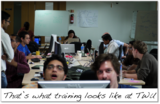
"TWU is the only place where you're happy to fail - an awesome program meant to prepare a person for challenges ahead." - - Student QuoteA testimonial like that from a student, makes my day. Over the last few months you've heard me make references to the new avatar of ThoughtWorks University (TWU) - our graduate training program. If you were ever to walk into a ThoughtWorks University term in full flow, it will look nothing like a training program you've seen. People working at dining table like set ups. Laptops and pairing monitors all around, a client who doesn't let up, index carded walls tracking progress for the project, and a team completely abuzz with activity. You'll feel like you've walked onto a proper software delivery project. That's been our motto for version 2.0 of TWU - work is learning, learning is work. I'm ecstatic to share with you how we've workscaped this training program, to help fresh graduates learn the ropes of technology consulting by being in the thick of real action. But before that, some context!The History"An all round learning experience from people with very unique and distinctive skill sets. An unforgettable 6 week experience!" - Student QuoteTWU is something most ThoughtWorkers are extremely proud of. An incredibly successful program, Kraig Parkinson started it in 2005 when we called it the Global Boot Camp. Every grad that we hired all across the world had the opportunity to travel down to our most vibrant office in Bangalore and attend six weeks of training with the best consultants at the company. As it turned out, 'Boot Camp' wasn't a really popular word with immigration personnel, and every now and then graduates got held up at the airport asking if they were undergoing any military training! So, after a round of brainstorms we decided to rebrand the program as ThoughtWorks University and ever since, the name has stuck.TWU started off as a really strong academic program, run by our consultants for our consultants. The target audience for the course were our graduate developers, business analysts and quality analysts. Our curriculum had three distinct parts to it. We had four weeks of shared curriculum, common to all the roles. We then followed this up with a week's discipline specific curriculum and finally a week's project simulation for the students to apply all that they'd learned. As you can imagine this was a really intense program where despite our best intentions we were pushing heaps of knowledge onto our students. Learning isn't knowledge transfer and our program lacked the affective context that students needed to be able to learn and remember effectively.The Catalyst for Change"I felt the trainers were great, and running a long simulation has given me the confidence for beginning work soon. These six weeks made me even more excited to be a ThoughtWorker." - Student QuoteSomewhere in 2007, my friend, colleague and past TWU trainer Patrick Sarnacke had an idea. While people enjoyed the five weeks of training, they seemed to learn the most in the project simulation. Not surprisingly, because they failed miserably in the project and failure's a great catalyst for learning. So Sarnacke said, "If people learn the most during the project simulation, then why can't we simulate a project for most of the course?" Of course, we then shrugged our shoulders and said to each other, "We've got a lot of material to cover - so this is never going to work." And so, the idea never took off until late 2009 when I went around interviewing (on camera) past students and trainers of the course asking what they found most valuable in the course. The answers I got were fairly unanimous. Most people pointed out the following elements as the most valuable:The project simulation, since they could see every practice in action and learn how to really do things.The discipline specific curriculum, since that's what they could apply immediately to their roles.The social interaction amongst grads and trainers across the globe, because that's where they serendipitously learned from each other.The individualised coaching that they got from the trainers, since we tailored it to their needs.Hmmm... surprise, surprise! Not many people said they found the five weeks of classroom training crucial. It seemed from the feedback that real work was the biggest driver for learning. Back to Pat's question then.If real work provides the best context for learning, then why not create a learning program where learning is a consequence of working on a real project?Time for some Soul-Searching"TWU provided us with a safe environment in which we were free to stumble, to question, to observe, and to learn. I will never forget my experience here." - Student QuoteSo my team and I acknowledged it was time to get back to the drawing board. Our big challenge was that we had five weeks of coursework to still complete. As we started to go back and analyse our coursework, we realised a few things:Sometimes, in the attempt to make training engaging, we spend 3 hours teaching things that take 10 minutes to just explain simply.Behaviour takes time and experience to correct. A lot of our consulting coursework (17 hours or so), focussed on changing behaviours through training. This was hugely ineffective; students forgot most lessons by the time we got to the project simulation and made the same mistakes we warned them against. Feedback and coaching during the simulation could have been a much better way to help students learn these lessons from a state of pain.As a company, we have very few best practices. If you look at the Cynefin model and then compare the constantly changing ThoughtWorks ecosystem to it, most of our practices are either emergent or novel. So while we tried to project a simplistic picture of our practices, it took real world experience to learn how things actually work. No wonder, our most common answer to students was, "It depends!"Last, but certainly not the least - learning out of the work context can tend to be hugely ineffective. For example, in a classroom it can take hours to explain how ThoughtWorks estimates projects and plans releases. It's a really controversial topic at times. OTOH, if you were to bring a newbie into a group estimation meeting and explain what we're doing, you could get that person onboard in a matter of minutes and they would just get it. So some topics were best suited to on the job learning.So we critically evaluated every part of our curriculum; even parts of it which we'd painstakingly created ourselves. For each part, we asked ourselves, "What if we don't teach this at all? What's the worst that can happen?" Turned out that the worst that could happen was that people would learn from their experience on the project. Why didn't we think of this before?Look Ma - No Training!"The lessons learned through project simulation could never be taught in a classroom." - Student QuoteSo, after much chopping and changing, we decided that our course would be two weeks of training and four weeks of project work for the developers and one week of training and five weeks of project work for the BAs and QAs. We decided to limit our training to the bare minimum skills and knowledge the grads needed to start working on their project. A large part of that training was an introduction to the ThoughtWorks ecosystem, our culture, values and principles -- something that none of us can do without.We also created several pieces of elearning to help students gain some basic skills when they needed them. Coupled with a social learning platform and a 6:1 student-coach ratio, we were looking at a program that focussed heavily on individualisation as against an experience that was one-size-fits-all-but-fits-nobody. Even with the elearning, we ensured that we were pragmatic in partnering with external content providers whose content met our quality standards.How it Went"I think four weeks of project was very helpful for the learning of the team. I think the end of week two and the beginning of week three was a time when the team was excited, nervous and overwhelmed. I think only two weeks of classes is good. A skill TWers need is learning when they start on a new project. I think the best way to do that is through experience - with good learning sessions when needed. And I think the last week was when we all actually realised what we had accomplished." - Student QuoteTWU XVII was the first formal run of ThoughtWorks University 2.0 and what a ride it's been! As expected, and as the quotes until now may tell you, information in context trumped instruction out of context in a huge way. The project was an environment for students to fail in safety. Failure created the need for people to learn and a catalyst for us to coach and teach. A real project environment also allowed students to learn to learn. After all, if we did training sessions all day, how could they deliver an application to the customer? So, a lot was down to the students being able to figure things out by themselves and learning from each other. Teamwork was the order of the day.While interactions with customers helped students hone their consulting skills, working with each other, overcoming arguments helped them strengthen their interpersonal skills. Facilitating learning lunches and doing Pecha-Kucha's helped them practice their presentation skills in a safe and fun environment. Open Space sessions helped them define their own learning agenda, as against being captive to a predetermined schedule. In the final week of the project, which I unfortunately missed - the students took leadership of the project and the trainers just stood back. That week saw the students come together and put up their most outstanding performance. Wonderful things happen when you just let go - and it was almost like the time when a bird lets her children fly. In an environment where they could pull learning just when they needed it, the students amazed their trainers. I'm not exagerrating one bit when I say I'm proud of what the students have achieved and I'm proud to be their colleague. As one of the grads said, "We've made a product which we're proud of."Our success with ThoughtWorks University has been the proudest achievements of my professional career. I think it's given me significant evidence about how people learn and has reinforced my beliefs about modern learning and development. It's been great fun sharing this experience with you and in future months, I hope we can make this experience better, faster, stronger. I'd love ideas from you on how we can do this - a lot of what we've done on the course is inspired by great ideas from my personal learning network and I'm sure I can lean on you for more such ideas. I'd also love to know what you think of today's blogpost, so do drop in a comment or two while you're here.Photo Credits for this post - JK Werner and Pat Sarnacke (the visionary pose!)© Sumeet Moghe, 2009
Sumeet Moghe
.
Blog
.
<span class='date ' tip=''><i class='icon-time'></i> Jul 20, 2015 10:58am</span>
|
|
One of the many various different things I really enjoy about participating in the Social Web out there on a regular basis, is the fact you never really know where a conversation will be heading once it’s gotten started, specially, if that dialogue beings with a good bunch of the folks who are part of your social network(s) and who share a common passion for a specific topic, whether business related or not. In the last couple of days, once again, I have been exposed to such kind of conversations and, as I am reflecting today about them in this blog post, I can only be but rather grateful about them, because they have managed not only to inspire me to do better, but they have managed to completely change the way I work and interact with others. Welcome to The Secret Life of Your Bodyclock!
It all started with a couple of Google Plus conversations where I was sharing a personal story of how about two months ago I decided to step back, stop the world for a minute, and reflect on how I needed to make some changes to some of the habits I have gotten so used to over the course of the years and start becoming a bit healthier again. I was going in the direction of a rather perilous road and thought it would be a good time to revert it. So I was sharing some first hand experiences on what that change has meant over the course of those few weeks, as well as share some bits of what that journey has been like all along so far. I couldn’t help, but be rather wowed by the tremendous amount of responses I got from the first thread. Lots of positive reinforcement, as well as a good number of really helpful and rather handy hints and tips on how to make both exercise and a healthier diet work for yours truly.
It may be a bit too early to judge what the results would be like, but so far it’s been very encouraging! Thus I decided to take things into the next level and start another conversation on a topic I wanted to query folks about and see what they would say. During those few weeks where I have started some regular physical exercise (Running in this case), as well as a healthier diet, my morning routine has incorporated a one hour workout where I run about 7 to 8 KM non stop. And the funny thing is that I have discovered how I feel a whole lot less tired if I do that exercise in the afternoon, early evening, than in the morning, where I feel pretty much drained after that workout. So I went to Google Plus and I shared this question:
"Dear runners of the world … need a little bit of help … What do you prefer … running first thing in the morning … or right after work by the end of the day? Just got back from my first run in the evening, after work, and feeling less tired than in the morning!?!? Ha! Go figure! // Thanks for any insights / advice you can provide "
From there onwards an entire conversation developed where there was a mix of responses of people in my social network(s) who commented and shared their tips on why they would run in the morning, at midday or in the early evening. Lots of rather interesting insights! But there was one in particular that caught my attention specially, and which has triggered the creation of this blog post. You will see how this entry doesn’t actually have anything to do with the stuff I regularly blog about over here about KM, Collaboration, Communities or Social Computing. But does it really? Read on …
In that thread, Sam Ramadan shared a rather interesting and intriguing link to a rather enlightening and educational documentary that has completely blown my mind away! Along with the link, Sam suggested that, according to some research, it’s actually much better for your body to run in the afternoon, early evening, versus the morning, where it could potentially become even dangerous at some point. Goodness! Imagine me reading that as I am doing my daily workout in the morning! Shocking!! Of course, I had to read further into that link and find out more …
Goodness! Truly fascinating stuff! Sam, right there, put us all together in the direction of one of those rather wonderfully inspirational documentaries that will surely make people think twice about their daily habits, customs, needs and wants and whatever else and start paying more attention to what our bodies really need / want after all. In The Secret Life of Your Bodyclock you will find some pointers towards a Horizon documentary that tries to explain, based on that research, how our own bodies really operate according to our bodyclock and, most importantly, how we keep ignoring it time and time again at our own peril. Yes, I tell you, some pretty amazing stuff!
The documentary itself is divided in four different parts (Part 1, Part 2, Part 3 and Part 4) and all of them make up for an entire day of what actually happens within our own bodies and our internal bodyclock. It’s rather interesting to see how we have actually been accustomed to following different habits throughout the course of a day and eventually find out how they may not be that beneficial to our bodies in the long run. And how by doing a few little adjustments here and there we may be able to turn things around for the better. Simple things like sleeping enough hours, including micro-sleeps or power naps right in the middle of the day, finding out the best times to eat and rest, or the best time in the end when we are the most apt intellectually speaking (It’s not 09:00 am in the morning, by the way!), or when we would get the best results from some medicines we may be taking, or when it would be the most adequate time of the day to exercise (It’s not early in the morning either!), etc. etc. are certainly going to help us all lead healthier lives, which, in the end, is going to help us become much more effective and efficient knowledge workers and people in general.
And that is what I thought was remarkable from the 49 minute long documentary… That by doing little things, changing a bit our habits and adapting our routines to how our bodyclocks work, we are in a position to become more productive in the long run and live healthier lives, which, I guess is what most of us, including employers!, would want for everyone out there in the end! And I suppose that remote workers, i.e. those folks working away from the traditional office environment , the ones who have got plenty of flexibility when adapting their schedules to the nature of the work that needs to be done, could surely benefit from adapting those habits as mentioned and shared across on that video clip. Even office workers could adapt as well some of their own schedules to be a better fit for their bodies! I know for sure that, after watching it, I’ll surely be making some adjustments myself into how I can get the most of my own bodyclock and how it works for the better for me. Starting with changing that routine for the daily workout from earlier on in the morning, to late in the afternoon, early evening. And I will be more than happy to share the results over the course of time and see how those adjustments are moving along and whether my bodyclock regulates not only the way I live, but also the way I work. It sounds like a fun experiment altogether, don’t you think?
Now, can you imagine having that kind of flexibility, say, 10 or 15 years ago? I guess that’s what empowering your knowledge workforce to take a bit more responsibility of their own health and work environment is all about. Not just about having the right (social) tools to get the job done smarter, not necessarily harder, but also having the right physical and mental health to be able to carry out those jobs in an effective manner … And it all starts by watching Part 1 of "The Secret Life of Your Bodyclock", which only lasts for 12 minutes …
There you have it. Who hasn’t got 12 minutes to spare to become healthier by knowing a bit more about how our own bodies really work like and how we can start nurturing the right conditions for the perfect working (and living!) environment where we can all shine?:
After watching through each of the video clips, I wonder what it would take businesses out there to start adapting themselves more to the needs of their knowledge workers than vice versa. Somehow I suspect we are going to end up in another win-win situation where flexibility, mutual understanding of each and everyone’s responsibilities and, above all, trust are going to play a key part to help define the perfect environment for the future of the workplace in the 21st century. Something tells me that knowledge workers would be ready for that re-adjustment, but would businesses be ready for it as well? What do you think? Is your business willing to respect, understand and adapt to your bodyclock?
(I am just about to find out shorty myself …)
Luis Suarez
.
Blog
.
<span class='date ' tip=''><i class='icon-time'></i> Jul 20, 2015 10:58am</span>
|
|
There is probably very little doubt out there still about the huge potential, and impact, that Social Networking has been having within the corporate world over the last few years, to the point where a few folks have ventured into suggesting that we are witnessing the tipping point of how we are redefining the Future of the Workplace itself, something that has become, over time, one of my favourite topics as of late and which has finally triggered a thought that’s been lingering in my mind for a quite a bit already: from now onwards I’ll stop talking about Social Business (And leave it down to those folks who coined it first, for our own social good) and, instead, move on with "The Social Enterprise". And, more specifically, I would like to welcome you all to The Era of Intrapreneurship!
There are plenty of blog posts out there that have covered very well the topic of "The Future of the Workplace" and the impact of social computing in helping shape up the business world to become a whole lot more open, engaged, transparent and nimble. However, there is one particular article out there that became one of my all time favourite ones around this very same topic, and more than anything else, because it describes, pretty well, how work has evolved with the emergence of the Social Web in the last few years. I am not sure whether you folks may have read it already or not, but, if you haven’t, it’s probably one of those blog entries that I would consider an essential reading for people who are interested in getting a glimpse of what lies ahead, if not already! Check out Irving Wladawsky-Berger‘s "A New Style of Work".
Irving’s blog is probably one of the most refreshing, enlightening and entertaining reads you can bump into at the Internet Blogosphere. In case you may not have subscribed to it already, I can surely recommend you do so. And that blog post I mentioned above would certainly confirm why it’s a worth while read time and time again. In that article he basically defines the work life of Trust Agents, what I would call as well Wild Ducks, that group of knowledge Web workers who do lots of smart work together gathering in social networks, communities and whatever other informal groupings to carry out that piece of work they are truly passionate about and connected with one another due to a common affinity. Nothing to do with hierarchies, nor with organisations, nor with project teams, just plain wirearchy, without which all three of those would probably not exist today, as we know them. Apparently, what Tom Foremski has defined as an "atomic" business model as well.
"A New Style of Work" is a wonderful trip down the memory lane as well that will certainly act as a refreshing reminder of what the Web used to be and what it is today and, clearly, this particular quote states what’s meant for each and everyone of us as individual knowledge workers:
"My time is now my own. I have a lot more flexibility and personal choice in what I do and how I spend my days. The boundaries between work and personal life, already very porous when working at IBM, are practically non-existent.
But, as a self-employed individual, I am also on my own. While the various institutions I work with provide me some degree of support, their infrastructure and processes are geared to support their full time employees, not part-time professionals and contractors. I thus have had to come up with my own infrastructure and processes suitable for my present distributed work style"
To then finish it off with this other insightful quote that I am sure plenty more knowledge Web workers out there would agree with blindfolded:
"The Web has now essentially become my primary work infrastructure. My work processes are essentially web-based processes. While I use physical offices when spending time at any one of the institutions I work with, by primary office is the Web. My primary business address is someplace out there in the cloud"
This is exactly what I meant with the title of this blog post when welcoming you all to the Social Enterprise and the Era of Intrapreneurship. You are not reading it wrong. I actually meant every letter: The Era of Intrapreneurship. An era, where thanks to the Social Web, whether internal or external, or both!, knowledge workers, for the first time ever, are now in charged of their own productivity, of their own workflows and personal business relationships with others, of their own responsibility not only towards the work that needs to be done, but also towards the fellow peers they collaborate and share their knowledge with. Thanks to that Social Enterprise we are starting to see how knowledge Web workers are becoming a whole lot more open, public and transparent in narrating their own work, therefore making observable work an integral, critical and paramount activity at the workplace; we are starting to witness how knowledge workers are shaking off their fears for the work they do, or don’t do! as well the fears of no longer being considered indispensable, despite the the huge amount of knowledge they have accumulated over the course of the years, or those other fears of no longer being considered the experts they once thought they were. In short, fear is out, having fun @ work is in.
It’s that social revolution that we are witnessing entering, slowly, but steadily, the corporate world, that’s certainly going to help us move along, not thinking along the terms of becoming a social business, but more embracing that social transformation that trojan mice typically would provoke as intrapreneurs. It’s that social revolution and transformation that will help us all understand how critical it is for each and everyone of us having the right access not only to relevant information and content resources, but also access to the people behind it by nurturing and cultivating those relationships and networks on a regular basis in order to make better, smarter, more sensible and more informed decisions, regardless of wherever we may well be, whether in a physical office location, or while working from home, while travelling or while at a customer site. What will matter then is how work will start shifting around us, and not the other way around, as it’s been happening all along over the last few decades. Iriving’s account of how, amongst several other social flavours, mobility, i.e. going mobile, and blogging, specially, as one of the most powerful ingredients to help boost your own personal brand vs. that one of the corporation (as I have blogged about over here myself a few days back) is probably as good as it gets in helping set the stage of how the workplace has been transformed into something so empowering as helping employees take a bit more co-responsibility of their own workflows, without having to wait for orders, or being told what they would need to do. Quite the opposite, in most cases, the center of gravity has been, finally, lowered down tremendously, to the point where it’s through those informal social networks and communities they themselves co-facilite the ones who will be defining what work needs to get done and with whom.
Something that, to me, represents the true spirit of Entrepreneurship, in our case, for this article, Intrapreneurship. Something that, for the first time in a long while, could be classified as a truly inspirational social revolution that will help transform not only how we do business, but also how we behave as human beings in our very own societies. My dear friend, Susan Scrupski, couldn’t have put it in much better words than this wonderful gem she shared earlier on today to describe what I have meant all along with that social revolution within the enterprise:
"[...] The zeitgeist of Social is about introducing the promises of Web 2.0 (Openness, egalitarianism) to reinvent the way things have been done in prior eras, evolved from industrial age principles, e.g. Taylorism.
Social is not about anarchy ; it’s about freedom and democracy and innovation. It’s not about rigid structures and hierarchies; it’s about transparency and honesty and re-distributing power to create agile change motivated by passionate, engaged actors. It’s about leadership that rewards and recognises talent and instinctively has a collective understanding of the community it serves, because it’s tuned into what they think, as well as what they do. It’s about authenticity and trust. (Yes, trust)"
Like I said, I couldn’t have put it in better words than those and if you haven’t read the entire piece I would strongly encourage you all to go ahead and do so and go through the highlights of a keynote with 45k attendees that may have marked the beginning of that Social Revolution within the Enterprise itself.
Essentially, this is not about becoming a Social Business; because with the word "Business", we lose all of the original intent that sparked the creation of that Web 2.0 movement back in the day that Susan talked about in her post. We need to go beyond that! Further beyond that! This is all about embracing and living a new state of social empowerment that will break the status-quo within the Enterprise, and I do realise that for plenty of people out there I may be in fantasy land myself and won’t probably see it in my lifetime or perhaps a bit too deep into my Hippie 2.0 shoes, but just like recent global events have shown us, we are witnessing a truly unique historic moment where, now more than ever, it would be up to each and everyone of us to decide where we stand, i.e. whether we would want to co-lead it, or wait for it to blow us all away without remedy and no point of return! It’s your choice. It’s our choice. And I guess, if you have been reading this blog for a while, you know on which side I would be standing, right?
… Well, what about you though? Are you also a wild duck, one of those critical trust agents, intrapreneurs ready to co-lead that social change within your own enterprise? Are you ready to drop Social Business and instead continue to live the Social Enterprise Revolution we all once truly believed in, when we all thought we could change the world with the Social Web? What do you think?
Of course! Come on and join us! The waters have always been lovely!
Luis Suarez
.
Blog
.
<span class='date ' tip=''><i class='icon-time'></i> Jul 20, 2015 10:58am</span>
|
|
The last week has been absolutely incredible. The Agile 2010 conference seemed to be heaps bigger and better than last years conference and that seems to be a continuing trend. I was able to deliver a solo workshop on "Making Feedback work in Your Teams", to a packed house. More on that later, but the best feedback comment I got was, "I could listen to Sumeet all day!". Well, whoever wrote that, thank you! I'm sure if you do spend a day listening to me, you'll quickly realise how awful I can sometimes be. I spent a significant amount of time chatting with Martin Fowler - which may seem surprising, given Martin's a fellow ThoughtWorker, but then he's been busy writing his book, so we haven't seen him in India much recently. And I had Esther Derby walk up to me at the end of my talk and call me her ally, which was particularly heartening - thanks Esther for being a valuable participant in my workshop! I'll be particularly delighted if I could someday join forces with Esther and deliver a joint workshop on feedback in Agile teams.But today's blogpost isn't about the conference and Agile. Today I want to share with you one of the most magical experiences in my life and what I've taken away from it as a learning and development professional. So, some context - the conference was supposed to happen in Nashville, Tennessee. Unfortunately Nashville was hit by one of the biggest floods in many years and that made us move the conference venue to the Walt Disney World Swan and Dolphin Resort. At first I was a bit disappointed - I'm not one for amusement parks and in fact, I passed up my first opportunity to be at a Disney World in Hong Kong because I don't really care for the rides. "Just another amusement park.", I thought. Then again, I don't like sitting in a hotel when I'm in a new place and if I was going to be in Orlando, I had to go to Disney World if only for the record. Having spent time at the four major Disney World parks, I now have a completely changed opinion. In that itself, I've learnt a lesson to never judge a book by it's cover. The magic of Disney World is something for you to see to believe. If you don't like amusement parks, my words will have little effect on you, but I know that if you do chance upon this amazing place, you'll understand why Disney World is such a popular destination. Each day that I visited the place, I felt a strange heart warming happiness - unlike anything I've ever felt before. I felt like a child once again and yet I didn't find anything childish. There were important lessons for parents, children, professionals - in fact, I kept relating the way Disney does their business with the way we should train and present. Today, I want to share with you what I've learnt about my trade from these dream merchants.Keep things Simple"I am interested in entertaining people, in bringing pleasure, particularly laughter, to others, rather than being concerned with 'expressing' myself with obscure creative impressions." - Walt DisneyDisney movies maybe an elaborate affair in production, but for the audience, they're incredibly simple stories and morals to digest. If you think of any movie, you'll realise that the storyline revolves around a simple moral. Finding Nemo is about parents letting their children take chances and for children to realise why their parents care. Tinkerbell teaches you to believe in yourself. Toy Story and Up are about friendship, loyalty and the spirit of adventure. There's not a tale in the Disney cabinet that takes effort to understand. I love this, because the simplicity of Disney movies make them memorable for not just youngsters, but also grown ups.It's a lesson for trainers and presenters - simplicity takes effort. Simplicity is not equivalent to being simplistic. It takes great creativity to powerfully express an idea and yet make it easy to understand. I have never forgotten how Crush the turtle from Finding Nemo says to Marlin, "You never really know. But when they know, you'll know. You know?". I'm not a parent yet, but that's a great parenting lesson right there - it comes halfway through the movie after a significant amount of storytelling. The key is that Disney took the pains to tell a story that would make that message stick. And stick it has. When we do our presentations and training, what's our simple message that will always stick through? It's food for thought, isn't it?Set a Theme"We like to have a point of view in our stories, not an obvious moral, but a worthwhile theme. ... All we are trying to do is give the public good entertainment. That is all they want." - Walt DisneyDisney World's success is in being the world's first theme park. It's not just an amusement park with rides, it tells a story. So while Magic Kingdom is about making dreams come true, Animal Kingdom is about celebrating our planets biodiversity. If Hollywood studios is about celebrating backstage action from our favourite movies, Epcot is about education, science and innovation. Every corner of these parks, stays true to it's theme. Steve Jobs, one the best presenters of our era, does this with uncanny predictability. For example when he keynoted Macworld 2008 to announce the Macbook Air, he started off with the theme, "There's clearly something in the air today." To this day, it remains one of his most memorable keynotes in the way he introduced his latest family of notebooks.Themes allow our brains to relate items of information to each other. Our brain stores related information in contiguous areas, firing more neurons which eventually leads to better retention. Dr John Medina's book on Brain Rules is a fantastic text on how our brain works and even he says, "Our brain pays attention to patterns." So create that pattern by setting your theme and watch your audience sink into the experience.Entertain before you Educate "Your goal is to entertain, not only inform. The funnier you are, the more people will know you're smart because it takes great intelligence to be funny." - Guy KawasakiI spent a lot of my time in Epcot, Disney's educational park. I was particularly amazed at how Disney has gone to great lengths trying to make education fun. I wish I'd experienced this as a kid - I would have taken a stronger interest in science. Each ride was not just fun, but it was memorable. On Mission Space, I learnt how astronauts have to train to go on outer space missions. On Soarin I learnt about California and it's beautiful landscapes. On Living with the Land, I learnt how new ways of making agriculture more productive. On Test Track, I learnt how car manufacturers test their vehicles. On each of these rides, I learnt a little bit but had heaps more fun. Our brains are conditioned to remember interesting events. To create strong memories, we need an affective context. Disney creates an affective context on each of their rides and shows and I think if I can find use for some of the things I've learnt, I'm unlikely to forget these experiences.As Dr Medina says, "The brain doesn't pay attention to boring things, and I'm as sick of boring presentations as you are." That statement is quite conclusive in that we need to do more to make our topics interesting and fun for our audience. Hiding behind the excuse that a topic is dry isn't enough anymore; in fact, it's a waste of time. If we care about our topics enough, we need to find ways to make them interesting. Sometimes it's not easy and we need inspiration. Hans Rosling's fun talk on an incredibly dry topic, is testimony that this is possible.Create an Immersive Experience"Until a character becomes a personality it cannot be believed. Without personality, the character may do funny or interesting things, but unless people are able to identify themselves with the character, its actions will seem unreal. And without personality, a story cannot ring true to the audience." - Walt DisneyOne of the key things I noticed with the Disney World experience is how committed the entire crew is to ensuring that you're totally immersed in the experience. When you enter the haunted mansion, it's not your ride that begins, your attendant emerges saying, "Your time has come." When I got onto the Kilimanjaro Safaris, it wasn't about getting onto a jeep - it was about going on a two week trip and keeping your eyes out for poachers. The attention to detail is so minute that when you take the train from Rafiki's planet watch, you don't go to the Africa exhibit, your attendant sees you off to Harambe village in Africa. The Asian exhibit has moisture affected walls just as you'll see in India; a dhobi ghat with clothes strewn across the steps just as you'll see at many places in our country. All the Disney characters stay true to their mannerisms, every moment of the day. For long everything felt so real that I believed I was walking through a real life Disney movie!The immersive experience creates hugely memorable experiences. The race to find the poachers, the quest for the Iguanadon before asteroid impact on earth, the extreme g-forces when our rocket took off from the space station, have created a huge impression on me, which I'm unlikely to forget. This is a crucial lesson for trainers in particular - we learn lessons where we're kinesthetically part of an experience. As Nick Shackleton-Jones often mentions - it's ridiculous to think about learning as just knowledge transfer. The trainer of the future, inspires and involves learners in an experience of co-creation through storytelling, scenarios and simulations. Our approach with ThoughtWorks University has been a step in this direction.Performance Counts"Fantasy, if it's really convincing, can't become dated, for the simple reason that it represents a flight into a dimension that lies beyond the reach of time." - Walt DisneyAt Disney World, the show takes precedence over everything else. Perfectionism is the name of the game and you'll notice that they've gotten so good with their shows that they know how to run them without fail, each time. They don't put a step wrong, whether it's Donald's walk, Mickey's wave, the fireworks at Magic Kingdom or the Jammin' Jungle Parade. It appears they've practiced so hard that to improvise is never a chore. The flawlessness of execution is something for you to see, to believe me. The result is a perfect show that'll ring in your memory for years to come. As practicing experts, we're in a similar situation when we teach or present. We can choose to go out there and play it by ear, or do our audience a favour and practice diligently. There's heaps we can learn from the art of public performance, and we owe it to our audience to give them the most engaging, interesting and entertaining learning experience possible. The thought about performance also reminds me that Disney doesn't overdo live performances. If there's something that could be a recording, then they just leave it that way. For example the briefings for the rides - they seem live, but they're not! This is yet another lesson for us - never do a live demo if it doesn't add significant value. It's a recipe for disaster, creating an additional point of failure for your presentation or workshop. This is not to say you shouldn't do anything live. You just need to be pragmatic about what's valuable and what's not.It's tough to write all about my Disney experience in words. Call me shallow, corny or cheesy - there are 17 million others like me in this world! I loved being at Disney and learning about Walt has given me heaps of inspiration for the next few years. I guess it should suffice to say that I'm almost a new, refreshed person after my time at the parks.On a sidenote, please drop in a comment to let me know how you found today's article. If you're in Bangalore, do catch me for a coffee and I'll show you some of the pictures from my visits to Disney. I'm in Chicago as I write this post, and I'm missing the place already. I could stay there forever!© Sumeet Moghe, 2009
Sumeet Moghe
.
Blog
.
<span class='date ' tip=''><i class='icon-time'></i> Jul 20, 2015 10:58am</span>
|
|
Earlier on today, and continuing further with yesterday’s blog entry on "The Social Enterprise - Welcome to the Era of Intrapreneruship!" that I shared over here, my good friend, the always insightful Susan Scrupski put together a follow-up article that absolutely pretty much nails it for me on this whole topic of transitioning into "The Social Enterprise" from "Social Business". Under the rather thought-provoking title of "Zen and the Art of Enterprise Maintenance" Susan herself has set up some homework for all of those folks out there who may be involved with Enterprise 2.0, Social Networking / Computing or Social Business (In my case, Social Enterprise). To name: "We are aiming to change the world of work". And somehow although plenty of folks out there would see that as a call to (silent) arms I tend to think more along the terms of the Awakening 2.0 that a bunch of us have been waiting for a long while now…
Further down in that article Susan gets to explain, in a rather enlightening and insightful fashion, what she actually means with "We are aiming to change the world of work", which I guess is probably rather well described under this golden nugget:
"To get to the "fix" part of this equation, it’s going to take the smarts and knowhow of everyone who’s focused on the Enterprise. There’s a great thread on G+ from Sameer Patel on the "how." The lasting value will be to apply the spirit of social revolution in the enterprise to the practical application of social in the enterprise"
To then finish it all off with setting up the challenge ahead for all of us:
"This is the hard part. Delivering on the promise of social. So consider it a clarion call for all practitioners, consultants, and vendors (big and small): Figure it out. Bring it home for the rest of us and the planet. We’ve done the first hard part which is selling the promise of revolutionary change. And we’ll keep beating that drum, btw. It’s the backbeat to the song we’re singing"
Of course, as I finished off reading through her blog post I just couldn’t help thinking about the "Figure it out" part of her article and start thinking about potential solutions. And while catching up further with some other interesting reading I just couldn’t help pondering that we may have a holistic solution far too close to each and everyone of us to realise about it, and make it work. It all came clearer to me when I re-discovered a rather inspiring video clip that re-introduces a very innovative and creative concept that I would love to see it being explored by the enterprise world and not just by a few companies: The Circular Economy (Re-Thinking Progress)
In a rather revealing article over at the Guardian, Rosie Bristow describes quite nicely how the current linear economy hasn’t taken us too far ahead; quite the opposite! It seems that it’s made things a whole lot worse, not just for the business world, but just as much for both our societies and the world we live in:
"The basis for this thinking is that the linear way in which the world economy currently operates fuels a culture of consumption and creates more waste than is sustainable in the long term. In contrast, the living world operates in a circular cycle where the waste of one species provides the food for another and resources flow"
That last sentence is probably as good as it gets and it reflects how, once again, nature may be a whole lot wiser than all of us in managing her own resources to create, cultivate and nurture progress. Her progress: the one that affects us all in our day to day lives. So Rosie keeps wondering whether we could make the switch towards that Circular Economy along these very terms:
"What would a circular economy look like in practice? The video suggests that it’s about redesigning and rethinking products so that after they have been used by humans, their component parts return to manufacturers, with biological elements being used to support agriculture and valuable resource parts such as metals being used in the creation of new products. In this way, today’s goods become tomorrow’s resources, forming a circular cycle"
Not such a bad idea, don’t you think? While musing about Susan’s and Rosie’s articles I just couldn’t help thinking that perhaps what we really need to fully embrace and live the Social Enterprise would come pretty close to this whole concept of the Circular Economy, where we try to mimic what nature has mastered doing over the course of millions of years without facing too much trouble, till we humans started reverting that trend. Perhaps both growth and progress are meant to be that way. Perhaps we should starting shifting gears and introduce that whole concept of leasing / borrowing, instead of owning, which, if you ask me, is pretty close to what we would be doing with that Social Web activity we have all fallen in love with: sharing!
Sharing what we know, our experiences, our skills, our knowhow, our selves, so that others could benefit by reusing it themselves and make it better. Sharing our connections and personal business relationships, so that others would benefit from those new relationships instigated by empowering connectors / hubs. I am not sure what you folks would think about it, but this key trait from the Social Web / Web 2.0 does come pretty close to this whole concept of the circular economy, where progress is being made not so much on how much you grow, but by how much you are capable of reusing and learning along the way to create something better without having to destroy, without remedy, something in between.
It’s probably that openness, transparency, and trusting relationships in the system that surely have made it work for nature all along (Because she always knows what’s best for her and those around her…) and perhaps we need to fully embrace those critical social aspects to "figure it out", as Susan mentioned. Plenty of food for thought, for sure! And for those folks who may be skeptic about re-thinking new ways to help us progress further into the 21st century, let’s look at what that linear economy has managed to do in the last 3 to 5 years to see, and realise, we are probably not much better off than what we were a few decades ago after all…
Yes, we need a reboot. And pretty desperately. We have been probably needing it for over a decade already, and in times of (financial) crisis (Crisis as in choices / changes), we need now more inspiration than ever to leap forward and provoke that shift towards a Social Enterprise: a sustainable and engaged economy where all factors are looked up equally, including the resources we have got available to us all, so that growth finally makes its move towards progress, respectful and sustainable progress.
And that’s why from here onwards I’ll be making a huge effort, my ¢2, really, to start transitioning myself from that linear economy of consumerism, just for the sake of consuming, into that circular one by applying some smart and educated thinking in what I consume and buy and what I don’t. That basically means I will be looking up to those businesses that would want to start making a difference and change our future and I do seriously hope that my own company will be jumping the shark, too!, as it enters its second century of existence.
But what about yours? Is your business ready to embrace and live the Circular Economy? Do you think it’s worth while trying? Do we have a choice any longer? After all, what would we lose not trying it, right? Probably not much, but a lot to gain, for sure!
Our very own survival as a species.
Luis Suarez
.
Blog
.
<span class='date ' tip=''><i class='icon-time'></i> Jul 20, 2015 10:57am</span>
|
|
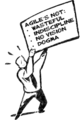
It was a great week at the Agile 2010 conference and it's very exciting to see that we're almost moving to an age of Agile pragmatism - what some will call post-modern Agile. It's often surprising to me how many misgivings and naivety gets attached to Agile. As Agile gets more and more mainstream, conferences such as Agile 2010 set the ground for the community to converge and discover best of breed approaches. I was fortunate to meet many interesting people and I must say the talks I went to, lived up to a very high standard as well. I've picked up a bunch of reflections from the conference and from those I want to quickly write up what I think Agile is absolutely not and I'd love to hear from you if you think I'm wrong.Agile is not about wasteful processWe never do things for the sake of doing things. Every piece of work we do needs to seek out some value for the customer. As we get better at doing agile, we need to question ourselves about the value of pretty much everything we do. For example one of the biggest wastes I see are in agile iteration planning meetings (IPMs). In traditional IPMs, the entire team gets together and discusses the stories they'll play in the upcoming iteration. They then re-estimate all the stories, task them out individually and then place the individual tasks on the card wall. This takes ages for the meeting to get over. I question the value of reestimating stories -- if you don't have an estimate for your story then there's no reason why it should be in scope for the iteration. If you do have an estimate for the story and none of the assumptions from the time of the estimate have changed, then why reestimate?I feel similarly about groups of people tasking out user stories - there's no better example of design by committee than this. Ideally we should be performing activities just-in-time, otherwise we just create inventory on our card walls. IMO the best time to task out a story is when a pair of developers picks it up from the card wall and starts to work on it.In a similar manner, I feel that teams need to be a lot more efficient about retrospectives. Retrospectives are valuable when the team has meaningful discussions about the problems they're facing. However most retrospectives seem to spend most of their time just brainstorming issues. I can say that for many retrospectives I've facilitated - so I'm not free of blame! A team that really cares about continuous improvement needs to generate retrospective discussion items continuously. In the recent past, I've tried to initiate the brainstorm much ahead of the actual retrospective meeting, so the team has a prioritised list of issues they'd like to discuss. I've used tools like Google Wave (soon to be discontinued) and Google Moderator for this. This makes the retrospective meeting itself hugely productive and we get a lot more done by way of discussion.These are just examples of waste we create on projects and that we can easily avoid -- I've generally observed that if I feel hugely uncomfortable about an activity or feel it's a 'necessary evil', there's definitely waste somewhere. That's a sign to refactor our team processes.Agile is not about indiscipline"Agile is about doing things that make our life simple. That doesn't mean that doing these things itself is easy." - Akash Bhalla, ThoughtWorkerI love that quote by my colleague Akash. We often mistake the fluidity of agile practices for a lack of discipline. As it turns out, Agile requires significantly more discipline and team commitment than traditional projects. The idea is a to practice good habits to an extreme. So just because we have user stories, doesn't mean that we don't track conversations related to them. User stories are a placeholder for conversations, but when those conversations do happen, we need to be diligent in tracking them. The card wall is everyone's responsibility, not just the project managers. It takes great discipline to be responsible for updating the status of your work on the card wall. That's our commitment to our team. In a similar manner Agile teams need to be fanatical about communication. Very often the lack of colocation becomes an excuse for not communicating frequently. Yet there are some of us who ensure that we communicate so frequently and with such a high degree of quality, that distribution almost never seems like an issue. This again needs discipline, because it means that apart from doing the easy part of communicating with our colocated team-mates, we also take the pain to communicate with those at a different site.Agile is not about a lack of visionAgile isn't all about eliciting a bunch of stories and delivering them in blind incremental fashion. We talk about delivering stories in the order of highest priority for the customer, but the fact is that a customer is making very poor guesses when looking at a flat list of user stories. Somewhere someone needs to spend time discovering the big picture of the project with the customer. This means seeing the project as a whole while iterating through development by delivering increments that slice through all streams of functionality. This is why Jeff Patton's story mapping approach is so popular for being able to envision your product. It tells the story of the application, though even that is only a step in the larger scheme of product discovery. The user experience of the application can't happen at a story level. Somewhere, someone needs to set the vision for the application's user experience so the entire team has a vision for what they're developing towards. As Jeff says, "Discovery and delivery are inseparable." Stories in isolation deliver no value - they deliver value as part of shippable software and the team needs to have a collective vision of what each shippable increment will do. As the product owner on ThoughtWorks University, this is what I set expectations for with my development team.Agile shouldn't be about dogmaLast but not the least, agile is not about dogma. As I've expressed earlier agile is all about delivering value to the customer. We often become very dogmatic about practices when the practices really are only a means to an end. For example, I feel that standup meetings don't HAVE TO BE a standard practice on an Agile team, especially across distributed teams. If it's about communicating status, then the team's card wall should do that on a continuous basis. If the card wall isn't up-to-date, then that's a huge smell. If it's about removing blockers, then that should happen continuously as well - that's the reason why we sit at one table, in a team room. If it's about public commitment, then again, that should happen continuously by communicating across the table as often as we can. In a time where we can use tools like Yammer to create a continuous stream of information about a project, I tend to think of standups as ceremony for the sake of ceremony and IMO, an outdated practice.In a similar manner, we need to overcome the dogma that for effective collaboration, you need colocation. For effective collaboration what you really need is the discipline and the passion to communicate. Folks like Keith Voos and Bill Krebs have provided empirical evidence to prove that we have reached a point where technology can help bridge geographical distances. So, the next time we feel we're being prescriptive with our process, we need to think again and ask ourselves if we're going through a practice only because that's the way we did it in the past. The world is evolving and so should Agile. I'm no Agile guru. In fact, at the conference I introduced myself as an Agile nobody. I do however have strong views about practicing Agile effectively through my association with ThoughtWorks in India and with ThoughtWorks University. I may be wrong in what I've said on the blog and one way or the other, I'd love to hear your thoughts. Do let me know by dropping a comment or two on this post.© Sumeet Moghe, 2009
Sumeet Moghe
.
Blog
.
<span class='date ' tip=''><i class='icon-time'></i> Jul 20, 2015 10:57am</span>
|
|
One of the main issues large corporations and small businesses have been having all along, when trying to go through that business transformation towards becoming a Social Enterprise, has always been the lack of an effective governance model and eventually decide to go for the easy way out: blocking social networking sites at work, hoping that knowledge workers would make better use of their own time, instead of goofing around, supposedly, when in reality they will just be switching devices and access those social networks regardless. Even without having to use your company’s resources.
It’s been one of those recurring themes that we keep coming back to time and time again, over the course of the years, and the solution always seems to be the same one, unfortunately. Instead of perhaps working a bit harder in trying to understand, address and mitigate whatever the potential risks, but also taking advantage of the many different benefits behind social networking for the enterprise, we keep bumping into news items that seem to confirm quite an interesting trend: instead of working your way towards a robust, trustworthy, essential and rather elemental social computing policy and guidelines, folks seem to want to leave that to others to figure it out, if anything at all, when it’s probably a bit too late already.
I remember the day when IBM was first facing that very same issue, on whether to put together a social computing policy and guidelines or not. At the time, May 2005, it was rather refreshing to see how instead of the company trying to figure it out by itself, on its own, it decided to rely on a group of prolific bloggers to come to the rescue and eventually put that policy on a wiki page over the course of two weeks. From there onwards, and 6 years later, two different revisions coming along and we now have got IBM’s Social Computing Guidelines, which we could possibly say have become an industry standard that other companies have adapted to their corporate culture and values to make them their own and shine through all the way. And it all got started with just a bunch of bloggers!
Fast forward to 2011, and I am still finding it somewhat provocative, and perhaps a bit too sad, how plenty of businesses still keep blocking the use of social networking tools, as business tools, thinking they can get away with it without making things potentially worse, for them and for their employee workforce alike. And it’s not just like we are back into 2005, or earlier when help and support were scarce; nowadays we have got a whole bunch of rather insightful articles and resources that can prove to be rather helpful when trying to draft your own guidelines and governance models (Those are some rather good resources to get you going, if you don’t have one just yet, by the way…) to match your company’s corporate culture as well as your values. So there is probably no excuse any longer, is there?
The interesting thing from this whole debate about governance models and social computing guidelines and whether to block access to these social tools or not, is that policy and guidelines don’t necessarily need to be boring and unsubstantial. Quite the opposite! It could well be plenty of good fun! In fact, it should be a fun activity. Like my good friend, Mark Masterson, would say, "If you treat people like sheep, they would probably behave like sheep". If you make it a fun activity, if you trust them to do the right thing, since you have hired hard working professionals in the first place, they would look at it and fully embrace it, internalise it and own it, to the point that they would match those guidelines to their own overall values and corporate culture of the business. And that’s probably as good as it gets, because the last thing you would want to see, as a hard working, socially networked professional is to witness how internal social tools get abused by others who think they just finally got Facebook for the enterprise to hit their next date!
It just doesn’t work that way! And here is a good example of a social computing policy and guidelines that combines fun, creativity, innovation and the right messages to be shared across in a format that’s very easy to digest. A video clip that lasts for a little bit over 4 minutes. Take a look into Social Media Policy, a YouTube video put together by the Department of Justice in Victoria, Australia (Yes, the Department of Justice! Who would have thought about that, right?), which explains quite nicely their own social media policy that they are using:
Fun stuff, eh? Well, after watching that video and seeing what’s possible to become a Social Enterprise, even for late-joiner industries like Government, I guess there isn’t probably any longer an excuse for you, as a business, to work your magic, just like they did on the video, and put together a policy and set of social computing guidelines that would be respectful and trustworthy of your employee workforce, as well as youself, as a business, towards your corporate culture and those values I mentioned above. That policy would eventually become your flagship as you enter the world of living and embracing social, just like it did for us, at IBM, over 6 years ago, just like it does for Victoria’s Department of Justice. The good thing is that you will no longer have to go the easy way out of blocking access and face the consequences. Quite the opposite; it can be quite an inspiring and creatively fun activity that everyone can contribute and benefit from. And, right there, that’s the next challenge for all of you who may be reading this and not have that policy in place just yet.
What are you waiting for? When are you going to start? Don’t leave for tomorrow what you can begin today! Make it fun, inclusive, participative, engaging, empowering, open and transparent; get that creativity juice going with all of that smart talent that is surrounding you and you will be off to a great start!
Your first step towards becoming a fully Integrated Social Enterprise.
Luis Suarez
.
Blog
.
<span class='date ' tip=''><i class='icon-time'></i> Jul 20, 2015 10:57am</span>
|
|
As a facilitator, I realise that I'm interested in some of the things that no one really cares about. These things however are the things that make a very silent difference to a group's collaboration and learning experience. For example, I like to come in early in the morning to ensure that a training room is set up in a pleasant clean fashion. When arranging a meeting or a workshop, I like to not just ensure that there are enough stickies, index cards and pens in the room, but also that it's easy for people to pick up one of these tools and participate. When facilitating an open space, I like to ensure that I set up the agenda wall with explicit instructions and a clear indication of venues and time slots.I like getting the whiteboards clean and keeping the right flipcharts on the wall. When facilitating, I maintain an invisible presence so I can help people out only when they need me but not be a barrier to the decision making or discussion process. Sometimes that means getting a projector in place or bringing in stationery or even picking up trash from a corner. These are boring, mundane tasks which most people may find frivolous and will most often neglect. I guess I am a facilitator because I am happy to be a servant to my group and do this work.© Sumeet Moghe, 2009
Sumeet Moghe
.
Blog
.
<span class='date ' tip=''><i class='icon-time'></i> Jul 20, 2015 10:57am</span>
|
|
There is no doubt that this week will probably be remembered for a long while, in the Social Enterprise space, at least, as one that served as the tipping point of embracing a new dynamic within the corporate world that is slightly different than what we have been witnessing all along with Social Business in the last couple of years. As we are wrapping it up, I am more and more convinced now that there are a good number of subtle differences between Social Business and Social Enterprise and somehow the main key differentiator between one and the other has got to do with a simple idea, yet with a tremendous powerful meaning: Social Revolution.
If you have been reading a couple of the blog entries I wrote this week, and, most importantly, a good bunch of the links I shared in those articles, I think we are witnessing that Awakening 2.0 phase I mentioned back then that is helping us all, knowledge workers, realise how this is our moment. Our true moment. Our opportunity to re-find and re-define our purpose in our workplaces, our wanting-to-make-a-difference moments; in short, experience that self-discovery journey of what we really want to do with our work lives, because, whether we like it or not, that’s also going to reflect on our own personal lives altogether. We now, finally, feel a whole lot more engaged, empowered, trustworthy, appreciated and … respected. And all of that thanks to the revolution social computing within the enterprise has, at long last, provoked within the business world, as well as in our society, as we know it. Something that my good friend, the always inspiring and very thought-provoking, Deb Lavoy, put together, beautifully, with this golden nugget in a recent blog post:
"If the industrial revolution’s idea of a great business was one in which every role, process and activity was well defined and controlled by management, social business is one in which every employee and customer are aligned around a common purpose"
To then follow it up with this other one that I, too, feel rather identified with:
"Social Business is one that recognizes that their mission is engaging hearts and minds to achieve excellence. Social Business is about respecting people"
Deb’s superb article under the suggestive heading of "Could E2.0 really mean Enlightenment 2.0?", and which I strongly encourage you all to read through it as I am sure it would leave a wonderful taste just before the weekend kicks off for everyone, finishes off with a final remark that would be very suitable, in my opinion, for both Social Business (= Customer focus) and Social Enterprise (Workforce focus) and the kind of impact they both have, whether internal or external, with the emergence of social networking at the workplace:
"A Social Business is a business that respects and profits from the complexity and unlimited potential of people"
But it’s not the only article we have seen this week covering this very same topic of the "Social Revolution within the Enterprise". Take a look, for instance, into this other brilliantly written blog post by another good friend, Bill Ives, under the title "The Gig Economy - Intrapreneurship - A New Style of Work" which pretty sums up this shift in the way we work with this rather inspiring quote as well:
"[...] one of the ways that things have changed is now workers are much more transparent about their work and having more fun at the same time. We are out from under the hierarchical cloud imposed by the industrial revolution. It is easier to do this as an enterprise of one that is connected to many organizations as I have experienced"
Once again, both themes of Observable Work and Intrapreneurship coming along nicely to help us define the future of the workplace. Our workplace. One that it is for us to define and shape up over time, according to how empowered, and engaged, we feel in doing what we love doing: our jobs. But there is more…
Check out this other great piece, over at Forbes, put together by David Kirkpatrick, under the heading "Social Power and the Coming Corporate Revolution" to see how, once again, the business world is about to be hit, without remedy, by that thing called the tsunami of the Social Web and what it has meant for our society as we know it in helping transform how we live and fully embrace those 2.0 core values of openness, transparency, engagement, trust, respect, and, above all, sharing. Another worth while read, for sure, to have a good glimpse of what’s to come, specially, based on the good number of stories from companies who have already embraced such social transformation and those that are facilitating it and what’s meant for them all along, containing as well, perhaps, one of my all time favourite quotes by another good friend, John Hagel, on such a key important trait for every single business transaction amongst knowledge workers and business people: Trust!
"Trust is built by sharing vulnerability [...] The more you expose and share your problems, the more successful you become. It’s not about the top executive dictating what needs to be done and when, it’s about providing individuals with the power to connect"
Absolutely spot on comment on what I truly believe the social revolution for the Social Enterprise would be all about. And talking about John himself there is another really interesting article that I would want to point you folks to, so that you can have a look and find out plenty more about why I mentioned above that I feel we have reached that tipping point of that internal social transformation provoked by social computing. In "John Hagel on Empowerment, Management Fears, and Social Software in Business" Adam Ludwig conducts a rather insightful interview with John, where the latter gets to talk about how we have already started the transition from being managed to being lead; to have leaders, instead of managers, acting as servants helping facilitate and get the most, and the best, out of their knowledge workers; to move away from the traditional hierarchical structures where a few told the vast majority what to do and what to think, to an environment where work gets regulated and done by both networks and communities, helping facilitate that transition from knowledge stocks into knowledge flows.
His description of how empowering it is to lower the center of gravity in decision making and problem solving is absolutely fantastic! Just as well as how social software tools help lower down tremendously both transaction and friction costs allowing knowledge workers to become more productive by solving business exceptions much faster, without having to rely anymore on traditional tools, which, on their own, probably made handling exceptions even worse over time! (Hint: email!)
Finally, one of my all time favourite ideas, the one that keeps me coming back to work, day in day out, that John gets to share on that interview, and which I think is the main culprit of what we are witnessing with the social revolution within the enterprise, on empowering and engaging your employee workforce, is passion. Passion of your knowledge workforce about what they do, what they believe in and the connections and relationships they have been able to build over the course of time as a result of it. Connecting people with a common affinity / passion for a particular topic, specially, work related, is a very powerful thing, as John mentions: "Passionate people are deeply motivated to improve themselves and drive themselves to the next level of performance".
Now, I am not too sure whether we are entering a new era of Enlightenment 2.0, as Deb suggests in her blog post, that I referenced above. Perhaps it may well be so. What I do know though is that this week we have just opened up the door towards a much more socially integrated, empowering, open, transparent, engaging and nimble enterprise and that has got to mean something.
There is no way back. Welcome to the Era of the Awakening 2.0!
Have a good one everyone!
Luis Suarez
.
Blog
.
<span class='date ' tip=''><i class='icon-time'></i> Jul 20, 2015 10:57am</span>
|