Blogs
|
Super Stacker 2 is a strategy game. The objective of the game is to stack shapes in such a fashion that they do not fall. The game proceeds in levels and you have different levels of difficulty.
At each level you are given some shapes and a hint on the kind of arrangement you should achieve. Using the shapes, you create a stack that stays stable till time runs out.
Here is one of the stacks that I successfully created:
Things I loved about this game
Simple Game Interface
The game interface is simple yet appealing . The game controls are simple and you do not get lost on how to play the game.
Strategising the solution
What is best in this game is that there are no fixed solutions. You actually derive or strategise the best solution depending on the shapes you have and the kind of arrangement you have to achieve.
Achieving the goal through trial and error
You play each level till you succeed in stacking the shapes in the right manner so that they stay. Every time you fail, you get to know where you went wrong and when you play again you keep the mistake in mind and do better.
Creating your own stack
You can also create your own stack and share it with their friends and see if they can solve it.
Hope you enjoy playing this game as much as I did.
Play the game now!
Let me know how you liked the game and what appealed you the most
Rupa Rajagopalan
.
Blog
.
<span class='date ' tip=''><i class='icon-time'></i> Jul 20, 2015 01:33pm</span>
|
|
Video de Katie Salen, ligada ao lançamento da escola Quest To Learn em Nova Iorque e diretora do Institute of Play. Neste vídeo aborda a importância do jogos no ensino.
A aprendizagem baseada em jogos (Game-Based Learning) promove experiências de aprendizagem e práticas que são consideradas importantes para as competências necessárias para o século XXI. Assim, na perspetiva de Katie Salen, os jogos são importantes porque :Promovem colaboração;
Fomentam trabalho em equipa ("team building");
Desenvolvem capacidade de resolver problemas em contextos complexos;
Permitem assumir novas identidades;
São ambientes onde o risco de falhar é reduzido;
Resumo de algumas ideias importantes do vídeo:
"Games work in a way that good teachers work.".
Good game design = good teaching.
Um videojogo ou qualquer outro media digital deve ser visto como mais uma ferramenta a usar pelo professor num determinado processo de ensino, tal como um livro ou conteúdos em linha. O professor deve escolher o meio mais indicado para ensinar determinado conteúdo.
Deve-se deixar de pensar nos jogos como simples entretenimento e analisar o seu potencial pedagógico.
As crianças perante um jogo ou perante qualquer media digital assumem muitas vezes o papel de um game designer.
O lado social do ensino e importância de cada aluno se sentir parte de uma comunidade é realçado por Katie Salen.
É importante que os pais e os professores entrem no mundo dos videojogos, domínio habitual dos mais novos, e partilhem experiências com os seus educandos. Os jogos podem ser a forma dos adultos poderem entrar e participar na cultura digital das gerações mais novas.
Katie Salen fala também sobre a avaliação e a validação de conhecimentos adquiridos. Distinguindo entre avaliação sumativa e formativa, defende o papel que os jogos podem ter nesse processo. No contexto de um jogo, o jogador é permanentemente avaliado e recebe feed-back imediato sobre a sua evolução. Como transportar este modelo para a escola é um assunto que Katie Salen investiga. Embora não referindo especificamente (o vídeo é de 2009), as mecânicas de jogos normalmente associadas ao conceito de Gamification, são apontadas como podendo contribuir para novas formas de avaliação.
Education & eLearning Blog
.
Blog
.
<span class='date ' tip=''><i class='icon-time'></i> Jul 20, 2015 01:31pm</span>
|
|
World Builder from Bruce Branit on Vimeo.
Rupa Rajagopalan
.
Blog
.
<span class='date ' tip=''><i class='icon-time'></i> Jul 20, 2015 01:31pm</span>
|
|
The Scruffs is an Hidden Object Game. In a Hidden Object Game you have to spot hidden objects and solve puzzles or mysteries. In this game The Scruffs, the goal is to uncover granpa’s secret and help The Srcuffs save their family home. To achieve this goal, you have to search the house for objects listed in grandpa’s notebook.
Despite rich visuals and lot of work for your brain, Hidden Object Games can be monotonous. You might get fed up looking for things in a huge mess and simply clicking on the screen. I havent played Hidden Object Games for a long time because they get too boring.
Surprisingly, The Scruffs is not boring at all. It is enjoyable and worth a play.
Things I liked About This Game
The Game Introduction
I liked the game introduction because it is short and simple. The game introduction runs like a short cartoon movie. What appealed me most is the use of humour in the introduction.
The Hints Section
In all Hidden Object Games, you get hints which you can use whenever you want to find the hidden objects.
I like the way the hints section has been designed in this game. You get three hints in this game. The three hints are indicated by the three bones. There is a dog sleeping on the right hand side corner. When you click on the dog, he eats the bone and is ready to help you. When you move your mouse across the screen, he gets excited when you get close to the object, thereby helping you find the object.
After you exhaust the three hints and when you click on the dog he shows a Do Not Disturb sign. Such strategies are humourous and appealing.
The Use of Mini Games To Break Monotony
What is interesting in this game, is the use of mini games to break monotony. For example, one of the objects in grandpa’s notebook is Family Photo. When you click on the Family Photo, a mini game is announced.
In this mini game, you have to click on every new scribble that appears on the photo. You must not click on an old scribble. If you do the game ends.
Well this is a welcome break from just clicking on the hidden objects.
You have a puzzle game also that breaks monotony at the right moment.
I like the way mini games have been integrated to go with the flow of the main game.
Hope you enjoy playing this game as much as I did.
Please note that the online version is a trial version.
The Scruffs
Uncover Grandpa’s secret and help The Scruffs save their family home.
Play this free game now!!
Rupa Rajagopalan
.
Blog
.
<span class='date ' tip=''><i class='icon-time'></i> Jul 20, 2015 01:29pm</span>
|
|
Entrevista à Professora Lynn Alves sobre o uso de jogos na educação. Mais uma posição a defender o uso de Game-Based Learning. Na entrevista é destacada a importância de pais e professores se envolverem e participarem, junto com os seus educandos, no mundo dos videojogos. Uma opinião semelhante à de Katie Salen (ver este post). Os jogos comerciais são defendidos como possuindo também potencial pedagógico.
Esta visão, de usar jogos comerciais, encaixa numa das três abordagens ao Game-Based Learning que, no essencial, têm sido aquelas que são adoptadas pelas escolas (ver Digital Game Based Learning: It’s Not Just the Digital Native Who Are Restless):Usar videojogos comerciais (COTS - Commercial Off-The-Shelf games), tirando partido da existência de conteúdos que possam ser usados para fins pedagógicos (learning through computer games). Nem todos os vídeojogos têm o mesmo potencial pedagógico havendo muitos em que é discutível a existência de qualquer valor pedagógico. No entanto, de uma forma geral, todos permitem desenvolver competencias de literacia digital, capacidade de resolver problemas e aumento da destreza manual e acuidade visual.
Usar Serious Games, videojogos desenvolvidos com propósitos não lúdicos e com fins bem determinados (learning with computer games). Os Serious Games, no entanto, enfrentam a concorrência dos jogos comerciais, não podendo competir com os orçamentos elevados que estes jogos actualmente implicam.
Os alunos constroem os seus próprios jogos (usando plataformas como o Scracth) permitindo o desenvolvimento da capacidade de resolução de problemas e competências de programação e de game design (learning by building computer games). Esta abordagem implica que os professores possuam também competências de programação e de game design, o que é certamente uma barreira importante à adoção mais generalizada desta abordagem.
Uma alternativa a estas três abordagens será a aplicação de Gamification: não o uso de jogos mas sim a aplicação das mecânicas de jogos e outros elementos associados a videojogos.
Education & eLearning Blog
.
Blog
.
<span class='date ' tip=''><i class='icon-time'></i> Jul 20, 2015 01:29pm</span>
|
|
by ruparajgo | Create your own Cartoon at www.toondoo.com
A Linear E-learning Course is the most basic of all kinds of e-learning courses. If you are a budding Instructional Designer, then you must choose to design a Linear E-learning Course first. It is comparatively easy to create a Linear E-learning Course than any other kind of e-learning course because the navigation and flow of this kind of a course are fixed.
In a Linear E-learning Course you go through the course progressively starting with the basics of the subject and then moving on to advance levels.
A typical Linear E-learning Course has:
· Course Contents : The first slide of the course where you list the course contents.
· Course Overview : A quick gist of the course and what learners will learn in the course
· Introduction Sections : Introduction to the subject
· Pre-tests: Quick tests to check how much the learners know about the subject
· Post-tests: Tests to check how much the learners have learnt
· Text and Images: Usually static or animated text appears on the left side with relevant images on the right side of the screen
· Text Animations : Blocks of text or text with bullet points appear one after the other
· Basic Interactivity: Drag and drop ,roll over text and mouse clicks
· Assessments: Multiple Choice Questions
· Locked Navigation: Back and Next buttons to navigate. Only when the learner completes module 1, he/she can access the subsequent module.
Here is an example of a Linear E-learning Course:
I have never liked linear e-learning courses because they get too boring. I always feel linear e-learning courses are digitized versions of text books.
But then over a period of time I also realized that linear e-learning course need not be boring.
Here are some articles by Tom Kulhmann where he illustrates how linear e-learning courses can be made interesting:
Click & Read E-learning Courses Don’t Need to Be Boring
Here’s How You Can Save Your Training Job in this Economy
Here’s Why Unlocking Your Course Navigation Will Create Better Learning
You have something to share about Linear E-learning Courses, please share your views, links to demos or articles in the comments sections.
Rupa Rajagopalan
.
Blog
.
<span class='date ' tip=''><i class='icon-time'></i> Jul 20, 2015 01:29pm</span>
|
|
Artigo aceite para a 3rd International Conference on TECHNOLOGY ENHANCED LEARNING, QUALITY OF TEACHING and REFORMING EDUCATION: Learning Technologies, Quality of Education, Educational Systems, Evaluation, Pedagogies (TECH-EDUCATION 2012). Em co-autoria com Rebeca Redondo e Ana Vilas da Universidade de Vigo.
Title: A Social Gamification Framework for a K-6 Social Network
Abstract: As video games, particularly, social games are growing in popularity and number of users, there has been an increasing interest in its potential as innovative teaching tools. Gamification is a new concept intending to use elements from video games in non-game applications. Education is an area with high potential for application of this concept since it seeks to promote people’s motivation and engagement. The research in progrees will try to find how to apply social gamification in education, testing and validating the results of that application. To fulfill these objectives, this paper presents the guidelines and main features of a social gamification framework to be applied in an existent K-6 social learning environment.
Keywords: game-based learning, gamification, e-learning, social networks, social games.
O "K-6 social learning environment" referido no abstract é a plataforma escolinhas.pt (ou schooools.com, na sua versão internacional) já várias vezes mencionado aqui (ver E-learning: Problemas em Aberto (3), Projectos E-learning (1): escolinhas.pt, Escolinhas.pt: Passos para a Internacionalização, Publicação na EDULEARN'11 e "Escolinhas" no Chile).
Education & eLearning Blog
.
Blog
.
<span class='date ' tip=''><i class='icon-time'></i> Jul 20, 2015 01:29pm</span>
|
|
I just now learnt about Ada Lovelace Day and women bloggers across the globe are being honoured for using any technology in an innovative way.
I am glad to see my name in the list of women named as Role Models in Educational Technology on Ada Lovelace Day.
Thank you Janet.
I feel honoured
Rupa Rajagopalan
.
Blog
.
<span class='date ' tip=''><i class='icon-time'></i> Jul 20, 2015 01:29pm</span>
|
|
A propósito desta passagem,
"No entanto, de uma forma geral, todos [os videojogos] permitem desenvolver competências de literacia digital, capacidade de resolver problemas e aumento da destreza manual e acuidade visual."
neste post, um tweet interessante de Niki Daun (@nikideerocks, Mon 14 Nov 10:28)
"and if u say my son needs to improve his hand-eye co-ordination (with violent games) then I say teach him to sew! "
Na verdade, qualquer videojogo comercial possui esse potencial de desenvolver algumas capacidades motoras e de coordenação. No entanto, e tal como também se destaca no mesmo post, há muitos videojogos comerciais "... em que é discutível a existência de qualquer valor pedagógico". Alguns destes podem ser instrumentos pedagógicos válidos mas a sua aplicação generalizada não será certamente a melhor aplicação de Game-Based Learning. E para efeitos de coordenação motora e acuidade visual, melhor será ensinar costura :)
Ver também este post, The trouble with video games isn't the violence. It's that most of the characters are dicks, a propósito do recente Call of Duty MW3 (refere uma situação do jogo onde por acaso passei ontem ...)
Education & eLearning Blog
.
Blog
.
<span class='date ' tip=''><i class='icon-time'></i> Jul 20, 2015 01:28pm</span>
|
|
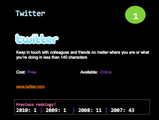
O Twitter aparece mais uma vez em primeiro lugar no top das 100 ferramentas de e-learning mais usadas em 2011. Esta lista é publicada anualmente por Jane Hart, tendo a deste ano sido divulgada em 14 de novembro. O Twitter, tal como na edição de 2010, mostra o seu potencial como ferramenta de ensino (ver este post de 2010). Em particular, destacaria a importância que tem para quem se dedica à investigação e como ferramenta de aprendizagem ao longo da vida (ver, a propósito, Twitter: Partilha de Recursos e ideias).
O Top 3 deste ano é igual ao do ano passado: Twitter (#1), YouTube (#2) e GoogleDocs (#3).
É útil também analisar a listagem por categoria de ferramentas: Best of Breed Tools 2011.
Education & eLearning Blog
.
Blog
.
<span class='date ' tip=''><i class='icon-time'></i> Jul 20, 2015 01:28pm</span>
|