Blogs
|
This forum is for the benefit of all people who want to start a career in Instructional Designing or shift jobs during this time of recession.
As far as I know and have heard the recession is not affecting Instructional Designers much. In November 2008, Prof Karl Kapp cites an article that shows that e-learning is right up and he also concludes his article saying "In this economy with large corporations laying off employees, you may want to consider designing e-learning for small companies (if you are a content developer.)
So what do you have to say?
Are companies hiring Instructional Designers?
Are companies hiring freshers who want to start their career in Instructional Designing?
Are freelance jobs more available than regular jobs?
How is the e-learning industry doing?
Please feel free to add more information.
You can do any of the following:
Post links to articles containing factual information about how recession is affecting Instructional Designers
Share information you have heard about recession in e-learning industry
Inform if you know of any friend who has got a job as an Instructional Designer in recent times
Please post the information in the comments section.
Rupa Rajagopalan
.
Blog
.
<span class='date ' tip=''><i class='icon-time'></i> Jul 20, 2015 01:39pm</span>
|
|
Algumas sugestões para usar o iPad na sala de aula (partilhado por @web20classroom, http://web20classroom.blogspot.com/)
62 Interesting Ways to use an iPad in the Classroom
Ver também:
Is the iPad The Future of Textbooks
iPad no Ensino
m-learning e o iPad
Education & eLearning Blog
.
Blog
.
<span class='date ' tip=''><i class='icon-time'></i> Jul 20, 2015 01:39pm</span>
|
|
by ruparajgo | Create your own Cartoon at www.toondoo.com
I am so glad that I have completed 2 successful years of blogging. I never thought I would come this far. I should say I have learnt a lot about Instructional Designing from the time I started blogging. I am glad I am a better Instructional Designer today and I wish I get better and better in the coming days.
In these 2 years I have become a part of the e-learning blog network both in India and across the globe. I have discovered really good blogs on Instructional Designing. I have interacted and shared information with fellow bloggers. It has really been an amazing learning experience and I hope this continues for a long time.
Thanks to Manish Mohan , Satish Narayanan, Cammy Bean, Christy Tucker, Janet Clarey, Prof Karl Kapp, Cathy Moore, Tom Kuhlmann, Dave Ferguson , Ken Allen and many more who have inspired me to write more.
Thanks to all the visitors of this blog. Thanks to all those who take time to pen comments.
This blog now has 137 posts on Instructional Designing especially useful for freshers. Freshers can check out the archives and read the posts in a chronological order from Feb 2007.
Recently I have been busy, so I havent been writing so regularly. I hope to write regularly from now on.
Please keep visiting my blog and looking forwading to interacting with all of you.
Cheers,
Rupa
Rupa Rajagopalan
.
Blog
.
<span class='date ' tip=''><i class='icon-time'></i> Jul 20, 2015 01:39pm</span>
|
|
O Projecto 110 Stories, promovido por Brian August, um nova-iorquino, teve como resultado o desenvolvimento de uma aplicação gratuita (para iPhone e Android) de realidade aumentada que permite visualizar a silhueta das Twin Towers no lugar que ocupariam na paisagem de Nova Iorque. O utilizador pode tirar uma fotografia da paisagem urbana da cidade aumentada com as silhuetas das torres. Para além da fotografia, pode partilhar uma história sobre os acontecimentos de 11 de Setembro de 2001. A aplicação funciona num raio de 40 milhas do Ground Zero.
A realidade aumentada já foi referida aqui nos posts Mundos Virtuais, Realidade Aumentada e Virtualidade Aumentada e Realidade Aumentada. O Horizon Report de 2011 aponta esta tecnologia como uma das mais promissoras, a médio prazo, para aplicação no sector da Educação.
As cerimónias que evocam os acontecimentos de 11 de Setembro de 2011 iniciam-se às 13h40 (08h40 em Nova Iorque).
Education & eLearning Blog
.
Blog
.
<span class='date ' tip=''><i class='icon-time'></i> Jul 20, 2015 01:39pm</span>
|
|
by ruparajgo | Create your own Cartoon at www.toondoo.com
This post is for the benefit of fresh Instructional Designers who want to learn about scenario based e-learning courses.
To begin with let me try and explain what a scenario based e-learning course is.
Scenario based e-learning courses use real life situations to teach the subject. Using real life scenarios heightens the relevance of the e-learning course simply because the focus is more on application than plain theory.
Scenario based approach is very effective especially in soft skill training. This approach is also used in software
training.
In a scenario based e-learning course the learner is presented with real life situations and is prompted to respond to the situation and in the process he/ she learns.
Scenario based courses are highly engaging and interactive. It requires the learner to be an active participant in the learning process. So if the learner is taking the course seriously he/she cannot switch his/her mind off from what is being taught.
Here is an example of a scenario based course on fraud detection.
This is a good example for branching scenrio. This is called branching scenario because all the scenarios are interlinked and essentially part of a single story. The learner responds to one situation and his/her response leads to the next situation and so on. Branching scenario is essentially a chain reaction.
You also have e-learning courses that show scenarios that are not essentially interlinked and very discrete.
For example in an e-learning course on customer service training for call centre employees the learner is put in different situations and is prompted to respond.
Scenario A might have a situation where a customer is complaining about his problem not yet resolved and the learner is asked to choose a response.
Scenario B might have a situation where a customer is requesting for some information and the learner is asked to choose a response.
The learner gets feedback for his/her response for each scenario which is not necessarily linked.
You can find some more examples of scenario based training here.
Scenario based e-learning courses work well with learners. At the same time for an Instructional Designer, it is highly challenging to create an effective scenario based e-learning course. I shall take up this topic in my next post.
Meanwhile if you want to share anything about scenario based e-learning course please feel free to post them in the comments section.
Some questions to help you get started:
Have you create a scenario based e-learning course?
What are the major challenges in creating a scenario based e-learning course?
Are there any pain points?
You have any good examples of scenario based course?
Rupa Rajagopalan
.
Blog
.
<span class='date ' tip=''><i class='icon-time'></i> Jul 20, 2015 01:38pm</span>
|
|
A plataforma escolinhas (schooools, na sua versão internacional) foi notícia no jornal chileno El Mercurio (17 de Julho de 2011), a propósito da participação deste projecto no programa Startup Chile.
O escolinhas é uma rede social que se constitui numa plataforma colaborativa para comunicação e partilha entre alunos, pais e professores do ensino básico.
Ver também este post.
Education & eLearning Blog
.
Blog
.
<span class='date ' tip=''><i class='icon-time'></i> Jul 20, 2015 01:37pm</span>
|
|
Building effective scenarios is a major challenge in designing a scenario based e-learning course.
The challenge lies in building scenarios that are:
Realistic ( Based on day to day activities of the learners)
Relevant (Learners must be able to relate to the scenarios)
Precise ( Scenarios cannot be long winding)
Sensible ( Scenarios must have depth)
Cater to the Learning Objectives ( Scenarios must be based on the learning objectives defined)
Consider you have to create a scenario based Course on Leadership skills. Let’s say the SME has
given you all the information he/she has on the subject in pdf format.
This is what you discover after evaluating the content:
You find the content unstructured and scattered
You feel the information presented is not learner centric
You find the example and the scenarios given in the pdf is not enough or too simple
You find lot of missing information
Now you wonder how do you build scenarios using the such information.
Here are some tips to handle this kind of a situation.
Internalise the Information
Given a situation as I mentioned before, you cannot just work with the content superficially. You need to think beyond the given content. You need to internalize the subject. You need understand the essence of the information you are going to deal with.
Think From the Perspective of the Learner
When you are evaluating the content or structuring the content, always think from the learners’ point of view.
Think in terms of usefulness of the information and how the learner will be able to put the information to practical use.
This will help you get an idea about the scenarios that you are going to build for the course.
There is a marked differnce between listing the benefits of a product and specifying how the product can be used by the person. Specifying how someone can use the product is more relevant to the customer than simply listing the benefits.
The bottomline is never miss out on the learners’ point of view.
Read Up on the Subject and the Context
It gets very important for you to get a good understanding about the subject and the context you are dealing with. If the course is about leadership, apart from getting yourself familiar with leadership concepts, you need to find out information about the relevant industry and learner job profiles.
If the leadership skills course is for the software industry then you build scenarios based on how things happen in a software company.You fix the leadership skills as it would be relevant for someone in the software industry.
Make Best Use of SME Support
While working on a scenario based course, you typically interact with the SME continuously. Instead of asking SMEs to give you scenarios, do some research and trying coming up with a basic storyline for the scenario and ask the SME for inputs.
This way the SME is assured that you are also taking a lot of interest in the subject and he/she will be interested to help you.
It is very important that you understand what kind of information you would need to build the scenarios.
So you need to ask the SME the right questions and get the right information.
Discuss Scenarios With Friends and Colleagues
You cannot work in seclusion while working on a scenario based course. Most of the time you will not have all the information. So what you do is discuss with people around. This way your source for information is not restricted. You get broader perspectives.
Get Scenarios Validated
No matter how much you hunt for information, the fact is that you are not an expert in the subject you are dealing with. So always get all the scenarios and information you are going to cover in the course validated by the SME.
With this I end the post here and leave it open for discussion.
You have more tips to share? Please leave your tips in the Comments section for the benefit of all Instructional Designers who visit this blog
Rupa Rajagopalan
.
Blog
.
<span class='date ' tip=''><i class='icon-time'></i> Jul 20, 2015 01:36pm</span>
|
|
O potencial da Gamification no ensino pode ser ilustrado pelo uso de sistemas de regras e de experiências característicos dos videojogos. Alguns exemplos do que pode ser usado numa sala de aula: Criar desafios adaptados ao nível de conhecimentos do aluno, aumentando a dificuldade desses desafios à medida que o aluno adquire novas competências;
Definir vários caminhos para atingir um objectivo com sucesso, permitindo que os alunos escolham objectivos intermédios dentro de uma actividade mais vasta.
Definir tarefas pequenas com objectivos facilmente apreendidos, proporcionando feed-back ou uma recompensa imediata que permita evoluir para uma nova tarefa, normalmente de maior grau de dificuldade (a recompensa por resolver um problema é propor a resolução de um problema mais complexo).
Considerar o insucesso como parte do processo de aprendizagem. A resolução de uma tarefa pode ser conseguida apenas após diversas tentativas falhadas. Por cada tentativa falhada, o aluno aprende algo que lhe permite ir reformulando a sua estratégia de resolução da tarefa/problema. Nos sistemas de ensino actuais, as oportunidades de por à prova os conhecimentos adquiridos são poucas e as consequências de falhar são importantes. Os alunos só obtêm retorno do seu esforço ao fim de bastante tempo. Tudo isto gera ansiedade. Nos jogos porém, as oportunidades são muitas, as consequências de um insucesso são poucas e o retorno é imediato. Isto motiva os alunos a irem executando pequenas tarefas e a evoluir para tarefas sucessivamente mais exigentes.
Possibilitar, num ambiente de gamification, que os alunos possam assumir outras identidades e desempenhar papéis diferentes permitindo explorar outros aspectos da personalidade de cada um num ambiente controlado.
Permitir o reconhecimento por parte dos pares ou dos seus professores dos pequenos sucessos e da evolução de cada um promove o aumento do estatuto social. Os professores e os colegas podem ainda recompensar esses sucessos (com o tipo de troféus adequado ao contexto).
(ver também o post de Karl Kapp, In Defense of the Term "Gamification" as used by Learning Professionals).
Referências:
Gee, J. P. (2007). What Vídeo Games Have to Teach Us About Learning and Literacy, Revised and Updated Edition, Palgrave Macmillan.
Joey J. Lee, J,, Hammer, J. (2011), Gamification in Education: What, How, Why Bother?
Raymer, R. (2011). Gamification: Using Game Mechanics to Enhance eLearning
Education & eLearning Blog
.
Blog
.
<span class='date ' tip=''><i class='icon-time'></i> Jul 20, 2015 01:36pm</span>
|
|
by ruparajgo | Create your own Cartoon at www.toondoo.com
Hi all,
I strongly believe that playing lots of games helps you design better e-learning courses.
Games give you ideas on how to :
Visualize
Design interactive strategies
Engage and entertain the audience
Set measurable goals and objectives
Guide the audience to achieve the goal
Well, the list goes on and on.
Now that games have so much value, why not play a game every week.
Starting this week, every friday, you will find an online game waiting for you in this blog. All that you have to do is click on the game link and start playing.
Why I chose online games? Well, they are easily accessible, short and fun to play.
Have fun!
Happy Gaming!
regards
Rupa
Rupa Rajagopalan
.
Blog
.
<span class='date ' tip=''><i class='icon-time'></i> Jul 20, 2015 01:35pm</span>
|
|
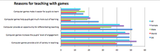
Simon Egenfeldt-Nielsen apresentou, numa palestra na National Conference on Game-Based Learning (Dinamarca, Maio de 2011), os resultados de um inquérito efectuado a professores de um conjunto de países (Dinamarca, Noruega, Finlândia, Portugal e Estados Unidos) relativo ao uso de videojogos nas suas actividades lectivas.
Os slides (em PowerPoint) da apresentação, Game-based Learning in Schools - A Teacher Survey, podem ser descarregados aqui. Desconhece-se o critério de seleção das nacionalidades dos participantes mas destaca-se o facto de terem participado 9 professores portugueses num total de 275 participações.
Algumas das principais conclusões:60% dos inquiridos usam videojogos para ensinar;
O uso de videojogos foi motivado sobretudo por interesse pessoal e os jogos usados foram escolhidos pelo próprio professor;
Os professores inquiridos revelam ainda alguma cautela sobre o uso de videojogos;
A maioria considera que o uso de videojogos é uma forma de aumentar o nível de envolvimento dos alunos;
Os principais obstáculos ao uso de videojogos estão relacionados com problemas de utilização dos equipamentos informáticos e de instalação de software;
O fraco conhecimento dos videojogos por parte dos professores é apontado como a principal razão para a sua não utilização;
A maioria dos não utilizadores considera poder vir a usar videojogos no futuro.
Education & eLearning Blog
.
Blog
.
<span class='date ' tip=''><i class='icon-time'></i> Jul 20, 2015 01:34pm</span>
|