Blogs
|
Open Culture highlighted this one a couple of weeks ago, but having since spent some time on it, I wanted to make sure to point it out to Mission to Learn readers. UniversitiesandColleges.org’s Master List of Free Language Learning Resources is indeed an impressive list of courses, podcasts, and iPhone applications covering a wide range of languages. If you are out to pick up or brush up on a language, it is a great starting place.
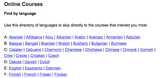
One of the things I like about the list - and a large part of the reason that I mention it here - is that the author has done a good job of organizing the resources. Too often these kinds of lists are purely about quantity in an effort to attract links. In this case, however, an initial table of contents is provided along with additional navigational tools for locating the language and resource of interest. Here’s a screen shot from the courses section to give you an idea of what I mean:
If learning a language online, on you iPod, or on your iPhone is part of your summer learning plan, definitely take a look at this list. And also check out the range of language learning resources here on Mission to Learn.
Jeff Cobb
Mission to Learn
Jeff Cobb
.
Blog
.
<span class='date ' tip=''><i class='icon-time'></i> Aug 19, 2015 02:44am</span>
|
|
RT @russeltarr: SqoolTube Educational Videos (RT @dianadell): http://tinyurl.com/nhqne2 #learningmonitor #
Good post by Michele Martin on info literacy and habits of mind: http://bit.ly/xxSbn #
Good resources for learning philosophy from Open Culture: http://bit.ly/8hYrG #
Huge visual list of educational Web apps - http://edu.allmyfaves.com/ - via Downes - http://bit.ly/e6L1b #
New serious game from Gotham Gazette. Getting on the ballot in NYC: http://www.gothamgazette.com/article/issueoftheweek/20090707/200/2961 #
50 Open Courseware classes on fitness and nutrition: http://bit.ly/8n5O5 #learningmonitor #
100 Lectures from the World’s Top Scientists via @openculture http://bit.ly/vfvnJ #learningmonitor #
RT @ResearchChannel: Is your food safe? Explore issues surrounding food quality and safety: http://ow.ly/gB7C #learningmonitor #
Learn English with King of Pop Michael Jackson: http://bit.ly/GUg2B #
Twine: free tool for authoring branching stories (viaAldrich): http://bit.ly/14lV5y #
Studies suggest video games improve recall, speed: http://bit.ly/CLiwA #
Properly hydrated brains seemingly work better: http://bit.ly/17NjGh #
Do Brain Trainer Games and Software Work? Bulk of research "murky" http://bit.ly/FFhl3 #
A visual explanation of Skype. Nice short video from Say It Visually! : http://bit.ly/tP7WM #
@peggyhoffman Thanks for the tweet re: learning a language, Peggy! #
A new Learning Monitor comes out at noon eastern today. Subscribe now and you will get last month’s and the new one: http://bit.ly/nBQ1c #
Atlas Obscura: A Compendium of the World’s Wonders, Curiosities, and Esoterica http://atlasobscura.com/ #learningmonitor #
Blogging for nonprofits: tips, traps, and tales ($35), July 9 http://bit.ly/ONpv2 #learningmonitor #
Free Webinar from Ancestry.com, July 8 Genetic Genealogy Made Easy: http://bit.ly/x7As0 #learningmonitor #
RT @rjleaman: Great slideshare presentation from @c4lpt : Twitter Workshop http://tinyurl.com/my58zk #learningmonitor #
How to garden videos from http://www.bewaterwise.com: http://www.bewaterwise.com/video_01.html #learningmonitor #
Introduction to Strategic Sustainable Development: http://bit.ly/WV3Tx
#learningmonitor #
RT with corrected hashtag: Free online writing courses: http://bit.ly/XKNky #learningmonitor #
Free audio seminars from the Hadley School for the Blind: http://bit.ly/o9ZsX
#learningmonitor #
Free online writing courses: http://bit.ly/XKNky
#learning monitor #
Free couponing 101 course. Save money with coupons: http://www.choystercash.com/ecourse.html #learningmonitor #
Science made simple - everything you need for winning science fair projects: http://www.sciencemadesimple.com/ #learningmonitor #
Free online math courses for teachers: http://bit.ly/RBIm7
#learningmonitor #
20 Free English Language and Literature Courses from EFL Geek: http://bit.ly/2h1gw #learningmonitor #
TechSoup’s Roadmap to Microsoft Training Resources recorded Webcast: http://bit.ly/OL1S5 #learningmonitor #
Free online financial education program from the FDIC: http://www.fdic.gov/consumers/consumer/moneysmart/mscbi/mscbi.html #
New M2L post on free, collaborative language learning sites: http://bit.ly/FhCvk #
Educational game for Japanese language. Low cost, free trial: http://nihongoup.com/ #
Naps, learning, and REM (not the band http://bit.ly/lktKK #
Free brain fitness Webinar, July 21: http://bit.ly/1a5Key #
The Power of Brain Plasticity: http://bit.ly/tkAW8 #
Future of Learning Institutions in a Digital Age: http://creativecommons.org/weblog/entry/15522 #
Just noticed that Evernote has introduced shared notebooks. Good stuff. http://bit.ly/CePEO #
Learning via Self-Experimentation: http://bit.ly/JnJnj #
30 Days (is enough time to build a habit): http://www.mattcutts.com/blog/30-days/ #
Four intellectual traps for understanding learning: http://bit.ly/eHOpr #
25 Edu Blogs Worth Reading: http://bit.ly/DX7De #
5 Ways You Can Support Self Education on the Web: http://bit.ly/2hrr3 #
Brief listing of some nice resources -Digital Literacy and Information: http://bit.ly/E7ctj #
From Zaid: Use Google Translator To Translate OER Into 47 Languages! http://bit.ly/E9tUD #
@npmaven Thanks for the RT and for alerting me to #nonprofit in reply to npmaven #
Thanks for the RT re: A Lifelong Learning Guide Post! - http://tinyurl.com/lpnxcp #
New from Mission to Learn: A Lifelong Learning Guide Post - http://www.missiontolearn.com/blog/2009/06/lifelong-learning-guide-post/ #
Learning by playing: http://personalmba.com/learning-play/ #
@russeltarr Many thanks for the tweet on 25 Free Online Resources for Lifelong Learners: http://bit.ly/16gUHM in reply to russeltarr #
25 Free Online Resources and Web Apps for Lifelong Learners: http://bit.ly/16gUHM #
5 Ways Gaming May Transform the Future of Health and Wellness: http://bit.ly/1rfwb9 #
Will Higher Education Be the Next Bubble to Burst? http://chronicle.com/free/v55/i37/37a05601.htm #
25 Free Online Resources and Web Apps for Lifelong Learners: http://bit.ly/16gUHM #
As Downes suggests, understanding how persuasion/influence works is a critical skill for the 21st century learner: http://bit.ly/73lsl #
Seth on textbooks, "more mail about this post than any other post ever" - and a good link for Flatworld Knowledge. http://bit.ly/SwgMg #
@etalbert belated thanks for your tweet re: Revisiting Learning 2.0 ebook free http://bit.ly/13sCDs in reply to etalbert #
New version of Re-Mission Game For Cancer Patients planned: http://bit.ly/FYQ0D #
Meditate for a bigger brain: http://bit.ly/18JmJh #
Brain Scientists Identify Links between Arts, Learning http://bit.ly/uXPXX #
@nytimeskristof in today’s NYTimes, good as always, on race, genetics, IQ -evidence from three groups http://tinyurl.com/ogqnx3 #
@brasst Thanks for the tweet re: 36 Learning Games for Change http://tinyurl.com/d6vorl via http://www.diigo.com/~brasst in reply to brasst #
@lutzland Thanks for the tweet re: the Howard Rheingold Social Media Classroom podcast! http://bit.ly/15tiqR in reply to lutzland #
@online_experts Thanks for the tweet/post on the free Leaning 2.0 for Associations eBook. http://tinyurl.com/r5lm6b in reply to online_experts #
50 Awesome Ivy League Lectures All About the Future: http://bit.ly/1jFCZ #freelearningmonitor #
Surviving the World: Daily Lessons in Science, Literature, Love, and Life: http://survivingtheworld.net/ #freelearningmonitor #
Wikinomics guy Don Tapscott on the demise of the university: http://bit.ly/4DnbL #
New Mission to Learn post: 35+ Free Online Business Education Sites. http://bit.ly/16mVDY #
Checking out Coaching Ourselves: http://www.coachingourselves.com/ #
Write a Life Mission (to Learn?) Statement: http://bit.ly/58hXX #
Free "Gaming in Libraries" course: http://www.gamesinlibraries.org/course/ #
UN announces launch of world’s first tuition-free, online university. Via Open Education News: http://bit.ly/Esbkk #
@searchhashtags Thanks for spreading the word! More where that came from in the Free Learning Monitor! http://bit.ly/15uNki in reply to searchhashtags #
May edition of the Free Learning Monitor is out. Subscribe now (free) and you’ll get April as well. http://bit.ly/15uNki #
Powered by Twitter Tools.
Jeff Cobb
.
Blog
.
<span class='date ' tip=''><i class='icon-time'></i> Aug 19, 2015 02:42am</span>
|
|
A recent posting on Brand Autopsy featured the following quote from Jeffrey Pfeffer’s What Were They Thinking?: Unconventional Wisdom About Management:
Instead of sitting in meetings and spending time preparing fancy PowerPoint presentations, develop your strategy adaptively, by using your company’s best thinking at the time, learning from experience, and then trying again, using what you have learned. Under almost all circumstances, fast learners are going to outperform even the most brilliant strategists who can’t adapt. (p. 170)
Aside from resonating with parts of my own work experience right now, the quote struck me as a nice intersection between the musings about social media that have been going on over on the Acronym blog and the criticisms of strategic planning consistently voiced by Jamie Notter and Jeff De Cagna. (For a potential starting point see, for instance Notter’s Strategic Planning is Killing Us and De Cagna’s follow up Three Reasons Why Strategic Planning is Killing Us.)
One of the great enticements of social media is that many of the technology tools to support it are free, and it is thus quite easy to dive into with little forethought. That will happen at some organizations, while at other organizations decisions about whether to embrace social media will get bogged down in long meetings and PowerPoint. Neither approach is likely to produce success.
Few management teams or boards are going to be able to figure our how social media can best benefit their organization by holing up in a meeting room and hashing out all the possibilities. On the other hand, simply diving in without tying efforts back to a clear sense of strategy and an organizational commitment to learn from the experience usually doesn’t work either.
Notter and De Cagna’s approach to strategy, at least as far as I understand it, is a much more iterative approach than has been used traditionally by associations or most other organizations. For organizations that want to successfully embrace social media, an iterative approach is essential. Start with a clear set of strategic assumptions and a commitment to learn, dive in and experiment with the social media tactics that seem to make most sense strategically, and then adapt strategy, tactics, or both as needed.
(I know—easy to write, much harder to do.)
JTC
No related posts.
Related posts brought to you by Yet Another Related Posts Plugin.
Jeff Cobb
.
Blog
.
<span class='date ' tip=''><i class='icon-time'></i> Aug 19, 2015 02:42am</span>
|
|
Right around the time of my critique of Andrew Keen’s article in Associations Now last week I received notice from the Development Gateway of its new OER Introduction Booklet. This seemed like good fodder for a posting that might continue the counter argument against Keen’s elitist line of thinking. Zaid Ali Alsagoff, however, has already discussed the new OER booklet in a post on Zaidlearn and followed it with another excellent post on open educational resources earlier this week. This is one of those occasions where I think it is best for me to simply point to the good work of another blogger.
Related to OER, however, I will mention that I have continued (and will continue) to add to my original posting, OER - Open Educational Resources, as I’d like to try to centralize the bulk of the OER resources I collect on this site for easier access. One resource I came across recently (though it is not a new resource) is a video of Richard Baraniuk, from Rice’s Connexions project, speaking in February 2006 on open source learning. His talk is titled "Goodbye, textbooks; hello, open-source learning." It is embedded below for those reading this on the Mission to Learn site. Those reading in an RSS reader can link to it on the TED site.
The slides from the Baraniuk presentation (or something close to them) are available in PDF form. Obviously, the vision that Baraniuk presents here continues not only at Connexions, but also in the many other places that Zaid has highlighted in his posts.
JTC
No related posts.
Related posts brought to you by Yet Another Related Posts Plugin.
Jeff Cobb
.
Blog
.
<span class='date ' tip=''><i class='icon-time'></i> Aug 19, 2015 02:42am</span>
|
|
A while back I briefly mentioned Yochai Benkler’s The Wealth of Networks: How Social Production Transforms Markets and Freedom and Paul Hawken’s Blessed Unrest: How the Largest Movement in the World Came into Being and Why No One Saw It Coming in a posting that suggested the dynamic of serendipity, and ultimately, order that seems to emerge from the blogosphere (Connections and Comparisons: The Wealth of Blogs). Both Benkler and Hawken have continued to pop up on my radar screen with some frequency, but this week they happened to pop up again at nearly the same time and again in a somewhat related way.
First, I came across (via Downes, via Federman) the following video of Hawken speaking at the Bioneers 2006 conference (just click this link if you don’t see a video below). It is right around six minutes long and offers a good general overview to the premise of Blessed Unrest.
Second, as I was catching up on my blog reading, I came across a posting on elearnspace that pointed to an interview with Yochai Benkler on Jason Kottke’s blog. I particularly liked the following from Benkler on the scope, quality, and ultimately, value of information on the Web:
The probability that any newspaper, however well-heeled, will be able to put together the kind of legal analytic brainpower that my friend Jack Balkin has put together on his blog, Balkinization, is zero. They can’t afford it. On the other hand, even the Weekly World News is tame and mainstream by comparison to the quirkiness or plain stupidity some people can exhibit. The range is simply larger. That’s what it means to have a truly diverse public sphere.
If you want to find evidence of nonsense, as of course it is important to people whose sense of self-worth depends on the special role traditional mass media play in the public sphere, you will easily find it. If you want to find the opposite, that too is simple. What’s left is to wait and see over time whether one overwhelms the other. As I wrote in the book, I do not think we are intellectual lemmings. I don’t think we jump over the abyss of drivel, but rather that in this environment of plenty we learn to develop our own sense of which is which, and where to find what. Perfect information about all the good things, we won’t have. But we don’t have it now either. Instead we have new patterns of linking, filtering, recommendation, that allow us to do reasonably well in navigating a much more diverse and interesting information environment than mass media was able to deliver.
This, of course, brought to mind my recent critique of Andrew Keen’s article in Associations Now. Keen’s thinking, in my opinion, goes against the idea of "a truly diverse public sphere" and the elitist approach to information gatekeeping and expertise he favors is a force against the type of movement that Hawken describes. Fortunately, it is not enough of a force to hold the movement back—a point made clear by the continually scrolling screen of more than 130,000 organizations loosely united to created the "blessed unrest" that Hawken describes.
A bit of added serendipity: Mark Federman, whose blog was on the path to the Hawken video, also features a critique of Keen that is well worth reading. As Federman puts it, Keen’s argument "is problematic twenty-five ways to Sunday." He goes on to identify four specific problems with it. I also like Harold Jarche’s comment on the posting that "the amateur can afford to lose, and is therefore open to criticism as part of his or her development."
One final bit of serendipity: In my original Connections and Comparisons posting I specifically pointed to blogger David Sabol as someone whose thinking seemed to be running parallel to mine that week. In the time since then, Dave’s wife was in a very serious car accident, and he has been focused on the challenges of caring for her and their son. Naturally, this meant putting aside blogging for a while. Last week, however, the postings started back up at Associated Knowledge. Those of us who are regular readers are glad to have Dave back.
JTC
No related posts.
Related posts brought to you by Yet Another Related Posts Plugin.
Jeff Cobb
.
Blog
.
<span class='date ' tip=''><i class='icon-time'></i> Aug 19, 2015 02:41am</span>
|
|
According to a recent study out of U. Mass Dartmouth, it is clear that
…charitable organizations are outpacing the business world in their use of social media. Seventy-five percent of the charitable organizations studied are using some form of social media including blogs, podcasts, message boards, social networking, video blogging and wikis. More than a third of the organizations are blogging. Forty-six percent of those studied report social media is very important to their fundraising strategy.
I am a bit late to the newsroom on this one. Marketing Pilgrim mentioned it in mid-November, and I noticed it on Beth Kanter’s blog as I was catching up on my reading this weekend. Still, it seems notable enough to be worth noting again. And besides, it helps me point to a handful of other things.
First, a big qualifier for this report: it focuses on the 200 largest charities in the U.S, and the business comparison group is the Inc. 500. In other words, this is what’s going on in the big leagues. Two of the Forbes 200—the American Red Cross and the Alzheimer’s Association—showed up as examples in a recent presentation on Learning 2.0 that I did. It was obvious (and not surprising) in gathering examples for that presentation, that big organizations were the easiest place to look.
As Beth notes in her posting, a study earlier this year by the Overbrook Foundation paints a less optimistic picture of Web 2.0 (meaning primarily social media) adoption by nonprofits. Here is some of the most telling language in the summary from the Overbrook report:
Organizations are frantically raising money and do not feel that they have time to stop and think about how they work, how they engage their constituents, and what the most appropriate approaches to social media are for them. This leads to a culture of pushing the new tools away because the groups don’t know enough about them, don’t have the staff to explore and learn about them, and are working in environments that are often on the wrong side of the digital divide. As one participant in the group discussions said, "I think I’m missing something really big, but I don’t know what it is or how to find out what it is."
Sound familiar? The Overbrook Foundation report focuses specifically on human rights organizations, and the size of the nonprofits involved cover a much wider range than is exemplified by the top 200 nonprofits. Not that large charities are immune from the type of culture described above, but certainly it is more entrenched in smaller charities—and for that matter, smaller associations that are scrapping for members, or small businesses that are obsessed with cash flow.
I’ve seen the same thing happen with online learning. Taking a look through the Forbes list of the Top 200 charities, I can pick out dozens that I know have substantial e-learning initiatives underway. Not as true among smaller nonprofits, though fortunately there is evidence that the situation is changing—probably due in no small part to decreasing costs and increased usability of e-learning software, and to at least some extent, the growth of the open educational resources movement.
Much of what is available in the social media world has the advantage over early (and most current) e-learning software options of being free. And certainly groups like TechSoup are doing great work supporting social media usage by smaller nonprofits. Still, I see so many small organizations struggle with social media opportunities or miss out on them entirely.
I’m greatly heartened that a good model seems to be developing in the big leagues, but given that there are more than a million nonprofit organizations out there right now (see the National Center for Charitable Statistics for numbers) -most of them quite small—I’m certain there is still plenty of work to be done.
JTC
No related posts.
Related posts brought to you by Yet Another Related Posts Plugin.
Jeff Cobb
.
Blog
.
<span class='date ' tip=''><i class='icon-time'></i> Aug 19, 2015 02:41am</span>
|
|
Several years back I started and ran an online learning company with the branding line "Learning to Change the World." I’m not sure if we really managed to change the world much, but the linguist in me always liked that line. That "learning" is a gerund , a word that has characteristics of both noun and verb, just seems so right for its role in that phrase. "Learning," taken independently, suggest an action—and certainly learning happens through action—while the phrase as a whole—"Learning to Change the World"—acts as a thing and suggests an accumulation of a certain type of knowledge.
I won’t belabor the analysis. I suspect few of our prospects or customers were conscious of the grammatical drama playing out before them, and yet I could always tell the line had an impact and was effective for us. That was important. We were a small company trying to bootstrap and create a brand for ourselves. We needed a line that would really resonate with our target customer base.
Nancy Schwartz over at Getting Attention is also a big believer in the power of taglines, and she is specifically interested in how nonprofits can us them more effectively. As she puts it:
In today’s competitive marketing (including fundraising, of course) environment, nonprofit taglines must be strong enough to get attention and provoke questions.
Effective taglines complement an org’s name, convey the unique value its delivers to its community and differentiate it from the competition. (Americorps’ "Getting Things Done" is a great example of a tagline that works on all three fronts.)
But more often, nonprofit taglines are vague, ambiguous, over-reaching, too abstract or simply non-existent.
So, to help pave the way for better nonprofit taglines, Nancy has launched a survey to gather more information about how effective nonprofit taglines are. You can access it at:
http://www.surveymonkey.com/s.aspx?sm=zjXNjEU9fh1wCcHCZelFYQ_3d_3d
It involves only six brief questions and takes just a few minutes to complete. Those who do complete it can request a free copy of the report that will come out of it.
The one thought I would add to the work Nancy is doing with this survey is that taglines don’t just apply to overall organizational branding. They can also play an important role in the promotion of specific organizational products and services—like, for instance, an online learning or social media initiative.
JTC
No related posts.
Related posts brought to you by Yet Another Related Posts Plugin.
Jeff Cobb
.
Blog
.
<span class='date ' tip=''><i class='icon-time'></i> Aug 19, 2015 02:39am</span>
|
|
"Just Because You Have Always Done It That Way Doesn’t Mean You Should" —That was the title of one of the best sessions I attended at the American Society of Association Executives (ASAE) Great Ideas Conference in Orlando. In this posting and the next handful after it I plan to highlight thoughts prompted by this session and other events at the Great Ideas conference. Here’s one:
Associations Need to Be Excellent Oysters
The "Just Because…" session was led by Mickie Rops and Amy Smith, each co-authors (along with Jeff DeCagna, Jamie Notter, and Dave Gammel) of We Have Always Done It That Way: 101 Things About Associations We Must Change. Rops and Smith took a semi-"un-session" approach and asked attendees to choose from a range of possible topics the three that were of most interest. "Association value proposition is information (pushing out lots of content)" took the top spot.
The starting point for the discussion was a recognition that, as a direct result of the Web, people now have access to more information than they can ever put to meaningful use. Associations that see their role as simply pushing out information are not doing their members any favors. Rops argued in the session, as she has before in Knowledgizing Associations, that associations need to filter information and find meaningful ways to add value in the process.
Benkler makes a similar point, though in a broader context, in The Wealth of Networks: How Social Production Transforms Markets and Freedom (see, for instance "Relevance/Accreditation" in Peer Production and Sharing). In short, filtering is an essential activity of effective knowledge networks—and certainly most associations would like to see themselves as knowledge networks.
Readers familiar with the recent history of the Chesapeake Bay and similar bodies of water may realize why, with all this talk of filtering, my thoughts turn to oysters. Oysters provide tremendous filtration capabilities to the ecosystems in which the live. They are natural masters at removing excess from the environment and preserving ecological balance. As the Chesapeake Bay Foundation sees it "Oysters are a keystone species in the Chesapeake Bay, meaning they are one of the key indicators of a healthy Bay."
I don’t want to push the metaphor too far. The filtering that oysters do is valuable but limited and, well, mindless. As Jeff DeCagna rightly suggested during the session, there needs to be an element of choice to effective filtering in a democratic social system. Still, I like the image of associations as a "keystone species" providing filtering within the knowledge ecosystem.
One point not raised in the Great Ideas session is that associations are now competing with many other potential filters out on the Web—including, in many cases, their own members acting independently. In other words, keystone species status should not be taken for granted. Back to Rops view that not only does filtering need to happen, it needs to produce value for members.
The point is, associations have an important role to play in keeping the knowledge ecosystem in balance—and perhaps producing a pearl or two on occasion.
JTC
No related posts.
Related posts brought to you by Yet Another Related Posts Plugin.
Jeff Cobb
.
Blog
.
<span class='date ' tip=''><i class='icon-time'></i> Aug 19, 2015 02:39am</span>
|
|
"You are all a lost generation" - Gertrude Stein as quoted by Ernest Hemingway
"Generation X is being skipped over" -session attendee at Great Ideas as paraphrased here.
The session attendee’s idea was one I had not really heard before, but which rang eerily true once spoken. Generation X had its brief moment in the spotlight—mostly for purposes of being called lazy—but attention has since moved to the Millenials (aka Generation Y). The point of the person who spoke up at Great Ideas is that organizations are pandering to the perceived needs of the Millenials, and are not making sufficient efforts to groom GenX’ers for leadership. Succession problems are sure to follow as Boomer’s retire.
Rationally, I know it cannot be true that an entire generation is being overlooked, but the thought did prompt me to do the math. Here are some typical date ranges applied to the generations. (I know people disagree-sometimes vehemently- about the ranges, but these are solid enough for my purposes here.)
Boomers: 1946-1964 GenX: 1965-1980Millenials: 1981-2000
So, assuming an average retirement age of 62 (likely low for true retirement), the youngest Boomers will exit the workforce in 2026, at which point the oldest Millenials will be 45—a ripe age for moving into the top levels of organizations.
Hmm.
Well, like I said, I know it’s not rational to think that an entire generation—my generation, I should add—could be effectively skipped over. Then again, I may just need to find a good café in Paris where I can think it over some more.
JTC
Postscript, Dec. 13, 2007
This probably belongs in the comments area, in response to Lisa Junker’s comment, but knowing that a lot of people don’t read comments, I’ve decided to update the main post. Lisa points to an excellent posting by Tammy Erickson at Harvard Business. I had not been familiar with Tammy’s blog before Lisa’s comment and was struck by the fact that her (admittedly much more knowledgeable) posting appeared on the same day as mine. Just another instance of the serendipity or collective consciousness I continually see in the blogosphere and have commented on before in Connections and Comparisons: The Wealth of Blogs and Benkler and Hawken Reunited.
Photo credit: ferminet under Creative Commons license
No related posts.
Related posts brought to you by Yet Another Related Posts Plugin.
Jeff Cobb
.
Blog
.
<span class='date ' tip=''><i class='icon-time'></i> Aug 19, 2015 02:39am</span>
|
|
I am glad to say that this posting does actually fit in with my previous two postings about the Great Ideas conference. Part of the reason I was at the conference was to attend a meeting of the professional development section council. During the council meeting, we brainstormed about topics for the next annual meeting, and open education sparked a lot of interest. I hope to see it on the schedule.
In the meantime, Yale announced Tuesday that it is joining the ranks of MIT and many other universities worldwide in making some of its most popular course content "freely available to anyone in the world with access to the Internet." Initially this will mean seven courses from the undergraduate curriculum, but Yale promises 30 additional courses over the next several years.
I won’t go into all the details here. There is information available on the Open Yale courses site and in the press release. I first came across the news on Open Culture and later (of course) on Zaid’s blog.
One interesting and very important aspect of the whole OER movement that I will note, however, is its global focus. Certainly associations that are focused on going global should bear this in mind. Here’s what Open Yale will be doing globally:
In India, Yale is working with the Indo-U.S. Inter-University Collaborative Initiative in Higher Education and Research’s Amrita satellite network to broadcast courses to universities throughout India.
In China, China Education Television (CETV) has agreed to broadcast individual lectures on CETV. CETV broadcasts are viewed by millions of Chinese.
Individual faculty members at universities around the world will use Open Yale Courses in their classrooms. Faculty at the following universities are participating: University of Bahrain, Instituto de Tecnologia de Buenos Aires — ITBA (Argentina), Fudan University (China), University of Ghana, Jimma University (Ethiopia), Tec de Monterrey (Mexico), University of Mumbai (India), Peking University (China), University of Tokyo (Japan) and Waseda University (Japan).
If going global is part of your organization’s strategy, you might consider how opening up some, or possibly even all, of your educational content under a Creative Commons approach might fit in. I know that will sound insane to some, but in the spirit of Bruce Turkel, who keynoted Great Ideas, I’d ask you to drop your bazookas and not shoot down the idea. Yale (or MIT, or Berkeley, or….) are hardly giving away the store after all. The institution’s core business and brand will almost certainly be enhanced rather than damaged by the move. Can you imagine a similar scenario for your organization?
JTC
Related Posts:
OER - Open Educational Resources4.5 Projections for Association E-learning
OER Continued
No related posts.
Related posts brought to you by Yet Another Related Posts Plugin.
Jeff Cobb
.
Blog
.
<span class='date ' tip=''><i class='icon-time'></i> Aug 19, 2015 02:39am</span>
|