Blogs
|
"Trying stuff is cheaper than deciding whether to try it." As Stephen Downes noted, this showed up quite a few places yesterday, though I came across it first on Kottke.org. Kottke and others quote from a LinuxWorld posting that suggests knowing when to kill something—in this case, GooglePages—can be as important as trying it in the first place.
As it happens, I finished up a brief article earlier in the day that encourages organizations to jump in and try out one or more forms of social media. It’s free in most instances, and the learning curve is not particularly steep. As suggested previously in Just Do It (But Strategically)—and as the LinuxWorld author suggests—don’t get bogged down in lengthy meetings that ultimately cost more than simple experimentation.
On the other hand, while I think a lot of learning can be gained from experimenting just for the sake of experimenting, most organizations benefit from having a general strategic framework in which experimentation takes place. Why? Among other benefits, it helps you know when to quit.
Organizational cultures being what they are, it can also help to experiment first in a safe sandbox—for instance, inside your organization
rather than in front of your customers or members. To that point, Michele Martin has a great post over on The Bamboo Project aptly entitled Don’t Want to Look Stupid in Front of Your Customers? Start Playing with Social Media Inside Your Organization First.
One great thing about experimenting with social media internally, of course, is that social media tools provide a platform for conversation among staff and other key stakeholders like board members or volunteers. Conversation can and should drive strategic thinking. Further experimentation can then occur within a more strategic context. It’s a beautiful cycle. Somebody get me a tissue.
JTC
No related posts.
Related posts brought to you by Yet Another Related Posts Plugin.
Jeff Cobb
.
Blog
.
<span class='date ' tip=''><i class='icon-time'></i> Aug 19, 2015 02:38am</span>
|
|
"Repetition is the mother of learning" was a phrase often repeated back in my days of learning and teaching Russian. I believe it is true, particularly for learning a language. It is also true that immersion or other forms of learning-by-doing are much more effective than rote learning from a textbook. What has really struck me during the past year, however, is how fundamentally important an individual’s will is to true learning. Neither repetition nor doing culminate in learning if the will to learn is not present.
I say this in response to the Big Question for December posed by Tony Karrer on the Learning Circuits blog: What did you learn about learning in 2007? I can’t say I have not considered and valued the role of the individual will in learning prior to the past year, but certain events in 2007 caused me to grasp its importance at a deeper level than ever before.
To start with, my wife and I had our first child. I’m old enough at this point to have seen quite a few babies arrive in the world and grow up, but I’ve never been this close to the process before. Cy is now nine months old, and it is amazing to see the native, internal drive he has for learning about the world around him. Nobody is telling him to try things (usually with his mouth), or to repeat the same actions again over and over. To the extent they are, he doesn’t really understand them at this point anyway. It is his own will that is driving him to learn.
Toward the other end of the spectrum, my sister graduated from college this year, some 20 years after she took her first college class. In the intervening time, she built a good career for herself. Many, if not most people in her position would not have bothered to go back to complete a degree. But my sister wanted it, and it is clear from watching her over the past few years that "it" meant much more than a set of credentials. Her will to learn was strong. She got her credentials, but more importantly, she learned a great deal and was transformed in the process.
I think the biggest challenge faced by institutional learning programs—corporate, governmental, or academic; internally or externally-facing—is that of somehow connecting with the will of individual learners like my sister, and eventually, my son. I also think that institutions have dramatically less control over meeting this challenge than has been assumed (or at least desired) traditionally. Attempts at imposing control have a tendency to sap the individual’s will to learn, resulting in rote rather than real learning.
The good news, of course, is that a whole array of new tools have arrived that have the potential to put much more control back in the hands of individual learner. We are at the dawn of an age in which the will to learn has the potential to assert itself in new and powerful ways. I look forward to seeing how things continue to develop in 2008 and beyond.
JTC
P.S. For a blog called Mission to Learn, this seems like a good post to end the year on. I will be taking next week off and will begin posting again on January 3.
No related posts.
Related posts brought to you by Yet Another Related Posts Plugin.
Jeff Cobb
.
Blog
.
<span class='date ' tip=''><i class='icon-time'></i> Aug 19, 2015 02:38am</span>
|
|
This post is in the process of being restored after a server failure.
Related posts:A Lifelong Learning Guide Post This post is in the process of being restored after...
Related posts brought to you by Yet Another Related Posts Plugin.
Jeff Cobb
.
Blog
.
<span class='date ' tip=''><i class='icon-time'></i> Aug 19, 2015 02:38am</span>
|
|
This post is in the process of being updated after a massive server failure at Bluehost.
In the meantime, you can find information about this eBook and download it at Learning 2.0 for Associations
Related posts:A Lifelong Learning Guide Post This post is in the process of being restored after...Mission to Learn Site Restoration Owing to a massive server failure at Mission to Learn...
Related posts brought to you by Yet Another Related Posts Plugin.
Jeff Cobb
.
Blog
.
<span class='date ' tip=''><i class='icon-time'></i> Aug 19, 2015 02:37am</span>
|
|
This post is in the process of being restored after a massive server failure at Bluehost. Some of the links in it do not currently work.
As I have time, I am continuing to reflect upon two years of Mission to Learn, and part of that reflection is to spend some time going back through old posts to try to understand how the site has evolved, and what I may have learned along the way. It occurred to me in doing this that I should pull together a post that reflects some of the major themes and resources. So, here it is.
I’ll keep coming back and revising and adding to this one as I think it will serve as a good guide for new visitors to Mission to Learn.
A Definition of Learning
This is a very recent post and one that was long overdue: a blog about learning should offer a definition of what learning. I won’t claim there is anything relelationary in this one, but it serves its purpose.
A Definition of Learning
Perspectives on Learning
The following posts offer thoughts on how we learn, how we might learn better, and what has changed about learning in a hyper-conected world.
5 Themes for the Web 2.0 Learner
5 Tips to Lean Towards Lifelong Learning (Guest Post from Katie Wilson)
Is Your Brain In a Box?
What Have I Learned at Work and the related When’s the last time you asked why?
Taking Notes(s)
Learning Tools
The following posts offer some great tools you can use to enhance your learning efforts.
10 Tools for Tracking a Topic or Issue
7 LinkedIn Tactics for Lifelong Learning
25 Free Online Resources and Web Apps for Lifelong Learners (Guest post from Karen Schweitzer)
Learning Experiences
The following posts offer a wide range of places to learn on the Web - most of them free. And don’t forget you can follow Mission to Learn on Twitter and subscribe to the Free Learning Monitor to get more resources on a regular basis.
36 Learning Games to Change the World
More Than 100 Free Places to Learn Online and Counting
20 Language Links from the Free Learning Monitor
35+ Free Online Business Education Sites
(And see also Learning to Do Business - And Other Things: 4 Models)
More Than 50 Web Widgets for Your Learning Mix
Customer Education: 25 Sampler Sites
The Organizational Perspective
I don’t write quite as much in this vein here anymore - I tend to do it more over at Hedgehog & Fox to the extent I do it at all. Here, however, are a couple of posts that may be of perennial interest.
Learning 2.0 for Associations
Learning in Context - From the Bottom Up
Well, that’s it for now. Please let me know any comments you have about the items above or about things you might like to see here on Mission to Learn going forward.
Jeff Cobb
Mission to Learn
Related posts:5 Tips to Lean Towards Lifelong Learning The following is a guest post from Katie Wilson. It’s...
Related posts brought to you by Yet Another Related Posts Plugin.
Jeff Cobb
.
Blog
.
<span class='date ' tip=''><i class='icon-time'></i> Aug 19, 2015 02:37am</span>
|
|
In part of a desperate effort to dive back into the blogosphere and try to get caught up on my reading, I came across this interesting little tool recently released to beta by the Open Knowledge Foundation: Weaving History.
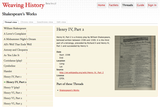
The gist of the tool is that it enables you to create what the foundation calls ‘factlets‘ that contain "information about historical events, persons, and so on, which you can string together to create historical ‘threads‘. These threads can then be visually represented on maps and timelines."
You can only get a partial feel for the result through a still image, but here, for example, is a screen shot of the factlet for Shakespeare’s Works.
Weaving History struck a chord with me because it was precisely this sort of activity that, as a teacher of great books of the western world, first opened my eyes to the power of computer-based multimedia as a teaching and learning tool. Of course, back in those days I was using CD-ROMS on my Mac to put together the same sort of ‘factlets’ that Weaving History facilitates and would then use them in conjunction with teaching The Inferno or Madame Bovary to help put the works in context. (Context, of course, is such an important part of learning on so many levels!)
If you are trying to get a quick, high-level sense of context and timeline around a person, event, or place about which you are learning, this may be a good tool to have in your learning mix.
Jeff Cobb
Mission to Learn
P.S. - Follow Mission to Learn on Twitter at http://twitter.com/missiontolearn
No related posts.
Related posts brought to you by Yet Another Related Posts Plugin.
Jeff Cobb
.
Blog
.
<span class='date ' tip=''><i class='icon-time'></i> Aug 19, 2015 02:36am</span>
|
|
Owing to a massive server failure at Mission to Learn hosting provider Bluehost, all of the files for Mission to Learn have been lost. I am in the process of restoring them, but it’s going to take some time.I’m also going to take this set-back as an opportunity to make some other changes here. Stay tuned.
Bluehost, by the way, is now the former hosting provider for Mission to Learn.
Jeff Cobb
Mission to Learn
Related posts:Are You a Miner?
Jeff Cobb
.
Blog
.
<span class='date ' tip=''><i class='icon-time'></i> Aug 19, 2015 02:36am</span>
|
|
This is a guest post from Karen Schweitzer.
The Internet has made the lifelong pursuit of knowledge easier for nearly everyone in the world. There are tons of websites dedicated to providing free courses, reference books, education apps, and other learning materials. Here are 25 stand-out sites that would be useful to almost any lifelong learner.
Clusty - This unique search engine sorts results into clusters of related information so that it is easier to sort out the relevant from the irrelevant.
Schoolr - Schoolr is a fully-customizable search engine that can be used to search Google, Wikipedia, and other popular sites. It can also be used to translate text, convert units, and cite sources.
MyStickies - This site offers an alternative to bookmarking. Instead of saving URLs and page titles, MyStickies allows you to place digital sticky notes with annotations around the web so that you can retrieve previously viewed pages and understand immediately why they are important.
Diigo is a handy research tool that can be used to highlight and annotate pages on the web. Anything that is marked with Diigo can be accessed later on from any PC.
Hooey - Hooey is a unique tool for people who like to surf the web. It records browser history, measures productivity, and offers tips to help you better understand your browsing habits.
Internet Public Library - The IPL is a free public library for the Internet community. Resources include books, magazines, reference materials, subject collections, a physical library locator, and an "Ask the Librarian" section.
RefDesk - This award-winning, family-friendly website is a great place to find reference materials online. RefDesk also offers one of the best fact checkers on the Internet.
SparkNotes - SparkNotes is an incredibly useful resource. In addition to an enormous literature section, the site also offers study guides and discussion forums for a wide range of academic subjects.
Schmoop - This free beta site makes it fun to study literature, poetry, and U.S. history. Schmoop features include easy-to-read study guides, homework helpers, and other educational materials.
History.com - The official History Channel website is one of the best places on the web to learn about a broad range of history topics. You can read articles, watch videos, and explore many other resources.
Wolfram MathWorld - This extensive math resource contains contributions from all over the world. Entries include information about algebra, geometry, calculus, applied mathematics, discrete mathematics, number theory, statistics, and other math topics.
OpenCourseWare (OCW) Consortium - The OCW Consortium is a collaboration of more than 200 higher education institutions. The Consortium’s website is an excellent place to find free courses and course materials from some of the world’s best colleges and universities.
Lecturefox - Lecturefox is an online directory of free audio, video, and text-based lectures from universities like MIT and Yale.
LearnOutLoud - This Internet catalog contains more than 20,000 free educational materials, including books, videos, audio lectures, and podcasts.
The Online Books Page - The University of Pennsylvania’s Online Books Page is one of the best places to find free unabridged books online. The site lists more than 35,000 books that can be downloaded or viewed at no cost.
The Free Library - Farlex’s Free Library contains more than five million books and articles that can be viewed online for free. The site also allows you to create your own home page with your favorite bookmarks and RSS feeds.
BookMooch - This book swapping site makes it easy to get rid of the books you don’t need and get books you want in exchange. Membership is free and books can be exchanged worldwide.
wePapers - This site is geared toward college students, but it is also an excellent resource for lifelong learners. At wePapers, you can find academic papers, study groups, and a venue to share your knowledge.
Livemocha - Livemocha is an international community of foreign language learners. You can use it to study almost any world language at your own pace.
VerbaLearn - VerbaLearn is a good place to practice English vocabulary. You can review words, make flashcards, and customize the way you learn.
Class Marker - At ClassMarker, you can create online quizzes that test your knowledge on any subject. No software or download required.
Mikogo - This free screen sharing tool makes it easy to share your computer screen with other people who are online. Mikogo works well for online meetings, presentations, and collaborative learning.
Bloglines - This web-based tool makes your home page look like a newspaper. It allows you to assemble all of your favorite sites and blogs amidst information like local weather, sports, and other items of your choosing.
ThinkFree - ThinkFree offers Internet-based file sharing and storage as well as a Microsoft Office compatible application suite that allows you to access documents without opening the necessary application.
Guest post from Karen Schweitzer, the About.com Guide to Business School. Karen also writes about online colleges for OnlineCollege.org.
P.S. If you enjoy what you read here on Mission to Learn, I encourage you to subscribe to the RSS feed or use the e-mail subscription form at the top right side of this page.
Related posts:35+ Free Online Business Education Sites My previous post, To Learn, To Lead, highlighted McGill professor...
Related posts brought to you by Yet Another Related Posts Plugin.
Jeff Cobb
.
Blog
.
<span class='date ' tip=''><i class='icon-time'></i> Aug 19, 2015 02:36am</span>
|
|
The following is a guest post from Katie Wilson.
It’s an understatement to say that the human brain is a complicated mass of neurons and connections that is hard to comprehend. What we can understand though is the concept of plasticity, the fact that the brain can be taught nearly anything with the right amount of effort and the right kind of motivation. Your brain changes its wiring to adapt to new situations, new knowledge and new information. This makes learning a pretty easy concept. And since the brain retains plasticity even as we age, here’s how you can use it to enhance your lifelong learning practices:
Work at learning
A job that requires you to keep updating your knowledge may sound like a lot of work, but it is a huge blessing in disguise. For one, it keeps you from becoming bored with a mundane routine; and for another, you’re forced to keep pushing your brain and challenging it by learning new things and understanding new concepts.
Make a conscious decision to learn
Don’t be content with what you know; use any time that you have on your hands to expand your skills - learn a new language, play an instrument, take up music or dance or painting lessons. Reading, from varied sources, keeps you informed and in touch with all that is going on in the world. So read as much as you can if you want to stay current and relevant.
Make learning your best friend
The best way to motivate yourself to learn is to surround yourself with people who are intellectuals. I don’t mean they must be Einsteins or Edisons, just that they must have a thirst for knowledge that refuses to be slaked. When you hang around such people, their motivation is bound to be contagious and push you to explore your interests and realize your ambitions.
Expand your learning interests
You can connect learning to other things that you love to do or things that affect you deeply. For example, if you’re a fitness freak, you could learn more about the human body and health by reading up on it. If you have a friend or a relative with a chronic illness (or you suffer from one), you could search for more information on it and become a sort of pseudo-expert. If you love sports, learn more about the rules and origins of the game to enhance your brain’s database.
Grow with learning
The more you learn, the more mature you become. Learning need not come just from books and other sources; it could come through experience too. When you go through various experiences, you learn more, about yourself, and about the people you interact with. You may forget the experiences in time, but it’s important that you remember the lessons that they taught you. Learning helps you grow, both mentally and emotionally.
Continuous and lifelong learning helps you remain young and may help keep mental disorders like Alzheimer’s and dementia away. And as long as you keep pushing on with the learning process, you can keep pushing away boredom, illness and stagnation.
This post was contributed by Katie Wilson, who writes about the universities online. She welcomes your feedback at KatieWilson06 at gmail.com
Related posts:A Lifelong Learning Guide Post This post is in the process of being restored after...
Related posts brought to you by Yet Another Related Posts Plugin.
Jeff Cobb
.
Blog
.
<span class='date ' tip=''><i class='icon-time'></i> Aug 19, 2015 02:35am</span>
|
|
Over the weekend, Mission to Learn quietly slipped into its third year. As befits such occasions, I’ve been trying to spend a bit of time reflecting on how the site has changed over time and where I’d like to take it going forward. One thing that occurred to me is that, in spite of this being a site about learning, I’ve never actually offered a definition here of what I mean by "learning." So here’s my definition:
Learning is the lifelong process of transforming information and experience into knowledge, skills, and habits.
I might add to that:
It is not dependent upon classes and courses - though these can be very useful tools for learning
It does not require a degree, certificate, or grade to prove its worth - though clearly these have social value that most people would be unwise to ignore
It does not always - probably not even most of the time - happen consciously - though I think that those who strive for a more conscious approach to learning throughout their lives - whether at work or otherwise - tend to be more successful in pretty much whatever way they define success.
I think that pretty well sums up the view of learning that drives my efforts here at Mission to Learn. What do you think? Does this capture your view of learning? What would you add or take away?
Jeff Cobb
Mission to Learn
P.S. - Please join me on the ongoing Mission to Learn. Subscribe to the RSS feed or use the e-mail subscription form at the top right side of this page.
No related posts.
Related posts brought to you by Yet Another Related Posts Plugin.
Jeff Cobb
.
Blog
.
<span class='date ' tip=''><i class='icon-time'></i> Aug 19, 2015 02:35am</span>
|