Blogs
|
Want a way to add a little language learning to your blog or Web site - or in some cases your Facebook, iPhone, or other digital channels? Here are 7 sources for widgets that may fit the bill. (Not sure exactly what a widget is? Check out the explanation from Jim Pettiward on BBC Learning English.)
Learn10
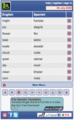
The Learn 10 widget is a "tool for building vocabulary when learning a language. Users are shown a dynamic list of 10 words from a chosen language pair. Learn10 can be positioned on social network homepages, search engines & blogs, and is available as a Google gadget which can be added to any web page. Subscription to extra features (such as sound) is an option for users. Learn10 is designed to work using the techniques of advertising: frequent exposure to a stimulus in a variety of locations." The Learn10 widget currently works for Russian, Japanese, Spanish, Welsh, English, Czech, Arabic, Korean, Polish, Dutch, Swedish, Chinese, Norwegian, Italian, French, Portuguese, Turkish, German, Hindi, and Danish. And here’s a YouTube video on how to use the Learn10 widget.
Language Tools Widget
The Language Tools widget from Tropical PC Solutions allows you to search multiple online dictionaries and it will also translate text into various languages.
Internet Polyglot Word Widget
This Internet Polyglot Word Widget widget "shows a random word in Arabic, Chinese, Dutch, English, French, German, Greek, Hindi, Italian, Japanese, Polish, Portuguese, Romanian, Russian, Spanish, Turkish. You can click a speaker icon and hear audio pronunciation of this word in these languages. Click "Next" and see the next random word of the day."
China 8
China 8 offers searchable dictionaries, phrases, brief lessons and photos in blog and Web site widgets for learners of Mandarin Chinese.
Rockie Lingomigo
Lingmigo offers blog and Web site Widgets for connecting with others that want to learn Spanish or Portuguese.
Word of the Day from Language Learning
The Word of the Day Widget from Language Learning is "an easy way for you to learn a new word each day, and allow all of the visitors to your site the same opportunity!" Language Learning offers widgets for Spanish, French, Italian, German, Portuguese, Chinese, Japanese, and Russian.
Word of the Day from Transparent Language
Transparent Language offers one of the more comprehensive collection of Word of the Day Widgets across multiple languages. "Why learn a word a day? Simply click on any "more about this word" button below to visit the specific language. Sometimes we’re flooded with so much information that we don’t have time to digest what we learn. Word of the Day gives you 24 hours to meditate on a single word, reading it, hearing it, and seeing it used in real sentences. We figure sometimes slow and steady wins the race."
Know of other widgets you think should be in this list? Be sure to comment and let Mission to Learn readers know about them.
Jeff Cobb
Mission to Learn
P.S. - Be sure to check out other language learning resources here on Mission to Learn.
Related posts:5 Free Web Tools for Learning a Language Collaboratively20 Language Links from the Free Learning MonitorMore than 50 Web Widgets for Your Learning Mix
Jeff Cobb
.
Blog
.
<span class='date ' tip=''><i class='icon-time'></i> Aug 19, 2015 02:29am</span>
|
|
Lexiophiles has issued its annual list of Top 100 Language Blogs. Knowing that most people will probably focus on the top 20 (which, I am happy to say, includes Mission to Learn), I thought I’d take a minute to highlight some of the blogs further down the list I found interesting.
23. Self-Made Scholar. Learn Free.
What can I say - I go for anything that blends "self-made" with "free" and "learn." I’ve come across Jamie Littfield’s blog before and mentioned it in the Learning Monitor, among other places. Well worth a visit.
36. Esperanto Blog
Our Esperanto Blog is a series of frequently published articles about Esperanto language. Our blogger, Alex Joy, speaks and studies Esperanto and is very passionate about sharing his knowledge with our readers.
Esperanto gets no respect. Maybe this blog is the answer.
46. eduFire. Live Video Learning.
I’m high on video these days, and this looks like a very cool site. Notably, the current post is on Top 10 Learning Resources for the Aspiring Esperantist.
59. The Smiling Eggplant. All about Italy
I like Italy. I like the name. You might want to combine this one with…
77. Verba Molant. Linguistical blog for Italian language lovers
And finally…
85. Women Learning Thai … and some men too . Expat making her way through Thai language and culture.
I’m not sure if the "…and some men too " appended to the blog’s title header means the men are learning Thai or the women are learning men, but in any case, I wanted to be sure to include an eastern language.
Well, enough from me. Go check out some of the Top 100 Language Blogs.
Jeff Cobb
Mission to Learn
Related posts:Top Eight E-learning BlogsFree Language Learning Resources - The Master List7 Language Learning Widget Sources
Jeff Cobb
.
Blog
.
<span class='date ' tip=''><i class='icon-time'></i> Aug 19, 2015 02:29am</span>
|
|
This is a guest post by Michelle Fabio. Personally, I am heartened to see association and nonprofit online education initiatives at the top of the list. This is a great post to bookmark for future reference and share. Use the links at the bottom of the post to do that easily. - JTC
Would you know what to do if someone (or a pet!) was severely injured, had trouble breathing, or started choking in front of you? That is, do you know basic first aid or how to do Cardiopulmonary Resuscitation (CPR) or use an Automated External Defibrillator (AED)?
You never know when you might find yourself in emergency medical situation, which means that you should know at least basic first aid techniques. The good news is that now it’s easier than ever to learn as there are many great free online first aid courses and resources; some even give you the opportunity to become certified in CPR and AED right from the comfort of your home.
Here is a list of 10 of the best free online first aid resources:
1. American Heart Association e-Learning: Lots of information on heart emergencies with basic First Aid, CPR, and AED courses (for a small fee) that can be completed anytime, anywhere; also has a Pocket First Aid & CPR iPhone application.
2. American Veterinary Medical Association Pet First Aid: Printable information on how to deal with small and large pet emergencies from poisoning and seizures to broken bones and heatstroke.
3. CPR Dude: Run by an American Red Cross CPR, AED, and First Aid instructor, this site offers lots of information presented in a fun, interactive way.
4. FirstAid4All: Comprehensive resource with information on dealing with emergencies like choking, absence of heartbeat or breathing, poisoning, sunstroke, and electric shock as well as with accidents like burns, cuts, fractures, dislocations, bruises, bleeding, and foreign objects in the eyes or ears; also provides a checklist so you can create your own first aid kit to keep handy.
5. First Aid Web: Offers free self-guiding CPR and First Aid courses with regular quizzes to chart your progress; note in order to receive certification, there is a fee.
6. Health World Online: Instructions for dealing with many different kinds of accidents and emergency situations including animal and insect bites, fainting, frostbite, hyperventilation, seizures, splinters, and more.
7. Kids Health: Great for parents, the First Aid & Safety section covers how to prevent and respond to emergencies at home, outdoors, and also away from home.
8. Mayo Clinic: Lots of information on how to deal with accidents and emergencies, including corneal scratches, chemical splashes, head trauma, snake and tick bites, and nosebleeds; also tips on making your own first aid kit.
9. University of Washington School of Medicine: Includes instruction on first aid for choking, standard CPR, hands-only CPR, CPR for children and infants, and CPR for pets; also printable instructions, videos, fun facts, and even iPhone and Android applications.
10. Waveland Fire Department: Offers guidance on CPR procedures and the Heimlich Maneuver for choking victims, including helpful diagrams and illustrations.
Guest post by Michelle Fabio, About.com Guide to Law School, who also writes about online nursing classes at OnlineNursingClasses.com.
Interested in guest posting on Mission to Learn? Contact us.
Related posts:25 Free Online Resources and Web Apps for Lifelong LearnersMore than 100 Free Places to Learn Online - and Counting35+ Free Online Business Education Sites
Jeff Cobb
.
Blog
.
<span class='date ' tip=''><i class='icon-time'></i> Aug 19, 2015 02:29am</span>
|
|
Oz never did give nothing to the Tin Man, that he didn’t already have. - America
A while ago I remarked upon the "alternative" MBA program that marketing guru Seth Godin had announced. Coincidentally, as I was posting recently on Henry Mintzberg’s criticisms of the traditional MBAs in To Learn, To Lead, Seth offered an update on his program that I would recommend to readers here.
The quick background on Seth’s program, is that it involves a small group of people spending six months in New York with Seth to engage in a lot of reading and discussion and learn from various guest experts and field trips. But most of all, it involves spending time working on actual business projects and learning by doing.
Seth’s post describes the various activities in the program along with some of the lessons he and participants have learned along the way
Maybe the most important thing you’ll learn in this program is that you don’t need this program. There’s not much I’m going to tell you that’s not in my blog posts or books. What this program will do is give you the structure and support to encourage you to do what you already know. But you can do that by yourselves. (Emphasis added.)
Yes, we can - in theory - but as often as not, we don’t. We hold ourselves back, put up our own barriers, fail to exercise discipline, and in general, don’t realize our own potential when it comes to learning and life. I certainly believe it is within all of us to overcome these hurdles, but…
But, of course, it’s usually not a trivial matter to find, develop, create "the structure and support to encourage" us in our efforts. Traditionally, we’ve manufactured and relied upon institutions - schools, universities, training departments - to help us with this effort. But that reliance has evolved into a dependency that is a very often a poor fit for our current era. And as Seth’s example suggests, some of the institutions on which we have relied traditionally may not be up to the current task.
Given the learning opportunities - and the potential to be overwhelmed, misinformed, or misled - that are now possible in a hyper-connected world, I think we increasingly need people who can play the sort of role Seth played with his program. Not purveyors of content, or traditional stand-and-deliver instructors, but curators of experience. People who can help orchestrate a context in which we realize our own potential.
And perhaps more than ever, we also need to learn better how to do this for ourselves. It’s a matter of discipline, of asking why and what, of continually developing learning habits. Of learning how to tap into the networks that may be of most help to us - and to which we can add value in the process.
How are you going about this in your own life and learning? Have you participated in anything akin to Seth’s MBA? Please comment and share your thoughts.
Jeff Cobb
Mission to Learn
P.S. - Please join me on the ongoing Mission to Learn. Subscribe to the RSS feed or use the e-mail subscription form at the top right side of this page.
P.S.S. - Here’s the classic scene from the Wizard of Oz in which the mysterious Oz distributes gifts to Dorothy and her gang.
No related posts.
Jeff Cobb
.
Blog
.
<span class='date ' tip=''><i class='icon-time'></i> Aug 19, 2015 02:29am</span>
|
|
Mashable wrote about open education recently. This month’s Fast Company (not-quite-so-fast web edition not yet available as of this post) features an article on it. The venture capitalists have been circling for a while. Since it started opening major parts of its curriculum to open access via the Web in 2001, MIT OpenCourseWare has been joined by more than 200 other institutions with similar projects.
Is open education starting to enter the mainstream?
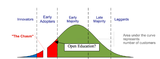
Adoption Curve adapted from Wikipedia. Click for original.
Based purely on user numbers, you might argue that it entered the mainstream some time ago: more than 56 million users have accessed MIT’s open courseware initiative alone. No doubt many multiples of that number have accessed the wide range of open educational resources now available across the Web.
But any dotcom entrepreneur can tell you that user numbers do not necessarily equate to sustainability - a quality that tends to be favored in the mainstream. As Geoffrey Moore argued nearly two decades ago in Crossing the Chasm, there is generally a significant gap - a chasm - between the early visionaries for an innovation and the pragmatists who take it into the mainstream. The latter most definitely seek sustainability - and more often than not, a measurable return on their investment.
Why does all of this matter from the standpoint of the lifelong learner? There are positives and negatives.
One huge positive is clear: the open education movement as a whole has been a significant force in introducing free educational content onto the Web, and arguably, helping to keep quality levels higher than might have otherwise been the case. Having institutions like MIT, Yale, and Berkeley in the game certainly raises the stakes some. More visibility for open education and its potential role in bringing down the costs of formal education could lead to more, and more strategic, investment in open educational resources that may benefit lifelong learners.
On the other hand, money always has a tendency to muddy the waters. The Fast Company article, for instance, seems to lump together such diverse efforts as the open courseware consortium (which offers conent completely free for learners), University of the People (which charges fees, albeit very reasonable ones, for participation), and Knewton (a venture-funded start-up that charges $890 for test prep courses). Each of these initiatives signals a seismic shift in the world of education, but the degree of true "openess" varies dramatically across them.
How sustainable structures are built for carrying open education forward - and whether these structures represent foundations or simply new and different walls - seems now to be the core issue. That the movement has evolved to this level - and that an array of new hands are contributing to the work - strikes me as the clearest sign that open education has crossed the chasm and is poised to become part of the mainstream educational landscape.
Wherever it all ends up, the open education movement has helped spark a broad debate about the cost of education, the value of our traditional approaches to validating and accrediting education, and the role of traditional institutions like the university (which open education leader David Wiley, quoted and pictured in the Fast Company article, has said could be "irrelevant by 2020.") As this debate continues to gain ground, so too will open education.
What do you think - have we crossed the chasm? Is open education entering the mainstream?
Jeff Cobb
Mission to Learn
P.S. 11-Aug- 09 - I did not notice until this morning (via Downes) that the Open Education Conference is using "Crossing the Chasm" as its tag line this year. A coincidence, but a serendipitous one in signaling that some of the people closest to the movement sense that a major shift is occurring. See also the Chronicle article on Obama’s Great Course Giveaway referenced by Downes.
P.S.S. - If you enjoy what you read here on Mission to Learn, subscribe to the RSS feed or use the e-mail subscription form at the top right side of this page.
Related posts:Open Education Marches On At YaleThe Tragedy of Open Education? A Look at a New BlogOER - Open Educational Resources
Jeff Cobb
.
Blog
.
<span class='date ' tip=''><i class='icon-time'></i> Aug 19, 2015 02:28am</span>
|
|
Ever wish you were just a little bit better at remembering the things you would really like to learn?
You can find plenty of memory improvement tips out there, and a whole industry has grown up around the concept of "brain training," but figuring out what’s worthwhile and what’s not can be an extremely confusing process. I won’t claim to be an expert, but I decided to go "learn about" in an effort to cut through all the confusion and come up with some practical wisdom to put to work in my own life. Having now sifted through a wide range of writings on the topic, it seems to me that improving your memory boils down to five key areas.
Here are the first three: sleep, physical exercise, and stress management. Stay tuned for the next two - diet and memory techniques - in part two of this series.
Sleep
If you are like me, you know from practical experience that your memory doesn’t tend to function as well when you are sleep-deprived. As it happens, a wide range of scientific studies support the idea that sleep is necessary for helping to "consolidate" memory, or at least certain types of memory. (See About Memory for a good list of studies.) A recent MIT study brought us a significant step closer to understanding the sleep-memory connection by showing that "mice prevented from "replaying" their waking experiences while asleep do not remember them as well as mice who are able to perform this function."
The bottom line: Sleep is important; get enough of it if you want to make sure your memory is functioning properly.
Of course, that begs the question: what is enough? Unfortunately there is no "one-size-fits-all" answer to that question. The safest bet seems to be to aim for at least the standard 7-8 hours a night recommended for most adults and to pay enough attention to how you feel and act based on that amount of sleep to adjust up or down as needed. For more information on sleep needs from infants up to adults, I recommend an article on sleep requirements from Parenting Science.
Physical Exercise
Physical exercise is a somewhat grayer area than sleep when it comes to memory, but there seems to be a reasonable body of evidence suggesting that physical fitness and cognitive fitness are linked. At a minimum, a short-term effect of exercise, and in particular aerobic exercise that is continued over a period of at least 30 minutes, is an increase in blood flow and corresponding oxygen supply to the brain. This can help boost cognitive function, including memory. A regular exercise habit can help to improve circulation in general and also ward off stress and depression - two established enemies of optimal cognitive function.
Research also suggests that physical exercise may directly benefit the hippocampus - an area of the brain that is essential to memory. A recent study, for example, showed that "elderly adults who are more physically fit tend to have bigger hippocampi and better spatial memory than those who are less fit." As one of the lead researchers on the study puts it, "Basically, if you stay fit, you retain key regions of your brain involved in learning and memory."
So how much exercise should the average person be getting? There’s plenty of debate on the topic, but one reasonable starting point is the Center for Disease Control’s "How much physical activity do you need?"
Stress Management
As noted above, stress is known to have an impact on cognitive function, and this includes memory. For starters, stress can interfere with sleep, which we have already identified as important to memory. But stress also impacts the brain more directly in both positive and negative ways.
On the positive side, when we are presented with problems or challenges, our bodies are stimulated to produce norepinephrine, a neurotransmitter that is essential to memory. This can be a good thing when studying for a test or preparing for some other challenge. But too much stress over too long a period takes its toll. The work of neurologist Robert Sapolsky and a range of other researchers have shown that chronic stress can, over time, lead to degeneration of the hippocampus, thus interfering with our capability to process and store memories. (see Memory and Stress).
So what are some approaches to managing stress? Getting enough sleep and exercising regularly are an excellent starting point - and these come with the memory benefits already noted. Additionally, there is some evidence that meditation and other well-known relaxation techniques may have a direct impact on the hippocampus - at least in the elderly. At a minimum, long-term practice of meditation or other relaxation techniques helps ward off chronic stress, an established enemy of memory. If you don’t feel like meditation is right for you, you might consider the simple breathing exercises advocated by alternative health practitioner Andrew Weil.
If you are getting the sense that promoting and maintaining good memory is largely a matter of good lifestyle choices and habits, you are right. Stay tuned for more on that as well as some practical memory techniques in part two of this series.
Jeff Cobb
Mission to Learn
P.S. - If you enjoy what you read here on Mission to Learn, subscribe to the RSS feed or use the e-mail subscription form at the top right side of this page.
Related posts:25 Sites and Tools to Exercise Your BrainIs Your Brain in a Box?
Jeff Cobb
.
Blog
.
<span class='date ' tip=''><i class='icon-time'></i> Aug 19, 2015 02:28am</span>
|
|
Time for another round of linky learning via Mission to Learn on Twitter. Seems we had the mind on our mind this time around. Enjoy.
The Human Mind & Learning
Top five ways to beef up your brain: http://bit.ly/rhU8F
Daniel Goleman on building willpower, neuroplasticity http://bit.ly/19iTuX
Why is it hard to "unlearn" an incorrect fact? http://bit.ly/Sae7G
50 tips to improve memory http://bit.ly/gt3eB
Do we learn more from success than failure? http://bit.ly/BpDcG
4 Steps to Mindfulness: http://bit.ly/bvMDh
10 Questions for Your Reflective Practice: http://bit.ly/19qvy8
New Mission to Learn post on improving and maintaining memory: http://bit.ly/qPGhX #
Cool Tools & Resources
15 Free Online Collaboration Tools and Apps: http://bit.ly/196Aqe #
Just came across http://www.charityhowto.com/ - site with video training for nonprofits. Looks good #learningmonitor #
101 Experiments in the Philosophy of Everyday Life via BoingBoing: http://bit.ly/rLruD
4 sites to get good free advice online: http://bit.ly/mciTd
10 simple ways to back up your life. http://bit.ly/18SNZn Hit home, given that I recently lost quite a bit due to not backing up properly.
The Ultimate Self Education Reading List http://bit.ly/4rRAd8 #learningmonitor
New M2L post 7 Language Learning Widget Sources http://bit.ly/3357jg #languages
5 TED Talks on Science that Will Blow Your Mind http://bit.ly/eUL2U #learningmonitor
RT @bookoven: @LibriVox now has a catalog of 2,500 (!) free, public domain audiobooks: http://librivox.org #learningmonitor
Health & Medical
10 Free Online First Aid Resources - Learn to Save a Life! New M2L post - http://bit.ly/poLCZ
The King Kong List for Feee Medical Online Resources from @zaidlearn http://bit.ly/8S2k3 #learningmonitor
Learning News
Duke professor uses crowdsourcing to grade - via Digg http://bit.ly/1hs34F
via @openednews Creative Commons launches DiscoverEd http://bit.ly/OyOjb
A little trivia fun on Mission to Learn: http://bit.ly/11Bb6a
Open Courseware Consortium Webinar series http://bit.ly/3tqbMb via @openednews #learningmonitor
Serious Games
Top 100 Learning Game Resources http://bit.ly/IHKVe #learningmonitor
Survey of electronic games that teach: http://www.wingz2fly.com/Ga… via epistemic games
The CEO Game: A Serious Business Game http://www.theceogame.com/ #learningmonitor
Will Wright on educational gaming: http://bit.ly/9Pq5X
Have a great weekend, and be sure to follow Mission to Learn on Twitter!
Related posts:Surprise! Assorted EdutweetsFree Learning Resources and other Edutweets25+ Sites and Tools to Exercise Your Brain
Jeff Cobb
.
Blog
.
<span class='date ' tip=''><i class='icon-time'></i> Aug 19, 2015 02:28am</span>
|
|
What's in your Learning 2.0 Tool Belt?
While speaking at a conference over the weekend, I noted that I haven’t participated in a lot of formal professional development over the past few years. Maybe I’ve attended a class, workshop, or conference here or there, but the biggest chunk of my learning has happened informally, and mostly on the Web. That got me thinking about the tools I use the most these days for learning. I hope you’ll comment to share your own with other readers, but to start with, here are the five I use most:
Search
Google is the starting point for pretty much everything. And when I land on a blog, Web site, or wiki that looks like a good resource, the search box is often the first place I go. I also set Google searches as one way of tracking a topic or issue.
RSS
My RSS reader is pretty much my own little personal learning management system. I’m subscribed to hundreds of feeds (I really need to do some clean-up!), and I’ve got these feeds organized into folders and tagged in all sorts of ways. (Not real clear on what RSS or an RSS reader are? Check out Commoncraft’s brief, entertaining, yet highly educational video on RSS in Plain English.)
Podcasts
A colleague gave me an iPod a while back in appreciation for some consulting I provided, and I have been addicted ever since. I regularly listen to podcasts across a wide range of topics. I also learn a lot by creating the Radio Free Learning podcast, which I plan to kick back into gear in the next couple of weeks. Favorites? Marketing Over Coffee, Duct Tape Marketing, pretty much any TED talk, and Sound Opinions (okay, that last one is more for personal pleasure than professional development - but I do learn a lot!).
Bookmarking
I have no idea how many bookmarks I have at this point. A lot of them are local to my laptop, but I’ve gotten more and more in the happen of putting them on Delicious. This is the main way I find my way back to things I would otherwise forget. It is also an area where I need to improve my habits some - e.g., being better about writing descriptions for bookmarks and also spending more time revisiting and mining my bookmarks on occasion.
Blogging
I put blogging last because it is the tool that plays the biggest role in transforming all of the above into learning, at least as I define it. For me, nothing beats having to write about a topic or issue for really consolidating my knowledge and reaching higher levels of learning. I write a great deal more than actually winds up in my blog posts, and I also post on the blog on my personal Web site as well as on the site for my company, Tagoras.
Runner up: Twitter
I use Twitter to tag (#learningmonitor) items (and encourage other to tag them) that I might include in the monthly Learning Monitor newsletter as well as to share other resources I come across. More importantly, I learn about a lot of new things from following other tweeps. One of those tweeps is Lindy Dreyer. You might want to also check out her brief list of good people to follow if you are interested in informal learning (provided by Jeff Hurt). Who knows, Twitter might bump one of the other tools above out of the top five at some point.
How about you? What are the key tools in your learning mix? I’d be truly grateful if you would comment and share with other readers here at Mission to Learn.
Jeff Cobb
Mission to Learn
P.S. - If you enjoy what you read here on Mission to Learn, I’d be truly grateful if you would consider subscribing to the RSS feed.
Related posts:Ten Tools for Tracking a Topic or Issue15 Free Online Collaboration Tools and Apps
Jeff Cobb
.
Blog
.
<span class='date ' tip=''><i class='icon-time'></i> Aug 19, 2015 02:27am</span>
|
|
The human mind is wired to be learning all the time - even during significant parts of the time when we are asleep - but with all the noise, distractions, and interruptions of modern life, it can be hard to find time for truly focused learning.
How can you carve out the hours needed to learn Swahili, master delta blues guitar, understand Aristotle’s view of ethics, or _________ (fill in one of your current areas of learning)?
One of the easiest ways to find more time is by by stealing pockets of time from other areas of your life.
The following are some ideas for reclaiming minutes and hours that you might then apply towards your focused learning efforts. You can look at these as temporary fixes - something to try over a 30-day period. During that time, pay attention to what works for you and what doesn’t - and come up with other ideas for reclaiming time.
Television. I’m not an enemy of television. There are shows I like enough to tune into weekly or order on Netflix. But one show can easily lead to another, and before you know it, you’re watching 150+ hours a month like the average American. Want to open up a big chunk of "cognitive surplus," as Clay Shirky has put it? Drop the TV !
Internet. This one is tougher for me - and probably for you, too, if you are here reading this post. I practically live on the Web, and a lot of what I do here is learning related, But, of course, a lot of it really is not. Cut the random surfing, tweets and other non-essential activities by even just 30 minutes a day and you free up a few hours a week for focused learning.
Early to bed, early to rise
makes a man healthy, wealthy, and wise.
- Benjamin Franklin
Get up earlier. I’m not convinced that getting up earlier has made me any wealthier, but Benjamin Franklin had it right on the "wise" part. Early morning tends to be a great time for solitude - particularly if you have kids in the house. I find I am at my most creative and productive in the morning, but even if that is not true for you, the time can be spent for review and reflection. Try getting up 30 to 60 minutes earlier. Or if that doesn’t work for you, stay up an hour later. Either way works.
Email. Maybe this belongs with "Internet," but I think e-mail is enough of a time sink on its own that it needs to be mentioned separately. Try taking the advice of Tim Ferriss, author of The 4-Hour Work Week, and check e-mail only once or twice a day at a specific time. I haven’t been able to stick with this habit so far, but it is one I truly hope to make permanent going forward. The world really doesn’t stop when you don’t check e-mail every ten minutes, and aside from freeing up more of your time, your ability to concentrate shoots up when you aren’t jumping from one e-mail stream to the next. (For a great resource on this one, see Tim’s Change This manifesto on e-mail elimination.)
Cut back on shopping. And plan when you do shop. I’m not a big shopper in general, but I know a lot of people are. And even with the little bit of shopping I do, I find that I often end up making multiple trips for shopping that might have easily been handled in one trip if I had taken the time to make a list, review it thoroughly, and plan out my time. If you can, cut back to shopping only for essentials and plan those essential trips well.
*Leave work early. If your work allows it, see if you can leave work earlier. If you have a smart boss, the only thing that will matter is if you’re getting your work done — not how long you’re in the office. So really focus on getting the essential work done within the time you have, and leave an hour earlier. Or, go to work late. The flip side of the above suggestion. Again, this is if your work allows it.
*Take a longer lunch. Sometimes it’s easier to squeeze out extra time for your lunch break than it is to come in early or to leave early. If you can take 90 minutes for lunch, use the first 30 for eating (pack a lunch if possible) and the other 60 for reading, practice - whatever applies to your learning.
Go on a news diet. How much time do you spend reading a daily paper (online or off), checking in on CNN or ESPN, or tuning in to NPR news in the car? I don’t advocate living in ignorance of what’s going on in the world, but try cutting out news for 30 days and see how much you really miss. Probably not a great deal, and in the meantime you free up a lot of time. If you go back to daily news, try cutting down to 20 minutes or less.
*Don’t do anything after work. If you make social commitments after work, or business meetings, or whatever, stop making these plans for 30 days and use this time for focused learning.
Trim civic commitments. Do you volunteer or serve in an organization or are you a member of some group? That’s a great thing - and I don’t advocate dropping these activities. But often those who volunteer over-extend themselves and commit to doing more than is reasonable. Are there things you are doing that someone else could easily do? Perhaps you could recruit a new volunteer to share or take over an activity. You’ll strengthen the organization in the process and also free up some time.
Minimize housework/yardwork. Do these chores take up a large part of your day? See if you can minimize them, just for a month. Relax your standards a little. Or do a speed-cleaning stint once a week for two hours, and don’t clean the rest of the week. Do your laundry once a week rather than multiple times. For yardwork, hire a teenager to do it for a month. Reassess after a month and consider how you might keep these activities to a minimum going forward
Cut out non-essential reading. To even talk about cutting into reading pains me, but I do a lot more unfocused, undisciplined reading than I really should, and I’m betting you do too. Cut out magazine reading and most book reading (unless it’s essential) to give you some extra time. This will also include cutting out newspaper and Internet reading, as mentioned above.
*Minimize recreation. Partying, drinking, playing sports, playing video games … however you spend your free time, see if you can cut into that time.
Use car time efficiently. Cut off the music and NPR and plug in an educational podcast or CD. The car can be a great place for listening to books or practicing a foreign language. Be sure to pay attention to the road, though!
Take a walk. Sometimes just dropping everything, putting on a good pair of shoes, and heading out the door can be the surest way to cut the distractions and free up time for focused learning. I try to make this as much of a daily habit as possible. Take a long an iPod with some educational content if you like (try LearnOutLoud or iTunes University), or just use it as a time for reflection. Aside from learning a little, you will also be contributing to your physical well-being (which, in turn, can help your memory.)
If you find any of the above particularly effective - or not - in your life, or if you have other ideas for reclaiming time, I’d really appreciate it if you would comment and share with other readers.
Some notes on the origins of this post:
I am a fan of Leo Babauta’s Zen Habits and have been thinking for some time that I would like to take him up on his "uncopyright" and create a series of Zen learning habits. More recently, I have decided that I want to be much more serious about building Mission to Learn and I enrolled in Leo’s A-list Blogging Bootcamp. This gave me the incentive to finally pursue the Zen learning habits series.
This post is based on Leo’s 15 Ways to Create an Hour a Day of Extra Time … for Solitude. For me, solitude and focused learning go hand-in-hand, so it seemed like a great starting point. I have kept nearly all of Leo’s original 15 points, though have consolidated some of them into single points and added two of my own - Use car time efficiently and Take a walk. I have also re-written all of them except for the four with stars. In other words, I haven’t completely lifted Leo’s writing - I’ve mostly just used it as inspiration.
Look for other Zen learning habits soon as well as other changes on Mission to Learn. After recently restoring the site after a server crash, I’ll be getting a general face lift done and will also be revving the Learning Monitor newsletter and Radio Free Learning podcast back up.
No related posts.
Jeff Cobb
.
Blog
.
<span class='date ' tip=''><i class='icon-time'></i> Aug 19, 2015 02:27am</span>
|
|
That’s what Copyblogger Brian Clark says, and I believe him. Both because it has been true in my own career and because I have been a member of his Teaching Sells program since it launched nearly two years ago.
I am excited that the Teaching Sells program has re-opened today after being closed to new members for many months. I feel pretty certain there is a sizable segment of Mission to Learn readers who will want to consider enrolling. At a minimum, make sure you download some of the great free resources Brian offers. (He asks for your e-mail, but my experience is that he can definitely be trusted to only do what he says he will do with it - and you can unsubscribe at any time.)
That’s all I’ll say here. I encourage you to read my further thoughts on Teaching Sells, if you are interested, or to find out more on the Teaching Sells site.
Jeff
No related posts.
Jeff Cobb
.
Blog
.
<span class='date ' tip=''><i class='icon-time'></i> Aug 19, 2015 02:27am</span>
|