Blogs
|
Just this morning, I came across MIT Media Lab’s announcement for its Learning Creative Learning online course. You can read about it or skim the outline to make your own judgment; I’m enjoying the laid-back description, which tracks with my previous massive open online course experience:
"This is a big experiment. Things will break. We don’t have all the answer."
"We hope that participants will jump in as collaborators rather than passive recipients."
"Check out our shiny new platform. Actually, don’t, because we didn’t build a shiny new platform."
I’ve registered, I’ve joined the LCL community on Google+, and I’ve set up a place in Evernote to help me organize what I do in LCL. This (I think) is a sign I’ve learned from past experience. A while back, I joined PLENK, a MOOC on public learning environments, networks, and knowledge. I stayed with it for a while, but eventually stopped participating. There were things about the MOOC format that annoyed me, but the biggest factor in my leaving was that I hadn’t made enough connections with people whose interests overlapped sufficiently with mine.
Many of the participants were students, academics, or people closely tied to formal education (schools or colleges). That’s not the world I work in, or one I often turn to. I don’t blame the MOOC for that, any more than I blame sports bars for always having athletic events on TV.
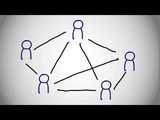
PLENK is an example of a connectivist MOOC. George Siemens seemed to use cMOOC and xMOOC as informal and possibly tongue-in-cheek shorthand for the difference between an experience like PLENK and the more, shall we say, institutional MOOC like those from edX or Coursera. More relevant to learning is this comment he makes:
Our MOOC model emphasizes creation, creativity, autonomy, and social networked learning. The Coursera model emphasizes a more traditional learning approach through video presentations and short quizzes and testing. Put another way,cMOOCs focus on knowledge creation and generation whereas xMOOCs focus on knowledge duplication.
As a veteran of many, many corporate training and learning efforts, I’m trying not to see the rise of the University MOOC, and especially the for-profit-corporate MOOC, as "Lecture Hall Meets Facebook."
As a refresher for myself, and a first action for LCL, I posted in Google+ a link to this video by Dave Cormier, who’s partnered with Siemens and others, with advice on how to succeed in a MOOC.
ORIENT: Find out where stuff is. Then remember where it is.
DECLARE: Set up a place to record and share your thoughts.
NETWORK: Follow others; interact with them.
CLUSTER: Once you’ve gotten your feet wet, get together with people who share your interests.
FOCUS: "Halfway through," Cormier says, "your mind starts to wander." So have a way to apply what you’ve been learning.
We’ll see how well I apply myself.
Dave Ferguson
.
Blog
.
<span class='date ' tip=''><i class='icon-time'></i> Aug 19, 2015 04:59pm</span>
|
|
I’ve been reading All I Really Need to Know (about Creative Thinking) I Learned (by Studying How Children Learn) in Kindergarten, by Mitchel Resnick of the MIT Media lab. This was the suggested reading for the first session of the Learning Creative Learning online course.
This paper argues that the "kindergarten approach to learning" - characterized by a spiraling cycle of Imagine, Create, Play, Share, Reflect, and back to Imagine - is ideally suited to the needs of the 21st century, helping learners develop the creative-thinking skills that are critical to success and satisfaction in today’s society. The paper discusses strategies for designing new technologies that encourage and support kindergarten-style learning, building on the success of traditional kindergarten materials and activities, but extending to learners of all ages, helping them continue to develop as creative thinkers.
Resnick’s image of kindergarten learning
Resnick is referring to the kind of kindergarten where kids are not "filling out phonics worksheets and memorizing flash cards" — more like the one I remember, with huge wooden blocks, a full-size rolltop desk, and nothing that I can recall as an effort to get me ready for the LSAT.
His diagram’s a spiral because the steps in this process aren’t as distinct or sequential as describing or depicting them might imply.
It’s through this process that kindergarteners "develop and refine their abilities as creating thinkers." And, as they grow, they need resources beyond wooden blocks and finger paint.
I like his stress on little-c creativity ("creativity within one’s personal life"). Not everyone’s going to be the next Freeman Dyson or Linus Torvalds, but everyone can "become more creative in the ways they deal with everyday problems."
In the Imagine section, he points out that many kindergarten materials encourage the imagination-they don’t over-structure. By contrast, a lot of "education technologies are overly constrained" — you can only do what they’re set up to do.
It’s like all that fun drill and practice.
He offers the example of Crickets, which I hadn’t heard of: small programmable devices, suited to children, that they can interconnect, modify, and program. Don’t take my word for it, though:
In the article, he says:
The design challenge is to develop features specific enough so that children can quickly learn how to use them, but general enough so that children can contine to imagine new ways to use them.
For some reason, this reminded me of explanations of "simple machines" in long-ago science classes-things like inclined planes, wedges, screws, and pulleys. I’d been told that a screw was a kind of inclined plane, but when it came to pulleys, I don’t think we ever actually rigged up a bunch of pulleys to experience how the right combination would let us lift a load we otherwise could not.
While reading the Create section, I read this line three times:
With Mindstorms and Crickets, for example, children can create dynamic, interactive constructions — and, in the process, learn concepts related to sensing, feedback, and control.
It’s the last part that got me. What it brought to mind was the first course I wrote in the computer-based training system we used for reservations training at Amtrak. Things I had learned about learning (like using a minimalist approach, or providing feedback without giving away the answer) clicked. I could create a course that would help someone learn how to request and interpret train schedules-and I wouldn’t have to be there when that happened.
Resnick says (sensibly) that playing and learning ought to be linked. "Each at its best involves…experimentation, exploration, and testing." This is part of why he disliked "edutainment" (and not just for its overripe, marketeerish name).
Studios, directors, and actors provide you with entertainment; schools and teachers provide you with education… In all of these cases, you are viewed as a passive recipient. If we are trying to help children develop as creative thinkers, it is more productive to focus on "play" and "learning" (things you do) rather than "entertainment" and "education" (things that others provide for you).
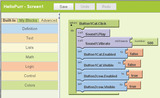
Also in this section, he mentions Scratch, a programmable language that kids can use to create interactive stories. I haven’t gone into this, but just the illustrations of the code remind me of the MIT App Inventor that I used to build a smartphone app (touch a picture of a cat, hear a purring sound, after which the image changes to a cow).
A scrap of Scratch
Say meow, then switch to the cow.
Scratch is one way that Resnick’s article moves into the Share section. He quotes Marvin Minsky as saying that the Logo programming language has great grammar but not much literature.
So the Scratch website is an example of "both inspiration and audience." And, in my way of thinking, if that’s not what you want to share, you at least see how sharing can happen.
Resnick is talking about children, but I come to this from a career mostly involving helping adults to learn. And perhaps the single biggest drawback to learning in the workplace (well, after you get past icebreakers and listening-as-learning and endless recordkeeping) is the dearth of support for reflection.
What are you doing? Why are you doing it? How’s it going? What do you think made that happen (for all kinds of outcomes)?
A colleague I respect recently said he’s decided to propose his first professional-conference presentation. I was surprised that he hadn’t presented already, but no matter. I can recall the first one I did. I wanted to share with people, but I was nearly paralyzed by the idea that I didn’t have all that much to say.
And you know, maybe I didn’t, depending on what measurements you choose.
What I did have was my particular experience (using a complex computer-based training system) combined with the data-based, lean approach to helping people improve, which I’d learned from folks like Geary Rummler and Dale Brethower.
My point is that thinking about what I’d been doing, and trying to uncover value it might have for other people, helped me see the everyday in a new light. That’s the goal of useful reflection.
* * *
I’ve written this post both to help me process the ideas in Resnick’s articles and to set down thoughts of my own. In addition, I found myself noting in a separate document things I wanted to know more about (like Crickets, epistemic games, and Lev Vygotsky). To me those were sidelights; I might discuss them one on one, but this post is plenty long as is.
Dave Ferguson
.
Blog
.
<span class='date ' tip=''><i class='icon-time'></i> Aug 19, 2015 04:59pm</span>
|
|
In the Learning Creative Learning online course, one suggested activity this week was to read Gears of My Childhood, Seymour Papert’s essay on how playing with gears as a very young child has influenced his life, and to share with others in the course a similar reflection based on your own experience.
I’ve enjoyed reading many of these. People talk about skateboards, about a box of dress-up clothes, about a "typewriter" with 12 keys (constructed from an egg carton, a paper-towel tube, and similar highly engineered materials).
One woman wrote about a box of watercolor paints her mother got for her:
…which she said were the best watercolors on the market at that time. I felt so professional! I made many paintings with them, including huge ones… The little watercolor pans are incredibly visually appealing to me and have a particular paint smell that I still find irresistible. I love the case, the way it snaps, the way the brushes fit elegantly in the isle between the rows of pans, and the way the palette comes out and attaches to the box to create huge mixing space.
She captured me with that snap. To me the word, the sound perfectly captures a way in which childhood memories are stored so deeply. We’re attending (without necessarily focusing deliberately) on so many parts of the experience and interpreting them in ways that make sense to us.
So the snap of the box is a central part of how she remembers and relives her paintbox experience. She is now a teacher of visual and media arts. In her comments, she says:
I recommend that my students go touch all the sketchbooks in the art store and buy the one that feels the best to hold. For many it helps establish a different relationship with the work and be a lot more productive. I think this concept also applies to the physical spaces in which we live and work.
Immediately I thought of an artifact from long ago — a repair manual I bought in college to help maintain my 1963 VW Beetle. I’ve written before about How to Keep Your Volkswagen Alive as an outstanding job aid.
The words about touch, though, reminded me of chapter 3, "How to Buy a Volkswagen." The chapter is 10 pages long, including an 18-step "pre-purchase procedure" that starts by telling you what tools to bring along.
It’s crammed with practical information intended to help the novice make a better decision about a used car:
[Start the car, and with the engine idling]…put your hands over the tail pipes, quickly because they’ll soon be hot, and feel the pressure. Feel the pulses; they should be even…
Then hold your hands about four to five inches away, letting the exhaust pass over them. The pulses should be even and about the same temperature If they are not, the engine needs or will soon need a valve job.
Prior to that pre-purchase procedure, Muir has advice on things to do before you even put the key in the ignition. These are paraphrases:
Walk around and look at the car. Does it sag and look beat? Do the doors open and close well?
Put your foot on the brake; it should stop three inches or more from the floor.
Push the clutch pedal with your hand till it’s hard to push. Let it up and see how much free play there is. More than two inches: the clutch is suspect.
He goes on with a short paragraph about the upholstery (as an indicator of overall treatment), the engine (it’s air cooled - dirt is a bad sign), play in the front wheel.
And then:
Now sit back and look at it again. Does it stand up with pride? Does it feel good to you? Would you like to be its friend? Use your other senses. Sit in the driver’s seat and scrunch your butt around. Hold the wheel and close your eyes and FEEL!
…Get away from the car and the owner or salesman to let your mind and feelings go over the car and the idea of the car. What has its karma been? can you live with the car? Walk around or find a quiet place, assume the good old lotus and let the car be the thing. At this point some revelation will come to you and you will either be gently guided away from that scene…
It is important that you neither run the motor or ride in the car until this preliminary scene has run its course. It also puts the owner-salesman up the wall because he has no idea of what you are doing and will be more pliable when the hard dealing time comes.
I was never quite that touchy-feely, not even when I bought my original copy of this guide from the Whole Earth Catalog back in 1968 or so. But I think Muir did a great job of situating the pragmatic, procedural parts of VW ownership and maintenance within the context of the reader situating the car into his life.
Dave Ferguson
.
Blog
.
<span class='date ' tip=''><i class='icon-time'></i> Aug 19, 2015 04:58pm</span>
|
|
A priest, a minister, and a rabbi walk into a bar.
The bartender looks up and says,
"What is this, some kind of joke?"
No matter how you reacted to that, it’s a lot like how I react to infographics.
Most of them are more about the graphic than the info, I think. In fact, I’d been planning to write a post contrasting infographics with job aids, because I think many people confuse the former with the latter.
Instead, thanks to Mark Oehlert, I came across Desmond Wong’s post, Infographics to Teach You How to Create Infographics. Wong talks about them as a marketing tool, then goes into the details of constructing them using PointPoint, and of harnessing layout and graphics to achieve your goal.
What’s that got to do with those folks walking into a bar?
Infographics are like jokes.
(This is a different statement from "infographics are a joke.")
Infographics are situational.
People enjoy jokes, but enjoyment (usually) hinges on context. What’s funny at work isn’t always what’s funny at the game; what sparks conversation at the coffee shop can put off someone reading online.
If you’re uninterested in the context, reading an infographic can sometimes like work-the kind of work you’re glad you don’t have to do.
If the graphic elements are well-done, though-when they engage us, the way a good joke-teller does-we’ll at least take time to find out what happens next. We might not stay long, but we didn’t pass by.
Infographics rely on patterns.
I haven’t read enough Jung to be sure, but I’d bet he thought about "walking into a bar" as one of his archetypes. It’s really the framework for a pattern: "I’m going to arrange some ideas here and play with them."
Not every pattern shows up in every good joke, any more than the same cards show up in a good poker hand. Like music, though, jokes and infographics are subject to their version of Duke Ellington’s test: "If it sounds good, it is good."
X-walks-into-a-bar is a stage for a virtual performance. For infographics, that stage is set, as Wong points out, with strong visual elements: blocks of color, distinctive shapes, headlines, callouts, hand- (or cherry-) picked data.
Even the overall shape is a pattern. While I’ve seen exceptions like Randall Munroe’s graphics on money and radiation, most infographics embrace a long-but-not-wide format. My hunch is they’re following the online convention: people scroll down, but not sideways.
Infographics are an invitation.
People tell jokes for all kinds of reasons, but they don’t tell them to themselves. Telling is only the start of the process. A joke is an invitation to share.
Maybe you’re sharing silliness or mockery. Maybe you’re sharing stereotypes to ridicule them-or to signal that you’re on the same side. Two-way sharing can be a kind of camaraderie: "Okay, how many accordionists does it take to change a lightbulb?"
Through wordplay and juxtaposition, jokes invite you to take up a different viewpoint. The unexpectedly funny jokes engage us with their contrast and make us feel good because we got them.
A good infographic invites you to look at its content in new ways. Whether polemical or political or even poetic, the infographic is saying, "Did you ever think…?"
I do have some misgivings. Some people seem to think that any collection of text, shapes, and colors doing time together is an infographic. I suspect they’re the same sort of people who think "outtake" is a synonym for "hilariously funny."
Still, if somebody wants to follow Desmond Wong’s tutorials and come up with his own infographic, I think that’s great. He’s got some design fundamentals and a set of templates as a fast start. The real learning begins where the infographic leaves off.
Dave Ferguson
.
Blog
.
<span class='date ' tip=''><i class='icon-time'></i> Aug 19, 2015 04:58pm</span>
|
|
My French isn’t that good: I can hold a conversation (sometimes) but I couldn’t hold a job. One way I try to get better is to read more and listen to more in French. I recently came across the Langue Française section of the TV5Monde site, which has an almost overwhelming range of features.
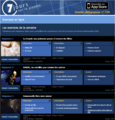
One of them is 7 jours sur la planète (7 Days on the Planet). It’s a regular feature with three segments from the week’s TV news. For each segment, you can watch the video clip, read a transcript, and then test your comprehension with three levels of questions (elementary, intermediate, and advanced).
I watched the first clip in the grid above, about fish fraud (one species of fish passed off as another). I got the gist, then brought up the transcript to spot words I didn’t know, or catch meanings I might have mistaken.
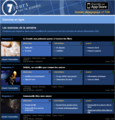
That’s when I discovered Alexandria. TV5Monde’s site is set up so that on a page with a special icon (red circle with a question mark in the upper right of the following image), you can double-click any word to bring up a multi-language dictionary:
In this example, I clicked on l’étiquette. Alexandria popped up with a French-language dictionary, which reminded me that une étiquette is a little card or tag with the price, origin, or instructions for some product or item of merchandise.
You can set the dictionary to translate into any of more than two dozen languages:
("Choose your target language.")
What impresses me about this approach is that TV5Monde doesn’t have to create specialized hypertext for certain words. As far as I can tell, Alexandria’s dictionary works with any word on the page.
If you don’t know any French, of course, this would be a terrible way to learn it. You wouldn’t have any background to decide between one meaning and another, and a dictionary can’t tell you much about syntax or context. The title of the segment in French, La fraude aux poissons passe à travers les filets, could be read as "Fish fraud passes through the nets." But even my paperback French-English dictionary has 27 main entries for passer, and given the subject, I’d translate the title as "Fish fraud is slipping through the nets."
If you’ve got a low-to-intermediate level of ability with French, this is a powerful tool to help you understand more of what you read on the TV5Monde site.
It looks like there’s a lot more to Alexandria-more than I can spend time on this morning. I have the impression you can link any web page to the dictionary’s features. I haven’t tested that yet, but I will.
Dave Ferguson
.
Blog
.
<span class='date ' tip=''><i class='icon-time'></i> Aug 19, 2015 04:58pm</span>
|
|
I’ve been doing a little self-directed learning lately. And it came about because someone told me about Larrivée guitars. Although I hadn’t heard of them till a couple of months ago, I can assure you they’re out of this world-one has been on the international space station for years.
I play guitar, not very well. Mostly I strum chords, because I like to sing. But in that conversation I mentioned, my friend encouraged me to think about getting a quality instrument. That suggestion came at a good time; although I’m not quite ready to spring even for a used Larrivée, I did start picking up the somewhat battered classical guitar I bought when I was in college.
For much of that time I’ve kept a couple of books on fingerpicking. Every so often I’ll work through one or the other, and when I sense some improvement, I feel pretty good. In addition, because I’ve been on a Zachary Richard kick lately, I’ve been trying to learn a couple of his songs, like Travailler, c’est trop dur (link to a video and an English translation on my French-language blog).
That was one track: doing more with my own guitar. A second track was to find out more about Larrivée guitars, and there seem to be few better places than the Larrivée online forum.
When I enter a new community like this, I wander around for a bit and don’t say too much too soon, unless I can contribute something positive, if only to my experience with a guitar-tuning app for Android phones.
I saw that someone on the forum was selling some DVDs-tutorials for fingerpicking. Turns out they feature Happy Traum, a prolific and popular guitarist and instructor. In fact, one of those instruction books I’ve hung onto for so long is his.
Even if you don’t play an instrument, you can get a sense of Happy’s relaxed, encouraging approach:
That sealed it for me, and the DVDs arrived last weekend. As Bill Deterline said, "Things take longer than they do," so I’m not fooling myself about how quickly I’ll pick up the techniques in the DVDs.
I can’t help but notice the interplay between what’s essentially a lecture-Happy Traum on DVD, explaining and demonstrating-and the invitation to not simply practice, but to actively modify your practice in order to expand you abilities.
Fundamentally, this is a tightly focused relationship. In effect, Happy’s done instructional design around a specific topic: not just "fingerpicking styles" (content alone) but "how to help a beginner learn to fingerpick."
He can’t see you or hear you, and he probably doesn’t have enough time in his schedule to work with every student one-to-one. Instead, he starts by slowly and carefully demonstrating and explaining fundamentals. It’s show-and-tell so you can hear-and-do (or at least hear-and-try).
The first thing we should work on is your steady thumb… Keep a bass going relentlessly, so that you always have that pulse underneath your picking… The ability to keep that thumb going while you’re doing whatever else… You have to develop the facility for doing that. It’s kind of like reprogramming your brain…
First thing we’ll do, just do it on one string… Do this with me…
Within a few minutes of that, he adds:
"The most basic melody note" — add a treble note by plucking the first string on just the first beat
Switch the treble note to the second string, still on the first beat
The second string on the first and the third beat
"Now let’s try putting a note on the first and second beat, but leave the third and fourth alone."
Same thing, but with the second string.
Alternating between the first and second string (first string on the first beat, second string on the third beat).
I don’t want to keep quoting from the DVD, but I do think that attendees at more than one learning conference could profit from seeing how deftly Happy introduces complexity at a rate that challenges but (mostly likely) doesn’t frustrate the beginner.
(As for badges-when you’re able to get through "Skip to My Lou" at a normal pace, with the steady thumb-beat and the melody in the upper strings, you’ll have all the badge you need for attaining that particular level.)
Probably some people could figure this out on their own, but I suspect that as with so many other fields, beginning guitar players can feel overwhelmed, not knowing what to pay attention to or what’s an optimal way to proceed. Brownie McGhee certainly didn’t learn guitar from a DVD — but Happy Traum learned from McGhee, and depending on your access to an in-person teacher and your interest in guitar, you can learn from Happy’s DVD.
To emphasize the variety of things that people mean when they say "learning," I often talk about learning a language. Does learning mean mastering basic grammar? Reading literature in that language? Watching movies without subtitles? It depends on context.
And that’s true with "learning the guitar." There are some areas that most people would agree on-you probably need to know what standard tuning is, and probably need to know the basic fingering for chords. So there’s explicit knowledge as a foundation for tacit knowledge (it’s one thing to know what the tuning is, it’s another to actually tune). Beyond such fundamentals, there’s the melody or song you want to play, and there’s the integration of all this into a performance.
I’m not performing much yet. One of my mid-term goals is to improve enough that I could try a Larrivée in a store without completely embarrassing myself. We’ll see how that works out.
Dave Ferguson
.
Blog
.
<span class='date ' tip=''><i class='icon-time'></i> Aug 19, 2015 04:58pm</span>
|
|
Between the corporate and academic worlds, the borderlands are wide and mostly ill-defined, but you can always rustle up a ruckus by asking, "What’s the difference between training and education?"
I’m not that big a ruckus-rustler, and nearly all my career has taken place in the non-academic world-at least since a Certain University bounced me, and other unworthies, from its adjunct faculty because we lacked what it referred to with a straight face as "the terminal degree."
But even in the efficient system of a corporation (which, as Voltaire might have said, is at times neither efficient, nor systematic, nor corporeal) you can spark a decent-sized ruckus by asking about the difference between training and learning.
The main difficulty is that many people who’ve worked in what used to be called training and development have come to see that training as it’s been practiced can be:
Narrow in scope (the task, maybe the job, rarely the function)
Limited in timeframe (this week, this month, this quarter)
Modeled on the dreariest aspects formal education (classrooms, lectures, the semester contact hour)
Posited on the transfer of skill-and even more so on the transfer of knowledge
I think all of those are generally true, though I don’t think they’re generally evil. For example, I see "transfer of skill" as a metaphor for a process through which someone who lacked a skill comes to acquire it. I do not equate that phrase with "content dump," though I’ve sat through more than one training class that held strictly to the knowledge-as-freight approach.
Still, the traditional (albeit diminishing) approach to training is a kind of freight train. There’s no steering wheel; someone else controls the signals and throws the switches. To further overextend the metaphor, the suboptimal form of learning is-I don’t know, some solar-powered, personal flying car, powered by your innate desire to learn.
I’m all for learning, and in particular for learning the things that interest me, but I’m not delusional enough to think that I can necessarily maintain the standard of living I’d like to maintain solely through that.
The drawback, at least in the most extreme forms of this point of view, is that somebody’s got to value your ability to learn what you want, when you want, enough to provide you with a means of making a living. I’m sure people manage that, even a few people I know, but I have no clue how to pull that off myself.
And that’s okay. Especially since I have a new home (Victoria, British Columbia) and a new job-working for a crown corporation in BC. (It’s roughly the equivalent of a not-for-profit corporation, established by the province to administer public-sector pension plans.)
I’m a curriculum designer, which means I work with stakeholders and subject-matter experts to figure out how our people can master new or changing conditions in order to better serve members of pension plans, as well as satisfying the requirements of the plans themselves.
The job search that led to this move is one reason I haven’t posted here for so long: I’d hit a slow period in terms of consulting, and I was ready to make a change. Moving 3,000 miles to another country seemed to have accomplished that.
Years ago, my first professional experience with social media was as part of the original TRDEV-L listserv begun by David Passmore of Penn State. (If you have no idea what a listserv is, then you have some idea how long ago that was.) Many participants wanted to make clear that they spoke for themselves and that their opinions were not necessarily those of their employer’s. My own email signature for TRDEV-L included "My opinions, not GE’s."
Tthat approach still holds. I’ve missed my blog and want to resume thinking out loud about the interests, ideas, and notions that I see as relating to learning and performance in the workplace. None of this should be taken as necessarily reflecting any policy or program of BC Pension Corporation, or the province of British Columbia, or the government of Canada, or anything other than something that held my interest long enough for me to write about it.
It’s good to be back.
Dave Ferguson
.
Blog
.
<span class='date ' tip=''><i class='icon-time'></i> Aug 19, 2015 04:58pm</span>
|
|
I recently came across a link to this infographic by Julian Hansen.
Infographic by Julian Hansen
I don’t see most infographics as a job aid. They usually aren’t intended to guide you through a task, and don’t usually serve well as reference job aids (my term for information that’s been organized for quick reference). I don’t think this would serve as a true job aid for most non-designers-it’s really busy, and the criss-crossing paths could easily confuse someone.
As this Fontfeed article states, though, that wasn’t really Hansen’s goal.
Instead of simply browsing through type specimens, Julian wondered if he could come up with something more rational, a systematic approach [to choosing typefaces]. His project took the form of a flowchart on a poster. Studying different type finders made him come to the conclusion that selecting type really could be a matter of taste…. This made Julian decide that his poster should not only be useful, but also be light-hearted and make fun of stereotypes. This made him throw in options like "is it an Italian restaurant?" for instance. His ultimate goal was to show that typefaces convey a whole lot of meaning that "ordinary" people just don’t see.
Assuming that’s true, I see the chart as one way to demonstrate understanding: here’s what I think about fonts and when to use them. This is part of what I think Jane Bozarth means when she says, "We learn by doing, and by telling what we’re doing, and by watching others do things, and by showing others how we did something."
Personally, I’m not much info fonts.
That’s not the point, though. Work like Hansen’s has the potential to trigger further interest in people. For example, after reading his chart and the Fontfeed article, I happened to see a tweet by @MizMinh linking to an article on The Next Web:
The Science Behind Fonts (and How They Make You Feel)
Personally, all my working out loud lately has been done on site, in my new job. I’m not unhappy about that; I’m working on an engaging project and I have collaborative colleagues. But I’ve been neglecting other avenues, and this post is one effort to overcome that neglect.
Dave Ferguson
.
Blog
.
<span class='date ' tip=''><i class='icon-time'></i> Aug 19, 2015 04:58pm</span>
|
|
For a few months, I’ve been head-down in my new job (I’m a curriculum developer with the BC Pension Corporation). Much of it involves helping our staff adapt to changes in the tools they work with or in the processes that those tools work on, in order to serve our members-the people covered by various public-sector pension plans here in British Columbia.
There’s a significant procedural component to that. Pension plans in general are governed by all kinds of rules — vesting requirements, contribution tracking, tax issues — and can have so many options that they’d daunt Benoit Mandelbrot. That’s one reason that a few weeks ago I noted this post by Misty Harding at the eLearning Brothers site.
One trigger for her post on handling boring content was boring content:
I realized that I didn’t need to spend any more time wrestling with that yawn-worthy content, and neither did the learner. I achieved this through (brace yourself Instructional Design World), not focusing on the content.
Much of what she then offers will strike many people as common sense, but those people are probably turning out pretty good stuff. This is a quick summary; read her full post for helpful details.
Give them something to do that isn’t at its core touring the boring content.
Violate expectations: approach the learning challenge (as opposed to "the content") in an unexpected way.
Let them take on a role so they need to solve a problem.
Part of what Misty Harding is addressing, I think, is the gap between procedural knowledge and tacit knowledge. In any organization serving individual customers, be it BC Pensions or Zappos, you’ll find reams of procedures. Invariably these deal with routine processes — or at least processes that can be routine-ized, because at some level the steps and the decisions are predictable and the range of outcomes is fairly small.
What’s far more challenging is combining these procedures effectively-a point that Harold Jarche makes in this diagram:
From Tacit Knowledge Not Included by Harold Jarche
If like me you’re trying to help people who have to deal with things on the "routine work" end of the diagram so they can deliver things of higher value, then whatever training and support you produce benefits from being set in a realistic context.
It also benefits from avoiding stuff that doesn’t relate to that delivery. (I recall an EEO compliance officer who insisted that people needed to know the dates of EEO-related legislation-in a course on helping an employee to pursue a discrimination complaint.)
"Realistic" also does not mean the typical software Field Trip:
This is the Last Name field. Enter the last name here.
This is the First Name field. Enter the first name here.
This is the Street Address field. What do you enter here?
(ad blooming infinitum)
The training course I’m working on at the moment deals mainly with changes to our procedures caused by legislation going into effect next month. It’s not earth-shaking; it’s not going to reset paradigms for everyone who works at the corporation. Even so, our design relies heavily on teaching the rules and principles by having participants work through a series of problems.
Even the initial look at procedures for choosing the beneficiary for a pension will involve opening the online procedures (just like you do in the target jobs) and working a sample nomination form (our term) through the initiation, evaluation, and entry stages.
What about things that are new or significantly changed? Well, take one new on-screen button. It enables a feature that didn’t exist in the previous version, because the underlying capability didn’t exist. No matter what the label is on such a button, without context people are likely to misinterpret it.
Rather than introduce it as part of a field trip ("here are 27 changes you’ll see on 9 different screens"), we’ll deal with it in the third practice exercise, which will be the first time clicking that button would make sense.
What’s all this got to do with tacit knowledge? In part I think tacit skills emerge as you combine procedural skills (and interpersonal skills) in job-related contexts. You’ve got to build them up, and working with realistic problems-including relating them to your experience, speculating about variations, and exchanging ideas with experienced people-is one way to help foster that construction of knowledge.
Public domain button image by decosigner.
Dave Ferguson
.
Blog
.
<span class='date ' tip=''><i class='icon-time'></i> Aug 19, 2015 04:58pm</span>
|
|
Four years ago I started using the WWDiary app to keep track of how I was doing with the Weight Watchers approach to, well, watching my weight. I never officially joined Weight Watchers, but my wife did, and I seized an opportunity for self-improvement.
I’ve written about this topic here, and especially here (my favorite), and most recently (if Oct. of 2011 is recent) here.
I’m revisiting the topic in part because as I write this, it’s four years to the day since I started with that app, and I weigh 55 pounds less than I did then.
Another reason is that this anniversary, and how I reached what to me is a milestone, relates closely to the idea I came across today in this tweet from Ruud Hein (@RuudHein):
The link in the tweet takes you to this post on Google+ and onto another of those virtuous cycles that make the hyperlinked world such a joy at times. I’m crediting Hein, who credits All Smith and Branko Zecevic with linking to a post on Inc.com by Jeff Haden.
(Got that?)
I want to highlight the excerpt that Hein highlights:
Commit to a process, not a goal….
We put unnecessary stress on ourselves to lose weight or to succeed in business or to write a best-selling novel. Instead, keep things simple and reduce stress by focusing on the daily process and sticking to your schedule instead of worrying about big, life-changing goals.
When you focus on the practice instead of the performance, you can enjoy the present moment and improve at the same time.
Often in my life, to-do lists have just depressed me-especially the end-of-day or end-of-week carryover, as still-to-do items plodded through the calendar. There was the temptation to knock off a mess of low-priority things.
(Admit it; you’ve done it, too. The deadline is looming and you spend the afternoon fixing the transitions in PowerPoint.)
Looking at the process is a higher-level way of answering the question, ""What do you want to have happen?"
Four years ago, I started with "lose some weight" but reframed that to "get in good shape" (which I guess sounded better to me at the time than "be healthy," if only for the active verb). That turned out to be a far better goal, because it was easier for me to identify some processes likelier to get me there eventually.
I don’t mean for a second to position myself as a expert on weight loss — but I’ve become a far better manager of my own systems. I’m a practitioner of things that tend to keep me on a path I wanted-and still want-to be on.
I’ve been at my new job four months now. I have coworkers I look forward to seeing, people who want to share, to experiment together, and with whom it’s a pleasure to figure things out. Even as my current project rushes to the delivery date, I find myself engaging more both with my face-to-face peers and, sporadically, the many virtual colleagues I’ve encountered.
That’s part of the practice I need to be practicing: not just connecting, but regularly and purposefully connecting. Not just reading, but regularly and purposefully reading. Not just thinking out loud, but regularly and purposefully doing that.
CC-licensed photo by Víctor Nuño.
Dave Ferguson
.
Blog
.
<span class='date ' tip=''><i class='icon-time'></i> Aug 19, 2015 04:58pm</span>
|