Blogs
|
I started to write about learning new software. But no one learns software for its own sake. Software’s like a second language: you learn it because you have a goal. Even the well-intended "everyone should know how to code" silliness has a goal, which is less about coding and more about something like logical thinking, understanding complex systems, or producing a result that the coder finds worthwhile.
I decided I wanted to write about two things: why I wanted to learn this particular software, and how I’m not learning the way the program’s developers think I should. I’m not even learning the way I might have thought I should. It’s going to take me a couple of posts; this is the first.
What I wanted to learn
Last year, I joined the Victoria Gaelic Choir. Gaelic (Gàidhlig, Scottish Gaelic) was the language of my ancestors and even my grandparents. I know only a few words and phrases, but I’ve know Gaelic singing for a long time-and if you don’t, there’s a list at the end of this post to get you started.
As I said last year, this opened a clutch of challenges. I needed to learn lyrics in a language I don’t speak-one whose spelling and pronunciation aren’t always easy for an English speaker:
O seinnidh mi dàn do dh’eilean mo ghràidh
(O, I’ll sing a song to the island that I love)
"oh shay-nee mee dawn doh yell-un mo gr-eye…"
And before the lyrics, I needed to learn the melody for many songs I’d never heard. (Tune first, words second; trust me.) Even for those I did recognize, I needed to learn the tenor part.
I can pick out a tune or a tenor line on guitar, but that’s not a practical way to learn a choral piece. I seriously considered buying an electronic keyboard, but my son (thank goodness) suggested I experiment with a 30-day trial of Sibelius First.
With Sibelius, I know what I’m doing. Or what I should do.
This $120 package lets you compose music on your computer and share it with others. I didn’t plan any composition, but the features that caused my son to suggest Sibelius include the ability to scan printed sheet music, to create an editable digital score, and to export sound files.
Sheet music to an mp3? Does it work?
Let me show, rather than tell. That line of Gaelic above is from Uibhist Mo Ghràidh (Uist, My Love), an archetypal Gaelic song about the island of North Uist, where my mother’s people came from.
O seinnidh mi dàn do dh’eilean mo ghràidh
far an d’fhuair mi m’àrach nuair bha mi nam phàisd’
Far am bi mo chrìdhe gu deireadh mo là
ann an Eilean Uibhist an eòrna.
O, I’ll sing a song to the isle of my love
where I was raised as a child
where my heart will be to the end of my days
In the Isle of Uist of the barley.
If you want some idea of how I felt when everyone else in the choir knew this, listen to Linda NicLeòid — Linda MacLeod — singing. (I’ll resume below below the video.)
A recording like this demonstrates the melody, and from Wednesday night choir practice I had a nodding acquaintance with the tenor line. But "once a week" takes the idea of spaced practice to an extreme. I needed to hear the tenor part on its own, a lot, so I could practice.
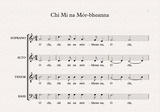
I chose Uibhist Mo Ghràidh for this post to show what I was able to do after working with Sibelius off and on for about three months. Starting with a good copy of the sheet music, arranged for soprano, alto, tenor, and bass:
I scanned the music into Sibelius.
I edited a few errors the scan didn’t quite catch.
From the digital version, I exported audio files for each part and for the four parts together.
Sibelius allows me to choose instruments-which means I can make the audio sound like piano, or like human voices. I went the latter route. Here’s the full choir audio, and here’s the tenor part.
The audio comes out as .wav files. It takes me less than a minute to convert them to mp3s, which I can then send to my phone or share with other members of the choir.
That’s where I went. Next time: how I got there.
It’s taken me a while to write this post, because I kept rethinking what it was I wanted to learn and how I could explain the context. If I had to summarize my own learning goal, it’d be "have the tune for the tenor parts to Gaelic songs I want to sing." That’s an oversimplification, but it was also a 14-word target I wanted to hit.
It took some effort before I could hit it, and the process of that learning is what will be in the next post.
Those Gaelic songs I promised
Raylene Rankin(Click for an appreciation from the Halifax Chronicle Herald)
Song may be one of the most enduring ways to preserve and transmit a language. Here are a few examples-the links in the song titles lead to a recording of the song. When I’ve been able to find an online translation into English, I’ve put a link for that as well. (The links are set to open in a new window.)
The late Raylene Rankin (a distant cousin) singing An Innis Aigh, The Happy Island, about Margaree Island, which you can see from my home town on Cape Breton. (Lyrics and English translation at the same link)
Kathleen MacInnes, Òganaich An Òr-fhuilt Bhuidhe, Young Man with the Golden Hair (lyrics and English translation).
The Campbells of Greepe, who start with puirt-à-beul ("mouth music") meant to imitate instruments and meant to dance to.
Karen Matheson, Gleann Bhaile Chaoil, Ballachulish Glen (lyrics and English translation).
Runrig, Cearcall a’ Chuain, The Ocean’s Cycle (both Gaelic and English in the video). There are typos in the Gaelic, but you’ll probably overlook them.
Dave Ferguson
.
Blog
.
<span class='date ' tip=''><i class='icon-time'></i> Aug 19, 2015 04:57pm</span>
|
|
Lots of people in my extended network have been working out loud — sharing what they do, and the thought process behind it — long before #WOL as a term got very far down the street. This informal reflection (often followed by informal exchange) has made a tremendous difference in how I learn things and how I get better at things.
If you’re not familiar with the idea, for starters there’s John Stepper’s book, and there’s Jane Bozarth’s Show Your Work. In both cases the emphasis is not simply on what gets done, but how it gets done.
Before the week’s over, I wanted to go out loud with a small item that’s produced a lot of progress for me in the past six weeks. I’d like to have something more obviously impressive, but I’m going with "personally worthwhile." I can’t find the original source — most likely because it’s buried in the cognitive junk drawer of my Twitter favorites. But the idea is this:
If you’ve got some future goal — say, you’re giving a presentation in four months — there’s research to suggest that framing your goal in days, rather than weeks or months, is a much more effective way of spurring yourself on.
Try it yourself: which has more psychological weight? "I’ve got three months" or "I’ve got 91 days."
The notion intrigued me, and with not much searching I found the Countdown Widget at the Google Play store.
The day I installed it was four months ahead of the target I’d set for myself. But the widget counts down in days — so it displayed 120 on my phone.
As you can see in the screen shot I took this morning, that’s now down to 78. I’ve got work to do this weekend.
I made sure to put the widget on the home page, and so every time I glance at my phone, I’ve got a double reminder of the schedule I chose: the number of days appears, and the bright ring around the number disappears, bit by bit, with each passing day.
What this has done for me is probably what end-of-the-day reflection does for other people, or a carefully tended to-do list: I look at this and ask myself what I can do next to move forward toward my goal.
Another out-loud angle: I talked about this with a co-worker, and at least three times a week she’ll notice the countdown on my phone and ask what I’ve done on my project lately.
Dave Ferguson
.
Blog
.
<span class='date ' tip=''><i class='icon-time'></i> Aug 19, 2015 04:57pm</span>
|
|
Joe Ganci, a prolific and generous e-learning consultant, just published a column in Learning Solutions Magazine: The State of Authoring Tools: Where We’ve Been, Where We’re Going.
I think it’s worth reading in full, especially since Ganci’s experience is deeper and far more recent than my own. His reflections on the origins of e-learning triggered a number of thoughts for me, and this post is a sort of extended comment on Joe’s article.
Oh, boy, we’ve got learning NOW! (CC-licensed image by Patrick Finnegan)
He mentioned two of the ancestors of modern elearning: PLATO and TICCIT, both of which began in the 1960s. I first encountered mainframe-based computer-based training (as elearning was called then) in 1978 via the IBM Interactive Instructional System, and two years later was the head of a team developing training for Amtrak’s new reservation system, using a competing product, Boeing’s Scholar/Teach 3.
It’s telling that I couldn’t find a worthwhile link for either of these last two.
I also remember a long-ago conference where someone asked, "How many of you have seen PLATO?" Nearly every hand went up. "How many of your organizations use PLATO?" Not a one.
In 1979 I was put in charge of developing CBT for Amtrak’s new reservation system-to new it was still under development as we learned the authoring system and started designing the courses. Our IT department got the CBT software up and running, but we were left on our own when it came to using it. So I had to teach myself and then my team quasi-programming concepts like using variables to track progress, record quiz results, and control paths within a course.
I clearly recall the next stage of elearning, a proliferation of chip-laden devices rolling through trade shows like the Bandwagon Express. When Joe mentioned the two Authorware camps — icon-draggers and codeheads — I recalled a set of definitions that’s served me well for years:
Easy to learn: hard to use.
Ease to use: hard to learn.
Easy to learn and easy to use: won’t do what you want.
The reality is that the people who buy elearning systems (as with much other organizational technology) are not the people who have to use them, either as developers or, alas, as learners. Hence my agreement with this passage in Joe’s article:
Very often we hear vendors say that we no longer need instructional designers because the tools are so easy to use that Harry the Engineer can create the engineering course himself, or Susan the Physicist can build that physics lesson herself. The bean-counters in those organizations buying those tools are psyched at all the money they can save by not hiring or contracting instructional designers (and of course programmers) to fill their learning needs.
They don’t know, of course, that the resulting lessons are often at the very least anemic and at the worst nothing more than boring text and images punctuated with a Jeopardy game and quizzes. Learners end up expecting their eLearning to be onerous and are resigned to getting through it as quickly as possible and in some cases cheating if they can.
Some of those people may have taken a course I once worked on, aimed at supervisors. The client insisted that a lesson take two hours to complete-because that was the standard required by the state of California for the topic at hand.
This approach and similar ones have nudged corporate elearning ever closer to to the status of Death By PowerPoint, only with voiceover. And the inevitable Jeopardy review.
Formal training in organizations has always struggled between flashy features (the ooh!) and effective learning (the ah!). Far too often, the ooh wins — so you’ve got terabytes of animated demos of corporate systems, with the apparently mandatory click-click imitation typing, yet almost never a way for people at work to practice safely in the actual systems (such as via a robust training mode built into the system).
I admire Joe Ganci’s optimism, and I couldn’t agree more with this opinion:
If you ask yourself, "What will my tool allow me to do for this audience and this content?" then you’re asking the wrong question. The real question should be, "What is the best approach to have this audience learn and so what interactions should I build?"
Dave Ferguson
.
Blog
.
<span class='date ' tip=''><i class='icon-time'></i> Aug 19, 2015 04:57pm</span>
|
|
I’ve been collaborating on a course with my colleague, Tanis. An unexpected benefit has been the ability to float an initial idea, talk about it, and have it improve from the discussion, from feedback, and from new ideas these things engender.
I want to talk about one of those engendered nuggets. I’m a bit hesitant, because when you get to the end, you may well think "Yeah, so?" For me the path was well worth following, and I might not have taken it without the back-and-forth with Tanis. So this is another form of working out loud.
The topic doesn’t actually matter much. If you’re curious, see the following aside; otherwise, just skip past.
About the topic:
Many pension plans allow purchase of service, a way for a person who hasn’t contributed to the plan (for example, during a leave of absence) to pay additional money into the plan. That payment is the purchase. The person then gains credit for the corresponding work time-that’s the service. Purchasing service can increase the amount of your eventual pension.
Different plans have different rules and coverage, and within a plan there are usually several types of purchase of service. You can see typical examples here (for an Ontario plan) and here (a Pennsylvania plan).
Some pension plans use other terms, but purchase of service is the one we use.
The nugget emerged as we juggled three goals for the first part of our course:
Introduce a new type of purchase
Connect this new type to what people already know
Provide a framework to show what the various types of purchase have in common
Employees taking our course would already have learned how to handle certain purchases, like the leave of absence mentioned above. In the new course, they’ll learn the details for purchasing arrears (payment for a period when contributions should have been made to the pension plan but were not-for example, because of clerical error).
Version one: framework → known → new
CC-licensed image by João Moura
Working with internal documents and with our subject-matter experts, we discovered a pattern that seemed to apply at a high level to all purchases:
Circumstances occur that make a purchase possible.
The plan receives an application for the purchase.
Plan staff analyze the application to see whether the purchase is permissible.
Plan staff calculate the cost of the purchase.
There’s a lot more to it, and there are nuances and conditions for each of those, but it didn’t seem like a bad framework. Having laid it out, we could ask participants how a leave-of-absence purchase would fit into this, since they’d already know how those purchases work. Then we could start talking about arrears purchases, to show how at this level they’re like other purchases the participants have worked with.
On second or third glance, though, this version felt abstract. Our plan staff don’t work directly with frameworks; they work with the specific purchases. And so we moved to…
Version two: known → framework → new
In the revision, we decided to start by describing out a leave-of-absence purchase according to our framework: a person goes on maternity leave; she later applies to purchase the service; the staff evaluate the application; we provide a quote for the cost. We’d make sure participants saw how at a high level thus was how the LOA purchase worked. Finally, we’d introduce arrears purchases using the same framework.
CC-licensed photo by MTSOfan
This felt better, in no small measure because we began with the specific and not the abstract. And we felt we were doing a better job of connecting to what people already knew.
As we worked on other parts of the course, we’d revisit the intro. Gradually we began to feel that we were explaining for the sake of explaining.
I’ve been in the instructional design field longer than Tanis has, and I feel as though I should have known better. It’s always tempting to try and make things clear. As we poked at this, though, we realized that the key point is not that a leave-of-absence purchase follows these four stages, and so does an arrears purchase.
What was important? Knowing about LOA helps you to learn about arrears.
Version three: known → new
Here’s the sequence we now have-and in the course, the sequence takes much less time than you’ve spent reading this post:
Ask participants to describe the phases of a LOA purchase, from the member’s point of view, in 25 words or less. (We don’t care about word count; brevity encourages big-picture summary.)
Show a diagram with LOA information illustrating our four phases: the maternity leave, the application, our research, the cost estimate. Discuss how the experience of the participants aligns with this pattern.
Redraw the diagram with an arrears purchase replacing the LOA one.
CC-licensed photo by James
We really like having the participants start by sharing their own ideas about the processes involved in the purchases they already work with. We then show our summary (the LOA in the four phases) and make sure they see their own experience in that summary. Finally, we can start talking about arrears.
So now we don’t belabor the four phases; they’re just stepping stones between the familiar and the new. We’re inviting participants to build the connections that work for them.
What comes next? We use this intro as a springboard to what’s different about purchasing arrears. We ask participants what they think might trigger an arrears. If they already have an idea, great-we can reinforce that. If they don’t, that’s okay, too; their interest level is higher as we move into the explanation.
Dave Ferguson
.
Blog
.
<span class='date ' tip=''><i class='icon-time'></i> Aug 19, 2015 04:57pm</span>
|
|
In a previous post, I talked about deciding to learn Avid’s Sibelius First, which is software for composing music. My goal wasn’t composition, but I’d read that I could scan sheet music and produce an audio file. I’d joined a choir and wanted to hear the tenor parts for the songs we sing.
This post is about challenges I ran into and reflections I’ve had about how I went about learning.
Cha cheòl do dhuin’ a bhròn uil’ aithris.
(It’s no music to a man to recite all his woe.)
From a glance at the product site, I thought my choral problems were over. "Choose the note input method that’s most comfortable for you-play a MIDI instrument, transcribe audio, or scan sheet music." I downloaded the software and launched into my own 30-day trial.
There’s more than one meaning for "trial."
What I bumped into was my own misapprehension. After fiddling around with the menus and discovering that the reference manual is 437 pages long (not counting glossary, shortcuts, and index), I found that I couldn’t scan handwritten music (like the first piece I wanted to try), only printed music.
I also discovered that while I knew a few things about music (I can play guitar and on a piano can pick out melodies on the treble clef), the details of Sibelius First were a bit like the details of relational databases or organic chemistry: the individual words mostly made sense, but the combinations and contexts often left me stranded.
Chan e na léughar a ni foghliumte ach na chuimhn-ichear.
(It’s not what’s read but what’s remembers that makes one learned.)
Sibelius First comes with three tutorials whose printed guide is 87 pages long. Here’s what you find under "Start Here."
Warning!
However much you may dislike manuals, you must read the whole of this introduction in order to get started with the program.
You are then very strongly advised to work through at least the first three of the five tutorial products before embarking on any serious work of your own with Sibelius First. Sibelius First is easy to learn and mostly self-explanatory, but if you don’t work through these projects you will run a risk of never discovering some basic features, particularly if you are used to notation programs that work in different ways. By the time you have completed the projects — which will take you only a few hours — you will be able to input, edit, play back and print out straightforward music, and you’ll know how to get going on more complicated music too.
Actually, I stuck with the tutorial long enough to read the "7 main elements" of Project 1. They include opening a score, editing and inputting notes, selections (I think they mean "selecting") and copying music, and "Flexi-time™ input." Not a word about scanning.
I had no interest in opening a score, and doubted whether Sibelius could open a PDF of a printed score I had. I had some specific goals in mind, and the admonitory tone of the warning didn’t seem to offer much hope of reaching those goals without submitting to a period of initiation.
I don’t want to beat up on Sibelius. This is the crux of off-the-shelf software training: it homogenizes learners to such an extent that it abandons almost all context that’s meaningful to them.
So I refined my context: how do I scan music? It was at about this point I began printing selected chapters of that 437-page manual. Tracking down mentions of scanning, I came across "PhotoScore," which seemed to be a kind of add-on needed to scan. Where was it? Why didn’t I see it?
I was better able to tackle these questions, in part I think because their scope was more limited. At worst, I’d have to discovered I was wrong — but I wasn’t. It’s been a while and I may have the sequence wrong, but I think I did the download wrong.
I assumed it was one big download with all the necessary parts. In retrospect, I had to go back to the download page two or three more times to pick up various packages I didn’t realize I needed.
This began a series of two-steps-forward, one-step-back incidents, such as:
Discovering I had to start PhotoScore from outside Sibelius.
Scanning my first page and not understanding the results.
Scanning a complete piece and figuring out how to edit
Moving the edited piece from PhotoScore to Sibelius
Discovering that I couldn’t hear any audio because I hadn’t downloaded the audio portion of Sibelius
It’s been close to six months now. I’ve produced audio files for at least 10 pieces, including eight that include separate parts for all four choir voices, along with nice clean scores in PDF. I even bought a numeric keypad to attach to my laptop (see footnote below for technical explanation). Most important, I’m more than satisfied with my investment of time and money.
And what about learning?
Beiridh am beag tric air a mhòr ainmig.
(The frequent little will overtake the infrequent large.)
Especially early on, I’d work trying to transcribe a piece. I’d stop when I felt stumped, roam around in the manual, but very often would make guesses about what might work. Some of those guesses became more educated in time. So I was doing the typically messy learning by doing (and, yes, learning by failing).
Ironically, I continue to have very little interest in finishing the Sibelius tutorials. Some of that is just my annoyance at the tone of the warning; some is the sense that I may have taught myself a good portion of what I might have learned, and I’m several pieces of music to the good.
On the other hand, now that I’m more familiar with what *I* can produce, I might be more open to picking up something unexpected.
Which leads to another reflection: for me, in this circumstance, good enough is good enough. I’m not trying to make a living as a music composer or arranger; I’m just trying to learn my choir parts. I think there’s a message in that for those hoping to turn people in the workplace into All Learning, All the Time: most people don’t want to do anything all the time.
At the same time, my definition of "good enough" is changing; my standards have become higher. When I see in sheet music something tricky like a pick-up bar (one at the start of a piece that doesn’t have, say, the four beats that 4/4 time calls for), I want to get the Sibelius transcription to show it and the audio file to play it as written.
I’ve even managed to do things like take music written on two staffs, like this, and scan it…
…and then have Sibelius expand it so that each voice is on its own staff, like this:
That latter version takes more space, since the lyrics appear separately for each voice. Choir members like that; they can more easily focus on their own line, especially when not every voice is singing the same word for the same length.
That’s another lovely song, and one you might have heard. Here are the Rankins singing it:
And here are the lyrics in Gaelic and English.
I’ve become more curious about musical things; I understand more about notation, and I want to figure out how to get Sibelius (and thus the audio files) to do things like multiple repetitions of a chorus — especially because in a Gaelic song like Horo Gun Togainn air Hùgan Fhathast (link to a BBC audio file), with a three-line chorus interwoven with two-line verses.
My choir takes the summer off, and I’ve been working on a professional project (if you’re going to DevLearn at the end of September, I’ll see you there), but I need to reacquaint myself with Sibelius. I’ve got melodies to learn and tenor lines to master.
Dave Ferguson
.
Blog
.
<span class='date ' tip=''><i class='icon-time'></i> Aug 19, 2015 04:57pm</span>
|
|
A Peak near the Shore of Lake WakatipuWhāia te iti kahurangi, ki te tuohu koe, me he maunga teitei.Pursue the treasures you hold most dearly - should you stumble, let it be against a lofty mountain. - Māori proverbI’ve just dropped in on Andrea Hernandez’s latest post, Getting (and staying) focused. She summarises her goals for the year but goes further, speaking of the self, the inner being, its place and relationship with the rest of the universe, and the need for avoiding overstretching. She has started what she set out to do by giving her blog a new look.I said in my heart,"I am sick of four walls and a ceiling.I have need of the sky.I have business with the grass." - Richard HoveyAndrea also reflects on her resolve to blog this year. I recommend you take a look at her post. It made me think about how I do things and how I go about them.Praxis through observation:I’m a great believer in ‘practice through observation’. Yes, you may have to read these last 3 words again. This may be a strange concept to some, but it’s one I’ve been aware of for a while. I call it mind praxis.I first discovered how it worked for me about 30 years ago, when I had to hang a new door while renovating my living room. The plan was simple. I knew what to purchase. I had the tools and got all the required materials. I’d just never hung a door before.I had watched my father do this task when he did renovations at home. And I’d watched him perform similar jobs with his chisels, many times, for I loved to watch my father at work in his joinery workshop. Through the practice of observing, and only observing, I’d learnt a lot.I pencil-marked the positions of the hinges. When it came to the chop and I had to lift the chisel and mallet to chip away the recess for the first hinge, I knew how to hold the tools. It was awkward at first, but the memory of watching my father showed me how to present the chisel to the timber, how to tap with the mallet, lightly at first, to mark the wood. How to take care not to tap too heavily, working delicately close to the pencilled line, clearing away waste timber from the recess as I went.I’ve also experienced this learning when watching technique in playing a musical instrument. Studying a master musician can lead to learning by proxy, if it’s done vigilantly and often enough, making it so much easier to accomplish when the technique is attempted by oneself.I’m not saying that all can be learnt this way. There comes a point when what’s perused has to be put to practice. But if one is familiar with related skills, putting a new technique into action isn’t as traumatic as it may first seem.If I don’t manage to fly, someone else will. The spirit wants only that there be flying. - Rainer Maria RilkeIt’s the same with blogging. Skellie’s advice is to study other expert bloggers. Just do it, and don’t think about the subject of the posts you’re studying. When the desire to write is there, the key is to start. If you have no past experience, pull on what you’ve learnt form your observation of others. For most bloggers just starting off, this will be all the experience they have had.Richness in variety:My involvement in the Comment Challenge in May last year was so very helpful to me, and for a number of reasons. One of the most helpful things was the sheer variety of tasks we were given to perform. And every new task held something different from the last. Michele Martin and her team of masters, recognised the need for the learner to keep shifting place while learning.There is a need for learners to provide this variety for themselves, to try things new. Even if it’s only a bit removed from what was done before, the difference is important. Sooner or later, the learner will see opportunities to put what’s learnt or observed into practice.Always keep movingMove to the open spaceBe ready for the open pass - Lino Di LulloTrying something completely new with technology is sometimes traumatic for me. This is part of how I am, and it takes a lot of effort on my part to make the leap. I don’t think this idiosyncrasy I have is entirely my own genius, for I’m sure many others have the same or similar hang-ups.But often I find that by trying something new, I’m taken down pathways that can be so intriguing, and worth exploring, that I inevitably find many new things to learn.There is a bevy of questions that I ask myself, always to do with relevance, as I take stock of what I'm learning, and it’s sometimes difficult to avoid the old cognitive overload that Andrea refers to in her post. It just takes time when there’s a lot to look at and learn, and I have to counsel myself to remember this.One does not discover new lands without consenting to lose sight of the shore for a very long time. - André GideAndrea mentions the need for her to share and to trust in this sharing - with her students, with her work mates, with her colleagues in the blogosphere. Through these developments, the individual can discover new learning pastures and help others to do the same.It may be true that he travels farthest who travels alone. But the goal thus reached is not worth reaching. - Theodore RooseveltHaving read Malcolm Gladwell’s Outliers twice now, I have twice confirmed my suspicions about the attributes of purpose, resolve and perseverance being so important to gaining expertise.Andrea has made a decision to push herself to improve in the way she shares her development and learning with others. Her words are resolute. They define exactly what it is she has chosen to do.Press on. Nothing in the world can take the place of persistence. Talent will not; nothing is more common than unsuccessful (people) with talent. Genius will not; unrewarded genius is almost a proverb. Education will not; the world is full of educated derelicts. Persistence and determination alone are omnipotent.- Calvin Coolidge
Ken Allan
.
Blog
.
<span class='date ' tip=''><i class='icon-time'></i> Aug 19, 2015 04:52pm</span>
|
|
Notepad, a simple text editor, has been released with all versions of MS Windows since 1985. I've been giving it a bit of airing recently. It’s one of those little apps that seem to have countless uses, simple as well as complex.Easy and simple html:Late last century, in my sojourn with html, I learnt that web builders often used Notepad directly to build web pages. This intrigued me. I’d realised that a file-extension had a function, and that in some files the extension could be changed without the screen exploding.Someone who is well familiar with the ins-and-outs of html can open a Notepad file and type in text, adding their own html code to put in the formatting, such as font, colour, text-size etc. Of course, the code remains visible as code when the Notepad file is saved.But by altering the file-extension (.txt) to .html, the file takes on a new function as web page, that’s recognised by the computer.Useful elearning:I’ve found this use of Notepad to be a valuable one-off measure for sending onto students active links to videos on the Internet. You can try this for yourself.Browse to your favourite YouTube video. Copy the embed code that permits you to share the video. Open a Notepad file and paste in the embed code. It's also easy to add a caption or notes.When you name and save the file, add the extension .html in place of the usual .txt . If you then examine the file, you’ll notice that it will be saved as a web page, as shown by its icon and file-extension .html .Double clicking the new file opens it, but the code that was pasted in will not be displayed. Instead you will see the familiar start menu for your chosen video. Altering the file extension to .txt permits editing.The html file made this way can be sent as an email attachment, making it easy for the recipient to open and view the video contents immediately, provided there’s a connection to the Internet.Obstinate files and Notepad:Occasionally, Windows Explorer’s indexing prohibits a file from being deleted until the next time the system is started up. This can be frustrating, but you can often use Notepad to help you delete the file. Here’s how:Open Notepad and select File > Opencheck that Files of Type: is set to All Files,not Text Documents (*.txt)navigate to the location of the file to be deletedright-click on the file and choose Delete and follow through to delete the fileempty the Recycle Bin.Not a criticism of Notepad:Something I learnt recently is that some people don’t like using Notepad. Perhaps it has earned this reputation from its peculiarities. Here’s an old one that I’ve only just come across.Apparently there is a bug in the application that can be made evident by saving a Notepad file containing 2 three-letter words, 1 four-letter word and 1 five-letter word, in any order with single spaces in between. Example lines that do this when saved as the only data in the file are:this app can breakedit the end errorNero hid the factsChoose your own four-letter name instead of Nero in the last example. Provided the Enter key isn’t used at any time when entering any one of the text lines shown above, the text becomes invisible when the file is saved and is then re-opened. Not all words trigger the fault.One line that I tried that didn’t disappear was: Good for USA ObamaI don’t think it’s a political plot. Check out WinCustomize.com.Thought for the week:If odd bugs are to be found in Microsoft Windows' simplest application, perhaps it’s best to take all the automatic updates!
Ken Allan
.
Blog
.
<span class='date ' tip=''><i class='icon-time'></i> Aug 19, 2015 04:52pm</span>
|
|
Courtesy NASAA recent search I made on Google Reader returned, among other interesting information, a series of unrelated posts dated earlier than 2005 and that had no comments.They reminded me of the Ashleigh Brilliant quote:"I waited and waited, and when no messagecame, I knew it must have been from you."I frequently come across posts with no comments and I often think of why this occurs. Considering the millions of potential hits these lonely posts could have had, it seems unlikely that they should be so neglected. But of course, posts don’t acquire comments the way one might expect.Courtesy Google AnalyticsEven if one remains as the most current post on a blog for several months, it is very likely that its visitor profile will look like the above Google Analytics (GA) graph of a Typical Post. There’s a shower of activity when it is first posted. That activity quickly decays, evidenced by a sharp trailing tail; then nothing. It's dead Jim. The post becomes a time capsule, rarely visited, and usually never commented on again.When I first announced my Index Page, Sue Waters remarked that because of the way most readers interact with blogs, there is no guarantee it would be used. I think she was right in part. Even the most popular posts are visited and commented on most often when they’re newly up, but they all trail a rapidly diminishing tail of visits and comments that dwindles to nothing.There are exceptions:Tony Karrer’s Blog Guide for first time visitors is an exception. It was the first post I came across that evidently did not have the typical visitor profile. It had accumulated 27 comments by the time I read it, and had been posted on Tony’s blog for about 2 years. A reasonably popular post, it had a long comment tail and is still accumulating comments at the rate of 1 every 2 months or so.My own index page has a parade of visitors that makes it one of the most popularly visited posts on the blog. At the time of writing this post, it is top of the blog's popularity poll. It has a weekly procession of between 25 and 30 visitors with a reasonable average time on the page and favourable bounce rate.Both these regularly visited posts, Tony’s Blog Guide and Middle-earth’s Index, have their links clearly visible at the top right of their respective blog pages. They are also linked to, from time to time, in posts, so it’s easy to see why their visitor profiles are atypical.Courtesy Google AnalyticsVisitors to these special posts will come at a rate that coincides closely to the dates of new postings, as shown in the above visitor-frequency-graph of the Index Page to this blog.Blogger's day in hell:In Sue Waters’ post, Interlinking! Is it YOUR idea of fun?, she speaks of the time consuming practice of adding links in new posts to older posts on the blog - what Natasa describes as a Blogger’s Day In Hell.Unless the blogger is proficient in editing links in posts, I would not recommend attempting this. I must confess to using this practice, however, and I have recorded GA evidence for it providing significant visitor access to old posts.The ‘related posts - >>’ series of links at the base of this post is such a link system. Like the common links to popular posts in the widgets and lists on the side-bar to the right of this post, it can indeed delay the onset of time-capsule disease in older posts.related posts - >> ( 3 ) ( 2 ) ( 1 )
Ken Allan
.
Blog
.
<span class='date ' tip=''><i class='icon-time'></i> Aug 19, 2015 04:49pm</span>
|
|
This article was first published on Futurelab in March 2008. I've reproduced the text of the article here with some minor amendments. Some links to resources are now no longer current.Considering the raft of links that could be included in the text, I chose to preserve the referencing style used in the original article. Those who detest wading through a fan of links will be relieved. Enjoy! It is today we must create the world of the futureEleanor RoosveltWhat is elearning?The language of elearning continues to expand, as is evident by the burgeoning number of glossaries of elearning terms[1] that are emerging. Elearning systems are big business[2, 3], education authorities are centring attention on their use in schools and there is interest in the effective use of elearning for specific ethnic groups of learners[4].But there is much discussion on what elearning should consist of. Some opinion holds that it should not necessarily exclude the use of printed text, while others believe that inclusion of the internet is not essential. Elearning is often considered as a means of permitting access to learning by using any or all of the following technologies:Simply the provision of passive learning material that’s electronically based, such as a pdf posted on the internet, is not commonly considered elearning. This is similar to the provision of text material as a single means of learning where no opportunity is available to ask questions or to enter into discussion.Elearning has immediacyA key feature of elearning is that it is interactive[5]. It uses a two-way or multi-way exchange of information that gives immediacy to the learning process and has the potential to provide the synergy that is absent when a student attempts to learn from passive resources alone. Numerous types of feedback can assist learning but not all of them are considered interactive:self-assessment (passive - needs motivation)online feedback/assessment (interactive - can be immediate)teacher feedback/assessment (interactive - can be immediate)peer-to-peer assessment (interactive - can be immediate)peer-to-peer discussion (collaborative - can be immediate).There are two broad spheres of interactive learning for student groups:synchronouslearning the same things at the same timetimetabled within set periodssometimes inconvenient for students in different time zonesfixed pace of learningpotential for social interactionsuitable for discussions - immediacyasynchronouslearning at own pace and according to personal time schedulechoice when to studyconvenient for students in different time zonesflexible pace of learningdelayed social interactionless useful for discussions - delayed feedbackImmediacy by way of direct interaction is understood to be very important to the learning process. While it is accepted that discussions are best done synchronously as this provides immediacy, asynchronous chat-room discussion does not exclude the exchange of ideas and opinion. Both these elearning tools have been widely used in studies using a collaborative approach to learning[6n/a].Computer-based learning or any electronic means giving direct feedback, such as open access interactive websites like BestChoice[7], can also provide a degree of immediacy, even if impersonal, while it does not need to be synchronous. Asynchronous learning allows a flexible pace and permits round-the-clock access, especially important for groups of students living in different time zones.Elearning can support teaching and learningJohn D Bransford and co-workers report that technology can play a significant role in supporting teaching and learning[8n/a]. It can permit students to gather information on real world-related problems which can be community-based or of global significance.Such technologies as communication networks and the computer software interface can offer prompt feedback to students. In addition to these advantages, scaffolding can occur when a technology assists students to solve more complex problems.Bransford further asserts that "it is easy to forget that student achievement in school also depends on what happens outside of school. Bringing students and teachers in contact with the broader community can enhance learning." He also upholds that "when teachers learn to use a new technology in their classrooms, they model the learning process for students; at the same time, they gain new insights on teaching by watching their students learn."Barriers to elearningLearning barriers introduced by the hardware and software of the electronic interface between student and the learning materials have been acknowledged and recorded since web-based course delivery was in its infancy[9].Provision of learning resources that are based exclusively on electronic means, or that require the use of electronic agencies, may not only limit student potential to learn but can also be impractical. This becomes evident when English reading material, such as novels and other long texts, are provided solely on CD-Rom or over the internet from an online library[10], or when a virtual lab environment[11] is offered as the sole means for studying practical chemistry.The keyboard presents a real barrier to student feedback in chemistry, Chinese, Japanese, mathematics and many other areas of learning where it is either impossible or extremely difficult to use the keyboard to write script or complex expressions and formulae. Moreover, one of the accompanying skills that the student must acquire is clearly the use of a pen.Many examinations require the student to read questions from the printed page and write their answers with a pen. The exclusive use of the screen and keyboard simply does not provide the necessary experience for a student to be adequately prepared for those examinations.Also the print quality of assessment items may well have to be maintained to determined moderation standards. But the provision of printable resources in electronic format, such as pdf, may not necessarily meet those standards when printed by the student and there is no simple way of checking this.A blended approach to elearningMany elearning authorities in industry[12] and in schools[13] now accept that a blended approach[14] offers countless advantages in most areas of learning, and good practice has been developed in a hybrid online model[15].A careful fusion of print-based and electronic resources, each chosen optimally for its specific purpose, is superior to the exclusive use of any single means of delivery. As well, learning outcomes may be enhanced by the provision of learner choice, where various types of resources having the same content are accessed through student preference, or where a resource has been previously selected to match a student’s personal learning style.What skills are needed to teach online?Being an effective elearning teacher calls for additional key competencies[16] that are dynamic, exacting and specific. Excellent keyboard skills as well as expert knowledge in specific aspects of ICT, especially to do with the elected elearning platform, are simply essential day-to-day requirements for the teacher.The ever-present advancement of ICT requires the constant acquisition of vital new skills and knowledge by all teachers through professional training and study, but the need is most urgent for the elearning teacher.Skills and knowledge also have to be attained by the attentive elearning student. This has additional implications for the teacher, who is often the first port of call for instructional assistance. The role of the elearning teacher can be far more demanding and exacting even than that of the traditional distance educator who selects appropriate learning resources and diligently assesses and reports on student work returned through postal services.Elearning contentThe debate over ways to develop elearning content has been going on for years in industry[17] and in schools. Use of existing internet material in a course requires vigilant maintenance as such resources are capriciously subject to change.Likewise the mercurial specifications directed by authorities over curriculum content can require constant revision of course material. The consequence of those and other aspects where change is a considered and important factor elicits the need for strategy in the development of elearning content.Digital resourcesWhile much consideration has been brought to the promotion of software used for building e-resources, no single method of content use has received more interest or attention than the reusable learning object[18] (or digital learning resource).It has been defined as a reusable, media-independent collection of information used as a modular building block for elearning content. Utilising a wide range of audio, video, animation and interactive technologies, it is perfectly suited to elearning and has enjoyed some use in industrial training as well as in pre-tertiary and tertiary education.The digital learning resource is particularly useful for introducing the student to concepts difficult to introduce in static diagrams or pictures, or where it would be impossible or dangerous for the student to view a particular situational instance such as the synchronous operation of a human heart valve or the function of moving parts of the internal combustion engine.Likewise digital learning resources are useful for demonstrating the use of equipment that cannot be supplied easily to the student, such as an electron microscope or other expensive instrumentation.Design theorySeveral researchers, including David Wiley, have developed an instructional design theory and a sequencing theory[19] for creating and using digital learning resources, both of which have a pedagogical foundation. But the concepts behind the design and application of this unique resource type are intricate, and to some degree these may have discouraged educators from using it as a learning tool.Nevertheless the digital learning resource holds merit in its modularity and has the potential to be extremely flexible. The idea of sharing resources of this type has been recognised and accepted internationally in SCORM (Shareable Content Object Reference Model)[20].References (some are no longer current).1 - http://www.learningcircuits.org/glossary.html2 - http://www.onlinelearning.co.nz3 - http://www.blackboard.com/4 - http://elearning.itpnz.ac.nz/5 - http://www.google.co.nz/search?hl=en&q=define%3Ainteractive&btnG=Search&meta=6 - now not available - www.infogreta.org/magazine/articles-9-2.htm7 - http://130.216.56.150/Public/ChemConf/8 - now not available - www.books.nap.edu.com/html/howpeople1/ch9.html9 - http://www.love2learn.com/delivery.htm10 - http://www.thefreelibrary.com11 - http://www.chem.ox.ac.uk/vrchemistry/LiveChem/transitionmetals_content.html12 - http://www.learningcircuits.org/2006/March/gray.htm13 - http://www.schools.nsw.edu.au/learning/yrk12focusareas/learntech/blended/index.php14 - http://en.wikipedia.org/wiki/Blended_learning15 - http://www.educause.edu/ir/library/pdf/eqm0313.pdf 16 - http://www.e-learningcentre.co.uk/eclipse/Resources/teach.htm17 - http://www.learningtechnologies.co.uk/magazine/article_full.cfm?articleid=97&issueid=11§ion=118 - http://www.learningcircuits.org/2000/mar2000/Longmire.htm19 - http://www.opencontent.org/docs/dissertation.pdf20 - http://adlcommunity.net/mod/resource/view.php?id=458( 7 ) << - related posts - >> ( 5 ) ( 4 ) ( 3 ) ( 2 ) ( 1 )
Ken Allan
.
Blog
.
<span class='date ' tip=''><i class='icon-time'></i> Aug 19, 2015 04:49pm</span>
|
|
photo by Hannah DearThe gates of Wellington East Girls' College -within which is fostered a culture of learning.My good friend and fellow blogger, Shaun Wood, in his post,I Hate Homework But . . . , brought our attention to the post,Homework. Should it Stay or Should it Go?In these posts and in their accompanying comments, there is useful and varied strategy given on how homework might be administered. Advice is also offered on how homework should be checked and assessed by the teacher. Some argument is put forward for and against why homework should be given at all.While great store is placed in the virtue of lifelong learning, I found small mention of any need to introduce the culture and custom of it to the young learner.Could it be that the value of introducing the practice of lifelong learning has escaped the realm of the classroom? In deference to all the useful and worthy advice contained in the posts, and there was much, I left my comment on Shaun’s, the gist of which is here:In the secondary sector, home study is almost a necessity for many learners. As learners progress to certificate levels, it's crazy for them not to do home study.BUT the distinction between home study and homework is important. Many learners will not do home study unless given homework. There is a solid layer of learners who will do their own home study even if they aren't set homework to do.Home study is a learning accelerator pedal for many learners. By pushing it, some learners can take real control over what they can achieve. Not giving homework lets some learners slip through the net, and many of those simply do not know how to do their own home study.I'm a pragmatist when it comes to learner achievement. I believe it's a two way process when time spent is concerned.If the learner is prepared to put in the time with homework, I'm prepared to give them my time. If a learner is not prepared to put in the time, I'm not going to take time to follow it up, for the willing learners need my time.A culture of learning exists in the classroom and within the school.For lifelong learning to become a practice, the culture has to extend beyond the precinct of the school and into the home of the learner.( 2 ) << - related posts
Ken Allan
.
Blog
.
<span class='date ' tip=''><i class='icon-time'></i> Aug 19, 2015 04:48pm</span>
|