Blogs
|
(This is a continuation of a previous post based on John M. Carroll’s The Nurnberg Funnel)
The main elements in the Minimal Manual test-a task-centric approach to training people in using computer software-were lean documentation, guided exploration, and realistic exercises. So the first document that learners created was a letter. In earlier, off-the-shelf training, the first task had been typing a description of word processing, "something unlikely to be typed at work except by a document processing training designer."
This sort of meta-exercise is very common, and I think almost always counterproductive. Just as with Amtrak’s training trains that (as I said here) didn’t go over real routes, trivial tasks distract, frustrate, or confuse learners. They don’t take you anyplace you wanted to go.
Not that the practice exercise needs to look exactly like what someone does at his so-called real job; the task simply needs to be believable in terms of the work that someone wants to get done.
Into the pool
After creating the Minimal Manual, Carroll’s team created the Typing Pool test. They hired participants from a temp agency and put them in a simulated office environment, complete with partitions, ringing phones, and office equipment. These people were experienced office workers with little prior computer knowledge. (Remember, this was in the 1980s; computer skills were comparatively rare. And Carroll was testing ways to train people to use computer applications.)
(Click to enlarge.)
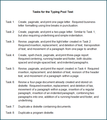
Each group of two or three participants was given either the Minimal Manual (MM) or the systems style instruction manual (SM). Participants read and follow the training exercises in their manuals and periodically received performance tasks, each related to particular training topics. (You can see the task list by enlarging the image on the right.)
Some topics were beyond the scope of either the MM or the SM; interested participants could use an additional self instruction manual or any document in the system reference library.
After finishing the required portion of training material, participants took the relevant performance test. They were allowed to use any of the training material, the reference library. They could even call a simulated help line. This last resource had an expert on the system who was familiar with the help line concept but unaware of the goals of the study.
So what happened? Carroll provides a great deal of detail; I’ll summarize what seem to me to be the most important points.
Minimal learning was faster learning.
In all, the MM participants used 40% less learning time then the SM participants — 10 hours versus 16.4. ("Learning time" refers to time spent with either the MM or SM materials, not including time spent on the performance tasks.) This was true both for the basic tasks (1 through 3 on the list) and the advanced wants.
In addition, the MM group completed 2.7 times as many subtasks, as the SM group. One reason was that some SM participants ran out of time and were unable to try some of the advanced tasks. Even for those tasks that both groups completed, the MM group outperformed by 50%.
We were particularly satisfied with the result that the MM learners continued to outperform their SM counterparts for relatively advanced topics that both groups studied in the common manual. This indicates that MM is not merely Wiccan dirty for getting started… Rather, we find MM better then SM in every significant sense and with no apparent trade-offs. The Minimal Manual seem to help participants learn how to learn.
In the second study, more analytical while more limited in scope, similar results were found. In this study, Carol’s group also compared learning by the book (LBB) with learning by doing (LWD). The LBB group were given training manuals and assigned portions to work with. After a set period of learning, they were given performance tasks. This cycle was repeated three times. The LWD learners received the first task at the start of the experiment, as they completed each task, they received the next one. There was also an SM by-the-book group and an SM learn-by-doing group.
So there are two ways to look at the study: MM versus SM as with previous study, and LWD versus LBB for each of those formats. To make that clear, both sets of LWD learners received at the start both the training materials and the relevant performance test to complete; both sets of LBB learners had a fixed amount of time to work with the training materials (which included practice) before receiving the performance tests.
Among the things that happened:
MM learners completed 58% more subtasks than SM learners did.
LWD learners completed 52% more subtasks than LBB learners did.
MM learners were twice as fast to start the system up as SM learners.
MM learners made fewer errors overall, and tended to recover from them faster.
Mistakes were made.
One outcome was the sort of thing that makes management unhappy and training departments uneasy: the average participant made a lot of errors and spent a lot of time dealing with them. Carroll and his colleagues observed 6,885 errors and classified them into 40 categories.)
Five error types seemed particularly important-along the accounted for over 46 percent of the errors; all were at least 50 percent more frequent than the sixth most frequent error…
The first three of these were errors that the MM design specifically targeted. They were imprtant errors: learners spent an average of 36 minutes recovering from the direct consequences of these three errors, or 25 percent of the average total amount of error recovery time [which was 145 minutes or nearly half the total time].
The MM learners man significantly fewer errors for each of the top three categories-in some cases nearly 50% less often.
This to me is an intriguing, tricky finding. A high rate of errors that includes persistence and success can indicate learning, though I wonder whether the participants found this frustrating or simply an unusual way to learn. I’m imagining variables like time between error and resolution, or number of tries before success. Do I as a learner feel like I’m making progress, or do I feel as though I can’t make any headway?
The LWD participants (both those on MM and on SM) had a higher rate for completing tasks and a higher overall comprehension test score than their by-the-book counterparts. So perhaps there’s evidence for the sense of progress.
Was that so hard?
Following the trial, Carroll’s team asked the participants to imagine a 10-week course in office skills. How long would they allow for learning to use the word processing system that they’d been working with. The SM people thought it would need 50% of that time; the MM people, 20%.
Slicing these subjective opinions differently, the LBB (learn-by-book) group estimated less time than the LWD (learn-while-doing) group. In fact, LBB/MM estimated 80 hours while LWD/MM estimated 165.
What this seems to say is that in general the MM seemed to help people feel that word processing would be easier to learn compared with SM, but also that LWD would require more time than LBB.
♦ ♦ ♦
The post you’re reading and its predecessor are based on a single chapter in The Nurnberg Funnel-and not the entire chapter. Subsequent work he discusses supports the main design choices:
Present real tasks that learners already understand and are motivated to work on.
Get them started on those tasks quickly.
Encourage them to rely on their own reasoning and improvisation.
Reduce "the instructional verbiage they must passively read."
Facilitate "coordination of attention" — working back and forth between the system and the training materials.
Organize materials to support skipping around.
I can see-in fact, I have seen-groups of people who’d resist this approach to learning. And I don’t only mean stodgy training departments; sometimes the participants in training have a very clear picture of what "training" looks like, what "learning" feels like, and spending half their time making errors doesn’t fit easily into those pictures.
That’s an issue for organizations to address-focusing on what it really means to learn in the context of work. And it’s an issue for those whose responsibilities include supporting that learning. Instructional designers, subject-matter experts, and their clients aren’t always eager to admit that explanation-laden, application-thin sheep-dip is ineffective and even counterproductive.
CC-licensed image: toy train photo by Ryan Ruppe.
Dave Ferguson
.
Blog
.
<span class='date ' tip=''><i class='icon-time'></i> Aug 19, 2015 05:01pm</span>
|
|
At the Innovations in e-Learning Symposium this week, Dan Bliton and Charles Gluck from Booz Allen Hamilton presented a session on "failure-triggered training." I was really impressed by their description of a study that explored different approaches to reducing the risk of phishing attacks in a corporate setting. For one thing, as I told Charles immediately after the session, they invented the flip side of a job aid. But I’m getting ahead of myself.
In this post:
Their session description (from the symposium brochure)
My summary of the session, with a few excerpts from their presentation
(I’ll repeat this link a few times in this post; all those links are for the same set of materials. You don’t need to click more than once.)
(At least) three implications for improving performance
The session description
Study Results: Failure-Triggered Training Trumps Traditional Training
We didn’t expect our highly interactive eLearning (that generated great post-test scores) to be completely ineffective in changing behaviors in the work environment! Could the same eLearning be made effective if delivered as failure-triggered training? Come learn the outcomes of a blind study of nearly 500 employees over nine months which analyzed multiple training approaches. The study shows that the same eLearning was significantly more effective when delivered as spaced events that employed learning at the point of realization. This combination of unannounced exercises and failure-triggered training (a See-Feel-Change approach) significantly reduced improper responses to phishing attacks by 36%.
I didn’t ask Bliton or Gluck about this, but "see-feel-change" seems related to what John Kotter talks about here: making a seemingly dry or abstract concept more immediate and concrete.
What I heard: BAH’s study
(Note: this is my own summary. I’m not trying to put words in their mouths, and may have misunderstood part of the session. If so, that’s my fault and not theirs. In no way am I trying to take credit either for the work or for the presentation by Dan Bliton or Charles Gluck.)
The Booz Allen Hamilton (BAH) study, involving 500 employees over 9 months, analyzed different training approaches to "phishing awareness." The training aimed at making employees aware of the risks of phishing attacks at work, with the goal of reducing the number of such attacks that succeed.
The study wanted to see whether interactive awareness training produced better results than static, page-turner training. In addition, the study used fault-triggered training, which Bliton and Gluck explain this way:
Unannounced, blind exercises [simulated phishing attacks] delivered in spaced intervals, combined with immediate, tailored remedial training provided only to the users that "fail" the exercises.
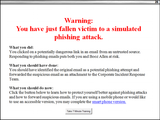
In other words, if you click on one of the fake phishing attempts, you immediately see something like this:
BAH divided the study participants into three groups:
The control group received generic "training" about phishing that did not tell them how to respond to attacks.
The wiki group’s training consisted of a non-interactive pageturner, copied from a wiki.
The interactive group’s training included practice activities (how to identify likely phishing, how to respond).
In post-training comments, the Interactive group gave their training an overall score of 3.8 out of 5. As the presenters noted somewhat ruefully, the Wiki group gave theirs 3.7 - and the control group gave theirs 3.4. (See slide 11 in the presentation materials.) The page-turning Wiki group actually felt better prepared to recognize phishing than the Interactive group.
Posttest questions indicated that 87.8% of the Wiki group and 95.6% of the Interactive group knew whom to notify if they spotted suspicious email.
From the response to the first simulated attack, however, Dan and Charles learned there was no significant difference between the three groups (Control, Wiki, Interactive) — nearly half the participants in each group clicked the link or replied to the email.
What happened next at BAH
Over six months, participants received three "exercises" (mock phishing attempts). "Failure" on these exercises consisted of either clicking an inappropriate link (producing an alert like the example above) or replying to the email — hence, "failure-triggered training."
The study provide good data about actual performance, since it captured information like who clicked a link or replied to the simulated phishing.
Incorrect responses fell dramatically between the first and second exercises, and further still between second and third:
Bliton and Gluck attribute this decrease to two main factors: the spaced-learning effect produced by the periodic exercises, and "learning at the point of realization," since what you could think of as failure-feedback occurred just after someone responded inappropriately to what could have been an actual phishing attack.
If you’re familiar with ideas like Gottfredson and Mosher’s Five Moments of Need, which Connie Malamed summarizes nicely, this is #5 ("when something goes wrong").
I’ve left out plenty; if you’ve found this description intriguing, take a look at their presentation materials. I can tell you that although Bliton and Gluck’s presentation at IEL12 had a relatively small audience, that audience really got involved: question, opinions, side conversations-especially striking at 4 o’clock on the last afternoon of the symposium.
What I thought, what I think
This approach is much more than training, in the sense of a structured event addressing some skill or knowledge need. I told Charles Gluck that it’s almost the flip side of a job aid. A job aid tells you what to do and when to do it (and, of course, reduces the need to memorize that what-to-do, since the knowledge is embedded in the job aid).
At first I thought this approach was telling you what not to do, but that’s not quite right, because you just did what you shouldn’t have. You can think of it as being like a ground fault circuit interrupter (GFCI), a special type of safety device for an electrical circuit.
GFCIs can respond to a problem too small for a circuit breaker to detect. So you’re blow-drying your hair, when click! the wall outlet’s GFCI trips, safely breaking the circuit and interrupting your routine. Not only do you avoid a shock; you also have feedback (if you know about how GFCIs work) that you’d been at risk from electrical hazard.
In the same way, BAH’s mock-phishing exercise interrupts the flow of work. By following the interruption with immediate, relevant, concrete feedback, as well as an offer for further details via a brief training program, this short circuit is turned into a smart circuit.
Which to me opens the door to — let’s use a different term instead of "failure-triggered" — task-triggered performance support. Like a virtual coach, the BAH exercises detect whether I responded inappropriately and then help me not only to recognize and even practice what to do instead.
What I’m leaving out
This was a study and had limits. For one thing, because of the failure-trigger, we don’t know much about the people who didn’t click on the phishing attempts: have they really mastered this skill, or did they just not happen to click on these trials?
There’s also some data about the best response (don’t click the link, do report the attempt), though the numbers seem very small to me. (I don’t recall anyone asking about the details on this topic, so I could well be misunderstanding what the numbers represent).
On the corporate-culture side, what happens within the organization? Does this seem Orwellian? Can the organization apply it as formative feedback intended to help me improve, or do I just end up feeling that Somebody’s Watching? I’d like to look for some data about the effects of retail mystery-shopper or secret-shopper programs, a similar activity that can seem either like trickery or like process improvement.
What about habituation? Will the effectiveness of this approach fade over time?
Most intriguing: can you harness this as a form of ongoing training? For example, along with informing people about some new security threat, create and send out further exercises exemplifying such a threat. Their purpose would be to provide a kind of on-the-job batting practice, with "failure" producing two-part feedback ("You missed this security threat, which is…" "To find out more, do this…").
Dan Bliton, Charles Gluck, and their colleagues have done more than make BAH more secure from phishing. They’ve also shared a creative, practical experiment.
Dave Ferguson
.
Blog
.
<span class='date ' tip=''><i class='icon-time'></i> Aug 19, 2015 05:01pm</span>
|
|
Dave Child, a web developer in the UK, is a a creator and an advocate of cheat sheets — his term for quick reference guides. He’s also the founder of Cheatography, a site which helps people create and share cheat sheets.
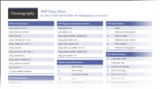
I’ll write more about Cheatography in a future post. For now, I want to show one of his creations, the PHP Cheat Sheet (link is to a PDF version).
Image links to http://www.cheatography.com/davechild/cheat-sheets/php/pdf/
Who uses this job aid?
PHP is "a general-purpose server-side scripting language" used to produce dynamic web pages. The person using this cheat sheet is most likely competent in working with PHP. Not that a neophyte can’t benefit at all, but such a person probably lacks a good deal of helpful context.
What’s the task it supports?
This is an example of what I call a reference job aid. It doesn’t guide a specific task, the way the fire-shelter inspection guide does. Instead, it organizes certain information in a way that’s helpful in a number of different but related situations: often a quick look at the job aid is sufficient. You aren’t sure of the code if you want a long month name ("September") versus a short one (Sep). Or you want to check the syntax of a regular expression function. So you go to the cheat sheet.
(Tangent: In my experience, organizations that frown on terms like "cheat sheet" aren’t usually strongholds of effective on-the-job support. All the more so if the people doing actual work refer to their quick reference materials as cheat sheets-and wouldn’t dream of letting someone take them away.)
One challenge in creating a reference job aid is deciding what information to include (and what to deliberately leave out) and how to organize it. The PHP cheat sheet uses boxes and subtitles as an organizing principle. Here’s Dave Child’s own description of how he came up with the first version:
I wrote the first one waaaaay back in 2005 because I was visiting the PHP manual so often for the same information. I’d started printing pages from the manual and jotting notes down all over my desk, and eventually decided this was just silly and organised all the notes into one page. The layout wasn’t really planned at that point.
This is the way a lot of job aids begin, especially ones for reference: people note the things that are helpful to them, but that they don’t seem to remember. If you’re looking to support the performance of others, spend some time trying to find out what’s on homebrew job aids. They may not have the best design; they may even include errors or misconceptions. But they invariably highlight information that the person (a) sees as important and (b) has trouble keeping in memory.
Dave Ferguson
.
Blog
.
<span class='date ' tip=''><i class='icon-time'></i> Aug 19, 2015 05:01pm</span>
|
|
"What do you call someone who speaks three languages?"
"Trilingual."
"What do you call someone who speaks two?"
"Bilingual."
"And what do you call someone who speaks only one?"
"American."
It’s an old joke — and I once hear it from someone who mocked her own countrymen by changing the punch line to "French." It’s here because I’ve been wondering about how many Americans are able to speak more than one language.
A 2001 Gallup poll said that about 1 American in 4 can hold a conversation in a second language. Looking at the topic from a different angle, a 2007 report from the Bureau of the Census said that "of 281.0 million people aged 5 and over, 55.4 million people (20 percent of this population) spoke a language other than English at home."
Of those 55.4 million, about 31 million claimed to speak English "very well", and another 11 million said "well."
It’s something of a moving target, then, depending on how you define bilingual. I focused on it after seeing an article by science writer Catherine de Lange. The version I first saw appeared in the Washington Post, based on a longer piece de Lange wrote in New Scientist (paywall). De Lange’s mother, who was French, spoke French to her from infancy, and the articles have to do with the effects of bilingualism on the brain.
One study she mentions discussed "a profound difference [in brain imaging] between babies brought up speaking one language and those who spoke two." In essence, researcher Laura Ann Petitto says, the babies’ bilingualism seems to "wedge open" the window for learning language, making it easier for them to acquire new languages through life.
And there’s this (from de Lange’s Washington Post article):
Ellen Bialystok, a psychologist at York University in Toronto, first stumbled upon one of these advantages while asking children to spot whether various sentences were grammatically correct. Both monolinguals and bilinguals could see the mistake in phrases such as "apples growed on trees," but differences arose when they considered nonsensical sentences such as "apples grow on noses." The monolinguals, flummoxed by the silliness of the phrase, incorrectly reported a grammar error, whereas the bilinguals did not.
One explanation (based on work by Viorica Marian and her colleagues) is that the two languages "are constantly competing for attention in the back of the [bilingual] mind." As a result, the brain is constantly getting "the kind of cognitive workout…common in many commercial brain-training programs." (Those programs require you to ignore distracting information.)
What about the long-term effect of this competition? De Lange reports that Bialystock and colleagues found that bilinguals were slower than their monolinguals peers to show signs of Alzheimer’s — by four to five years, even after taking in factors like occupation and education.
So possibly all that activation strengthens the brain in a way that helps it resist the disease. Not that you should try learning another language as a form of medication-though if that’s the way you look at it, enjoy.
More speculative, but just as interesting were de Lange’s comments on how a bilingual person can express himself — can behave, so to speak — differently in the two languages. There’s a hint that the person may have the mental equivalent of two channels, one for each language.
Which probably bodes well for the bilingual Karen Matheson, who sings Canan nan Gaidheal (The Language of the Gaels). (The song tells of the Western Isles — the Outer Hebrides — the stronghold of Scottish Gaelic.)
Dave Ferguson
.
Blog
.
<span class='date ' tip=''><i class='icon-time'></i> Aug 19, 2015 05:01pm</span>
|
|
There’s this:
"Stir the mixture well / Lest it prove inferior…"
And there’s this:
"…then put half a drop / Into Lake Superior."
Even conceding that many of the "blended learning" hits are from formal education (schools, academia), it’s a little depressing that only 3% of them mention job aids. I personally doubt it’s because everyone uses job aids. It’s almost as if developers, yearning to produce ever-more-engrossing courses, are blind to this kind of performance support.
This is closely related to what Cathy Moore says in the opening minute of the following clip:
And here, at 4%… is what is possibly the least expensive and most effective approach [for blended learning]: on-the-job training tasks. Apparently we are still stuck in the mindset that training is a course.
The clip actually covers a lot of territory in six minutes, including realistic tasks, application, relevant examples, and so on, but I want to focus here on the aspect of figuring out how not to train — or, more accurately, how to not train. Cathy demonstrates the use of "a mega job aid" to enable on-the-job learning. This is her term for combining a job aid (which stores information or guidance so you don’t have to remember it) with instruction (which tells you how to apply what’s in the job aid to a specific task).
How do you know it’s a job aid?
It’s external to the individual.
It reduces the need to memorize.
People use it on the job.
It enables accomplishment.
I asked Cathy for some comments about job aids.
"Before designing formal training, consider whether a job aid is all you need."
Here, she’s asking what makes you think you need formal training for X? Is there another way to help people accomplish the desired result?
"If you decide training is necessary, make sure the job aids are top-notch, and consider having the ‘course’ teach people how to use the job aids."
It’s not a job aid if you don’t use it while you’re performing the task. So if you build a job aid but find that people need to practice using it, that practice should be like on-the-job use. They’re not going to be doing the real-world task from within the LMS (unless, poor devils, their real-work job is managing the LMS). Embalming a job aid inside a course is like disabling an elevator in hopes that people will learn how to get from the 3rd to the 9th floor without "cheating."
"Don’t duplicate the job aid info in the course."
Part of the decision about whether to build a job aid involves the nature of the task. Among the considerations:
The likelier it is that the task will change (and thus that the steps for accomplishing it will change), the more sense it makes to build a job aid — and the less sense it makes to duplicate the job aid inside a formal course.
Instead, as part of your formal training, use the same job aid people will use on the job. And figure out how to make updates easily available.
No matter what learning management ideology claims, there are only three kinds of people who return to an online course for reference information:
People who work for the vendor.
Actors appearing in the vendor’s materials.
People on the job who are really bored or really desperate.
Because she involves herself with what people actually do on the job, Cathy has some inexpensive yet highly effective ideas about where to get started:
To evaluate and improve job aids, physically visit learners’ work stations and look around. What support materials have people created for themselves? Often someone on the job has already created a good job aid and you just need to "borrow" it.
Even if it’s a less-than-ideal job aid, the fact that someone’s created it and is using it suggests both that the task is important and that people feel the need for support as they’re carrying out the task. That’s one heck of a head start, and you haven’t had to create a single "at the end of this training program" statement.
Dave Ferguson
.
Blog
.
<span class='date ' tip=''><i class='icon-time'></i> Aug 19, 2015 05:01pm</span>
|
|
Thanks to David Glow, whose mention of it I happened to notice on Twitter last night, I found a blog post by Steve Flowers that I hadn’t seen: Just a Nudge-Getting into Skill Range. He’s talking about skill, mastery, and the (ultimately futile) "pursuit of instructional perfection."
Steve starts with a principle from law enforcement: only apply the minimum force necessary to produce compliance. (This is why those "speed limit enforced by aircraft" signs rarely mean "cops in helicopter gunships"). Then he works on a similar principle for, as he puts it, "instruction performance solutions."
Trying to design training / instruction for skill mastery can hinder-or defeat-the learning process, he says. That’s because mastery, in whatever form reasonable people would define it, is likely the outcome of a long period of practice, reflection, and refinement.
"Mastery" sounds good, which is why the corporate world is hip-deep in centers of excellence and world-class organizations. A lot of the time, though, "world-class" is a synonym for "fine," the way you hear it at the end of a TV commercial: "available at fine stores everywhere." Meaning, stores that sell our stuff.
He’s not saying there’s no place for formal learning, nor for a planned approach to helping people gain skill. What he is saying is that we need "to design solutions to provide just the right nudge at just the right moment."
Most of the time, we don’t need mastery on the job, he says, and I agree. We do need competence, which is what I believe he means by helping the performer move into a "skill range" — meaning the performer has the tools to figure out a particular problem or task.
From a blog post by Steve Flowers(Click image to view his post.)
I’ve been mulling some related ideas for some time but hadn’t figured out how to even start articulating them. One theme has to to with the role of job aids and other performance support-things that Steve believes strongly in. I despair at the server farms full of "online learning" that shows (and show), and tells (and tells and tells) while failing to offer a single on-the-job tool.
Listen: the only people who’ll "come back to the course" for the embedded reference material are (a) the course reviewers, (b) the utterly bored, and (c) the utterly desperate.
A second theme has to do with the two different kinds of performance support that van Merriënboer and Kirshner talk about in Ten Steps to Complex Learning. In their terminology, you have:
Procedural information: this is guidance for applying those skills that you use in pretty much the same way from problem to problem. That’s the heart of many job aids: follow this procedure to query the database, to write a flood-insurance policy for a business, or to update tasks in the project management system. You can help people learn this kind of information through demonstration, through other presentation strategies, and through just-in-time guidance.
Supportive information: as vM&K say, this is intended to bridge the gap between what learners already know, and what they need to know, to productively apply skills you use differently with different problems. "Updating the project management system" is procedural; "deal with the nonperforming vendor" is almost certainly a different problem each time it arises. (That’s why Complex Learning uses the somewhat ungainly term "non-recurrent aspects of learning tasks.") Types of supportive information include mental models for the particular field or area, as well as cognitive strategies for addressing its problems.
As the complexity of a job increases, it’s more and more difficult to help people achieve mastery. That’s not simply because of the number of skills, but because of how they related, and because of the support required.
Part of the connection I see, thanks to Steve’s post, is that the quest for perfect instruction ignores both how people move toward mastery (gradually, over time, with a variety of opportunities and guided by relevant feedback). In many corporations and organizations, formal learning for most people gets squeezed for time and defaults to the seen-and-signed mode: get their names on the roster (or in the LMS) so as to prove that learning was had by all.
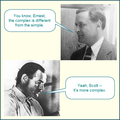
We focus on coverage, on forms, on a quixotic or Sisyphean effort to cram all learning objectives into stuff that boils down to a course. I’m beginning to wonder, frankly, whether any skill you can master is a course is much of a skill to begin with. At most, such a skill is pretty near the outer border on Steve Flowers’ diagram. So the least variation from the examples in the course-different circumstances, changed priorities, new coworkers-may knock the performer outside the range of competence.
(Images adapted from photos of F. Scott Fitzgerald and Ernest Hemingway from Wikimedia Commons.)
Dave Ferguson
.
Blog
.
<span class='date ' tip=''><i class='icon-time'></i> Aug 19, 2015 05:00pm</span>
|
|
I have two main psychomotor skills: I can touch-type, and I can drive a stick.
That’s about it. I was never much at sports, though in high school I learned how to play soccer at an intramural level best known as "not entirely horrible if the year is 1964."
Sometime after that, I learned about the PIP, Tom Gilbert’s shorthand for the potential to improve performance. I wrote about that some time back, but the quick summary is this:
The greater the gap between the exemplary performer and the average performer, the easier it is to improve performance.
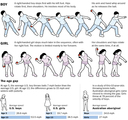
What does the PIP have to do with sports? I came across an article in the health and science section to today’s Washington Post: "You throw like a girl." Tamar Haspel began by exploring her inability to throw a ball far or accurately. She learned that the gap begins around the age of 4, long before the bodies of boys are all that different from the bodies of girls. Yet around the world, the differences are significant-pre-pubescent girls throwing at 51% to 69% of the distance that boys do, at 51% to 78% of he velocity.
I liked the examination of what "throwing like a girl" means — and it seems to have to do with how much of the total body is involved, as shown by this great graphic from the Post article (image links to the source):
The short answer: "women tend to rotate their shoulders and hips together, and even if they don’t, they don’t rotate the two areas as fast as men."
There could be genuine biological differences. One expert Haspel consulted. Jerry Thomas of the University of North Texas, wonders if there might not be an explanation in the nervous system.
Even so, he says, "People don’t like to talk about it [the biological difference] because girls will give up, but perhaps if we talk about it, girls can learn. And they can learn."
And that’s where the PIP comes in. Overall, the average woman isn’t going to learn to throw a baseball as well as a major league pitcher does. But neither is the average man. And as Tom Gilbert was arguing, looking at a gap between average performance and exemplary performance is a good way to cure yourself of the over-optimistic notion that if you’d only chosen the right people, you wouldn’t have to help them learn and provide them support.
Haspel worked with Jenny Allart, who coaches Harvard’s softball team. What I liked about the consultation:
After warmups, Allard tested Haspel’s throw, to establish a baseline. (55 feet was about the best she could do.)
Allard broke the throwing actions into 3 pieces, and coached them in reverse order:
Practice whipping arm and hand.
Practice extending arm and rotating forward.
Practice stepping back before that extension.
After a half-hour lesson, Haspel was able to get the ball to first base (60 feet) and even a bit beyond-a 10% improvement in 30 minutes.
I told Allard that I’d been cautioned that instruction without practice doesn’t help much.
"Neither does practice without instruction," she said.
This reminded me of something Jim Fuller said once: practice doesn’t make perfect; it makes permanent. Fuller was talking about the need for useful feedback, feedback that you can use to modify and improve your performance.
Clearly, most people don’t do a lot of ball-throwing in their lives, and many of them don’t feel the need to improve their ball-throwing skill. In this article, though, I see a balanced, non-deterministic approach to investigating differences and then working on ways to improve the results that an average performer can produce.
* * *
(In a comment on this post, Kathy Sierra mentioned The Cambridge Handbook of Expertise and Expert Performance. This is a link to its listing on Amazon.)
Dave Ferguson
.
Blog
.
<span class='date ' tip=''><i class='icon-time'></i> Aug 19, 2015 05:00pm</span>
|
|
Quite a while back, I came across a site that used to be called Universal Subtitles but now seems to call itself Amara.
You can submit a video via a URL of "an Ogg, WebM, flv, mp4, Youtube, Vimeo or Dailymotion video." There’s also a script capability. Once you upload the video, you can enter or upload subtitles, and then synchronize to the video.
You can probably see lots of ways to apply this. I thought I’d enter the lyrics to a few songs, especially ones not well known to English speakers. And since Amara lets you provide subtitles in multiple languages, I tried a few songs by Georges Brassens, a French singer-poet known throughout the francophone world, but who’s about as well known to English speakers as… most French-speaking singer-poets not named Jacques Brel.
In this song, he’s asking to be buried not in a cemetery, but on the beach at Sète, his home town (about 50 miles west of Marseille).
The control in the bottom left corner of the video lets you choose subtitles in English or in French; they’ll appear as the video plays, and you can switch between languages on the fly. (Although the embed code is finicky; I hope they’re working on something a bit more reliable for WordPress blogs.)
This seems like a great way to help connect the written words of a language with native speech (in this case, with Brassens’s distinctive accent), among many other things.
Besides, this is a terrific song. It’s a shame I don’t know more people who speak French, or I’d ask to include it at my funeral.
Dave Ferguson
.
Blog
.
<span class='date ' tip=''><i class='icon-time'></i> Aug 19, 2015 05:00pm</span>
|
|
I’ve really enjoyed the wide-ranging comments on Monday’s post about throwing like a girl. I keep relating Tamar Haspel’s effort to throw a ball farther and faster with other goals that people choose, complex ones that don’t have an end point.
What I mean is, it’s one thing to say, "I’m going to learn to do quadratic equations." That’s a pretty specific goal, and (I assume) at some point you can do any one that’s handed to you.
Many things that adults set out to master — with "master" being a very flexible word for "develop a satisfactory level of capability" — lack those crisp boundaries. Like learning a language other than your native one.
For now, though, I want to pick up on Tamar’s closing comment: "You’ll have to excuse me, because I need to find a violin teacher."
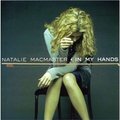
Naturally, this reminded me of Margaret Ann Cameron Beaton. She was the maternal grandmother of Natalie MacMaster, part of an extended family of Cape Breton musicians (like cousin Andrea Beaton, uncle Kinnon Beaton, and uncle Buddy MacMaster). Natalie’s album In My Hands includes the track Gramma, with a pair of Irish fiddle tunes. The track opens with a recording of Margaret Ann at the age of 91. Although I’m putting a transcription here, you ought to listen to the clip to hear not only her warm Cape Breton accent but her shimmering wish that she’d learned to play:
Margaret Ann Cameron Beaton ("Gramma")
I wasn’t rich enough to get a violin when I was young. But if I happened to have the money, boy, oh boy, I would be a violin player. My god, I just — I was alive with it.
Dave Ferguson
.
Blog
.
<span class='date ' tip=''><i class='icon-time'></i> Aug 19, 2015 05:00pm</span>
|
|
When people talk about formal versus informal learning, or training versus instruction, or similar after-the-conference-but-still-in-the-bar topics, I tend to watch for hidden discriminations-clusters of things that are different, tucked into a conceptual container and wrapped in paper that says "generalization."
Take "learning a language," about as good an example of a complex skill as you could find. What do you mean by "learning?" In fact, to me there’s a curious time-travel aspect to it: someone who’s learning a language clearly has a way to go; someone who’s learned a language is evidently a skilled user — but how did she get from the one state to the other?
When linguists get together, of course, they ask, "What do you mean by ‘language?’" Or maybe they don’t, because most of them know about Max Weinreich, the linguist, who said:
אַ שפראַך איז אַ דיאַלעקט מיט אַן אַרמײ און פֿלאָ
A shprakh iz a diyalekt mit an armey un a flot.
(A language is a dialect with an army and a navy.)
(I did come across a variation: a language is a dialect with a missionary.)
To me the relevant point is that, at least for adults, it’s the learner who decides what a language is, and who (probably with help) decides on what learning means. It might be the learner accepts the definition of other people, like the language program in a college. Or he may have a more pragmatic definition, like "get a job in Norway," and uses that to help him choose what learning Norwegian means (reading, writing, and speaking it well enough to earn a living).
I’ve been mulling this over in terms of my own efforts to be more fluent in French. And like "learning" and "language," "French" is a covert discrimination. Despite the eye-rolling that most Americans like to do when (once every six years or so) they think of l’Académie française, millions of people worldwide who are effectively if not officially part of La Francophonie don’t lose sleep over whether le week-end is in l’Académie’s dictionary.
There are the Acadiens, for instance, scattered over North America. The singer Zachary Richard gave a stirring performance of his song Réveille at an Acadien festival in New Brunswick a few years ago. I wrote about it and included an English translation of the lyrics here on my French-language blog, though I want to highlight what he said in his introduction:
I appeal for help on behalf of the Acadiens of Louisiana. We have fallen off the cliff, but we have not yet struck the ground. The next generation in Louisiana will probably be the first in two hundred years not to speak French, or to understand that preserving the French language does not mean preventing the assimilation of Anglo-American words into our vocabulary — but preventing the assimilation of the French-speaking community on the border.
So what are they doing to (better) learn their language? This video is in French; it describes efforts by Louisianans, especially those who identify as Acadien, to preserve or recover their language. The first three minutes talk about people who meet weekly, for an hour, to speak only in French.
And if you advance to about the 3:00 mark, you’ll hear Erin Stickney from Lafayette, LA, speaking in French with a strong Southern American accent. At one point she says,
I would like (her children, when she has them) to learn the French of this region. Because it’s important for Louisianans to learn the French of Louisiana. It’s good to learn the French of France also, but we have to learn this French we have here, because otherwise it’s practically the same as learning Arabic, Spanish, or Japanese. There’s a reason French exists here, and we have to continue that.
I admire the efforts these people are making. Stickney is able to converse with a French interviewer and to make herself understood.
Stephen Fry, of all people, spent some time with people who speak a much less widespread language: Irish. (Many people tend to use "Irish" as the English word for Gaeilge, the Goidelic language of Ireland, and "Gaelic" for Gàidhlig, the Goidelic language of Scotland, though you’ll hear "Gaelic" applied to both.) He touches on native speakers and on efforts in Ireland to encourage use of the language, though it’s not an easily traveled road.
Jim McCloskey, an expert on modern Irish, has a refined view on the role of Irish. "Traditional Gaeltacht Irish [Irish spoken as a first language in certain regions of Ireland] will almost certainly cease to exist in the next 30 years or so," he wrote in this post on the Language Log blog. He does, however, see the creation of a lively "second language community" that’s much larger than the Gaeltacht community. So for him, the disappearance of Irish may be more a transformation-fewer and fewer native speakers, but many people who use and enjoy using the language.
A final look at language use, again from the Language Log, involves an attempt to revive Cornish. When I took a linguistics course in grad school, one "fact" we learned was that the last native speaker of Cornish died in 1777. Whether Dolly Pentreath was in fact the last person to have learned Cornish as a birth language doesn’t matter, because give or take a few years, no one has learned it as a birth language since Vermont was an independent country.
I return to Geoffrey Pullum’s post time and again. He’s talking about "living languages," rather than "learning a language." The two are related, though, and this is his elegiac summary of what learning would have to be like to keep a language living:
Always remember this, as we head into the sad time of massive language extinctions that is coming. Ask around the village and find the age of the youngest people using a language every day for all their normal conversational interaction. If the answer is a number larger than 5, the language is probably dying. If the answer is a number larger than 10, it is very probably doomed. If the answer is a number larger than 20, you can kiss it goodbye right now: no amount of nostalgic appreciation of it will make it last even one more generation as a going concern.
Dave Ferguson
.
Blog
.
<span class='date ' tip=''><i class='icon-time'></i> Aug 19, 2015 05:00pm</span>
|