Blogs
|
Lena H. Sun of The Washington Post, who often reports on health-related topics, has an article in today’s paper about the use in medical training of "standardized patients" — healthy people portraying patients. (Here’s how Johns Hopkins Medicine describes its standardized patient program.)
Developing the capabilities of doctors, nurses, and other practitioners is a clear example of complex learning. You have a wide range of skills. Some are primarily procedural: when you draw blood, do it like this; when you’re checking vital signs, do it like that. Follow this process for obtaining and recording data.
Most of what we think of as medical training, though, involves skill for situations where there’s no single correct approach to a given problem. So the standardized patient is an individual who’s portraying a particular type of patient-in other words, someone who’s acting as a realistic learning task.
Many [of the standardized patients] are actors, but actors don’t always make the best patients, clinical directors said. Improv is not allowed. People trained to portray a particular type of patient must work from the same facts and deliver responses in the same way to the students examining them.
"They can’t overact," said Kathy Schaivone, clinical instructor and director [of the Clinical Education and Evaluation Laboratory] at the University of Maryland at Baltimore. "If I can’t guarantee that all five will cry, the ones that I know that can [cry], I have to ask them not to."
(Here’s an overview of the standardized patient curriculum at U-Maryland Baltimore.)
One challenge for the standardized patients is to provide a structured debriefing: "Did the student palpate the sinuses? Listen to the heart in all four places? Wash hands before and after touching the patient?"
In this setting, I see two interconnected sets of skills:
Those needed by the medical practitioners to relate to patients, interact with them, and arrive at a reasonable diagnosis based on limited information.
Those needed by the standardized patients in order to believably and consistently portray someone with a particular condition.
Behind both of these, of course, is an intensive effort to design, develop, and implement the training. Beyond the somewhat obvious (what conditions are both useful to have portrayed and suited to the standardized patient approach?), there’s the multilevel skill required of the patients: how do I portray the condition? What do I share readily? What do I tend to withhold? What am I incorrect about?
In addition, the patients need to debrief the students, both via checklists and via face-to-face feedback. Program directors like Schaivone, meanwhile, need to monitor the performances of both the patients and the students.
To illustrate the complexity of behavior, the online version of Sun’s article has a link to this May 2011 article on how doctors struggle to show compassion, by Manoj Jain, an infectious disease specialist and professor at Emory University.
‘Standardized medicine’ image adapted from the CC-licensed original by Ben Weston (Tek F).
Dave Ferguson
.
Blog
.
<span class='date ' tip=''><i class='icon-time'></i> Aug 19, 2015 05:03pm</span>
|
|
In the few days since my last post, I’ve spent time thinking about how people get better at producing results on the job. That’s a bit of a paraphrase, but "how people learn" is too broad for what I usually end up working on. My projects vary widely, but what they have in common is the client’s desire to improve what people accomplish.
I believe that less and less of that improvement will come from the efforts of traditional, corporate training and development. (Note that calling yourself "Organizational Learning" isn’t the same thing as having people in your organization learn.) I do think there’s a role for planned, structured efforts to help people acquire and improve important skills — but it’s like the supporting role of the earl of Exeter in this clip, rather than the leading one of his nephew, King Henry (whom the king of France refers to as "our brother England").
Some of the skills that learning professionals have specialized in — analysis, design, structuring, and so far — are moving out of their control, because other people need to apply those skills and can’t or won’t wait. This is a topic I’ll pick up again in 2012. I’ve been considering what I know that’s effective and thinking about how to enable other people to be effective with that knowledge. Like, for example, how to build job aids.
One way to look at a job aid:
It’s information external to you (rather than inside your head)
…that you apply on the job (rather than, say, reviewing beforehand)
…to achieve acceptable results
….while reducing the need to memorize.
So in part this last post of 2011 looks ahead to what I’ll be working on in 2012. And in part it’s a reason-as if I needed one-to (re)post my explanation of Robert Burns’s most famous song, one you’re likely to hear this weekend. Auld lang syne is a Scots phrase. Literally, it’s "old long since;" it means "the days that are past," and it has a sense of "the things that we shared."
Even if you decide not to bother with my chart, you ought to take the time to listen to Eddi Reader’s singing. The video is from the opening of the new Scottish Parliament building in 2004. In the first half, she solos with a traditional melody. In the second half, the attendees join with a version you likely know better.
What Burns wrote
The gist
Should auld acquaintance be forgot,
And never brought to mind?
Should auld acquaintance be forgot,
And auld lang syne?
These are rhetorical questions:
- Should we forget old friends and never think about them?
- Should we forget old friends along with everything that’s past?
For auld lang syne, my dear,
For auld lang syne.
We’ll tak a cup o’ kindness yet,
For auld lang syne.
Not at all-in fact, we’re going to have a drink together for the times gone by.
We twa hae run about the braes,
And pou’d the gowans fine;
But we’ve wander’d mony a weary fit,
Sin’ auld lang syne.
We two have run along the hillsides
And picked the lovely daisies together-
But we’ve wandered many a weary foot
since the times gone by.
We twa hae paidl’d in the burn
Frae morning sun till dine;
Now seas between us braid hae roar’d
Sin’ auld lang syne.
We two have paddled in the stream
From dawn till dusk
But broad seas have roared between us
Since those times gone by.
And surely ye’ll be your pint-stowp!
And surely I’ll be mine!
And we’ll tak a cup o’ kindness yet,
For auld lang syne.
(I know) you’re good for your drinks ( "be your pint-stowp" — "pay for your tankard" ), and you know I’m good for mine. We’ve still got that drink to share for the times gone by.
And there’s a hand, my trusty fiere
And gie’s a hand o’ thine
And we’ll tak a right gude-willie waught
For auld lang syne.
So, here’s my hand, my trusty friend
And give us (= give me) yours
We’ll take a good, hearty drink
For all the times gone by.
Dave Ferguson
.
Blog
.
<span class='date ' tip=''><i class='icon-time'></i> Aug 19, 2015 05:03pm</span>
|
|
Dave’s Whiteboard marked its fifth anniversary last month. (No, I didn’t notice, either.) You might not think it, given my recent output, but my Whiteboard means a lot to me — so much so that whenever I think about changing the theme (the package of files that controls the appearance) I end up considering one that looks much like what I’m currently using.
Sticking with what I’ve had has more and more often meant I run into technical problems. My current theme is out of date in several ways-for example, it’s not widget-aware. That means is that I can’t take advantage of simple ways to customize and control the appearance.
I’ve occasionally written several posts on a single topic (a series of posts). At the time I used a WordPress addon (a plugin) that automatically added previous/next links so that a reader could work through a series without worrying about date or about intervening but unrelated posts. That same plugin created a table of contents as well, so you could tell where you were in the series.
That plugin stopped working a few months back; I have no idea why. The effort to manually input the links-to hard-wire them, so to speak-was more than I was ready to expend. Still, I plan to write a series or two in the coming months, and I wanted to have a low-maintenance way to present all my series.
So this past weekend I started experimenting with the Organize Series plugin. I tested to see if it could link the three posts in my series about the book Improving Performance, by Rummler and Brache.
And it could. What’s more, with a $15 add-on, I’m able to use a little bit of code and automatically generate a list of posts in a series, like this:
Improving Performance (the book)
Rummler and Brache: Improving Performance Three levels of performance Process is a verb, output is a noun Dirt in the performance engine
I had to do some tinkering, and I had to purchase a $15 add-on for the plugin, but I’m content so far: I’ve accomplished my short-term goal of making each of my series work like a series again-without a lot of hand wiring.
That list of posts in the Improving Performance series, for instance: to make it appear here after installing the Organize Series plugin and the add-on, I inserted the following code into my post:
[ post_list_box series=65 ]
Enough WordPress mumbo-jumbo. I’m going to revisit this from the perspective of learning on the job. My hunch is that there’s a kind tradeoff that a person’s willing to make when he has a problem to solve (or an opportunity to seize). What going into figuring worth is the amount of effort expended, and the value of the results… as seen by the person with the problem or opportunity.
CC-licensed photo by Craig Bennett / theclyde.
Dave Ferguson
.
Blog
.
<span class='date ' tip=''><i class='icon-time'></i> Aug 19, 2015 05:03pm</span>
|
|
When I read about the Organize Series plugin for WordPress (a focus of Monday’s post), I thought, "This could do it."
No I didn’t. I don’t know about you, but I rarely think to myself in complete sentences. Phrasing like this is how we capsulize a more complex experience. What I believe was going on at the time was something like this: I had a situation I wanted to change (the way I used to manage a series of posts here on my blog no longer worked). And the Organize Series plugin at first glance looked like it could accomplish at least two things:
Provide automatic navigation between posts in a series (so I wouldn’t have to hard-wire the links).
Display a list of all the posts in a given series (for me to use as a summary or as a table of contents for the series).
If I’d thought about it longer, I might have articulated another goal: have some way to list all the different series I have. But I’m not usually that strategic. Still, what I came up with (provide navigation, display a list) acted as my critical-to-quality elements. CTQs were widely used at GE when I worked there; I use that acronym partly tongue-in-cheek and partly to highlight informal criteria.
So, I put Organize Series to work, and within 10 minutes I had automatic next/previous navigation for posts in a series, along with an indication that they were part of a series:
(You can click the image to see the entire post.)
When I was still considering whether to use the plugin, I said to my wife, "Wouldn’t it be great to know how to write a plugin?" On reflection, I realize this statement was another capsulization-a series of them, nested inside each other. "Know how to write a plugin" really means:
"Know how to write a plugin" really means "write a plugin that works…."
Which in turn means "write one that produces results…"
Which means "write one that people use to accomplish things that matter to them."
To me, this is an important distinction for workplace learning: You can learn on your own for your personal satisfaction, and if you’re satisfied, then that’s a sufficient result. In the workplace, though, you’re part of a larger group (even if that group is you and one individual client), and so the result has to matter within that context.
What’s this got to do with my plugin tinkering?
Think of it as my own workplace learning. At this point, I was still some distance from my (loosely articulated) end state. I hadn’t moved much toward my other CTQ of displaying a list of all the posts in a series. In fact, I didn’t yet grasp all the options in the plugin, let alone know how to make them work in a way useful to me.
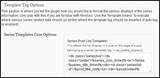
About 5% of the info from the plugin's page of options
But…In my first 15 minutes with the plugin, I’d achieved a result that I found valuable. That left me more willing to experiment-which, put another way, says I was somewhat more willing to spend time trying to achieve the next valuable result.
To me, this is a core principle for any type of workplace learning: formal or informal, face-to-face or virtual. I need to be able to accomplish something that looks to me like real work-produce something that I see has having on-the-job value. And I need to do that sooner rather than later, which is why twenty minutes on introductions, half an hour on expectations for this workshop, and twenty minutes on learning objectives will invariably drive me to teeth-clenching frustration. Or to eating more of those lowest-bid-hotel pastries.
One of the unexpected outcomes of achieving an initial on-the-job goal is that you end up better able to visualize other goals. In a sense, learning leads to new problems (or opportunites) because you’re better at grasping the current situation and at visualizing different ones.
In the course of my experimenting with the Organize Series plugin, I did find at least one way to display a list of all the posts in a series. I can make a box like this appear alongside the title for each post:
The posts in my most complex series
You can click that image if you’d like to see the first post in the series, though I’ve turned this "series post list box" feature off for now, until I learn how to control the way it displays. Having managed to produce it, though, I’ve picked up several more goals for myself. I was about to write "learning goals," but I want to stress that they’re all tied to accomplishment.
I want to learn how to use code that’s part of the plugin to, for example, display a list of posts like the last example where and when I want it.
I want to find out how to modify the plugin’s template (the tool it uses to display the full text of all the posts in a series).
I may even want to learn how to modify the PHP or CSS code to make things happen.
That last is quite a goal for someone who doesn’t really know how to program. But my various experiments to date, and especially the things I see as successes, have taught me that I can learn to successfully modify small bits of PHP code and achieve relatively high-value results.
So I’m accomplishing what looks like real work to me.
Dave Ferguson
.
Blog
.
<span class='date ' tip=''><i class='icon-time'></i> Aug 19, 2015 05:03pm</span>
|
|
My grade school was St. Brigid’s, in northwest Detroit. The parish has been closed for 22 years, and I suppose the school closed before that. I remember getting half a day off school for Father Brennan’s feast day. I remember teachers like Sister Patrick Elizabeth and Sister Mary Eamon (Eamon, as in de Valera-the school had lots of green on St. Patrick’s Day).
More than anything, I remember my sixth-grade English teacher, Mr. Strunk. He was only the second teacher I’d had at St. Brigid’s who wasn’t a nun, and the only one who was male.
In hindsight, I suppose I didn’t have a mental model for what a male teacher would be like. I was disconcerted at first by how different he seemed. I need to say that I had some very good teachers: I don’t recall any of that whacking-with-rulers stuff that people seem to assume was mandatory in pre-Vatican II Catholic schools.
But Mr. Strunk was really different. He said things that were funny, wry, unexpected. He read to us from Mad Magazine-and may have been planting a crop of critical thinking with the seed-starter of parody. He went far beyond the stuffy borders of our textbook.
Early in the school year, when he’d said something funny, I responded with with a sarcastic laugh. (I suppose it was my ten-year-old’s critique: teachers weren’t supposed to be cracking wise.) He said, not harshly, "If you don’t think it’s funny, don’t laugh."
That was a door he opened just for me, but he spent a lot of time opening doors like it: "Think for yourself. You can do it."
He’d open them by assigning sixth graders a 1,500 word composition. Topic: The Dime. That was it; a two-word topic and a length. What can you do with that?
Another assignment: a 48-line poem. This time, he assigned the title: "The Last Voyage of The Albatross."
I don’t recall anything I wrote-but I have a vivid sense of enjoying the writing. I have an even more vivid sense of what he wrote on my paper, because it leapt into my memory and has never left:
Your poetry improves, my friend,
with each brand new endeavor.
I wish that I had words to lend
to serve you as a level.
But while such things as kings and men
on your mind’s sea do toss,
don’t let this be the last voyage
of your young Albatross.
School was never the same, and a few teachers after him suffered by comparison. I lost contact with him after going out of state for most of high school. In pre-Facebook days, it was hard to track down someone out of state; in post-Facebook days, it can still hard to connect with someone who was over 25 when John Kennedy was assassinated.
Through a friend of my younger brother’s, I learned last year that Mr. Strunk was still in the Detroit area; he spent 40 years teaching and coaching. The friend sent me an address, but warned me that his health was poor. I wrote a letter that week; I’d sealed it and stamped it, then realized he might not be up to a written reply. I reprinted the letter and included a phone number, on the outside chance that he might remember me and might be up to calling.
No such luck, but that was all right. The important thing for me was to say to him directly, more personally, the kinds of things I’ve talked about here.
I have not seen Mr. Strunk since, I suppose, 1963. Many of my classmates will remember one of his weekend gigs at the parish’s activities building: hosting a hootenanny (and that’s a word well on its way to joining "floppy disk" and "antimacassar" ) . One of his standards was The MTA Song - about a hapless Boston commuter who lacked the "exit fare" and so couldn’t pay to get off the train.
And did he ever return?
No, he never returned
And his fate is still unlearned.
He may ride forever
‘Neath the streets of Boston:
He’s the man who never returned.
For me, Mr. Strunk was the man who always returned. I decided to become a teacher in part because of his example. Even after leaving the education field, I would recall his intelligent encouragement, his genuine interest in his students, his respect for their intelligence that included challenging them.
I learned only today that Mr. Strunk died last month. One woman wrote in the funeral home’s online guestbook, "My all time favorite teacher and I will never forget how honored I felt when he told me to call him Frank."
It’d be hard to top that. I am grateful to be able to say "Mr. Strunk" and still feel his presence. I’ve read comments from people who were students in his final years of teaching, and from classmates of mine-we who were the first class he taught, more than 50 years ago. There are teachers I will always cherish-Brother Leo and Brother André, Father McKendrick and Dr. MacDonald, Professor Bauder — but there was only one Frank Strunk.
Dave Ferguson
.
Blog
.
<span class='date ' tip=''><i class='icon-time'></i> Aug 19, 2015 05:03pm</span>
|
|
Scotland’s most famous poet wasn’t much of a success by the age of 26. He’d farmed, but not successfully, though he has more success in sowing certain kinds of oats. Out of prospects, he’d accepted a job as a bookkeeper on a plantation in Jamaica… but didn’t have the money for the voyage.
His friend Gavin Hamilton, in whose memory I’ll have a little something this evening, suggested that Burns publish his poems "as a likely way of getting a little money to provide him… in necessaries for Jamaica."
Poems, Chiefly in the Scottish Dialect appeared in July of 1786. By September there was interest in a second edition. Within six months he was a celebrated artist. Jamaica was forgotten-until yet another of his loves, Agnes McLehose (known as Nancy to her friends), chose to rejoin her estranged husband… in Jamaica.
In a final letter before she left Scotland, Burns sent her the poem known as Ae Fond Kiss. It’s his birthday today; not a bad way to celebrate.
Ae fond kiss, and then we sever;
Ae fareweel, alas, for ever!
Deep in heart-wrung tears I’ll pledge thee,
Warring sighs and groans I’ll wage thee! (pledge)
Who shall say that Fortune grieves him
While the star of hope she leaves him?
Me, nae cheerfu’ twinkle lights me,
Dark despair around benights me.
I’ll ne’er blame my partial fancy;
Naething could resist my Nancy;
But to see her was to love her,
Love but her, and love for ever.
Had we never loved sae kindly,
Had we never loved sae blindly,
Never met—or never parted
We had ne’er been broken-hearted.
Fare thee weel, thou first and fairest!
Fare thee weel, thou best and dearest!
Thine be ilka joy and treasure,
Peace, enjoyment, love, and pleasure!
Ae fond kiss, and then we sever!
Ae fareweel, alas, for ever!
Deep in heart-wrung tears I’ll pledge thee,
Warring sighs and groans I’ll wage thee! (pledge)
Dave Ferguson
.
Blog
.
<span class='date ' tip=''><i class='icon-time'></i> Aug 19, 2015 05:03pm</span>
|
|
I have mixed feelings about the word "curation." On the one hand, I acknowledge its spirit-what Clay Shirky means when he says, "Curation comes up when people realize it isn’t just about information seeking; it’s also about synchronizing a community."
Or what I think he means, because, let’s face it, there’s a certain lack of specificity to "Hey, Dad, watch me while I synchronize the community."
I don’t think of what I do as curation. I think of it as putting stuff aside because I think it might have value for me. In the olden days, when "bookmark" means something you slipped between the pages of a book, those things tended to go into file folders and bookshelves. Now, when content is (mainly) digital and storage is (virtually) free, they go into files.
To be honest, they tend to stay there, too. That isn’t the direction to take for things you want to learn, or learn from. So, once again, I’m profiting from the example of Harold Jarche, who for some time has made a habit of posting Friday Finds: weekly compilations of insights and observations that he’s captured on Twitter.
Via Kristina Halvorson (@halvorson), a link to Corey Vilhauer’s blog post, Building Confidence: The Hidden Content Deliverable. The ostensible topic is content strategy (which is what both Halvorson and Vilhauer really do), but anyone working in learning or workplace performance could read the post in that particular light as well. When we’re young and working as advisors, he says,
…We look down our nose. We assume our clients are dumb. The faster this goes away, the faster we can start doing the real work: understanding and embracing the needs of our clients and organizations.
From Yammer: The Blog, a post by Maria Ogneva, This is Not Your Parents’ Software Training. Nothing earthshaking, just a clear summary of alternatives to a bunch of same-time people in a bunch of same-time seats being told when and what to click.
From Vicki Davis (@coolcatteacher), a link to Brett McKay’s post, 4 Sites for Free Vintage Photos.
From Sweden, a 45-minute presentation at the Technical Communication UK Conference 2011 by Magnus Ohlsson and Jan Fredlund of IKEA’s communications group. The topic is how IKEA meets the challenge of 400 new sets of assembly instructions per year, plus revisions. The presentation comes via Mediasite, and the interface allows you to click through the slides; the audio will jump automatically to stay in sync. The first 18 minutes (slides 1-13) are background about the IKEA approach and the work of the group; starting at slide 14, there’s a more detailed look at what goes into the ubiquitous guides.
Via Pascal Venier, Graham Allcott’s new productivity rules of the road. Allcott’s business is helping people and organizations become more productive (warning: you’ll find Getting Things Done stuff). Among the thoughts that struck me-in part because you don’t often hear the relentlessly busy say things like these:
Starting well: beginning the day with meditation, exercise, a hearty breakfast, and "consuming limited information of my own choosing."
Going dark: from 9 till 1, Allcott shuts his internet connection off.
Making himself take lunch, and not work through it.
Via @Evernote, 10 useful tips from Brandie Kajino, their "organization ambassador."
…That’s the first installment of my shared keepers. You can think of them as having been curated if you want. Posting them here for me is my reworking/reprocessing of things. (I tossed a few others overboard-not everything labeled "keeper" merits being kept.)
Dave Ferguson
.
Blog
.
<span class='date ' tip=''><i class='icon-time'></i> Aug 19, 2015 05:03pm</span>
|
|
I’m not a fan of catchy for the sake of catchy, which probably explains why "celebrity" is not a word that appeals to me. I am a fan of titles, invitations, or openings that are succinct, intriguing, and mnemonic.
One example comes in the first paragraph of Unhappy Meals, Michael Pollan’s January 2007 essay in The New York Times Magazine:
Eat food. Not too much. Mostly plants.
Definitely succinct. To me, intriguing-well, of course you should eat food. (Pollan advocates avoiding processed and manufactured food. He points out that produce doesn’t usually come with a label shouting "healthy!") As for mnemonic (in the sense of assisting memory), his three phrases epitomize the three main arguments in his essay.
I’ve written about weight management (here and here and here) and tried to explain effective, evidence-based approaches as a form of performance management. Perhaps that’s made me all the more receptive to an item in Obesity Panacea. Part of the PLoS (Public Library of Science) blog network, OP examines "the science (or lack thereof) behind popular weight loss products," as well as discussing other items related to weight.
The item? Can you limit your sitting and sleeping to just 23.5 hours a day?
Peter Janiszewski, who writes the blog along with Travis Saunders, highlights a video by Dr. Mike Evans of the Health Design Lab at the University of Toronto. Evans effectively poses his question in a succinct, intriguing way, and then offering a summary of evidence to support the treatment he recommends.
I find myself wondering how much practical information I could share like this, together with evidence, in less than 10 minutes. (Personally, I’d leave out the sketching-on-a-whiteboard-the images are engaging, but for me the sped-up drawing lost its charm quickly. That’s nitpicking, though.) In terms of mnemonic effect, the title and the recommendation definitely stay with me.
Dave Ferguson
.
Blog
.
<span class='date ' tip=''><i class='icon-time'></i> Aug 19, 2015 05:03pm</span>
|
|
On January 15, 2009… US Airways Flight 1549…experienced an almost complete loss of thrust in both engines after encountering a flock of birds and was subsequently ditched on the Hudson River about 8.5 miles from LaGuardia Airport (LGA), New York City… The flight… had departed LGA about 2 minutes before the in-flight event occurred.
That’s from the 200-page report (NTSB/AAR-10/03) issued by the National Transportation Safety Board. Among the reasons I’ve been reading the report is to learn more about the interplay between training, learning, performance support, and the environment in which this emergency took place.
The NTSB report cites four major factors contributing to the survival of all 150 passengers and 5 crew members:
The decisions and "crew resource management" of the flight crew
The airplane itself, which was equipped with forward slide/rafts although these were not required on this flight
The performance of the cabin crew in expediting the evacuation of the airplane
The proximity and rapid arrival of emergency responders
A quick timeline:
At 3:24 p.m. Eastern time, the tower cleared 1549 for takeoff.
At 3:25:51, the captain reported the plain was at 700 feet, climbing to 5,000.
At 3:27:10, "…the captain stated, ‘Birds.’ One second later, the CVR [cockpit voice recorder] recorded the sound of thumbs and thuds followed by a shuddering sound."
The report notes that the altitude was 2,818 feet and that engine speed started to decelerate.
At 3:27:23, the captain took over control of the plane from the first officer, telling him, "Get the QRH [quick reference handbook] loss of thrust on both engines."
Captain Chesley Sullenberger later reported that when he said this, First Officer Jeff Skiles already had the checklist out-showing how the two worked smoothly throughout the emergency.
At 3:27:50, the first officer began calling out steps in the Engine Dual Failure checklist.
At 3:29:11, the captain announced to the cabin, "Brace for impact."
At 3:30:41: the cockpit equipment broadcast "a 50-foot warning." The flight data recorder reported 33 feet.
From impact to ditching, about three and a half minutes.
Who Does What, and What Gets Done?
In an interview with Air and Space Smithsonian, Sullenberger discussed his collaboration with First Officer Jeff Skiles. Typically, he said, the first officer flies the plane, and the captain monitors. In this case, "even though Jeff was very experienced…[with] as much total flying experience" as Sullenberger, it was the first time Skiles had been on an Airbus A320 since training. So Sullenberger decided "we were best served by me using my greater experience in the [A320] to fly the airplane."
I also thought that since it had been almost a year since I had been through…recurrent training, and Jeff had just completed it…he was probably better suited to quickly knowing exactly which checklist would be most appropriate, and quickly finding it in this big multipage quick reference handbook that we carry in the cockpit.
Checklists and Focus
The NTSB report, in Appendix C, reprints the three-page Eng Dual Failure checklist. Skiles and Sullenberger lacked time to get through more than the first page. As it is, the checklist notes "optimal relight speed" [for the engines] is 300 nautical miles. Skiles at the time said, "We don’t have that." The report states that the maximum airspeed after the bird strike was 214 knots.
The checklist also assumes far more altitude than 1549 had. Step 3, on page 3 of the checklist, starts with what to do above an altitude of 3,000 feet.
Accidents and incidents have shown that pilots can become so fixated on an emergency or abnormal situation that routine items (for example, configuring for landing) are overlooked. For this reason, emergency and abnormal checklists often include reminders to pilots of items that may be forgotten. Additionally, pilots can lose their place in a checklist if they are required to alternate between various checklists or are distracted by other cockpit duties; however, as shown with the Engine Dual Failure checklist, combining checklists can result in lengthy procedures. [NTSB report, p. 92]
It seems clear to me that both captain and first officer believed that the engine-failure checklist was the best procedure to use. While there is a procedure (a checklist) for ditching the A320, 1549′s crew never got to use it. "Time would not allow it," Sullenberger said in the A&S interview. "The higher priority procedure to follow was for the loss of both engines. The ditching would have been far secondary to that."
Elsewhere the report notes that "low-altitude, dual-engine failure checklists are not readily available in the industry" — in other words, this is not limited to US Airways or to Airbus.
Adding to stress for the flight crew was an array of alarms and warnings. The ditching checklist, which they had no time to consult, included steps "to inhibit the ground proximity warning system and terrain alerts." In other words, since you know you’re ditching, you can shut these alarms off.
Training
According to the NTSB report, training at US Airways for dual-engine failure involves a full-flight simulator in which the failure occurs at 25,000 feet. No training scenarios involve "traffic pattern altitudes," which I take to mean "near airports." In addition, "dual-engine failure scenarios were not presented during recurrent training." A similar approach is true for Airbus’s training.
The outcome
Sullenberger, Skiles, and the cabin crew (Sheila Dail, Donna Dent, and Doreen Walsh, each with at least 26 years’ experience with the airline) worked together to save the lives of 150 passengers. Media reports tend to concentrate on the pilot’s actions, which were essential, since together with the first officer he was able to ditch the plane in a survivable manner.
The NTSB report notes that the accident "has been portrayed as a ‘successful’ ditching." It notes that the success "mostly resulted from a series of fortuitous circumstances" including these:
An experienced flight crew
Good visibility and calm water
Extended-over-water equipment (e.g., rafts) on the plane though not required for this flight
Nearness of vessels and responders available to rescue passengers and crew
Complex skills are…complex
I don’t have grand conclusions to put here. I do think that the Sullenberger interview, and the details in the NTSB report, provide more balance than many mass-media "miracle on the Hudson" reports. Clearly a success, in that everyone survived. The causes of that success, and how to increase the likelihood of similar success in the future, are much more complex.
For example: Sullenberger at one time was a glider pilot. A&S asked how that experience helped him. "I get asked that question…a lot," he said, "But that was so long ago, and those are so different from a modern jet airliner, I think the transfer [of experience] was not large."
For all of 1549′s crew-in the cockpit and in the cabin-performance resulted from experience, and experience was shaped not only through time in the air, but through regular training intended to focus on critical events, to provide feedback, and to increase the likelihood of success in critical, unpredictable situations.
Consider by way of contrast a large group of untrained people: only 77 passengers (just over half) evacuated with their seat cushions. This seemingly small element is a performance challenge: most passengers pay little attention to the safety briefing, and almost no one reads the safety card. The NTBS report suggests that those who took cushions did so because all preflight briefings point out that the cushion "may be used as a flotation device." In other words, some passengers were apparently habituated to that information and able to recall it when needed.
Life vests were not mentioned in the preflight safety briefing because 1549 was not an "extended overwater" flight. 19 passengers attempted to retrieve life vests from under their seats; only 3 "were persistent enough to eventually obtain the life vest." 30 others tried to put a vest on once outside the plane, but only 4 said they were able to do so properly.
Small, regular deposits
You’d be hard pressed to find a better summation of building your own expertise than the way Sullenberger expressed himself to Katie Couric of NBC News:
One way of looking at this might be that for 42 years, I’ve been making small, regular deposits in this bank of experience, education, and training. And on January 15 the balance was sufficient so that I could make a very large withdrawal.
Dave Ferguson
.
Blog
.
<span class='date ' tip=''><i class='icon-time'></i> Aug 19, 2015 05:03pm</span>
|
|
Okay, I confess. Elmore Leonard does not have any advice for better training. Not that I know of. But a book review I read yesterday reminded me (as if that were necessary) how much I’ve enjoyed his writing.
I also enjoy the list of rules for writing he says he’s picked up along the way. An example:
5. Keep your exclamation points under control.
You are allowed no more than two or three per 100,000 words of prose.
One thing he strives for, he says, is "to remain invisible when I’m writing a book." So the rules are "to help me show rather than tell what’s taking place in a story."
That’s a pretty decent starting point to take if you’re creating something that’s meant to help other people learn. So I thought I’d see if you could adapt his rules to designing for learning in the workplace. Or to supporting learning. Or at least to keeping away from CEUs and the LMS.
1. Never open with "how to take this course."
Angry Birds is a software application in which you use launch suicidal birds via an imaginary slingshot to retaliate against green pigs who’ve stolen eggs and are hiding in improbable shelters. 12 million people have purchased Angry Birds in the past two years, none of them because of the "how to play Angry Birds" module.
Honestly, there are only two groups of people who look for "how to take this course." In the first group are those who designed the course, along with the lowest-ranking members of the client team. In the second group are folks who still have their Hall Monitor badge from junior high.
2. Never begin with an overview.
I can’t do any better than Elmore Leonard on this one:
[Prologues] can be annoying, especially a prologue following an introduction that comes after a foreword. But these are ordinarily found in nonfiction. A prologue in a novel is backstory, and you can drop it in anywhere you want.
Cathy Moore worked with Kinection to create the military decision-making scenario, Connect with Haji Kamal. If you haven’t seen it, click the link. It takes about 10 minutes. And notice: the overview on that first page is 17 words long.
3. Never use "we" when you mean "you."
Maybe I was a grunt for too long. Maybe I’m just contrary. But anytime I run across some elearning that’s yapping about "now we’re going to see," I think, "who’s this we?"
"We" is okay when you’re speaking in general about a group to which you and your intended audience both belong. But especially in virtual mode, it wears out quickly.
4. Don’t act like you’re the marketing department. Even if you are.
This is a first cousin to the "we" business. Once at Amtrak, a group of ticket clerks was learning a marketing-oriented approach to questions about our service. When a customer asks, "What time do you have trains to Chicago?" the proactive response is to fill in the formula, "We have ___ convenient departures at (time), (time), and (time)."
For several stations in my area, there was one train a day in each direction. From Detroit to Chicago at the time, there were two.
It’s not only bombastic to talk like this, it also confuses a feature with a benefit, a distinction any good salesperson would explain if marketing just asked. It doesn’t matter if you have sixteen departures a day if I, the customer, don’t find any of them convenient.
5. Keep your ENTHUSIASM under control!!
I suppose there’s less of this around than there used to be. I’m a staunch believer in the value of feedback. I believe just as firmly that feedback needs to be appropriate to the context. Shouting "That’s great!" for trivial performance mainly makes people feel like they’ve time-traveled back to an ineffective third grade.
6. Don’t say "obviously."
The thing about the obvious is: people recognize it. That’s why so few of us are surprised when we press the button for the fifth floor and the elevator eventually stops there. Except in a humorous tone (and remember, tragedy’s easy; comedy’s hard), words like "obviously" and "clearly" can sound maddeningly condescending.
7. Use technobabble sparingly.
When does tech talk become babble? When it doesn’t pertain to the people you’re talking with. If I’m discussing interface design with people who work in design-related areas, then "affordances" probably makes sense to them. But, for example, if in a post here on my Whiteboard I say that Finnish has features of both fusional and agglutinative languages, I can think of perhaps one frequent reader who has any idea what that means. Accurate as those terms might be for linguists, they’re a dead loss for a general audience.
8. Avoid detailed descriptions of things that don’t matter to people doing the work.
This goes with the backstory remarks above, but I’m also thinking of any number of computer-user training sessions I’ve seen. One GE executive told me that the typical Fortune 100 company has more than 50 mainframe-based computer systems, most of which don’t talk well to each other.
What does that have to do with training people to use them?
The typical worker could not possibly care less whether it’s a mainframe, whether it uses Linux, who built it, where it stores data. If he thinks about cloud computing at all (unlikely), he suspects the phrase is mostly puffery, the IT equivalent to "available at fine stores everywhere."
The introductory course at a federal agency dealing with pensions was stuffed to stupefaction with that sort of data-processing narcissism. What the participants in the course needed to know was: What’s my job, and how do I do it?
The answer is never "the QED Compounder pre-sorts input from the Hefting database in order to facilitate the Rigwelting process." Even if these things are technically true (and who could tell?), they’re meaningless.
Not to say that a quick summary of the process is worthless. It simply has to make sense:
"The Intake Group reviews personnel records from a new pension plan and makes sure they can go into our system so we can analyze them. Once the Intake Group finishes, we cross-check the new account in our system to uncover any conflicts with the data as it appeared in the original system. The team at the Resolution Desk handles the conflicts that can’t be fixed quickly."
9. Don’t go into great detail describing the wonderfulness of the business, the product, or the CEO.
As Bear Bryant said once about the motivational codswallop so beloved at alumni dinners, "People love to hear that shit. Winning inspires my boys."
Certainly you want people to recognize the good qualities-what makes the company and its product valuable to the customer (and thus to the shareholder). Since people in structured organizational learning already work for the outfit, they’ve already got plenty of information, and most likely an opinion, about its world-class, paradigm-shifting splendor.
10. Try to leave out the parts people don’t learn.
What don’t people learn?
They don’t learn what’s trivial (except to get through the unavoidable Jeopardy-style quiz). They don’t learn what doesn’t relate to their job (or to a job they’d like to have). They don’t learn what they don’t get a chance to practice. They don’t learn what they don’t need to learn because they already know where to look it up when they need to.
And they especially don’t learn what they knew before they got there.
If it sounds like "training," redo it.
Training, learning, performance — these are all variations on a theme. I believe if you talk too much about the process of how you train, or how you learn, people nod off quickly. This is especially true of the beloved rituals of the Stand-Up Instructor: icebreakers, going-around-the-room introductions, that creative nine-dot puzzle, and your expectations for this course.
I do think it’s good to find out what people want or hope or expect, but really: if this is a workshop on designing job aids, then assuming I could read the sign at the front, I’m not here for Assumptive-Close Selling for the INFP.
Dave Ferguson
.
Blog
.
<span class='date ' tip=''><i class='icon-time'></i> Aug 19, 2015 05:02pm</span>
|