Blogs
|
I’ve been neglecting my cognitive tools. Admittedly, they don’t need the shot of WD-40 that I use on the garden clippers. But I’m not taking care of the tools I rely on every day.
My grandfather would disapprove. He was a craftsman with serious technology (locomotives) and practical technique (carpentry).
I’m sure Jack D (as everyone called him) had plenty of tools, but probably not too many. He’d consider the likely benefit against the cost. His skill meant he could achieve superior results with adequate means.
As for the tools he did have, he had them ready to use. Blades were honed, sawdust was cleared, dirt was wiped away. Pegs, racks, drawers, tins were chosen and rearranged to support effective use.
Earlier today, I came across a colleague’s question related to RSS feeds. To help answer his question, I opened my (often neglected) NetVibes feed reader. And it’s a mess.
Messy in part because it’s easy to add feeds, so I’ve added lots. I don’t always step back and thing about what value I get from a particular feed, though.
I do sometimes cluster them. NetVibes has tabs, so I group learning stuff under one, science stuff under another, "not work" stuff under a third.
I see this tendency to collect things without much reflection in my Delicious tags (513 of them) as well. And in my Evernote notebooks.
Adding is just collecting. Grouping is a potentially helpful advance. It take more time to pause and consider what you’ve got, what you get, what you think about that, and what you want to do differently.
Which reinforced the need for (and the value of) organizing what I’ve got.
If I charged for these posts, I’d call it curating, one of those highfalutin words I enjoy satirizing, like affordances.
The concept is apt, though; the medieval Latin word curator, related to "care," meant an overseer, manager, or guardian. I can’t resist adding that in the Middle Ages, according to the Online Etymology Dictionary, this meant the care of "minors, lunatics, etc."
Care is much more than amassing. In fact, care sometimes includes pruning: cutting back and discarding things that aren’t useful, things that can even impede productive growth. "Productive," naturally, is up to you and the results you have in mind.
Or, up to me. So I’ve got some chunkifying to do. It’s not always copy and paste, you know. Sometimes select and delete has a big payoff as well. If you’re going to keep the saw, then make sure it’s sharp. But every so often, ask if that’s a saw worth the keeping.
CC-licensed image:Coffee cup and clippers by Pollyalida.
Dave Ferguson
.
Blog
.
<span class='date ' tip=''><i class='icon-time'></i> Aug 19, 2015 05:06pm</span>
|
|
I had a side conversation just now about some technical glitches related to #PLENK2010 (the online course about personal learning environments). Well, I think I did — it was via Facebook message, but I don’t see evidence of that in the ad-crammed junk drawer of Facebook’s interface.
No matter. I found myself thinking of this exchange (and similar ones with other people) in terms of how you connect in general with people you don’t know.
It might be related in some way to the riddle of online resonance that Jenny Mackness and Matthias Melcher wrote about: in this virtual / at-a-distance context, they’re asking how what can cause the initial resonance that can nudge a potential connection along till it becomes an actual one.
In my own case, what I saw myself doing was delivering potentially frustrating feedback ("your X isn’t working" can often imply "and it ought to, buddy"). And I felt slightly ill at ease about that.
I’m usually sane enough to believe that people like the PLENK facilitators welcome comments meant to improve or enrich the experience. At the same time, I hate to seem querulous, let alone the online equivalent of a grammar fascist. (Trust me, I can be querulous. I just tend to dress it up with over-the-top humor.)
Which gets to the persona part, the image I’d like people to have of me (probably a lot like the image I’d like to have of me). In an early post here, I wrote that persona was the mask used by Greek and Roman actors, and that another meaning for "actor" is agent-the person causing something to happen.
So as I start doing things in a new community like PLENK, I’m scattering bits of evidence from which people will form impressions. I can’t control what those will be, but I can try to influence that a bit.
Early in the game, then, I take out "connection insurance":
I tend to send feedback privately rather than publicly-in part because of my own self-consciousness, and in part because I might be incorrect.
I try to include useful, factual detail: the URL I have in mind, an exact title, a copied string of text.
I try to signal that I’m in a collaborative, non-confrontational frame of mind.
About confrontation: I know that some people see heated discussion as a sign of interest, and maybe even respect: I wouldn’t be arguing with you if I didn’t think you were worth the argument.
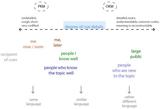
Closer to the main thread here, Mackness & Melcher in their second post talk about this chart by Magdalena Bottger.
Notice that arrow across the top. In terms of early connections, I see an analogy, a continuum from"folks you just met" (the right-hand side) through "people you know well and who know you well" (over on the left).
The way you move a from right to left-the way the "connection neurons" get all Hebbsian-is through a series of interactions over time. You take extra care initially to signal intent. People on the other side of the relationship will take that in, along with other signals.
In other words, if you’re polite in private messages but seem like a cranky, dismissive, and apostrophe-challenged troll on your blog, that politeness will only carry you so far.
When you have enough public personas, people can form a pattern from them. Might be the one you’d form, might not.
CC-licensed resonance image by gillicious.
Dave Ferguson
.
Blog
.
<span class='date ' tip=''><i class='icon-time'></i> Aug 19, 2015 05:06pm</span>
|
|
If you saw Shakespeare in Love, you may remember an early scene in which Philip Henslowe, the producer, is warned by moneylenders that when people don’t pay their debts, their boots catch fire. (The real-life Henslowe kept a diary-actually an account book listing payments and other data-that’s a prime source for information about the Elizabethan theater.) Eventually Henslowe convinces the money guys to back Will Shakespeare’s new play, Romeo and Ethel, the Pirate’s Daughter.
Geoffrey Rush as Philip Henslowe
In this first week’s experience of PLENK 2010 (the online course about personal learning environments), I kept hearing Henslowe and the moneylender discuss how a play comes to be.
Henslowe: Mr. Fennyman, allow me to explain about the theatre business. The natural condition is one of insurmountable obstacles on the road to imminent disaster.
Fennyman: So what do we do?
Henslowe: Nothing. Strangely enough, it all turns out well.
Fennyman: How?
Henslowe: I don’t know. It’s a mystery.
By no means am I implying that PLENK is on the road to imminent disaster. Or better, it’s a road company, in at least two senses:
It’s a work in progress. What goes in, what happens, and especially what comes out can’t be known. Like the road company for a play, it takes place in multiple locations. (See the Google map started by Heli Nurmi, with only some of the 1,000+ registrants.)
It’s a group of people. They’ve met in this virtual space for their own reasons, much like an earlier group:
At nyght were come into that hostelryeWel nyne and twenty in a compaignyeOf sondry folk, by aventure yfalleIn felaweshipe, and pilgrimes were they alle,That toward Caunterbury wolden ryde.
By nightfall, into those lodgings had comeNine-and-twenty people in a companyOf sundry folk, by chance fallenInto fellowship, and they were all pilgrimsWanting to ride to Canterbury.
As with Chaucer’s pilgrims, each person in PLENK showed up at the virtual Tabard Inn because of his own reasons: curiosity, a desire for focus, challenges to address. And each one will have a story to tell.
More than one story, I think. Harry Bailey, the host, urged that compaignye to each tell two stories on the way to Canterbury, and two on the return. He wanted the travelers to enjoy the two-day to Canterbury (an early suggestion that the journey could be the reward).
PLENK’s company isn’t like Chaucer’s; one of our commonalities is that we’ve got different destinations (if in fact we’ve figured out where we want to go).
So the "road" that the company travels isn’t a specific route. It’s more like the Oregon Trail or the Silk Road: a general direction with multiple paths.
For my own part, I’ve read a sheaf of blog posts and discussion posts from participants this week, along with some of the resources contained in PLENK’s daily feed. These are the stories that the pilgrims tell-not fictional ones, told on the way to Canterbury, but sense-making ones, told on the way to understanding.
I’ve found people trying to make sense of PLNs and PLEs in contexts like high school teaching, graduate education, personal growth, and (thank goodness) learning on the job.
Not all the sense they’re making makes sense to me, but it’s not supposed to, any more than every presentation at a conference or every course in the catalog is supposed to. Really, I’m still feeling my way along, but I’m not too uncomfortable with that.
PLENK facilitator Rita Kop wrote about information abundance and economy of attention the other day. She mentioned John Hagel‘s thoughts on attention as an increasingly scarce resource. My quick take on what that means: the more inputs available to you, the less you can afford to, well, pay attention to all of them-because you’ve only got so much attention to spread around before you hit cognitive homeopathy.
Kop was trying to work out concerns of some PLENK participants and wondering about whether there’s a good match between "learner needs and educator support." I couldn’t say, but included this in my comment at her post:
For some people, plopping into PLENK is like an American suddenly teleporting to London. Or maybe Amsterdam, where enough people speak English that he’s mostly disconcerted by all that Dutch on signs.
For some, though, it’s like being teleported to Riga or Mumbai, with a lot more "foreignness" — an abundance of unfamiliar information. When it comes to economy of attention, they feel like their account is overdrawn.
Speaking of which, if attention’s an account, then time is the wallet you keep the card in, and I have to watch how often I get that wallet out.
Dave Ferguson
.
Blog
.
<span class='date ' tip=''><i class='icon-time'></i> Aug 19, 2015 05:06pm</span>
|
|
Kevin Kelly, in this week’s New York Times Magazine, writes about home-schooling his eighth-grade son. He balances a nothing-special tone ("one of more than a million students home-schooled" last year) with crisp examples like the boy’s decision to learn to make fire the old-fashioned way.
He was surprised by the enormous amount of bodily energy required [to use the bow method]… and how a minuscule, nearly invisible bit of fuel… can quickly amplify into a flame and then a fire. Chemistry, physics, history and gym all in one lesson. And, man, when you are 13 years old and Prometheus, it’s exhilarating!
(Probably took a little while longer than this demo I found on YouTube.)
Kelly and his wife had a goal: to provide an ideal learning environment. Their son had gone to school for 7 years, and planned to attend an "intense" high school. He was the one who asked if he could be home schooled.
What stands out for me is Kelly’s statement that technology was not a major factor in the success of this year. Yes, lots of online materials and research. But the computer was only one tool among many.
Kelly sees "technological literacy" as yet another proficiency children need to acquire. It supplements but isn’t the same kind of critter as critical thinking, logic, or the scientific method:
Technological literacy is…proficiency with the larger system of our invented world. It is close to an intuitive sense of how you add up, or parse, the manufactured ralm. We don’t need expertise with every invention; that is not only impossible, it’s not very useful. Rather, we need to be literate in the complexities of technology in general…
What kinds of literacy is he talking about? These stood out for me:
Technologies improve so fast you should postpone getting anything you need until the last second. Get comfortable with the fact that anything you buy is already obsolete.
This aligns with a tongue-in-cheek watchword: never buy a low serial number. More seriously, it’s allowed me to happily skip at least 1 out of 2 OS upgrades.
Before you can master a device, program or invention, it will be superseded; you will always be a beginner. Get good at it.
"You will always be a beginner." It sounds like you’re being sentenced. It’s more like having a gate opened: you’re not the only one here.
Be suspicious of any technology that requires walls. If you can fix it, modify it or hack it yourself, that is a good sign.
Nobody has any idea of what a new invention will really be good for. The crucial question is, what happens when everyone has one?
The older the technology, the more likely it will continue to be useful.
That last point truly resonated with me. Among other things, it recalled a somewhat dry but oddly compelling book I’ve been rereading: The Coming of the Book: the Impact of Printing, 1450-1800.
Kelly’s website announces the coming of his latest book, What Technology Wants. Here’s part of what he says about the book as a book:
I suspect this will be the last paper-native book that I do. The amount of work required to process atoms into a sheaf of fibers and ink and then ship it to your house or the local bookstore is more than most of us are willing to pay anymore. And of course the extra time needed upfront to print and transport it is shocking. This book was finished, designed, proofed, and ready to be read four months ago. But atoms take time, while bits are instant.
What about Kelly’s son? I think he’ll do fine in that demanding high school, based on this anecdote near the end of the NYTM piece:
On one particularly long day, with books piled up and papers spread out, my son was slumped in his chair.
"Is everything O.K.?" I asked.
"It’s hard," he said. "I not only have to be the student, I also have to be the teacher."
"Yes! So what have you learned about being a teacher?"
"You have to teach the student — that’s me — not only to learn stuff but to learn how to learn."
"And have you?"
"I think I am doing better as the student than the teacher. I’m learning how to learn, but I can’t wait till next year when I have some real good teachers — better than me."
Dave Ferguson
.
Blog
.
<span class='date ' tip=''><i class='icon-time'></i> Aug 19, 2015 05:06pm</span>
|
|
I started wondering earlier today, in one of the PLENK2010 discussions, how many participants come from backgrounds like mine — training and learning in organization and corporate settings — as opposed to school (primary and secondary ed) or academia ("higher education").
Partly I’m hoping to learn ways that people are trying to encourage or support learning in non-educational settings. Not just in the be-a-lifelong-learner or take-charge-of-your-learning frame of mind, but also in terms of focusing that encouragement and support around some organization-specific goal. Because, you know, if Sgitheanach Financial is merging with Sinon Real Estate, we’re probably going to have new systems, new goals, job changes, and other things that people will need to adapt to. It won’t all happen via Twitter and Facebook.
In no way am I implying that I don’t value the contributions of people in educational or academic settings. I’m just using this question to find people whose challenges/problems/opportunities are more clearly like mine. Or at least like some of mine.
I didn’t see a(n obvious) tool to create a survey within the discussion, so I’m trying one here. No ulterior motive; I’m just curious about the makeup but not up to reading a thousand here’s-my-intro posts in the course Moodle. Feel free to comment.
(I suspect this may need revising, which might mean another poll. I wouldn’t want to mess up the results of this one any more than I need to.)
If you’re an independent practitioner (like me), considering answering based on where the majority of your work (or income) comes from.
Note: There is a poll embedded within this post, please visit the site to participate in this post's poll.
* Just an excuse to repeat the story about a reporter asking Pope John XXIII how many people worked at the Vatican. His reply: "About half."
CC-licensed survey image by psd / Paul Downey.
Dave Ferguson
.
Blog
.
<span class='date ' tip=''><i class='icon-time'></i> Aug 19, 2015 05:06pm</span>
|
|
The third week of PLENK2010 is ending. When I decided to sign up for this online course ("Personal Learning Environments, Networks, and Knowledge") I didn’t have a goal much more solid than "find out more." I assumed the "more" would involve PLEs and PLNs.
Finding out more about knowledge wasn’t that high on my list. Like a vegan who’s confessing his weakness for Twinkies, I feel vaguely uneasy saying this, but most high-abstraction discussion just makes me sleepy.
That probably explains a stretch of about five days when I didn’t do anything PLENK-related; I even closed the Tweetdeck column I had for the #plenk2010 hashtag. Everyone and his cousin Bernie drew diagrams of their networks, and a daunting number of discussion posts probed the nuances of PLE versus PLN versus VLE… truly, I expected to see RSVP versus SPQR.
That’s okay. I don’t have to like, much less use, a term like MOOC (Massive Open Online Course). I see the intention as an opportunity that’s participatory, that has a focus but not a required sequence, and from which I select what I choose to select.
This post is just me, flipping through things that stand out after three weeks.
In how to take this course, the PLENK facilitators said the purpose isn’t to use a bunch of tools; it’s to practice using those tools to select content, rework it, create something new, and share-particularly with others in the course.
I already had this blog and a Delicious account. I take Twitter so much for granted that I was surprised the PLENK profile form didn’t have a specific field for it.
Putting the "dis" in "discuss"
I find the Moodle-based discussion kludgy, from a user standpoint. For one thing, each week’s discussion list gets sorted by most-recent-addition, which means the order constantly changes. But there’s nothing to tell me if I’ve already read the posts in a given discussion. Since there are 36 discussions in Week 2 and 12 in Week 3, I’m unlikely to remember on my own that I’ve seen everything in the thread with 34 posts but not everything in the one that has 31.
The same way that you make less coffee if you have a finicky coffeemaker, I find the recurring annoyance of navigating the discussions has probably conditioned me to open them less often. I have to nag myself to make an effort, because I’ve benefited from what other people have shared.
Net worth
Lots of people have made lots of diagrams of their PLEs and PLNs. I’ve skimmed some, though after a while they all kind of look the same. I realize at some level they are the same, because the diagrams show relationships that matter to those who created them.
Me? I read Dave Cormier’s thought that the difference between PLE and PLN is mostly semantic, and thought, "Works for me."
Yeah, yeah, semantics matter, but in this case not very much to me.
About the best thought I can draw for myself is the value of reflecting on where and how I learn, especially in my professional life. Some of this-exchanges with my peers, reading what experts (however defined) have written-is of such longstanding, it’s kind of like the way I write. I don’t spend a lot of time thinking about my use of passive verbs, or having pronouns agree with their antecedents, because I’m at pretty freakin’ high strength for those particular skills.
I do find myself thinking more along the lines of "so what?" What (if anything) do I do with what I take in? I don’t want to be some kind of conceptual holding tank, or a guy with 10 gallons of Knowledge stored in the basement next to the water heater.
Follow disgruntle
I’ve used this phrase before. It’s my way of telling myself to pay attention to annoying things I want to dismiss. (Note: when you come with your friend to evangelize me, I’m still going to pretend I’m not home.)
So, for example, I like to make fun of words like "affordances," which at times seems like the Learning Business’s latest synonym for "general wonderfulness." Deep down, I knew all along that probably wasn’t the full picture; I just couldn’t drag myself to find what it was. But in a side conversation with yet another online colleague (YAOC), I got some useful, cognitive-psychology explanation.
I’m still going to make fun of "affordances," but not as often.
Since I didn’t make a map of my PLE, though, I’m feeling as though I have to at least try making a concept map. Of what, I’m not sure. Why? Mostly to put myself through the exercise of trying to do it-to see whether I end up with a result that seems of higher value than expected.
I understand what George Siemens meant when he said mindmaps have a center but concept maps don’t. I have to do one, I suppose, to grasp the implications of how concept maps "communicate relatedness and reasons for relatedness."
Seeking Ellumination
I missed the first week’s Elluminate broadcast because I couldn’t get it to work. It took till nearly the second week’s broadcast to discover the problem was on my end (my so-called security software wouldn’t let the session open).
These are handled about as well as you can handle a high-tech conference call. The session moderators have done well, I think, and the participants share enough of a focus that the level of silliness or randomness (in the "backchannel" of the chat window) is about what you’d get in an in-person workshop.
What I didn’t expect to happen is that I’ve done some post-session followup each time with individuals who spoke (or, more accurately, chatted) up during the session. As with Twitter discussions, what someone says in an Elluminate session can move me to make further connections.
* * *
Hmmm… I’m kind of a wordy blogger anyway. Skimming what I have here, I don’t have much sense of a conclusion. In part I wrote this from the notes I kept (in an Evernote document) over the past couple of weeks. There’s more, equally ill-formed, so I’m just going to stop now and let things percolate (or incubate) for a bit.
* * *
(Added afterward)
I forgot to mention that my survey (asking about the backgrounds of people in the course) did confirm an impression I had. Only 12% of respondents say they work in corporate / for-profit areas, while 39% work in academia.
Another 6% say they work at the Vatican, which is a good reminder of the value of informal surveys.
Dave Ferguson
.
Blog
.
<span class='date ' tip=''><i class='icon-time'></i> Aug 19, 2015 05:06pm</span>
|
|
I have no idea how I ended up at unrefinery.com, "a style, design, and technology filter for gents" where they "like finding cool stuff and making fun of everything else." I’m pretty sure I’m not their target market; almost none of my clothes have the name of living people on the label. (And even Leon Leonwood Bean, who died 43 years ago, might not count as a designer.)
Even so, I appreciate their combination of focus, opinion, and attitude. And that was before I found this compare-and-contrast gem:
To fully appreciate unrefinery’s style, read the entire post. If you stay here, I’m just going to talk about their slightly tongue-in-cheek decision guide, and about how it relates to learning at work.
To bag, or not to bag?
A reader asked whether a bag in an earlier unrefinery post didn’t look "a lot like a purse." The blog agreed that the reader had a good point.
"While there’s no one thing that makes a bag more or less masculine," unrefinery goes on, "there are a few parameters that taken collectively make all the difference."
Now, if that’s not a nice way to concretize some tacit knowledge, I don’t use dry-erase markers on my (real) whiteboard.
Here, then, are the factors ("in order of importance") used in that comparison above:
Size: the bag you choose should be "at least as big as the briefcase it replaces."
Aspect: "wider than it is tall. No exceptions."
Carrying method: padded handles. Failing that, a same-side strap. As a last resort, a cross-body strap (but see the full post for cautionary detail).
Color: darker and more neutral. A bag in a lighter color had better be something "no self-respecting woman would ever be seen carrying."
In under 300 words, unrefinery sets out considerations and provides clear yet nuanced criteria. (I can’t tell you how relieved I am that the black leather bag I use for my computer meets all four, though I don’t expect to see it featured on their blog.)
Whether you agree with the considerations is another question, but using the points here, you could evaluate any number of bags for men and come up with a judgment that, more often than not, would align with that of the exemplars at unrefinery.
Beyond the bag
Hardly any jobs are entirely made up of little decision guides. I do think, though, there’s usually a fair amount of this stuff that’s not obvious to newcomers or even people who’ve been toiling in the field for a while.
(I was apparently absent the day someone said that virtually all French nouns ending in -tion, like collaboration, gestion, and natation, are feminine. There are a couple of exceptions, like un bastion. I’m still sorry I didn’t learn this 30 or 40 years ago.)
So imagine people in a workgroup whipping up considerations and criteria like this for decisions relevant to the job.
The effort to make the tacit knowledge more explicit encourages reflection and revision.
Differences in interpretation and practice become visible. Maybe there’s more than one way to accomplish something-or maybe the differences have resulted in unnecessary variation.
Concrete examples help people work their way toward more general principles.
One way to think about learning is that it involves both acquiring information and applying it to a situation. In the world of style, you might rephrase that as savoir faire.
Dave Ferguson
.
Blog
.
<span class='date ' tip=''><i class='icon-time'></i> Aug 19, 2015 05:05pm</span>
|
|
I’m sometimes confused by mission statements and vision statements. Sometimes I can’t tell the difference, and I don’t think it’s always my fault.
In a 2005 post at Lifehack, Rosa Say wrote that the difference only matters if you use the the statements.
Vision Statements and Mission Statements can be power-packed drivers in a company culture when they are done right, and when they are used to release the potent energy within the people who make up that company. (Don’t for a moment think that companies are made up of anything else.)
The best missions and visions become mantras for action; they’re catalysts. The worst ones are those pretty, carefully crafted ones up on the walls in frames that are long and detailed: too much to memorize and remember, too much to bother with at all. No one pays attention to them, and no one lives them. Rotate them with famous quotations or snippets from eloquent speeches and no one will even notice, because none of the real people in the company say those things.
She offers these crisp descriptions:
Your mission is what you do best every day.
Your vision is what the future is like because you do that.
I wandered sideways into this topic because of Saving Private Ryan. Though it’s been years since I saw the movie, one scene stayed in my mind as an example of people on the front line understanding the bigger picture. It’s a brief exchange between Captain John Miller (played by Tom Hanks) and Captain Fred Hamill (played by Ted Danson), not long after the allies had secured the Normandy beachhead.
That short conversation begins at about the 5:45 mark in this clip. (I’ve put a transcript of the conversation below.)
Hamill: What have you heard? How is it all falling together?
Miller: Well, we got the beachhead secure. Problem is, Monty’s taking his time movin’ on Caen. We can’t pull out till he’s ready, so…
Hamill: That guy’s overrated.
Miller: No argument here.
Hamill: You gotta take Caen so you can take Saint-Lô.
Miller: You gotta take Saint-Lô to take Valognes.
Hamill: Valognes, you got Cherbourg.
Miller: Cherbourg, you got Paris.
Hamill: Paris, you got Berlin.
Miller: And then that big boat home.
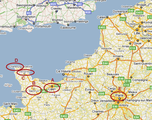
I have no idea if real captains talked like this, but I like the capsulization. Especially because in under 50 words, it sketches a broad plan while showing that the two men get the plan. (The landing on Omaha beach was due north of Saint-Lô, roughly where the B is on this map.)
In a completely different setting, Herb Kelleher of Southwest Airlines said, "I can teach you the secret to running this airline in thirty seconds. This is it: we are THE low-fare airline. Once you understand that fact, you can make any decision about this company’s future as well as I can."
Chip and Dan Heath, in Made to Stick, note that this idea "isn’t the whole story, of course." Many Southwest employees take great satisfaction in their jobs, although Southwest is thrifty to an extreme and "it’s not supposed to be fun to work for pennypinchers." A clear, shared sense of purpose can’t hurt.
Vision Statements and Mission Statements can be power-packed drivers in a company culture when they are done right, and when they are used to release the potent energy within the people who make up that company. (Don’t for a moment think that companies are made up of anything else.) The best missions and visions become mantras for action; they’re catalysts. The worst ones are those pretty, carefully crafted ones up on the walls in frames that are long and detailed: too much to memorize and remember, too much to bother with at all. No one pays attention to them, and no one lives them. Rotate them with famous quotations or snippets from eloquent speeches and no one will even notice, because none of the real people in the company say those things.
Dave Ferguson
.
Blog
.
<span class='date ' tip=''><i class='icon-time'></i> Aug 19, 2015 05:05pm</span>
|
|
Stephen Ellis is a partner at the law firm Tucker Ellis & West. Thanks to David Maister’s blog (which Maister discontinued in January 2010), I came across a commencement address Ellis gave at Case Western Reserve School of Law in May 2008.
Unlike the Case grads, I’m far from the beginning of my career, but I found Ellis’s ideas both pertinent and refreshing.
And that was before this section:
The fact is, our profession has become increasingly unhappy over the past couple of decades. I am convinced the vast majority of that unhappiness derives from a single seemingly innocuous event in the late 1980’s: The American Lawyer magazine began publishing the AM LAW 100, and listed the profits per partner of the 100 largest firms. Virtually all of the firms in this country immediately bought in to that statistic as the only credible measure of success. The game was on - we lawyers would now take our measure almost entirely from money, at least in terms of what was publicly discussed. Without question, integrity, service and professionalism were important, but how we measured ourselves was money.
This was a terrible mistake and now, more and more of us see its dark implications: the bragging rights on how many billable hours we charge (and the matching lost weekends and evenings); rates that are topping $1000 an hour; and clients who believe their files are being worked to death by armies of inexperienced associates.
Here’s the title of Ellis’s address: On Being a Happy (and Successful) Lawyer. He speaks well (judging from the transcript), and I thought many of his points would be worthwhile to pull out and adapt to… well, to me, a person in the learning profession.
So I’m putting several of those points here, for when I don’t have time to reread the entire address. Where he talks about the law, I just mentally edit things to read "the learning profession." It’s worth the effort.
First, be someone others can count on.
Clients come to you because they have a situation they cannot solve on their own. Most are not looking for an analysis of the law. Most want you to solve a problem. So solve it, don’t add to their problem by being hard to find, by missing deadlines, or by simply describing their problem back to them.
Second, be an interesting person.
Force yourself to do be able to talk about more than law - read books, go to movies, be part of politics, go to lectures. You’ll meet people, you’ll be able to talk about things that other people find interesting, and you won’t burn out on your job.
Look out for yourself.
Mentors are important, but they are only a resource. Accept that you are in change of your success…. If you think you need experience in an area, make it your business to go get it.
Determination matters.
Great careers are the result of day after day deciding to do good work and being someone who others count on.
Be enthusiastic.
We lawyers take pride in being the first one to find fault with an idea. Makes us look smart…. clients want to do things. They don’t call you so they can not do things. They want to stay in the borders of the law, but they want to be told how to do what they want to do…
There is no better way to end a client meeting than saying "This is going to be great" and to mean it.
Trust yourself.
Among the most important conclusions I came to as a young lawyer was that if I didn’t understand something, it was because the thing in fact didn’t make sense, not because I was stupid.
Most of the times I’ve found myself in hot water it’s because I let a conversation continue past the point where I understood what was being said. And virtually every time I would say "Stop, I’m not following this," someone would come up to me after the meeting and say "Boy, I’m glad you said that. I had no idea what we were talking about."
People I admire talk a lot about organizational culture. Whatever image I had of the culture of a law firm, I’ve had to modify it (at least as it applies to a good law firm) based on Ellis’s thoughts. I know these are good reminders for my own professional life as well.
Dave Ferguson
.
Blog
.
<span class='date ' tip=''><i class='icon-time'></i> Aug 19, 2015 05:05pm</span>
|
|
Yesterday marked one year since my dad died. As the date approached, I thought of a term I first heard a few months ago from my friend Zoe: "a year’s mind."
Dad, with his youngest great-granddaughter
It means a remembrance, as in the one year anniversary of someone’s death. And as October 21 approached, I’d been thinking about my dad. I had considered writing something here on the date, but decided against it. Or had decided, until this morning, when I read Karyn Romeis’s poignant post in which she marked her own father’s birthday.
So I’ve decided to talk about one of the ways I remember Dad.
My mother asked me to give the eulogy at his funeral, and while I was working on that, I found an image I’d made years before. He’d written me a letter about ten years ago, when his parents’ house was torn down, and for some reason I’d scanned the letter. I’m glad I did, because there’s so much of him in it.
Dear Dave,
Hope the shock of getting a letter from this end won’t be too hard on you.
No one who knew Dad would be surprised by the wry humor.
I cut this out some time back and forgot where I put it until today.
"It" was a two-photo feature from my home town newspaper. The big, cream-colored house that his father built in 1923 had been demolished.
I have a lot of nice memories about life in (the) big house but my fondest memories are of the Red Rows where I was born.
My home town was a coal-mining town on the western shore of Cape Breton Island. The mine built dozens of little duplex houses, all painted red: the Red Rows. Dad said one time of his family’s place in the Red Rows (a home for his parents, six or seven children, and his grandmother, that there was so little room that "before we went to sleep they must have given us something so we’d sleep and hung us up on hooks."
I was to a dance in Windsor Saturday night. Buddy MacMaster played and the place was jammed. Music was excellent. I got home about 2:15 a.m. I went with Alex and Muggsy. It was a nice evening as I saw a lot of friends both young and old. It was a trip to Cape Breton.
Dad and Mom were living in Dearborn, Michigan, a suburb of Detroit; Windsor, Ontario is just the other side of the Detroit River. Alex and Muggsy are part of the vast Cape Breton diaspora that for decades has out-networked Facebook.
As for Buddy MacMaster, he’d have played tunes like these and these, though the clips are from a concert in Boston, not a dance like the one in Windsor.
I read the paragraph about the dance at Dad’s funeral-and I added that if not for the date on the letter, he could have written it any time from 1951, when he moved to Detroit, till 2009.
Weather here very nice, a little frost each morning.All the rest of the family OK.
I don’t think I ever had a letter or a phone call without his asking about the weather. I’ve come to see this not just as standard conversation, but his way of connecting more with someone in another place: what’s it like for you? Here’s how things are for me… and for the people around me.
Hope you can make out the writing. The old hand is getting pretty shaky.
I suppose it was shaky enough-but every week, Dad would write a letter to his older sister. Like this one, I’m sure they rambled from topic to topic, but they were as much a part of him as sitting in someone’s kitchen with a strong cup of tea.
* * *
And those are some of the things I’m remembering, some parts of this year’s mind.
Dave Ferguson
.
Blog
.
<span class='date ' tip=''><i class='icon-time'></i> Aug 19, 2015 05:05pm</span>
|