Blogs
|
A link on Twitter led me to a post at the Law Blog of the Wall Street Journal. Ashby Jones had fun mocking Our Tech-Savvy Supreme Court.
They were hearing oral arguments in City of Ontario (California) v. Quon. At issue was whether a member of the Ontario police could expect privacy for personal messages received on his SWAT-team pager, and whether people sending texts to that device could expect that the recipient’s employer would not review those texts.
Jones highlights some remarks by the justices:
Chief Justice Roberts asked what the difference was between e-mail and a pager.
Justice Kennedy wondered whether, if you’re sending a text as one arrives, the person who sent that one sees something like "you call is important to us; we’ll get back to you."
Justice Scalia asked whether a sent text doesn’t go right to the recipient. (Jones thinks he was confused by the idea of a service provider.)
(You can judge for yourself, if you’d like. Here’s the transcript of the oral arguments. I think the remarks that Jones highlights are at pages 29 [Roberts, email and pages], 44 [Kennedy, your call is important], 48-49 [Scalia, service providers; printing texts].)
Yes, it is amusing if you think the youngest member of the Court doesn’t know the difference between email and a pager. But that’s about all it is, amusing. What I think is more pertinent here is that the justices were asking questions to better understand things unfamiliar to them, and that they were focusing on larger issues and not the details of technology.
For instance, Jones left off the first part of Roberts’ question, so I’ll highlight it here:
Maybe everybody else knows this, but what is the difference between the pager and the e-mail? (transcript, page 29)
I have no idea what level of techno-expertise Roberts has, but I’d guess he’s more familiar with email than with pagers, and trying to understand (a) what the difference might be, and (b) whether that difference makes a difference.
In terms of the busy-signal question from Justice Kennedy, it turns out that a few minutes earlier, Roberts had asked:
What happens, just out of curiosity, if you — he is on the pager and sending a message and they are trying to reach him for, you know, a SWAT team crisis? Does he — does the one kind of trump the other, or do they get a busy signal?
To which the attorney answered, "I don’t think that’s in the record," which is how a lawyer often phrases "I don’t know."
As for Scalia’s remark about where a message goes, my guess is that he was being facetious (though we can’t know till there are audio recordings of oral arguments).
A discussion (starting about page 45 in the transcript) had to do with whether it made a difference that the text messages were handled by a service provider. Scalia asked whether, when you send a text message, you’re pretty much aware that it remains private only if the recipient "or somebody else who has power over the recipient" chooses to look at it. The lawyer said yes.
Roberts: Well, then they can’t have a reasonable expectation of privacy based on the fact that their communication is routed through a communications company.
Dammeier (attorney): Well, they — they expect that some company, I’m sure, is going to have to be processing the delivery of this message. And -
Roberts: Well, I didn’t — I wouldn’t think that. I thought, you know, you push a button, it goes right to the other thing.
Dammeier: Well -
Scalia: You mean it doesn’t go right to the other thing?
[Laughter]
You may not agree with the opinions that the justices issue, but I think the transcript illustrates several things. First, they’ve gotten a grasp of the legal issues in the case (which is, after all, their job). Second, they’re more than willing to ask questions. Third, as evidenced by Roberts, at least some of them are unafraid of saying, "I don’t understand X. Can you explain it to me?"
Which isn’t a bad way to start learning more about things you know that you don’t know.
Supreme Court image adapted from this CC-licensed photo by Virginia Foxx.
Dave Ferguson
.
Blog
.
<span class='date ' tip=''><i class='icon-time'></i> Aug 19, 2015 05:08pm</span>
|
|
About ten years ago, my parents got a computer. Dad was 87 and Mom was 81. They weren’t really early adopters, except maybe among their age group.
The primary reason was my dad’s eyesight-he couldn’t drive safely at night to visit friends and play cards. The computer allowed us to install card-game software. The software created virtual partners for cribbage, pinochle, and euchre, as well as solitaire cards that never got sticky.
A few weeks later, my mother asked if they could get to the internet. We got her an AOL account and bought two copies of a graphic-rich how-to book. (That way, when she had a question, I’d use my copy and say, "Look on page 32. I’ll walk you through the steps…")
I printed the first email she sent, in May of 2000. It read, in part:
I want to know what URL means. I want to know if my address book has the e-mail addresses in it. And how do I get it?
Those are great, goal-oriented questions. And I had forgotten this from my dad, about a month later, until I found the copy this morning:
Hi David
Mom made me do it
This is the old fellow trying to compose a little note.
How am I doing?
Love Dad
For quite a while, they had fun with email (mostly receiving, since their typing skills weren’t the greatest). Over time, though, Mom and Dad had difficulties with the mechanics: they’d get attachments they couldn’t open, and their in-basket will fill up because they didn’t quite get the hang of filing.
Then I had an epiphany: I set up what I called the world’s smallest blog (audience: two). Instead of writing letters or email, I started posting to the blog. Instead of searching their in-basket, they’d click on the desktop shortcut I created.
With photos embedded in the posts, they didn’t have to open attachments. The blog would automatically archive by month, and also by broad topic. And my three children (who between them have more than half a dozen blogs) had author access, so they too could plop down at this digital kitchen table for a visit.
I mention this for a number of reasons. First, Sunday was the blog’s fourth anniversary (official readership is down to just my mother). Second, and not entirely by chance, Sunday also marked the blog’s one-thousandth post.
That’s right: for four years, my parents have had virtual guests about five posts a week.
By and large the posts on their blog are astonishingly mundane. I write about a trip into Washington, or making chicken stew provençal, or (much less often) about a consulting project I’m working on.
Oh, and the weather. My dad always wanted to know what our weather was like.
My kids tease me, but they know the real purpose: each post is a brief chat with my mother, often with pictures (she got a lot of pictures of last February’s snowpocalypse), letting her know what’s going on here. They add their own comments, and a fair number of pictures of the great-grandchildren.
Another reason I mention this is that when I came up with the idea, I realized I’d broken through my own preconception of what a blog was. Blogs are for the world at large? Not necessarily. They have your Big Thought of the Day? Ehh, maybe not. They’re all about ever-expanding readership? It’s debatable.
What really happened is that I had a problem to solve-Mom and Dad’s challenges in working with email, and my own spotty record in sitting down to write them some email. And by ignoring what I thought were conventions of the medium, I found a solution.
The only drawback? My brother, who lives with my mother, urges me to post at least four times a week. If I miss two days running, he says, my mother worries that there’s something wrong, either with her computer or with me.
I’m not sure which worries her more.
Screenshot from WordPress is mine; CC-licensed tea photo by adactio / Jeremy Keith.
Dave Ferguson
.
Blog
.
<span class='date ' tip=''><i class='icon-time'></i> Aug 19, 2015 05:08pm</span>
|
|
I’ve lost about 18 pounds in the past three months, so I’ve been thinking about goals and performance improvement. (When I say there’s more to me than you might think, I’m not necessarily bragging.)
In February, people in my wife’s office started a Weight Watchers group. It seems if enough people sign up, the Weight Watchers organization arranges for a leader who coordinates weekly meetings. My wife saw this as an opportunity to lose weight that had begun to bother her. I’ve gotten to benefit from the program without having to be in the group.
This post and its planned successor aren’t meant to advocate for Weight Watchers per se. What I’m doing is examining this specific program as a multifaceted approach to a complex problem.
You’d think the goal part would be simple. "Lose 20 pounds" sounds reasonable. When you hear that, you assume someone’s done some analysis, and a 20-pound loss is the desired result. In a way, it’s like a client who wants people to "understand" some business process.
When I’m off duty, I think "understand" is a terrible word to see in a goal. It utterly fails the Heydad test: "Hey, Dad, watch me while I understand inventory management." Not that I don’t believe in understanding. It’s more that people will load this over-broad term with their own meanings, and it’s inevitable that the various meanings will clash.
I’m reluctant to change a client’s own vocabulary at the outset, though, so I’ll try to find out what "understand" means in terms of observable results. And that’s an approach to take with "lose 20 pounds" as well, even if the client is your own fair self. Probe for the symptoms, probe for the possible causes, and look at the fit between cause and possible intervention.
What tells you you need to lose weight? What indicates that 20 pounds is a good amount to lose? What time frame do you have in mind (and why)? How do you know a diet is the way to go?
To make some of those answers explicit for myself, I’ve come up a goal of being in the best shape I can be. That’s tough to write, because I’m not in particularly good shape, and because I can be mighty self-critical. But it helps me reframe weight loss as an enabling objective: I want to lose weight as part of getting myself in shape.
This reframing also helps keep quibbling down. Take body-mass index, a widely used formula to relate weight to health risks. If you’re really tall, or really short, or really muscular, then your BMI may not be a good indication of health.
On the other hand, if you’re six feet tall, not muscular, and weigh 243 pounds, you could do worse than pay attention to your BMI number.
That number would be 33. It’s beyond overweight; it’s more than 20 pounds into the "obese" range. Whatever a good weight for you is, it’s probably not one with a BMI of 33.
When you come to Weight Watchers, the program assumes you’ve done some of that analysis, and that weight loss is a reasonable goal for you. I can’t say for sure, but I’d guess the meeting leader tries to counsel people who don’t seem to need to lose weight.
The program’s "healthy weight ranges" make use of BMI, suggesting that you aim somewhere between 20 and 25 (for that six-footer, 147 to 184 pounds). But dogmatism isn’t the characteristic tone:
For now, use the Healthy Weight Ranges chart as a guide… your ultimate weight goal is totally up to you, and any weight loss that results in a lower BMI than your current one and can be maintained for the log term means success.
In addition, if you adopt a goal outside the range for your height, the program will accept that with a note from your doctor.
While I assume many people have some ultimate goal in mind from the beginning, Weight Watchers suggests an interim target of 5% of your current weight. (That 243-pound person’s target would be 12 pounds.) So you’ve got a flexible goal tailored to the individual, one that relates to the short-term desire for progress while acknowledging that its achievement is a stage on the way to greater accomplishment. The next target? 10% of starting weight. (That’s cumulative, not an additional 10%.)
I see a great deal of value in this. For most people, it’s hard to lose weight. Without extreme effort, a pound or so a week is good progress. But who wants to "progress" through 20 or 30 or 40 or more weeks? Three months isn’t a bad time horizon. In fact, in the initial stages of a weight-loss plan, most people lose at a slightly more rapid rate.
Here’s the deal: if you want to lose weight, you have to use more calories than you consume. How you manage that equation can vary: eat less, move more, or combine the two. "Eat less" and "move more" are concise expressions of complexes of behavior.
In my next post, I’ll talk about a number of approaches to initiate and sustain behavior to help achieve the overall goal.
CC-licensed photo of baby and scale by Salim Fadhley.
Dave Ferguson
.
Blog
.
<span class='date ' tip=''><i class='icon-time'></i> Aug 19, 2015 05:08pm</span>
|
|
My previous post talked about goals related to a complex problem. I even reframed the problem, from "losing weight" to "being in good shape." Yes, there are still covert qualifiers, but the main thrust is: poke and prod a problem statement for a while. This is what Joe Harless had in mind with his dictum that an ounce of analysis is worth a pound of objectives.
You want to look for some evidence that the possible causes are in fact contributing to the problem. Evidence is what helps prevent cause-jumping, charging full-tilt toward a solution based on the cause you’re sure is at work.
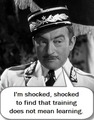
Outside of its meaning in Morocco, Louis Renault’s order to round up of the usual suspects is not all that different from prescribing doses of training to solve some pressing on-the-job problem.
I’ve been studying Weight Watchers as one multifaceted approach to losing weight, whether as an end in itself or as part of an overall goal of good health. I see a cluster of "health skills" that are like constituent skills from Ten Steps to Complex Learning:
Eat smart (when you’re in charge)
Dine smart (as a guest, in a restaurant, at a party)
Shop smart (at the grocery store)
Cook smart
Live smart (get along with those you live with)
I’m sure there are plenty of others, and not all apply to everyone: maybe you don’t cook much and don’t want to. The various tools and approaches used by Weight Watchers work in different ways as part of a performance system.
For example, they rate food by points based on fiber, calories, and fat. You calculate your own point allowance based on your age, your height, your sex, your activity level, and your starting weight. My initial "point budget" was 33% higher than my wife’s. That meant I didn’t start out feeling as though I was going to starve to death.
Performance standards: I haven’t yet done the math, but I’m pretty sure your point allowance aligns with the Mayo Clinic’s strategy of setting a realistic goal for weight loss. To lose 1 to 2 pounds a week, they say, you need to burn 500 - 1,000 more calories per day than you take in.
Monitoring and feedback: By tracking your points, you’re increasing your awareness of what you eat. I use a third-party app on my phone, but there are also paper checklists, including some with a grid to track your state of mind throughout the day (full, satisfied, hungry).
Social support: people like my wife participate in weekly meetings, with the benefit of both the meeting leader and the other people working through the program. For me, it’s mainly the fact that the two of us have collaborated (for four months now).
Process change: in a series of 10 booklets, the program offers quick-start tips, menu ideas (with points already calculated), suggestions for increasing your physical activity, and even strategies based on the particular problems or setbacks you identify in yourself.
In a related change, we spend about 45 minutes each weekend picking out dinner recipes for the week, then building a grocery list based on those menus. (An unexpected discovery: many of the recipes in Jacques Pépin’s cookbooks fit our "point budgets" just as they come. This one I estimate at 6 points per serving; my daily allowance is 32.)
♦ ♦ ♦
I don’t want to turn this post into a dieting column. Really, I’m looking at a number of ways to go about accomplishing what Tom Gilbert would call a worthwhile result. And part of the point is that long-term, significant performance requires a wide variety of interventions. Some are pretty straightforward, procedural skills: learn to manage portion size; always track points. Some are more situational.
Most, if not all, have evidence to support their value. Whether that evidence is pertinent to you is something else. Evidence suggests, for instance, that frequent monitoring of weight (like weighing yourself daily) helps you progress and also maintain the new weight once you reach your goal. Helps, not guarantees. But stepping on the scale every day isn’t usually too strenuous.
CC-licensed photo of retro scale by teresia.
Dave Ferguson
.
Blog
.
<span class='date ' tip=''><i class='icon-time'></i> Aug 19, 2015 05:07pm</span>
|
|
Jonah Lehrer at The Frontal Cortex talks about "feelings of knowing" — how we feel sure we know what we can’t retrieve from memory. He’s talking about tip-of-the-tongue things: you can’t quite remember who played the sheriff of Nottingham in Robin and Marian, but you know he had a short last name that started with S.
Lehrer suggests that this "feeling of knowing" is often highly accurate. (I hadn’t considered this concept before, so I’m glad Lehrer linked to this study (PDF) by Janet Metcalfe.) This comes into play (as he notes) when Jeopardy contestants click the buzzer without (presumably) knowing the answer: they’re betting that they will know it (retrieve it) within five seconds.
And often, they’re right.
The larger point is that we won’t get a genuinely "human" version of artificial intelligence (not to mention more energy efficient computers) until our computers start to run emotion-like algorithms. What Watson needs isn’t a bigger hard drive or some more microchips - he needs to develop feelings of knowing, which will tell him that he probably knows the answer even if he’s still drawing a blank.
For decades, we’ve assumed that our emotions interfere with cognition, and that our computers will outpace us precisely because they aren’t vulnerable to these impulsive, distracting drives. But it turns out that we were wrong. Our fleeting feelings are an essential aspect of human thought, even when it comes to answering the trivia questions on Jeopardy.
In an update, Lehrer links to a later post by Vaughan Bell at Mind Hacks, who sees the early-buzzing of Jeopardy players as a kind of metacognition. "It’s being able to manage your mental resources based on estimations."
Dave Ferguson
.
Blog
.
<span class='date ' tip=''><i class='icon-time'></i> Aug 19, 2015 05:07pm</span>
|
|
Twitter’s a great way to connect with people—or to fire off a wisecrack, which I’ve done a time or two. Like last night in #lrnchat, when I said:
Every time someone launches another "elearning" with a Jeopardy game, a neuron loses its wings.
At 140 characters, Twitter encourages economy of expression, though you can’t easily come off as concise and nuanced in a single tweet.
Jeopardy games in on-the-job learning are a hot button for me. Like someone on the bus whose MP3 music is just loud enough that you imagine a mosquito practicing the snare drums, that kind of interaction is mostly harmless but rarely enriching.
Monkey, see?
A Jeopardy game is often a quick fix, like a food-court burger, fries, and Coke when you’re slogging through the MegaMall. At best, a mediocre choice. Whatever kind of learning you’re trying to encourage, will dolling quiz questions up in the format of a 56-year-old game show do the trick?
A more significant drawback is that Jeopardy‘s format unduly emphasizes recall and application. You’re focusing learner attention on lower-value tasks. And there’s the disadvantage that few jobs present people with "answers" to which they have to respond with questions.
Where to (re)draw the line
I’ve created interactions based on game formats, including Bingo. Success came in part from listening to people like Thiagi (Sivasailam Thiagarajan). One thing he suggests is that you play with, not within, the rules.
So if you must resort to a Jeopardy format, remember that no law requires people to answer with a question. Nothing forces you to let the winner choose the next question. It’s far more important to match what people do in the interaction with what they’ll do on the job.
Which explains Call Book Bingo.
Some years ago, a client replaced the paper "call book" used by its sales force with a custom computer application. Most of the sales force hadn’t used computers before, so to them it felt like a huge change. The instructor-led training stressed hands-on practice, which meant that by the second day the sales reps felt overwhelmed and unsure of themselves.
So we passed out the sophisticated learning aid you see here, then gave the directions:
Write a number between 1 and 75 on each line that has a number sign. Mix ‘em up. Use each number only once.
When the "caller" (the instructor) gives a number, check your card to see if you have it.
If you do, write the answer to the question in that square.
That was pretty much it-except for the time we spent coming up with questions that involved looking up and interpreting things from all the important parts of the call book. And phrasing them so there was only one right answer. "What’s the weekly sales volume at International House of Widgets?" "Does Myrna’s Accounting and Catering include Contract JT-42?" "How many stores in ZIP code 66431 carry berm flanges?"
There’s a lot there that’s nothing like Bingo: no preprinted numbers, no B-I-N-G-O across the top. Conversely, there’s a lot that’s very much like the real job: pertinent questions about accounts, and the need to research using the new, computerized tool.
No one complained about the variation from "real" Bingo. In fact, most often the learners would ask to continue playing till everyone got at least one Bingo. Often they’d start helping one another as "doing my job" won out over "winning this game in class."
Play around a little
Mindlessly including a copy of a predictable "interaction" doesn’t make for better learning any more than riding the D train makes you a New Yorker. As the noted instructional designer Mary Chapin Carpenter urges,
Show a little passion, baby, show a little style Show the knack for knowing when and the gift for knowing how…
If you’d like to acquire or strengthen that knack, try this advice from game designer Richard Powers.
Circle image adapted under a CC license from this original by Patrick Hoesly.
Dave Ferguson
.
Blog
.
<span class='date ' tip=''><i class='icon-time'></i> Aug 19, 2015 05:07pm</span>
|
|
I know "knowledge management" is a high-value buzzword; I just tend to feel a twinge of weariness when I see it. I’m not sure you can manage knowledge; the best you can hope for, I think, is to try and set up weirs, reservoirs, sidings, and whatnot to channel some of the flow. The idea is that you’ll eventually be able to retrieve it and put it to use.
What helps foster that retrieval? Note-taking. I’m not sure I agree with the authors of this study (PDF), who believe that "learning to take notes well… takes as much time as learning to write in a relatively experienced way." They see the purposes of taking notes as "to record information and/or to aid reflection."
A note to take: "and/or" is nearly always the worst possible phrase. It implies precision but just smudges things. You’re dithering or obsessing or both. (See how I managed to say that without "and/or?")
"Aid reflection" isn’t the term I’d use. I like Stephen Downes’s description of note-taking as your contribution a two-way communication with the source of learning. Downes recently noted a post by D’Arcy Norman, who says:
Note taking is not primarily about manual duplication of a set of resources produced by a teacher. It’s an active process of sense-making and internalization. Of visualizing the processes of thinking.
Granted, that’s not the way people often think about note-taking. For them the phrase is a quick trip back to a lecture hall, with a professor relentlessly flinging chunks of some "body of knowledge" at you. Eventually you’d have to reassemble them to the satisfaction of the flinger.
I can be a very traditional note-taker. As an undergraduate, I adopted two strategies that I thought were worth about 0.75 on a four-point grade scale: sit in the first or second seat of a row, and take notes. Both of these acted to keep me more awake and more engaged, even during the tedium of English Literature: The Augustans.
I have a longstanding habit of taking notes in ink:
Two of my 101 pages of notes from "Complex Learning in Ten Steps"
Ink’s no more essential to note-taking than a soup spoon is to lunch, even if the lunch is soup.
If I’m trying to capture a lot of information for later analysis and search, my first stop is… Microsoft Word’s outlining. I’ve created a few outline templates (one with I-A-1-a numbering, one with that technoid 1.0, 1.1, 1.1.1 format, and other with indents and various bullets for different levels). I type fast and can shift outline levels almost without thinking, which means I’ve got more bandwidth available to take in and reprocess whatever I’m outlining.
Especially when the knowledge stream’s wider than it is deep, I use Evernote. I like the idea that my notes are in two places-online, where I can access them from any computer, and on my own laptop, where my useful paranoia means I back my stuff up.
Evernote extends the concept of "note," because I can take photos of signs, whiteboard sketches, or flipchart pages. Evernote lets me search for text in images, as in the example on the right (click for a larger view).
I’ve used personal wikis to collect information, and I use several blogs as well. Each wiki or blog has a focus, a way of deciding what parts of the flow to direct into the format. And by actively directing-through entering text, through tagging, through classifying and moving-I’m working with the information and increasing the likelihood that I’ll recall it in a context that makes sense to me.
Some more-or-less related items I found along the way:
iPad, Therefore iKludge: David Dobbs writes about problems with noting, and sharing notes, on devices like the iPad.
Teaching with Wikis: Sandra Porter enables electronic notes for students who forget the dead-tree kind.
Cognitive Effort during Note Taking (PDF), a 2005 paper that appeared in Applied Cognitive Psychology.
Much of what I found deals with note-taking in an academic setting. That last paper by Piolat, Olive, and Kellogg makes the point that
…from a cognitive perspective, note taking cannot be conceived of as only a simple abbreviated transcription of information that is heard or read…. on the contrary,it is an activity that strongly depends on the central executive functions of working memory to manage comprehension, selection, and production processes concurrently.
I thought it worth including that statement. For one thing, note-taking looks obvious-you take notes. But what you really do, as the researchers are saying, is manipulate incoming information while managing the technical aspects of recording the results of your manipulation.
If you were into straight transcription, like a court reporter, then it’s possible you learn very little, because your focus is purely on the capture. But for notes to be useful, other than as a transcript, you’re doing things mentally while you’re doing things physically.
Dave Ferguson
.
Blog
.
<span class='date ' tip=''><i class='icon-time'></i> Aug 19, 2015 05:07pm</span>
|
|
I haven’t read any of the Twilight books by Stephenie Meyer, and now I don’t have to, thanks to the reviews at Pop Suede. (I started with the third, the one for Twilight: Eclipse, but here they’re in what I think is the proper sequence.)
Review of Twilight:
Review of Twilight: New Moon
Review of Twilight: Eclipse
What’s the point (other than a teensy bit of humor)?
It struck me that, based on the little I’d picked up from newspapers and online, the Pop Suede folks have done a great job of capturing the plot of each book, then tweaking it enough that you see both the textual source and the satiric object. It’s like a wildly informal approach to… a book report.
Understand: I no more want everyone churning out lolcats book reviews than I want another couple thousand terabytes of online-learning Jeopardy quiz. But think what it took to put these things together: you had to grasp the key points of the original book, weed stuff out, and then express your understanding in a way that communicates.
It’s that kind of reworking and recasting of a complicated set of ideas that helps foster learning, not a 20-item multiple-guess test at the end of the half-day module on Twilight: New Moon.
I once needed to mitigate the effect of the typical marketing department information dump. New victims employees were sentenced to hear 90 minutes’ worth of feeds and speeds about three major products. So I asked the product managers to agree to a new format in which they’d present for only an hour, take a short break, and then participate in a discussion with the new hires.
This is how I explained the "discussion" to the sales folks, immediately before the first presentation:
We’re going to have three one-hour presentations today.
Yeah, I know, but after two of them, you get a 15 minute break.
Look on the back of your name card. You’re in one of three groups based on the colored dot.
At the end of each presentation, I’ll name one of the colors. During the break, that color group has 15 minutes to make a pitch on "the 10 main ways to sell [whatever the product is]."
After the break, you make your pitch. The rest of you get to ask questions, kibitz, figure stuff out.At the end, the Product Manager will jump in.
Yeah, it was manipulative. Hey, I’d been working with sales reps for a while.
Some of the things I had in mind:
Reduce potential product-manager-induced sleep by 33% (one hour instead of 90 minutes).
Increase attention, at least in the first session, since the sales rep didn’t know if he had to work on the pitch till after it was over.
More breaks than expected (a feature, but for most folks, a benefit).
Rethinking / reworking by the sales reps replaced canned product-manager summary.
Product manager got to hear what the sales reps thought were the main sales ideas.
In a way, it was very formal learning: one-time, face-t0-face, scheduled. We even had mediocre coffee, pastries, and PowerPoint. But we also got the salespeople doing what their jobs called for: thinking about the products and how they could sell them to potential customers.
Dave Ferguson
.
Blog
.
<span class='date ' tip=''><i class='icon-time'></i> Aug 19, 2015 05:07pm</span>
|
|
In a cartoon I saw years ago, two Romans are sitting high in the Coliseum, watching people being thrown to the lions. One man says to the other, "You know, I’m a Christian, too — I’m just not a fanatic about it."
I’m kind of that way about hiking, and about learning design. In terms of hiking, my idea of enjoyably strenuous is Lowe’s Bald Spot, a "small subordinate peak below Mount Washington" in New Hampshire’s White Mountains. Which may explain why I enjoy hiking (okay, walking) along converted railbeds like Québec’s Parc Lineaire Le P’tit Train du Nord. Just last week, my wife and I ambled along a similar, smaller route in the town of Annapolis Royal, Nova Scotia.
What’s that got to do with learning design?
Well, learning is what someone does-either through active pursuit or through the relentless looping of stimulus, response, and feedback. Thus what you learn, where, and how all depend on your context, which includes the experiences and inclinations that you bring to the new setting.
If you’re not much of a hiker, then the hiking equivalent of learning design is an effort to help you achieve a satisfactory experience. It took us a little while to figure that the gravely path winding past a marsh had been a railbed, though I had my suspicions. Then I saw a clear, orderly fork, a place where one track had split from another, and I knew.
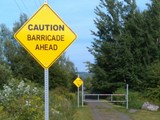
That kind of trail doesn’t need to provide a lot of guidance-though for newcomers, it’s helpful to make clear it is a trail, and to set forth some basics:
We’d entered from a side route and only found this gate as we approached the beginning of the trail. Seems obvious that you’re not supposed to drive here. At least that was my take. But then we noticed the adjoining sign:
Additional user guidance, I guess. What the trail planner (or the town attorney) had in mind, I suppose, was someone tooling along in his car on the approach to the trail, at night, and perhaps not noticing the metal gate. A standard road sign format might help.
Then we moved a bit further away:
A lot of corporate and organizational learning is intended to increase effectiveness. We want people to be more productive, able to do things more quickly, or to a higher level of quality. It’s the mantra of better, faster, cheaper, more.
That’s fine. That’s what you should aim for in an organization, because when you’re better at what you do, you can achieve the goals you had in mind.
A lot of corporate and organizational learning, though, hews doggedly to the throughput model. Give people stuff. Explain. Direct. Tell. Don’t waste time having folks fumble around trying things.
What’s more, I believe many people in those organizations-the folks attending the formal learning-expect that approach. Boil it down. Don’t waste my time. Gimme facts. For heaven’s sake, don’t be a fanatic about making me do stuff in the hope that I’m going to learn.
Combine that with the urge that "learning professionals" have to be helpful, and you can end up with a day’s formal training that includes half an hour of icebreakers, another half hour on groundrules and objectives, 15 minutes’ recap before lunch and 15 minutes afterward, to say nothing of end-of-the-day reviews, reactions, and ritual bows toward the flipchart-sheet parking lot. That’s a whole lotta time going to paralearning.
I’m going to post that third picture in my office as a not-too-subtle reminder that I shouldn’t make things too obvious
Dave Ferguson
.
Blog
.
<span class='date ' tip=''><i class='icon-time'></i> Aug 19, 2015 05:07pm</span>
|
|
In her comment on yesterday’s post, Kathy Sierra included a link to a presentation she made at a recent Government 2.0 Expo. Here it is:
Sierra’s often talked about passion, and makes a good distinction here between "passion" and "fantasy models." In the workplace (as elsewhere), passion means more than "I’m interested in" or "I care about" something. For her, it means that you’re so into whatever you’re into that you’re constantly learning.
Not everyone is, which explains the difference between 15 years’ experience and one year repeated 14 times.
That’s how I interpret her remark about passion meaning that you’re engaged in "a sustainable way." You’re not just connected to something passively. You interact with it, and that interaction changes you.
In her talk, she touches on the fact that many people don’t learn and change even when they’ve got a real stake in the outcome-like people who’ve had coronary bypass surgery.
That doesn’t mean they can’t, of course. It may mean that they need better tools to help them change-clearer examples, support systems, networks, all that stuff.
In the meantime, her suggestions for getting started include:
Teach something cool (as a bridge to other things)
Provide opportunity for self-expression (meaning, let people do things with what they’re learning)
Wrap the mundane or pragmatic in a compelling context
If you’re in the U.S., your local jurisdiction produces an annual water quality report (here’s the Washington Suburban Sanitary Commission’s version). Sierra points to recent reports from the city of Bryant, Texas (available from the Water Services department’s main page). Since 2004, they’ve worked at doing things differently, at least in part to raise awareness of what the department does for citizens.
Links at the Water Services page offer reports from earlier years, like the 2004 edition from which I took the picture above. Even without reading all the text, you get a striking image. They’re talking about backflow prevention-keeping hazardous material from contaminating the water system (not to mention the water from your faucet). The city has backflow prevention in place, and so can you.
So the citizens of Bryant could learn more about their water and modify their usage based in part on the report. And on a couple other levels:
The staff of the water department has more visibility.
The city thinks differently about how it communicates with citizens.
Individuals (workers, citizens, passers-by) see a fresher, potentially more effective way to share a message.
Maybe it’s not always calendars. Or maybe the calendar form, and the increased resolution that Kathy Sierra talks about, helps drive people to more and more creativity. It’s like what the poet Robert Francis said about the sestina in general and his poem Hallelujah: a sestina in particular:
If you drape thirty-nine iron chains around your arms and shoulders and then do a dance, the whole point of the dance will be to seem light and effortless.
Robert Francis knows, as Kathy Sierra knows, that "light and effortless" won’t happen unless you pick up those chains, get out on the floor, and dance.
Dave Ferguson
.
Blog
.
<span class='date ' tip=''><i class='icon-time'></i> Aug 19, 2015 05:07pm</span>
|