Blogs
|
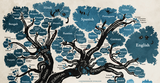
Click image, then click again, to enlarge
Call it counterintuitive clickbait if you must, but Forbes’ Pascal-Emmanuel Gobry made an intriguing argument when he granted the title of "Language of the Future" to French, of all tongues. "French isn’t mostly spoken by French people and hasn’t been for a long time now," he admits," but "the language is growing fast, and growing in the fastest-growing areas of the world, particularly sub-Saharan Africa. The latest projection is that French will be spoken by 750 million people by 2050. One study "even suggests that by that time, French could be the most-spoken language in the world, ahead of English and even Mandarin."
I don’t know about you, but I can never believe in any wave of the future without a traceable past. But the French language has one, of course, and a long and storied one at that. You see it visualized in the information graphic above (also available in suitable-for-framing prints!) created by Minna Sundberg, author of the webcomic Stand Still. Stay Silent. "When linguists talk about the historical relationship between languages, they use a tree metaphor," writes Mental Floss’ Arika Okrent. "An ancient source (say, Indo-European) has various branches (e.g., Romance, Germanic), which themselves have branches (West Germanic, North Germanic), which feed into specific languages (Swedish, Danish, Norwegian)."
Sundberg takes this tree metaphor to a delightfully lavish extreme, tracing, say, how Indo-European linguistic roots sprouted a variety of modern-day living languages including Hindi, Portuguese, Russian, Italian — and, of course, our Language of the Future. The size of the branches and bunches of leaves represent the number of speakers of each language at different times: the likes of English and Spanish have sprouted into mighty vegetative clusters, while others, like, Swedish, Dutch, and Punjabi, assert a more local dominance over their own, separately grown regional branches. Will French’s now-modest leaves one day cast a shadow over the whole tree? Perhaps — but I’m not canceling my plans to attend Spanish practice group tonight.
via Mental Floss
Related Content:
Learn 48 Languages Online for Free: Spanish, Chinese, English & More
The History of the English Language in Ten Animated Minutes
How Languages Evolve: Explained in a Winning TED-Ed Animation
Noam Chomsky Talks About How Kids Acquire Language & Ideas in an Animated Video by Michel Gondry
Stephen Fry Gets Animated about Language
Colin Marshall writes on cities, language, Asia, and men’s style. He’s at work on a book about Los Angeles, A Los Angeles Primer, and the video series The City in Cinema. Follow him on Twitter at @colinmarshall or on Facebook.
The Tree of Languages Illustrated in a Big, Beautiful Infographic is a post from: Open Culture. Follow us on Facebook, Twitter, and Google Plus, or get our Daily Email. And don't miss our big collections of Free Online Courses, Free Online Movies, Free eBooks, Free Audio Books, Free Foreign Language Lessons, and MOOCs.
The post The Tree of Languages Illustrated in a Big, Beautiful Infographic appeared first on Open Culture.
Open Culture
.
Blog
.
<span class='date ' tip=''><i class='icon-time'></i> Aug 26, 2015 03:39pm</span>
|
|
//www.youtube.com/watch?v=mQVrMzWtqgU
In the past, the good folks over at Blank on Blank have turned rarely-seen interviews with the likes of Ray Bradbury and John Coltrane into brilliant little animated shorts. This week, their latest installment is on Ayn Rand.
Rand, of course, is the mind behind Objectivism, the patron saint of laissez faire capitalism, and the author of such unwieldy tomes as The Fountainhead and Atlas Shrugged. Among Wall Street bankers, Washington conservatives and insufferable college sophomores, Rand is a revered figure. Former vice presidential candidate Paul Ryan and presidential candidate Rand Paul are both acknowledged followers. Former Federal Reserve head Alan Greenspan was Rand’s protégé. To a lot of other people, of course, her theories are little more than a shrill justification of sociopathy, an empathy-challenged vision of social interaction that flies in the face of basic ideas of human decency.
The interview dates back to a 1959 interview by Mike Wallace (see the original here) who grills Rand on her concept of love and happiness, which leads to this exchange:
Ayn Rand: I say that man is entitled to his own happiness. And that he must achieve it himself. But that he cannot demand that others give up their lives to make him happy. And nor should he wish to sacrifice himself for the happiness of others. I hold that man should have self-esteem.
Mike Wallace: And cannot man have self-esteem if he loves his fellow man? Christ, every important moral leader in man’s history, has taught us that we should love one another. Why then is this kind of love in your mind immoral?
Ayn Rand: It is immoral if it is a love placed above oneself. It is more than immoral, it’s impossible. Because when you are asked to love everybody indiscriminately. That is to love people without any standard. To love them regardless of whether they have any value or virtue, you are asked to love nobody.
Watching the piece, I kept hearing the title of Raymond Carver’s brilliant short story run through my mind, "What We Talk About When We Talk About Love." (Hear Carver read that story here.) My sense is that her version of love is very different from mine. Watch the full animated video above.
Jonathan Crow is a Los Angeles-based writer and filmmaker whose work has appeared in Yahoo!, The Hollywood Reporter, and other publications. You can follow him at @jonccrow. And check out his blog Veeptopus, featuring pictures of vice presidents with octopuses on their heads. The Veeptopus store is here.
Related Content:
Flannery O’Connor: Friends Don’t Let Friends Read Ayn Rand (1960)
Ayn Rand Adamantly Defends Her Atheism on The Phil Donahue Show (Circa 1979)
The Outspoken Ayn Rand Interviewed by Mike Wallace (1959)
Ayn Rand Trashes C.S. Lewis in Her Marginalia: He’s an "Abysmal Bastard"
An Animated Ayn Rand Dispenses Terrible Love Advice to Mike Wallace (1959) is a post from: Open Culture. Follow us on Facebook, Twitter, and Google Plus, or get our Daily Email. And don't miss our big collections of Free Online Courses, Free Online Movies, Free eBooks, Free Audio Books, Free Foreign Language Lessons, and MOOCs.
The post An Animated Ayn Rand Dispenses Terrible Love Advice to Mike Wallace (1959) appeared first on Open Culture.
Open Culture
.
Blog
.
<span class='date ' tip=''><i class='icon-time'></i> Aug 26, 2015 03:38pm</span>
|
|
//www.youtube.com/watch?v=Nsi06PG7w_0
Stanley Kubrick’s The Shining might have left critics scratching their heads when it first came out, but it has since come to be recognized as a horror masterpiece. The film is both stylistically distinctive - those long tracking shots, the one-point perspective, that completely amazing carpeting - and narratively open-ended. Kubrick freights the movie with lots of signifiers without clearly pointing out what they signify: Like why is there Native American imagery throughout the film? Why is Jack Nicholson writing his masterpiece on a German typewriter? And, for that matter, why is he reading a Playgirl magazine while waiting for his job interview? The multivalence of The Shining inspired a whole feature-length documentary about the meaning of the movie called Room 237, where various theorists talk through their interpretations. Is it possible that the movie is both about the horrors of the Holocaust and about the staging of the Apollo 11 moon landing?
So perhaps it isn’t surprising that The Shining has been the fodder for filmmakers to impose their own meaning on the flick. A couple recent video pieces have reimagined the movie as shot by two of the reigning auteurs of cinema - Wes Anderson and David Lynch.
Wes Anderson is, of course, the filmmaker of such twee, formally exacting works as The Royal Tenenbaums, Moonrise Kingdom and, most recently, The Grand Budapest Hotel. Filmmaker Steve Ramsden creates a quick and witty mash up of The Overlook Hotel and the Grand Budapest. The video raises all sorts of questions. How, for example, would The Shining have been different with an officious concierge with a pencil mustache? You can see Wes Anderson’s The Shining above.
Of the two filmmakers, David Lynch is thematically closer to Kubrick. Both have made violent, controversial movies that plumb the murky depths of the masculine mind. Both have made innovative films that play on multiple levels. And both made movies that completely freaked me out as a teenager. Kubrick was even a big fan of Lynch. In his book Catching the Big Fish: Meditation, Consciousness, and Creativity, Lynch recalls meeting Kubrick, and Kubrick telling the young filmmaker that Eraserhead was his favorite movie. If that doesn’t provide you with a lifetime’s worth of validation, I don’t know what will.
Richard Verina crams every single Lynchian quirk into his eight-minute video - from creepy red curtains to dream-like superimpositions to really interesting light fixtures. Sure, the piece might be a minute or two too long but for hardcore fans this piece is a hoot. Verina even manages to work in references to Lynch’s bête noir, Dune. You can see Blue Shining above.
Related Content:
Stanley Kubrick’s Annotated Copy of Stephen King’s The Shining
The Making of The Shining
Saul Bass’ Rejected Poster Concepts for The Shining (and His Pretty Excellent Signature)
Jonathan Crow is a Los Angeles-based writer and filmmaker whose work has appeared in Yahoo!, The Hollywood Reporter, and other publications. You can follow him at @jonccrow. And check out his blog Veeptopus, featuring pictures of vice presidents with octopuses on their heads. The Veeptopus store is here.
Stanley Kubrick’s The Shining Reimagined as Wes Anderson and David Lynch Movies is a post from: Open Culture. Follow us on Facebook, Twitter, and Google Plus, or get our Daily Email. And don't miss our big collections of Free Online Courses, Free Online Movies, Free eBooks, Free Audio Books, Free Foreign Language Lessons, and MOOCs.
The post Stanley Kubrick’s The Shining Reimagined as Wes Anderson and David Lynch Movies appeared first on Open Culture.
Open Culture
.
Blog
.
<span class='date ' tip=''><i class='icon-time'></i> Aug 26, 2015 03:38pm</span>
|
|
//www.youtube.com/watch?v=OkH11ZiIL9E
Part of the mission of the Cornell Lab of Ornithology is to help people answer the question, "What is that bird?" And so, in collaboration with the Visipedia research project, they’ve designed Merlin, a free app available on iTunes and Google Play.
The app asks you a few basic questions — what’s the color, size, and behavior of the bird you saw, and also when and where did you see it — and then, drawing on a database of information gathered by Cornell experts and thousands of bird enthusiasts, the app will give you a shortlist of possibilities. From there you can zero in on the actual bird you saw.
The free app (introduced in the video above) launched with "285 species most commonly encountered in North America." But Cornell plans to add more species and features over time. Meanwhile, the current app already offers "more than 2,000 stunning images taken by top photographers," "more than 1,000 audio recordings from the Macaulay Library, identification tips from experts, and range maps from the Birds of North America Online."
Happy birdwatching!
via Cornell/Petapixel
Related Content:
Cornell Launches Archive of 150,000 Bird Calls and Animal Sounds, with Recordings Going Back to 1929
A Bird Ballet in Southern France
A Stunning, Chance Encounter With Nature
Dan Colman is the founder/editor of Open Culture. Follow us on Facebook, Twitter, Google Plus and LinkedIn and share intelligent media with your friends. Or better yet, sign up for our daily email and get a daily dose of Open Culture in your inbox.
What Kind of Bird Is That?: A Free App From Cornell Will Give You the Answer is a post from: Open Culture. Follow us on Facebook, Twitter, and Google Plus, or get our Daily Email. And don't miss our big collections of Free Online Courses, Free Online Movies, Free eBooks, Free Audio Books, Free Foreign Language Lessons, and MOOCs.
The post What Kind of Bird Is That?: A Free App From Cornell Will Give You the Answer appeared first on Open Culture.
Open Culture
.
Blog
.
<span class='date ' tip=''><i class='icon-time'></i> Aug 26, 2015 03:37pm</span>
|
|
//www.youtube.com/watch?v=GnLVMREVA6M
Jim Jarmusch, like his younger compatriots in filmmaking Quentin Tarantino and Wes Anderson, made his name as much with his taste as with his body of work. Or maybe it makes more sense to say that he’s made his name in large part by making films shaped by, and showcasing, that taste. This seems to have held especially true in the case of Only Lovers Left Alive, his most recent feature, which focuses on a married couple of vampire aesthetes who split their time between her place in Tangier stacked with yellowed volumes of poetry, and his decaying Detroit Victorian decked out with a noise-rock recording studio and an iPhone patched through an old tube television.
//www.youtube.com/watch?v=9uHAM-3PJ5k
So Jarmusch’s fans will by definition have some familiarity with the director’s preferences in clothing, music, European cultures, and niches of Americana. But what about in other movies? Here we have a top ten list from the maker of Permanent Vacation, Mystery Train, and Night on Earth, originally composed for the British Film Institute’s 2002 Sight and Sound top ten poll. Three of Jarmusch’s selections you can watch online here, or find them in our collection, 700 Free Movies Online: Great Classics, Indies, Noir, Westerns, etc..
L’Atalante (1934, Jean Vigo)
Tokyo Story (1953, Yasujiro Ozu)
They Live by Night (1949, Nicholas Ray)
Bob le Flambeur (1955, Jean-Pierre Melville)
Sunrise (1927, F.W. Murnau)
The Cameraman (1928, Buster Keaton/Edward Sedgwick)
Mouchette (1967, Robert Bresson)
Seven Samurai (1954, Akira Kurosawa)
Broken Blossoms (1919, D.W. Griffith)
Rome, Open City (1945, Roberto Rossellini)
The true Jarmusch enthusiast will immediately notice a number of connections between his own pictures and those he names as his favorites. He began his career working as an assistant to the director of They Live by Night, Nicholas Ray (and you can even glimpse Jarmusch in Lightning Over Water, Wim Wenders’ documentary on Ray’s final years). Jarmusch’s Ghost Dog: The Way of the Samurai shares not just titular but philosophical qualities with Kurosawa’s Seven Samurai. With Bob le Flambeur, Jean-Pierre Melville gave birth to cinematic "cool," a tradition Jarmusch has done his level best to uphold. And if D.W. Griffith’s Broken Blossoms sounds a bit like Broken Flowers, the similarities — the indirect ones, at least — don’t end there.
//www.youtube.com/watch?v=g1NbA_eO7Es
And all cinephiles, Jarmusch fans or otherwise, will notice that he has included not a single color film among his top ten. Some of this might have to do with his generally retro sensibility (something to which even casual viewers of his work can attest), but the likes of Stranger Than Paradise, Down By Law, Dead Man, and Coffee and Cigarettes suggest that he himself counts as one of the finest users of black-and-white cinematography in the modern day. The vivid colors Yorick Le Saux captured for him in Only Lovers Left Alive (and Christopher Doyle did in its predecessor, The Limits of Control), suggest that Jarmusch’s universe exists equally well in both visual realms, but speaking from my own Jarmusch fandom, I do hope he has at least one more black-and-white picture in him.
Related Content:
Two Short Films on Coffee and Cigarettes from Jim Jarmusch & Paul Thomas Anderson
Jim Jarmusch: The Art of the Music in His Films
Free: F. W. Murnau’s Sunrise, the 1927 Masterpiece Voted the 5th Best Movie of All Time
Jim Jarmusch’s Anti-MTV Music Videos for Talking Heads, Neil Young, Tom Waits & Big Audio Dynamite
Colin Marshall writes on cities, language, Asia, and men’s style. He’s at work on a book about Los Angeles, A Los Angeles Primer, and the video series The City in Cinema. Follow him on Twitter at @colinmarshall or on Facebook.
Jim Jarmusch’s 10 Favorite Films: Ozu’s Tokyo Story, Kurosawa’s Seven Samurai and Other Black & White Classics is a post from: Open Culture. Follow us on Facebook, Twitter, and Google Plus, or get our Daily Email. And don't miss our big collections of Free Online Courses, Free Online Movies, Free eBooks, Free Audio Books, Free Foreign Language Lessons, and MOOCs.
The post Jim Jarmusch’s 10 Favorite Films: Ozu’s Tokyo Story, Kurosawa’s Seven Samurai and Other Black & White Classics appeared first on Open Culture.
Open Culture
.
Blog
.
<span class='date ' tip=''><i class='icon-time'></i> Aug 26, 2015 03:37pm</span>
|
|
//www.youtube.com/watch?v=_li_d_YviZ4
Sometime in the last decade, as both YouTube and smart phones became our primary means of cultural transmission, the isolated vocal track meme came into being, reaching its summit in the sublime ridiculousness of David Lee Roth’s unadorned "Running With the Devil" vocal tics. His yelps, howls, and "Whoooohoooos!" produced the very best version of that virtual novelty known as the soundboard app, and welcomed many a caller to many a kooky voicemail greeting. The isolated track has since become a phenomenon worthy of study, and we’ve done our share here of poring over various voices and instruments stripped from their song’s context and placed before us in ways we’d never heard before.
//www.youtube.com/watch?v=hbKh0Y_QCrc
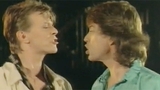
Perhaps serious analysis too shall be the fate of a goofy visual meme that also thrives on the ridiculousness of pop music’s presentation: the musicless music video. The idea is a similar one, isolating the image instead of the sound: popular videos, already weirdly over the top, become exercises in choreographed awkwardness or voyages into uncanny valleys as we watch their stars pose, preen, and contort themselves in weird costumes for seemingly no reason, accompanied only by the mundane sounds of their shuffling feet and grunts, belches, nervous laughter, etc. Take the particularly funny examples here: Mick Jagger and David Bowie prancing through the bizarre "Dancing in the Streets" video (original here); the members of Queen performing domestic chores in "I Want to Break Free" (original); Elvis Presley squeaking and spasming onstage in a TV take of "Blue Suede Shoes"; Nirvana moping and swaying in that high school gym while a nearby custodian goes about his business…..
//www.youtube.com/watch?v=5Jd9AmepgdM
Though these skewed re-evaluations of famous moments in pop history make use of a similar premise as the isolated track, the sounds we hear are not—as they sometimes seem—vérité audio recordings from the videos’ sets. They are the creation of Austrian sound designer, editor, and mixer Mario Wienerroither, who, The Daily Dot informs us, "works from a sound library that he’s spent years amassing." The results, as you will hear for yourself, "range from humorous to disturbing and everywhere in between." Musicless music videos remind us of how silly and artificial these kinds of staged, mimed pseudo-performances really are—they only become convincing to us through the magical editing together sound and image on cue and on beat.
//www.youtube.com/watch?v=mUNiUg8_Nwc
Wienerroither began his project with the Queen video, inspired when he caught it playing while his TV was on mute. The moment, he says, was "a vital spark." Since then, dozens of musicless music videos, and TV and film clips, have popped up on YouTube (see a sizeable playlist here.) One of the most awkward, The Prodigy’s "Firestarter," helped rocket the phenomenon into major popularity. Imitators have since posted musicless videos of the Friends intro and Miley Cyrus’ "Wrecking Ball." What can we learn from these videos? Nothing, perhaps, we didn’t already know: that pop culture’s most enduring moments are also its most absurd, that nostalgia is a dish best served remixed, that the internet—a powerful force for good as well as ill—is often at its best when it is a powerful force for weird. Though the medium may be frivolous, these are messages worth remembering.
Related Content:
Listen to Freddie Mercury and David Bowie on the Isolated Vocal Track for the Queen Hit ‘Under Pressure,’ 1981
Kurt Cobain’s Isolated Vocal Track From ‘Smells Like Teen Spirit,’ 1991
Hear Isolated Guitar Tracks From Some of Rock’s Greatest: Slash, Eddie Van Halen, Eric Clapton & More
Josh Jones is a writer and musician based in Durham, NC. Follow him at @jdmagness
Open Culture
.
Blog
.
<span class='date ' tip=''><i class='icon-time'></i> Aug 26, 2015 03:36pm</span>
|
|
//www.youtube.com/watch?v=k52nEiV8TYY
Gérard Courant is a French filmmaker, who, at least until 2011, held the distinction of directing the longest film ever made. Clocking in at 192 hours, and shot over 36 years (1978-2006), Cinématon consisted of "a series of over 2,880 silent vignettes (cinématons), each 3 minutes and 25 seconds long, of various celebrities, artists, journalists and friends of the director, each doing whatever they want for the allotted time." Ken Loach, Wim Wenders, Terry Gilliam, Julie Delpy all made appearances. And so too did Jean-Luc Godard. (See below.)
//www.youtube.com/watch?v=Hf65408Gwbc
While making Cinématon, Courant also created another kind of experimental film — what he calls "compressed" films. In 1995, he shot Compression de Alphaville, an accelerated homage to Jean-Luc Godard 1965 sci-fi film, Alphaville. Then came a "compression" (top) of Godard’s À bout de souffle/Breathless (1960), the classic of French New Wave cinema.
//www.youtube.com/watch?v=1eq0VzjxNP4
During the 1960s and 1970s, when Courant came of age as a filmmaker, sculptors like César Baldaccini created art by compressing everyday objects-like Coke cans-into modern sculptures. So Courant took things a step further and figured why not compress art itself. Why not compress a 90 minute film into 3-4 minutes, while keeping the plot of the original film firmly intact.
Along the way, Courant asked himself: Do compressed films honor the original? Does one have the right to touch these masterpieces? And can one decompress these compressed films and then return them to their original form? Ponder these questions as you watch the examples above.
Note: If you read French, Courant gives more of the backstory on his compressed films here.
via Dangerous Minds
Related Content:
Jean-Luc Godard Gives a Dramatic Reading of Hannah Arendt’s "On the Nature of Totalitarianism"
A Young Jean-Luc Godard Picks the 10 Best American Films Ever Made (1963)
Jefferson Airplane Wakes Up New York; Jean-Luc Godard Captures It (1968)
Watch the Rolling Stones Write "Sympathy for the Devil": From Jean-Luc Godard’s ’68 Film One Plus One
Dan Colman is the founder/editor of Open Culture. Follow us on Facebook, Twitter, Google Plus and LinkedIn and share intelligent media with your friends. Or better yet, sign up for our daily email and get a daily dose of Open Culture in your inbox.
The Entirety of Jean-Luc Godard’s Breathless Artfully Compressed Into a 3 Minute Film is a post from: Open Culture. Follow us on Facebook, Twitter, and Google Plus, or get our Daily Email. And don't miss our big collections of Free Online Courses, Free Online Movies, Free eBooks, Free Audio Books, Free Foreign Language Lessons, and MOOCs.
The post The Entirety of Jean-Luc Godard’s Breathless Artfully Compressed Into a 3 Minute Film appeared first on Open Culture.
Open Culture
.
Blog
.
<span class='date ' tip=''><i class='icon-time'></i> Aug 26, 2015 03:36pm</span>
|
|
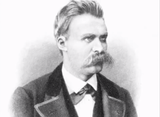
In March, we featured 43 original tracks of classical music by philosopher and self-taught composer Friedrich Nietzsche, better known as the author of books like Thus Spoke Zarathustra and Beyond Good and Evil. Despite the enduring importance of his textual output, Josh Jones noted that "what Nietzsche loved most was music." He "found the mundane work of politics and nationalist conquest, with its tribalism and moral pretensions, thoroughly distasteful. Instead, he considered the creative work of artists, writers, and musicians, as well as scientists, of paramount importance."
Today we offer more of the eccentric, highly opinionated 19th-century German philosopher’s musical side. In the playlist just above, you can hear his piano compositions as collected on Michael Krücker’s Friedrich Nietzsche: Complete Solo Piano Works. "Most of the works on this album date from the 1860s, when [Nietzsche] was a celebrated young professor and philosopher," writes AllMusic’s James Manheim. "The music is light, often quasi-improvisatory, and some of it resembles the keyboard music of the composer whom Nietzsche extolled later in life, Georges Bizet. The most substantial piece, the 20-minute Hymnus an die Freundschaft, was essentially his last composition, but he later reworked it with texts by his then-love interest, Lou Andreas-Salomé; that version was later arranged for chorus and orchestra by another composer."
Manheim also notes that this selection of piano pieces, in their brevity, suggest that "the aphoristic style of Nietzsche’s late writings was anticipated by his musical thinking." Enthusiasts of Nietzsche’s life and career will certainly find themselves making even more connections between his musical and philosophical work than that. But those looking for his motivation to work in this purest of all arts perhaps need look no further than this typically unequivocal pronouncement: "Without music, life would be a mistake."
You can find more Nietzschean piano compositions below, these performed by Dorothea Klotz. To hear the music, you will need to download Spotify’s free software, if you haven’t already.
Related Content:
Hear Classical Music Composed by Friedrich Nietzsche: 43 Original Tracks
130+ Free Online Philosophy Courses
The Philosophy of Nietzsche: An Introduction by Alain de Botton
A Free Playlist of Music From The Works Of James Joyce (Plus Songs Inspired by the Modernist Author)
The Digital Nietzsche: Download Nietzsche’s Major Works as Free eBooks
Colin Marshall writes on cities, language, Asia, and men’s style. He’s at work on a book about Los Angeles, A Los Angeles Primer, and the video series The City in Cinema. Follow him on Twitter at @colinmarshall or on Facebook.
Hear Friedrich Nietzsche’s Classical Piano Compositions: They’re Aphoristic Like His Philosophy is a post from: Open Culture. Follow us on Facebook, Twitter, and Google Plus, or get our Daily Email. And don't miss our big collections of Free Online Courses, Free Online Movies, Free eBooks, Free Audio Books, Free Foreign Language Lessons, and MOOCs.
The post Hear Friedrich Nietzsche’s Classical Piano Compositions: They’re Aphoristic Like His Philosophy appeared first on Open Culture.
Open Culture
.
Blog
.
<span class='date ' tip=''><i class='icon-time'></i> Aug 26, 2015 03:35pm</span>
|
|
Art lovers who visit my hometown of Washington, DC have an almost embarrassing wealth of opportunities to view art collections classical, Baroque, Renaissance, modern, postmodern, and otherwise through the Smithsonian’s network of museums. From the East and West Wings of the National Gallery, to the Hirshhorn, with its wondrous sculpture garden, to the American Art Museum and Renwick Gallery—I’ll admit, it can be a little overwhelming, and far too much to take in during a weekend jaunt, especially if you’ve got restless family in tow. (One can’t, after all, miss the Natural History or Air and Space Museums… or, you know… those monuments.)
In all the bustle of a DC vacation, however, one collection tends to get overlooked, and it is one of my personal favorites—the Freer and Sackler Galleries, which house the Smithsonian’s unique collection of Asian art, including the James McNeill Whistler-decorated Peacock Room. (See his "Harmony in Blue and Gold" above.) Standing in this re-creation of museum founder Charles Freer’s personal 19th century gallery—which he had relocated from London to his Detroit mansion in 1904—is an aesthetic experience like no other. And like most such experiences, there really is no virtual equivalent. Nonetheless, should you have to hustle past the Freer and Sackler collections on your DC vacation, or should you be unable to visit the nation’s capital at all, you can still get a taste of the beautiful works of art these buildings contain.
Like many major museums all over the world—including the National Gallery, the Rijksmuseum, The British Library, and over 200 others—the Freer/Sackler has made its collection, all of it, available to view online. You can also download much of it.
See delicate 16th century Iranian watercolors like "Woman with a spray of flowers" (top), powerful Edo period Japanese ink on paper drawings like "Thunder god" (above), and astonishingly intricate 15th century Tibetan designs like the "Four Mandala Vajravali Thangka" (below). And so, so much more.
As Freer/Sackler director Julian Raby describes the initiative, "We strive to promote the love and study of Asian art, and the best way we can do so is to free our unmatched resources for inspiration, appreciation, academic study, and artistic creation." There are, writes the galleries’ website, Bento, "thousands of works now ready for you to download, modify, and share for noncommercial purposes." More than 40,000, to be fairly precise.
You can browse the collection to your heart’s content by "object type," topic, name, place, date, or "on view." Or you can conduct targeted searches for specific items. In addition to centuries of art from all over the far and near East, the collection includes a good deal of 19th century American art, like the sketch of Whistler’s mother, below, perhaps a preparatory drawing for his most famous painting. Though I do recommend that you visit these exquisite galleries in person if you can, you must at least take in their collections via this generous online collection and its bounty of international artistic treasures. Get started today.
via Kottke
Related Content:
Download 35,000 Works of Art from the National Gallery, Including Masterpieces by Van Gogh, Gauguin, Rembrandt & More
40,000 Artworks from 250 Museums, Now Viewable for Free at the Redesigned Google Art Project
Rijksmuseum Digitizes & Makes Free Online 210,000 Works of Art, Masterpieces Included!
Josh Jones is a writer and musician based in Durham, NC. Follow him at @jdmagness
Smithsonian Digitizes & Lets You Download 40,000 Works of Asian and American Art is a post from: Open Culture. Follow us on Facebook, Twitter, and Google Plus, or get our Daily Email. And don't miss our big collections of Free Online Courses, Free Online Movies, Free eBooks, Free Audio Books, Free Foreign Language Lessons, and MOOCs.
The post Smithsonian Digitizes & Lets You Download 40,000 Works of Asian and American Art appeared first on Open Culture.
Open Culture
.
Blog
.
<span class='date ' tip=''><i class='icon-time'></i> Aug 26, 2015 03:34pm</span>
|
|
Tim Hunt won the Nobel Prize in Medicine or Physiology in 2001. He was knighted by the Queen in 2006, making him Sir Tim Hunt. He’s a member of the Royal Society. And he’s apparently a chauvinist too. Speaking to an audience Monday at the World Conference of Science Journalists in South Korea, Hunt reportedly made an argument for why men and women should work in separate science labs: "Let me tell you about my trouble with girls. Three things happen when they are in the lab: You fall in love with them, they fall in love with you, and when you criticize them they cry."
Despite issuing something of a non-apology later, Hunt had to resign from his honorary position at University College London (UCL). The school then issued a statement saying, "U.C.L. was the first university in England to admit women students on equal terms to men, and the university believes that this outcome is compatible with our commitment to gender equality."
It’s easy to dismiss Hunt as someone who is intelligent in one part of his life, and fodder for jokes in the other. But, as Kate Maltby points out on Twitter, "men like Tim Hunt still run universities, businesses, politics." They give with their accomplishments, and they take away maybe more with their prejudices.
via The New York Times
Follow us on Facebook, Twitter, Google Plus and LinkedIn and share intelligent media with your friends. Or better yet, sign up for our daily email and get a daily dose of Open Culture in your inbox.
Nobel Prize-Winner Tim Hunt Makes Asinine Comments About Women & Science; Loses His University Post is a post from: Open Culture. Follow us on Facebook, Twitter, and Google Plus, or get our Daily Email. And don't miss our big collections of Free Online Courses, Free Online Movies, Free eBooks, Free Audio Books, Free Foreign Language Lessons, and MOOCs.
The post Nobel Prize-Winner Tim Hunt Makes Asinine Comments About Women & Science; Loses His University Post appeared first on Open Culture.
Open Culture
.
Blog
.
<span class='date ' tip=''><i class='icon-time'></i> Aug 26, 2015 03:33pm</span>
|