Blogs
|
//www.youtube.com/watch?v=yFIE-ISqNoU
Hayao Miyazaki’s The Wind Rises came out in 2013 to a great deal of acclaim and attention—as, I suppose, do all the movies his Studio Ghibli puts out, so painstakingly have they built up their reputation for medium-transcending depth, artistry, craftsmanship, and attention to detail. But that fictionalized biographical story of Japanese World War II airplane designer Jiro Horikoski received even more notice than most due not just to the controversial nature of its material, but to its place as Miyazaki’s supposed swan song, the last feature film he would ever direct.
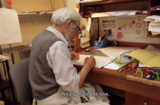
Then again, Hayao Miyazaki has spoken of many possible retirements over the years, and no longer animating feature films hardly means the end of his all-consuming impulse to create, which drives him to continue working on Tokyo’s Ghibli Museum and drawing the art for comic books, among other projects. Certain Miyazaki associates have publicly told us not to be surprised if the master one day emerges from this particular "retirement," but since the man himself seems quite serious about putting full-length pictures behind him, we can assume for now that the clip above shows him at work on the last bit of film animation in his career: The Wind Rises‘ final shot.
The footage comes from last year’s The Kingdom of Dreams and Madness, a documentary on a moment in the life of Studio Ghibli—and possibly one of the last moments in the life of Studio Ghibli, given their announcement of a "brief pause" production as a result of Miyazaki’s retirement. On the subject of the studio’s future Miyazaki speaks bluntly in the documentary: "The future is clear: it’s going to fall apart. I can already see it. What’s the use worrying? It’s inevitable." But all things do, a fact which the finest works of Japanese art—Miyazaki’s films included—have always accepted. But they also take notice of what small things we can appreciate along the way to dissolution, as does Miyazaki himself: "Isn’t animation fascinating?" he asks, seemingly to himself, as he walks away from the drawing board.
Related Content:
Hayao Miyazaki’s Magical Animated Music Video for the Japanese Pop Song, "On Your Mark"
Watch Sherlock Hound: Hayao Miyazaki’s Animated, Steampunk Take on Sherlock Holmes
How to Make Instant Ramen Compliments of Japanese Animation Director Hayao Miyazaki
Colin Marshall writes on cities, language, Asia, and men’s style. He’s at work on a book about Los Angeles, A Los Angeles Primer, and the video series The City in Cinema. Follow him on Twitter at @colinmarshall or on Facebook.
Watch Hayao Miyazaki Animate the Final Shot of His Final Feature Film, The Wind Rises is a post from: Open Culture. Follow us on Facebook, Twitter, and Google Plus, or get our Daily Email. And don't miss our big collections of Free Online Courses, Free Online Movies, Free eBooks, Free Audio Books, Free Foreign Language Lessons, and MOOCs.
The post Watch Hayao Miyazaki Animate the Final Shot of His Final Feature Film, The Wind Rises appeared first on Open Culture.
Open Culture
.
Blog
.
<span class='date ' tip=''><i class='icon-time'></i> Aug 26, 2015 03:17pm</span>
|
|
//www.youtube.com/watch?v=e3I9o6OwDNI
There are strong people quietly willing to do "what needs to be done" for the public good, and then there are those who enjoy insinuating that they are that sort of person, usually as justification for their self-serving, frequently racist or xenophobic actions. When the latter reaches for the Bible as back up, look out!
No one ever had more fun with this monstrous type than the writer Flannery O’Connor, a devout Catholic with a knack for wrapping her characters’ foul purposes in the "stinking mad shadow of Jesus."
In her longest story "The Displaced Person," the boorish, Bible-thumping Mrs. Shortley is not the only baddie. The refined Mrs. McIntyre, widowed mistress of the dairy operation that employs the Shortleys and a couple of African-American farmhands, is just as quick to indict those with whom she imagines herself at cross-purposes.
Transfer them to the small screen, and every actress over 40 would be clamoring for the chance to sink her teeth into one or the other.
In 1977, PBS hired playwright Horton Foote to adapt "The Displaced Person" for "The American Short Story," and the roles of Shortley and McIntyre went to Shirley Stoler and Irene Worth, both excellent.
(See above…it’s always so much more amusing to play one of the villains than the hardworking, uncomplaining, titular character, here a Polish refugee from WWII.)
The audio quality is not the greatest, but stick with it to see Samuel L. Jackson, not quite 30, as the younger of the two farmhands.
O’Connor buffs will be interested to know that Andalusia, the writer’s own Georgia farm, served as the location for this hour-long project. (No need to rent a peacock!)
Despite the stately production values that were de rigeur for quality viewing of the period, the story retains the unmistakable tang of O’Connor—it’s a bitter, comic brew.
via Biblioklept
Related Content
Flannery O’Connor Reads ‘Some Aspects of the Grotesque in Southern Fiction’ (c. 1960)
Rare 1959 Audio: Flannery O’Connor Reads ‘A Good Man is Hard to Find’
Flannery O’Connor’s Satirical Cartoons: 1942-1945
Ayun Halliday is an author, illustrator, and Chief Primatologist of the East Village Inky zine. Follow her @AyunHalliday
See Flannery O’Connor’s Story "The Displaced Person" Adapted to a Film Starring a Young Samuel L. Jackson (1977) is a post from: Open Culture. Follow us on Facebook, Twitter, and Google Plus, or get our Daily Email. And don't miss our big collections of Free Online Courses, Free Online Movies, Free eBooks, Free Audio Books, Free Foreign Language Lessons, and MOOCs.
The post See Flannery O’Connor’s Story "The Displaced Person" Adapted to a Film Starring a Young Samuel L. Jackson (1977) appeared first on Open Culture.
Open Culture
.
Blog
.
<span class='date ' tip=''><i class='icon-time'></i> Aug 26, 2015 03:16pm</span>
|
|
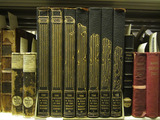
In 1929, the book publisher George Macy founded The Limited Editions Club (LEC), an imprint tasked with publishing finely illustrated limited editions of classic books. In the years to come, Macy worked with artists like Matisse and Picasso, and photographers like Edward Weston, to produce books with beautiful illustrations on their inner pages. And sometimes The Limited Editions Club even turned its design focus to other parts of the book. Take for example this 1946 edition of Edward Gibbon’s The Decline and Fall of the Roman Empire and its pretty amazing spine design.
Created by Clarence P. Hornung, the design captures the essence of Gibbon’s classic, showing Roman pillars progressively crumbling as your eyes move from Volume 1 to Volume 7. George Macy later called the collection, which also features illustrations by the great 18th-century printmaker Giovanni Battista Piranesi, "the most herculean labor of our career."
Find more information about this 1946 edition here, or even buy a copy here. Also feel free to download a different edition of Gibbon’s classic from our Free eBooks and Free Audio Books collections.
Dan Colman is the founder/editor of Open Culture. Follow us on Facebook, Twitter, Google Plus and LinkedIn and share intelligent media with your friends. Or better yet, sign up for our daily email and get a daily dose of Open Culture in your inbox.
via @Pickover
Related Content:
700 Free eBooks for iPad, Kindle & Other Devices
630 Free Audio Books: Download Great Books for Free
The History of Rome in 179 Podcasts
Free Courses in Ancient History, Literature & Philosophy
Rome Reborn: Take a Virtual Tour Through Ancient Rome, 320 C.E.
The Splendid Book Design of the 1946 Edition of Gibbon’s Decline and Fall of the Roman Empire is a post from: Open Culture. Follow us on Facebook, Twitter, and Google Plus, or get our Daily Email. And don't miss our big collections of Free Online Courses, Free Online Movies, Free eBooks, Free Audio Books, Free Foreign Language Lessons, and MOOCs.
The post The Splendid Book Design of the 1946 Edition of Gibbon’s Decline and Fall of the Roman Empire appeared first on Open Culture.
Open Culture
.
Blog
.
<span class='date ' tip=''><i class='icon-time'></i> Aug 26, 2015 03:16pm</span>
|
|
//www.youtube.com/watch?v=JQ8pQVDyaLo
While it now bears embarrassing marks of the 1960s here and there, the future envisioned by Stanley Kubrick’s 2001: A Space Odyssey remains, on many levels, chillingly plausible. True, Pan Am Airlines went under in the 1990s instead of launching a space station like they’ve got in the movie, but in the smaller details, 2001 gets a lot right, at least insofar as its reality resembles the one in which we find ourselves in the actual 21st century. No less an aggregation of brainpower than Samsung thinks so too: in fact, they’ve gone so far as to cite Kubrick’s sci-fi masterwork before a judge as proof that the director invented tablet computing.
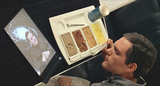
"In 2011, an unusual piece of evidence was presented in court in a dispute between technology giants Apple and Samsung over the latter’s range of handheld tablets, which Apple claimed infringed upon the patented design and user interface of the iPad," writes the British Film Institute’s Samuel Wigley. "As part of Samsung’s defence, the company’s lawyers showed the court a still image and clip showing the astronauts played by Gary Lockwood and Keir Dullea eating while watching a TV show on their own personal, mini-sized, flat-screen computers."
Apple and Samsung have not, in recent memory, played nice. Apple accused Samsung of "slavishly" copying the design of the iPad for their own Galaxy tablet, a charge that in some ways aligns with Samsung and other major Korean manufacturing companies’ reputation for rapidly adapting and even improving upon products developed in other countries. Samsung’s defense? Watch 2001‘s footage of its "Newspads" (above), and you can see that Kubrick invented the tablet before either company — or, in the words of their attorneys, he invented a computer with "an overall rectangular shape with a dominant display screen, narrow borders, a predominately flat front surface, a flat back surface, and a thin form factor."
Even in their lifetimes, 2001 gave Kubrick and his collaborator Arthur C. Clarke, sci-fi eminence and author of 2001 the book, reputations as something like seers. "I’m sure we’ll have sophisticated 3-D holographic television and films," Kubrick speculated in a Playboy magazine interview we featured last year, "and it’s possible that completely new forms of entertainment and education will be devised." Certainly the opening up of the realm of tablets has made new forms of entertainment and education possible, but I wonder: could he ever have imagined we would one day use our Newspads to watch 2001 itself?
Related Content:
In 1968, Stanley Kubrick Makes Predictions for 2001: Humanity Will Conquer Old Age, Watch 3D TV & Learn German in 20 Minutes
1966 Film Explores the Making of Kubrick’s 2001: A Space Odyssey (and Our High-Tech Future)
James Cameron Revisits the Making of Kubrick’s 2001: A Space Odyssey
Howard Johnson’s Presents a Children’s Menu Featuring Kubrick’s 2001: A Space Odyssey (1968)
Colin Marshall writes on cities, language, Asia, and men’s style. He’s at work on a book about Los Angeles, A Los Angeles Primer, and the video series The City in Cinema. Follow him on Twitter at @colinmarshall or on Facebook.
Did Stanley Kubrick Invent the iPad in 2001: A Space Odyssey? is a post from: Open Culture. Follow us on Facebook, Twitter, and Google Plus, or get our Daily Email. And don't miss our big collections of Free Online Courses, Free Online Movies, Free eBooks, Free Audio Books, Free Foreign Language Lessons, and MOOCs.
The post Did Stanley Kubrick Invent the iPad in 2001: A Space Odyssey? appeared first on Open Culture.
Open Culture
.
Blog
.
<span class='date ' tip=''><i class='icon-time'></i> Aug 26, 2015 03:15pm</span>
|
|
//www.youtube.com/watch?v=DhM-Dm2PHHo
Opportunities to meet one’s heroes can go any number of ways. They can be underwhelming and disappointing, embarrassing and awkward, or—as Tom Waits found out in meeting Keith Richards and Charles Bukowski—completely overwhelming. Both encounters became too much for Waits for the same reason: when you "try to match them drink for drink," he says in an interview, "you’re a novice, you’re a child. You’re drinking with a roaring pirate." Waits "wasn’t able to hang in there" with these veteran imbibers—"They’re made out of different stock. They’re like dockworkers." But of course it wasn’t just their legendary drinking that impressed the sandpaper-voiced L.A. troubadour.
//www.youtube.com/watch?v=gArkJVq7IMo
Waits calls both Richards and Bukowski artistic "father figures"—two of many stand-ins for his own absent father—but it’s Bukowski who had the most profound effect on the singer and songwriter. Both Southern California natives, both keen observers of America’s seedier side, as writers they share a number of common themes and obsessions. When he discovered Bukowski through the poet’s "Notes of a Dirty Old Man" column in the LA Free Press, Waits observed that he "seemed to be a writer of the common people and street people, looking in the dark corners where no one seems to want to go." Waits has gone there, and always—like his literary hero—returned with a hell of a story. His songwriting voice can channel "Hank," as Bukowski’s friends knew him, and his speaking voice can too—with sharp glints of dry, sardonic humor and surprising vulnerability, though much more ragged and pitched several octaves lower.
//www.youtube.com/watch?v=P5hhqvNDak8
Waits’ artistic kinship with Bukowski makes him better-suited than perhaps anyone else to read the down-and-out, Dostoevsky-loving, alcoholic’s work. At the top of the post, hear him read Bukowski’s "The Laughing Heart," a poem of weary, almost resigned exhortation to "be on the watch / There are ways out / There is light somewhere," in the midst of life’s darkness. Below it, Waits reads "Nirvana," a poem we’ve featured before in several renditions. Here, the poet tells a story—of loneliness, impermanence, and a brief moment of solace. For comparison, hear Bukowski himself, in his high, nasally voice, read "The Secret of My Endurance" above.
Waits almost became more than just a Bukowski lover and reader; he was once up for the role of Bukowski’s alter-ego Henry Chinaski in Barbet Schroeder’s 1987 Bukowski adaptation, Barfly. "I was offered a lot of money," says Waits, "but I just couldn’t do it." Mickey Rourke could, and did, but as I hear Waits read these poems, I like to imagine the film that would have been had he taken that part.
Related Content:
Four Charles Bukowski Poems Animated
Hear 130 Minutes of Charles Bukowski’s First-Ever Recorded Readings (1968)
Charles Bukowski Rails Against 9-to-5 Jobs in a Brutally Honest Letter (1986)
Josh Jones is a writer and musician based in Durham, NC. Follow him at @jdmagness
Tom Waits Reads Two Charles Bukowski’s Poems, "The Laughing Heart" and "Nirvana" is a post from: Open Culture. Follow us on Facebook, Twitter, and Google Plus, or get our Daily Email. And don't miss our big collections of Free Online Courses, Free Online Movies, Free eBooks, Free Audio Books, Free Foreign Language Lessons, and MOOCs.
The post Tom Waits Reads Two Charles Bukowski’s Poems, "The Laughing Heart" and "Nirvana" appeared first on Open Culture.
Open Culture
.
Blog
.
<span class='date ' tip=''><i class='icon-time'></i> Aug 26, 2015 03:14pm</span>
|
|
Close your eyes for a moment and picture the artist Vincent Van Gogh. What do you see?
Probably one of the prolific post-Impressionist’s self-portraits. That’s all well and good, but who else did you see?
Kirk Douglas?
Indie darling (and Incredible Hulk adversary) Tim Roth?
Director Martin Scorsese?
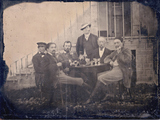
Thanks to the recently discovered photograph at the top of this article, we may soon have the option of picturing the actual Vincent Van Gogh as an adult artist. As Petapixel tells us, he sat for portraits at age 13, and again as a 19-year-old gallery apprentice (below), but beyond that no photographic evidence of the camera-shy artist was known to exist.
Exciting!
That’s Paul Gauguin on the far right. Others at the table include Emile Bernard and Arnold Koning, politician Felix Duval and actor-director André Antoine. But who is the bearded man smoking the pipe?
Van Gogh?
So thought the two collectors who purchased the small 1887 photo at a house sale a couple of years ago. Serge Plantureux, an antiquarian bookseller and photography expert who examined their find was optimistic enough to help them with further research, as he noted in the French magazine, L’Oeil de la Photographie:
I didn’t want to start doing what Americans call "wishful thinking," that trap into which collectors and researchers fall, where their reasoning is governed only by what they want to see.
Don’t ditch Douglas, Roth, and Scorsese just yet, however. Experts at Amsterdam’s Van Gogh Museum say the bearded fellow cannot be the artist. According to them, there’s not even much of a resemblance. He wasn’t so much camera shy, as deadly opposed to the photographic medium. His refusal to be photographed was an act of resistance.
That kind of puts a damper on things…
So.. no go Van Gogh? Oh well…vive la photo nouvellement découverte de Paul Gauguin (and friends)!
Related Content:
The Unexpected Math Behind Van Gogh’s "Starry Night"
Simon Schama Presents Van Gogh and the Beginning of Modern Art
Van Gogh’s ‘Starry Night’ Re-Created by Astronomer with 100 Hubble Space Telescope Images
Ayun Halliday is an author, illustrator, and Chief Primatologist of the East Village Inky zine. Follow her @AyunHalliday
Discovered: The Only Known Picture of Vincent Van Gogh as an Adult Artist? (Maybe, Maybe Not) is a post from: Open Culture. Follow us on Facebook, Twitter, and Google Plus, or get our Daily Email. And don't miss our big collections of Free Online Courses, Free Online Movies, Free eBooks, Free Audio Books, Free Foreign Language Lessons, and MOOCs.
The post Discovered: The Only Known Picture of Vincent Van Gogh as an Adult Artist? (Maybe, Maybe Not) appeared first on Open Culture.
Open Culture
.
Blog
.
<span class='date ' tip=''><i class='icon-time'></i> Aug 26, 2015 03:14pm</span>
|
|
A quick heads up: Neil Young’s 36th studio album, The Monsanto Years, is now streaming for free online thanks to NPR’s First Listen web site:
The album can also be pre-ordered as a CD on Amazon, or bought in digital format from the Pono music store (which pre-supposes that you have one of Neil’s Pono music players.)
About the new album, NPR has this to say:
Here, we have a series of taut and stone-simple Neil Young songs that fit together under a catchall concept (about companies wielding extraordinary influence over many aspects of our quality of life), each powered by its own supply of righteous fury. Enjoyment of it probably depends less on whether you agree with Young’s positions than on how much tolerance you have for a mantra, repeated frequently, using the three syllables that make up the trade name Monsanto. It also helps to like your harangues set to three-chord rock and expressed through triadic melodies. This is not subtle, Harvest Moon Neil, brooding at the piano. This is ornery, snarly Neil.
Meanwhile, if you actually do side with Neil’s political positions, you’ll probably find some amusement in today’s news that Young, having blasted Donald Trump for using his 1989 song "Rockin’ in the Free World," turned around and gave Bernie Sanders free license to use the song. And that he did.
Related Content:
Neil Young Busking in Glasgow, 1976: The Story Behind the Footage
Great Story: How Neil Young Introduced His Classic 1972 AlbumHarvest to Graham Nash
Miles Davis Opens for Neil Young and "That Sorry-Ass Cat" Steve Miller at The Fillmore East (1970)
Neil Young’s New Album, The Monsanto Years, Now Streaming Free Online (For a Limited Time) is a post from: Open Culture. Follow us on Facebook, Twitter, and Google Plus, or get our Daily Email. And don't miss our big collections of Free Online Courses, Free Online Movies, Free eBooks, Free Audio Books, Free Foreign Language Lessons, and MOOCs.
The post Neil Young’s New Album, The Monsanto Years, Now Streaming Free Online (For a Limited Time) appeared first on Open Culture.
Open Culture
.
Blog
.
<span class='date ' tip=''><i class='icon-time'></i> Aug 26, 2015 03:13pm</span>
|
|
Cinema Sem Lei has made a nice supercut video essay that explores the influence of German Expressionism on the films of Tim Burton. There’s undeniably some direct quotes: The first shot comparing the cityscapes of Metropolis and Batman Returns, the shadows on the wall of both The Cabinet of Dr. Caligari and The Corpse Bride, and the similarities in the haircuts of Metropolis’ Rotwang and Christopher Walken’s Max Shreck (the name a tribute to the title actor in Nosferatu) again in Batman Returns. (Beetlejuice is notoriously absent.)
But there’s also a sense that Cinema Sem Lei’s video is cutting off a crab’s legs to make it fit in a box. Not everything in Burton’s films has a direct link to German Expressionism, and to do so is to pretend that this silent movie style lie dormant between the 1920s and 1982, when Burton created his first animated short, Vincent. (Watch it here.) It’s to ignore that Burton most likely got his Expressionism, like many other ’80s filmmakers, second and third hand.
German Expressionism didn’t result in that many films, but the ones that did have become famous for their visionary aesthetic, standing out visually and intellectually against the other films of the day. When many of its directors fled the Nazis and moved to Hollywood, the style began to influence horror movies and film noir. One other place where Expressionism popped up was in the animated films of Warner Brothers, Disney, and MGM, something Burton definitely grew up watching. The comic exaggerations in Tex Avery are nothing but expressionist, and the design of both the desert vistas of Chuck Jones’ Road Runner films, and his wild sci-fi designs bear the distortions of Caligari‘s sets.
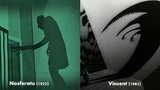
So while we can see the angled rooftops and spindly stairs of Caligari in the shot of Burton’s Vincent sulkily climbing the stairs to his room, a more direct influence was the art of Dr. Seuss, and while a skeleton might play a bone as a flute in Murnau’s Faust, it’s Burton’s childhood love of Ray Harryhausen that you can see in the skeleton band from Corpse Bride.
Also, it’s not known when Burton may have seen these classic silent films. Growing up in the ‘70s he would have had to seek out prints, or look at stills in books about the history of horror. Once he got to CalArts to study, his access to films would have expanded beyond what was on television.
But it’s interesting that in most interviews, Burton quickly diverts the discussion if and rarely when asked about German Expressionism, but indulges when asked about what he watched as a child.
Once working in the film industry, no doubt those Burton brought on for his art directors and costume designers came with their own knowledge of history, while music videos in the early ‘80s were also awash with Expressionist influence mixed with modernist design. Not to say that Burton isn’t a singular visionary with a stack of influences, but one who had grown up lonely, he soon found himself among many who shared his particular tastes, the film production as a second family.
via Slate
Related content:
Six Early Short Films By Tim Burton
Watch 10 Classic German Expressionist Films: From Fritz Lang’s M to The Cabinet of Dr. Caligari
Vincent: Tim Burton’s Early Animated Film
Tim Burton’s The World of Stainboy: Watch the Complete Animated Series
Ted Mills is a freelance writer on the arts who currently hosts the FunkZone Podcast. You can also follow him on Twitter at @tedmills, read his other arts writing at tedmills.com and/or watch his films here.
How German Expressionism Influenced Tim Burton: A Video Essay is a post from: Open Culture. Follow us on Facebook, Twitter, and Google Plus, or get our Daily Email. And don't miss our big collections of Free Online Courses, Free Online Movies, Free eBooks, Free Audio Books, Free Foreign Language Lessons, and MOOCs.
The post How German Expressionism Influenced Tim Burton: A Video Essay appeared first on Open Culture.
Open Culture
.
Blog
.
<span class='date ' tip=''><i class='icon-time'></i> Aug 26, 2015 03:12pm</span>
|
|
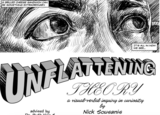
My circle of friends includes more than a few grad students, but few of them seem very happy, especially those who’ve already put every part of the process behind them except their dissertation. As they struggle to wrestle that daunting beast to the ground, I — as a non-academic — try to provide whatever perspective I can. To my mind, a dissertation, just like any other major task, demands that you break it down into small pieces and frame each piece in your mind just right, so I naturally think Nick Sousanis made the right choice by writing his dissertation, panel by panel, frame by frame, as a graphic novel.
Boing Boing’s Cory Doctorow recently wrote about Unflattening, Sousanis’ "graphic novel about the relationship between words and pictures in literature" that doubled as Sousanis’ dissertation in education at Columbia University. Doctorow quotes Comics Grid‘s Matt Finch, who describes the work as one that "defies conventional forms of scholarly discourse to offer readers both a stunning work of graphic art and a serious inquiry into the ways humans construct knowledge." Uniting the perspectives of "science, philosophy, art, literature, and mythology, it uses the collage-like capacity of comics to show that perception is always an active process of incorporating and reevaluating different vantage points."
//www.youtube.com/watch?v=j5SicXrnOYU
A bold claim indeed, but one you can evaluate for yourself by reading the fifteen-page excerpt of Unflattening now available for free, or purchasing your own copy of this groundbreaking dissertation online. It will give you an idea, making reference along the way to astronomy, ancient Alexandria, modern Manhattan, Gilles Deleuze, Sousanis’ dog, Ulysses, Buddhism, and the medium of the comic book — or the graphic novel, or sequential art — itself. You can find out more about this impressive work of art, scholarship, or however you prefer to regard it at the Harvard University Press site or Sousanis’ own. The video just above, on an exhibit of work from Unflattening, features Sousanis talking about his experience in this "amphibious medium."
via Boing Boing
Related Content:
The History of Economics & Economic Theory Explained with Comics, Starting with Adam Smith
Read John Nash’s Super Short PhD Thesis with 26 Pages & 2 Citations: The Beauty of Inventing a Field
The Illustrated Guide to a Ph.D.
How to Dance Your Dissertation: See the Winning Video in the 2014 "Dance Your PhD" Contest
Colin Marshall writes on cities, language, Asia, and men’s style. He’s at work on a book about Los Angeles, A Los Angeles Primer, and the video series The City in Cinema. Follow him on Twitter at @colinmarshall or on Facebook.
Doctoral Dissertation as a Graphic Novel: Read a Free Excerpt of Nick Sousanis’ Unflattening is a post from: Open Culture. Follow us on Facebook, Twitter, and Google Plus, or get our Daily Email. And don't miss our big collections of Free Online Courses, Free Online Movies, Free eBooks, Free Audio Books, Free Foreign Language Lessons, and MOOCs.
The post Doctoral Dissertation as a Graphic Novel: Read a Free Excerpt of Nick Sousanis’ Unflattening appeared first on Open Culture.
Open Culture
.
Blog
.
<span class='date ' tip=''><i class='icon-time'></i> Aug 26, 2015 03:12pm</span>
|
|
Every period of literary history has its share of bawdy, satirical poetry, from Mesopotamia, to Rome, to the age of Jonathan Swift. Every period, it often seems, but one: The late Victorian era in England and America often appears to us like a dry, humorless time for English poetry. Two of the most renowned poets, Alfred Tennyson and Henry Wadsworth Longfellow are, fairly or unfairly, viewed as wordy, sentimental, and didactic. At the dawn of the new century, tough-minded modernists like William Carlos Williams, Ezra Pound, and T.S. Eliot remedied these failings, the story goes. And yet, despite their symbolist influences, these would-be radicals can seem themselves pretty conservative, turning Tennyson and Wadsworth’s affirmations of an ordered world into maudlin, and reactionary, laments over its loss.
Eliot’s work is especially characteristic of this high church disdain for social change. Eliot, writes Mental Floss, was "stodgy." Adam Kirsch in Harvard Magazine writes of Eliot’s "almost papal authority in the world of literature" and his "magisterial criticism"—hardly descriptions of a revolutionary. "Looking at the severe, bespectacled face of the elderly poet on the cover of his Complete Poems and Plays," writes Kirsch, "it is hard to imagine that he was ever young." But young he was, and while always pedantic in the most fascinating way, Eliot was also once a writer of very bawdy verse.
He was also, unfortunately, a composer of racist verse, a fact which many readers of Eliot will not find overly surprising. Mental Floss quotes from one of those ugly early works, featuring "the racist caricature of a well-endowed ruler named ‘King Bolo.’" But it also quotes from an early poem said to contain the first use of a word that aptly describes the language in that first distasteful poem. According to Language Log, a site maintained by University of Pennsylvania professor Mark Liberman, who source their etymology from the Oxford English Dictionary, the word "bullsh*t" originated with Eliot’s poem "The Triumph of Bullsh*t."
Wyndham Lewis first mentions the poem, which he calls a bit of "scholarly ribaldry," in 1915, but it was probably written in 1910. With its first three stanzas addressed to "Ladies," and all four ending with "For Christ’s sake stick it up your ass," the poem piles up line after rhyming line of archaic, Latinate words, undercutting their obscurantism with lowbrow crudeness. The third stanza becomes more direct, less laden with clever diction, as Eliot lays out the conflict:
Ladies who think me unduly vociferousAmiable cabotin making a noiseThat people may cry out "this stuff is too stiff for us" -Ingenuous child with a box of new toysToy lions carnivorous, cannons fumiferousEngines vaporous - all this will pass;Quite innocent - "he only wants to make shiver us."For Christ’s sake stick it up your ass.
"The Triumph of Bullsh*t" functions as a bratty riposte to Eliot’s critics. (It was, in fact, originally addressed to "Critics," then changed to "Ladies" in 1916.) Language Log questions whether Eliot "really invented bullsh*t in 1910," since he "could hardly have aimed to shock the ‘ladies’ by naming his little poem ‘The Triumph of Bullsh*t’ if the term had not already been a commonplace vulgarity." Perhaps. But according to Wyndham Lewis and the OED, he was the first to use the word on record. Harvard Magazine’s Kirsch calls these early poems (collected here)—and others such as the profane "Inventions of the March Hare"—the last manifestations of the "American Eliot" before he went off and became the "British Eliot" who would not deign to utter such vulgarities so freely.
The word in question never appears in the poem itself, only the title, and given the speaker’s literary chest-thumping, we might even speculate that "Bullsh*t" is a proper name, or a personification, and his triumph consists of a gleeful middle finger to Victorian decorum. It’s language only slightly more exaggerated than some of Mark Twain’s or Herman Melville’s characterizations, marking Eliot’s kinship with a particularly American sense of humor. The poet, writes Kirsch, later "buried his Americanness deep enough that it takes some digging to recognize it." In these poems, we see it—juvenile insults, grotesque, sexualized racial caricatures, a crude defiance of tradition—and women’s opinions…. And yes, whether he invented the word or just did us the honor of popularizing it, a snide elevation of what he rightly called "bullsh*t."
via The Paris Review
Related Content:
T.S. Eliot Reads His Modernist Masterpieces "The Waste Land" and "The Love Song of J. Alfred Prufrock"
T.S. Eliot, as Faber & Faber Editor, Rejects George Orwell’s "Trotskyite" Novel Animal Farm (1944)
Listen to T.S. Eliot Recite His Late Masterpiece, the Four Quartets
Groucho Marx and T.S. Eliot Become Unexpected Pen Pals, Exchanging Portraits & Compliments (1961)
Josh Jones is a writer and musician based in Durham, NC. Follow him at @jdmagness
Open Culture
.
Blog
.
<span class='date ' tip=''><i class='icon-time'></i> Aug 26, 2015 03:11pm</span>
|