Blogs
|
Click to view in a big, high-res format
Last week we highlighted for you a beautiful Tree of Languages infographic, created by Minna Sundberg using data from ethnologue.com. This week, we present another visualization of world languages, this one produced by Alberto Lucas Lopéz, on behalf of the South China Morning Post. And, once again, the underlying data comes from ethnologue.com, a research project that catalogues all of the world’s known living languages.
Today’s graphic — click here to view it in a large format — takes the world’s 23 most popular languages, and then gives you a visual sense of how many people actually speak those languages overall, and where geographically those languages are spoken. The more a language is spoken, the more space it gets in the visual.
When you view the original graphic, you’ll note that Chinese speakers outnumber English speakers by a factor of four. And yet English is spoken in 110 countries, as compared to 33 for Chinese. And the number of people learning English worldwide dwarfs the number learning Mandarin.
As you look through Lopéz’s visual, you’ll want to keep one thing in mind: Although the 23 languages visualized above are collectively spoken by 4.1 billion people, there are at least another 6700 known languages alive in the world today. Someone has to cook up a proportional visualization of those. Any takers?
Speaking of learning popular languages, don’t miss our collection: Learn 48 Languages Online for Free: Spanish, Chinese, English & More.
via Mental Floss
Follow us on Facebook, Twitter, Google Plus and LinkedIn and share intelligent media with your friends. Or better yet, sign up for our daily email and get a daily dose of Open Culture in your inbox.
Related Content:
The Tree of Languages Illustrated in a Big, Beautiful Infographic
The History of the English Language in Ten Animated Minutes
Noam Chomsky Talks About How Kids Acquire Language & Ideas in an Animated Video by Michel Gondry
A Proportional Visualization of the World’s Most Popular Languages is a post from: Open Culture. Follow us on Facebook, Twitter, and Google Plus, or get our Daily Email. And don't miss our big collections of Free Online Courses, Free Online Movies, Free eBooks, Free Audio Books, Free Foreign Language Lessons, and MOOCs.
The post A Proportional Visualization of the World’s Most Popular Languages appeared first on Open Culture.
Open Culture
.
Blog
.
<span class='date ' tip=''><i class='icon-time'></i> Aug 26, 2015 03:24pm</span>
|
|
//www.youtube.com/watch?v=4dxRdPLw3Es
Many of us in the West live in some of the most fragmented religious landscapes in the world, but in the midst of deepening levels of conflict over policies of birth and death, these two issues that divide us also join us together. More than at any time in history, people live in expectation of similar spans of life; we all lament the loss of loved ones who die at any age; and most of us live with some fear of death, or at least violent, untimely death like the kind Alan Watts describes above.
Watts, English Zen guru of sorts (though he would not like the label) lectured more on death than perhaps any other philosophical or religious teacher since the Buddha, but he did so in a way that illuminates our ideas about the inevitable end, even if it should come upon us all of the sudden.
You heard a bomb coming at you, you could hear it whistle and you knew it was right above you and heading straight at you, and that you were finished.
This is no abstract thought experiment, of course, but the historical experience of millions of people, from Dresden to Iraq. But despite the terrifying example, Watts describes achieving in that moment absolute clarity and universality. The dreaded bomb whistles toward you, "and you accepted it," he says.
//www.youtube.com/watch?v=qK1BJkBJdtY
How exactly does one achieve that acceptance? Without dogmatizing or mysticism, Watts offers some wisdom in another excerpt from a lecture above. This video’s use of melodramatic film clips and cinematic music may be a little schmaltzy, but his matter of fact talk isn’t lessened by it. Though not everyone passes on their genes to a next generation, an example he discusses in both excerpts, we do all leave the planet to make room for new people, wherever they come from, and this, he says, "is an honorable thing…. It’s a far more amusing arrangement for nature to continue the process of life through different individuals than it is through the same individual."
//www.youtube.com/watch?v=K0mdOvNEUiA
Watts was not at all doctrinaire about death, particularly in his later years. In a conversation with Aldous Huxley’s wife Laura in 1968, he called dying "an art," though not quite like Sylvia Plath did: "It is also," he said, "an adventure." He considered Aldous Huxley’s unorthodox death—on an LSD trip while Laura read to him from the Tibetan Bardo Thodol—a "highly intelligent form of dying." Nonetheless, Watts, an Episcopal priest become an explainer of Zen Buddhism in America, also had a great deal to say about more formal religious ideas of death.
In the lecture above, from a 1959 American television program, Watts explains a particular Buddhist concept of reincarnation and rebirth through various realms. It’s a picture as fantastic and picturesque as Dante’s, and like his creative act, one that can be read with some literal and much profoundly philosophical significance. These conceptions help demonstrate that far from fearful, our puzzling over the inevitability and mystery of death can be, as it was for Watts, "one of the most creative thoughts I ever thought in my life."
Related Content:
Zen Master Alan Watts Discovers the Secrets of Aldous Huxley and His Art of Dying
The Wisdom of Alan Watts in Four Thought-Provoking Animations
The Zen Teachings of Alan Watts: A Free Audio Archive of His Enlightening Lectures
Josh Jones is a writer and musician based in Durham, NC. Follow him at @jdmagness
Alan Watts Explains Why Death is an Art, Adventure and Creative Act is a post from: Open Culture. Follow us on Facebook, Twitter, and Google Plus, or get our Daily Email. And don't miss our big collections of Free Online Courses, Free Online Movies, Free eBooks, Free Audio Books, Free Foreign Language Lessons, and MOOCs.
The post Alan Watts Explains Why Death is an Art, Adventure and Creative Act appeared first on Open Culture.
Open Culture
.
Blog
.
<span class='date ' tip=''><i class='icon-time'></i> Aug 26, 2015 03:23pm</span>
|
|
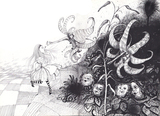
This year, readers worldwide celebrate the 150th anniversary of the publication of Alice’s Adventures in Wonderland. (Click to see the original manuscript, handwritten & illustrated by Lewis Carroll.) Carroll’s fantastical, unexpectedly psychological and intellectual children’s tale has inspired writers, artists, and other creators of all ages since it first came out in 1865. New editions and adaptations have kept appearing, each reflecting the spirit of their own time through the askew prism of Alice‘s sensibility. And which living illustrator could provide more askew imagery than Ralph Steadman?
We all know that Alice’s dreamlike journey begins in earnest when she drinks from a bottle labeled "DRINK ME" and eats a cake labeled "EAT ME." See what metaphors you will, but to my mind, this alone makes the story obvious Steadman material: many of us discover his art through its appearance in Hunter S. Thompson’s Fear and Loathing in Las Vegas, a collaboration that qualifies Steadman as no stranger at all to visualizing unreal circumstances heightened, or induced, by one ingested substance or another.
Fear and Loathing in Las Vegas appeared in book form in 1972; Alice in Wonderland Illustrated by Ralph Steadman appeared the next year, and went on to win the Francis Williams Book Illustration Award. His version, writes io9’s Cyriaque Lamar, "has gone through various print runs throughout the decades, and he modeled several of the characters on decidedly modern personalities. For example, the Cheshire Cat is a television talking head, the Caterpillar is a grass-smoking pedant, the Mad Hatter is a barking quizmaster, and the King and Queen of Hearts are a melting mass of political authority."
See more of Steadman’s pieces by picking up your own copy of the book, or visit Brain Pickings, where Maria Popova describes them as bringing "to Carroll’s classic the perfect kind of semi-sensical visual genius, blending the irreverent with the sublime." Though by all available evidence thoroughly sane himself, Steadman’s illustrations have, over his fifty-year career, lent just the right notes of English insanity to a variety of subjects, from wine to dogs to psychogeography. Only natural, then, to see them accompany the insanity — which, sentence by sentence and page by page, comes to seem like sanity by other means — of a classic English tale like Alice’s Adventures in Wonderland.
Related Content:
See the Original Alice In Wonderland Manuscript, Handwritten & Illustrated By Lewis Carroll (1864)
See Salvador Dali’s Illustrations for the 1969 Edition of Alice’s Adventures in Wonderland
Lewis Carroll’s Photographs of Alice Liddell, the Inspiration for Alice in Wonderland
When Aldous Huxley Wrote a Script for Disney’s Alice in Wonderland
Colin Marshall writes on cities, language, Asia, and men’s style. He’s at work on a book about Los Angeles, A Los Angeles Primer, and the video series The City in Cinema. Follow him on Twitter at @colinmarshall or on Facebook.
See Ralph Steadman’s Twisted Illustrations of Alice’s Adventures in Wonderland on the Story’s 150th Anniversary is a post from: Open Culture. Follow us on Facebook, Twitter, and Google Plus, or get our Daily Email. And don't miss our big collections of Free Online Courses, Free Online Movies, Free eBooks, Free Audio Books, Free Foreign Language Lessons, and MOOCs.
The post See Ralph Steadman’s Twisted Illustrations of Alice’s Adventures in Wonderland on the Story’s 150th Anniversary appeared first on Open Culture.
Open Culture
.
Blog
.
<span class='date ' tip=''><i class='icon-time'></i> Aug 26, 2015 03:23pm</span>
|
|
//www.youtube.com/watch?v=7LviGTHud5w
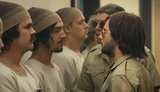
In 1971, Stanford psychology professor Philip Zimbardo undertook a study to determine whether situations determine behavior or whether a person’s disposition leads to behavior regardless of their situation. As seen in the above trailer for the Stanford Prison Experiment, a new film adaptation of Zimbardo’s controversial study, it was explained thusly: people acted like prisoners-lashing out at authority, angry, maladjusted-purely by dint of being put in prisons. And people abused their authority when put in the position of authority. The hypothesis had its basis in the past: the action of Nazi guards at the concentration camps. The results have ramifications through to the present: witness the confessions of the guards who tortured inmates in Abu Ghraib.
The trailer plays like a psychological thriller, but so far it looks true to the record. Prof. Zimbardo-having just earned tenure at Stanford (and played in the film by Billy Crudup)-chose 24 healthy student subjects and randomly assigned them either the role of guard or of prisoner. The Psychology Department’s basement was turned into a mock prison, with holding cells, guard rooms, solitary confinement, and an exercise yard. Cameras recorded all that went on, observed by Zimbardo and his crew. The "guards" could come and go according to shifts, but the "prisoners" could not. While the "guards" could not use physical force on the "prisoners," they could use as many psychological tactics as possible to break the will of their fellow students. However, the "prisoners" were not told exactly what would happen to them. When, on the first day, the "prisoners" were "arrested" in the morning, stripped, searched, shaved and deloused, they were already in a state of shock. An early documentary exists on the experiment and its results here:
//www.youtube.com/watch?v=1Py3JJZ2ZrI
Suffice it to say (and you may have seen this coming) the student guards really got into their roles, and the "prisoners" rebelled. All the while Prof. Zimbardo wanted to keep going for the planned one to two weeks. Only because of the objections of Christina Maslach, a graduate student and Prof. Zimbardo’s girlfriend, did the group abandon the study after six increasingly frightening days. (Proving as well that Prof. Zimbardo was affected by the experiment in ways similar to his subjects, as he was unable to initially stop something out of control.)
The study was funded by the U.S. Office of Naval Research to "study antisocial behavior." The student subjects were paid $15 a day for their help and half quit the experiment before it was finished. All of the guards stayed on. As detailed in the official FAQ on the study, none of the students showed any lasting trauma, though Prof. Zimbardo said:
"I was guilty of the sin of omission — the evil of inaction — of not providing adequate oversight and surveillance when it was required… the findings came at the expense of human suffering. I am sorry for that and to this day apologize for contributing to this inhumanity."
The experiment is now used in psychology textbooks as an example of the "psychology of imprisonment." Prof. Zimbardo turned his science to helping people, looking at promoting heroism in daily life, helping veterans normalize into social life, working with shy people, and, coming full circle, testifying during the court martial of Sgt. Ivan "Chip" Frederick, who was charged with crimes during his time at Abu Ghraib. Zimbardo has since retired and recently advised on the upcoming film. Christina Maslach later married Prof. Zimbardo and is currently Vice Provost for Undergraduate Education at the University of California, Berkeley.
And if Prof. Zimbardo’s experiment sounds a bit like Stanley Milgram’s 1961 experiment in obedience to authority, well, it’s no coincidence. Stanley Milgram and Philip Zimbardo were high school friends.
However, there’s some interesting differences. For one, the "victims" of Milgram’s experiment were acting the electric shocks they supposedly received. Despite that level of fakery, Milgram was denied tenure at Harvard. The City University of New York Graduate Center, on the other hand, knew a psychology superstar when they saw one and gave him tenure.
Related content:
Watch Footage from the Psychology Experiment That Shocked the World: Milgram’s Obedience Study (1961)
The Little Albert Experiment: The Perverse 1920 Study That Made a Baby Afraid of Santa Claus & Bunnies
Free Online Psychology Courses
How To Think Like a Psychologist: A Free Online Course from Stanford
Hermann Rorschach’s Original Rorschach Test: What Do You See? (1921)
Ted Mills is a freelance writer on the arts who currently hosts the FunkZone Podcast. You can also follow him on Twitter at @tedmills, read his other arts writing at tedmills.com and/or watch his films here.
Open Culture
.
Blog
.
<span class='date ' tip=''><i class='icon-time'></i> Aug 26, 2015 03:22pm</span>
|
|
Recently deceased artist Chris Burden had a long history of working with automobiles in his art. In his early days he crucified himself to the top of a VW Beetle (a piece called Trans Fixed). He set about designing and building a 100 mph and 100 mpg automobile based on intuition called the B-Car. In Big Wheel he used a motorcycle to power…a big wheel. And in Porsche with Meteorite he suspended the two objects above the museum floor on each end of a gigantic scale.
But his massive kinetic sculpture Metropolis II is something else: a child’s fever dream of a Hot Wheels-scale city, with 1,100 cars driving endlessly on 18 roadways, with two ramps that are 12 feet high and three conveyor systems that feed the cars back into the loop. The metal and the electricity needed to run the sculpture means that the thing is not just a sight to behold, but it’s staggeringly loud.
The title of the kinetic sculpture gives away its reference, that of Fritz Lang’s 1927 Metropolis (watch it online) and its imaginary city scapes of elevated freeways and train tracks and people movers and planes that fly in between:
//www.youtube.com/watch?v=5PAdQ5anhZE
Burden’s work has its own structures too, some of which are made from building blocks, Lego, and Lincoln Logs, turned into houses and skyscrapers. Don’t expect sensible urban planning in this city: seen from above, Metropolis II is a chaos of roads, and closed systems from which there is no escape.
There was a trial run of the sculpture called Metropolis I, a smaller version that was soon sold to a Japanese collector and taken out of the public view.
For the sequel, Burden went bigger, enlisting eight people full time for five and a half years to build the piece. Said the artist:
"We wanted to expand it and make it truly overwhelming — the noise and level of activity are both mesmerizing and anxiety provoking."
But instead of a nightmare commentary, Burden wanted the piece to be utopian. The cars are moving at 240 mph, according to scale, and there’s no gridlock. He was looking ahead to a future of driverless cars, as he shared a hatred like many Angelenos of endless traffic jams.
The 30 foot wide sculpture was bought for an undisclosed sum by billionaire businessman Nicholas Berggreun, who also sits on LACMA’s board. He’s loaned it to the museum until 2022 and it is currently now situated in a special wing where visitors can see it both at ground level and from above. It takes one assistant to keep it free of hiccups and it only runs for a few hours at a time, and only on weekends.
However, LACMA’s entryway is also home to a Burden piece one can see 24/7, the iconic Urban Light.
via Coudal
Related Content:
Watch Chris Burden Get Shot for the Sake of Art (1971)
LA County Museum Makes 20,000 Artistic Images Available for Free Download
Chris Burden (R.I.P.) Turns Late-Night TV Commercials Into Conceptual Art
Ted Mills is a freelance writer on the arts who currently hosts the FunkZone Podcast. You can also follow him on Twitter at @tedmills, read his other arts writing at tedmills.com and/or watch his films here.
Open Culture
.
Blog
.
<span class='date ' tip=''><i class='icon-time'></i> Aug 26, 2015 03:21pm</span>
|
|
Image via Mario Casciano
Music is dangerous and powerful, and can be, without intending to, a political weapon. All authoritarian regimes have understood this, including repressive elements in the U.S. throughout the Cold War. I remember having books handed to me before the Berlin Wall came down, by family friends fearful of the evils of popular music—especially punk rock and metal, but also pretty much everything else. The descriptions in these paranoid tracts of the bands I knew and loved sounded so ludicrous and hyperbolic that I couldn’t help suspect each was in fact a work of satire. They were at the very least anachronistic, yet ideal, types of Poe’s Law.
Such may be your reaction to a list published in 1985 by the Komsomol, the Soviet youth organization formed as the All-Union Leninist Young Communist League in 1918. (Find it below.) Consisting of thirty-eight punk, rock, metal, disco, and New Wave bands, the list is not at all unlike the materials printed around the same time by certain youth organizations I came into contact with. The mechanisms of state repression in the Soviet Union on the eve of perestroika overmatched comparatively mild attempts at music censorship made by the U.S. government, but the propaganda mechanisms were similar. As in the alarmed pamphlets and books handed to me in churches and summer camps, the Komsomol list describes each band in obtuse and absurd terms, each one a category of the "type of propaganda" on offer.
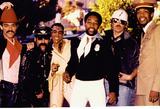
Black Sabbath, a legitimately scary—and politically astute—band gets pegged along with Iron Maiden for "violence" and "religious obscurantism." (Nazareth is similarly guilty of "violence" and "religious mysticism.") A great many artists are charged with only "violence" or with "sex," which in some cases was kind of their whole métier. A handful of punk bands—the Sex Pistols, the Clash, the Stranglers—are cited for violence, and also simply charged with "punk," a crime given as the Ramones’ only offense. There are a few oddly specific charges: Pink Floyd is guilty of a "distortion of Soviet foreign policy (‘Soviet aggression in Afghanistan’)" and Talking Heads endorse the "myth of the Soviet military threat." A couple hilariously incongruous tags offer LOLs: Yazoo and Depeche Mode, two of the gentlest bands of the period, get called out for "punk, violence." Kiss and the Village People (above), two of the silliest bands on the list, are said to propagate, "neofascism" and "violence."
Sex Pistols: punk, violence
B-52s: punk, violence
Madness: punk, violence
Clash: punk, violence
Stranglers: punk, violence
Kiss: neofascism, punk, violence
Crocus: violence, cult of strong personality
Styx: violence, vandalism
Iron Maiden: violence, religious obscuritanism
Judas Priest: anticommunism, racism
AC/DC: neofascism, violence
Sparks: neofascism, racism
Black Sabbath: violence, religious obscuritanism
Alice Cooper: violence, vandalism
Nazareth: violence, religious mysticism
Scorpions: violence
Gengis Khan: anticommunism, nationalism
UFO: violence
Pink Floyd (1983): distortion of Soviet foreign policy ("Soviet agression in Afghanistan")***
Talking Heads: myth of the Soviet military threat
Perron: eroticism
Bohannon: eroticism
Originals: sex
Donna Summer: eroticism
Tina Turner: sex
Junior English: sex
Canned Heat: homosexuality
Munich Machine: eroticism
Ramones: punk
Van Halen: anti-soviet propaganda
Julio Iglesias: neofascism
Yazoo: punk, violence
Depeche Mode: punk, violence
Village People: violence
Ten CC: neofascism
Stooges: violence
Boys: punk, violence
Blondie: punk, violence
The list circulated for "the purpose of intensifying control over the activities of discoteques." It comes to us from Alexei Yurchak’s Everything Was Forever, Until It Was No More: The Last Soviet Generation, which cites it as an example, writes one reader, of "the contradictory nature of Soviet life, where as citizens participated in the ritualized, pro forma ideological discourse, this very discourse allowed them to carve out what they called ‘normal meaningful life’ that went beyond the state’s ideology." A large part of that "normal" life involved circulating bootlegs of ideologically suspect music on improvised materials like discarded and stolen X-Rays. The Komsomol eventually wised up. As Yurchak documents in his book, they co-opted local amateur rock bands and promoted their own events as a counter-attack on the influence of bourgeois culture. You can probably guess how much success they had with this strategy.
See the full list of thirty-eight bands and their "type of propaganda" above.
Related Content:
Soviet Hipsters Bootlegged Western Pop Music on Discarded X-Rays: Hear Original Audio Samples
Bruce Springsteen Plays East Berlin in 1988: I’m Not Here For Any Government. I’ve Come to Play Rock
Yakov Smirnoff Remembers "The Soviet Department of Jokes" & Other Staples of Communist Comedy
Josh Jones is a writer and musician based in Durham, NC. Follow him at @jdmagness
Soviet Union Creates a List of 38 Dangerous Rock Bands: Kiss, Pink Floyd, Talking Heads, Village People & More (1985) is a post from: Open Culture. Follow us on Facebook, Twitter, and Google Plus, or get our Daily Email. And don't miss our big collections of Free Online Courses, Free Online Movies, Free eBooks, Free Audio Books, Free Foreign Language Lessons, and MOOCs.
The post Soviet Union Creates a List of 38 Dangerous Rock Bands: Kiss, Pink Floyd, Talking Heads, Village People & More (1985) appeared first on Open Culture.
Open Culture
.
Blog
.
<span class='date ' tip=''><i class='icon-time'></i> Aug 26, 2015 03:19pm</span>
|
|
Image courtesy of Jonty Wilde
Most of us come to Michael Palin through his work as a comic actor (in the role of dead parrot salesman or otherwise), but at this point almost as many know him second as a founding member of Monty Python, and first as an affable globetrotter. That part of his career began in 1988, when he hosted the Earth-circumnavigating BBC travel series Around the World in 80 Days. (See an episode here.) Its success has led him, over the subsequent 27 years, onto further (and farther-flung) televised journeys: from the North Pole to the South, around the Pacific Rim, in the adventurous footsteps of Ernest Hemingway, across the Sahara, up the Himalayas, across the "new" central and eastern Europe, around the world again, and most recently through Brazil.
Not content to set a high watermark for travel television, Palin has also written a companion book for each series, lavishly collecting maps, pictures, and his own travel diaries. Those last reveal a more nuanced side of "the nicest chap in Britain," whose famously easygoing, deferential, and unsurprisingly good-humored persona place him so well to deal with the world’s staggering variety of people, places, and inconveniences. "I can summon up nothing but resignation at the thought of cooking with the locals all morning, then having to listen to music and songs I don’t understand for the rest of the afternoon," he writes after waking up on yet another island, in an entry excerpted in last year’s Travelling to Work, the latest published volume of his life’s diaries. "And, worst of all, having to look as if I’m enjoying it."
But these books also reveal that most of the time, Palin really is enjoying it. His insatiable curiosity (not to mention his inexorable production schedule) drives him continuously ahead, a curiosity in which you, too can share now that he’s made all these books free to read online at palinstravels.co.uk. Click on the links/titles below, and then look for the prompts that say "Discover the Series Here" and, below that, "Start Reading the Book."
Around the World in 80 Days
Pole to Pole
Full Circle
Hemingway Adventure
Sahara
Himalaya
New Europe
80 Days Revisited
Brazil
And if you make a free account at the site, it will even allow you to you keep virtual "bookmarks" in as many of the books as you like, guaranteeing that you won’t get lost amidst this wealth of travel content. But if you choose to follow Palin’s example and actually get out there into every corner of the world, well, no such anti-lostness guarantees exist — but as every fan of Palin’s Travels knows, those very complications make it worthwhile. As least you won’t have a five-man crew trailing behind.
Related Content:
Trains and the Brits Who Love Them: Monty Python’s Michael Palin on Great Railway Journeys
Michael Palin’s Tour of the Best Loved Monty Python Sketch Locations
Colin Marshall writes on cities, language, Asia, and men’s style. He’s at work on a book about Los Angeles, A Los Angeles Primer, and the video series The City in Cinema. Follow him on Twitter at @colinmarshall or on Facebook.
Free: Read 9 Travel Books Online by Monty Python’s Michael Palin is a post from: Open Culture. Follow us on Facebook, Twitter, and Google Plus, or get our Daily Email. And don't miss our big collections of Free Online Courses, Free Online Movies, Free eBooks, Free Audio Books, Free Foreign Language Lessons, and MOOCs.
The post Free: Read 9 Travel Books Online by Monty Python’s Michael Palin appeared first on Open Culture.
Open Culture
.
Blog
.
<span class='date ' tip=''><i class='icon-time'></i> Aug 26, 2015 03:19pm</span>
|
|
Umberto Eco, now 83 years old, has some advice to pass along to the young.
In March, the Italian semiotician, philosopher, literary critic, and novelist — and, of course, author of Foucault’s Pendulum - published How to Write a Thesis. It’s a witty, irreverent and practical guide for the student laboring over a thesis or dissertation. Josh Jones has more on that here.
Now, in a newly-released video from The Louisiana Channel (a media outlet based in Denmark), Eco turns his attention toward aspiring writers. And his wise counsel comes down to this: Keep your ego in check, make sure your ambitions are realistic, put in the time and the hard work, and don’t shoot for the Nobel Prize in Literature straight out of the gate. That, Eco says, kills every literary career. He’ll also tell you that writing is "10% inspiration and 90% perspiration." They’re truisms — you discover when you’re an octogenarian — that turn out to be true.
Find more tips for aspiring writers below.
Dan Colman is the founder/editor of Open Culture. Follow us on Facebook, Twitter, Google Plus and LinkedIn and share intelligent media with your friends. Or better yet, sign up for our daily email and get a daily dose of Open Culture in your inbox.
Related Content:
Ernest Hemingway Creates a Reading List for a Young Writer, 1934
Ray Bradbury Gives 12 Pieces of Writing Advice to Young Authors (2001)
Toni Morrison Dispenses Writing Wisdom in 1993 Paris Review Interview
John Steinbeck’s Six Tips for the Aspiring Writer and His Nobel Prize Speech
Stephen King Creates a List of 96 Books for Aspiring Writers to Read
Kurt Vonnegut Gives Advice to Aspiring Writers in a 1991 TV Interview
Umberto Eco’s Advice to Aspiring Writers is a post from: Open Culture. Follow us on Facebook, Twitter, and Google Plus, or get our Daily Email. And don't miss our big collections of Free Online Courses, Free Online Movies, Free eBooks, Free Audio Books, Free Foreign Language Lessons, and MOOCs.
The post Umberto Eco’s Advice to Aspiring Writers appeared first on Open Culture.
Open Culture
.
Blog
.
<span class='date ' tip=''><i class='icon-time'></i> Aug 26, 2015 03:18pm</span>
|
|
//www.youtube.com/watch?v=oBQVvEMc-VQ
We’ve shown our fair share of Star Wars mashups and fan films over the years. I cite for example:
Hardware Wars: The Mother of All Star Wars Fan Films (and the Most Profitable Short Film Ever Made)
A 2 Hour Annotated Star Wars Film That Reveals the Cinematic Influences Behind George Lucas’ Classic Film
Fans Reconstruct the Authentic Version of Star Wars, As It Was Shown in Theaters in 1977.
Star Wars Recut as Silent Film
The latest and maybe not greatest fan reworking of Star Wars (now available on YouTube) lets you watch all six Star Wars films online. At once. With one film layered upon the other.
Is there some cultural value to this layering of films? Maybe only insofar as it gives the keen observer the chance to find some meta trends running through the films. One YouTuber commented, "The really interesting part is that they’re similarly paced. If you skip around you’ll almost always find all talking scenes lined up and all action scenes lined up. Just shows how formulaic movies are (or at least how formulaic George Lucas is)."
Feel free to drop your own observations in the comments section below. And, by the way, the person who created this mashup has also made available a full gallery of HD still frames on imgur here.
via Twitter
Follow us on Facebook, Twitter, Google Plus and LinkedIn and share intelligent media with your friends. Or better yet, sign up for our daily email and get a daily dose of Open Culture in your inbox.
Meta Star Wars: All Six Films in One is a post from: Open Culture. Follow us on Facebook, Twitter, and Google Plus, or get our Daily Email. And don't miss our big collections of Free Online Courses, Free Online Movies, Free eBooks, Free Audio Books, Free Foreign Language Lessons, and MOOCs.
The post Meta Star Wars: All Six Films in One appeared first on Open Culture.
Open Culture
.
Blog
.
<span class='date ' tip=''><i class='icon-time'></i> Aug 26, 2015 03:18pm</span>
|
|
You may have come into contact at some point with Tracey Emin’s My Bed, an art installation that reproduces her private space during a time when she spent four days as a shut-in in 1998, "heartbroken": the bed’s unmade, the bedside strewn with cigarettes, moccasins, a bottle of booze, food, and "what appears to be a sixteen year old condom"…. If you were savvy enough to be Tracey Emin in 1998—and none of us were—you would have sold that messy room for over four million dollars last year at a Christie’s auction. I doubt another buyer of that caliber will come along for a knock-off, but this doesn’t mean the messes we make while slobbing around our own homes are without their own, intangible, value.
Those messes, in fact, may be seedbeds of creativity, confirming a cliché as persistent as the one about doctors’ handwriting, and perhaps as accurate. It seems a messy desk, room, or studio may genuinely be a mark of genius at work. Albert Einstein for example, writes Elite Daily, had a desk that "looked like a spiteful ex-girlfriend had a mission to destroy his workspace." Einstein responded to criticism of his work habits by asking, "If a cluttered desk is a sign of a cluttered mind, then what are we to think of an empty desk?" Mark Twain also had a messy desk, "perhaps even more cluttered than that of Albert Einstein." To find out whether the messiness trait’s relation to creativity is simply an "urban legend" or not, Kathleen Vohs (a researcher at the University of Minnesota’s Carlson School of Management) and her colleagues conducted a series of experiments in both tidy and unruly spaces with 188 adults given tasks to choose from.
//www.youtube.com/watch?v=t043bPqCKUY
Vohs describes her findings in the New York Times, concluding that messiness and creativity are at least very strongly correlated, and that "while cleaning up certainly has its benefits, clean spaces might be too conventional to let inspiration flow." But there are trade-offs. Read about them in Vohs’ paper—"Physical Order Produces Healthy Choices, Generosity, and Conventionality, Whereas Disorder Produces Creativity." And just above, see Vohs’ co-author Joe Redden, Assistant Professor of Marketing at the University of Minnesota’s Carlson School of Management, discuss the team’s fascinating results. If conducting such an experiment on yourself, it might be best to do so in a space that’s all your own, though, like the rest of us, you’re too late to creatively turn the mess you make into lucrative conceptual art.
Related Content:
Albert Einstein Tells His Son The Key to Learning & Happiness is Losing Yourself in Creativity (or "Finding Flow")
Why You Do Your Best Thinking In The Shower: Creativity & the "Incubation Period"
John Cleese’s Philosophy of Creativity: Creating Oases for Childlike Play
Josh Jones is a writer and musician based in Durham, NC. Follow him at @jdmagness
Open Culture
.
Blog
.
<span class='date ' tip=''><i class='icon-time'></i> Aug 26, 2015 03:17pm</span>
|