Blogs
|
My pastor was talking about exploring your passion today and played this viral video-a tribute by passionate fans asking Foo Fighters to come to their little town in Italy. I have been wondering how I want to start off this year and this made it all click for me.
The first day in class I am going to share some videos of young people doing amazing things that they are passionate about. I haven’t figured out which ones yet, but definitely want young people doing things for the good of others. If you have a great suggestion I would love to hear it in the comments.
Then I will share with the students about the best project that we are going to do this year:
I want to tell you guys about the best project that you are going to do this year. It is going to be so incredible and life changing for the audience. It will change your lives too as you make sacrifices and make a differences for others. I can’t tell you very many details about it today though. It is kinda a secret. Not so much a secret from you, but from me.
You see, the thing is, I can’t tell you more about it because I don’t know anything else about it yet. Last year you did some incredible projects like design tools to help refugees and made documentaries to honor WWII veterans. You were in your first year of PBL and those projects were designed by your teachers. You are no longer freshmen.
This year the best project will be when you take over this class and decide to do something amazing. The teachers are not going to come up with the purpose, product, and audience. You are. This is your year to take charge of your learning and to do something to change the world. The "real world" is not some future place but is our classroom and you will change it starting now.
We will spend a lot of time the rest of the first week building culture in our class and establishing the need to be a critical analyzer of bias. I know the culture that I want to build with students, but this first day is all about setting up proper expectations.
My expectation of my students is that they will be passionate and want to be active citizens who make a difference in the world.
Once students understand this then I can’t wait to be amazed by what they decide to do!
Mike Kaechele
.
Blog
.
<span class='date ' tip=''><i class='icon-time'></i> Aug 26, 2015 03:44pm</span>
|
|
Teachers love to establish protocols at the beginning of the year and in general it is a good practice. We need structure in schools but I feel like there is often an overemphasis on rules that is based on administrators trying to control teachers or teachers trying to control students (same exact phenomenon really).
I have spoken out against standardization and structure at times, but it has a time and place. For example when I drive my car I am very happy that we have rules about driving: which side of the road, how to signal and make turns, and slow drivers in the left lane!!!!! Without these protocols I would probably be dead. Protocols around safety make sense and are imperative. In the classroom we need protocols to establish safety for our students and this is especially important for their emotional safety.
The counter example is a chef. There are protocols for proper cooking techniques. There is a science to how to prepare food properly so that it is safe and delicious. My wife and I often watch Chopped. The format of the show is that it is a competition where contestants are giving 4-5 mystery ingredients that they need to turn into appetizers, main courses, and desserts. The chefs on the show never make the same dishes because cooking is also an art. If they do the science wrong, then the dish can be a disaster. But if they do the science right, but don’t personalize it into a unique dish then the food can be bland and boring.
Teaching is like being a chef. It is an art and a science. There is a science and a structure behind good teaching (PBL is my favorite structure :). I do not believe that teachers should just show up and "wing it" everyday. On the other hand, if we truly believe in student voice and choice then we need to have some flexibility in our classrooms. Protocols and rules need to be able to change and adapt to the students’ needs in our rooms. If you haven’t started school yet, then you have no relationships to build protocols on. Too much structure and protocols can stifle creativity and learning.
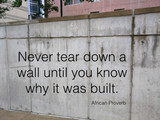
I love comparing the African proverb with the Picasso quote at the top. Breaking protocols for no purpose makes no sense. But when you really understand what you are trying to accomplish then you will start to recognize when protocols are getting in the way. My thermometer is to ask myself if the protocol limits student learning through voice and choice. If yes, then I need to consider other ways to structure learning.
Final thought: build protocols with your staff or students. Don’t force structure on them!
Mike Kaechele
.
Blog
.
<span class='date ' tip=''><i class='icon-time'></i> Aug 26, 2015 03:44pm</span>
|
|
https://commons.wikimedia.org/wiki/File:Armando_Galarraga_pitching_2010_cropped.jpg
I had the privilege of joining Michigan Educator Voice Fellowship and attending their convening last week. I wasn’t 100% sure what I was getting into, but I really enjoyed the two days. As it turns out the purpose of this organization is to support teacher leaders and to amplify their voices. Pretty cool! The best part was meeting and connecting with other leaders from across the state of Michigan.
My favorite part of the convening was a session on creating pitches to use when talking to state legislators. Creating a short, powerful pitch is not something that they teach you in pre-service education or anywhere in education that I have seen. I loved the emphasis on stories that connect people to your message. I struggled a bit with the initial hook part, but after seeing an example from Melody Arabo it quickly came to me. We practiced our pitches taking them from two minutes down to fifteen seconds.
As I reflect on the importance of a good pitch, I see it as a vital skill that teachers should use all of the time. We should be "pitching" the new projects to students with great entry events tied to a story. We should use pitches to parents to help them understand how our classes are different from the school they went to and why. Having a pitch to share a new idea with colleagues, administrators, and school boards could be very effective to gain consensus. We should be able to pitch our class projects to local business and community partners to motivate their involvement and support.
Sometimes educators feel they need to be humble and servant like and pitching feels dirty to them. The truth is that teachers need to stand up and speak out for what is best in the classroom and for their kids. Pitching shouldn’t be about promoting yourself but about promoting your students’ work and about the best kind of schools that we can create. When considered in that light, one can be humble and pitch important ideas at the same time. I would go for far as to say that we have an obligation to start pitching positive stories about education to change the negative stereotypes in this country.
Mike Kaechele
.
Blog
.
<span class='date ' tip=''><i class='icon-time'></i> Aug 26, 2015 03:43pm</span>
|
|
The basis of bad decision-making is human behavior. But behavior is often simply reinforced by current decision-making processes. In order to break through, one needs to redesign the environment, and be the architect of the context and conditions. That's a strong statement, but it's what John Beshears and Francesco Gino have asserted in their article, "Leaders as Decision Architects" which
Susan Smith Nash
.
Blog
.
<span class='date ' tip=''><i class='icon-time'></i> Aug 26, 2015 03:43pm</span>
|
|
One interesting way to engage students is to put together a PowerPoint presentation that can be shared via social media, and which gives the opportunity to create a response presentation, and which includes a mystery / adventure story line.
In this case, which was for a basics of petroleum geology course, I created a six-slide PowerPoint presentation which I shared using Slideshare. The story
Susan Smith Nash
.
Blog
.
<span class='date ' tip=''><i class='icon-time'></i> Aug 26, 2015 03:42pm</span>
|
|
Making effective, collaborative expert instruction and mentoring readily available is an ongoing challenge. Welcome to an interview with Rajeev PS of Blobeo, a new entity dedicated to facilitating the process of bringing together industry practitioners and those seeking practical knowledge. 1. What is your name and your relation to eLearning?My name is Rajeev PS and the Co-Founder of
Susan Smith Nash
.
Blog
.
<span class='date ' tip=''><i class='icon-time'></i> Aug 26, 2015 03:42pm</span>
|
|
Infographics can serve a unique purpose in an online course or training program in that they both engage learners and provide a very handy mnemonic which assists in the storing and retrieving of information.
Infographics are easily incorporated into courses, and can be deployed via social media and within learning management systems. Further, it is a simple process to store your infographic in a
Susan Smith Nash
.
Blog
.
<span class='date ' tip=''><i class='icon-time'></i> Aug 26, 2015 03:42pm</span>
|
|
With the "great crew change" accelerated by the oil and gas downturn, knowledge transfer is more important than ever. Welcome to an interview with Braulio Perdigao, PMP, CEO/Founder of Petrolessons.com - the first knowledge marketplace dedicated to the oil and gas industry.
What is your background? What are your areas of experience?
I'm Brazilian, been in Houston for 15+ years.
Experienced in
Susan Smith Nash
.
Blog
.
<span class='date ' tip=''><i class='icon-time'></i> Aug 26, 2015 03:42pm</span>
|
|
//www.youtube.com/watch?v=HpuXfQHB6MM
In 1986, Yoko Ono commissioned the Oscar-winning animator John Canemaker to bring to life the drawings and doodles of John Lennon (1940-1980), culminating in the release of a short film called The John Lennon Sketchbook. Almost 30 years later, that film has now been officially released on YouTube.
A product of Liverpool’s art schools, John Lennon drew throughout his life, illustrating two of his books with playful drawings, and drawing Christmas Cards for Oxfam, just to cite two examples. You can see Lennon’s visual talents on full display in The John Lennon Sketchbook, a short animation that is pretty whimsical and fun — until the very end, when Lennon seemingly predicts his own violent death in the audio recording that serves as the film’s soundtrack.
The John Lennon Sketchbook will be added to the Animation section of our larger collection, 700 Free Movies Online: Great Classics, Indies, Noir, Westerns, etc..
via Cartoon Brew
Related Content:
I Met the Walrus: An Animated Film Revisiting a Teenager’s 1969 Interview with John Lennon
The Beatles: Why Music Matters in Two Animated Minutes
John Lennon Illustrates Two of His Books with Playful Drawings (1964-1965)
Bed Peace Revisits John Lennon & Yoko Ono’s Famous Anti-Vietnam Protests
The John Lennon Sketchbook, a Short Animation Featuring Lennon’s Drawings, Premieres on YouTube is a post from: Open Culture. Follow us on Facebook, Twitter, and Google Plus, or get our Daily Email. And don't miss our big collections of Free Online Courses, Free Online Movies, Free eBooks, Free Audio Books, Free Foreign Language Lessons, and MOOCs.
The post The John Lennon Sketchbook, a Short Animation Featuring Lennon’s Drawings, Premieres on YouTube appeared first on Open Culture.
Open Culture
.
Blog
.
<span class='date ' tip=''><i class='icon-time'></i> Aug 26, 2015 03:41pm</span>
|
|
//www.youtube.com/watch?v=c-dHxJNsxJc
It seems perfectly natural to us that animation is a medium dominated by cel-by-cel drawings, whether made with paint and brush or mouse and software. But it might have been otherwise. After all, some animated films and videos have been made in less conventional formats with less conventional materials. In the past, we’ve featured here stop-motion animations made with dead bugs, innovative pinscreen animations, unusual cutout animations, and the "destructive animation" of painted plaster. And today, we bring you the live-action sand animation of Hungarian artist Ferenc Cakó, who projects his work on a screen for a theatrical audience. These more sculptural forms may be more painstaking than traditional cel animation, and for that reason more rare, but they are also often much more interesting.
//www.youtube.com/watch?v=go7wlUOC5dg
Cakó performs his "sand animations," all over the world, to the accompaniment of classical compositions like Bach’s Orchestral Suite No. 3 in D major and Orff’s Carmina Burana. Here we have his animated interpretation of the most well-known work of Vivaldi, the Four Seasons ("Spring" and "Summer" above, "Autumn" and "Winter" below.) The effect of Cakó’s live technique is mesmerizing; his hands and arms break the fourth wall in broad gestures under which successions of images take shape. His sand drawings tend to be rather static—instead the animated elements in Cakó’s sand animations are his hands as he pushes the sand around, rapidly forming it into faces, flocks of birds, angry clouds. These are quickly wiped away and remade into trees, frightened horses, solitary shepherds….
//www.youtube.com/watch?v=fCEB4v3o-50
Watching him work raises many a question: Is Cakó using from storyboards? (No.) How much of his live animation does he improvise? (A good deal.) And why sand, anyway? (It’s dry.) You will find more comprehensive answers to these questions and many more in an interview posted on Cakó’s website. Alluding to the difficulty of his work, compounded by its performative aspect, Cakó says, "Sand cannot be corrected, so while working I do not have control, no motion control. I do not have any opportunity, which cartoonists do, such as the tracing paper phase, during which they either draw the lines or scan them in the computer." In other words, this is uniquely difficult art that requires the skills of a uniquely confident artist.
//www.youtube.com/watch?v=MGS6uSPGqvo
Cakó’s website also contains photos of the artist at work, a biography that is also a film-, art-, and performance-ography, and a page devoted specifically to scripting "the way Mr Cakó should be announced," complete with inexplicable uses of parentheses. It’s a fitting bit of bravado for an artist who has legally copyrighted his process.
(Ladies and Gentlemen, what you shall see tonight, is a)
Live Sand Animation Performance, created by Mr Cako, right here by his hands, to the rhythm of the music.
(on the stage and on the screen…….. Mr Ferenc Cako!)
See many more "sandanimations"—and "paint animations"—at Cakó’s YouTube channel.
Related Content:
Watch The Amazing 1912 Animation of Stop-Motion Pioneer Ladislas Starevich, Starring Dead Bugs
Nikolai Gogol’s Classic Story, "The Nose," Animated With the Astonishing Pinscreen Technique (1963)
Watch Piotr Dumala’s Wonderful Animations of Literary Works by Kafka and Dostoevsky
Josh Jones is a writer and musician based in Durham, NC. Follow him at @jdmagness
Vivaldi’s Four Seasons Brought to Life in Sand Animations by the Hungarian Artist Ferenc Cakó is a post from: Open Culture. Follow us on Facebook, Twitter, and Google Plus, or get our Daily Email. And don't miss our big collections of Free Online Courses, Free Online Movies, Free eBooks, Free Audio Books, Free Foreign Language Lessons, and MOOCs.
The post Vivaldi’s Four Seasons Brought to Life in Sand Animations by the Hungarian Artist Ferenc Cakó appeared first on Open Culture.
Open Culture
.
Blog
.
<span class='date ' tip=''><i class='icon-time'></i> Aug 26, 2015 03:39pm</span>
|