Blogs
|
A couple of #MACUL-maker Space time lapse videos, a reflection video, and Storify of tweets:
and
A reflection video by @BillVanLooTeach
See also Why a MakerSpace for a reflection on its creation and the story of one participant.
Storify of #MACUL15-maker Tweets
[View the story "MACUL15 Maker Space Tweets" on Storify]
Mike Kaechele
.
Blog
.
<span class='date ' tip=''><i class='icon-time'></i> Aug 26, 2015 03:49pm</span>
|
|
Last summer at a rented house in Evert, Michigan some #michED folks had an "Unplugg’d" weekend. We talked about how to help make the MACUL conference more of a place for people to interact, connect, and reflect rather than just sit and listen to presentations. The idea of a makerspace was thrown out as an inviting way to get people to connect and reflect. Kit Hard, Jeff Bush, and I decided to make it happen.
After months of Google Hangout sessions, a trial run at NovaNow, and the addition of Ben Rimes to our wolfpack it came to fruition last Friday. With the help of many volunteers (huge shoutout to our #michED friends) including both teachers and students, we hosted the MACUL MakerSpace. We felt like it was a huge success as attendees spent time "playing," creating, designing, and connecting.
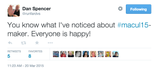
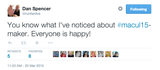
My friend Dan Spencer summarized it best:
I would like to share one story that exemplifies what happened in the space. My friend Rachelle met Aron, a Hebrew teacher, as he visited the MakerSpace. She explained to him about QR Codes so he could access our resources. Aron started playing with Wikkistix and making Hebrew letters on foam board.
I talked to Aron and he explained that he was going to have students who struggled with Hebrew make these letters and then take pictures of them. Then he is going to post them digitally along with a recording of himself pronouncing the letters correctly. He was so excited by the combination of the tactile making with digital curation to help students. Aron ended up staying in the Maker Space all afternoon and kept plugging away until he finished the whole alphabet!
Aron was so excited and so passionate about learning while doing! Aron definitely will bring back an exciting change to his students. At the same time Aron was able to process and reflect on his time at MACUL. He also connected with Rachelle and I. We are glad to have met Aron and look forward to learning with him in the future! Never in my wildest dreams would I have guessed that this would be a result of creating a MakerSpace. It is a great example of how people can creatively explore and learn when given the space and opportunity.
See this post for more about #MACUL15-maker Space including time lapse videos, a reflection by @BillVanLooTeach on making our sign, and the Storify of Tweets.
Mike Kaechele
.
Blog
.
<span class='date ' tip=''><i class='icon-time'></i> Aug 26, 2015 03:49pm</span>
|
|
I spent the weekend co-facilitating a workshop on PBL (I am in training in this model). I found the situation to be extraordinary. This was a group of people who will be starting a PBL / STEM school next fall in a large, urban setting. So the workshop was scheduled on the weekend because they all have other jobs currently.
The crazy part that I did not know ahead of time was that the participants had never met before and did not know each other. So they showed up on the weekend and jumped into a workshop with strangers who are going to be their future colleagues. I can not exaggerate how great this group of educators was. They bonded and started collaborating the first day. They dreamed big and had great ideas. They were not a bunch of recent college graduates either. Many of them were seasoned educators.
Barbara is a sweet educator who loves to encourage others and has 29 years of experience. She said that she has been waiting her whole life to be a part of a school like this. I truly was blown away by the passion for kids and learning in this group.
The principal of this new school has been dreaming of starting his own school for years and has spent over two years doing the hard background work for this one to be born. He told me that he was an administrator in the "system" and that it was too difficult to change. He was obstructed by other people all of the time. To him, the only way that he could create the right learning environment for kids without resistant adults interfering was to start a new school from scratch and hiring teachers who wanted to be a part of it.
So while they are not re-creating everything about education they are starting new. And I do think that there is something powerful about that. Every school and district has a culture. Changing culture is very, very hard.
When you create a new school you get to create your culture from a clean slate. It is not totally clean because it will be based on the experience of the staff, but it will be unique and different than where they came from. For example the Founding Fathers got to create a new government after the United States won independence from England. I would argue that they created an innovative, new system of government, but it was not created in a vacuum. It was based on their experience with British government and the ideals that they saw in Ancient Greece and Rome. The Founding Fathers then fused these ideas together to create a system that was definitely new in the world.
I don’t want to say that this is the only way to change schools, but it sure seems faster and more powerful than incremental change from within.
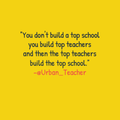
I teach in a similar situation as my school started four years ago in the PBL model and every staff member was hired because they wanted to be a part of it. This quote from Urban Teacher resonates with me:
I would add that it also takes administration that trusts teachers and treats them as professionals.
So the issue that I really want to weigh in on is the question of whether or not we need to blow up schools and start over?
Mike Kaechele
.
Blog
.
<span class='date ' tip=''><i class='icon-time'></i> Aug 26, 2015 03:49pm</span>
|
|
I am a big proponent of PBL as a framework for student centered learning. But more and more I believe that culture is the most important part of a successful school or class. PBL can lead to creating that culture (but it is not an automatic thing!) but the culture is a separate thing.
In working with a new school I was able to challenge them with the opportunity that they had to create a culture from scratch. No student would be coming with any realistic pre-conceived notions about what the school will be like. They will be coming excited and curious to find out. The first days of school are critical for establishing the culture of the school every year. But it is more than how the year is launched, because culture is the norms that are actually lived through out the whole year.
I have had years that did not go well. Culture was the main reason why. The good news is that culture can always be re-created in a new year or shifted in the middle of the year. We are well over the half way mark of this school year, but it is still not too late to shift culture in your class.
Are you happy with your culture? What should you change? What should you keep?
Mike Kaechele
.
Blog
.
<span class='date ' tip=''><i class='icon-time'></i> Aug 26, 2015 03:48pm</span>
|
|
I was in a professional development once and the presenter was identifying students in a video that they were about to show. They identified one student as an African-American boy, another as a girl, and a third student as the other boy. The audience was divided into three groups and each group was assigned the task of evaluating a different student for their presentation style.
An African-American woman then asked, "What is the race of the other boy?" The presenter recognized their mistake (of using race to identify one student), how it sounded, and apologized immediately. It turned out that the presenter could not identify the race of the other student (he was Asian). We had a laugh as a group about trying to identify the other boy’s race.
What struck me about this interaction was two things. First, how often privilege is invisible and we don’t even realize it. It is so easy to speak without realizing how it sounds to others and the assumptions that we are making. Second, the way this lady pointed it out in a non-threatening way. She made her point without accusing, getting angry, or causing any kind of disruption. She also did not assume that the presenter was racist.
Sometimes I see situations like this (especially on social media) escalate to where both sides end up angry with each other and offended. I find this intimidating and makes me not want to talk about race issues with people like this. I hope we can find ways to address issues of race and privilege in civil ways that lead to tolerance, respect, and understanding.
Mike Kaechele
.
Blog
.
<span class='date ' tip=''><i class='icon-time'></i> Aug 26, 2015 03:48pm</span>
|
|
If we are ever going to shift away from an adult based, content heavy curriculum then what should we expect students to learn in schools? I am talking about a system where students are free to study according to their passions and interests. A system of projects designed by students and teachers together. A system that has no bells, no "classes." The type of school where students drive all aspects of the learning.
I am going to argue that there is a core set of skills that all children should learn. I am also going to argue that this list is enough for all children to be successful. Implicit in this list is that all children are going to learn "how to learn" anything they choose to independently. By independently I do not mean in isolation, but without adult direction. That is each student should know how to research and connect with others who are experts to learn anything that they choose to.
It is a short list and probably each item deserves a separate post to describe what it is and isn’t. Here is my list of the skills that every student should learn:
Reading Students will learn to read all kinds of texts and genres as they are naturally exposed to them through classmates, parents, teachers, and exploring their passions through projects.
Writing Students will learn to write all kinds of texts and genres as they are naturally required to through their projects.
Speaking Students will learn to share their learning publicly developing important communication skills.
Computing Students will learn basic math computations as required by their exploration in projects. "Advanced" math will be learned in context when needed. All students will need an understanding of algebraic thinking and more emphasis should be spent on statistics.
Collaborating Students will learn the social skills of working together with others and how to take on different roles in different situations.
Problem Solving Students will learn to ask questions with depth. Emphasis will be on analyzing and evaluating results, rather than on the solutions.
Critical Thinking Students will learn to look at problems and situations from multiple viewpoints. Students will learn to identify and evaluate bias.
Empathy Students will learn to look at problems from multiple viewpoints and understand and relate to competing views.
This list represents everything that I think students should know how to do. It is absent of any specific "content" but applies to any subject that adults can make up. It is heavy on the 4C’s but intentionally omits creativity because I don’t believe that we need to teach or assess it. Adults just need to allow space and creativity will happen. It is innate in all humans.
What do you think? Anything missing? Unclear? Could this ever be the real national standards in the US or anywhere? Why not?
Mike Kaechele
.
Blog
.
<span class='date ' tip=''><i class='icon-time'></i> Aug 26, 2015 03:48pm</span>
|
|
Recycling
When planning a PBL scope and sequence for the year should you repeat projects from previous years or start from scratch? I think there are definitely times when you should repeat projects.
The most important reason to repeat a project is when you find a great community partner that you want to build relationships with that person or organization. You can organically grow that project year after year. As you and your community partner better understand each other the opportunities for students to go deeper and do more focused work improves. So I definitely would repeat projects that have strong community partners centered around meaningful work.
Another reason to recycle a project is that although your students change yearly your core content does not. It makes sense to reframe and refocus certain projects, but it does not make sense to start over from scratch every year. One way to do this is to adjust the project. We like to mix up entry events, DQ’s, and final products sometimes. Other times we keep them the same. A local, national, or world event can create a different way to frame a project so that it stays relevant, while keeping most of the workshops and assessments the same.
The projects that we switch up the most are the ones that seem to fall flat. My most difficult topic is the Spanish American War. It seems small, insignificant, and irrelevant to today. In three years we have tried three different approaches: the first time we had students make Common Craft style videos. The second year we had students debate Manifest Destiny vs. Imperialism as America’s motivation in different countries around the world.
This past year we ended up combining the Spanish American War with 9/11 monument project. What didn’t change in all three of these projects is that we had students consider how early American expansion was a continuation of Manifest Destiny. We contrasted the language of Manifest Destiny with our imperialistic actions. We then continued to look at American foreign policy through the rest of the twentieth century through this lens.
Each year I feel like it got better, but to be honest I think I will be re-doing it again next year. So I don’t think there is a right or wrong way to approach project planning. Sometimes you repeat and sometimes you start over. But even when you start over you can still use many of the same resources and workshops by just reframing the entry event, purpose, and audience.
Note: This was inspired by excellent thoughts from this John Spencer post.
Mike Kaechele
.
Blog
.
<span class='date ' tip=''><i class='icon-time'></i> Aug 26, 2015 03:47pm</span>
|
|
Yong Zhao wrote an incredible, research based piece arguing the way that schools should be. It is a lengthy piece but you should read it in its entirety right now! No really, go do it.
Now that you have finished I want to respond to his recommendations at the end with some questions. I want to make it clear that my questions do not come from a perspective of disagreement, but rather that I find his writing to be a strong theoretical argument that I agree with. My questions come as a practicing teacher wondering how to implement his recommendations and from the challenges that I see in my classroom. Although I am a skeptical person, these questions are in the spirit of how to make this shift happen on the ground level.
My main question is how do we structure this kind of learning environment? I am going to explore this from two perspectives. First from an elementary point of view and next from middle and high school.
If we start students out in a school that is entirely student driven than I think it could work naturally. Students would never be "poisoned" by motivation killing things like forced AR reading logs, boring worksheets, and other adult proscribed manipulation. I do believe that humans are naturally curious and enjoy learning things that they choose to learn.
I truly can see this approach working and I believe that it has been done in systems such as Montessori and Reggio Emilia schools.
Developmentally students change in middle and high school and I have harder questions about Yao’s approach there. First of all, if students were in this kind of environment their whole lives and never experienced "traditional," controlled schooling than maybe it would keep working for all students. I never seen this in action, so I don’t know. Part of being a teenager is finding one’s identity and I wonder if "fighting" against schooling would happen for some children no matter what the environment?
In my PBL school we have lots of voice and choice (but not the level of freedom that Zhao recommends of no classes or curriculum. We still teach to the standards). I see some students thrive when given the chance to explore their passions in class. I see other students whose default choice is to hang out and not do much when given the opportunity. They would rather play games, watch videos, or text/talk to their friends.
How do we handle this in Zhao’s recommendations? Do we allow students to "detox" from being forced to learn for a period of time? (this question deserves its own post). Is this a result of years of boredom in schooling that had no purpose to them personally? How do we shift students from a traditional, adult controlled model to a student centered one? How do we deal with students with little motivation? How do we deal with students who have personal and family issues that are much more important and often overwhelming to them than anything at school?
I would love to see a follow up to this theory piece dealing with how we should structure, if at all, student centered learning and how to successfully shift classrooms to it.
Mike Kaechele
.
Blog
.
<span class='date ' tip=''><i class='icon-time'></i> Aug 26, 2015 03:47pm</span>
|
|
Photo Credit: Bryn Pinzgauer via Compfight cc
Everyone knows that ELA and math are the focus of standardized testing so hence the focus of the majority of schools in this country. Reading, writing, expressing oneself well, computing, and using logic are all extremely important skills that every student needs to acquire to be successful in life. We definitely need to make sure students are mastering these skills.
But that last word is very important. ELA and math classes and standards are built around skills. The content of these classes are almost exclusively skills that can be applied in many different contexts. Curriculum should not be built on skills but on content that is relevant to students because it is authentic, motivating, or personal.
That is why I thing schools should focus their curriculum on science and social studies. These classes hold the interesting ideas, problems, and concepts where the ELA and math skills can be developed. Any good science will lead to experiments that require logical thinking and mathematical computation. Social studies requires extensive reading, writing, and analyzing skills. To be honest ELA skills should be integrated into every class. That is why we see movements like reading and writing across the curriculum.
To be clear I am not saying that there is nothing of value or interest in math or ELA as they stand alone. But I fear in isolation these classes only appeal to students who love literature, writing, or algorithms. I think there is a danger to our silos of curriculum that focus on ELA and math test prep that is boring and irrelevant.
If we want all students to be motivated to develop ELA and math skills we would do well to design curriculum around science and social studies issues into interesting PBL projects. Then we will give students authentic reasons to use the ELA and math skills. We might be amazed at how students would grow when given the chance to do "real" work right now, instead of some day when they are old enough.
Mike Kaechele
.
Blog
.
<span class='date ' tip=''><i class='icon-time'></i> Aug 26, 2015 03:45pm</span>
|
|
My teaching partner is changing careers and leaving education. So there is an opening at my school for 10th grade ELA (must be ELA certified in Michigan or equivalent) in an integrated American Studies block. The bad news is that you will be my partner The good news is that I teach in an incredible PBL school that is fun to work at. So if you want to teach in an out of the box, PBL school that is student centered, check it out!
Job Posting link
Mike Kaechele
.
Blog
.
<span class='date ' tip=''><i class='icon-time'></i> Aug 26, 2015 03:45pm</span>
|