



All Resources
Nexans - Too Much Downtime
Nexans "Too Much Down Time" is a sample of a software and technical story lesson where content is taught within the context of a story and real-life setting. By Ray Jimenez, Ph.D. 2014

WISDOM-BASED eLearning: How to Fill Employees Lack and Loss of Experience
Businesses are witnessing an epidemic: the lack and loss of experience in employees. In the past, U.S. Government Accountability Office (USGAO) data showed , that for every 10 employees, 7 are experienced and 3 are new. Today, this is reversed; 6 are new and 4 are experienced. The problem impacts the profits and performances of all types of organizations.

Developing Those Who Lead Functions: A Critical Leverage Point for Boosting Organizational Performance
Those leading a function have arguably the greatest impact on overall business performance, yet organizations continue to underinvest in developing this level of their talent pipeline. Many organizations are missing a huge opportunity to drive business growth.
Why? With significant spans of responsibility, function leaders offer immense competitive value. While strategic executives determine the company's mission and direction, functional executives control expenses, manage resources, make decisions about specific projects that will be undertaken, and drive the success or failure of many strategic priorities.
Learn why the development of function leaders is an imperative in the new MDA white paper, Developing Those Who Lead Functions: A Critical Leverage Point for Boosting Organizational Performance.
Click below to download the white paper.

Using PowerPoint to Enhance Learning & Engagement
In this webinar, you’ll learn research-based principles and practices for using PowerPoint to train more effectively, meaning that your trainees will understand more clearly and remember longer what you tell them. This webinar will also demonstrate the interactive features of PowerPoint. You’ll discover ways to use animation and personas to tell stories and portray scenarios. Practical step-by-step examples of slide makeovers will show you how you can create dynamic and engaging slides.

Navigating the Skills Economy
The Big Why
We are at a critical juncture.
At this very moment, the world is experiencing a monumental shift in the way everyone works and learns. A Fourth Industrial Revolution1 is ushering in cyber-physical systems involving entirely new capabilities for people and machines. We’re seeing the impact in retail, construction, manufacturing and healthcare. No industry is immune.
These sweeping advancements in technology will require augmenting current skills and developing new ones to meet the demands of the future. Not just proficiency skills, but social and managerial skills that will have tremendous impact on how everyone, and every "thing," works together. The next 10 years will be completely different from the last 50. Yet the majority of organizations aren’t keeping pace, offering stagnant content and stale learning experiences.
Click below to download the white paper.

How to Turn Your Organization's Leaders into Powerful Presenters
In surveys, employers consistently say that verbal communication is the most important skill they want in their employees. For internal meetings and sales, presentation skills are essential. But how do you train employees to improve these skills?
5 Reasons Bite-Sized Learning Helps Retention
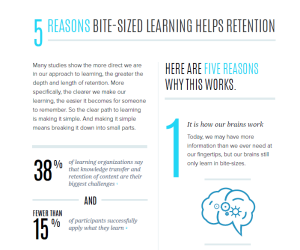
Many studies show the more direct we are in our approach to learning, the greater the depth and length of retention. More specifically, the clearer we make our learning, the easier it becomes for someone to remember. So, the clear path to learning is making it simple. And making it simple means breaking it down into small parts.
Click below to download this white paper.

Teleporting Learners: Creating Visually Interactive Story Learning
The convergence of visual design, neuroscience, artificial intelligence and storytelling provides eLearning designers and developers an opportunity to "teleport" the learners’ minds. This trend presents eLearning designers with a strategic advantage to provide solutions that can be solved with visually interactive story learning.
Captivate Tips and Tricks for Building Responsive Animations and Interactions
Adobe Captivate 2017 is power-packed with a brand-new, easy-to-use workflow for creating responsive eLearning courses. This new workflow will allow you to easily create responsive projects, using fluid boxes instead of breakpoints, which makes it possible for you to design content for a single screen, and it works right on any device — any size or orientation. This white paper takes a step-by-step approach through a workflow to create a responsive project using Fluid Boxes.
Click below to download this white paper.

Truths and Lies: Keeping Authenticity in eLearning Stories
Do stories in eLearning have to be true? How much can you embellish? What you should never lie about?
Authenticity is a characteristic that builds or destroys trust in the learners’ minds or hearts. Learners know when a story is fabricated or when they are true. This impacts believability and applicability of the learning ideas. It becomes a crucial problem in eLearning design, because learners only interface with what we show and tell electronically.

4 Most Common Types of Learning Cultures
In this whitepaper, you'll learn:
What learning culture "fit" means for training, development, and growth
What issues arise when a company operates under the wrong learning culture
How to measure the success and strength of your learning culture

How to Build Micro-Scenarios: Snappy, Fast, Engaging
How do we develop eLearning content that teaches content yet is also short, concise, snappy, fast and instant?
The demand for fast, rapid, instant and on-the-go learning plague eLearning designers, developers and leaders. Many of us are still stuck with the very old and antiquated "data dump" and "learners must learn" paradigms. We are shackled by our design philosophy. Yet, we are forced to comply with the new affordances of mobile tools, faster Internet connections to cater to busy and overloaded learners.
The New Training Content Paradigm
Even in today’s digital-first world, there are still some people who wax poetic about reading a ‘real’ print book. They emphasize that it feels good to hold a physical book in their hands. Manually turning pages is a satisfying practice.
When was the last time anyone said something similar about their training materials?
People often ask ‘how can you demonstrate that digital materials are effective?’ But do they have a method for demonstrating print is effective?
In this paper, you will learn trends in training content delivery, the benefits to digital beyond simple cost savings, and how digital helps content owners and trainers become more effective.

Methodology Madness: Completing Your Projects While Saving Your Sanity
Project Management and Methodologies are really twins separated at birth. A smart and busy project manager knows the benefit of leveraging a standard development process methodology as a 'cheat sheet' to determine the tasks needed for a project to be successful.

Business Transformation MOOC Playbook
At the end of a really effective corporate MOOC the stadium cheers, the leadership high-fives, and you get to do your touchdown dance in the endzone, yeah baby!
But what if you’re in the huddle trying to figure out how to run that MOOC, the one that will win the learning game for your learners and your organization?
This playbook will walk you through the basic components of choosing a program to run as a MOOC and how to execute it effectively for the utmost impact on your learners and on your organization’s priorities.

Fixing Leadership Development Programs & Developing Effective New LD Initiatives
As a Human Resources executive, trainer, and consultant Ralph Jacobson used many of the conventional approaches to leadership and change management training. He found most did little to help the organization achieve its strategic objectives. Despite billions of dollars spent on leadership training, employee engagement surveys suggest low morale and followership. Authors such as Pfau/Kay, Gary Hamel, Barbara Kellerman confirm the assessment.
Strategies, Solutions, and Skills for Becoming a Successful New Manager
Congratulations on your new position! Being a manager is an exciting, rewarding, and challenging experience. While you're excited about your new role, you're also probably nervous.
It's normal to be nervous. After all, you have a lot on your plate as a manager. On top of your own work, you might also be responsible for providing feedback, delegating tasks, managing former co-workers or friends, cultivating employee engagement, and motivating employees.
Relationship management is the primary focus of your new role. Developing your emotional intelligence and working on skills like empathy, organizational awareness, emotional self-control, leadership, and strategic thinking are crucial to becoming a successful manager.
Many of these responsibilities might be new for you. So how should you get ready for this position? Cultivating the right mindset is a great place to start. You can also think through possible challenging scenarios and put some solutions down on paper. The New Manager Playbook is full of actionable advice like this to help you start thinking like a manager.
In this eBook, you'll find:
How to cultivate the right mindset for your new position
Essential skills of a successful manager
The most common challenges new managers face and how to overcome them
Strategies to combat doubts or concerns about yourself
Prompts to help find solutions in challenging situations


Tips for the Positive Deviant
What's a positive deviant? Researcher Jerry Sternin discovered that, "In every group there are a minority of people who find better and more successful solutions to the challenges at hand. Even though they have access to exactly the same resources as the rest of the group, their uncommon practices or behaviors allow them to flourish".

23 Microlearning Models for Strategy Planning
Why involve your SMEs and leaders?
In doing our work of implementing Microlearning, we often have to design creative ways to help our clients easily understand the process. One of the best approaches is to involve SMEs, stakeholders and leaders. Encourage them to visualize and brainstorm decision-making points. When they are involved, they provide valuable guidance and experience the process as well. They feel and visualize the ideas.
The 23 models and post-it notes brainstorming makes the process both educational and well thought out. When team members meet to discuss plans, problems and solutions, they can refer to the 23 models as a possible source of solutions.
Click below to download this white paper.


Think Mobile Learning First
Whether you are developing a new course, selecting a new LMS or thinking about developing a mobile app you'll need to understand what's involved in designing and delivering content on mobile devices from smartphones to tablets to hybrids, this webinar will provide a overview of what you need to define, how to sketch out concepts, prototyping and testing your ideas and then how to deliver. You'll learn about apps vs web apps and understand which works best.

10 Big Impact Areas for Microlearning
Here are 10 Big Impact Areas for Microlearning.
Click below to download the white paper.

Building a Pipeline of Culturally Agile Professionals
While our world is becoming increasingly more interconnected through cyberspace and international airports, success in global business requires more than a passport and a plane ticket. Success in global business is a function of people - those with an ability to operate effectively in intercultural and multicultural situations—people with cultural agility.
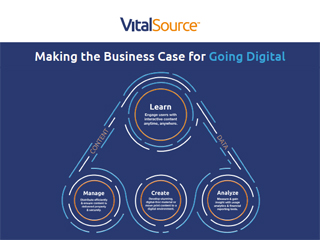
Making the Business Case for Going Digital
In today’s technologically charged business world, organizations must quickly adapt to emerging technologies or risk being left behind. Technology is necessary to remain competitive and at the forefront of change. As more training programs become virtual and learning moves beyond the event itself, a transformation to digital content delivery is essential to support today’s workforce.

Help me Obi-Social Kenobi. Social is my only hope. Using the Force of Enterprise Social Networks to Keep Training Alive
You slave away at designing your training programs. You struggle to get people excited, enrolled, and in the ‘seats’. The program commences and everyone gives you awesome feedback. You feel successful. Then the momentum dies. How do you keep training excitement alive? How can you boost pre-training anticipation and post-training involvement?

