Blogs
|
Governance, business, and learning models are moving from centralized control to network-centric foundations. For instance, coalition governments are increasing in frequency, businesses are organizing in value networks, and collaborative and connected learning is becoming widespread. In these cases, collaboration (working for a common objective) and cooperation (sharing freely without direct reciprocity) flow both ways.
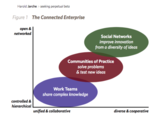
There are advocates for a dual operating system to deal with the complexity of the networked era: one that is hierarchical and another that is networked. This makes more sense than an elaborate 8-step model but the duality misses an important connection between structured work and cooperative networks. That space is the community of practice, which is neither project team nor professional network. Networks provide new ideas and perspectives from their diverse weak social ties. Work teams often have to share complex knowledge, and this requires strong social ties. Communities of practice are the bridge between these two, where we can test new ideas in a trusted space. This trinity is not three separate operating systems. It is one, that without the others is ineffective.
This is the Triple-A organization, as proposed by Valdis Krebs. It is structured to take advantage of the complexity and noisiness of social networks, allowing information to flow as freely as possible, and affording workers the space to make sense of it and share their experiences and knowledge. The underlying concept of a Triple-A model is that organizations and their people are members of many different types of networks, communities of practice, and close-knit collaborative work teams.
The Triple-A organization supports both collaborative and cooperative behaviours. That framework is one of overlapping networks, communities of practice, and work teams. It differs from the traditional organization chart in that it incorporates relationships outside the organization. Like the web, it is about talking to one another. What I see with my clients is the challenge of connecting social networks, with communities of practice, and with work teams, while also maintaining privacy and security. The Triple-A model shows the need to communicate (and learn) across these boundaries.
Inspired by Valdis Krebs
Awareness
To let knowledge flow, people first have to become responsible for their own sense-making. This reverses the existing practice of corporate training that is designed centrally and distributed through the hierarchy. Personal knowledge mastery (PKM) is a set of processes, individually constructed, to help each of us make sense of our world and work more effectively. People can learn more and connect to diverse knowledge networks outside the organizational walls. The first step is connecting to external knowledge networks, a key part of PKM. Increasing connections, developing meaning, and improving autonomy are necessary skills in the network era. PKM ties these into an easy to understand framework: Seek > Sense > Share.
Alternatives
With every worker actively practicing PKM, seeking new knowledge and making sense through experimentation, then communities of practice can form to promote knowledge-sharing. Professional communities of practice connect the work being done with the ever-changing external world. They are an essential safe place to fail. Organizations need to support and reinforce existing communities, not build these as if they were project teams. People only share complex knowledge with others whom they trust. This takes time.
Action
Hierarchies can be temporary agreements to get work done, but the general organization structure has to be much more flexible, enabling self-directed work teams. A structure of loose, mutually agreed-upon, hierarchies within strong networks can help build the Triple-A organization. With the individual as the primary operating unit, each person needs to master sense-making and then people have to organize in communities to make sense together. They cannot wait to be told what to do, which is why ‘awareness’ is essential. A guiding principle is that collaboration must happen at the organizational level, not the process level. This means everyone has to be connected to the overall mission, and not just focused on their part (job). Goal oriented conversations, especially in communities of practice, keep people and the organization connected.
One challenge for traditional organizations is that a core aspect of PKM is critical thinking, or questioning assumptions, which may be threatening to command & control management systems. But as Valdis Krebs states, "Awareness and alternatives are useless without the ability to take action on them." Finally, giving up control, and promoting self-governance, is the essence of the Triple-A organization that enables action.
Networks enable organizations to deal with complexity by empowering people to connect with whom they need to, without permission. Network thinking means that anyone can connect to another colleague, and the default permission to get access to information is public. Networks are in a state of perpetual Beta. Unlike hierarchies, they can continuously change shape, size, and composition, without the need for a formal reorganization. Our thinking needs to continuously change as well.
Hierarchies were essentially a solution to a communications problem. They are artifacts of a time when information was scarce and hard to share, and when connections with others were difficult to make. That time is over. Markets, competitors, customers, and suppliers are already highly connected. The Internet has done this. It is why a Triple-A enterprise needs to be organized more like the Internet, and less like a tightly controlled machine.
Continue to next post: the trinity model
Harold Jarche
.
Blog
.
<span class='date ' tip=''><i class='icon-time'></i> Dec 04, 2015 09:10pm</span>
|
|
Following up on my last post, the network era trinity, I have put together two images to synthesize the multiple concepts behind them. These images are my attempt to create a simple model that explains how networked organizations need to operate differently.
Individuals must be supported in interacting with diverse social networks, as part of their work, to enhance the possibility of serendipitous connections. This is the practice of PKM.
Communities of practice must be supported as safe places to test out new ideas. This is where HR and L&D departments can play a significant role.
Working on complex or creative projects is the realm of human activity in the network era. These teams are effective as temporary negotiated hierarchies that can be reformed as the situation changes.
Every worker is involved in all three of these spaces continuously, therefore working and learning are not separate activities.
Knowledge flows from implicit personal knowledge and is socialized while learning with communities or working in groups. The organization can curate knowledge from the flows of discussions among its workers and codify it in systems of record.
Harold Jarche
.
Blog
.
<span class='date ' tip=''><i class='icon-time'></i> Dec 04, 2015 09:10pm</span>
|
|
Every fortnight I curate some of the observations and insights that were shared on social media. I call these Friday’s Finds.
"It is difficult to get a man to understand something when his salary depends upon his not understanding it" — Upton Sinclair - via @jerrymichalski
"They tried to bury us. They didn’t know we were seeds." - Mexican proverb - via @LalitBhojwani
"What we want most as free & independent human beings is agency." - @dsearls - via @katrynadow
The Atlantic: Good jobs aren’t coming back
While wages of $12 an hour are much higher than Tennessee’s minimum wage of $7.25, they represent a significant drop in pay for jobs in manufacturing, which were once a pathway to America’s middle class. This is the disappointment of 21st-century onshoring: Though some of the jobs coming back to the U.S. require advanced degrees and skills, and are the good jobs pundits predicted would return, many are not.
Today, more than 600,000 manufacturing workers make $9.60 an hour or less, and one in four make $11.91 or less, according to the National Employment Law Project. Manufacturing workers once made more than average U.S. wages, but by 2013, they made 7.7 percent less than the median wage for all occupations. And when adjusted for inflation, wages for manufacturing workers have declined 4.4 percent between 2003 and 2013, according to NELP.
The Life and Death of an Amazon Warehouse Temp: What the future of low-wage work really looks like. - via @michelemmartin
When it comes to low-wage positions, companies like Amazon are now able to precisely calibrate the size of its workforce to meet consumer demand, week by week or even day by day. Amazon, for instance, says it has 90,000 full-time U.S. employees at its fulfillment and sorting centers—but it plans to bring on an estimated 100,000 seasonal workers to help handle this year’s peak. Many of these seasonal hires come through Integrity Staffing Solutions, a Delaware-based temp firm … This system isn’t unique to Amazon—it pervades the U.S. retail supply chain. Many companies choose to outsource shipping work to so-called third-party logistics providers, which in turn contract the work to staffing companies … For employers, the appeal of this system is obvious … For employees, though, it means showing up to work every day with the knowledge that you are always disposable. You are at least one entity removed from the company where you work, and you are only as good as your last recorded input in a computerized performance monitoring system. In the event that something goes wrong in your life—illness, injury, a family crisis—you have few, if any, protections.
Dee Hock, Founder and CEO Emeritus of VISA on capitalism and spirituality - via @janhoglund
The primary principle in monetized corporations is that whoever has money and can buy shares takes everything they can get and all other parties are given as little as possible. That prostitutes the meaning of capital by restricting it to money. It ignores natural capital-that is the value of what the earth produces for us at no cost. It ignores the value of community, and that is a form of capital. It ignores intellectual capital-that is the intrinsic ability and intelligence of people. It ignores every form of capital that is not reducible to the mathematics of money. Money is just alphanumeric data-a means of measurement. It has no intrinsic value …
… There is a place for control. If you want a perfect silicon chip, you need a total dust-free environment. If you want to do some intricate laser surgery on my eye, I don’t want a chaotic situation in the operating room. The fact is there is a role in nature for control. Something regulates your heartbeat. But the fact that this is useful for a limited set of purposes by no means implies it is the best way to run a complex, dynamic, fast-changing totality. But that’s what we’ve done.
14,000 Free Images from the French Revolution Now Available Online - @openculture
Last words and death of the aristocracy - French Revolution Digital Archive
Harold Jarche
.
Blog
.
<span class='date ' tip=''><i class='icon-time'></i> Dec 04, 2015 09:09pm</span>
|
|
I first got to know Jay Cross through his blog (it was before we even used the term) in the late 1990’s. I was one of the few people to comment on his posts and that was the beginning of our friendship. Several years later (2002) I got an email from Jay saying he would be in Moncton, New Brunswick, asking if that was near where I lived. Our first face to face face meeting was in a pub, 50 km from my house. Jay started the conversation saying that since we already knew each other so well, there was no need for small talk. "Let’s figure out how we can work together", he said.
Our first venture together was the ‘Informal Learning Unworkshop’ series, where we used a different web conference platform each time, sometimes changing in mid-course when the technology broke. I learned to fly by the seat of my pants with Jay. Later we spoke together at an ASTD conference, where we received feedback from some participants that it was the best presentation ever. We were told by others that it was worst presentation ever. I learned to take immediate feedback with a grain of salt.
I worked on several consulting projects with Jay over the past decade: Canadian Textile HR Council, Cigna, AstraZeneca, Canadian International Development Agency, and the Oberkotter Foundation. Jay initiated the creation of the Internet Time Alliance, and brought together Jane Hart, Charles Jennings, Clark Quinn, and myself. He introduced me to his worldwide network, which sometimes required that I sleep on the floor of his hotel room, due to my limited travel budget. It was always an adventure with Jay, such as the time we were asked to leave the Pergamon Museum in Berlin for ‘illegally’ filming.
Jay was a deep thinker and a man of many talents, never resting on his past accomplishments. His 2006 book on informal learning changed the course of an industry. This year, he was working on his next book on ‘Real Learning’. Jay Cross died last week, and I will miss him greatly. He taught me to seize the day, and I will.
Harold Jarche
.
Blog
.
<span class='date ' tip=''><i class='icon-time'></i> Dec 04, 2015 09:09pm</span>
|
|
"essentially, all models are wrong, but some are useful" - George Box
The shift to the network era will not be easy for many people and most organizations. Common assumptions about how work gets done have to be discarded. Established ways of earning education credentials will be abandoned for more flexible and meaningful methods. Connections between disciplines and professions are growing, and artificial boundaries will continue to crack. Systemic changes to business and education will happen. There will be disruption on a societal level as we enter what is looking more and more like a post-job economy.
Learning is a critical part of working in a creative economy. Being able to continuously learn, and share that new knowledge, will be as important as showing up on time was in the industrial economy. Continuous learning will also disrupt established hierarchies as no longer will a management position imply greater knowledge or skills. Command and control will be replaced by influence and respect, in order to retain creative talent. Management in networks means influencing possibilities rather than striving for predictability. We will have to accept that no one has definitive answers anymore, but we can use the intelligence of our networks to make sense together.
Here is an excerpt from Frederick Winslow Taylor’s Principles of Scientific Management (1911):
"It is only through enforced standardization of methods, enforced adoption of the best implements and working conditions, and enforced cooperation that this faster work can be assured. And the duty of enforcing the adoption of standards and enforcing this cooperation rests with management alone."
My Principles of Networked Management use a similar format to show how different the network era will be: It is only through innovative and contextual methods, the self-selection of the most appropriate tools and work conditions, and willing cooperation that more creative work can be fostered. The duty of being transparent in our work and sharing our knowledge rests with all workers, especially management.
A new economy and new management principles require new models for getting work done. When I speak with progressive managers they intuitively understand the usefulness of the 70:20:10 model that is based on observations that generally, people learn 70% of what they need to do their job from experience. About 20% is learned from exposure to new tasks or environments. Only 10% is learned from formal education. While these numbers are not firm, they provide a rule of thumb, especially for resource allocation to support learning at work. Basically, more resources are needed to support learning while working, and fewer for formal courses. Convincing management of the usefulness of this model is not difficult.
However, the 70:20:10 model challenges the traditional domain of the Learning & Development (L&D) discipline. Many people in this field only work in formal education & training, most particularly designing courses. The reference model implicitly says, you are only being 10% effective in supporting learning at work. Of course many would react strongly against such a model.
"It is difficult to get a man to understand something when his salary depends upon his not understanding it!" — Upton Sinclair
It may be even worse. Training may be only 5% of organizational learning. For a long time this small slice has been the primary focus of most L&D departments. The other 95% was just taken care of by the informal networks in the organization. On-job-training in some cases, or just observation and modelling in others. Then the Internet arrived. All those informal networks became hyper-connected. First with hyperlinks and later with ubiquitous mobile devices.
While the 10% (Education) is the domain of the L&D discipline, the other 90% (Exposure & Experience) could be supported by people from sales, marketing, communications or many other areas. It is not a foregone conclusion that these roles will be filled by trainers, and that is unsettling for ‘learning’ professionals who have most of their experience in designing formal training and education. In my experience, trainers are often let go during a transition to a more performance and social focused L&D function, replaced by people with other skills from varying backgrounds. The network era enterprise does not need ‘Training 2.0’ but rather a new organizational learning approach, where learning is integrated into the workflow. Many departments outside L&D are already staking this new ground and building their expertise. They understand the usefulness of the 70:20:10 model.
Image: @gapingvoid
Harold Jarche
.
Blog
.
<span class='date ' tip=''><i class='icon-time'></i> Dec 04, 2015 09:08pm</span>
|
|
"Apprenticeship is the way we learn most naturally. It characterized learning before there were schools, from learning one’s language to learning how to run an empire." - Cognitive Apprenticeship: Making Thinking Visible
In the apprenticeship model, novices learn under the tutelage of a master, but for the most part are assisted by journeymen, who are qualified in their trade but not yet masters. The amount of formal education in this model is usually around 10%.
"The journeyman license certifies that the craftsman has met the requirements of time in the field (usually a minimum of 8,000 hours) and time in an approved classroom setting (usually 700 hours)." - Wikipedia
A cursory look at several Canadian trades programs confirm this general ratio of 10% education to 90% field experience.
When looking at the 70:20:10 model (Experience, Exposure, Education) the 10% formal education component is easy to understand, as is the 70% experience component. Less obvious is what makes up the 20% exposure component. Given the dominance of knowledge work in the modern workplace, the cognitive apprenticeship model may provide some insight. It includes six methods:
Modeling
Coaching
Scaffolding
Articulation
Reflection
Exploration
While cognitive apprenticeship was originally designed for teachers working with students in a formal setting, it can be used in the workplace as well. In organizations where experts may be significantly more advanced in their skills than novices, there is a role for a knowledge journeyman. This person’s role would be to provide the six components of cognitive apprenticeship, and be a bridge between the experts and novices. Too often experts forget how they learned the basics and find it difficult to coach novices. Novices need the support of sense-makers as companions on their journey to mastery.
In many organizations formal instruction is provided for basic skills or compliance training. But the path to expertise is not made clear. Appointing journeymen to provide the 20% exposure is a way to recognize the importance of learning as a part of work. Supporting these journeymen in how to be good coaches can be the role of the Learning & Development department. This is not course production or delivery. It is helping organizational knowledge grow.
Organizations should have systems in place so that non-supervisors are required to coach less experienced coworkers. This will build resilience into the knowledge networks that drive organizational performance. When work is learning, and learning is the work, we cannot leave the bridge between education and experience unmanned.
Harold Jarche
.
Blog
.
<span class='date ' tip=''><i class='icon-time'></i> Dec 04, 2015 09:08pm</span>
|
|
Every fortnight I curate some of the observations and insights that were shared on social media. I call these Friday’s Finds. I am currently in Toronto, returning from speaking at the Institute for Performance and Learning where my topic was ‘Humanity: the killer app’.
"One reason I find it a revelation to read newspapers, listen to radio: Human-curated news is tremendously more varied than machine-filtered." - @mims
"the people driving for Über are doing R&D for automatic cars!" says @rushkoff at #platformcoop - via @jerrymichalski
"I’m not a human resource. Certainly not an asset. Don’t even mention a human capital. I’m a human being, period." - @Mintzberg141 via @rachelbotsman
Dee Hock, Founder and CEO Emeritus of VISA, on capitalism and spirituality - via @janhoglund
"So, if you really think deeply about such things, you come to realize that every organization is nothing but a mental construct, an idea around which people and resources are assembled theoretically in pursuit of common purpose and in accordance with a belief system of some sort. So I became convinced that it is really the ultimate design problem. If an organization is really nothing but a mental construct, then anything you can conceivably imagine in putting together the relevant materials, which include people and their relationships, is possible. And this construct will either bring out the best in people or the worst in them. In the long run, the command and control model rewards and brings out the worst in people instead of their best."
Transforming an Organization, even when that organization is a country, by @markfederman
‘Everyone in an organization connects to everyone else via a set of valence (uniting, combining, reacting) relationships. Change a person and you necessarily change the interactions among those relationships. Change the quality and nature of those interacting relationships and you change the organization. Thus every new arrival and every fresh departure is a transformational act. Contemporary hiring strategy is less of "what skills do we need?" and more of "who, what, and how do we want to become?"‘
"Planning automobile cities focuses on saving time. Planning accessible cities focuses on time well spent."— R. Cervero via @grescoe
A Human City
Harold Jarche
.
Blog
.
<span class='date ' tip=''><i class='icon-time'></i> Dec 04, 2015 09:08pm</span>
|
|
[Note: this is a repost from medium.com and a combination of two previous posts]
Governance, business, and learning models are moving from centralized control to network-centric foundations. For instance, coalition governments are increasing in frequency, businesses are organizing in value networks, and collaborative and connected learning is becoming widespread. In these cases, collaboration (working for a common objective) and cooperation (sharing freely without direct reciprocity) flow both ways.
There are advocates for a dual operating system to deal with the complexity of the networked era: one that is hierarchical and another that is networked. This may make more sense than an elaborate 8-step model but the duality misses an important connection between structured work and cooperative networks. That space is the community of practice, which is neither project team nor professional network. Networks provide new ideas and perspectives from their diverse weak social ties. Work teams often have to share complex knowledge, and this requires strong social ties. Communities of practice are the bridge between these two, where we can test new ideas in a trusted space. This trinity is not three separate operating systems. It is one, that without the others is ineffective.
The networked organization trinity is based on the Triple-A organization, as proposed by Valdis Krebs. It is structured to take advantage of the complexity and noisiness of social networks, allowing information to flow as freely as possible, and affording workers the space to make sense of it and share their experiences and knowledge. The underlying concept of the trinity model is that organizations and their people are members of many different types of networks, communities of practice, and close-knit collaborative work teams.
The trinity model supports both collaborative and cooperative behaviours. That framework is one of overlapping networks, communities of practice, and work teams. It differs from the traditional organization chart in that it incorporates relationships outside the organization. Like the web, it is about talking to one another. What I see with my clients is the challenge of connecting social networks, with communities of practice, and with work teams, while also maintaining privacy and security. The trinity model shows the need to communicate (and learn) across these boundaries.
Essentially, networked organizations need to operate differently.
Individuals must be supported in interacting with diverse social networks, as part of their work, to enhance the possibility of serendipitous connections. This is the practice of PKM.
Communities of practice must be supported as safe places to test out new ideas. This is where HR and L&D departments can play a significant role.
Working on complex or creative projects is the realm of human activity in the network era, as this work cannot be automated. These teams are effective as temporary negotiated hierarchies that can be reformed as the situation changes.
Every worker is involved in all three of these spaces continuously, therefore working and learning are not separate activities.
Knowledge flows from implicit personal knowledge and is socialized while learning with communities or working in groups. The organization can curate knowledge from the flows of discussions among its workers and codify it in systems of record.
Awareness
To let knowledge flow, people first have to become responsible for their own sense-making. This reverses the existing practice of corporate training that is designed centrally and distributed through the hierarchy. Personal knowledge mastery (PKM) is a set of processes, individually constructed, to help each of us make sense of our world and work more effectively. People can learn more and connect to diverse knowledge networks outside the organizational walls. The first step is connecting to external knowledge networks, a key part of PKM. Increasing connections, developing meaning, and improving autonomy are necessary skills in the network era. PKM ties these into an easy to understand framework: Seek > Sense > Share.
Alternatives
With every worker actively practicing PKM, seeking new knowledge and making sense through experimentation, then communities of practice can form to promote knowledge-sharing. Professional communities of practice connect the work being done with the ever-changing external world. They are an essential safe place to fail. Organizations need to support and reinforce existing communities, not build these as if they were project teams. People only share complex knowledge with others whom they trust. This takes time.
Action
Hierarchies can be temporary agreements to get work done, but the general organization structure has to be much more flexible, enabling self-directed work teams. A structure of loose, mutually agreed-upon, hierarchies within strong networks can help build the networked organization. With the individual as the primary operating unit, each person needs to master sense-making and then people have to organize in communities to make sense together. They cannot wait to be told what to do, which is why ‘awareness’ is essential. A guiding principle is that collaboration must happen at the organizational level, not the process level. This means everyone has to be connected to the overall mission, and not just focused on their part (job). Goal oriented conversations, especially in communities of practice, keep people and the organization connected.
One challenge for traditional organizations is that a core aspect of PKM is critical thinking, or questioning assumptions, which may be threatening to command & control management systems. But as Valdis Krebs states, "Awareness and alternatives are useless without the ability to take action on them." Finally, giving up control, and promoting self-governance, is the essence of the trinity model that enables action.
Networks enable organizations to deal with complexity by empowering people to connect with whom they need to, without permission. Network thinking means that anyone can connect to another colleague, and the default permission to get access to information is public. Networks are in a state of perpetual Beta. Unlike hierarchies, they can continuously change shape, size, and composition, without the need for a formal reorganization. Our thinking needs to continuously change as well.
Hierarchies were essentially a solution to a communications problem. They are artifacts of a time when information was scarce and hard to share, and when connections with others were difficult to make. That time is over. Markets, competitors, customers, and suppliers are already highly connected. The Internet has done this. It is why an enterprise based on the trinity model is more like the Internet, and less like a tightly controlled machine.
Harold Jarche
.
Blog
.
<span class='date ' tip=''><i class='icon-time'></i> Dec 04, 2015 09:07pm</span>
|
|
"If we emphasize Autonomy, the Node Artifact, Autonomy as the core organizing principle, this will result in individuals, small groups and tribes, forming complex responsive flows e.g. through conversations and flexible ad hoc structures." - John Kellden
In the triple operating system (Awareness>Alternatives>Action) work gets done by self-governing work teams with a degree of autonomy operating in temporary, negotiated hierarchies. Self-organizing teams are more flexible than hierarchical ones, but they require active and engaged members. One cannot cede power to the boss, because everyone is responsible for the boss they choose. Like democracy, self-organized teams require constant effort to work. Hierarchies work well when information flows mostly in one direction: down. They are good for command and control. Hierarchies can get things done efficiently. But hierarchies are useless to create, innovate, or change. Hierarchies in perpetual beta are optimal for creativity and to deal with complexity.
What is autonomy in the workplace? Employees are given different degrees of autonomy in terms of the decisions they are allowed to make within the confines of organizational power. Discretion for action is usually accorded by virtue of one’s place in the hierarchy. Usually the higher one goes, the more autonomy one has.
One way to look at autonomy is the type of action people are allowed to take without permission. The self-governance maturity model shows five levels of autonomy: where you work, how you get things done, what you work on, who you will work with, and why you do the work in the first place. Each one builds on the other, so that people need to be able to decide for themselves where to work before they can be autonomous in how they work. The constraints of space and place must be released in order to find the best ways to get work done, such as the selection of the appropriate tools. Once people can decide where and how they work, they can make informed decisions on what they will work on, as nurses at Buurtzorg do. Given this autonomy, workers can then decide who they work with, as employees at Semco do. Finally, when business strategy is informed by the emergent activities of all employees with their customers and environment, the the ‘why’ of work truly reflects the organization and is not imposed on the people doing the work. This is full autonomy, aligned with the principles of networked management:
It is only through innovative and contextual methods, the self-selection of the most appropriate tools and work conditions, and willing cooperation that more creative work can be fostered. The duty of being transparent in our work and sharing our knowledge rests with all workers, especially management.
Image: adapting to perpetual beta
Note: This post, like hierarchies in a self-governing organization, is in a state of perpetual beta.
Harold Jarche
.
Blog
.
<span class='date ' tip=''><i class='icon-time'></i> Dec 04, 2015 09:06pm</span>
|
|
Most best practices are self-evident, whereas the problems that consume our time and efforts are usually complex. Instead of looking for best or good practices, we should take the time and money to invest in an experiment. What works for one organization often will not work for another. There are too many variables, and the environment keeps changing. However, examples of emergent practices can inform us, as long as we see them as guide posts, not rule books.
Currently, I offer online workshops on personal knowledge mastery and social learning. These have been highly successful and involve cohorts of participants from a wide variety of backgrounds. As one of the objectives is to learn from each other, this diversity increases the potential for serendipitous learning. Taking these workshops and running them inside an organization would not yield the same results. That is why I offer co-creation as a service.
If you see value in my workshops, my books, or the subjects I discuss here - such as innovation, leadership, and the connected enterprise - then I can help you create your own programs. We can use my experience with a number of organizations, from the inside and outside, to coach and guide your organization in creating your own professional development programs or transition projects.
This is not a cookie-cutter type of service. There is no recipe book to follow. This is a journey where we work together for a set period of time, and then you go on your own. I provide resources, coaching, advice, and access to a worldwide network of professionals.
"What the Internet Time Alliance group brought to the table in our engagement, in the person of Harold Jarche, was not only his extensive experience and network, but also the expertise of the rest of the Alliance and their networks as well. While we in our organization have networks of our own, the quality and extensiveness of the ITA network added a value that we would not have been able to tap alone, and led us to a superior solution that will better serve our customers." (Corporate University Manager within Fortune 500 Health Insurance company)
If you realize that buying ‘off-the-shelf’ will not address the complex and unique requirements for learning and working in your complex organizational environment, then let’s talk about taking a journey together. Let me share some of my blood, sweat, and tears with you. Mastery takes time.
Mastery by Amy Burvall
Harold Jarche
.
Blog
.
<span class='date ' tip=''><i class='icon-time'></i> Dec 04, 2015 09:05pm</span>
|