Blogs
|
Every fortnight I curate some of the observations and insights that were shared on social media. I call these Friday’s Finds.
1984 Revisited - @avivakillian
"What is the aim of mass surveillance? One may suppose it is to stop terrible acts before they happen - as a means to watch over and protect the lives of innocent civilians. Another may suppose it is to establish a dictatorship that suppresses freedom of thought and seeks to solidify existing power structures. Its pretty obvious which of the two Orwell envisaged:
And its true, if you want to keep a secret these days you can’t even share it with yourself. Whether its a nude, details of an extra marital affair or even something as bland as your search history, it seems everything is on the table for whoever wants it in the age of hacktivism, mass surveillance and data broking."
Image via blog.meeco.me
We spent two weeks wearing employee trackers - @FastCoExist
‘What can this data be used for besides squeezing more work out of its users? There are few use cases outside of fixing the bottom line. If we had a specific business goal, perhaps the data could have been used to make changes to achieve that, but the information didn’t do much to improve individual workers’ understanding of their jobs.
Their thoughts might best be captured by a stray thought of Clendaniel’s as we paged through Humanyze’s analysis: "There are few use cases for personal improvement here, and many more for productivity and efficiency." He wasn’t being particularly positive.’
"Massive inequality is incompatible with robust democracy" - Robert Reich
"An economy depends fundamentally on public morality; some shared standards about what sorts of activities are impermissible because they so fundamentally violate trust that they threaten to undermine the social fabric.
It is ironic that at a time the Republican presidential candidates and state legislators are furiously focusing on private morality - what people do in their bedrooms, contraception, abortion, gay marriage - we are experiencing a far more significant crisis in public morality."
Why we cannot learn a damn thing from Semco, or Toyota - @NielsPflaeging
"What I mean is this: When talking about organizational leadership, even the best example just doesn’t help! At least not as long as one, almost magic ingredient for change, or transformation, is missing. And that magic ingredient is our image of human nature, the way we think about people around us, and what drives them. Not just the trust we place in other people is key, but whether we trust them to be self-motivated, driven by the need for self-fulfillment, and capable of self-organizing within boundaries and team settings."
As Systems Collapse, Citizens Rise - @Otto Scharmer
"To summarize, the refugee crisis is a microcosm of the future that we all face over the next 10-20 years. The social grammar of that crisis looks like this:
• As rules and regulations (that always reflect the past) are increasingly out of sync with the actual reality on the ground, we see
• Systems starting to fail, break down and collapse, which leads to…
• People, journalists/media rising to the occasion or not-and accordingly…
• The logic of collective action arising from either the past (muddling through or regression) or from the present moment (co-sensing by tuning into what the emerging future calls us to do).
If the latter happens, we begin to see that the crisis and breakdown of our larger systems are actually a phenomenal opportunity to renew and update our old bodies of rules and regulations to be more fluid and in sync with the actual situation on the ground.
If the former happens we will see an enormous magnification of human suffering and amplification of the system breakdowns on an unprecedented level of global scale."
Harold Jarche
.
Blog
.
<span class='date ' tip=''><i class='icon-time'></i> Dec 04, 2015 09:14pm</span>
|
|
Sharing complex knowledge requires trusted professional relationships. You cannot just throw people together and hope they will work effectively on difficult problems.
"strong interpersonal relationships that allowed discussion, questions, and feedback were an essential aspect of the transfer of complex knowledge" - Hinds & Pfeffer (2003)
Being engaged with a diverse network of people who share their knowledge makes for more effective workers. Understanding how to do this becomes a key business skill in the network era.
"We learned that individual expertise did not distinguish people as high performers. What distinguished high performers were larger and more diversified personal networks." - Rob Cross, et al (2004)
It is not the size of our networks that matters, but the diversity of opinions and expertise that we can draw upon, in order to prevent group think, or an ‘echo chamber’ effect. In times of crisis, when information is critical, then having a diversity of opinions can ensure that drastic measures are not taken for the wrong reasons, or that viable options are not ignored.
"We need input from people with a diversity of viewpoints to help generate innovative new ideas. If our circle of connections grow too small, or if everyone in it starts thinking the same way, we’ll stop generating new ideas." - Tim Kastelle (2010)
We all need to balance strong and weak ties to ensure that we are effective as professionals and engaged citizens. Doing so is an art that can be mastered over time, with practice.
"Experts have long argued about the optimal structure of a person’s professional network. Some say that a dense, cohesive network brings more social capital, while others argue that a sparse, radial network, one that provides opportunities for innovation and entrepreneurial activity, equates to greater social capital. [Paul] Erdős’ network shows both patterns — a densely connected core along with loosely coupled radial branches reaching out from the core. The people in the core/center of your network probably know the same things you do, while the people along your network’s periphery probably know different things and different people than you know." - Valdis Krebs (2015)
Image: finding perpetual beta
Harold Jarche
.
Blog
.
<span class='date ' tip=''><i class='icon-time'></i> Dec 04, 2015 09:14pm</span>
|
|
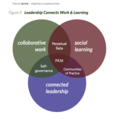
About 10 years ago I worked on a project with nursing staff as they changed their basic care model from one that was patient-centric to a model where "nurses engage the person/family to actively participate in learning about health". The McGill Model of Nursing is learning-centric. This fundamental shift in focus is a prime example of the major organizational change required from both our education systems and our management models, as we transition into a networked creative economy. In an era of ubiquitous connectivity, leadership at all levels and all sectors must be about promoting learning. There is no other way to address the many wicked problems facing us. If work is learning and learning is the work, then leadership at work should be all about promoting learning.
Consider the case of young children. Do they really need to master a core curriculum? Marie Bjerede describes how she learned to relax and let her daughter take control of her own learning.
What is interesting to me about all this is that I have completely ignored my daughter’s work other than to listen when she wants to share and to provide the digital tools that make it possible. As she tells me about this passion I learn about the skills she has developed on her own: [Hours in Front of a Screen] … In other words, my daughter has taken ownership of her informal learning in an area she is passionate about. The digital resources and communities of interest available to her through the Internet means she is able to independently pursue her interests without waiting for an adult to mediate her learning. And as a side effect of doing what she loves, she is gaining both cognitive and non-cognitive skills that will serve her in college, work, and life.
Marie is taking a learning-centric approach to parenting, providing support only when asked. In adapting to perpetual beta I described how leadership in networks must be learning-centric. Leaders have to set an example by initiating change and themselves learning by doing. They also have to create systems that let others do the same.
So what is connected leadership?
Help the Network Make Better Decisions — Managers should see themselves as servant leaders. Managers must actively listen, continuously question the changing work context, help to see patterns and make sense of them, and then suggest new practices and build consensus with networked workers.
Improve insights — Too often, management only focuses on reducing errors, but it is insight that drives innovation. Leaders must loosen the filters through which information and knowledge pass in the organization and in- crease the organizational willpower to act on these insights.
Provide Learning Experiences — Managers and supervisors may be vital for workers’ performance improvement, but only if they provide opportunities for experiential learning with constructive feedback, new projects, and new skills.
Focus on the Why of Work — Current compensation systems ignore the data on human motivation. Extrinsic rewards only work for simple physical tasks and increased monetary rewards can actually be detrimental to performance, especially with knowledge work. The keys to motivation at work are for each person to have a sense of Autonomy, Competence and Relatedness, according to self-determination theory. This is a network management responsibility.
Be Knowledge Managers — Leaders need to practice and encourage personal knowledge mastery throughout the network.
Be an Example — Social networks shine a spotlight on dysfunctional managers. Cooperative behaviours require an example and that example must come from those in leadership positions. While there may be a role for good managers in networks, there likely will not be much of a future for bosses.
Harold Jarche
.
Blog
.
<span class='date ' tip=''><i class='icon-time'></i> Dec 04, 2015 09:13pm</span>
|
|
Every fortnight I curate some of the observations and insights that were shared on social media. I call these Friday’s Finds [due to my travel and work schedule in South Africa this week, I am a day late].
"Money is the wealthy person’s curtain which hides all their defects from the world." - Anon - via @RogerFrancis1
@Orgnet - "You need both strong ties and weak ties for a successful professional network". More: Professional Social Graphs
Project Syndicate: Germany is not Volkswagen
The most important factor behind Germany’s success is that the structure of its firms improves the quality of their products. German exporters are organized in a way that is less hierarchical and more decentralized than other European firms. This gives them several advantages. Decentralization enables employees at lower levels of the corporate hierarchy to devise and implement new ideas. As these employees are often closer to customers than those higher up, their collective knowledge about what the market is demanding is an important source of value.
State of Freelancing in the USA - via @abarrera
Freelancers are a growing workforce. There are now almost 54 million Americans freelancing, an increase of 700,000 over last year. That’s more than a third of the American workforce. Millennials, as I’ve argued before, are native freelancers, and it shows: They are freelancing at a higher rate than any other group.
Independent workers are freelancing by choice. Survey respondents told us that they’re freelancing because of the flexibility, freedom, and balance that it offers. In our survey, 60% of respondents said they started freelancing more by choice than by necessity, compared to last year’s figure of 53%.
Critically, half of freelancers we talked to said that they wouldn’t take a traditional job, no matter how much it paid. And because being a freelancer lets you work from anywhere, a third of freelancers say they have been able to move because of the flexibility their career provides.
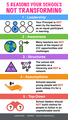
Five Reasons Your School is Not Performing - @iPadWells
Harold Jarche
.
Blog
.
<span class='date ' tip=''><i class='icon-time'></i> Dec 04, 2015 09:13pm</span>
|
|
The best leaders are constant learners is the subject of a recent post in the Harvard Business Review, written by Kenneth Mikkelsen and myself. This is resonating with many readers who realize that the network era is changing the nature of all organizational relationships.
As we attempt to transition into a networked creative economy, we need leaders who promote learning and who master fast, relevant, and autonomous learning themselves. There is no other way to address the wicked problems facing us. If work is learning and learning is the work, then leadership should be all about enabling learning. In a recent Deloitte study, Global Human Capital Trends 2015, 85% of the respondents cited learning as being either important or very important. Yet, according to the study, more companies than ever report they are unprepared to address this challenge.
Leadership today is not about being the most important node in the network, it is about making the network stronger. This was also the topic of my closing keynote at the International Conference on Open & Distance Education, in South Africa yesterday. As ICDE participant Modiehi Rammutloa noted, "connecting with people is not really a problem, sustaining the network is always a challenge". Sustaining the network, and making it more resilient, is the work of appointed and emergent leaders today.
Harold Jarche
.
Blog
.
<span class='date ' tip=''><i class='icon-time'></i> Dec 04, 2015 09:12pm</span>
|
|
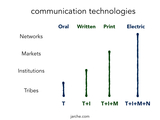
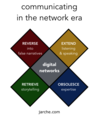
I presented the McLuhan media tetrad last week in South Africa. [see ‘a world of pervasive networks’ for background on these laws of media]. Societies change their basic organizing structures when the primary mode of communication changes [T+I+M+N]: from oral, to writing, to print, and now to electric (digital). As we shift our dominant communications medium from print to electric, our organizing methods must change as well. We no longer organize as tribes in ‘developed’ countries, but we still have strong cultural and familial bonds. Our institutions have not disappeared but they are inadequate for many of the modern challenges facing us. Faith in markets is declining, as they are found to be inadequate to share wealth in any equitable fashion. We are seeing an increase in cooperation among many agents in the networked society as they try to create new ways living together and exchanging value.
TIMN by David Ronfeldt
Ubiquitous networks have the potential to extend our humanity as we connect and understand each other. Networked models will obsolesce markets and institutions. For example, the blockchain technology will significantly change banking and financial markets. But networks will retrieve a sense of kinship, as I experienced last week, connecting with people I have only known online, and then spending time in physical communities where the sense of human connection is extremely strong. The way people in places like Soweto connect, recognizing each other each time they meet, may become the norm in a networked society. We see this already with the derision that marketing speak receives on social media. As the authors of the Cluetrain Manifesto observed in 1999: "Corporations do not speak in the same voice as these new networked conversations. To their intended online audiences, companies sound hollow, flat, literally inhuman." Corporations represent the declining market model of organizing. But it is not all good news when examining technology shifts with McLuhan’s tetrad. A networked society could reverse into a popularity contest, where our value is only measured in our mediated reputation, such as numbers of Twitter followers, or some other arbitrary figure.
The key to progressing to a new way of organizing human activities in the network era is to ensure that the old models are not allowed to drive the agenda. Neither our tribal leaders (religious, geographical, cultural), our institutions (political, religious, economic), nor our markets (corporations, exchanges, trade deals), have the answers. Only networked individuals, with positive intent, can determine how best to organize the next society. It is a big challenge, but my faith in humanity was restored this week in the many exchanges I had with people facing seemingly insurmountable odds in building a new democracy. An aggressively engaged and intelligent citizenry can be an unstoppable force for change.
Harold Jarche
.
Blog
.
<span class='date ' tip=''><i class='icon-time'></i> Dec 04, 2015 09:12pm</span>
|
|
Ubiquitous digital networks are extending our capacity to listen and speak with others. In a hyperlinked world, we can tap multiple global perspectives and easily push our own views through various free and inexpensive media options. This is making many traditional centres of expertise, like news sites, obsolete. At the same time, access to important contextual knowledge is limited to the few, such as attendees at the yearly World Economic Forum in Davos. With all of this access to information and knowledge, we are seeing a retrieval of storytelling. The TED talks are one example of finely crafted stories, though their impact and the agenda of sponsors may over time reverse into a single or even false narrative, controlled by a few powerful interests. This is how McLuhan’s laws of media can be useful in seeing what kinds of changes digital networks will bring about in how we communicate as a society in the network era. Every new technology enhances some aspect of humanity, obsolesces some previous technology, retrieves something from our past, and can reverse into the opposite of its initial intention.
I recently read David Hutchens’ latest book, Circle of the Nine Muses, and if you you want to master the art of storytelling then I would highly recommend it. I worked with David on a project a couple of years ago, and he is a master of his craft. This book reflects his mastery. Topics include: Four Core Stories, Hosting Story Circles, Listening & Sense-making, and Leadership Archetypes. I want to talk about this last topic.
Sixteen leadership archetypes are identified in the book: Caregiver, Companion, Creator, Everyman, Genie, Hero, Innocent, Jester, Lover, Mentor, Prophet, Rebel, Ruler, Seeker, Storyteller, Wizard. Each one is described in detailed, such as the response to the ‘dragon’ (a challenge one faces). David generously sent me a copy of the cards representing these archetypes and I used them to close my workshop on networked leadership, at the UNISA Graduate School of Business Leadership, two weeks ago. In the exercise I asked the participants to identify three archetypes they would take with them while changing their organization from a hierarchical to a more networked management structure. Two of the archetypes were selected above the others: Rebel & Jester. Each one provides an outside (on the edge) perspective for the journey. As we face the challenge of ‘digital transformation’ or whatever name your organization gives to its current change management initiative, consider not just what you need to do, but who who would like to have beside you. These archetypes can help foster that conversation and focus it so that you can create your own story.
Image by David Hutchens
Harold Jarche
.
Blog
.
<span class='date ' tip=''><i class='icon-time'></i> Dec 04, 2015 09:12pm</span>
|
|
Every fortnight I curate some of the observations and insights that were shared on social media. I call these Friday’s Finds.
"It is not for me to change you. The question is, how can I be of service to you without diminishing your degree of freedom?" - Buckminster Fuller, via @decasteve
"Results are gained by exploiting opportunities, not by solving problems." - Peter Drucker, via @africadean
@lemire: Secular Stagnation
‘We are moving to a more abstract world. It is a world where it becomes harder to think about "productivity", a concept that was invented to measure the output of factories. What is the "productivity" of a given Google engineer? The question is much less meaningful than if you had asked about the productivity of the average factory worker from 1950.’
Twitter cuts employees; but not to save money
‘It’s not that they are getting rid of low performers…it’s just that every extra employee impedes agility. It’s the complete opposite of "employees are our greatest asset."
I suspect one of the surprising benefits of the gig economy / on-demand workforce is that organizations will find it refreshing to have fewer full-time employees to manage. It means fewer layers, less people in meetings, fewer steps between each employee and customers, and less politics.’
@freelancersu: 4 Questions to Ask Yourself Before Going Freelance
1. Why are you freelancing?
2. What are your key strengths?
3. What are your customer’s needs?
4. Can your bank account handle the transition?
FastCompany: Welcome To The Share The Crumbs Economy
"That’s why the share-the-crumbs economy is more than a labor tragedy—it’s an existential challenge. In short, the gurus of the sharing economy have been at the vanguard of an audacious attempt to forge an economic system in which individuals and businesses with "more money than time" are able to use faceless interactions via brokerage websites and apps to force an online bidding war among lower-income people to see who will charge the least for their labor, or to rent out their personal property (such as their car or home). If everyone is consigned to doing piecework, and no one knows when the next job will come, or how much it will pay, what kind of private lives can we have, and what kind of relationships or families?"
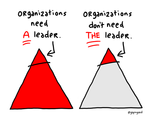
"Organizations need A leader" [not THE leader] - via @anthonyonesto
Image by @gapingvoid
Harold Jarche
.
Blog
.
<span class='date ' tip=''><i class='icon-time'></i> Dec 04, 2015 09:11pm</span>
|
|
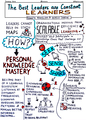
The are many ways we can add value to information and knowledge. I have described 14 ways of sense-making as part of personal knowledge mastery. One of these is the use of infographics, such as one on PKM published here. Recently, Tanmay Vora created a visual description of learning and leadership, based on an article by Kenneth Mikkelsen and me.
"One of the crucial leadership skills for today and future is ability to learn constantly from various high quality sources, synthesizing information and collaborating with a community to get a better grasp of the constantly changing reality." - Leadership, Learning & PKM
Here is Tanmay’s infographic.
Image: Tanmay Vora
Tanmay Vora’s visual synthesis adds value by showing connections that may not have been obvious in our HBR published article. When we create content and publish it in an open form, we invite opportunities to further contextualize it, seeing it from different perspectives. The network enables us to co-create new context and add meaning. I have never met Tanmay but we have become knowledge co-creators. This is the power of social learning in digital networks, enabling knowledge to flow in directions we cannot know in advance.
Harold Jarche
.
Blog
.
<span class='date ' tip=''><i class='icon-time'></i> Dec 04, 2015 09:11pm</span>
|
|
I’ve worked as an organizational learning & performance consultant since 1998. Every year I get new challenges but usually I have something in my toolbox that fits the requirement. Then one day in 2012 I was asked to solve a problem for a client that I did not have a clue how to even begin looking at. This involved complex knowledge about information technology, organizational behaviour, knowledge management, and social media. The client required a model to determine how their suite of IT platforms aligned with a newly developed learning & performance model that was being implemented across the enterprise. In short, they asked me "simplify the complexity".
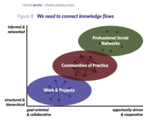
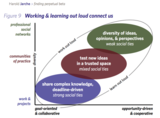
I was a bit nervous, not knowing where to begin. But I put my faith in my knowledge networks and communities of practice where I had been involved for the past 14 years. I went out to my networks, looking for as wide and diverse opinions as possible. I also checked my collections of social bookmarks and blog posts to see if I had come across anything useful in the past few years. As I found a few models and ideas, I tested them out with some trusted colleagues, including the client team who were keen on solving the problem. Over several weeks, many conversations, and a lot of searching and probing, I developed a working model that the client accepted. It was only through working out loud, learning out loud, and engaging the networks and communities that I had already developed, that I was able to accomplish the objective. In the end, I realized I was only as good as my network. This is the new world of work today. It requires us to not solely focus on our jobs doing regular work and projects. The network era rewards people who can bring their communities of practice and professional networks to bear on complex problems. Nobody’s individual toolbox is big enough.
Image: finding perpetual beta
If you want to hear more about what I learned from this project, watch the 30 minute video.
This new world of work means that we all have to constantly dance between our work teams, communities, and networks. But when we are faced with a complex problem it’s too late to start engaging in a community of practice or building a knowledge network. These have to be in place beforehand. This approach is a challenge for many people who are too busy in their own workplace to look outside. But it is essential, and this is becoming clear to many business leaders. They just don’t know how and where to start.
Developing individual skills, like PKM, is a good start. Then changing daily habits, like working out loud, shows that the organization values knowledge sharing. Finally, many of our organizational practices have to be removed or changed, in order to shift away from the still dominant scientific management framework to a networked management approach.
Harold Jarche
.
Blog
.
<span class='date ' tip=''><i class='icon-time'></i> Dec 04, 2015 09:11pm</span>
|