Blogs
|
Here is a good story that shows the value of learning as working, as opposed to relying on previous expertise.
"On the surface, John looked like the perfect up-and-coming executive to lead BFC’s Asia expansion plans. He went to an Ivy League B-school. His track record was flawless. Every goal or objective the organization had ever put in front of him, he’d crushed without breaking a sweat.
But something broke when John went to Asia. John struggled with the ambiguity, and he didn’t take prudent risks. He quickly dismissed several key opportunities to reach out for feedback and guidance from leadership. It became clear that John had succeeded in the past by doing what he knew and operating rather conservatively within his domain. It also became clear that the company was going to massively miss the promises it had made to the Board and the Street if John remained in the role.
With a heavy heart, BFC’s CEO removed his promising protégé from the role and redeployed him back in the US. He decided he had no choice but to put a different kind of leader in the role - Alex.
While talented, Alex had come to be known behind closed doors by the moniker "DTM" - difficult to manage. He marched to the beat of his own drummer, and he wasn’t afraid to challenge the status quo. He loved a challenge, and he was comfortable taking risks. It turned out to be the best move the CEO ever made.
No stranger to ambiguity, Alex was flexible in formulating his strategy and sought feedback from the people around him. He made a risky move at the beginning that backfired on him. But as a result, he learned what not to do and recalibrated his approach. That was the key to success. His tendency to buck the established BFC way of doing things was exactly what was required for the company to successfully flex its approach and win in the new territory". - Harvard Business Review: Improve Your Ability to Learn
Alex understood that complex situations, which this definitely was, require experimentation. He probed the system, failed, observed and discussed, and then refined his initial probe, which succeeded in the long term. More and more of our work will be non-routine and will deal with complex issues. Routine cognitive work will continue to be eaten by software and machines. A client once said that she wished to have just one day of only routine problems. I doubt she will. I doubt many of us will.
If experimentation, and bucking the established way of doing things, is becoming a necessity then a few things have to change to keep an organization effective. Many policies and procedures will have to be replaced with principles and heuristics. Individuals will have to become comfortable with experimentation and be allowed to take risks. Learning by doing will have to be the new routine, requiring active and ongoing sense-making in our networks and communities of practice.
In the network era more of our work will be to Probe-Sense-Respond as we Seek>Sense>Share.
Harold Jarche
.
Blog
.
<span class='date ' tip=''><i class='icon-time'></i> Dec 04, 2015 09:19pm</span>
|
|
Platform capitalism is the ability of a common internet exchange medium to enable easy commercial transactions. Buyers of services get convenience, while sellers get a larger market. The spoils go to the owner of the platform, receiving a significant percentage of revenues. Most of these platforms are created when regulations and oligopolies make these transactions difficult by traditional means. Platform capitalism initially disrupts a sector that is poorly served. It requires four contributing factors.
A platform: a central application that controls the data on all interactions and activities.
A critical mass of users: tech-savvy users looking for an easier way to get something, usually requiring minimum human interaction.
Desperate service providers: people with no ability to organize due to weak or non-existing trade unions in their field, who need to make up for a non-living wage, part-time, or contractual work.
Lack of regulations and oversight: government agencies that either cannot keep up with technology advances, or political leadership that condones poor working conditions in the name of progress.
For example, we see many people willing to drive for a company like Uber in order to increase cash-flow. But drivers for Uber have no career track and as the platform gets richer, drivers become replaceable commodities. Over time they may even be replaced by self-driving cars. This is an indicator of what a post-job economy may look like for many.
One of the outcomes of this phenomenon [platform capitalism] is that over time the democratization of communication, the initial impetus for this blog, gets sideswiped, to varying degrees, by new re-massifying forces. The niche offerings that made the online environment so refreshingly unlike the mass market world of hierarchical decision-making, capital-intensive production and distribution, and limited shelf space, are still there of course, but what we’re seeing is a privileging of those who sign up for more industrial muscle with the new middleman companies such who aggregate the work of podcasters, YouTubers, Instagrammers, Vine creators, etc. and optimize it for an advertising-supported world of content. - IP: Getting Value from your Creativity
Control of data is the new source of power in the network era. "Each of us has the gold and many companies feel they can simply take it. It’s time to empower ourselves and take our data back", says Chris Middleton. Whether we socially own our data, or if it is capital for trade by third-parties, will be a key economic question our society needs to address.
The truth is we are living in neither a digital capitalist nor a digital socialist future just yet. We are poised between the two, but nearing the point where these two different viewpoints collide in a global conflict. Let’s call it the First World Data War. Forget religion, this is the real Great War of our age. There will be bloodshed, both figuratively and literally. - Diginomica
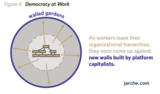
The democratization of our data, which is more and more the dominant form of the fruit of our labour, is a major issue for how wealth will be distributed in the network era. For now the platform capitalists seem to be winning. But society is waking up, with initiatives like the Ingenesist Project and Project VRM. We can use open source models to shut off the lights of big data. Many of us are leaving, or have left, the confines of hierarchical organizations of the industrial and information eras and are becoming mobile and global knowledge workers in a creative economy. But at the same time we need to prepare to assault the new walls already created by the platform capitalists.
Image: adapting to perpetual beta
Harold Jarche
.
Blog
.
<span class='date ' tip=''><i class='icon-time'></i> Dec 04, 2015 09:18pm</span>
|
|
Jane Hart compiles a list every year of the Top 100 Tools for learning. Voting closes on 18 September.
Here are my top tools this year, with last year’s position shown in brackets.
Please add yours!
10 (new): Netflix: I find I am watching a lot of documentaries on this popular video streaming service and I am learning a lot. The latest was a series on the American civil war.
9 (new): Slack: this message application is a great way to stay connected and work in small groups and I am a member of two active Slack communities. More information on why Slack is more than chat.
8 (new): Skype: I find I am using Skype more to stay in touch with people through conversations and text messaging.
7 (7): Apple Preview: is the productivity tool I use the most, so I can focus on learning, not fighting with applications. It lets me annotate pictures, resize images, add signatures, and most importantly ensures I do not have to have Adobe Acrobat to open PDF’s. It is a huge time-saver.
6 (new): Pixabay: is a great source for copyright free photos to use in presentations.
5 (5): Keynote: Apple’s presentation application has enabled me to improve my slide presentations, through its simplicity and lack of clip art.
4 (4): Feedly: is my feed reader to keep track of blogs and news sites via RSS.
3 (3): Diigo: Social bookmarks are a quick way for me to save a web page and find it easily.
2 (2): Twitter: Next to my blog, Twitter is my best learning tool and allows me to stay connected to a diverse network.
1 (1): WordPress: powers my blog, which is the core of my PKM. It’s easy to use, has a huge community, and there are many plug-ins and additions available. I also use it to deliver my online workshops.
Harold Jarche
.
Blog
.
<span class='date ' tip=''><i class='icon-time'></i> Dec 04, 2015 09:18pm</span>
|
|
Every fortnight I curate some of the observations and insights that were shared on social media. I call these Friday’s Finds.
@hrheingold: "Don’t refuse to believe; refuse to start out believing." #crapdetection
@nielspflaeging: "Any tool involving points and badges is superfluous, even systematically destructive in an organizational context."
@kjeannette: What is a Community of Practice? 6 lessons:
1) Narrow down the domain and purpose (i.e. make it attainable)
2) Hire a community facilitator, or even better, a social artist?
3)Reduce bottlenecks and start with ‘low hanging fruit’ type of platforms.
4) Modeling how to be social is critical.
5) Learning might lead to collaborative works.
6)CoPs grow like gardens and that’s why developmental evaluation is becoming really interesting to me.
Why I Am No Longer a Measurement Specialist - via @surreallyno
Teachers and many parents understand that children’s development is far too complex to capture with an hour or two taking a standardized test. So resistance has been met with legislated mandates. The test company lobbyists convince politicians that grading teachers and schools is as easy as grading cuts of meat. A huge publishing company from the UK has spent $8 million in the past decade lobbying Congress. Politicians believe that testing must be the cornerstone of any education policy.
The most important app you will ever download - via @tantramar [I agree, I use 1Password]
In June of this year, [Chalene’s Johnson’s] Twitter account was hacked, as was her main Instagram account. She shared this sad tale on her podcasts … Upon completing the tedious and time-consuming task of recovering from the hack, Chalene researched password managers to ensure she’d never have to endure such an experience again. At the end of her quest to find the best password manager, Chalene discovered 1Password!
Job Polarisation In Europe: Are Mid-Skilled Jobs Disappearing? - via @mbauwens
The implication for policy is that there is no inescapable trend in occupational developments. The pervasive forces of technical change or international trade do not necessarily polarise or upgrade occupational structures: different policies and contexts can significantly alter their effect. And as in many other areas, the Scandinavian countries provide the most attractive example.
Cooperation is what makes us human - via @RogerFrancis1
Ultimately, Tomasello’s research on human nature arrives at a paradox: our minds are the product of competitive intelligence and cooperative wisdom, our behavior a blend of brotherly love and hostility toward out-groups. Confronted by this paradox, the ugly side—the fact that humans compete, fight, and kill each other in wars—dismays most people, Tomasello says. And he agrees that our tendency to distrust outsiders—lending itself to prejudice, violence, and hate—should not be discounted or underestimated. But he says he is optimistic. In the end, what stands out more is our exceptional capacity for generosity and mutual trust, those moments in which we act like no species that has ever come before us.
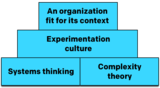
@samihonkonen: An organization Fit for its Context
The proper way to conduct ourselves in the complex domain is through experiments. Constant, short, safe-to-fail experiments that give us empirical data on what works. Successful experiments are scaled up, unsuccessful ones we learn from and then forget.
Yet blind experiments, random shots in the dark, are not effective. We need something to guide our experiments. When we understand our business and our organizations as a system, we can make educated guesses on what would lead towards better performance for the whole company. Systems thinking helps us find leverage.
Source: http://www.samihonkonen.com/an-organization-fit-for-its-context/
Harold Jarche
.
Blog
.
<span class='date ' tip=''><i class='icon-time'></i> Dec 04, 2015 09:17pm</span>
|
|
Donald Taylor notes that, "everyone has a memory that is particularly attuned to learning some things very easily". In his post, Donald says that the context in which we learn something, as well as how it is presented and received, are all important aspects of whether we will remember something.
"This was not a matter of super memory but of meaning. When shown a board not from a game, but with randomly arranged pieces, the masters fared no better than the beginners. They were unable to use their immediate appreciation of how the pieces related to each other to make sense of the position. It was like trying to memorize a poem with jumbled up words." - Memory is more than Ebbinghaus
I came across the concept of memory chunking while working as a training development officer in the air force in the mid-1990’s. There was relatively new research that showed how experienced air traffic controllers (ATC) chunked, or categorized, the aircraft on their screens, so they could allocate their working memory to the more important or urgent matters. Even more interesting is the evidence that shows that pilots and ATC’s chunk differently.
"The way in which the information contained in a message is chunked depends on the person receiving the message: a pilot and ATCO are likely to chunk a message in rather different ways. This is due to the familiarity of each person and their professional experiences. It is also associated with the position of the person, either as the sender or the receiver … This illustrates that what may be familiar chunking by the controller is not necessarily familiar chunking by the pilot. The frequency for the next sector is used all the time by the controller and is one chunk for him, but this is not the same for the pilot. Vice versa, the call sign is much more familiar to the pilot than to the controller. A recommendation often made, associated with air-ground communications, is to limit the number of elements in a message to two to reduce the chance of an element being missed or misheard." - Memory in ATC
People in the same environment will notice and remember different things in different ways. For those designing training programs, or supporting social learning in the workplace, this is an important phenomenon to consider. Memory is not linear. Remembering is not homogeneous.
Even more important is the understanding that we can develop better skills at chunking and other sense-making skills.
"Consciousness concerns itself only with the most meaningful mental constructions and is ever hungry to build new patterns over existing architectures. To help in this aim, it itches to combine and compare any objects in our awareness. How the brain supports consciousness closely mirrors these functions. Those specialist regions of the cortex that manage the processing endpoints of our senses—for instance, areas involved in recognizing faces, rather than merely the colors and textures that constitute a face—furnish our awareness with its specific content. But there is also a network of our most advanced general-purpose regions that directly draws in all manner of content from these specialist regions. This is the core network, incredibly densely connected together, both internally and across major regions throughout the brain. In this inner core, multiple sources of meaningful, potentially highly structured information are combined by ultra-fast brain rhythms. And this, neurally speaking, is how and where consciousness arises." - Daniel Bor: The Ravenous Brain
These three examples show only a small part of the wonders of human memory and learning. If you consider yourself a learning professional, there will always be something new to learn.
Harold Jarche
.
Blog
.
<span class='date ' tip=''><i class='icon-time'></i> Dec 04, 2015 09:17pm</span>
|
|
‘As Steve Jobs said, "You can’t connect the dots looking forward; you can only connect them looking backwards. So you have to trust that the dots will somehow connect in your future."’ - Michael Simmons
Michael Simmons shows that Jobs had the ability to be a member of many networks, meaning that he was often the outsider, but this gave him a larger perspective than someone in a closed network, where everyone knows each other. Successful people, according to network theory, are those with more open networks. This goes against our tribal instincts and the norms of most of our institutions. Even the marketplace can be fairly homogeneous, with companies sticking to industry standard practices. But innovation often happens on the edges of disciplines. Jobs instinctively knew this with his innate curiosity.
If we cannot connect the dots looking forward, what can we do? In complex systems, self-organization can give the flexibility needed to adapt to things we cannot ever fully understand.
"Self organization works by a combination of attractors and boundaries. Attractors are things that draw components of a system towards themselves (gravity wells, a pile of money left on the ground, an invitation). Boundaries (or constraints) are barriers that constrain the elements in a system (an atmosphere, the edges of an island, the number of syllables in a haiku)." - Chris Corrigan
A discipline like PKM is one way of preparing the mind for life in the network era. Gary Klein, in Seeing What Others Don’t, looked at over 100 cases of how new insights occurred in organizations and categorized them as five main types. Three of these can be enhanced through the practice of personal knowledge mastery:
Making better and more diverse professional and social connections.
Increasing the chances for coincidences though social networks.
Practising curiosity through new experiences.
Chance favours the prepared and connected mind. Only then will the dots have an opportunity to connect.
Image: adapting to perpetual beta
Harold Jarche
.
Blog
.
<span class='date ' tip=''><i class='icon-time'></i> Dec 04, 2015 09:16pm</span>
|
|
The following extract is the concluding section of finding perpetual beta. The last personal knowledge mastery in 40 days online workshop for 2015 started this week
"Work is learning, learning work" — that is all Ye know on earth, and all ye need to know.
Our increasing interconnectedness is illuminating the complexity of our work environments. More connections create more possibilities, as well as more potential problems. On the negative side, we are seeing that simple work keeps getting automated, like automatic bank machines. Complicated work, for which standardized processes or software can be developed, usually gets outsourced to the lowest cost of labour. On the positive side, complex work can provide unique business opportunities. Because complex work is difficult to copy and creative work constantly changes, these are where long-term value for human work lies.
Both complex and creative work require greater implicit knowledge. Implicit knowledge, unlike explicit knowledge, is difficult to codify and standardize. It is also difficult to transfer. Implicit knowledge is best developed through conversations and social relationships. It requires trust before people willingly share their know-how. Social networks can enable better and faster knowledge feedback for people who trust each other and share their knowledge. But hierarchies and work control structures constrain conversations. Few people want to share their ignorance with the boss who controls their pay cheque.
If we agree that complex and creative work are where long-term business value lies, then learning amongst ourselves is the real work in any organization today. In this emerging network era, social learning is how work gets done. Becoming a successful social organization will require more than just the implementation of enterprise social technologies. Developing, supporting, and encouraging people to use a range of new social workplace skills will be just as important. Individual skills, in addition to new organizational support structures, are both required.
PKM skills can help to make sense of, and learn from, the constant stream of information that workers encounter from social channels both inside and outside the organization. Keeping track of digital information flows and separating the signal from the noise is difficult. There is little time to make sense of it all. We may feel like we are just not able to stay current and make informed decisions. PKM gives a framework to develop a network of people and sources of information that one can draw from on a daily basis. PKM is a process of filtering, creating, and discerning, and it also helps manage individual professional development through continuous learning.
The mainstream application of knowledge and learning management over the past few decades has had it all wrong. We over-managed information because it was easy and we remain enamoured with information technology. The ubiquity of information outside the organization is showing the weakness of centralized enterprise systems. As enterprises begin to understand the Web, the principle of ‘small pieces loosely joined’ is permeating thick industrial walls. More and more workers have their own sources of information and knowledge, often on a mobile device. But they often lack the means or internal support to connect their knowledge with others to get actually get work done.
PKM frameworks can help knowledge workers capture and make sense of their knowledge. Organizations should support the individual sharing of information and expertise between knowledge workers, on their terms, using PKM methods and tools. Simple protocols can facilitate this sharing. Knowledge bases and traditional knowledge management (KM) systems should focus on essential information, and what is necessary for inexperienced workers. Experienced workers should not be constrained by work structures like teams but rather be given the flexibility to contribute how and where they think they can best help the organization.
We know that formal instruction accounts for less than 10% of workplace learning. The same rule of thumb applies to knowledge management. Capture and codify the 10% that is essential, especially for new employees. Now use the same principle to get work done. Structure the essential 10% and leave the rest unstructured, but networked, so that workers can group as needed to get work done. Teams are too slow and hierarchical to be useful for the network era. Social businesses should leave teams for the sports field, and managing knowledge for each worker.
People who are adept at learning how to learn will be better prepared for jobs of the future because they know how to engage with a community and tap into net- works for support. This is what PKM is all about. It starts by seeking people and knowledge sources and the Seek > Sense > Share cycle finishes by sharing with communities and social networks. There is a need for PKM skills in all types of organizations and for people at all levels, from freelancers, researchers, managers, executives, and many more. The benefits are not just for individuals, preparing for their next job, but the organization gains from employees who take control
of their learning and freely share their knowledge. PKM makes for more resilient individuals and the companies they work in.
Much of PKM is about finding balance. In seeking knowledge sources, we have to balance aggregation, or getting as much information as possible, with filtering, or ensuring that we have more signal than noise. Our networks need to be diverse and varied in order to be exposed to new ideas, but we cannot keep track of everything, so we have to be judicious with our time. We need to constantly lump things together, while filtering out the good stuff so we can find it again. It is like breathing information in and out, while making sense of only a small portion at a time, sometimes built by many grains before trying to express our knowledge in order to make sense of it.
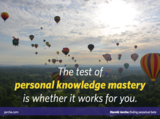
These processes are not taught in schools or training programs. There is no right answer in PKM. There are only processes that work. The test of PKM is whether it works for you. A person’s PKM practices will change over time, and the most important aspect is being aware of how we seek sources of information, make sense of our own knowledge, and then share it at work, in communities or through networks.
It is all about continuous learning. PKM practices can help make sense of the current environment, whether it be your profession, your job, or your areas of interest. A resilient learning network, that can develop from practicing PKM, creates a more resilient framework from which to make decisions about the future. The more you give to your networks, the more you will receive from them. PKM provides a way to do this in a more structured, but personal, manner. The result is enhanced serendipity, always an advantage in a changing world.
Harold Jarche
.
Blog
.
<span class='date ' tip=''><i class='icon-time'></i> Dec 04, 2015 09:16pm</span>
|
|
At Red Hat, the enterprise IT company, "managers focus on opportunities, not score-keeping".
‘We also rely on associates’ peers and communities to informally assess how people perform. We pay attention to their reputations and how they are regarded by others. We look at the scope and quality of their influence. The result is that rather than "managing up" to their boss to get a good review, Red Hatters are accountable to the community as a whole.’ - Jim Whitehurst, CEO Red Hat
This is a good example of networked management, as opposed to scientific management (1911), which informed the past century of practice.
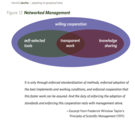
Principles of Networked Management: It is only through innovative and contextual methods, the self-selection of the most appropriate tools and work conditions, and willing cooperation that more creative work can be fostered. The duty of being transparent in our work and sharing our knowledge rests with all workers, especially management.
Image: adapting to perpetual beta
1. "innovative & contextual methods" = in the network era work and jobs cannot be standardized, which means first getting rid of job descriptions and individual performance appraisals and shifting to simpler ways in order to organize for complexity.
2. "self-selection of tools" = moving away from standardized enterprise tools toward an open platform in which workers, many of which are part-time or contracted, can use their own tools in order to be knowledge artisans.
3. "willing cooperation" = lessening the emphasis on teamwork and collaboration and encouraging wider cooperation.
4. "duty of being transparent" = shifting from ‘need to know’ to ‘need to share’ especially for those with leadership responsibilities, who must understand that in the network era, management is a role, not a career. Transparency is probably the biggest challenge for organizations today, and it can start with salary transparency.
5. "sharing our knowledge" = changing the environment so that sharing one’s knowledge does not put that person in a weaker organizational position. An effective knowledge worker is an engaged individual with the freedom to act. Rewarding the organization (network) is better than rewarding the individual, but only if people feel empowered and can be actively engaged in decision-making. Intrinsic, not extrinsic, motivation is necessary for complex and creative work.
Harold Jarche
.
Blog
.
<span class='date ' tip=''><i class='icon-time'></i> Dec 04, 2015 09:15pm</span>
|
|
Every fortnight I curate some of the observations and insights that were shared on social media. I call these Friday’s Finds.
@skap5 - "The economic game has been completely transformed and the farm system where the next generation learns how to play hasn’t."
The Buurtzorg Model of socialcare, via @GC_carrGomm
Cutting bureaucracy is only one part of the socio-political equation, because the Buurtzorg model is one of workplace autonomy and democratic leadership where decision making and setting targets is decentralised to clinical teams.
ANZ bank brings in robot workers to do the ‘boring’ jobs, via @RossDawson
"I think if people’s jobs are to do things that robots can do, then that is not a good place to be. It is a challenge for us to ensure we actually move people into roles and enhance the roles so that they adapt," he said.
"There are likely to be significant changes in many professional roles as we go along. But then again, when I was doing my degree there used to be a role called bookkeeper. Those don’t exist any more, but there has never been more people employed in accounting as today, the roles are just different."
Dee Hock: The Art of Chaordic Leadership (PDF), via @DebraWatkinson
Leader presumes follower. Follower presumes choice. One who is coerced to the purposes, objectives, or preferences of another is not a follower in any true sense of the word, but an object of manipulation. Nor is the relationship materially altered if both parties voluntarily accept the dominance of one by the other. A true leader cannot be bound to lead. A true follower cannot be bound to follow. The moment they are bound they are no longer leader or follower. If the behavior of either is compelled, whether by force, economic necessity, or contractual arrangement, the relationship is altered to one of superior/subordinate, manager/employee, master/servant, or owner/slave. All such relationships are materially different from leader/follower.
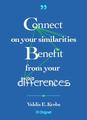
@orgnet - "Connect on you similarities. Benefit from your differences."
Harold Jarche
.
Blog
.
<span class='date ' tip=''><i class='icon-time'></i> Dec 04, 2015 09:15pm</span>
|
|
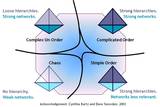
Verna Allee says that in states of ‘complex unorder’, loose hierarchies and strong networks are necessary. This point was driven home this morning as I listened on CBC radio about the closure of a rural school in Nova Scotia and how the option of turning it into a ‘hub school’ was beyond the comprehension of the school board and department of education. These are strongly hierarchical organizations, while the community has been strengthening its networks between multiple actors in the region and beyond. The community understands it is dealing with a state of complex unorder, while the bureaucrats still think it is merely ‘complicated order’, as the departmental guidelines on hub schools attest.
"The neo-liberal argument is that the demand for school space is down and surplus inventory should logically be discarded. School sites are just property, a disposable public asset, and a potential public liability if they do not yield a return on their investment. By this logic fewer school children mean fewer schools. Schools have no place in neighbourhoods too small to supply a large enough clientele to make them ‘viable’. Market forces and market thinking trump democratic ideals for local communities." - The School as Community Hub
Image by Verna Allee
Alexis de Tocqueville, in his book ‘Democracy in America’ based on his travels in 1831, identified ‘associations’ of citizens to be a driving force in the new democracy. John McKnight, in The Careless Society, described these groups as having three key capabilities: "the power to decide there was a problem, the power to decide how to solve the problem - that is, the expert’s power - and then the power to solve the problem". As de Tocqueville saw how a society could function without an aristocracy, we now must see how government can function without a bureaucratic elite, and communities can operate without bureaucratic overlords. At this time, communities best understand their problems, and have the networked ability to solve them, but they lack the expert’s power of access to legislation and taxation.
Almost two hundred years ago the association of engaged and connected citizens enabled a functioning democracy in early America. Today, the dominance of markets, and market-centric thinking is coming to an end. In the early network era we need to develop systems of loose hierarchies and strong networks to deal with the increasing complex unorder our communities face. Democratic ideals must trump market thinking, or we will be doomed to live in the past, using the tools of the past.
Source: adapting to perpetual beta
The European Union is an example of how decentralization can work within a unified political entity. It is still a work in progress, as is democracy.
"Under the principle of subsidiarity, in areas which do not fall within its exclusive competence, the Union shall act only if and in so far as the objectives of the proposed action cannot be sufficiently achieved by the Member States, either at central level or at regional and local level, but can rather, by reason of the scale or effects of the proposed action, be better achieved at Union level." - EU Declarations
Subsidiarity is a founding organizational principle for democracy in the network era. It enables community-level cooperation to counter competitive market forces to meet local needs within a global context. Imagine if our governments had a clause that stated that they would act only if objectives could not be achieved by the local community. Neither the market nor the government have the answers to our problems anymore. Both need to step aside for network era democracy to work. The solutions to our problems are in our networks, local and global.
Harold Jarche
.
Blog
.
<span class='date ' tip=''><i class='icon-time'></i> Dec 04, 2015 09:14pm</span>
|