Blogs
|
Highly successful people (HSP) don’t need help making sense of their days.
"What if you could rely on others in your life to handle these things and you could narrow your attention filter to that which is right before you, happening right now now? I met Jimmy Carter when he was campaigning for president and he spoke as though we had all the time in the world. At one point, an aide came to take him off to the next person he needed to meet. Free from having to decide when the meeting would end, or any other mundane care, really, President Carter could let go of those inner nagging voices and be there. A professional musician friend who headlines big stadiums and constantly has a phalanx of assistants describes this state as being ‘happily lost’. He doesn’t need to look at his calendar more than a day in advance, allowing each day to be filled with wonder and possibility." - Daniel Levity, in The Organized Mind
The rest of us have to figure out some other way to manage our daily lives, as well as how to stay in current in our fields. The idea that HSP’s live a different life from the rest of us helps to understand why it is difficult to sell cooperative and social learning to senior executives. They may understand that non-HSP’s need compliance training, and that skilled workers need training. However, it is likely they don’t internally understand that many people need to keep up with as much new knowledge and information as HSP’s do, but the rest of us do not have the staff to outsource our cognitive loads.
I was attending a lunch for senior learning and development (L&D) folks in Canada, while speaking at the Institute for Performance & Learning’s annual conference a couple of weeks ago. The subject of conversation was a recent report on the state of L&D. One of the questions that was posed to the group of about 30 professionals was how to convince organizational leaders of the return on investment (ROI) for workplace learning. I proposed that if executives ask for the ROI of an initiative, it really means that they do not believe in it. If they think something is important for the business, they don’t ask to see any ROI.
If those in leadership positions are to really promote workplace learning (not just compliance courses) they have to believe that it is good for them. HSP’s have to be practicing cooperation in knowledge networks to develop emergent practices, in order to truly understand any inherent value. Selling the concept of cooperative workplace learning for non-HSP’s does not relate to the special life of the HSP. In order for executives to believe in workplace learning and support frameworks like personal knowledge mastery, necessary for the rest of us, they have to see it for themselves. All of the effort put into preparing business cases for organizational learning initiatives should instead be focused on getting the leadership to adopt new practices. After that, there is no longer any need to sell the idea. Justifying ROI is selling to the wrong part of the HSP brain.
Source: perpetual beta series
Harold Jarche
.
Blog
.
<span class='date ' tip=''><i class='icon-time'></i> Dec 04, 2015 09:05pm</span>
|
|
Harold Jarche
.
Blog
.
<span class='date ' tip=''><i class='icon-time'></i> Dec 04, 2015 09:04pm</span>
|
|
Critical thinking - the questioning of underlying assumptions, including our own - is becoming all-important as we have to make our way in the network era. Critical thinking can be looked at as four main activities:
Observing and studying our fields
Participating in professional communities
Building tentative opinions
Challenging and evaluating ideas
Critical thinking must be practiced. It should be encouraged in the workplace by freely sharing what I call ‘half-baked ideas’. In this way, professionals can engage in problem-solving activities at the edge of their expertise, where they should be in order to deal with complex issues. One way to build a cognitive toolbox would be to start with each of the four critical thinking categories described above, through the applied use of social media
Social media are tools that can help us develop emergent practices. They enable conversations between people separated by distance or time. Social media can facilitate the sharing of implicit knowledge through conversations to inform the collaborative development of emergent work practices. Conversations that push our limits enable critical thinking, and the questioning of our assumptions.
Critical thinking takes practice. Living in such a state of perpetual Beta can be uncomfortable. The key is to be engaged in your learning. It requires strong opinions, loosely held. That means going out on a limb knowing you may criticized. It also means putting forth your half-baked ideas, which over time and exposure may develop into something more solid.
Finding and weaving our knowledge networks is getting easier with billions of people connected by the Internet. This scale and diversity is an advantage, not something to be concerned about. There is no such thing as information overload. I have yet to see someone completely filled with information. The real challenge is finding the right information. The more I learn, the more I realize I have to learn even more. Our networks can help us think critically: if they are are open, transparent, and most importantly, diverse.
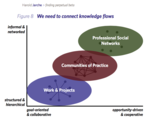
From our external social networks we can discover new ideas and opinions, though in a chaotic, unstructured, and random way. This is where serendipity often beckons. In our communities of practice, which comprise a mix of strong and weak social ties, is the ideal liquid space for mixing learning and work while sharing advice and knowledge. Social media are the enabling technologies that can connect external networks, communities of practice, and project teams. Social learning flows on these networks, which is how critical thinkers seek, make-sense, and share their knowledge using frameworks like PKM.
Image: finding perpetual beta
Harold Jarche
.
Blog
.
<span class='date ' tip=''><i class='icon-time'></i> Dec 04, 2015 09:04pm</span>
|
|
Every fortnight I curate some of the observations and insights that were shared on social media. I call these Friday’s Finds.
"A job is an artifact of a renaissance era scheme to prevent us from creating and exchanging value among ourselves." - Douglas Rushkoff, via @fer_ananda
The Case for No Bosses and a 4-Day Work Week, via @rogerfrancis1
‘As we do not have bosses in our organization, we decided to have just one meeting every 6 months in order to share amongst us all where we are going as a company, defining a maximum of 3 primary objectives. The important thing here is that we don’t determine "how" we will reach the goals, we simply decide on the objectives to reach. Later, each team member is responsible for finding out "how" we will get there.’
3 Lessons on L&D from Tesla, via @jclarey
"Inevitably people are always asking the CEO for more formal training, tuition reimbursement, some form of more formal training- some individuals believe that if they’re not in a class they’re not learning. I communicated firmly that my overall goal was to never have ‘more formal training’ be asked again. So how do we do that? Two ways: we help people change their perception that formal training is the only way you learn, and then we have to get other stuff out there so they realize formal isn’t the only way." - Beth Loeb Davies, Director L&D
The System vs the Medical Doctor, by @fewererrors
"But most of my errors have not been from lack of knowledge. When I miss a pulmonary embolism, it’s not because I don’t know how a pulmonary embolism presents. No, when I reflect carefully, most of my errors have been triggered by the factors Dr. Meagher identifies in his book. I was in too much of a hurry to really settle down and be present with the patient and listen to their story. Or I was distracted by an earlier patient’s anger after I refused his request for more oxycontin. Or I was tired from broken sleep the night before my shift. Or I was impatient and irritable and judgemental, all of which interfered with really attending to the patient I was there to help." - Dr Allison Dysart
The Trains to Hope, by @mintzberg141 & @wolfgangmuel11
"At first, we in the city administration were very surprised. But then we realized that this was not uncoordinated. It was a highly professional, high speed performance. That is when it dawned on us that here was the self-organizing plural sector in action. So we in the city administration decided to give The Train of Hope all the technical support it might need, including background support on call. We then invited The Train of Hope to join the city’s crisis management network, an offer that was accepted. I am delighted to report that this cooperation has continued to perform consistently well, with no end date yet clear." - Wolfgang Müller, Chief of Operations, City of Vienna
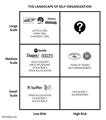
How to Choose a Model of Self-organization, by @aarondignan
Harold Jarche
.
Blog
.
<span class='date ' tip=''><i class='icon-time'></i> Dec 04, 2015 09:03pm</span>
|
|
Apologies for it being a number of months since the last post. Summer is Higher Ed IT busy season and between new management and a really big project, the blog got neglected.At least I got some of this in.....I need to do MORE of that....--------------------- Once we have the rough requirements, my next step is to organize the requirements in a way that makes more sense.When I was looking for a template for requirements elicitation, my current director recommended that I look at them in terms of Actor / Action / Acted Upon.Sounded to me a lot like the foundation of xAPI.Development Version - xAPI Spec 1.0.3----------------------------I decided to leverage the following definitions from the xAPI SpecActor - an individual, a group, or a thing / system (like a software application or a server)For Actors, I am focusing on roles that people will play in the solution. I'm still fine-tuning the list, but these are some of the patterns that I have seen appear across projects.User or Student (depending on context)Power User or Instructor (depending on context)System Administrator (does the technical administration of the solution)Program Administrator (helps run the human process around the solution and often does some technical activities within a solution) Verb - the action between the actor and the activityOne of the things I am trying to do is come up with a standard list of verbs for each scenario.Doesn't apply in all situations - I still occasionally have outliers - but narrowing verbs down a bit allows me toeasily see requirement duplication or...see trends across various stakeholder groups (am I seeing the same requirement across different sources?)find gaps in the requirements that we have collected organize the requirements list more easilySome verbs go across scenarios - such as "accesses".Other verbs are unique to the scenario or solution.A new controlled vocabulary verb list is out there.I'm not limiting myself to this list. Object - what the actor is performing the activity on. This can be another person or a group or a thing or an object.Object as person - Wendy called Dave Actor - WendyVerb - calledObject - Dave (and I'm sure any one of the Daves I know love being called an object)Object as group - Wendy interviewed the Payroll DepartmentActor - WendyVerb - interviewedObject - Payroll Department Object as a thing (Activity) - Wendy wrote about xAPIActor - WendyVerb - wrote Object - about xAPIObject as a thing (Statement or sub-statement) - Dave commented on 'Wendy wrote about xAPI'Actor - DaveVerb - commentedObject - 'Wendy writes about xAPI'------------------------------This video explains how I am leveraging these ideas in my requirements document:
Wendy Wickham
.
Blog
.
<span class='date ' tip=''><i class='icon-time'></i> Dec 04, 2015 08:31pm</span>
|
|
The next step is taking that list and prioritizing it into nice to have and need to have.For the Survey tool...what are the principles that guide that decision?Mine are:Can people get to the survey easily and using their preferred method of access?If it is a pain for them to get to the survey, they won't take it and I get no information.Can surveyors develop a survey quickly? Ease of useIdeally, they will have spent quality time thinking through what questions to ask and the type of answers they are looking for. A tool won't fix that.Can surveyors quickly view and distribute the results?Because if there is a survey being developed, it is likely because management has a question they want answered.Warning: if you are doing the requirements collection for a project you are going to have lengthy arguments discussions with the other stakeholders about the difference between "nice to have" and "need to have".Best for everyone to get real clear on the problem that the project is solving and the principles you are using to guide solution design first.Here Be Monsters
Wendy Wickham
.
Blog
.
<span class='date ' tip=''><i class='icon-time'></i> Dec 04, 2015 08:30pm</span>
|
|
....though it has not been for lack of trying......----------------------- Wendy - why are you worried about this?One of the biggest issues we ran into during our Unified Communications project was the development of test scripts.As you are implementing your learning ecosystem, chances are you will be asked to create test scripts. Or at least participate in that process.Spending time defining testable requirements (as much as possible at this point) will save time later on.Like...when you are also trying to develop training materials and prep for go-live.--------------------------- In Wendy's Utopian Fantasyland:Test scripts are based on requirements. The requirements are based on what the user needs to be able to do. And we wind up with a system that works for humans. Test scripts should have two levels:Functional - do the buttons workMost test scripts focus on the functional IT folks will focus on this. Functional testing is useful TO A POINT! Procedural - can someone actually complete a task All of the buttons can work and it passes the functional test, but if you try to walk through a series of steps - you can't complete the task. When I see solutions fail, it is because they tested whether the individual buttons work but didn't bother to walk through what humans actually do when they use the tool.I haven't seen a solution yet where I push just one button to perform a task.---------------------------------- Not all requirements have testable components.Some are just "does it exist - yes/no". So I figured it would be easier to identify what could be tested and what couldn't up front.You may need an IT friend, or two for this.How I'm approaching this (moving forward, because I learned my lesson) is explained in the video below.
Wendy Wickham
.
Blog
.
<span class='date ' tip=''><i class='icon-time'></i> Dec 04, 2015 08:30pm</span>
|
|
I received my MA in History in 1994 from the University of Georgia.Back in the day....those index cards were the way we organized our notes and thoughts so we could ultimately write our thesis.The idea was that once we had enough index cards, we can organize them and the thesis would "write itself". (ha!) No EvernoteNo "internet". We did have computers. And email - kinda.I studied what I could afford to study - which equaled something close to where I was since I didn't have a lot of money for travel.Mentors included whoever was close at hand, and maybe the occasional phone call or letter to someone else.Hence a thesis on Black Drink in Colonial Georgia. Because I was in Georgia.And near an expert in the Southeastern Indians.And the plant grew on campus.Back in the day, we killed trees. Lots and lots of trees. I am so grateful for the internet.
Wendy Wickham
.
Blog
.
<span class='date ' tip=''><i class='icon-time'></i> Dec 04, 2015 08:29pm</span>
|
|
This is one of my first web sites - developed in 2001. I chose the topic because it was controversial (still is) and it allowed me to use lots of pictures in buttons. Because in 2001, that was advanced.Note the matrices and the fact that the instructor printed out every page of the web site.As I sifted through my papers from my Instructional Technology Masters degree, it occurred to me that we are having the same conversations that we did in 2001.Despite lots of research, we are still designing the same stuff.Still asking how we can develop the same stuff FASTER vs how we can design effective solutions that better map to the way people learn and the environments we work in.The solutions I see now are very similar to the solutions I saw back then.Because when we are actually faced with having to DO something, we revert back to the same habits.Thinking in terms of courses.Thinking in terms of how fast we can develop a course vs whether a course is an appropriate solution in the first place.Thinking in terms of "training" vs helping people become more comfortable with change.Thinking in terms of events vs the small, distributed experiences that are proven to work. We have over 15 years worth of research - people!!!!Let's use it!!!!!
Wendy Wickham
.
Blog
.
<span class='date ' tip=''><i class='icon-time'></i> Dec 04, 2015 08:29pm</span>
|
|
Of course, life does not always provide time to come up with a strategy after careful consideration of requirements and capability.Sometimes, you just have to rely on prior history and gut feeling - as well as take advantage of opportunities as they present themselves. Behold! Our current content strategy!I can use this both for my own reference (where should I stash my stuff) and for the rest of the team (where should they stash it too). To create this, I had a working knowledge of the bits and pieces we had been using so far and what we did. In Wendy's Utopian Fantasyland - there would have been detailed requirements and capabilities much like with the survey. Um...yeah...didn't have that.I also tested some functionality with the movie files to see whether the proposed solution was feasible (otherwise known as spending time storing and retrieving movie files in various places to see what happened).This document was created in response to a gap I had been complaining about for a year now in regards to our functionality - ie, where do I stash my movie files if I am not supposed to stash them in our designated document management system or on my YouTube account?It was also created in response to a sudden proliferation in places where we COULD stash our stuff. Before we had our LMS (for stuff requiring tracking), our little corner of a web server (for interactive videos that did not require tracking), and a shared drive. Now we have a lot more options and places to put things. It got complicated. The headers were in response to the key capabilities and scenarios I encounter in this space:- What type of file or file package am I creating?- What type of reporting do I need?- Who is the audience?- Where are we stashing this file?- Other concerns or issues that have surfaced around this solution?- Potential next steps?- New / temporary solution options as we hash stuff out (the unlabled column)Eventually - there will be a detailed requirements and capability matrix for this space much like the Survey requirements. Eventually.....
Wendy Wickham
.
Blog
.
<span class='date ' tip=''><i class='icon-time'></i> Dec 04, 2015 08:28pm</span>
|