Blogs
|
Written by Chris Osborn Today's Q&A Thursday discusses a quote from Peter Drucker. He says "Management is doing things right. Leadership is doing the right thing." How can we find out what those right things are? Stay Up-to-Date on the Most Current Business Training Trends BizLibrary offers 7,000+ training videos in various business training topics, with new courses added every day. Succession Planning & The Development of Your High Potentials This complimentary eBook discusses how we as human resources and learning professionals engage and retain or top performers. BizLibrary's Mobile Learning App meets the needs of today's digital learners. Employees no longer wait for training departments to push learning content to them. Employees are used to pulling information to themselves, when they need it, on their own terms and conditions, and on their own devices. Video Transcription Hi, Chris Osborn, VP of Marketing with BizLibrary with today's Q&A. Today's question comes from Martha, she's an HR director at a medical services organization. In our webinar on social leadership, we used a quote from Peter Drucker. He says "Management is doing things right. Leadership is doing the right thing." What a great quote. And the question really comes to leaders: how do we evaluate what the right things are? How do we sort out the threats we need to address from internal vs external sources. And that's really the source of Martha's question. We talked about doing a SWOT analysis - an old fashioned consultants trick and it's really a fabulous tool to do exactly that. SWOT is an acronym that stands for strengths, weaknesses, opportunities, and threats. So if you think about this as existing in four different quadrants, strengths and weaknesses - this is the internal focus part of the equation. These are the things that your organization does well, or where you're weak. Examples of strengths are good systems, good quality control, or a strong product development team. Weaknesses could be we don't do innovation well, or we're slow to market, or we lack a deep bench to find emerging leaders. Opportunities and threats are external. So opportunities could be new markets, new ways to find customers for existing products, or a change in the competitive landscape where a major competitor is purchased, or just leaves the market altogether. Threats could be an emerging technology, or a new product, or a completely new competitor that we never anticipated emerging before. So doing the right things as leaders might mean leveraging or taking advantage of our strengths, addressing weaknesses or finding ways to do less of those things. It might also mean looking for ways to jump on growth opportunities, or address threats. Doing things right matters, we always have to execute. Choosing what those things will be is where leadership comes into play.
Chris Osborn
.
Blog
.
<span class='date ' tip=''><i class='icon-time'></i> Jul 14, 2015 01:56pm</span>
|
|
by Jen Weaver
We love their wine, culture, and food. But what do we know about Italians and their expectations when it comes to training and development? If your answer is "not much," keep reading!
Test Your Knowledge of Italian Culture
The modern Italian language evolved from what region in Italy?
Sardinia
Tuscany
Rome
Who is the head of the Italian government?
True or False. The official religion of the Republic of Italy is Roman Catholic.
Quick Tips for Training & Development in Italy1:
Italians are fans of refined and formal interactions, appreciating a dignified and smooth approach. Out of formality, do not use first names unless invited to do so.
Rapport is huge in Italy. Spend time preparing the factual details of your training, but also allocate an appropriate amount of time to invest in developing a strong relationship. The standing of your relationship will determine the level of interest in and receptivity to your training.
English is spoken by many business people even though Italian is the official language. Be sure to clarify if there is a language preference for your training materials as many companies opt to offer training in Italian even if their employees are proficient in English.
Even with a substantial religious background, Italians tend to use subjective feelings to make decisions rather than ideology or objective facts. As such, you may find it hard to move learners to a new perspective or methodology even if your reasoning is sound.
As a foreigner, you are expected to be punctual for meetings, although your Italian counterparts may run behind. It's also common for the most important person in the meeting to arrive last. The further north you travel, the more efficiency you'll find in business interactions and schedules.
The Italian view of time is that it's best managed when spent well, not necessarily requiring that appointments start or end on schedule. They value building relationships and are also heavy proponents of a work-life balance, favoring more "life" versus the American favoring of "work".
Respect for authority must be demonstrated, and one's authority often travels with the individual, not necessarily his or her title.
Even if your host comments negatively about Italian culture or history, be careful not to chime in. Italians can say things about their own country that outsiders cannot. Instead, safe topics of conversation include art, food, wine, and sports.
Excited and expressive gesturing is common and expected.
Italian Culture Answers:
(b) Tuscany. The Tuscan dialect was also the preferred dialect of some of Italy's greatest writers, including Dante and Boccaccio.
The prime minister. The president is the chief of state.
False. While a majority of Italians are Roman Catholic in heritage, there is no official religion.
References:
1Morrison, Terri, & Conaway, Wayne A. (2006). Kiss, bow, or shake hands (2nd ed.). Avon: Adams Media.
***
If you like Jen's articles, you'll love her live, online Localization classes. Check out her mini-course schedule here.
***
Developing international training and development materials? Contact Jen at Carmazzi Global Solutions.
Icon Logic Blogs
.
Blog
.
<span class='date ' tip=''><i class='icon-time'></i> Jul 14, 2015 01:56pm</span>
|
|
Out of the conversation in Learn Trends around making informal learning concrete, Cammy Bean asked:Cammy Bean: So is there a market for Social Media Instructional Designing Consultants?Jane Hart suggested that we use the term Social Learning Designer to describe the role. But what was fantastic is how well this crystallized the central question in my mind. Be it as an individual or as a function in an organization, we need to define what the whole business of social learning or informal learning is all about.Using a common marketing template, I thought it would be a great exercise to have people define our:BuyersBenefitsServicesDifferentiationHere's the template ... For _________ (buyers) we help in their desire to __________ (benefits) by ________ (services) unlike others we _____________ (differentiation).How do we fill this in for a social learning designer or a social learning organization?I would very much like to hear your answers.Here are a couple of examples from the chat to maybe help you get started:Jane Hart: i work with learning depts to help them create more participatory, collaborative approaches to learning - rather than just shoving content at peopleColleen Carmean: for learning orgs, we help in their desire to increase knowledge within the org by shaping systems that make info needed availalble to anyone at anytime. Unlike others, we do this by creating distributed spaces, places and tools for sharing, finding and creating knowledge. eLearning Technology
Browse eLearning Content
Tony Karrer
.
Blog
.
<span class='date ' tip=''><i class='icon-time'></i> Jul 14, 2015 01:56pm</span>
|
|
After delivering my 6Hr Mobile Learning Workshop for companies for a few months, today I’m opening it up for Learning Professionals.
Why Register for this Training?
This workshop is a result of months of research on mobile; mobile app design testing for best practices; countless hours of consulting and lots of learning about design from trial and error.
You will immediately benefit from all of this in a one 6-hr session.
Here’s what you will learn in this action-packed workshop:
Learn Key Mobile Learning Design Principles (vs. eLearning design)
Gain a thorough perspective on the Opportunities and Challenges that lie within Mobile Learning
Understand the mobile learning landscape, technologies and tools
Learn what TRUE mobile learning is and is not
Acquire important data for making a powerful business case for mobile learning in your organization
Become aware of the expectations of the new mobile user
Develop the right mindset needed to design for a multiscreen ecosystem
Learn key lessons in mobile learning from mobile apps
Reimagine your existing desktop courses for mobile through sketching
NOTE: Participants will be provided with a 100+ page PDF, which includes Slides, Hands-on Exercises, Best Practices and Resources
The following is a more detailed outline:
* The New Mobile Revolution Changes Everything
The End of the GUI and the beginning of Touch Computing
Making a business case for mLearning
Examples of how Smartphones transcend beyond Phones and make our lives better
Why Mobile has vastly more potential than the traditional PC ever did
Hands-on workshop exercises
* mLearning Opportunities and Challenges
Mobile is not about retrofitting a PC experience, it’s about Reimagining it for Touch
Examples of how we can create better learning on mobile vs. desktop
An Introduction to Mobile Sensor Superpowers
The Importance of embracing Mobile Constraints
The Advantages of Embracing Simplicity and thinking Mobile-First
mLearning lessons from mobile apps
Hands-on workshop exercises
* The Current State of mLearning Design Tools
Pros and Cons of Articulate Storyline, TechSmith Camtasia and Adobe Captivate for mLearning Design
Examples and Demos of these Tools on iOS and Android devices
Pros and Cons of native apps vs. mobile web for mLearning
The Advantage of Responsive Design for mLearning
Hands-on workshop exercises
* mLearning Design Principles
An Introduction to the new multiscreen world
Important patterns for a multiscreen learning design
Understanding the Mobile Learner
Best Navigation Patterns for mLearning
Touch Targets guidelines
Ideal Touch Target placement for multiple screens
mLearning design lessons from mobile apps
mLearning design best practices
From eLearning to mLearning: Sketching
Hands-on workshop exercises
When: January 9th, 2013. From 8:00am to 2:00pm Pacific time
Where: Online via Adobe Connect. The URL and the Agenda will be provided after you register.
Cost: $399 USD Per Person. Use the promo code: 2013mLearning save $50.
UPDATE: If you are interested in helping me promote this training, I have created an affiliate program HERE. The referral fee for this program is 10% of the ticket sales. Payments are made to you via PayPal when you promote the event and get attendees to sign up for the training. The process is simple, simply follow the steps and you will be able to easily place your personalized link on your blog, website, newsletter, etc. I thank you in advance if you choose to help me promote this event.
RJ Jacquez
.
Blog
.
<span class='date ' tip=''><i class='icon-time'></i> Jul 14, 2015 01:55pm</span>
|
|
Written by Jessica Batz Join BizLibrary and HR.com for a complimentary employee development webcast on July 15, 2014 on the Development of High Potential Employees - Best Practices in Succession Planning. HR.com webcasts deliver the latest industry news, research trends, best practices and case studies directly to your desktop. The complimentary webinar also offers Human Resource Certification Institute (HRCI) credit towards Professional in Human Resources (PHR), Senior Professional in Human Resources (SPHR), and Global Professional in Human Resources (GPHR) certifications. The webcast will be presented by Chris Osborn, Vice President of Marketing at BizLibrary. Employee development is an ongoing process. "A critically important resource in most organizations is high-potential employees, and effective development of these employees requires an adaptive approach that is evolving with changes in the market and workplace demographics," said Osborn, "During this webcast, we are excited to share a strategic approach to succession planning that incorporates best practices and learning principles to deliver bottom-line business benefits. Offering HRCI credit is an added bonus for our webcast attendees." Webcast Details: Title: Development of High Potential Employees - Best Practices in Succession Planning Date: Tuesday, July 15, 2014 Time: 1:00 - 2:00 p.m. ET / 12:00 - 1:00 p.m. CT See more at: /news-and-events/press-releases/bizlibrary-offers-hrci-credit-for-hr-professionals-through-webcast-with-hrcom.aspx Download a free eBook on Succession Planning here: /resources/ebooks/succession-planning-and-the-development-of-your-high-potentials.aspx
Chris Osborn
.
Blog
.
<span class='date ' tip=''><i class='icon-time'></i> Jul 14, 2015 01:55pm</span>
|
|
by Willam Van Weelden
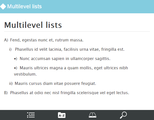
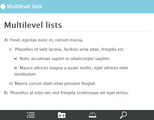
Multilevel lists are an often overlooked RoboHelp feature... a shame because multilevel lists are very powerful. As the name suggests, Multilevel lists allow you to create complex lists with multiple levels. For example: consider what you would have to do if you need a list that uses upper alphanumeric characters on the first level, lower roman on the second level and bullets on the third level. You can achieve the numbering scheme shown above by using a standard numbered list, but you would need to assign the correct list styling to every list level. That's a lot of manual labor. And it's not easy to quickly change the list style, especially if you've applied the style manually across multiple topics.With multilevel lists, you create a single style that can be used in multiple topics throughout a RoboHelp project. And best of all: you control everything through the style sheet, allowing you to change all the multilevel lists in a central location.In this article I will show you how to create and use a multilevel list. I will focus on the basic settings first. With these basic settings you can use Multilevel Lists in your projects. In a future article I will show you some cool things you can do with multilevel lists.Create a Multilevel List
On the Project Manager pod, double-click your style sheet to open the Styles dialog box.
In the Styles dialog box, right-click Multilevel Lists and chooseNew.
Enter a name for your list style and press [enter].
From the Apply Formatting To drop-down menu, choose Level 1.
From the Paragraph Style drop-down menu, choose a paragraph style. (I recommend using the Normal style so that the list uses the default topic formatting.)
From the List Style drop-down menu, choose a list style. (In my example I chose upper-alpha.)
Return to the Apply Formatting To drop-down menu and select and format other levels as needed. (In the sample list pictured at at the beginning of this article, I formatted the first three levels.)
When finished, click the OK button to save your changes.
The Multilevel list is now set up and ready to use.
Apply a Multilevel List To Topic Text
Open a topic and select some text.
Click the Create a Multilevel List tool.
Select your Multilevel List in the Available Lists Styles field and then click the OK button.
Note: To change the level of a list item, click the Increase Indent or Decrease Indent tools.
***
Looking to learn RoboHelp? We offer a live, two-day online RoboHelp class once a month. Feel free to contact us to learn other ways to meet your RoboHelp training requirements.
Icon Logic Blogs
.
Blog
.
<span class='date ' tip=''><i class='icon-time'></i> Jul 14, 2015 01:55pm</span>
|
|
We've just seen an interesting experience with Jay Cross having pulled together a 24 hour, worldwide discussion on the future of learning at Learn Trends. You can find some of the recordings here.There's a discussion thread with feedback, and you can read some of Jay's thoughts on doing this. It had very good attendance and the quality of people was very high.We encouraged people to drop by whenever they were free. They could join in for half an hour, then bail out. Participants did not need to register to attend. This revolving door of attendance makes measurement tough, but I’ll guess that 250-300 people were involved at least part of the time. On Tuesday morning, we had 125 listening in. On Wednesday morning, we had 50-60. In between, some sessions had 30-40 people, others dwindled to one.We had about 120 people for the Learn Trends on SharePoint in Corporate Learning and find the recording at SharePoint Video.We are deciding what we will do going forward. We plan to hold sessions in May and June. Topics are TBD. And likely the topic will partly decide what format we use.But I very much would like your help in brainstorming what else we might consider doing with the format?Please help with ideas or pointers to examples.Also, if you are interested in future conferences, please go sign up on the Learn Trends Ning Group. We will make sure we notify you of dates and topics. eLearning Technology
Browse eLearning Content
Tony Karrer
.
Blog
.
<span class='date ' tip=''><i class='icon-time'></i> Jul 14, 2015 01:55pm</span>
|
|
We have entered a new era of mobile computing. This mobile revolution is an opportunity for learning professionals to reinvent our industry, from the way we learn new things by interacting with information on our mobile devices to the way we design the next generation of learning experiences. To fully realize the potential of mLearning, though, we need to think outside the eLearning box and question many of our traditional practices.
Have RJ Jacquez speak at your event about the paradigm shift from eLearning to mLearning, his ideas around embracing simplicity in mLearning design, and how thinking "mobile first" can support creating great learning experiences not just on mobile, but also on the desktop.
About RJ Jacquez
RJ Jacquez is a Mobile Learning Analyst, Consultant and Speaker, who helps companies understand the potential of Mobile and make a successful transition from eLearning to mLearning in their organizations. Also a Mobile Learning Evangelist, Podcasting and Blogging the Mobile Learning Revolution as it happens. Before that, Jacquez worked for Adobe Systems and Macromedia as a Senior Evangelist. RJ is honored to be among great company in the following lists and articles: 1) mLearning’s game changers: Who’s on your dream team? (http://t.co/7j5KoylW) 2) Top 25 Most Influential Bloggers in Technical Communications (http://bit.ly/a8ooZC) 3) Top 20 most influential tweeters in eLearning, training and HR (http://bit.ly/vScfc0). 4) I was also mentioned in this article on Why Every Company Needs a Robert Scoble (infographic) for my work as an Adobe Evangelist (http://bit.ly/v0IMHs).
Name
Email
Message
Send a copy of this email to yourself
If you want to submit this form, do not enter anything in this field
RJ Jacquez
.
Blog
.
<span class='date ' tip=''><i class='icon-time'></i> Jul 14, 2015 01:55pm</span>
|
|
View and download the webinar slides. View the webinar recording. Additional Resources: "It's not just succession to the top - it's getting the right person in place for every job. Some of tomorrow's key jobs may not even exist now." Robert M. Fulmer, Growing Your Company's Leaders Top 10 Job Titles That Didn't Exist 5 Years Ago via LinkedIn "Managers need to stretch, challenge, and coach their high-potential employees… Without multi-dimensional dialogue about these issues, managers tend to hold on to their high-potential people instead of helping them along an intentional developmental pathway. High-potentials then may interpret this as a lack of company support and will be inclined to look elsewhere." Ron Ashkenas, The Paradox of High Potentials Harvard Business Review A Succession Plan for First Time Managers, Maria Plakhotnik and Tonette S. Rocco, T&D Magazine, December 2011 Leadership Development Courses and Videos "The hallmark of someone with learning agility is that they learn lessons from diverse experiences and are able to distill those down to rules of thumb so that, when they're put in an unfamiliar situation, they aren't stumped by it. It's almost becomes a price of entry for success now, especially in leadership and executive roles." Victoria Swisher, Becoming an Agile Leader.
Chris Osborn
.
Blog
.
<span class='date ' tip=''><i class='icon-time'></i> Jul 14, 2015 01:55pm</span>
|
|
by Jennie Ruby
This week we examine two of my pet peeves--the confusion of appraise and apprise and the confusion of flesh out and flush out. And some other bonus words may appear in the problem sentences!
To appraise something is to estimate its value:
I need to have my used car appraised before I decide on a selling price.
To apprise is to inform (Webster's says "to give notice to") someone or something:
The officer apprised the motorist of her rights.
To flush out: something that happens in plumbing or with birds who suddenly fly up:
The dog flushed the grouse out of the thicket.
The dog scared the birds, causing them to flush.
To flesh out: to put meat on the bones; to fill in.
The architect fleshed out the details of the blueprint over the weekend.
Here is the confusing words challenge for this week:
The director asked me to keep her appraised/apprised of the project status.
We later met to flush out/flesh out the details of the project.
During the buyer's walk-through, some squirrels were fleshed out/flushed out of the attic.
Please appraise/apprise the seller of her rights regarding the negotiated price.
We need to appraise/apprise the governor of the details of the scam.
Can we flush out/flesh out this outline before we submit it to the client?
The plumber appraised/apprised me of the condition of the old iron pipes.
The main line needed to be fleshed out/flushed out to allow water to flow freely.
We met with the plumber to flesh out/flush out the plan for upgrading the pipes.
We need to appraise/apprise students of how to access/excess the supplemental material.
When ready, submit your answers as comments below.
***
Confusing Words for 400 Answers
For the Confusing Words for 400 challenge, Gary Kuchel was first to respond with correct answers, followed by absolutely everyone who answered (see list below). None of you made any incorrect answers, but some missed additional problems elsewhere in the sentence. And Lorna McLellan was the only one to notice the typo on foregone!
Special thanks to Alan Sloan, David Pitts, and Karyn Smith for providing the name of the comedian(s). I was amused to see that each of you had a different take on who said, "Who's on first," and I re-watched one of the several versions of the video about three times from beginning to end. Both Abbot and Costello say "who's on first" so many times it is ridiculous to cite one over the other, except to say that Bud Abbot said it first, but Lou Costello asked it as a question.
Answers to the Confusing Words for 400 challenge are brought to you by Lorna McLellan.
Its/It's not a foregone conclusion that your/you're going to get these right.
Your/you're spelling checker may not correct these errors.
Your/You're likely to forget to save your/you're file if you leave work to/too quickly.
Whose/Who's to blame if the database is not updated properly?
Whose/who's keys are these?
The program may crash if its/it's cache is not cleared.
The client whose/who's form was received yesterday told us there was an error in its/it's text.
"Whose/Who's on first?" asked the comedian, whose/who's name escapes me at the moment.
Here are the correct-responders of last week not otherwise acknowledged above:
Cyndi Marino, Eric Nilsson, Lynn Walpole, Sonia Verma, Chris Zimmel, Patrick Brown, Elaine Study, Geri Moran, Julie Horn,Toni Wills, Pat Jones, Michelle Nienhuis, Alan Sloan, Renita Coleman, Karyn R Smith, Amy Grittman, Lisset Vega, Anne Louque, Lisa Mileusnich, Ginny Supranowitz, Jay Herman, David Pitts, JoAnn Bridges, Joanne Hofmeister, Mary Schoeller, Kay Honaker, Karyn Highet, Christine Pass, Vera Sytch, Kim Bullman, Julie Robertson, Susan Czubiak, Sharon Urquhart, Amanda Prussing, Denise Miller, Lisa J Stumpf, and Tanya Davis.
***
If you love Jennie's articles, you'll love her classes. Check out some of Jennie's mini courses.
Icon Logic Blogs
.
Blog
.
<span class='date ' tip=''><i class='icon-time'></i> Jul 14, 2015 01:55pm</span>
|