Blogs
|
This workshop has now been facilitated for IMU students (16/04/2015) and staff (06/05/2015). I am still learning, but Al-Hamdulilla this is Insya-Allah just a start to unleash and empower everyone to discover the potential in brain power covering everything from focus to creative thinking.However, this particular workshop focuses only on memory and reading skills. The creative thinking session, will be coming in the next version :)WORKSHOPIn this workshop, we will explore various techniques to stimulate and empower the brain and senses to be more focused, remember faster, speed read, and improve the understanding of whatever we are learning. In the process, we will discuss how the brain learns, and how we can apply various focus and memorization techniques to improve our ability to remember through visualization, association and imagination. Then, we will learn how to apply the SQ3R method to enhance our reading skills, and finally we will explore various techniques to speed read. By applying these super memory and reading techniques, we will learn more effectively, and be empowered with more time to focus on achieving our targets and being productive at IMU.OUTCOMESAt the end of this workshop, you will be able to:Discuss how the brain learns;Use at least 2 techniques to optimize your learning senses to improve focus;Use at least 3 techniques to improve your memory;Apply the SQ3R method to enhance your reading skills; andUse at least 3 techniques to increase your reading speed with comprehension.SLIDESHere we go: Super Memory & Reading Skills from Zaid Ali Alsagoff Yes, Yoda is one of the facilitators :)PARTICIPANTSPlease add your name, picture and something about yourself on this Padlet Wall:Created with Padlet
Zaid Ali Alsagoff
.
Blog
.
<span class='date ' tip=''><i class='icon-time'></i> Jul 14, 2015 02:09pm</span>
|
|
Written by Chris Osborn In today's Q&A Thursday video, Chris Osborn discusses the most common complaints with performance reviews, and offers advice on how to make them more effective tools. Stay Up-to-Date on the Most Current Business Training Trends BizLibrary offers 6,000+ training videos in various business training topics, with new courses added every day. How to Build a Business Case for Online Employee Training This complimentary eBook will help you get your online training proposal approved. It identifies the 5 key elements of a business case, discusses best practices, and includes examples to help you make your case solid. BizLibrary's Mobile Learning App meets the needs of today's digital learners. Employees no longer wait for training departments to push learning content to them. Employees are used to pulling information to themselves, when they need it, on their own terms and conditions, and on their own devices. - See more at: /technology/bizmobile.aspx#sthash.umjsk4e5.dpuf Video Transcription Hi, Chris Osborn, VP of marketing with today's Q&A. This has to do with performance reviews. We had an interesting webinar with performance reviews and we started the webinar by talking about the five most common problems that employees complain about with respect to performance reviews. We also asked our participants to tell us their most painful experience with performance reviews and we got some interesting responses. They included they didn't cover my entire work year, didn't really talk about my work ethic, it only related to the last two weeks before the performance review, I'd been there for nine years and every review had been exactly the same. Managers weren't really trained to do the review. It was more about blame. Some complaints were that the compliments were always the same, so they felt insincere and very artificial. Do any of these things sound familiar to you? Do these sound like the performance reviews you've dealt with over the course of your career, do these sound like the performance reviews that happen at your organization? Well, if that's the case, maybe you need to rethink what you're doing. Because if you take a real look at what performance reviews are supposed to do, aren't they supposed to help your employees perform better? Isn't it supposed to be about improving the overall performance of your entire organization, and motivating your employees to do better? In a poll conducted by TLNT, employees identified their five most common complaints with performance reviews, and they were they were demotivating, they weren't goal focused, they were subjective, they weren't frequent enough, and they were inconvenient. Sound familiar? Pretty much the same as what we heard from the audience, right? But we had an exception! Sam, a service manager at a large public professional services firm, said he only does them once a year, but he loves doing them because he works and coaches with his employees every single day. So why the difference? Why does that annual review work? Well, think about what Sam said. I work and coach my employees every single day. So think about what that turns that annual conversation into. Rather than a blame game or something subjective or the employee doesn't know what's going on, it turns into a celebration of the past year. A true conversation about a career! A true conversation about performance and improvement, where you've been and where you need the employee to go and what the plan is for the future. THAT is a performance review, and that's an effective way to do it. So Sam had it exactly right. Working with your employees day to day, being engaged with them, really connecting with them, and helping them succeed on a day to day basis. That's the secret to improved performance. That's how you get to where you need to go. So whether you call it a performance review, whether you call it an annual meeting to talk about goals, it doesn't make any difference. The key to improved performance is meeting your employees on a regular basis, working with them on goals, goals that are transparent, that everybody can understand, celebrating successes, but most importantly being engaged day to day and coaching for improvement.
Chris Osborn
.
Blog
.
<span class='date ' tip=''><i class='icon-time'></i> Jul 14, 2015 02:09pm</span>
|
|
by Kevin Siegel
Here's an interesting scenario: You create a Captivate project that contains 12 slides: 10 question slides, each worth 10 points, and two "transitional" slides containing simple navigation buttons.
During the testing phase, beta-testers who answer all of the questions correctly should be awarded 100 points. However, every beta-tester who answers the questions correctly receives a score of 96 from the LMS. Huh?
How about this one? You have a five-question Captivate project. As with the first example, the project also has a couple of "transitional" slides containing navigation buttons. During the testing phase, the progress indicator on each of the question slides indicates that you are on slide 2 of 6, when you are actually on the first question slide. Keep in mind that the project only contains five questions so the first question slide should have indicated that you were on slide 1 of 5.
I've seen both problems described before. The issues aren't with the question slides and they're not a problem with your beta testers. The problem is typically found with the interactive objects on non-question slides.
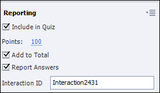
If you were to select a button and observe the Reporting area on the Properties Inspector, you'd see that many objects (click boxes, buttons, text entry boxes, etc.) can report interactivity. In essence, any interactive object can be treated like it's part of a quiz.
If you select Include in Quiz, your question number counts will be thrown off. If you select Report answers and Add to total, your quiz score will likely be thrown off.
Here's the real challenge: Imagine you have 100 slides. Some of the slides are question slides; the majority are simply interactive or contain buttons. It's going to be a real pain to open each of your slides, show the properties of objects and ensure the Reporting options are set correctly. What's a developer to do? Read on...
Choose Project > Advanced Interaction to open the Advanced Interaction window.
You can use this handy window to control all of the reporting objects in your project. For instance, if you wanted to stop a button from being added to the quiz total, all you would need to do is select the object in the Advanced Interaction window and then, on the Properties Inspector, deselect Add to total.
***
Looking for instructor-led training on Adobe Captivate? Check out our live, online, instructor-led Captivate classes.
Icon Logic Blogs
.
Blog
.
<span class='date ' tip=''><i class='icon-time'></i> Jul 14, 2015 02:09pm</span>
|
|
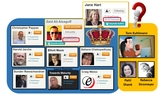
TOP 10The ‘Top Ten’ most influential people in the corporate e-learning sector World (2014) was according to Bob Little's annual list (Click their name to visit their SlideShare homepage. Not all could be found!): Craig WeissAn e-learning analyst, expert, author, speaker and thought leader who is CEO of E-Learning 24/7. Elliott MasieHead of The MASIE Center, a New York think-tank focused on how organisations can support learning and knowledge within the workforce. Christopher PappasGreece-based founder and CEO of the eLearning Industry's Network elearningindustry.com.Tom Kuhlmann (?) One of the world’s best known e-learning designers. Laura OvertonA speaker; member of ELIG, and managing director of Towards Maturity, a not-for-profit company that provides research and online resources to help organisations deliver effective learning interventions at work.Harold Jarche The Canada-based ‘thought catalyst’, writer and blogger who is also chairman of the Internet Time Alliance. Patti Shank (?) Founder of Learning Peaks, and an internationally recognised expert on, and advocate for, the pragmatics of the design of information and instruction to help people do what they need to do. Rebecca Stromeyer (?)Owner of ICWE, which runs Online Educa as well as E-Learning Africa. Sahana ChattopadhyayConsultant and Deputy Head at Tata Interactive Systems and writer of the ID and Other Reflections blog. Sunder RamachandranBlogger and also head of sales training at Pfizer in Mumbai, with over 11 years’ enterprise learning space experience. RESULTSWith the exception of Christopher Pappas (as of today), the Top 10 e-Learning Movers & Shakers (2014) of the World have a surprisingly LOW NUMBER OF FOLLOWERS on SlideShare. Why? Not getting into that!So, the WINNER of this category has to go instead to Jane Hart (No. 2 on the UK List), who outshines the top 10 big time (refer to the picture above)! Their total number of followers combined is not even close to her total. The same applies to Zaid Ali Alsagoff, which happens to be me! So, let's enjoy Jane Hart and Zaid Ali Alsagoff's awesome collections of presentations on SlideShare. We might not be the best overall, but when it comes to SlideShare...WE ROCK! Al-Hamdulilla!Also, let's not forget that Tom Kuhlmann is the IRON MAN for swooshing awesome PowerPoint related juice (with Articulate), but sadly I couldn't locate his SlideShare account.Finally, it is important here to highlight that the Top 10 e-Learning professionals (Corporate Sector) on the list above, have contributed to the e-learning world in so many other ways beyond SlideShare, and that is something we must keep in mind. SlideShare is just one of many tools, we can use to share our ideas, experiences, learning content, etc.In part 2, we will explore the Top 10's presence in ______....to be revealed :)@zaidlearn Thank you for creating this. I am a fan of your and @C4LPT 's presentations. @SlideShare @BobLittlePR @hjarche— Sahana Chattopadhyay (@sahana2802) April 21, 2015
Zaid Ali Alsagoff
.
Blog
.
<span class='date ' tip=''><i class='icon-time'></i> Jul 14, 2015 02:09pm</span>
|
|
Just got through reading - Long Live Instructor-Led Learning - by Saul Carliner, who is a person I know, like and respect. Wow, did he step in it on this one. Was his purpose link-bait by putting up something that is so horribly wrong as to cause us to want to respond? He had me scratching my head about Long Live what? Long Live - is actually an important issue being raised through this discussion that I'll get to below… Let me start with the fact that Saul and his article made no attempt to directly engage with any of the "bloggers" who he so quickly lumps together and dismisses. His article included citations with links, but included no links to the Learning Circuits Blog, nor to the post Workplace Learning in 10 Years that he discusses, nor to any of the individual responses several by well known and respect people from the industry. Death of the Classroom? You sometimes will run across posts or presentations that have the title - the Death of the Classroom. I'm guessing that Saul somehow assumed that this is what people were saying in their posts, but didn't actually read the 20+ individual posts when he said: Nearly all of the contributors predicted the death of the classroom For a person who is claiming to have done a better analysis and thus has a better prediction of the future he completely botched that. Instead, what the common theme was that organizations will likely have reduced the amount of classroom and courseware times. I would argue that today all classroom or courseware should be questioned. Can you reduce it by 50%? Can you make it 5 minutes long and just teach them how to use the rest of the resources? - Tony Karrer Formal learning will still be going strong but somewhat de-emphasised. Clive Shepherd we will continue to see ILT, eLearning courses (some of them page turners), and all the other stuff that we see today - Upside Learning And the list goes on. There were a couple of outliers who predicting bigger change, but that "nearly all" "predicted … death" is flat out a gross misrepresentation. To be fair to Saul, he points us to some important numbers from the ASTD State of the Industry Report: Despite a steady climb in the availability of e-learning, the overall percentage of instructor-led training is nearly unchanged: 71.97 percent in 2003 and 70.58 percent in 2008 (the most recent year for which statistics are available). What has changed, though not as significantly as one might expect, is the percentage of instructor-led training offered online, rising from 2.92 percent of all training in 2003 to 6.39 percent in 2008. This aligns with the eLearning Guild's numbers that I discussed last fall in Training Method Trends. However, the question was not a current state question - it was a future question. Saul seems to believe that total instructor-led training (f2f and online) will remain essentially unchanged as an expenditure or hours. I don't know that any of us has a perfect crystal ball. All we can look at is what's been happening and what the environmental forces are and try to predict what will happen in the future. Saul seems to think the future - 10 years from now - will be relatively the same. I believe that most of the voices you will see responding to the big question predict (for a variety of reasons) that time and expenditure on instructor-led classroom workplace learning will be lower in the future (again almost no one said dead, but many predicted lower). A few said relatively unchanged. I do think it's worth diving into some of the specific posts and thinking about it yourself. What do you think? Informal Learning After his questionable call on levels of instructor-led, classroom training in the future, Saul then tells us… More flawed than the analysis of the numbers is the proposition that formal classroom learning will be replaced by informal learning, which will primarily occur online through blogs and social computing tools. Although it sounds exciting at first, and certainly appeals to the emotions, several practical issues—all of which are ignored by the contributors to the ASTD 2019 discussion—limit the likelihood that organizations would primarily rely on informal learning. Hmmm …. don't organizations already primarily rely on informal learning? Is most of what we learn via formal learning or informal learning today? But I think I understand what he is trying to say with this, but again it's his tone that gets in the way of actual discourse. The common theme in the responses via the ASTD blog are: We are already seeing organizations look at how they can enable greater informal and social learning opportunities. As compared to today, there will be greater emphasis on support for informal and social learning in the workplace. So, it's a fair question - do we see a greater emphasis in the future for informal and social learning in workplace learning? Oh, actually, that was the question being raised and soliciting input from various sources. Blogs and Informal Learning Are Unreliable? Probably the funniest aspect of Saul's post is when he tells us that informal learning is unreliable. Another flaw is that informal learning can be inaccurate. In some cases, it's the learner's fault. Research on reading suggests that people tend to read inaccurately, especially online. So someone might interpret a point incorrectly, or mistakenly remember a fact. (As a result of this lack of credibility, people like President Obama don't rely on blogs [2]). But sometimes the errors in content result from the publication of erroneous content or opinion that is not properly labeled. The potential for those is high in blogs, which many people cite as an excellent learning resource. In her qualitative study of people who keep blogs on training and development topics, Kristina Schneider found that few of the bloggers differentiated between fact and opinion; nor did they verify the information they published; nor did the bloggers provide disclaimers about the nature of the content they published [3]. As a result, readers might believe the content they're reading is true when, in fact, there's also a chance that it's not. This is first funny because he's writing an opinion piece himself that is not properly labeled. If anything it is completely mislabeled. eLearn Magazine suggests this is some kind of vetted "Feature Article". But I know that T+D would not have let this out as an article without series editing. It's an opinion piece with no human editor vetting some of the statements that clearly don't pass muster. A few things from Schneider's thesis - all 5 bloggers write in the first person and none of them write in an academic style … The bloggers write in a mainly business writing style which is direct and open to opinion-based comments some blog posts are more editorial in fashion. However, there are rarely no statements such as "in my opinion" or "these are my own thoughts" to indicate what is opinion and what is fact. None of the bloggers studied have PhDs, yet many want to be seen as, or perceived themselves to be, experts There is no data to validate or invalidate their expert status—the only thing that can be garnered from the interview is their own emic perspective; that is, what they say about themselves and the permission they give themselves to analyse and give their opinions about certain issues within their area of knowledge. Though some participate in conferences, they speak more about their experiences holding conferences or speaking at them rather than about participating in them to learn. In these cases, then conferences serve marketing purposes first, not professional development purposes. Should we give her a pass on PhD implies expert? Should I assume that this means that Saul himself goes to lots of workplace training and attends lots of conference sessions himself. Kristina doesn't realize that she's describing most of the consultants / authors who have been in the industry for 20+ years. Saul should be a bit embarrassed citing this stuff without big time caveats around what the piece is and what it is really saying. Basically, she accurately describes blogging as not having the same quality control standards that a well-edited publication or professional journalist has. That's about it. When you read the responses to the ASTD Learning Circuits Blog Big Question - these folks are all writing their responses in a blog. I would claim the labeling is actually much better than eLearn Magazine and particularly Saul's piece. Yes, you should be suspicious of any content you find anywhere (including in a classroom). Oh and when it appears in a magazine and in a presentation at a conference. Did I mention that many of us bloggers are also people writing articles and doing presentations. Do we really need to revisit this conversation? How Do We Learn? Saul later tells us … Another flaw with informal learning is that people only learn it when they find it or stumble onto it, which might not occur when people actually need the material. In the case of getting to content when they need it, one of the problems with material on the Web is that people do not find it when they need it, or they find material that seems to be appropriate, even when it is not. They might not have assistance in verifying the selection or they might not seek it because they might not appreciate the need. Saul is right that if you need to ensure that someone has learned something specific - like you need to ensure that they meet a compliance requirement, then formal learning of some form (like courseware) is probably a good bet. What I don't quite get is how Saul proposes that formal learning can be used. The whole problem is Long Tail Learning. There is just way too much stuff that people need to learn that we have to make choices about what we spend our time publishing into formal learning events. The audience has to be large enough. As concept workers, we quickly go past formal learning opportunities. There's no course on what I do every day. And you cannot Separate Knowledge Work from Learning. One option is to say that limit of training / workplace Learning Responsibility is formal learning. Once you go beyond formal learning, then there's an immediate question of what else you will provide. I know from Data Driven performance improvement solutions that often informal learning can be very effective in driving results. To me, the answer is pretty clear. You've got to look beyond formal. Saul is right that it's sometimes hard to find the right information on the web when you need it. I would claim that we need to help people with their Search Skills. I would also claim that this is exactly why Network Learning is so important. I just don't get what Saul thinks is the alternative here? Similarly, informal learners might need the information, but can only learn when their time permits. Too often, however, the time set aside for learning is interrupted by something more immediate. Perhaps that's one of the reasons why the completion rates for tutorial-style e-learning are often disappointing. I'm guessing that Saul wants us to learn absolutely everything via classroom instruction before we ever do anything? I know he doesn't mean this, but … I would claim that if anything, Saul is pointing out the importance of teach informal learning skills so that they can get the information when they need it. Network Learning? Next up for Saul is questioning the value of social networking tools for informal learning… The contributors to the discussion also suggest that social networking tools (also known as Web 2.0) will play an important role in training. But that, too, might be an overstatement. … even the experts admit that the numbers merely indicate the quantity of people who have access to these tools; the numbers do not indicate the quality of participation. For learning purposes, it's the latter that matters. I had to check back. Yes, Saul is on LinkedIn and has 226 connections. And he's a first level connection for me. Saul can you Network Learning and get back to me on the value of being able to reach into a network like LinkedIn to reach high quality individuals for help with specific needs. Saul tells us … No single social computing tool is likely to meet every organization's learning needs. That's some pretty incredible insight. Did anyone suggest that there was a single answer or that any of this wasn't a terribly messy, complex problem? Further, I believe that this is highly personal. Different people will find different styles of use that are effective. But my point is always, that doesn't mean you can/should ignore them. Long Live? The real question that is behind the Big Question - Workplace Learning in Ten Years is where we should be putting our time and attention today. I had the opportunity to work with Stedman Graham and one of his favorite lines that I will paraphrase: We are all equal in this world. We all have 24 hours. What makes us different is how we choose to spend it. The problem I have with Saul's Long Live article (? or is it a blog post that was not edited ?) is that he's suggesting … what? He exhorts Long Live instructor led. Yes, go team go. You should double your bets on instructor-led training. Don't worry about reducing your spend on instructor-led for the next ten years. And ignore all that informal and social learning stuff. What? Long Live what? He cites an example of a public foundation that is the primary source of funding for more than 300 nonprofits in a metro area. They use a blended classroom, social learning and performance support solution to helping them. When I think about the particular situation I realize that it would be important for whomever is defining the specifics of the approach to be very much aware of things beyond instructor led learning. For example … There's a wonderful social learning solution that I believe would fit this situation very well from America Learns. As part of this solution, the normal kinds of reporting done by the individual nonprofits feeds into a knowledge base that then can be tapped by people in other nonprofits. It helps share effective patterns. I'm sure that there's already a fair bit of informal and social learning that's occurring. I wonder if there's more that could be done to help them better share beyond the formal learning opportunities that Saul describes? My guess is that the answer is very much a yes. Or maybe even it would be that we should give them more classroom training on how to become better social learners. Or maybe it's more time networking. It could be a lot of different things. And therein lies my main criticism with Saul's piece. He didn't help me understand what he believe is the important places we should spend our time. His main points seem to be: Don't worry instructor-led training is okay (hence the title - Long Live Instructor-Led Learning) Ignore social and informal learning. It has a lot of flaws. Bloggers produce poor quality and misleading information. Long Live what? If his point was only to say that people claiming the death of the classroom in 10 years are wrong … and that the classroom will still be around in ten years … then I agree. But it just seemed that his argument quickly left that and into a bunch of dubious statements. I would claim that it's probably much more instructive to go look at some of the individual posts cited and make up your own mind. And I would still ask you to answer the core question: Where will you spend your time? eLearning Technology
Browse eLearning Content
Tony Karrer
.
Blog
.
<span class='date ' tip=''><i class='icon-time'></i> Jul 14, 2015 02:09pm</span>
|
|
Written by Jessica Batz View and dowload the webinar slides. View the webinar recording.
Chris Osborn
.
Blog
.
<span class='date ' tip=''><i class='icon-time'></i> Jul 14, 2015 02:09pm</span>
|
|
1. En mLearnCon 2012, se destacó el proyecto Tin Can. Para saber más acerca de este interesante proyecto, puedes escuchar nuestro episodio anterior:http://rjacquez.com/esta-semana-en-el-aprendizaje-movil-episodio-07-proyecto-tin-can/
2. Apple´s World Wide Developers Conference: se presentó el MacBook Pro y el nuevo sistema operativo iOS 6. RJ Jacquez escribió más acerca de la historia móvil de Apple´s aquí: http://rjacquez.com/apple-proves-mobile-makes-the-desktop-better-a-lesson-for-us-in-mlearning-and-elearning/
3. Surface de Microsoft: una nueva tableta. Puedes encontrar las impresiones de RJ aquí: http://rjacquez.com/the-new-microsoft-surface-tablet-and-the-rear-view-mirror-effect-mobile/
4. Google I/O 2012: Google Nexus 7, Google Chrome para iOS, Google Drive en la tienda de Apple, Google+ (aplicación), Google Now y las tecnologías predictivas.
5. Adobe no soportará Flash en Jelly Bean (en dispositivos Android)
6. Adobe Captivate versión 6: no cumplió con las expectativas. RJ escribió su sincera opinión aquí http://rjacquez.com/an-honest-assessment-of-adobe-captivate-6-first-impressions/ y una secuela con sugerencias http://rjacquez.com/heres-how-adobe-captivate-6-could-have-been-a-game-changer-for-mlearning/
7. Camtasia Studio 8 de TechSmith: una herramienta indispensable para crear videos interactivos. Encuentra un análisis más detallado aquí:http://rjacquez.com/the-new-camtasia-studio-8-the-flipped-classroom-and-mobile-learning-review/
8. Aplicaciones de la Semana: Idea Sketch y Google Chrome
Your browser does not support the audio element.
Podcast Powered By Podbean
RJ Jacquez
.
Blog
.
<span class='date ' tip=''><i class='icon-time'></i> Jul 14, 2015 02:09pm</span>
|
|
by AJ Walther
Previously I shared some tips for creating your own great looking flat design eLearning. A recurring trend in flat design is the use of simplified icons in lieu of detailed drawings, images, or photos. Many icons can be found by inserting symbols or certain Clip Art images from within PowerPoint. Creating your own icons from scratch is also not terribly difficult. As an alternative, I'd like to share a fun (and free!) tool for quickly creating and customizing icons for use in eLearning.
Iconion is a free download that is still currently in Beta. After you've downloaded Iconion, you can choose from a large array of icons from four different icon font sets: Typeicons, Linecons, Font Awesome, and Entypo.
To create an icon, simply select an icon from the left of the Iconion window, preview it in the center panel, and then add a style from the right panel. The styles are many and varied and, in addition to looking great in your eLearning, would blend seamlessly with Windows and iOS. After you've chosen a style, you can make stylistic tweaks to fills, background colors, gradients, blurs, etc. From there you can save your icon to your desktop in a number of fully scalable sizes. Fast, easy, and great looking!
Here's an example of how I incorporated some icons from Iconion into the slide deck for an online training course here at IconLogic:
Icon Logic Blogs
.
Blog
.
<span class='date ' tip=''><i class='icon-time'></i> Jul 14, 2015 02:09pm</span>
|
|
Welcome to my NEW RM 69 Rapid e-Learning Studio (19 US Dollars) for rapid e-learning content development. RM 69When I saw the Gear Datura S2 (RM 69 or 19 US Dollars) at the IT One Superstore at 1Utama's Old Wing, I felt....WOW! If you look at the box cover, it kind of indicates that this is the ultimate leisure and consumption tool, but for me I immediately realized that this is the ultimate rapid content authoring tool (or enabler) that I have been looking for (for years! Though, in my mind passively!), which empowers any smartphone and tablet to be used for rapid video content development in many creative ways. RAPID E-LEARNING STUDIOThe first picture above, illustrates how I have used an iPhone and iPad to create content rapidly (within minutes). I believe that this LOON HOLDER (as it is called!) can empower you to develop awesome learning content on-the-fly within minutes. Of course, it is not appropriate for all kinds of content development, but it is excellent for concepts and ideas that need to be illustrated (chunked step-by-step), and empower us NOT to experience cognitive overload, which for example PowerPoint slides often do (unless the designer knows what to do).Using an iPad (Air 2) to record: Using iPhone (5) to record: This is just two examples on how you can create electrifying animated learning content within minutes using this approach. With your imagination, you can use this approach to create all sorts of learning content rapidly.Of course, animation tools like VideoScribe and PowToon empower you with a lot more features to create awesome animated stuff. But, if you use the method above, you will be empowered with more flexibility to customise and develop more relevant content on-the-fly rapidly!Try it out for yourself to find out. Please share your experiences. I am still learning! Stay tuned for the next article (post), which will discuss in more details, how I created the above videos...Insya-Allah :) @zaidlearn That's pretty cool. How is the quality? I was just visiting with someone who had a similar contraption, but it cost a lot more.— Tom Kuhlmann (@tomkuhlmann) April 27, 2015
Zaid Ali Alsagoff
.
Blog
.
<span class='date ' tip=''><i class='icon-time'></i> Jul 14, 2015 02:09pm</span>
|
|
Harassment and Discrimination The workplace requirements surrounding discrimination are well-established and have been for more than a generation. Further, we have a "gold standard" fixed for employee and manager training for harassment and discrimination prevention with the enactment of AB1825 in California in 2004. Now California, Connecticut, and Maine require private employers train their managers on preventing workplace harassment, especially sexual harassment. A.B. 1825 goes beyond the relatively straightforward requirements of these other states by significantly regulating the subject matter, quality, and delivery method of training. The impact of AB1825 is that organizations all over the country now essentially face a harassment prevention training mandate for managers and supervisors. But the whole area of discrimination is being stood on its head recently by the confusing mess of state laws, federal and state court decisions, executive actions, and general political rhetoric surrounding gay marriage. The reality for organizations is that this issue creates very real issues in terms of how HR teams and management teams will react to and handle a whole host of issues from family medical leave to benefits administration. A good rule of thumb, until the whole issue is finally settled, is to educate our manages on sensitivity to sexual orientation issues, and to teach sound management fundamentals to do our best to ensure that every employee is treated as fairly as possible. In other words, management best practices will likely trump any other form of risk avoidance or mitigation efforts. Defense of Marriage Act (DOMA) On June 26, 2013, the United States Supreme Court ruled in Windsor v. United States that Section 3 of the so-called Defense of Marriage Act, the 1996 law that denies legally married same-sex couples over 1,100 protections and responsibilities of marriage, is unconstitutional. By striking down Section 3 of DOMA, the Supreme Court has affirmed that all loving and committed couples who marry deserve equal legal respect and treatment. Recommended Resources This program is part of The HR Law for Managers Series. This series provides a comprehensive resource that will orient managers to components of key employment laws; provide details, relevant to managers, for each of these laws; and explain in practical terms, how to apply the laws in context with specific situations as relate to a manager’s duties. 7 HR Laws Training Topics for New Managers (and Experienced Ones Too!) Are your managers and supervisors aware of the anti-discrimination laws? Do they knowwhat the protected classes are and how they apply to the workplace? Do they know what their responsibilities are for compliance with these laws and their protected classes? Click here to download the complimentary eBook!
Chris Osborn
.
Blog
.
<span class='date ' tip=''><i class='icon-time'></i> Jul 14, 2015 02:09pm</span>
|