Blogs
|
Prof. Vasudha Kamat (Vice Chancellor, SNDT Women’s University) THANK YOU SO MUCH for inviting me again to facilitate this online talk for research students at the SNDT Women's University (First session in 2013).WEBINARLooking forward to giving an online talk (webinar) on July 12 (1:30 PM, KL time) Insya-Allah, as an invited speaker for the 'Online course on Research Methdology' at the SNDT Women's University, India.Title : Social Media for Research at SNDT Women's University!Date : July 12 (Sunday)Time : 1:30 PM (KL time)RECORDINGHere we go: CLICK HERE to view the WizIQ version of webinar recording.SLIDESHere we go: Social Media for Research at SNDT Women's University from Zaid Ali Alsagoff WOW! What an engaging and inspiring webinar session! The participants were amazing :)
Zaid Ali Alsagoff
.
Blog
.
<span class='date ' tip=''><i class='icon-time'></i> Jul 14, 2015 02:06pm</span>
|
|
For a very long time now, I have been a huge fan of TweetDeck, the desktop AIR app, for many reasons, including the fact that it’s an Adobe AIR app, which means that I could use it on my PC and Mac, and more importantly because it allowed me to have a sort of a Twitter command center of everything I was interested in, thanks to the ability to have as many columns as I needed, for mentions, DMs, lists and searches.
However TweetDeck started going down hill since Twitter acquired the company last year. In my opinion, this is one of those acquisitions that didn’t turn out well for us, the customers, nor for the small, agile and innovative company that TweetDeck once was.
I’m convinced that if TweetDeck was still an independent company, their Twitter apps would innovative and we wouldn’t have to look elsewhere for a better Twitter client. However this isn’t the case and for a while now I have been looking for a Twitter client alternative for Mac.
Enter Tweetbot
This is where Tweetbot comes in from a company called Tapbots. I started using Tweetbot on my iPad first and immediately become fond of it. I now also use it on my iPhone and now the company has released a public alpha version for Mac. I have been testing this for a few days now, and I like it a lot and feel this may be the software app that could very well replace TweetDeck, for all of us who have been a bit dissapointed with how the whole TweetDeck acquisition turned out.
Mobile-First Approach
In my previous post I talked about the advantages of thinking mobile-first and desktop second and Tweetbot is an excellent example of this way of thinking. Looking at their Mac version, I can see that they benefited from starting on mobile first, and now they are bringing the same simple, lightweight, yet powerful experience to the desktop. A great lesson for all of us in mLearning and eLearning.
At this point, this is only available for Mac and I’m not sure if the company has plans for a PC version, but I do recommend you check out the public alpha if you are a Mac user.
Share your Thoughts on TweetDeck and Tweetbot below.
RJ Jacquez
.
Blog
.
<span class='date ' tip=''><i class='icon-time'></i> Jul 14, 2015 02:05pm</span>
|
|
Since I'm out, I'm thinking this is a good time to point you to some past posts. The last post was what I've been writing this year that social signals say is good reading. Today, I want to point you to some posts that you may have missed along the way and a bit about why it might be worth reading. #1 Social Learning Models and LMS and Social Learning I've changed the title of the first post to make it more enticing. While it talks in terms of SharePoint, really the patterns described relate to all different types of tools. #2 Conversation Topics Maybe while I'm out you could take me up on this and start a dialog on one of these. For example: 24. A long, lost blog post that needs to be revisited. 80. A search tool other than Google that I use, when and why. 86. Hip learning trend during the past that was way over hyped. 99. How I find blog topics #3 Data Driven I firmly believe and have seen how this approach to performance improvement really does move the needle. I'm still not sure why there's not more discussion and adoption. #4 - Examples of eLearning 2.0 Wonderful set of examples of what people are doing out there around social learning and eLearning 2.0. #5 - LinkedIn Connection Approach Rethought Take my vacation as an opportunity to walk up to me and introduce yourself in the biggest networking cocktail party in the world. I'm frankly not sure why you are reading this and are not linked to me on LinkedIn or for that matter following me on twitter - @tonykarrer. #6 - Corporate Learning Long Tail and Attention Crisis Newspapers are failing by the day. We need to pay attention to that and recognize that we are publishers as well. Or at least we are right now. As work continually moves towards concept work demand for publishing will decrease and enabling tools, providing support and providing skills training will increase. The fat end of the long tail and the loss of attention is a critical issue that I'm not sure we are really ready to come to grips with. Can we file Chapter 11 for our training department? #7 - Second Life Learning Videos I still like these videos. They really show some of the power of virtual worlds for learning. Can you point me to a few more more recent videos that show this kind of thing? #8 - PWLE A bunch of posts (via eLearning Learning) all about the PWLE. It's a PLE, but emphasis is on concept work. And I still believe we need to be leading the charge around helping employees in our organizations figure out a rationale PWLE? #9 - Social Grid Follow-up & ASTD Follow-Up These are both follow-up posts to recent presentations. Both of these I thought were pretty good. eLearning Technology
Browse eLearning Content
Tony Karrer
.
Blog
.
<span class='date ' tip=''><i class='icon-time'></i> Jul 14, 2015 02:05pm</span>
|
|
Written by Chris Osborn Today's Q&A Thursday discusses organizational socialization. Stay Up-to-Date on the Most Current Business Training Trends BizLibrary offers 6,000+ training videos in various business training topics, with new courses added every day. How to Build a Business Case for Online Employee Training This complimentary eBook will help you get your online training proposal approved. It identifies the 5 key elements of a business case, discusses best practices, and includes examples to help you make your case solid. BizLibrary's Mobile Learning App meets the needs of today's digital learners. Employees no longer wait for training departments to push learning content to them. Employees are used to pulling information to themselves, when they need it, on their own terms and conditions, and on their own devices. - See more at: /technology/bizmobile.aspx#sthash.umjsk4e5.dpuf Video Transcription
Chris Osborn
.
Blog
.
<span class='date ' tip=''><i class='icon-time'></i> Jul 14, 2015 02:05pm</span>
|
|
We are proud to announce that our newest book, "Adobe Captivate 8: Beyond The Essentials" is now shipping.This book is a companion to our top-selling "Adobe Captivate 8: The Essentials" book and delves into such Captivate features as responsive layouts, creating project templates, accessible eLearning, and working with a Learning Management System.More information.
Icon Logic Blogs
.
Blog
.
<span class='date ' tip=''><i class='icon-time'></i> Jul 14, 2015 02:05pm</span>
|
|
This is becoming a question I get asked frequently, and I also see it asked quite a bit to other people. I happen to think this is a very valid question, especially as people begin to participate in conferences and conversations on the topic of using mobile for learning.
To me there are good arguments for answering yes and no. Let me explain.
The Answer is Yes
I think we can easily make an argument for simplifying how we refer to learning based on different definitions and the usage of technology and devices that goes along with the experience. The questions here is why not call it Learning, instead of e-Learning (electronic), m-Learning (mobile) t-Learning (Tablet), u-Learning (ubiquitous), etc. After all, our ultimate goal as learning professionals is to design learning experiences for learners by any means necessary, no?
For those frequent readers of this blog, you may have noticed that whenever possible I use phrases like "designing learning experiences" and "the next generation of learning" in an attempt to gradually steer the conversation toward thinking about designing learning for the new multiscreen world we live in, where the desktop is just one of many screens.
The Answer is No
However, I still see lots of benefits of keeping some of these specific references separate, especially eLearning and mLearning. I think mobile learning is in its nascent stage, and we are just beginning to scratch the surface of what’s going to be possible with mobile. Most learning professionals are still struggling to see the big deal about using mobile devices for delivering learning experiences to their learners.
I think there’s quite a bit of confusion out regarding the differences between eLearning and mobile learning and why people should care about mLearning.
Case in point, I was looking at the winners in this year’s Reader’s Choice Awards for the 2012 "Best of Elearning!Awards" and because of my focus on mobile authoring, I noticed the winner in the best mobile authoring solution category and couldn’t help to think just how misinformed we are in mLearning when we vote Adobe Captivate as the best tool in this category. Don’t get me wrong, Captivate is an excellente eLearning development tool, but to even consider it in this category, because of a new feature called HTML5 export, just means we have a long ways to go in understanding what mLearning really is and the types of tools that are required to create truly amazing mobile experience that delight users.
I’m also very optimistic because I realized there’s much work to be done in mobile learning to make sure that as an Industry, we don’t miss this amazing opportunity we have in front of us, and don’t simply dismiss mobile as merely an extension of eLearning, and something we can simply check off by converting our existing desktop eLearning to HTML5.
For mobile learning to be a success, what we need is a revolution, a new way of thinking, and not simply an evolution of eLearning.
Keeping eLearning separate from mLearning at this point will help us educate newcomers to mLearning about the differences between developing for the desktop and the fact that there is an ever-growing number of mobile devices out there that connected learns want to use to Learn.
What do you think, is it time to remove the ‘e’ and ‘m’ from Learning?
Note: There is a poll embedded within this post, please visit the site to participate in this post's poll.
RJ Jacquez
.
Blog
.
<span class='date ' tip=''><i class='icon-time'></i> Jul 14, 2015 02:04pm</span>
|
|
Coming back after a week of being mostly disconnected I'm woefully behind on email and even more so on my reading. Luckily, I have a short cut to seeing the stuff that is generating interest across most of the top eLearning bloggers. So, here's the hot list for April 1 - April 11 via eLearning Learning ...Top Posts The following are the top posts from featured sources based on social signals. Top 100 eLearning Items- eLearning Technology, April 7, 2009Interesting that my own post got the top spot.My top ten tips for getting started with eLearning:- Ignatia Webs, April 6, 2009It ain’t always easy to dive into eLearning. It always looks much easier than it is. Although everyone learns most from their mistakes, it does save a lot of money if you keep some tips in the back of your mind. If you are indeed considering to start with an eLearning project, you might want to demystify some eLearning myths...Building Better Learning Games- Learning Visions, April 9, 2009Interested in building casual games for your learners? Read on for notes from a webinar today, April 9, 2009: Building Better Learning Games: Leveraging Game Design and User Testing for Results Our hosts today: Enspire Learning (Ben Katz) Doorways to Dreams D2D -- financial entertainment. Work with and for consumers how to better manage their money. Focus on casual video games. (Nick Maynard) Skillpoint Alliance (Kristy Bowden) Partnership of profit and non-profit organizations.Communities, PLEs, small groups, & power- Adventures in Corporate Education, March 31, 2009My mom loves telling the following story about me, to emphasize the fact that I have always been bossy. I am the oldest, and I have one brother who is 16 months younger than me and another who is 3 and a half years younger (there are seven of us in all). Apparently, we all played together very nicely until my brothers discovered that they didn’t have to play exactly they way I told them to play. Once they figured this out, they would let me play with them as long as I didn’t try and dictate the rules.Solar power for your small and big mobile devices!- Ignatia Webs, April 7, 2009While trying out different types of solar panels, I began to like the set of solar panels mentioned below. Just imagine having to go abroad and no longer having to worry about electricity... ah, what bliss! With solar powered technology you will get all the workspace and electrical independence you need, even in your back garden. This sounds a bit like a sale pitch, so I have to warn you in advance, there are a lot of other solar panels for different equipments out there.Brain rules #3- Clive on Learning, April 1, 2009Rule 3: Every brain is wired differently In this chapter, John Medina explains how every brain is different from every other: "When you learn something, the wiring in your brain changes." "What you do in life physically changes what your brain looks like." "Our brains are so sensitive to external inputs that their physical wiring depends upon the culture in which they find themselves." "Learning results in physical changes to the brain and these changes are unique to each individual.Why mobile learning is on the rise and benefits diverse populations- Ignatia Webs, April 3, 2009In January 2009 Carly Shuler (a fellow at the Joan Ganz Cooney Center ) came out with a fabulous paper on the benefits of mobile learning entitled: pockets of potential - Using Mobile Technologies to Promote Children’s Learning . Although the document focuses on mobile learning for children, you can easily deduct the benefits for all learner groups. Carly Shuler recently graduated from the Harvard Graduate School of Education with an Ed.M. in Technology, Innovation and Education, where she studied how new media and emerging technologies can be used to effectively educate children.US surveys show e-learning on the rise as training budgets fall- Clive on Learning, April 2, 2009Thanks to Kineo for pointing me to the Market Update recently released by Ambient Insight which forecasts a compound annual growth rate of 16.3% from 2008 to 2013 for learning technology products and services. The report notes that "the market is favorable for learning technology suppliers, despite, or perhaps because of, the recession." The report forecasts especially rapid growth for collaborative e-learning, mobile learning, self-paced learning, and simulations and games.Informal Workplace Learning: paradigm changes - more- The E-Learning Curve, April 2, 2009I'm looking at some influences which are contributing to the emergence of informal and non-formal learning in the workplace. In my previous post on this topic, I outlined five change factors: ... The E-learning Curve blog shares thought-provoking commentary and practical knowledge for e-learning professionals. Find out more... ...Tags: nonformal learning workplace learning organizational learning non-formal learning definition of learning organizational development informal learning.Working With Online Learning Communities- Blogger in Middle-earth, April 1, 2009This article was first published on Futurelab in January 2008. I've reproduced the text of the article here. Some links to resources are now no longer current. What is an online learning community? Since the end of last century, government initiatives throughout the world have sponsored the development of online learning communities in schools and other learning institutions. A community can be classified as a group of people, each with different expertise and with access to diverse resources, in which a sharing occurs so that individuals within the group can benefit from each other.Why call it ‘eLearning’ when it is clearly NOT eLearning?- Don't Waste Your Time, April 1, 2009This has been brewing for some time now. I don’t apologies in advance if you see yourself in what I’m about to say. You know what really gets my goat? It’s when people keep talking about eLearning when they actually mean ‘distance’ learning, or ‘online delivery’, or computer-based training (CBT). In the same way that everything has [...] ...Tags: eLearning Academia Academia 2.0 Blog CBT Distance Learning University 2.0 Web 2.0 Wiki.Book: Mobile Communication Studies, edited by James E. Katz- Ignatia Webs, April 9, 2009Before jumping into the Easter holidays: another informative book. If you are into communication, culture and mobiles, this book will be a good buy. The Handbook of Mobile Communication Studies was released by MIT Press in 2008, it covers 485 pages and the book is edited by James E. Katz. ISBN: 9780262113120. The variety of researchers and topics make this into a worthwhile book if you are looking to get a deeper understanding of what mobile roads are being explored right now and all over the world.Top 9 Posts You May Have Missed- eLearning Technology, April 8, 2009Since I'm out, I'm thinking this is a good time to point you to some past posts. The last post was what I've been writing this year that social signals say is good reading. Today, I want to point you to some posts that you may have missed along the way and a bit about why it might be worth reading. #1 Social Learning Models and LMS and Social Learning I've changed the title of the first post to make it more enticing. While it talks in terms of SharePoint, really the patterns described relate to all different types of tools.Big Question: get your innovative eLearning ideas out no matter what others think!- Ignatia Webs, April 2, 2009Big question of April launched by Tony Karrer via the Learning Circuits Blog is: stuck/unstuck or how to cope with old-school learning when your head buzzes with new eLearning methods and ideas. eLearning is fun, great, innovative, wonderful…. up until the moment you meet - most of - the clients (corporate or educational) feedback. While talking with a teacher-centered drilled client, your initial eLearning models and suggestions can be downsized in a way that leave you feeling bewildered.Systems approach of designing instruction- Adventures in Corporate Education, April 8, 2009I’ve posted before about the Dick & Carey method of instructional design - while I was taking a class based on the Dick & Carey method. This method of instructional design is very popular because it represents a systems method of designing instruction. Click on the image below to see a diagram of how this method works: But what does a systems method of designing instruction actually mean? The definition of system is: A group of interacting, interrelated, or interdependent elements forming a complex whole. from thefreedictionary.Top Ten Annoying Tech Phrases- Kapp Notes, April 7, 2009This post is inspired by Oxford Researchers List Top 10 Most Annoying Phrases and Wayne and Garth. I thought and thought but still came up two short...please...help me out with the last two annoying tech phrases, please add. 10. No, no move your mouse to the left (or right or anywhere "Back-seat computer driving") 9. Are you a Mac or a PC Person 8. I thought I sent you an email about that! 7. No, I didn't get that email, can you resend? 6. Didn't you read my Tweet? 5. Sent from my Blackberry (or iPhone) 4. That's so old, I blogged about it last week. 3. Are you on Facebook? 2.Prezi goes live- Clive on Learning, April 6, 2009Prezi is the most exciting new presentation aid I've seen in ages and today sees its formal launch. Prezi is a Flash-based tool that does away with the traditional slide show metaphor. Instead you arrange your images, text, audio, video and PDF files on one great canvas that you navigate throughout your presentation. What makes Prezi exciting is the way you pan and zoom from object to object, either on a pre-defined navigational path or at will. Until now, all editing was conducted online, but the release version now includes a desktop editor, which synchs up to your online account.Top 20 Posts for Q1 2009- eLearning Technology, April 6, 2009One of the best things about having kids is getting a Spring Break with them. I'm fortunate enough to be doing that this week. So, rather than doing my normal posts, what I decided to do was to go back and do a couple of best of posts during the week. Of course, I cheated and used eLearning Learning to help me come up with these.Rapid Performance Analysis- Blender - Training Solutions, April 4, 2009Rapid performance analysis, is there such a thing? In a discussion with a LinkedIn connection, the topic of a quicker way to complete an effective performance analysis came up. His company frowns on spending time up front completing an analysis and wants him to dive into course development to "Save Time.New Webinar: Overcoming the Top 10 Objections to Social Learning- Engaged Learning, April 3, 2009photo credit: youngthousands ( WEBINAR REGISTRATION LINK ) This one is going to be good! (As if the others have not been….) But I am particularly excited about this one. It is based on a topic I love AND there is more audience participation. Let me explain… At DevLearn08 I presented this live session. But what made it even more fantabulous is that earlier in the week I attended Dave Wilkins’ session on social learning. We talked afterward and were SO on the same page.Can Your People Pass the Banana Test?- Bozarthzone , April 2, 2009I'm researching an upcoming live-online session, "Tips for the Positive Deviant" and just ran into this anecdote: During a positive deviance workshop designed to surface strategies for curtailing the spread of AIDS/HIV in Myanmar, "The group consisted of prostitutes -- nearly all of whom insisted she faithfully made her clients use condoms. The moment of truth occurred when each participant was asked to apply a condom to a banana. Varying degrees of dexterity quickly differentiated the pretenders from the practitioners...The Power of a Network in Action- Engaged Learning, April 1, 2009Remember this? I originally created and posted this a few weeks ago . It shows the possibilities of having a strong social network. Notice the happy face on the right in the middle? Ya - that’s me. The difference between the right and the left is something I talk about in the conference sessions, webinars, keynotes and trainings I do, what I write about on this blog and talk about in the webinar. This power of the network has been valuable to me in many instances.April 2009 - Getting Unstuck- The Learning Circuits Blog, April 1, 2009Last month's big question got quite a great response. I'm very much looking forward to the response this month. The inspiration for this question comes straight from Gina Minks' post - I think grad school is making me crazy . She is in a graduate school program and is a great self-directed learner: I’m learning about things like instructional theories, learning theories, how to tie learning to performance, how to tie learning to business requirements, and ways to measure all these things. I’m learning that my technical skills are important as learning moves to a web 2.0 platform. Top Other Items The following are the top other items based on social signals. Steve Hargadon: Web 2.0 Is the Future of Education, April 3, 2009web2.0 education technology learning collaboration elearning trends nscc_learn.SMBs and Social Learning Technologies, April 2, 2009Here are slides from the presentation I did yesterday. The session was hosted by SumTotal Systems. SMBs & Social Media (Sum Total) View more presentations from Janet Clarey . Some notes: Polls: Most attending work in L&D with some HR, IT, and learning services providers Most attending work in organization with 2000+ ee’s but several were SMBs (under 2K ee’s for this presentation) Current learning delivery channels primarily ILT classroom and ILT online as well as a fair amount of self-paced e-learning.Top Tools for Learning 2009, April 4, 2009As mentioned in earlier posting, this year I am building two lists - Top Tools for Learners and Top Tools for Learning Professionals based on contributions received. Although this year's activity has only been open for a few weeks we are seeing some clear leaders.Beware of Social Learning Backlash, April 11, 2009I’m finding out that the old adage, "You can lead a horse to water, but you can’t make him drink" has some major significance when it comes to introducing social learning (specifically, social learning tools) at an organization. In fact, even worse things can happen if you don’t market your offerings correctly… When introducing social learning tools and concepts, it’s easy to get excited and anxious to share our findings.Build a Learning Portal Using WordPress, April 3, 2009I’ve written before about learning portals and how they can be a great way to improve access to learning materials for users. I wanted to provide a more in-depth post that shows how you can create your own learning portal using the freely available content management system, WordPress . So, let’s get started… Refresher: What is a portal? (This paragraph is from a previous post .) A learning portal is a web site that contains links to all different types of learning and training materials for employees at an organization.Here’s An Easy Way to Create Whiteboard Lectures for Your E-Learning Courses, April 7, 2009I’m a doodler. It helps me think. When I present or talk to people I like to use a whiteboard. I feel like I’m better able to get my ideas across as I map them out visually. Not only does this help me express my ideas, it kind of forces me to lay them out in a manner that’s easier to understand. Dan Roam talks about this in his book The Back of the Napkin: Solving Problems and Selling Ideas with Pictures . He shares his ideas on how to tell your story visually.How to Find Pictures for Your eLearning " Engaged Training, April 2, 2009Engaged Training My Ramblings about Training, Leadership, and Learning Home Subscribe Entries (RSS) Comments (RSS) Recent Posts How to Find Pictures for Your eLearning Social Learning: A Heart Issue What Are Some Good Survey Questions for Social Learning Adoption? Does Certification Mean One Is Qualified?The Twitterprise - 2009 is about our Corporate Cultures, NOT the Technology, April 9, 2009I follow @marciamarcia on twitter...and have done so for a while. Totally forgot that she also writes for FastCompany . Sorry, Marcia ;-( She wrote an EXCELLENT article titled "Twitterprise: Bringing Whole Selves to Work" . So much great stuff in it that you must follow the link to get it all in. The reason I like the article so much is that it truly gets to the heart of all this 2.0 stuff. After the honeymoon buzz of new technologies wears off, we are still left with the realies of dealing with the people in our organizations.Learning Twitter Chat!, April 6, 2009Blame it on Marcia Conner (@marciamarcia), who’d been participating in Twitter chats for journalists and editors. She found them educational, and prodded a couple of us that maybe we should create the same sort of thing to talk about learning. We visited a few other chats, and it seemed worth experimenting with (it’s our duty, after all!). One thing led to another, and here we are: The first learn chat happens *this* Thursday , 5PM - 7PM PT, 8-10 PM ET. What do you have to do?Changing how people and organizations interact, April 5, 2009Jon Husband has recently published a paper, What is wirearchy? In case this is a new term, the definition of wirearchy is posted on the top right of my site. In the paper, Jon starts with the origin of the framework: In that context of ubiquitous impact, reams have been written about the erosion of the effectiveness of command-and control as the dominant model for leading and managing purposeful organized activities in business, education, government and governance, politics, culture and the arts … all the areas in which humans act together to create and get things done.My Prerequisites for IDs, April 6, 2009Ellen Wagner is a learning industry analyst with a passion for sustaining innovation and accelerating enterprise adoption of technologies for education, training and performance support. This is her blog. My interests in this ongoing discussion about instructional design competencies are both professional and personal. I have always been drawn to the way that one can structure, direct and produce a learning experience very much in the way that one can construct a museum exhibit, or art-direct a photograph, or write a screen play.Social Media Goals, April 2, 2009I spent yesterday touring the Web 2.0 expo (part of the time with fellow miscreant Jay Cross ), and it led me to think a bit more about social media tools and approaches. After touring the floor, having lunch, and touring the floor some more before the keynotes, my reflections have to do with hybrids and implementation. We were prompted to visit Blue Kiwi , which is probably the leading European social media platform. Talking to them, and the others there (Vignette & Lithium) has me reflecting more broadly.ScreenCastle, April 6, 2009Here's another online screencasting tool, that caught my eye. The reason it headlines with "One click screencasting" To launch the screencast recorder and record a screencast directly from you browser, just click the button on the right of the screen here : ScreenCastle [67 other screen capture or screencasting tools on this page of the Directory of Learning Tools] ...Tags: Tools.Here’s What You Need to Know About Mobile Learning, April 1, 2009Every few years it seems that there’s some hot new trend in the world of training. Right now it appears that mobile learning is all the rage. The world of mobile gadgets is converging with an always available wifi network. This gives us instant access to all sorts of information which fits in well with on-demand training. Since this part of the industry is so new to many of you, I thought it might be best to hook up with an expert in the industry to learn more. So I called one of my mentors and a real pioneer in the elearning industry, Dr. Werner Oppelbaumer, to pick his brain.Chatting, April 10, 2009Last night we held the first #lrnchat , a Twitter learning chat. As mentioned before, it was an idea from Marcia Conner based upon her previous experience with other chats and enthusiasm for Twitter. It was an interesting experience, with it’s plusses and minuses. There were great topics, and some interesting technical issues. The latter first: I finally ‘graduated’ from TwitterFox (a plugin for Firefox , and a great way to start Twittering) to TweetDeck, an AIR application.Conceptualizing the Performance Ecosystem, April 9, 2009So I’ve been playing with rethinking my Performance Ecosystem conceptualization and visualization. The original had very discrete components, and an almost linear path, and that doesn’t quite convey the reality of how things are tied together. I believe it’s useful to help people see the components, but it doesn’t capture the goal of an integrated system. I’ve been wrestling with my diagramming application (OmniGraffle) to rethink it. My notion is that systems, e.g.Climbing the collaboration curve, April 8, 2009Jon Husband sent me the link to short post by John Seely Brown, John Hagel, and Lang Davison on The Collaboration Curve. Everybody knows about network effects: the value of a network increases exponentially with the addition of each new node. ( Metcalfe’s Law .) Imagine what can happen if those nodes are people. Each new node gives them more opportunities to learn and to perform better. When people are actively pulling in learning resources rather than taking what’s pushed at them, the value of the network goes turbo, an effect the authors call the collaboration curve .Model learning, April 8, 2009On Monday, a hearty Twitter exchange emerged when Jane Bozarth quoted Roger Schank " Why do we assume that theories of things must be taught to practitioners of those things?" I stood up for theory, Cammy Bean and Dave Ferguson chimed in and next thing you know, we’re having a lively discussion in 140 characters. With all the names to include, Dave pointed out we had even less space! One side was stoutly defending that what SMEs thought was important wasn’t necessarily what practitioners needed.Push the Reset Button, April 11, 2009Charles Jennings made a comment on Corporate Learning Trends that got me thinking about the need for a reset of the whole training function: Baldwin, Ford and Weissbein’s research (20 and 10 years ago, respectively) showed that the USA spends around $100 billion on training every year, but only about 10% of the expenditures result in transfer to the job. I’m sure if the research was re-run today the results would be similar, whether in the US, in Western Europe or anywhere else, for that matter.Community Portals, April 3, 2009Looking back at lessons learned from community portals (2005) I would say that the transactional portal is the only one that still makes any sense to me: Transactional: sites which are accessible, complete, thoughtful, and coherent; and with more than one type of on-line interaction (e.g. payment, application, consultation, bookings). RSS has blown up the content-only portal funded through advertising but the wide adoption of Twitter is giving content publishers a new push mechanism to get eyeballs to their sites. Top Keywords 2009 (177)Twitter (31)Social Media (22)Learning 2.0 (9)Friendfeed (3)Social (54)eLearning Conferences (2)Harbinger (2)PWLE (2)Media (35)SWF (3)Web (55)Performance (28)Drupal (3)Learning (113)eLearning (55)Help (46)PLE (4)Informal (25)Support (31)Adoption (9)Software (28)Online (46)Trends (14)Presentation (23)Business (32)SharePoint (4)Informal Learning (20)Training (44) eLearning Technology
Browse eLearning Content
Tony Karrer
.
Blog
.
<span class='date ' tip=''><i class='icon-time'></i> Jul 14, 2015 02:04pm</span>
|
|
by Willam Van Weelden
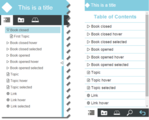
One of the hottest new features introduced in Adobe RoboHelp 11 is Responsive HTML5 layouts. The Responsive HTML5 output dynamically changes the way the content is presented based on the device the reader is using. For example, while a reader on a desktop might see a traditional table of contents on the right side of the page, someone using a smart phone will see a table of contents that is optimized for touch:
Responsive HTML5 output uses Screen Layouts, the skins for HTML5 output. With these skins you can control how your output will look for your users.
If you have used Responsive HTML5 before, you may have seen the following layout in the gallery:
The image above shows the Responsive Layout as it was delivered when RoboHelp 11 was released. You'll be happy to know that Adobe released an update of this layout with the RoboHelp 11.0.1 patch.However, even if you have installed the patch you may still be using the old layout.
While Adobe provided instructions on how to manually install the new Responsive HTML5 layout, they are hidden away in the release notes and you likely missed them. If so, here they are:
Close RoboHelp.
Using Windows Explorer, search for%appdata%\Adobe\RoboHTML. (The RoboHTML folder hidden within your AppData folder opens.)
Rename the folder 11.00 to 11.00_old. (A new 11.00 folder will be created when you restart RoboHelp.)
Start RoboHelp.
You can now use the improved Responsive Layout for your output:
***
Looking to learn RoboHelp? We offer a live, two-day online RoboHelp class once a month. Feel free to contact us to learn other ways to meet your RoboHelp training requirements.
Icon Logic Blogs
.
Blog
.
<span class='date ' tip=''><i class='icon-time'></i> Jul 14, 2015 02:04pm</span>
|
|
Written by Chris Osborn Today's Q&A Thursday discusses organizational socialization. Stay Up-to-Date on the Most Current Business Training Trends BizLibrary offers 6,000+ training videos in various business training topics, with new courses added every day. How to Build a Business Case for Online Employee Training This complimentary eBook will help you get your online training proposal approved. It identifies the 5 key elements of a business case, discusses best practices, and includes examples to help you make your case solid. BizLibrary's Mobile Learning App meets the needs of today's digital learners. Employees no longer wait for training departments to push learning content to them. Employees are used to pulling information to themselves, when they need it, on their own terms and conditions, and on their own devices. - See more at: /technology/bizmobile.aspx#sthash.umjsk4e5.dpuf Video Transcription
Chris Osborn
.
Blog
.
<span class='date ' tip=''><i class='icon-time'></i> Jul 14, 2015 02:04pm</span>
|
|
In a previous post entitled The "m" in mLearning means More, I made a case for why I believe mobile learning has vastly more potential than eLearning, in no small part because of all the sensor superpowers built into mobile devices.
I’m writing an eBook now on my thoughts on mLearning, and among other things, I’m trying to expand on the definition we currently have on Wikipedia on what mLearning is. Here’s how Wikipedia defines mLearning today:
Any sort of learning that happens when the learner is not at a fixed, predetermined location, or learning that happens when the learner takes advantage of the learning opportunities offered by mobile technologies.[1] In other words mobile learning decreases limitation of learning location with the mobility of general portable devices. http://en.wikipedia.org/wiki/MLearning
I fully see the point contributors to this wikipedia article were trying to get across; after all, the mobile revolution is what made us realize there’s a computing paradigm shift taking place, and made us pay attention to the potential of learning through our mobile devices.
mLearning is bigger than mobile devices
However, in my book I argue that our vision would have to be fairly shortsighted to think that mLearning is only about today’s mobile devices.
The mobile revolution brought about an opportunity for us to stop and rethink Learning design in general, and it gave us a reset button in a similar way in which I believe The iPad and iPhone not supporting Adobe Flash is a Great thing for mLearning and also why I believe it still not time to remove the ‘e’ and ‘m’ and all other letters from Learning. All of these things are important because they will help us cross the big chasm that exists between the PC paradigm and the new mobile paradigm.
It’s not about the desktop vs. mobiles devices
I strongly believe the future of Learning design is about creating learning experiences that reach Learners anywhere and at anytime, but it’s especially about experiences that will adapt to whichever screen is at hand at the time.
In other words, it’s no longer about the desktop vs. mobile devices, it’s about the fact that our desktop computers have now been reduced to merely one screen in this ecosystem of screens, that is all around us.
It’s about an ecosystem of screens
The future as I see it, will consist of lots of "screens" everywhere, from our smartphones to our Tablets, from our PCs to our Smart TVs, but also screens when we arrive at the airport and when we board our plane and when we go shopping and in our cars, and I see our personal information seamlessly and fluidly following us from screen to screen via our own personal Cloud.
My point is that it’s not too early to start thinking about how we can design learning experiences that adapt nicely and seamlessly to multiple screens and take full advantage of the uniquely inherent attributes of each screen.
Having said that, as we design for a multiscreen ecosystem, I highly recommend we think mobile-first for all the reasons I outlined in this post.
More on this topic in the eBook I’m working on right now.
Let me know your thoughts and if you like this post, please share with your friends on Social Media.
RJ Jacquez
.
Blog
.
<span class='date ' tip=''><i class='icon-time'></i> Jul 14, 2015 02:03pm</span>
|