Blogs
|
I created a list of eLearning Paradigms to talk about subscription learning, but I think the list could stand on its own--and I'd like comments to see what I've missed.
Elearning is still a relatively young field, having its start in the 1960's during the advent of the computer age and gradually gaining a critical mass after the internet became a mass phenomenon. Because it's a young field, we are still learning how to think about elearning. With each new paradigm, we think more deeply, more fully about what elearning is--and can be. Below is my categorization of the most important elearning paradigms as of 2014.
eLearning Paradigms 2014
Content Presenter (enables content to be presented to learners)
Comprehension Tester (enables learners' knowledge to be tested--and feedback provided)
Practice Provider (enables learners' decision-making to be tested--and feedback provided)
Performance Supporter (enables performers to be prompted toward action)
Reminder (enables learners or performers to be reminded to learn and/or take action)
Social Augmentation Provider (enables learners to learn from and with each other)
Gamification Provider (provides motivational incentives and behavioral prompts to action)
Mobile Learning Provider (provides learning and/or performance support through mobile technology)
Data Utilizer (enables data collection and data-based interventions)
Video Provider (enables video to be utilized in various ways)
Learning Organizer (provides organizational structure around learning opportunities)
Personalizer (enables content or prompting to be individualized or tailored)
Learning-Delivery Augmenter (enables easy delivery of content or prompting)
Context-Based Triggerer (enables content or prompting to be delivered depending on context)
Cost Saver (enables learning to be delivered at a lower cost)
I'm sure that I'm missing some elearning paradigms. You might have noticed that I'm only listing elearning memes that have a positive connotation. I am not mentioning such things as boring, trivial, poorly-designed. Also, some of the list may not be true, or may not always be true. For example, I've recently read research that shows that elearning is not often a cost saver. The bottom line, however, is that the list above represents a good number of the ways in which we tend to think about elearning.
Here's the thing: The paradigms listed above represent the dominant mental models we use when we think about elearning. As Thomas Kuhn wrote many years ago, paradigms are a double-edge sword. On the one hand, they help us think. On the other hand, they put boundaries on what we think. For us in the learning field, we get both benefits and costs from our elearning paradigms. They help us consider ways that we might design or utilize elearning. On the darker side, they constrict our thinking. One of the reasons we created the eLearningManifesto was to get the field to think beyond some of its weaker paradigms.
What are your thoughts on the dominant elearning paradigms?
If you want to learn more about subscription learning--offered as an additional paradigm for elearning, you can do that at SubscriptionLearning.com.
Will Thalheimer
.
Blog
.
<span class='date ' tip=''><i class='icon-time'></i> Jul 15, 2015 01:48pm</span>
|
|
App smashing: The art of merging content from a variety of apps to generate a unique finished product. Sounds pretty cool, right? That’s because this latest edtech craze is an app-solutley amazing way for students to really unleash their creativity… A way for them to not only demonstrate information about a particular topic but an opportunity for them to show off their tech-knowledge-y skills in a unique manner… To be innovative with mobile devices and digital media!
Still not sure you’ve wrapped your mind around this concept? Then follow along as I explain how I created the embedded example to demonstrate how app smashing can enhance learning while maximizing the potential of digital tools by combining their features and functions to create a pretty sweet final project—one that should be published to the web. After all, digital presence is the new resume!
The learning objective: After a unit on ancient civilizations, students would be asked to complete a culminating activity by selecting an aspect of culture and then highlight what they’ve learned. I chose to focus on architecture/history.
The process: First, I selected a famous building from each civilization—Egypt, Rome, Greece and China—and located a picture for each. Each image was then imported into the Photo Mapo app to create a postcard that included a map and brief description of the structure.
After saving each new image to the camera roll, I imported them into the second app—Pic Collage—to generate a postcard mashup. Again, I saved the finished product to the device (in this case an iPad).
Finally, I imported the collage into the ThingLink app and created hot spots within each monument image containing links to resources that can be used to explore additional information. Besides super cool interactivity, ThingLink also has multiple options for sharing—as you can see by checking out the collage shown below.
Now is that cool stuff or what? But the learning doesn’t just end with the app smashing. Think about the various ways students could benefit from experimenting with each other’s masterpieces!
BTW—There are really no hard and fast rules when it comes to app smashing, although consider this: In order to be able to merge content, you do needs apps that are capable of both importing and exporting media to and from the camera roll.
Classroom Connection:
App smashing encourages the meaningful use of technology to meet a chosen learning objective. It promotes critical thinking and problem solving in a challenging yet fun and engaging manner as well.
I know it sounds cliche, but the possibilities are pretty much endless because really, there are no restrictions! And that’s because with app smashing—if you can dream it, chances are—you can also bring that vision to life with the number of apps that exist!
Oh, yeah… Did I mention that this hot edtech topic has its own hashtag? Yep, check it out at #AppSmash for lots of great ideas and resources!
Edutech for Teachers team
.
Blog
.
<span class='date ' tip=''><i class='icon-time'></i> Jul 15, 2015 01:47pm</span>
|
|
New research shows that while people tend to avoid saying hello to strangers, when they do say hello, they are happier for it. Read this nice article in the New York Times which describes the research.
I add this article to this blog on learning, because it reminded me that we in the learning field often put too much trust on our learners. The bottom line is that learners often don't know how best to learn.
This means that we shouldn't willy-nilly design our learning to enable our learners to do anything they want to. Sometimes this can be beneficial because it gives learners a sense of autonomy and it can help them get information they need--but more often than not, it enables learners to make bad decisions about their own learning.
The article also reminded me about research on creativity which shows that domain spanners--people who spend time interacting with others outside their main area of interest are often more creative because they draw from other spheres of thought. It's interesting that we are shy talking to strangers, even though doing so will not only make us happier, but it may enrich us ways we can't imagine.
Will Thalheimer
.
Blog
.
<span class='date ' tip=''><i class='icon-time'></i> Jul 15, 2015 01:47pm</span>
|
|
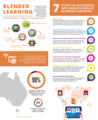
Making Blended Learning Work Infographic
In recent years, we have seen more and more Registered Training Organisations (RTOs) evolving their teaching by incorporating blended and online delivery modes. Blended learning, hybrid education, flipped learning, digitally-led teaching,.. whatever you choose to call it, the new wave of digital evolution is making clear headway, as RTOs realise the benefits that this has brought them. Originally designed for vocational training organisations in Australia, however the advice from the Making Blended Learning Work Infographic can be applicable to almost any other school or training organisation. The Making Blended Learning Work Infographic presents why a training organisation or a school should implement blended learning, and the 7 crucial steps to successfully implement it.
A few key points:
There are many reasons why training organisations or schools should consider blended learning as a delivery mode:
It provides more support and guidance than a fully online course. Consider your student needs: they may require a lot more tech support and hand-holding than you think.
A great way to cut down on delivery and operational costs.
Helping the school become less paper-heavy, eliminating human errors and non value-adding tasks.
Giving the school an ability to reach more students and scale quickly, without the huge overhead costs.
More face-to-face time is spent on practical skills training.
Responding to the requirements and preference of today’s students who are tech-savvy and enjoy collaborating with peers and teachers in real time.
When used properly, technology helps organisations and schools to deliver a high quality, engaging learning experience to more students and to collect the evidence of that delivery.
7 Steps to Successful Implementation of Blended Learning
Have a plan: Blending the delivery mode of your training courses is a strategic change that requires careful mapping and a clear "big picture" plan by senior management. Get experts involved early if required, don’t go in blindly.
Take baby steps, one target at a time: Systematically approach the execution process and learn quickly from your mistakes. Small successes will give you the know-how and motivation to do more and more.
Involve staff and students in the process: Don’t assume you know what your students and staff need or want. Ask them, and have feed back loops that allow them to provide feedback and comments.
Set clear learning goals: All activities - online or offline - should contribute towards the right learning goals. You should also set clear expectations for students from the start.
Have the right teaching resources: Material & resources for teaching online are very different from traditional ones. Interactive, engaging, bite-sized content can enhance the learning experience.
Make the system work for you: The right processes and workflows put in place will ensure that your courses are compliant. Consider your current systems and capabilities: in what way can you use technology to eliminate non value adding tasks?
Monitor, refine., and repeat: So you go live, and then..? Don’t forget to keep a close eye on the data collected: numbers and feedback can tell you whether the learning goals are fulfilled or not.
Via: www.circulus.com.auThe post Making Blended Learning Work Infographic appeared first on e-Learning Infographics.
eLearning Infographics
.
Blog
.
<span class='date ' tip=''><i class='icon-time'></i> Jul 15, 2015 01:47pm</span>
|
|
Robert Slavin, Director of the Center for Research and Reform in Education at Johns Hopkins University, recently wrote the following:
"Sooner or later, schools throughout the U.S. and other countries will be making informed choices among proven programs and practices, implementing them with care and fidelity, and thereby improving outcomes for their children. Because of this, government, foundations, and for-profit organizations will be creating, evaluating, and disseminating proven programs to meet high standards of evidence required by schools and their funders. The consequences of this shift to evidence-based reform will be profound immediately and even more profound over time, as larger numbers of schools and districts come to embrace evidence-based reform and as more proven programs are created and disseminated."
To summarize, Slavin says that (1) schools and other education providers will be using research-based criteria to make decisions (2) that this change will have profound effects, significantly improving learning results, and (3) many stakeholders and institutions within the education field will be making radical changes, including holding themselves and others to account for these improvements.
In Workplace Learning and Performance
But what about us? What about we workplace learning-and-performance professionals? What about our institutions? Will we be left behind? Are we moving toward evidence-based practices ourselves?
My career over the last 16 years is devoted to helping the field bridge the gap between research and practice, so you might imagine that I have a perspective on this. Here it is, in brief:
Some of our field is moving towards research-based practices. But we have lots of roadblocks and gatekeepers that are stalling the journey for the large majority of the industry. I've been pleasantly surprised in working on the Serious eLearning Manifesto about the large number of people who are already using research-based practices; but as a whole, we are still stalled.
Of course, I'm still a believer. I think we'll get there eventually. In the meantime, I want to work with those who are marching ahead, using research wisely, creating better learning for their learners. There are research translaters who we can follow, folks like Ruth Clark, Rich Mayer, K. Anders Ericsson, Jeroen van Merriënboer, Richard E. Clark, Julie Dirksen, Clark Quinn, Gary Klein, and dozens more. There are practitioners who we can emulate--because they are already aligning themselves with the research: Marty Rosenheck, Eric Blumthal, Michael Allen, Cal Wick, Roy Pollock, Andy Jefferson, JC Kinnamon, and thousands of others.
Here's the key question for you who are reading this: "How fast do you want to begin using research-based recommendations?"
And, do you really want to wait for our sister profession to perfect this before taking action?
Will Thalheimer
.
Blog
.
<span class='date ' tip=''><i class='icon-time'></i> Jul 15, 2015 01:47pm</span>
|
|
Today's New York Times has a fascinating article on the mostly European concept of practice firms. As the name implies, practice firms give people practice in doing work.
This seems to align well with the research on learning that suggests that learning in a realistic context, getting lots of retrieval practice and feedback, and many repetitions spaced over time can be the most effective way to learn. Of course, the context and practice and feedback have to be well-designed and aligned with the future work of the learner.
Interestingly, there is an organization that is solely devoted to the concept. EUROPEN-PEN International is the worldwide practice enterprise network. The network consists of over 7,500 Practice Enterprises in more than 40 countries. It has a FaceBook page and a website.
I did a quick search to see if there was an scientific research on the use of practice firms, but I didn't uncover anything definitive...If you know of scientific research, or other rigorous evidence, let me know...
Will Thalheimer
.
Blog
.
<span class='date ' tip=''><i class='icon-time'></i> Jul 15, 2015 01:47pm</span>
|
|
Top Rules of Engaging eLearning Infographic
Engaging eLearning, i.e. eLearning that makes the audience actively participate and pay attention, is an art all of its own. The Top Rules of Engaging eLearning Infographic presents the rules for creating engaging eLearning content.
1. Know Your Audience
Ask yourself these questions: Who are they? What do they like? How do they spend their time? How do they like to communicate? How do they like to receive communication? What annoys them?
2. Know Your Topic
It takes half a second to realize that the author of a course knew nothing about their topic. Engage subject matter experts and ask all the questions that you think might come up in the training.
3. Keep It Organized
The topics that are covered in an eLearning course should be relevant to the course itself. Headings and subheadings should clearly describe what the learner can expect to read, gather and gain from the content.
4. Keep It Simple
When creating an eLearning course, use clear and simple language and stay away from jargon.
5, Keep It Interactive
Interaction is import to retain your users. Note, though, that while interaction is good, too much interaction can be distracting.
6. Keep It Short
The maximum attention of a human being is not quite as much as we would like it to be, therefore, keep the courses short.
7. Keep It Relevant
Most boring courses are the result of the content not being relevant to the learner. Even if you build simple compliance training, there’s a way to make it relevant. Talk to your learners and find out how they use the compliance information. Then place the course in a context where it makes sense for the learner.
8. Free Up The Navigation
People like to explore and experiment. It helps them build context. Locked navigation doesn’t allow this.
View also:
10 Tips to Get eLearners Engaged Infographic
8 Ways to Engage eLearners Infographic
Engaging Students in eLearning Infographic
Engaged vs Unengaged Learners Infographic
Boosting Learner Engagement with Rich Media Infographic
Read also:
9 Tips To Improve Online Learners’ Engagement
Guiding Your Learner Toward Engagement
5 Tips To Drive Up Learner Engagement Online
Via: www.talentlms.comThe post Top Rules of Engaging eLearning Infographic appeared first on e-Learning Infographics.
eLearning Infographics
.
Blog
.
<span class='date ' tip=''><i class='icon-time'></i> Jul 15, 2015 01:46pm</span>
|
|
Phones, tablets, iPads and e-readers… What do these mobile devices have in common? It’s probably a pretty safe bet to say that most students own at least one of them in this day and age. So, instead of continually confiscating these items or telling students to put them away, why not take advantage of the handheld gadget craze and leverage these tools for learning?
Allowing students to utilize their own devices provides them with access to a variety of digital activities, essentially creating a 1:1 environment with a tool they already know how to use.
Furthermore, with many schools experiencing limited budgets, the BYOD concept is one that should be seriously considered. Without devices to complement learning, students are missing out on a modernized education as well as the development of important life skills. Yeah, that means actually having the know how to use technology beyond gaming and social media!
Sure, I know what you might be thinking: That sounds great, but what about privacy, security and safety? Yep, the concerns associated with implementing mobile devices in the classroom are legitimate, but they can be addressed by developing clear expectations and guidelines and by teaching our students the importance of digital responsibility.
Check out the infographic shown below outlining ten simple yet effective ways to impact the learning process with mobile device and real-world activities. Perhaps the tips included will entice you (and your administration) to give it a shot!
A shout out to Splash Math for sharing this nifty visual.
Classroom Connection:
Use the ideas mentioned in the infographic/visual to kick start or further enhance a mobile movement in your school and/or classroom.
Edutech for Teachers team
.
Blog
.
<span class='date ' tip=''><i class='icon-time'></i> Jul 15, 2015 01:46pm</span>
|
|
June is Debunk Learning Styles Month in the learning field!
One of the most ubiquitous myths in the world today, learning styles has risen to a crescendo within the workplace learning field and in education as well. The idea is that if you diagnose learners on their learning styles and then tailor learning methods to the different style -- that learning results will improve.
It's a widespread belief, but it's actually false. Research evidence suggests that using learning styles to guide learning design does not improve learning results.
The good news is that there are several solid research reviews that demonstrate this. Indeed, The Debunker Club, which I organize, has compiled some excellent resources for folks who want to see the evidence.
To see The Debunker Club resource page on learning styles, click here.
To join The Debunker Club in debunking learning styles now (June 2015), click here.
To become a member of The Debunker Club, click here.
Will Thalheimer
.
Blog
.
<span class='date ' tip=''><i class='icon-time'></i> Jul 15, 2015 01:46pm</span>
|
|
Eric Mazur, who I had the pleasure of meeting several years ago in his on-campus office, won the Minerva Prize, which is dedicated to rewarding "extraordinary innovation" in teaching.
Mazur, a professor of physics at Harvard University, developed the peer instruction method out of frustration with his students’ erroneous conceptions of physics. Too many of them utilized naïve mental models about the physical world in thinking about physics. Mazur wanted them to think like physicists. Unfortunately, his early attempts to improve their physics thinking had failed. He found that just presenting correct concepts was not effective in modifying his students’ faulty mental models.
Mazur’s Peer Instruction method begins with a question designed to surface misconceptions. Learners answer the question, and then talk with their classmates, before a class-wide discussion is engaged. By recognizing and confronting misconceptions, Mazur is better able to help his learners build correct physics conceptions.
To learn more about peer instruction:
Read Mazur's Book (which is focused on how to teach physics)
Look at some research
Read about it on Wikipedia
See Mazur on YouTube (this is very funny at times!)
Read about the Minerva Prize on the Boston Globe
Read Peer Instruction Blog by Julie Schell
Will Thalheimer
.
Blog
.
<span class='date ' tip=''><i class='icon-time'></i> Jul 15, 2015 01:46pm</span>
|