Blogs
|
The "Learning Benefits of Questions" is a research-to-practice report on how to use questions to boost learning results. First published back in 2003, and partially funded by Questionmark (to whom I am still grateful), the Learning Benefits of Questions was inspired by fundamental learning research, provided a practical perspective, and even provided a diagnostic to help readers determine how well they understood questions for learning.
Still getting requests and seeing people refer to this research-to-practice report, I've decided to reissue the report, with a few minor improvements. You can download the report using the following link:
Download Learning Benefits of Questions 2014 v2.0
You can also see our other papers, articles, and job aids at the Work-Learning Research catalog.
Will Thalheimer
.
Blog
.
<span class='date ' tip=''><i class='icon-time'></i> Jul 15, 2015 01:45pm</span>
|
|
To honor David Letterman soon after his sign off, I'll use his inverted top-10 design.
The following represent the Top 10 Reasons to Write a Blog Post Debunking the Learning Styles Myth:
10. Several scientific review articles have been published showing that using learning styles to design learning produces no appreciable benefits. See The Debunker Club resource page on learning styles.
9. If you want to help your readers create the most effective learning interventions, you'd do better focusing on other design principles, for example those put forth in the Serious eLearning Manifesto, the Decisive Dozen, the Training Maximizers Model, or the books Make It Stick, How We Learn, or Design for How People Learn.
8. There are already great videos debunking the learning-styles myth (Tesia Marshik, Daniel Willingham), so you're better off spreading the word through your own blog network; through Twitter, Hangouts, and LinkedIn; and with your colleagues at work.
7. The learning styles myth is so pervasive that the first 17 search topics on Google (as of June 1, 2015) continue to encourage the learning styles idea -- even though it is harmful to learners and wasteful as a learning method. Just imagine how many lives you would touch if your blog post jumped into the top searches.
6. It's a total embarrassment to the learning fields (the K-12 education field, the workplace training field, higher education). We as members of those fields need to get off our asses and do something. Haven't teachers suffered enough blows to their reputation than to have to absorb a pummeling from articles like those in The New York Times and Wired Magazine? Haven't instructional designers and trainers been buffeted enough by calls for their inability to maximize learning results?
5. Isn't it about time that we professionals took back our field from vendors and those in the commercial industrial complex who only want to make a buck, who don't care about the learners, who don't care about the science, who don't care about anything but their own special interests? Do what is right! Get off the mat and put a fist in the mouth of the learning-styles industrial complex!
4. Write a blog post on the learning-styles myth because you can have a blast with over-the-top calls to action, like one I just wrote in #5 above. Boy that was fun!
3. There's some evidence that directly confronting advocates of strong ideas -- like learning-styles true believers -- will only make them more resistant in their unfounded beliefs. See the Debunkers Handbook for details. Therefore, our best efforts may be to focus not on the true believers, but on the general population. In this, our goal should be to create a climate of skepticism in terms of learning styles. You can directly help in this effort by writing a blog post, by taking to Twitter and LinkedIn, by sharing with your colleagues and friends.
2. Because you're a professional.
1. Because the learning-styles idea is a myth.
Insert uplifting music here...
Will Thalheimer
.
Blog
.
<span class='date ' tip=''><i class='icon-time'></i> Jul 15, 2015 01:45pm</span>
|
|
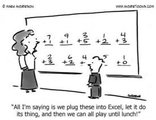
As Quincy Jones once remarked, "I’ve always thought that a big laugh is a really loud noise from the soul saying, "Ain’t that the truth."
That said, Edu-fun Friday is a series devoted to adding some humor to the lives of teachers who visit this blog. Even though it’s summer, there’s still nothing better than ending the week on a positive note! Plus, do we have some of the best topics to provide us with some comic relief or what?
I’m pretty sure this is what the lesson would look like if we let the digital natives run the show! You have to admit—he does have a point!
Thanks to cartoonist Mark Anderson for the laugh!
Edutech for Teachers team
.
Blog
.
<span class='date ' tip=''><i class='icon-time'></i> Jul 15, 2015 01:45pm</span>
|
|
Using Google Tools in Project-Based Learning Infographic
Project-based learning is a dynamic approach in which students actively explore real-world problems and challenges and acquire a deeper knowledge. Project-based learning should be student-driven, with a real-world connection. It should be core to learning, include structured collaboration, and have a multifaceted assessment. Giving students a real problem to solve, getting them engaged in their work, having them work with others, and assessing their work with more than just a grade sounds a lot like how many things in the ‘real world’ work, doesn’t it? After all, aren’t we trying to prepare students for the world after school?
Many of the digital tools used in classrooms are made especially for education. This is a great thing in many ways, but if you can integrate tools that students will also encounter in the real world, that should be considered a bonus, too. So why not dig deep into your Google Toolkit and build your project based learning tasks to use these tools? The Using Google Tools in Project-Based Learning Infographic presents how teachers can use google apps in project-based learning to streamline learning and processes and bring a wealth of information to their students’ fingertips.
Inquiry Tools
Once you’ve decided what the students will be focusing on, they’ll need more information on the topic. Google’s general search is a great place to start, but there are a number of other more specific tools that can help them both become better searchers and narrow down their searches a bit.
Google PowerSearch
Search Lesson Plans
Google Scholar
Patent Search
Create a custom search engine
Explore search trends
Image Search
Video Search
News Search
Google Earth
Google Books
Communication and Collaboration Tools
As a part of their work, students will likely need to connect with others - with collaborators in the classroom and with folks around the globe that can help them learn about what they need to know.
Google+
Gmail
Groups
Hangouts
Drive
Calendar
Expression Tools
An integral part of project-based learning is students having a voice in their work. When you need to get feedback from your students, put Google Forms to work for you. You can pose specific questions and pool the answers. Alternatively, creating a Site for your class can allow for a collaborative online space. A discussion forum using Groups can keep everyone in the loop and give everyone a voice.
Tools for Sharing, Presenting, Feedback, and Assessment
Project-based learning encourages sharing work and receiving feedback that is more meaningful than just a grade. Students will be sharing their work with more than just the teacher or the rest of their class. They can build websites, create photos, videos, maps or multimedia presentations. With many of these tools, the ‘showing’ doesn’t need to be static. The documents and products can continually evolve along with the project over time.
Google+
Sites
Blogger
Drawings
Drive
Slides
Gmail
Google Cloud Print
Picasa
YouTube
Panoramio
Via: dailygenius.comThe post Using Google Tools in Project-Based Learning Infographic appeared first on e-Learning Infographics.
eLearning Infographics
.
Blog
.
<span class='date ' tip=''><i class='icon-time'></i> Jul 15, 2015 01:45pm</span>
|
|
I'm a bad blogger. I don't analyze my site traffic. I don't drive my readers down a purchase funnel. I don't sell advertising on my blog site. I'm a bad, bad blogger.
Two months ago, I set up Google Analytics to capture my blog's traffic. Holy heck batman! I found out something amazing, and I'm not really sure how to think about it.
Over April and May 2014, my most popular blog post--that is, the one most visited--was a blog post I published in 2006. How popular was this 2006 blog post? It accounted for 50% of all my blog traffic! Fifty freakin' percent! And April and May have been relatively busy blog posting months for me, so it wasn't like I wasn't creating new traffic.
What blog post was the envy of all the others?
It was this one, on one of the biggest myths in the learning field.
I guess this makes sense, (1) it's important, (2) the myth keeps resurfacing, and (3) by now the link has been posted in hundreds of places.
If I die today, at least I have made a bit of a difference, just in this blog post.
I'm a bad, bad blogger. <<<<<WINK>>>>>
Will Thalheimer
.
Blog
.
<span class='date ' tip=''><i class='icon-time'></i> Jul 15, 2015 01:45pm</span>
|
|
People have been cheering on the Serious eLearning Manifesto for over a year now...
Those of us who instigated the effort have been delighted with stories about how people are integrating the Manifesto and its 22 principles into their work.
Here's an example from Mark T. Burke, Founder and Lead Innovative Educational Program Designer for ThinkID8 and elearning consultancy. Mark believes so strongly in the eLearning Manifesto that he's created a series of posters in his office.
Asked why he did such a thing, he said, "I was looking for something I could use as a personal framework. So, as you can see, I adapted the opening statements to 'I....' statements. Of course, I did this to demonstrate to others MY commitment to the collective vision of the Manifesto."
Kudos to Mark!
Postscript
I met Mark as he led a workshop with Dr. Karl Kapp at Bloomsburg University for instructional designers. The workshop is fascinating in that it's designed to help instructional designers learn how to take more entrepreneurial approaches to their work and careers.
Will Thalheimer
.
Blog
.
<span class='date ' tip=''><i class='icon-time'></i> Jul 15, 2015 01:45pm</span>
|
|
The spacing effect is one of the most potent learning factors there is--because it helps minimize forgetting.
Here's a research-to-practice report on the subject, backed by over 100 research studies from scientific refereed journals, plus examples. Originally published in 2006, the recommendations are still valid today.
Click to download the research-to-practice report on spacing. It's a classic!
And here's some more recent research and exploration.
Will Thalheimer
.
Blog
.
<span class='date ' tip=''><i class='icon-time'></i> Jul 15, 2015 01:44pm</span>
|
|
Like an arrow through the heart! Max Roser's tweet really kills. With his one tweet he spread false, misleading, and dangerous information to thousands -- maybe tens of thousands -- of people across the globe. 223 Retweets. 198 Favorites. Egads. What a disaster!
More reason The Debunker Club is needed. More reason for you to help debunk these myths!
Please, someone, please send me a tranquilizer...
And apologies to Max. I'm sure he's a fine human being. And of course he's not the only one who sends this bad information around (we have evidence that 223 others followed his lead), so I shouldn't really be focused on the poor lad....
But cripes! How do people get through the education system not knowing not to pass information around without at least a hint of skepticism, without checking sources, without taking a breath of oxygenated air...
Here's the evidence that this information is bogus: http://www.willatworklearning.com/2015/01/mythical-retention-data-the-corrupted-cone.html
Will Thalheimer
.
Blog
.
<span class='date ' tip=''><i class='icon-time'></i> Jul 15, 2015 01:44pm</span>
|
|
Student Summer Storage Tips Infographic
When you’re a student packing up all your possessions and transporting them back home every summer is a real chore. Dragging suitcases and bin liners full of dirty clothes on to a train or into the back of car is hard enough, but what about those duvets and pillows, computers, TVs, posters etc?
Over the course of a year, you’d be amazed how many extra items you pick up, even with only a maintenance loan to spend. As well as the standard additions of text books and learning equipment, there’s the additional memorabilia from spectacular nights to think about, the useless tat bought on Amazon at god knows what hour in the morning and the additional beer glass you might pick up at the odd bar.
Well, do not fear, help is on hand as the Student Summer Storage Tips Infographic shows there are plenty of storage options available that will save you or your parents having to hire a van to transport your goods up and down the motorway. Perfect for any student attending university or college wary of asking their parents for a favour!
View also:
College Student Storage Tips Infographic
Via: www.kellystore.co.ukThe post Student Summer Storage Tips Infographic appeared first on e-Learning Infographics.
eLearning Infographics
.
Blog
.
<span class='date ' tip=''><i class='icon-time'></i> Jul 15, 2015 01:44pm</span>
|
|
So, last week I shared an app smashing student project idea using Photo Mapo, Pic Collage and ThingLink. It received such rave reviews that I decided to have at it again—only this time I’m smashing some vacation photos with Pic Collage, ThingLink and Google Docs to develop an interactive learning journey.
Dubbed "Where in the World", this creation will challenge students to use information that identifies an unknown geographical location. In the process, they will hone their ability to read for details, conduct Internet searches and complete an online form as well.
Be sure to check out the interactive "hotspots" by hovering over the collage shown below.
Click here for a full screen version of this interactive image.
And BTW—in case you’re wondering… I did actually create this masterpiece while sitting on one of those beaches pictured in the collage using my iPad. And yes—I know… I need a tech-free intervention. I’m fully aware of my addictions, but the idea came and well, I just couldn’t let it go!
Classroom Connection:
Affording students with the opportunity to utilize interactive activities engages them in learning that is meaningful, relevant and thought-provoking. Plus, completing a project of this nature allows them to demonstrate the use of a variety of digital skills in the process.
This particular app smash was created for student use, but of course—they could also design their very own Virtual Destination mash-up to share with classmates.
Edutech for Teachers team
.
Blog
.
<span class='date ' tip=''><i class='icon-time'></i> Jul 15, 2015 01:44pm</span>
|