Blogs
|
I had the privilege yesterday of leading the Smackdown at the 38th Annual School Administrators of Iowa Conference.
The links and resources were flying furiously, and we did our best to capture them all:
Tools:
SweetSearch, A Search Engine for Students, via @AngelaMaiers
YourSphere, a community platform that helps students connect, create & share their work via @AngelaMaiers
Common Sense Media. digital citizenship curriculum for students, reviews & advice for adults
Hello Slide - give voice to your presentations via @jenwoodley24
Voki, talking avatars, useful for ESL
Remind101, safe texting
FlipBoard, social magazine
MobyMax, vocabulary development
Flash Panel, Cloud Management for Google Apps via @jenwoodley24
Blue Jeans Video Collaboration in the Cloud via @jenwoodley24
http://www.graphite.org/#.UgOdh9iCdaE.twitter Ingredients for Effective Teaching via @principaljgross
Symbaloo, bookmarking site utilizes titles via @ahuseman
Duo Lingo, Free Language Education for the World, via @jenwoodley24
Cedar Valley West School to Work, via @rcunningham78
Powtoon, A new kind of animated presentation tool via @jensigirst
Sites for Resources:
Iowa AEA Pinterest Board via @iowa_aea
findingDulcinea via @AngelaMaiers
Cybraryman, Resources for all things cybrary via @ahuseman
NY Times Learning Blog, search by content area for lessons/stories via @jenwoodley24
Connected Principals, a network of principals via @jenwoodley24
Symbaloo - Shannon Miller’s Resources, via @jenwoodley24
Teaching Channel, videos of teachers teaching in real classrooms, via @ahuseman
FreeTech4Teachers, Emerging technologies/resources via @jenwoodley24
101 Great Sites for Social Studies Class, via @AngelaMaiers
Presentations
Transforming your teacher librarian into a leader (Resources)
Transforming Your Teacher Librarian Into a Leader (Audio)
Iowa School Libraries: A Student-Centered Vision
Shaping a Vision for the Success of All Students
Articles/Videos:
Ted 2012 Remix, via @AngelaMaiers
Hello Literacy, via @kimjtierney
Big Ideas Group ties innovation, community in Cedar Rapids (Iowa Public Radio)
Vision for Iowa’s School Libraries
What Works: School Connectedness, a great resource on building a culture of excellence via @colinwikan
The 5 Best Practices to Consider When Using Facebook with Students via @crescerance
Jeff Bliss Remix- You Gotta Touch His Heart
West Monona Facebook page
*****
Additionally, at previous SAI Conferences, I have been asked to share tools and resources that will be useful when adopting the Common Core. Here is a list of resources I’ve assembled with my colleague and partner Mark Moran, CEO of Dulcinea Media, creator of findingDulcinea and SweetSearch:
SUGGESTED RESOURCES FOR IMPLEMENTING THE COMMON CORE
Evaluation of Online Material
Ten Steps to Better Web Research
Collaboration Tools
Wiggio: An free online collaboration tool that enables students to create groups, each with a unique web address, host web meetings, manage events, share files, send emails, text, send video messages and voice blasts.
Edmodo is a social network designed for students and educators.
Bookmarking and Note-Taking Tools
Evernote is a tool that helps students and teachers manage digital information. See the Evernote for Schools blog.
Symbaloo enables teachers and students to save their favorite websites as clickable "tiles" on a single page.
Tools for Students to Create and Publish Content Online
Blog platforms
WordPress is free blogging software widely used by professionals. WordPress.com is a free, hosted version, while WordPress.org is a more flexible version that requires your own Web host. This post explains the difference between them.
KidBlog provides teachers and students with a secure, private classroom blogging space.
Video Production
ScreenFlow is powerful, easy-to-use screen recording and editing software for the Mac.
Camtasia also offers screen recording and editing software for Windows and the Mac.
We Video is a collaborative video creation platform.
Video Publishing
YouTube Teachers makes it easier for teachers everywhere to find, make, share, and use videos educationally.
SchoolTube is the nation’s largest K-12 moderated video sharing platform for students and educators,and is endorsed by many national education associations.
Vimeo is also a video-hosting platform that provides lessons for making videos.
Presentations
Prezi is a unique online presentation tool that enables students to create and share.
SlideRocket is also a collaborative online presentation tool.
SlideShare is a place to publish presentations; it is one of the most visited sites on the Web.
Search Engines and Other Discovery Tools for Teachers and Students
SweetSearch is a curated search engine that searches only 35,000 authoritative resources. It heavily emphasizes primary source materials in its search results.
Science.gov "searches over 50 databases and over 2100 selected websites from 14 federal agencies, offering 200 million pages of authoritative U.S. government science information including research and development results."
Europeana explores the digital resources of Europe’s cultural institutions.
Wolfram Alpha is a "computational knowledge engine" that is great for math and science. It has created a guide for educators, complete with examples of how it can be used in the K-12 classroom.
Twitter is a real-time discovery and interaction platform. Read Guide to Twitter in the K-8 Classroom.
USING PRIMARY SOURCES
Advice for Teaching with Primary Sources
Primary Sources: At the Heart of the Common Core Standards
Using Primary Sources on the Web, Reference & User Services Association, American Library Association, 2003.
Top Ten Tips for Facilitating Effective Primary Source Analysis, Stephen Wesson, Teaching with Library of Congress.
Smithsonian Source offers advice and examples for teaching with primary sources for topics in American history.
Center for History and New Media offers several dozen case studies teaching world history with primary sources.
The Primary Source Librarian, a blog dedicated to teaching with primary sources, by Mary Johnson, librarian.
Curriculum specialist Glenn Wiebe offers the "DESCRIBE" method for analyzing a primary source document.
Canton’s Class, "Using Your Life to Teach Primary Sources."
Websites, Directories, and Search Engines for Finding Primary Sources
National Archives’ Teachers Page provides eight links as starting points for locating documents. The site is searchable by topic, by state and by historical era. There are also focused lesson plans and activities available. The Archives also manages the online collections of the presidential libraries of all U.S. presidents since FDR. Visit the DocsTeach section, where students and teachers together create their unique activities, which build specific competencies such as historical comprehension or chronological thinking. The "Eyewitness" section hones in on particular events and episodes in history.
Library of Congress also offers a teacher’s page. Browse pre-organized primary resource sets or search by state, or use the Today in History feature to find primary sources relating to a specific event. The LOC even offers a self-directed teaching module to help guide your search. The LOC’s American Memory project is a goldmine for U.S. History teachers. When using it, note the subject heading of the resources you find and the key terms you use, as links are deactivated from time to time.
The World Digital Library is searchable by place, time (as far back as 8,000 B.C.), topic and type of item, such as books, journals, maps and sound recordings. The site was developed by the Library of Congress, in partnership with UNESCO.
The Gilder Lehrman Institute of American History offers its own collection of primary sources, as well as thiscurated page of links to websites containing primary sources for history.
The University Library for California State University has curated primary sources across 11 categories; the "Event Specific" category is particularly useful.
The Institute of Historical Research at the University of London has a number of digital projects that assemble primary sources from British and Irish history.
The University of Sydney has curated links to primary sources for Australian history.
101 Great Sites for Social Studies Class, findingDulcinea, 2011.
9 Sites to Find Interesting Interviews, findingDulcinea, 2011.
Political Cartoons in America, by Christopher Coats, findingDulcinea, October 23, 2008.
findingDulcinea Web Guides: Native American History, The American Revolution, The Civil War, The U.S. in World War II, Civil Rights Movement and Slavery in America.
CybraryMan’s Primary Sources, a collection of links for teaching with and locating primary sources, aggregated by retired teacher and librarian Jerry Blumengarten.
Newspaper and Magazine Archives
Google Newspapers offers the ability to search thousands of historic newspapers at once.
Time offers archives back to 1923; free to subscribers
The Atlantic andThe New York Times offer a mix of free and paid articles going back more than a century.
The Paris Review offers author interviews from the past six decades.
The New York Times Learning Network bundles many of its articles into pre-packaged lesson plans
British Pathé offers more than 90,000 images and newsreels, both silent and with sound, dating back more than a century; also on YouTube
Chronicling America enables users to search and view newspapers from 1836-1922
The National Library of Australia’s Trove enables users to search historic Australian newspapers, recordings, images and other media
Rag Linen is an online museum and educational archive of rare and historic printed newspapers
Sports Illustrated Vault offers all the magazine’s articles since its 1954 debut
Cornell University and University of Michigan libraries’ Making of America projects are collections of journals and newspapers from the antebellum, wartime and reconstruction periods
Wisconsin Historical Society has scanned every issue of Freedom’s Journal, the first newspaper owned and operated by African-Americans
Angela Maiers
.
Blog
.
<span class='date ' tip=''><i class='icon-time'></i> Jul 16, 2015 09:23am</span>
|
|
This is a guest post from Amelia Friedman, a senior at Brown University. Amelia is also founder of Student Language Exchange, which introduces undergraduate students to languages and cultures that they do not have formal access to through their college curriculum.
Please support this essential program with a small donation to its crowdfunding campaign.
To learn more, visit its website, Facebook page, or follow its Twitter feed.
*****
"The United States may be the only nation in the world where it is possible to complete secondary and postsecondary education without any foreign language study whatsoever."
— Leon Panetta, Former Secretary of Defense
About 10 percent of native-born Americans— individuals who went through our education system— speak a language other than English. Many of these people learned their language from immigrant parents or through an avenue other than our public education system. Compare that to the over 60 percent of Europeans that speak a second language.
It’s not all bad news. In colleges and universities, enrollment is increasing, especially in languages like Arabic and Chinese. Increases in less commonly taught languages (e.g. Farsi, Kiswahili) have been particularly impressive at 31.2% between 2002 and 2006. Not bad at all.
But, through all of this data, there are certain languages that aren’t even part of the conversation. I’m going to list the 24 most widely spoken languages in the world (in order), and I challenge you to identify where they are primarily spoken:
Chinese
Spanish
English
Hindi
Arabic
Portuguese
Bengali
Russian
Japanese
Javanese
German
Lahnda (Panjabi, Seraiki)
Telugu
Marathi
Tamil
French
Vietnamese
Korean
Urdu
Italian
Malay
Persian
Turkish
Oriya
Some of these languages are studied by millions of students (K-16) every year. Some of them are only studied by a handful of eager college students. Some of them are not offered by a single institution.
Language learning is important. But learning Spanish, French and German is not enough. If we want to prepare our kids to communicate with people from around the world, we need to diversify language learning in this country.
I have just finished my third year at a prestigious American university that prides itself on creating spaces for free inquiry and promoting global learning. Here, I’ve made language learning the centerpiece of my education, studying five languages through the formal curriculum and several more in my free time. I’ve been disappointed to learn, however, that 10 of the 24 most widely spoken languages aren’t part of the 30+ languages offered here. More than half of our languages are European, and not a single African language finds itself in our curriculum.
Three years ago, Secretary of Education Arne Duncan told us that we need to ramp up our commitment to foreign language education, not just in European languages— 95% of college students are already studying them— but to these underrepresented languages. These languages are integral to our country’s success in our rapidly globalizing society. He challenged us to address "spotty" language education because, "today more than ever a world-class education requires students to be able to speak and read languages in addition to English." In 2004, the Modern Language Association reported on what they called "the nation’s language deficit": Students are not learning languages at a rate that supports our global interests. This remains true even for those languages labeled critical languages by our State Department.
This isn’t an easy problem to fix; three quarters of states report shortages in qualified foreign language teachers. And, in my experience, many students haven’t even heard of some of the languages from the list above, much less considered studying them. So, if we’re going to change the status quo, we need to renew our commitment to language education— we need to get American students excited about language learning now!
The Student Language Exchange is a first step in bringing diverse languages to the American consciousness. We mobilize international students studying in the US (there are 1.7 million at last count) to bring these underrepresented languages to our college campuses. At our pilot institution, we’re pulling languages like Bengali, Thai, Kiswahili, Bulgarian and Tagalog into the campus conversation. By building spaces for our peers to teach language and share their culture, we are able to get kids excited about learning these often-forgotten languages, and motivate them to use their newfound language skills to do something important. We’ve had former participants teach or study abroad, find passion in international social justice work, change their entire academic trajectory, or even discover their ideal global career following a Student Language Exchange experience.
At my university, we have been successful in diversifying language learning and cultural exploration. Now, we’re working to expand to new schools and build a larger movement that will begin to touch K-12 education as well. Last week, we launched our crowdfunding campaign so that we can execute our expansion plan. If you believe in the power of language learning, please join our movement!
As we prepare the next generation of world leaders, we need to consider how they will communicate with their peers around the world. How will we learn from one another? How will we expose ourselves to new cultures? How will we build a global conversation that celebrates diversity and encourages global cooperation?
Language education is only one part of the equation, but it’s the first step toward building an open, honest, respectful global society. Yes, English is becoming a global language. But language study is still critical. Encouraging language education encourages cultural awareness and appreciation. Learning another’s language can be a symbol of respect, showing people that you value their culture— even if they’ve learned your language, you are still working to meet them partway.
And not everyone in the world has the opportunity to learn English: Children around the world are denied educational opportunities. If we don’t learn these underrepresented languages, if we wait until the rest of the world learns English, people at the bottom of the socioeconomic pyramid will continue to be left out of the global conversation.
We cannot continue to put language learning on the backburner— when we scrimp on language learning, we are putting our future on the line. Help us remind our students that global communication is important, and that everyone’s voice— no matter how far or how small— matters.
Angela Maiers
.
Blog
.
<span class='date ' tip=''><i class='icon-time'></i> Jul 16, 2015 09:22am</span>
|
|
Today I had the honor of making a presentation to the employees of Strategic America, one of the leading marketing agencies in Iowa. My audience was 100 top corporate branding experts. I discussed personal branding, and how it has changed in the social media age. Here is my slide deck; I hope to make the video available in the next few weeks.
Why You Should Care and Be Aware - Brand You! from Angela Maiers
Angela Maiers
.
Blog
.
<span class='date ' tip=''><i class='icon-time'></i> Jul 16, 2015 09:21am</span>
|
|
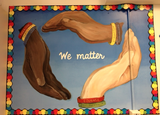
Wendy Bellagamba and Rachel Sepe, 4th grade teachers at Hough Street School in Barrington, IL, are "Teachers with Habitudes." They have a passion for helping students become involved citizens who fully develop their genius. This guest post by Wendy and Rachel describe how the mural posted above came to be on her classroom wall.
The inspiration for the mural came from Angela Maiers’ book, Classroom Habitudes. As we were studying the book at a staff meeting last spring, we brainstormed ideas to use "We Matter" in our room and with our students.
Rachel suggested a mural. Wendy knew her daughter, Christine, would jump in to help this summer, using her art background. We wanted the mural to illustrate that we all matter to each other in our classroom and school community.
Christine found the design, and it was her idea to show diversity with the hands. We knew we wanted to list the Habitudes in the mural, and, when our class birthday wristbands arrived in the mail, we thought wristbands with the words would work!
Christine created a stencil for the title, and we decided to keep it smaller so that photos of the students, or creations made by the students demonstrating the Habitudes could be added to the mural throughout the school year.
It was so much fun to create this with Christine, and as Angela says in her book, "spread the message of the habitudes’ powers in our classroom." It is also "an important reminder that we do nothing alone."
When Wendy was a student at Drake University, she read Inviting School Success by William Purkey. Purkey’s book has always stuck with her and helped her form her philosophy of education. It reminds us of Classroom Habitudes because it was written to be helpful to those who wish to improve the education of all students and, at the same time, approaches it from a humanistic viewpoint. Both books invite students, and teachers, to see themselves as able, valuable and self-directing.
We’re looking forward to teaching your lessons in the months and years ahead!
Angela Maiers
.
Blog
.
<span class='date ' tip=''><i class='icon-time'></i> Jul 16, 2015 09:20am</span>
|
|
This spring, Choose2Matter sponsored the Quest2Matter, which challenged students to take action to change our world.
Despite this being the first Quest, its short duration, and its coming at the end of the year, more than 100 inspiring quests were submitted.
Today, the Academy of Education Arts and Sciences announced that Mallory Fundora, founder of Project Yesu, will be the honoree for Student Initiative at the 2013 Bammy Awards in Washington, D.C.!
Please make a small donation to help us send Mallory to Washington, D.C. to collect her award! Click here for the donation page.
Mallory has raised tens of thousands of dollars to provide food, medicine and education to orphans in Uganda; it all started when she decided she no longer wanted Christmas presents for herself, but instead wanted funds used to support those in need.
http://www.youtube.com/watch?v=ouFqJLU0jGE
Read Mallory’s reaction on the Project Yesu blog.
Angela Maiers
.
Blog
.
<span class='date ' tip=''><i class='icon-time'></i> Jul 16, 2015 09:19am</span>
|
|
At East Greenwich High School in Rhode Island, "Mattering" is on the schedule!
Vice Principal, Tim Chace, believes that the relationship formed between a teacher and his student is more important, and will go further, than the content learned.
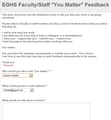
Inspired by the "You Matter" Talk at TEDxDesMoines, Tim created a "You Matter" Form for his school where both teachers and students could fill out the form, letting a co-worker or teacher know that something they did made a difference. This "You Matter" form was met with great enthusiasm. Take a look at the forms and read all about the culture change of mattering at EGHS.
Do the people in your life know that they matter to you?
***
Mattering at East Greenwich High School, By Tim Chace
It’s just a simple idea and a simple Google form.
But the results were far from simple.
In late April I decided to build it after seeing the You Matter speech and understanding the power of the message.
It was a tough year, as it is for most public schools. There is a powerlessness and debilitating feeling among many faculties that feel overwhelmed with all of the regulation from outside agencies, trying to work independently with kids to help them improve while being forced to teach in a one size must fit all "accountability" system and while listening to constant attacks in the media and from politician, "reformers" etc.
I make a regular practice of trying to notice at least 2-3 things a day that I can tell people face to face that they are making a difference and that they matter… but what if I could extend that… let everyone do it…. easily… quickly… as part of our culture…
What would happen then?
Attached is a screen shot of the form that I quickly developed… people have access to it through our student management system as well as through the emails that they receive when someone fills the form out for them.
I started it out by sending 6 messages to people… no fanfare… no announcement… didn’t even sign them.
By the next day 27 more had gone out.
People were surprised at how receiving one affected them and their day. One teacher (15+ year veteran) came to see me at lunch duty and said she was in tears because she didn’t think anyone noticed what she did and it was the nicest thing that’s ever happened at work.
And those were the unsolicited ripples from my "original six"… a few days later I explained what I was doing at a faculty meeting and let it take off from there. By the end of the year we had 361 "you matters" go out to a faculty of about 80. And it did change our culture.
Then with May being Teacher Appreciation Month, I decided to use it for another purpose, and chronicled it here.
I hope that you can see and understand how You Matter rippled out into the world and continues to do so in our little neck of the woods.
Angela Maiers
.
Blog
.
<span class='date ' tip=''><i class='icon-time'></i> Jul 16, 2015 09:19am</span>
|
|
This is a guest post by Maggie Maslowski, English teacher at Joliet West High School, Illinois. Her class Twitter account is @jthsmaslowski and they use the hashtag #jthsmas
***
Every new school year, teachers introduce themselves, their rules, routines, and expectations to the students. Many encourage the students to say a little about themselves. Those first days have a lot of first day jitters. The teachers might be anxious meeting new students and trying to learn all their names and faces quickly. The students are nervous about saying or doing anything awkwardly.
I joined Twitter on July 26, 2013. I was skeptical, but quickly learned that Twitter is a teaching tool that allows me into the classrooms and minds of many extraordinary educators. I learned more that first month I joined Twitter than I have learned in many years of courses and professional development, and I feel I’m contributing a little of my own successes.
Here is information about a beginning of the year activity that this year has been extraordinary with the addition of the You Matter message.
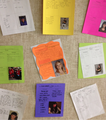
Students created a Poster about themselves to showcase in the classroom that I call a PDF because it stands for:
Proud Moment,
Dream Goals, and
Favorites.
Students wrote down their Proudest Moments to show off how amazing they are, their Dream Goals to ensure that they kept their eyes on the prize, and their Favorites to show their individual personalities that will enhance our classroom. They also added a favorite picture of themselves that was semi-current so that we could match their face with their name. This activity was a way to allow them to truly think about who they were and what made them who they are today. They were creating this for an authentic audience because their classmates would see these every day, and parents would see them on Open House. It was their creation where they were able to make many personal decisions about how it looked and were given a few days to think about it before we had class time to finalize the masterpieces that would be referred to as their PDFs.
Step 1
Step 2
Step 3
Students were given a blank sheet that had the four boxes that needed to be filled out.
Proud Moments
Dream Goals
Favorites
Own Picture
Students could choose from a variety of colored cardstock and be creative with their final product.
Daily, more and more PDFs were posted on the board. Students were excited to come in and see them.
Students LOVED being able to show their creativity in English. They weren’t just filling out a worksheet or writing a small paragraph for me…that might be put away in some file folder and never showcased. They had an authentic audience: their peers and their parents!
Every day, students came to class and went to the WE MATTER wall to see whose picture was up next. And, their excitement showed when their own picture was up or one of their friends. They wanted to come to my class and they felt like they mattered. They do Matter and so do their Dreams and their Proud Moments. They learned a LOT about one another those first few weeks of school and shared each other’s Proud Moments. The PDFs were definite conversation starters, and the excitement continued each day into each lesson.
I loved coming to class every day and learning more and more about my students. They were excited as well. They were well-behaved. They felt they mattered. And, to tell you the truth, we just finished week 4 of school and My Behavior Log is empty. I have classes filled with students who want to be in my class and I feel like I’m facilitating learning not managing behavior. Showing my students that this is THEIR classroom, not just MY classroom. They MATTER here, their OPINION counts, THEIR voice is heard, and they have CHOICES. Though the door says "Mrs. Maslowski," my WE MATTER wall is filled with my STUDENTS’ faces, dreams, goals, and favorites.
They are what makes the classroom successful and I hope the joy of being in my classroom continues throughout the year. Open House was earlier this week and I don’t usually have many parents who attend this event. This year was different. Students brought their parents and wanted to show them their picture, but only after introducing me.
It was amazing to hear from many parents: "My child hated school, but I had to meet the teacher who is his favorite!" And "My daughter told me you’re the best English teacher she ever had!" It was heart-warming to hear that, and we are only into the first month of school. I hope their love for English class keeps growing!
When Angela Maiers asked me to do a post for my PDF activity, I was extremely honored and I decided to survey my students with Socrative, to get their opinion of the worth of the PDFs we completed. Here are some of their comments:
"Working on the PDFs made me realize my goals and gave me motive to work towards my goals." (Allison)
"It has made me want to work harder in English class." (Angela)
"Taking the time to work on the PDFs have impacted the way I work in English class because one of my goals is to go to college and in English class I am trying to work to harder than I can." (Kylee)
"Yes because I’m showing her the type of person I am and the type of person I will be this year." (Steve)
"Yes because I feel more motivated to get work done." (Brian)
"Yes, because the PDFs really help you think better of yourself and show that you really matter." (Alicia)
"Yes because it reminds me of the goals I set for myself to become successful." (Waleed)
I am truly grateful for my students and for starting off the school year positively and successfully. We are motivated to Learn and Teach one another because WE MATTER. I hope this activity can be as successful for another teacher, as it has been for me!
Angela Maiers
.
Blog
.
<span class='date ' tip=''><i class='icon-time'></i> Jul 16, 2015 09:19am</span>
|
|
Can students really change the world?
In 1999, students at a rural Kansas high school began work on a National History Day project, with these goals:
extend the boundaries of the classroom;
contribute to history learning;
teach respect and tolerance;
and honor the classroom motto:
"He who changes one person, changes the world entire."
When our team at Choose2Matter speaks of changing the world, this is the essence of what we mean. A person who makes an effort to let another person know he or she matters, can have a lasting effect on that person, and a resultant effect on how that person impacts the world. This is why Teachers Matter so much.
Sometimes students change the world in broader ways, such as this amazing group of students whose achievements we wrote about this summer, and these students who declared their ambitions for changing the world when we visited their schools.
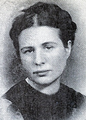
Back to Kansas: two ninth graders, Megan Stewart, Elizabeth Cambers, and an eleventh grader, Sabrina Coons, were encouraged by their teacher to delve further into a clipping he had from US News & World Report about Irena Sendler, who the clip said had saved the lives of 2,500 Jewish children by smuggling them out of the Warsaw Ghetto before they could captured by the Nazis. The teacher assumed there was a typo in that number, as surely a person who had accomplished such a feat would be celebrated around the world.
The story is explained in this post: the students’ research found that Sendler’s heroics were very real. While they had been quietly recognized by two Jewish organizations, her story was little known, even in her native Poland, where the post-war communist government had suppressed the stories of war-time heroes such as Sendler and Witold Pilecki, a spy who actually snuck into Auschwitz.
The three girls and other collaborators wrote a short play, "Life in a Jar," in honor of Sendler’s practice of documenting all of the children she had smuggled and burying them in glass jars in a friend’s backyard to facilitate post-war reunions with their birth families. They performed the play in many places in Kansas, and, learning that Sendler was alive, began to write her letters, through a Polish translator.
Sendler responded with dozens of letters. A Kansas businessmen saw the play and funded a trip for the students and supporters to go to Poland and meet Sendler. One of the children whose lives had been saved by Sendler deemed these students "rescuers - rescuers of Irena’s story."
Did this one little play, written by high school students in Kansas, really change the world? A post about the project on Chabad.org captures many of the student’s achievements:
In Sendler’s own words to the students, "Before the day you had written Life in a Jar, the world did not know our story; your performance and work is continuing the effort I started over fifty years ago. You are my dearly beloved ones."
At least 20 colleges in the U.S. and many more in Poland are using Sendler’s letters in their curriculum.
Holocaust education in Poland has changed dramatically; other Polish rescuers came forward with their stories.
Irena was given numerous awards—including the Order of the White Eagle, Poland’s highest honor, and was nominated for the Nobel Peace Prize in 2007. In April 2009, the Audrey Hepburn Foundation posthumously awarded Irena Sendler its 2009 Humanitarian Award.
In 2009, CBS aired a Hallmark Hall of Fame movie titled, "Courageous Heart" about Sendler’s work.
In Sendler’s final words to the students before her death, she wrote, "You have changed Poland, you have changed the United States, you have changed the world. I love you very, very much."
Students really can change the world.
Choose2Matter.
Angela Maiers
.
Blog
.
<span class='date ' tip=''><i class='icon-time'></i> Jul 16, 2015 09:19am</span>
|
|
If you want to find your passion, surrender to your heartbreak.
~ Umair Haque on hbr.com
Passion matters.
It is the differentiator and the difference maker.
In our quest to be passion driven learners and leaders,we are often advised to "follow our hearts" as the way lead us to our true passion and purpose in life.
What they fail to answer, is how exactly do we find that passion?
I am going to suggest something that on the surface seems counterintuitive; even silly.
I am going to suggest that you DO NOT follow your heart to find your passion and purpose.
Instead follow your heartbreak.
Although following your heart (feelings) can be useful while information-gathering, following your heart in decision-making does disservice. .
Finding your passion; surrendering to your heartbreak is really about finding what really moves you. Discovering what ticks you off and breaks your heart may be the first step in that direction.
Here’s why:
It identifies what you find interesting. When something truly breaks your heart, there is no doubt that you find it compelling enough to on to.
It uncovers a cause you long to be called for; what some call your "life’s purpose."
It unveils a process that you can and will want to use to learn skills you need to succeed and bring you closer to getting there.
It brings congruency bringing what’s inside you to what’s outside you in closer alignment, When you believe that world out there needs what you’ve got; it becomes the exact motivation you need to propel forward and make change happen.
And in my experience, following a heartbreak whether it is your own or the world’s is the single most effective way to help individuals, organizations and the world discover what they were meant and called to do.
So here we go.
Ask yourself this question: What Matters to You?
An important aspect of choosing to matter is discovering what you are most passionate about; what you are willing to commit to.
If we our going to change the world and ask others to do the same. then we need to find and articulate at least one thing that we are seriously, fiercely passionate about.
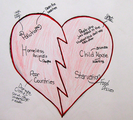
The process of Heart Mapping can be done individually or as a group. Use the following template to get your started as you explore the questions below.
What makes you happy?
What do you love?
What is the most fun you have ever had?
What memory is your favorite?
What things or objects are important to you?
What things in your heart are sad? Make you cry?
What secrets are in your heart?
What are your favorite things, toys?
What activities do you love?
Examples of Heart Maps done with students: Aaron Maurer’s students at Bettendorf, IA MS
2. What Breaks Your Heart About That?
This single question can cause some to to lie awake at night, wondering what happened to our lives and to our world and for others it can light a fire so bright it propels them to a greatness they never dreamed possible.
Give it a try. Here are instructions created by Karen MacMillan, a remarkable middle school teacher.
In the center of your heart map, write and/or draw the things that you are passionate about.
In the next level or circle, write and/or draw what breaks your heart about these things.
In the final level or circle, write and/or draw your ideas for the ways to resolve these heartbreaks.
Here’s what her students created.
3. Turning HeartBreaks into BreakThrough
The process of uncovering pain points or what we call "mini heartbreaks" is what drives breakthrough innovation.
Instead of jumping into something that we cannot do because it is too big, we tackle mini heartbreaks and search for solutions which uncover the fundamental drivers of new opportunities.
Questions to Consider
Person - who’s the specific person or people you’re innovating for?
Activities - what are the everyday things they do, why, and to what ends?
Insights - what are the processes, tools, or activities that they unnecessarily do or have invented themselves to "work around" the way things are "supposed" to be done?
Needs - what are the biggest pain points that are the root causes of the problems, unmet needs, or desires? What are the workarounds, things that cause stress or concern, dissatisfaction, or anything else that’s responsible for their "pain"?
Here’s the process in action (Video)
The most authentic thing about us is our capacity to create, to overcome, to love, to transform, and to be greater than our suffering.
Map Your Heartbreak and find out how strong you truly are.
Angela Maiers
.
Blog
.
<span class='date ' tip=''><i class='icon-time'></i> Jul 16, 2015 09:19am</span>
|
|
I am going to bed with a smile on my face. I was honored and thrilled to spend the weekend with cherished friends, colleagues and fellow change agents as an attendee and presenter at the second annual Bammy Awards in Washington DC.
There is so much to celebrate in our profession and so much to be proud of. I was anxiously waiting for some down time after the event, to go back into the tweet stream and see all that was captured and all that I missed.
I was fully expecting the usual "why we shouldn’t have awards for teachers-because it goes against what we stand" banter that emerges when we try to showcase what is good within our field.
But I was not expecting what came with it.
The ceremony was not perfect; a few aspects of it upset some people. This was only the second time it was held, and it operates on a tight budget - tickets to the ceremony are free - and with no full-time staff. My friend and fellow educator Pernille Ripp fairly lays out her feelings on the issues here.
I am not writing to debate what anyone perceived to be the shortcomings of the ceremony. What I find upsetting is the ensuing avalanche of negativity as educators "pile on," as though they want to bury the Bammys for good.
As Pernille brilliantly wrote in the wake of the Bammy nominations in May, "We are so good at making each other feel bad….We are so good at taking moments that should be celebrated and turning them into moments of shame….if we squelch the movements that are springing up to turn the tide of teacher bashing, then we are giving those who hate us a helping hand."
In the midst of my brewing and stewing, I sent this Tweet to 12yo Mallory Fundora, who I presented with the first Bammy for Student Initiative, for a fresh perspective:
And you will see in here response why I prefer to hang out with children!!
"I feel like winning this award means that people take me seriously for the work that I am doing, instead of looking at me like I’m just a kid. I want the educators in the room to understand that there are other kids like me in their classrooms and they could be overlooking them every day. I started Project Yesu when I was in the 6th grade. From then to now (not including this school year) I have had 14 teachers and only 3 of them ever showed any interest in what I am doing in Uganda. This year it’s different, after my teachers found out that I won a Bammy, it’s like they realize that I am for real. It bothers me that my teacher didn’t seem to care about what I do outside of their classrooms. So what I would like to say to the teachers, principals, superintendents or whoever that were there Saturday night is its great that you blog or tweet your great classroom ideas and experiences, or that you found a great app to use with your students, or helped them to understand fractions better, but what about caring about their passions? Showing interest in their lives? Encouraging them, finding their spark and helping them grow it, even if it doesn’t make them better on a standardized test."
Be The Change,
Mallory
Founder of Project Yesu
How many teachers are in the same position as Mallory? How many are known around the country and around the world for their contribution to the field of education, for their innovations in learning, and yet utterly ignored in their own schools?
The Bammys is a chance to celebrate all that is right in the education system, which is not done nearly often enough.
That is what matters most about the Bammys.
Angela Maiers
.
Blog
.
<span class='date ' tip=''><i class='icon-time'></i> Jul 16, 2015 09:19am</span>
|