Blogs
|
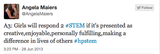
Last Friday, I was honored to be the featured guest in Huffington Post’s Twitter chat about encouraging girls to pursue studies and careers in STEM.
Huffington Post published this stellar re-cap, with highlights, of the chat, titled "Reimagining STEM At School: Education Heavy Hitters Discuss On Twitter." It noted that the discussion included "close to six hundred teachers, entrepreneurs and members of the STEM community."
Here are my other posts on Huffington Post about Women in STEM:
STEM in Words: Let’s Make What We Say Count
You Matter: The Two Most Important Words to Motivate Women in STEM
To-Be List for Aspiring Women Leaders
Habitudes of STEM Leaders
Reframing, Rebranding and Re-Energizing the STEM Conversation
Angela Maiers
.
Blog
.
<span class='date ' tip=''><i class='icon-time'></i> Jul 16, 2015 09:24am</span>
|
|
Last week I had the opportunity to share Choose2Matter with two educators on their own quest2matter. Tim (@tbed63) and Scott Bedley (@TASFair), aka The Bedley Bros, host a YouTube show that highlights educators who are striving to impact the world.
I was excited to have the opportunity to share my heart with them as they carry the Choose2Matter torch to the west coast. Tim, the 2013 Riverside County Teacher of the Year, teaches 4th and 5th grade and is known for his edutaining rock band, Rockin’ the Standards.
His younger brother Scott, the 2014 Orange County Teacher of the Year, is an innovator in connecting students to the real world and created the Technology Applied Science Fair. The three of us carried the message that kids truly matter and can impact the world.
The Bedley Brothers (@BedleyBros) were eager to learn about my current passion, Choose2Matter. I shared the thrilling story of the students at Dr. Justin Staub’s (@MrStabSTEM) Downingtown (PA) STEM Academy.
Justin, like the Bedley Bros, is one of those people who makes things happen. He cleared the way to give his students a chance to impact problems such as teen suicide, drug addiction, and poverty.
http://www.youtube.com/watch?v=BHlqjhBTHhU
The Bedley Bros are connecting educators to educational innovators such as Erin Klein, Steven W. Anderson, Rick Morris, and Adam Bellow. My message was clear in our short, but passionate conversation: kids can be vessels of change. I’m looking forward to connecting with Scott Bedley as he shares this message with one of the nations lighthouse districts, Irvine Unified, and adds to this global movement.
Check out the Bedley Bros #Edchat to see our conversation and how they are taking steps to impact education. Watch their shows live on Tim’s blog www.timbedley.com.
Angela Maiers
.
Blog
.
<span class='date ' tip=''><i class='icon-time'></i> Jul 16, 2015 09:24am</span>
|
|
"Teaching people to produce innovative work, off-the-chart insights, and yes, art is time-consuming and unpredictable. Drill and practice and fear, on the other hand, are powerful tools for teaching facts and figures and obedience. Sure, we need school and we need teachers. The thing is that we need a school organized around teaching people to believe, and teachers who are rewarded for doing their best work, not the most predictable work."
Excerpt From: Godin, Seth. "Linchpin."
The following video illustrates what can happen when we believe in kids, trust the process, and then and get out of the way…..
http://www.youtube.com/watch?v=6v1ONw3agzY
Angela Maiers
.
Blog
.
<span class='date ' tip=''><i class='icon-time'></i> Jul 16, 2015 09:24am</span>
|
|
This is a guest post by A.J. Juliani is a co-founder of Education Is My Life. He currently is a K-12 Technology Staff Developer overseeing a 1:1 initiative. He also founded the non-profit organization "Project: Global Inform" and wrote The 2.0 Teacher in 2009.
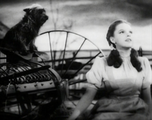
Dorothy may be the most beloved and well-known teenager in any movie. Her line, "Toto, I don’t think we are in Kansas anymore…" has been quoted thousands of times. I think it is an apt metaphor for our current state of education.
When Dorothy had a problem in Kansas, she deals with it the old-fashioned way: asking adults for help. When all of the adults in her life fail to help her, she runs away from her problems, thinking that there is nothing she can do besides hide.
When she lands in Oz, one thing becomes clear: Dorothy will have to find her own path, make her own way, and solve her own problems. During her journey she connects with others who are "searching", and they help each other reach their final goal.
Today in the world of K-12 education we have many students who are looking at teachers for all the answers. When they graduate from high school, they are left wondering what to do with their lives…and instead of living with purpose and following their passions, we have many young adults still searching well into their late twenties and early thirties.
I was like this too. Bogged down by coursework I shied away from delving into my interests during high school and college. I spent most of my time worrying about what I "had to do" versus what I would like to pursue. I’ve seen the same thing happen to my siblings and friends as well. The last thing I want for my students as a teacher is for them to "go through the motions". I want to give them opportunities to explore their interests, create with purpose, and go deep into subject matter. This problem is what led to my experimenting with 20% time in the classroom, and it changed everything.
20% Time is a simple premise. Give your students 20% of their time to work on whatever they want in your class. The idea is derived from Google’s own 20% policy with their employees. In education we also have teacher running Genius Hour projects, Fedex Days, and Innovation days/weeks. Each of these ideas are rooted in the belief that students do much more, and learn so much more when we give them autonomy in their school work.
When I first announced 20% time to my students they acted like Dorothy when she landed in Oz. They realized quickly that this was not the "same old classroom" they were accustomed too. I was not going to give them an assignment, set up their 10 steps, and show them how to succeed. Instead, they would have to create their own path, make their own way, and reach out for the help of others to reach their final goal.
In the past year we have seen a boom in 20% projects and Genius Hour projects happening in the K-12 classroom. Amazing educators have pushed this movement forward, and Angela Maiers Choose2Matter campaign is another way for students to find their passions and learn with purpose. This July we are running a "20% Time MOOC". The course offers two outcomes. Teachers will learn about the research behind Google’s 20% policy and how it can be applied in K-12 education; and, learners will also participate in their own 20% project throughout the course and present as a final product. I want to encourage you to join this MOOC and connect with so many teachers who are giving their students the power to choose (Access Code for the course is ZXQ2B-8CWMV).
When our students realize that it is them, and not the "wizard", who has all the power…we’ll all be on the path to making a difference. Let’s make it clear that we are not in Kansas anymore, and it’s time for all of us to work together to reach that final goal.
Angela Maiers
.
Blog
.
<span class='date ' tip=''><i class='icon-time'></i> Jul 16, 2015 09:24am</span>
|
|
Does 2013 feel like it’s flying by?! It is turning out to be a very blessed year for us and we couldn’t be more thankful.
To celebrate where we are and where we’re going, I present the top 10 posts of 2013 thus far:
1. People Know They Matter When…
The beginning of this year marked my blog partnership with The Huffington Post, which made 2013 a winning year for us right off the bat! Thus, I chose HuffPost to publish one of the most important posts I’ve ever done - one that teaches all of us how to let the people in our lives know that they matter to us.
2. Genius Hour-Let Your Students Challenge Themselves
Genius Hour has quickly become one of my favorite hours in the classroom. In March, I shared some of the amazing work students and teachers are doing in this hour. Please consider having your students participate in Genius Hour; it changes lives. Follow the #geniushour hashtag on Twitter for some incredibly exciting news about a new community, for students and teachers alike, that we’re creating around Genius Hour!
3. Offering Our Youngest Leaders a Seat at the Table
On May 22 and as part of my blog partnership with Switch and Shift, I shared my strong beliefs on the importance of open communication with our students and how Quest2Matter allows students a stronger, louder voice.
4. The Science Behind Mattering
I often write and speak about the importance of mattering and in May, I backed my voice with research studies that show just how important mattering is to every human being.
5. Teachers Matter
After the tragedy in Newtown, CT and Boston, MA, I wanted to share just how much teachers truly matter in situations of tragedy and in the everyday life of their students. For it is in both the little and big events in the lives our of students that they look to their teachers for guidance.
6. Unlocking the Potential of Millennials to Change Our World
At the beginning of June, we had the honor of visiting Downingtown STEM Academy in Pennsylvania where we met and spoke with 300 sophomores. After challenging these students to change the world, during their final two days of school, they created 12 companies to solve the world’s problems. Inspiring!
7. Secure Students’ Hearts, or You Don’t Have a Shot at Their Brains
In May, I wrote about the importance of reaching students’ hearts before we can reach them as learners. This was part of a tribute to the great educator Rita Pierson, who tragically passed away just a few weeks later.
8. The Passion Gap
In January, I spoke at a Dell Innovation in Education Panel. Out of that came this post on the cavernous passion gap between schools and the workplace.
9. To Be List for Aspiring Women Leaders
At Choose2Matter, we encourage our students to be the change they want to see in the world. To that end, in February we wrote a detailed to be list for aspiring women leaders.
10. The Courage to Teach
As teachers, sometimes the most important thing to know is that we don’t know everything and that that’s okay. To know and accept this takes courage; the courage to ask questions and learn new things.
Angela Maiers
.
Blog
.
<span class='date ' tip=''><i class='icon-time'></i> Jul 16, 2015 09:24am</span>
|
|
I’ve recently begun writing for Switch and Shift, a blog about the "human side of business." My focus will be on how adults can help guide today’s youth, with their considerable energy and passion, to change the world.
These articles are also often cross-posted to SAP’s Business Innovation blog.
I’ll be alerting you to my posts through my social media accounts, and mentioning many of them here.
My first post explained the need to bridge the gap between generations and create cross-mentoring opportunities.
My second post discussed how Choose2Matter is helping to unlock the potential of today’s youth to change the world.
My latest post was "An Open Letter to Millennials - Thank You for What I See in You," which expressed my appreciation for their passion, impatience and desire to change our world.
Of course, I will continue to blog here on a regular basis.
Angela Maiers
.
Blog
.
<span class='date ' tip=''><i class='icon-time'></i> Jul 16, 2015 09:24am</span>
|
|
Technology transforms the world in which we live. It can make the impossible possible and is the key to doing more with less. It’s not the technology—it’s how you USE it and more importantly WHO we become because of that experience.
Students are not motivated by technology. They are motivated and transformed when they get to use the technology to connect, create, collaborate and contribute to a world outside of their classroom. Technology CAN make all of that possible — but only if it helps the learner achieve these things.
The following presentation and framework help reframe and refocus our attention on what matters most; the learner and the learning.
In order to get "TECHNOLOGY right", we must first get "LEARNING right" and see the technology we use through these lens:
Opportunity, not Obligation
Impact, not Integration
Compelling, not Cool
Epic, not Engaged
Significant, not Sufficient
Last week, I had the honor of having this conversation in person with education leaders in the State of Maine. The following resources were shared as a way to help them and other school leaders through the process of effectively deploying technology in a way that not only engages the learner but transforms them in the process.
GettingTechnologyRIGHT from Angela Maiers
Additional Resources:
The outline for my full-day workshop on Getting Technology R.I.G.H.T.
An Open Letter to School Leaders, about using social technologies.
This Google Doc for links to the resources referenced in my keynote, and more of my advice to educators, as leaders & learners.
The Passion Gap
Unlocking the Potential of Millennials to Change the World
Secure Students’ Hearts, or You Don’t Have a Shot at Their Brains
Reframing, Rebranding and Re-Energizing the STEM Conversation
STEM in Words: Let’s Make What We Say Count
Angela Maiers
.
Blog
.
<span class='date ' tip=''><i class='icon-time'></i> Jul 16, 2015 09:23am</span>
|
|
From "Why," by Rascal Flats
You must have been in a
Place so dark
You couldn’t feel the light
Reachin’ for you through
That stormy cloud
Now here we are
Gathered in our little hometown
This can’t be the way
You meant to draw a crowd
Oh why, that’s what I keep asking
Was there anything I could’ve
Said or done
Oh, I had no clue you were masking
A troubled soul, God only knows
What went wrong and why
You would leave the stage
In the middle of a song
These are the lyrics from a song that has been playing in my head for the last year, especially today, as I’m gathered with my family to remember my little brother, Chrissy.
A year ago today, as I waited in the Las Vegas airport for him to pick me up, my sister called to tell me that he had killed himself with a handgun.
Over the next days, weeks and months, the question of WHY consumed us. A year later, a new perspective has emerged. My uncle, a cancer survivor, told me that he spent a great deal of time during his treatment asking that very same question, until he started to reframe the question in a new way: "WHY NOT ME?"
Even more importantly, what can my family and I share with others in a similar place, to provide them with insight, help and support?
My brother was and is a gift. On this anniversary of his passing, I do not want to focus on the darkness that surrounds his past. Rather, I want to share with you the beautiful gifts he helped us "unwrap."
The poet, Mary Oliver, wrote in her Thirst collection, "someone I loved once gave me a box full of darkness. It took me years to understand that this, too, was a gift."
Most people wouldn’t associate loss with being a gift. But because of Christopher, I do.
The death of my beloved brother, my box of darkness, was a gift. It just took a while to unwrap it completely. Here are some of the things that I’ve learned in the wake of my loss:
1. Knowledge is Empowering
My brother’s death was a beginning of a new and unwanted education for me.
Learning about suicide was never on my "bucket list," but as my family and I are thrown into a world we did not seek out, a world where one is forced try to fathom the unfathomable, education and knowledge saved us.
For the past year I have been trying to learn all I could about depression, suicide, mental illness, prevention and treatment. Between the books I have read, research I have done and the stories that have been shared with me since I made my journey public, the most valuable insights were these:
A person who dies by suicide is often so consumed by pain that he can no longer think of anything but ending that pain.
The pre-suicidal state of mind is one of extreme mental anguish where one’s judgment is distorted and one does not have the ability to "make choices" or see options. Our rational minds can’t fathom how our loved ones could have "chosen" to take their lives, but in their grief-stricken minds, there was no other choice.
This is why it is so critical to reach out to others whenever you have suicidal thoughts of your own; you may be in a tailspin that you cannot pull out of by yourself.
While it can be very difficult to "spot" someone in this state of mind, we all need to be alert to the warning signs.
Individual therapy and group therapy in any form is essential for helping survivors to deal with this grief.
The group of people I know who are "survivors of suicide" is much larger than I would have ever guessed. Suicide is still so stigmatized by our society that most people choose not to speak about it publicly. It has amazed and saddened me to discover how many people I know that have suffered the loss of a loved one to suicide, and that they only felt they could share this with me after I had become one of them.
2. ABC: Always Be Capturing
Noticing and noting have always been critical in my life and in my learning, but I have been more conscious and conscientious about keeping a record of important moments in my life, and more importantly, the people I get to share those moments with.
Remembering you, Christopher, has been a gift: Airplanes, Colorado, Tevos, Jar of Hearts, Soup.
I wish I had ALWAYS BEEN CAPTURING - my memories of you would be even greater.
3. Live in Appreciation; Forgive
I know it seems cliche. We don’t appreciate what we have until it is gone. There is a reason things are cliche….they are often somewhat based in truth.
To say my brother and I had our ups-and-downs would be an understatement. But months before his death, we had made a lot of progress in our relationship. I was on my way to see him and hopeful about starting a new chapter. It excited me to think that my children might get to know him better.
We never got that chance. As I look back at how much I anticipated our new relationship, I regret not appreciating what we had much earlier.
Now, in death, rather than in life, I find myself appreciating him more for who he was, and forgiving whatever it was that drove us apart. I find myself wishing I had the opportunity to appreciate our differences as a window to learn about our similarities. I would so relish the opportunity to better know him, learn from him, and love him more deeply.
Live in appreciation; forgive. Now.
4. Facing Death to Value Life
The meaning I have found in my brother’s suicide is to realize that life is tenuous for us all. Facing death with grace is the fulfillment of life, regardless of what you believe will follow.
Of all the gifts my brother bestowed upon me, this is the most significant of all.
We have the choice of making every minute count with the people we love from now on, and valuing them and our lives in a way we never did before.
5. Grace and Gratitude
The pain and loss of my brother’s death will always remain, but my grief is beginning to be transformed into grace. His memories remind me how ephemeral life is and how fortunate I am to be blessed with family, friends, and work that fill me up.
His memories remind me to live every day to the fullest, to take nothing for granted and let those whom I love know how much they matter and I love them
His memories remind me we live in a beautiful world that offers endless possibilities.
Thank you.. from the bottom of my heart.. to all that prayed for our family.. to all that shared so generously … to all who reached out to me and to my family in the weeks and months that followed. You will never know how much you were a part of my learning, my healing and my ability to support others in their grief.
Angela Maiers
.
Blog
.
<span class='date ' tip=''><i class='icon-time'></i> Jul 16, 2015 09:23am</span>
|
|
It’s already back-to-school time in many parts of the U.S. Over the next few weeks, I’ll be publishing, or re-publishing, much of my back-to-school content to help you start the new school year right. Today, I feature two "Dear Student" letters that I wish all students, of all ages, everywhere would receive from their teachers. The letters were written by Arin Kress, a self-described "5th grade teacher in Ohio who is constantly learning." Arin is on Twitter @KressClass and her blog is Hate Chalk.
The first letter encourages students to think about what their genius is. The second tells students they matter, and encourages them to let others know they matter as well. They are succinctly written and full of hope and encouragement - shouldn’t every student start the school year this way?
*****
Dear 5th graders,
Hi! My name is Arin Kress and I will be your math and science teacher this year. We haven’t met yet, but every day this summer I’ve thought about you.
I know that sounds odd - but please keep reading. I haven’t thought about you individually, because I don’t know who you are yet, but I’ve thought about you collectively. I’ve thought about the amazing group of 5th graders that will cross the threshold of my classroom in just a few weeks.
I’ve thought about challenging you.
I’ve thought about embracing your differences.
I’ve thought about your strengths.
I’ve thought about your weaknesses.
And I have a secret that I can’t keep in for another few weeks.
You
Are
All
Geniuses.
Shhh! Don’t tell anyone, but really you are. I know deep within you, your inner genius is ready to come out! I’ve worked with geniuses for seven years now, and let me tell you something - it’s amazing. And this year won’t be different.
So, before you walk through my door on the first day of school, think about YOUR genius. What are you an expert at? What do you enjoy? What can I learn from YOU? How are YOU going to change the world? I can’t wait to share my genius with you and for you to share your genius with all the other geniuses in the room: your classmates!
Ms. Kress
*****
Dear 5th graders,
Today I learned what it means to matter. I know it sounds silly, but it’s a powerful message. Two simple words - You Matter.
So many times we go about our daily lives and no one stops to thank us. No one seems to care if we go the extra mile. It’s odd really that we would find it odd for someone to tell us that we matter - because it’s such a simple thing to do.
So, I’m doing it right now - I want you to know that you matter to me before I even know your name. YOU are why I became a teacher. YOU will make a difference in my life. I hope to learn as much from YOU as you do from ME!
I want you to understand this: YOU MATTER to your family, YOU MATTER to your friends, YOU MATTER to so many people - You already matter to ME! Stop right now and think about who matters to YOU. (Most likely you matter to them too!)
So here’s your first assignment. Tell as many people in your life that THEY matter to YOU and, of course, tell them why. (Don’t just run up to strangers yelling, "You matter!" You might get a lot of confused looks!) Please take this seriously. It may be just one of the most important assignments you complete all year.
I hope you are enjoying your summer, because the ride you’re about to embark on will be full of ups and downs and winding curves. One thing you will learn about me is that I hate roller coasters - but I can’t wait for the ride to begin that we will experience together!
I look forward to telling you in person how much you MATTER to me. I hope to see you at Open House on August 19th!
Ms. Kress
P.S. If you have a mobile device (phone, tablet, etc.), bring it to Open House! We have some fun, interactive activities planned! J
Angela Maiers
.
Blog
.
<span class='date ' tip=''><i class='icon-time'></i> Jul 16, 2015 09:23am</span>
|
|
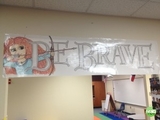
Matt Gomez, from Plano, TX, is a "Teacher with the Habitudes." In his kindergarten classroom, there is only one rule- "Be brave!" This "rule" applies to just about everything a young student has to face; from bullying to trying new things to missing mom.
Some may worry that a classroom would be chaotic with only one rule, but Mr. Gomez has high expectations for his class. He expects students to treat each other with respect, to clean up after themselves and to take ownership of class property. He feels these expectations are less restricting than rules, because he is able to handle each situation-and student-uniquely. We love how Mr. Gomez and his classroom embrace the habitudes!
Below, Mr. Gomez explains the rule, which is cross-posted on his blog.
***
This year will be my third year with a one rule classroom. Be brave! That is our only "rule." I wish I could put into words how powerful this rule has been in my class but really there is no way to for me to articulate it. Be brave is the perfect theme, motto or "rule" for any class. It helps with bullying, friendships, tying shoes, monkey bars, missing Mom, touching worms, tasting new food, etc. Be brave is exactly the type of attitude needed for young kids. Every day they are faced with challenges as they grow up into this big world. If the only thing I teach them is that they can "be brave," I have succeeded.
Without rules my room must be a crazy mess, right? Well maybe sometimes but that isn’t due to the lack of rules. I have expectations in my class. I expect the kids to treat each other with respect. I expect them to carry the iPad correctly. I expect them to clean up their messes. I don’t have rules. What is the difference? Rules are restricting and demanding. In my mind, rules tell the class that I am in control of their behavior and my goal is they realize they are in control. Beyond that, I have learned that by removing the rules I have the freedom to handle every situation and every child in a unique way.
I also do not use any rewards or a behavior management system in my class. I have written about my reasoning and journey to remove rewards from the class (read here) and it really has been a journey. I started with sticker charts and a treasure box just like most teachers. I also have used many different forms of behavior charts. My friend Miss Night does a great job of articulating the reasons I avoid using these systems on her blog post "Too high a price: why I don’t do behaviour charts." If you liked that post make sure and check out her follow-up post "Behavior management: relationships not systems." The big "light bulb" moment for me was when I realized that most behavior management systems are a form of control. The teacher is the one in control and I want my kids to learn to be in control. They learn by practicing and through mistakes not by being managed. I think Mis Night sums it up perfectly, "I have relationships, not systems." I may have to work a little harder without stickers and treasure digs but in the end the relationships built and ability to customize how I handle every situation has led to a much healthier environment and happier classroom.
I might just add these words from Christopher Robin to our class this year: "you are braver than you believe, stronger than you seem, and smarter than you think"
http://www.youtube.com/watch?v=9tRepZdoRmY
Angela Maiers
.
Blog
.
<span class='date ' tip=''><i class='icon-time'></i> Jul 16, 2015 09:23am</span>
|