Blogs
|
This morning, I had the pleasure of joining, via Google Hangout, the Amplify team at FETC, where lots of passionate teachers and leaders are wondering how to bring passion into their classrooms and schools. We started the conversation with a clear definition and distinction of how passion-driven learning is different from project-based learning.
Take a listen, and if you want to know more check out the resources below!
A collection of online resources
My white papers and books
Here is my presentation channel plus presentation notes and a few resources.
Here is my video channel- there are almost 200 videos of lessons, trainings, speeches, and more!
Leadership in the Digital Age: Getting Technology RIGHT
Rethinking Literacy in the Digital Age
Angela Maiers
.
Blog
.
<span class='date ' tip=''><i class='icon-time'></i> Jul 16, 2015 09:14am</span>
|
|
Seventh grade teacher Silvia Zanatta recently shared with me the ways in which she and her students are engaging in the You Matter movement. Through heartbreak mapping, memoir writing, and even slam poetry, Ms. Zanatta helps her students feel empowered to channel their genius and share it with the world. Ms. Zanatta is definitely a teacher with the Habitudes! Please enjoy her special post and follow what her students are up to on their class blog and on Twitter @Mszclass.
*****
I began the new school year last September with a plan to embed social media more into my educational practice. I was also interested in making the theme of Identity a focal point of the year. I knew that these would meld somehow, but I wasn’t yet sure how. After "bumping into" Angela Maiers’ work on the net (what she calls "tactical serendipity"), the shape of the year became clearer. Her messages about education, student voice and genius, and how everyone can make a difference in the world, resonated with me. Particularly at this age, kids begin searching for who they are, what they believe in, and what their identity is in the greater world. I knew that Angela’s "You Matter" movement would be an important part of my teaching.
We started the year talking about how we were going to share our learning with the world, on our class blog, through Skype and on our class Twitter account. I told my students: "I believe in you, you matter to me, and what you have to say matters to the world. And the world has a lot to teach us! So this year we are going to delve into who we are, and share it with the world through our social media activity."
I started out by focusing my language arts unit around teaching about memoirs, reading many of them, and then writing our own. We talked about the reason people write memoirs: what people experience, what they contribute to the world, matters, and there is something to learn from everyone. My students’ memoirs surprised me with their honesty, and emotional descriptions of difficult and joyful times in their lives. I believe they shared such personal stories because they were beginning to realize that what they had to say, and what they experienced, really mattered to me. The memoirs then became a springboard for an idea that would take greater shape, as I began reading about Angela’s ideas around #followyourheartbreak. Angela’s blog post, and then Joy Kirr’s heart mapping activity that I read on the "Teachers with the Habitudes" blog series, went perfectly with my theme of identity. After talking and thinking about their passions, my students did a similar heart mapping activity. (see picture). Coming up with how they could address what breaks their heart about the things they love was remarkably easy, because now they were really beginning to believe in their own genius and most importantly, that they matter! So what followed was no less remarkable.
I had toyed with the idea of teaching slam poetry for a while and as we were doing our heart maps, it struck me: slam poetry is emotional and it has a powerful message. What better topic to slam about then your heartbreak?! My students loved the idea. After watching many videos of other kids slamming, and being petrified about performing slam themselves, the poetry they wrote was stunning. Emotional, raw, honest and authentic. They told their stories of heartbreak, of what matters to them, in powerful language that left nothing unsaid. The culmination of their writing was a "Slam Café" morning, when we drank hot chocolate, wore our hipster outfits, dimmed the lights, and listened to everyone perform their slam poetry. Here’s a video of one of our amazing poets.
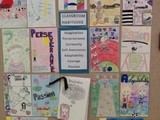
Immediately following our Slam experiences, we have begun discussing and reflecting on the Habitudes, and how they manifested themselves through the process of writing and performing our poems. Examining our heartbreaks, writing about them, and then sharing them in an emotional way taught my students how the Habitudes can elevate each of us to not only be our most authentic genius selves, but how we can share our full genius potential with others. We have represented the Habitudes artistically (see picture), used them as the reference point of our current novel study, and delved into how they can manifest in our lives by reflecting and connecting with each other, through things like blogging and Genius Hour sharings. The experience of writing and performing Slam based on their own personal heartbreaks, has given my students insight and experience of the seven Habitudes, and they have no doubt: they can imagine possibilities and change in the world that does not yet exist; they are curious learners who share their passion through things like Genius Hour; they have learned to persevere and be adaptable when faced with new things like performing a slam; they have had courage when sharing their work through Skype or our blog; and they have gained greater self awareness through our exploration of identity. If you would like to read my students’ blogs about the Habitudes, Slam Poetry, or Genius Hour, our website is mszanatta.weebly.com and you can follow our class on Twitter @mszclass.
Angela Maiers
.
Blog
.
<span class='date ' tip=''><i class='icon-time'></i> Jul 16, 2015 09:14am</span>
|
|
What happens when students are encouraged to become leaders and change the world with their genius?
They do it.
On January 21st, I asked 6,000 students in Hutto, Texas to realize that they are geniuses whose contributions to the world are desperately needed. With this spark igniting their hearts and minds, the students of Hutto embarked on a two-day adventure in discovering genius and acting on passion.
They formed groups around the big problems in education, human and animal rights, child hunger, environmental issues, and STEM. Students of varying ages interacted, shared their stories, and collaborated to design solutions to things that break their hearts about the world. Not only that, but when the challenge of working through this process with 6,000 students became overwhelming, guess who stepped up and saved the day?
The creativity, drive, and courage of these students did not go unnoticed! Teachers, families, and the community at large were awed by what transpired and came together to support the students’ inspiring ideas and efforts. Truly amazing things happen when students have the freedom and support to follow their passions and live their genius.
This video, created by a Hutto sophomore, is just one product of this event. Please watch for a glimpse of what we can accomplish when we boldly choose to matter!
Angela Maiers
.
Blog
.
<span class='date ' tip=''><i class='icon-time'></i> Jul 16, 2015 09:14am</span>
|
|
image credit: samuiblue via freedigitalphotos.net
In the midst of this frigid winter, my heart was warmed during a visit to Estherville Lincoln Central Community School District in northern Iowa. The teachers and administrators there are extremely passionate and are ready for change in the classroom. With the support of his colleagues, history teacher Tony Klein boldly made the leap to bring Genius Hour into his classroom! In this post, he shares his reasoning behind the decision and his vision for the journey. Stay tuned to Tony’s blog and follow him on Twitter @tklein11 for updates and to support him and his genius students!
*****
I recently surrendered eighteen of the ninety school days this semester for my students to work on Genius Hour. As it was, ninety days in a semester was not enough to teach all the lessons I would like to teach. SO WHAT IN THE WORLD AM I DOING? Implementing Genius Hour is a big change-revolutionary, perhaps-and like all big changes (such as the decline and fall of the Roman Empire and the French Revolution) there are many influences: Daniel Pink’s Drive, a professional Development day with Angela Maiers, support from the administration, current trends in popular historiography, and most importantly, my instincts.
Genius Hour is, simply, the opportunity for students to spend twenty percent of their time on a topic that intersts, excites, and challenges them. On Friday, January 24, 2014, I introduced Genius Hour to my Civics, Geography, and World History students. Genius Hour in my classroom uses models other teacher have used, primarily Chris Kesler’s "Genius Hour" website. There are three requirements: 1. The students must choose a topic they are passionate about or interested in. 2. They must do research. 3. The students must have a larger purpose in choosing their topic, such as "How can I make a difference?" or "What do I want others to know about my topic?"
Now for the ideological origins of Genius Hour in my classroom…
1. I am currently taking courses for a second master’s degree, this one an MS in Education through Southwest Minnesota State University. Each month, a course requirement is to read a work on an educational topic. During the first week of January, I read Drive: The Surprising Truth About What Motivates Us by Daniel Pink, an option for our January meeting on motivation. Pink hypothesizes that most people in our contemporary economy are motivated by the desire for more autonomy, the opportunity to achieve mastery, and doing work that is purposeful. He argues, therefore, that a system of rewards and punishments, which dominated the twentieth-century business and education systems, no longer works today and must be replaced. Among the alterations he suggests is Genius Hour, which originated with Google. Though intrigued by this idea, Pink’s argument was not enough to sway me to give up twenty percent of class time to my students’ interests.
2. On Wednesday, January 15, Estherville-Lincoln Central teachers had a professional development day in which Angela Maiers, a nationally known educational consultant from Des Moines, was the key-note speaker. Among Maiers’s major messages was that students need to be told that they matter, they are geniuses, they have the opportunity to follow their passions, and they can make a difference in their world. What really resonated with me was when she off-handedly mentioned how her vision for schools were similar to Pink’s vision for businesses. In a moment of extreme clairvoyance, I instantaneously committed myself to implementing Genius Hour in my classroom. Whatever concerns I had vanished and I became certain of the benefits of providing students the time and support to pursue their interests and passions.
3. Pay close attention to the previous sentence: the words "I …committed" imply autonomy. So I have the autonomy to give students autonomy! (There’s a great lesson in classical early modern European political philosophy here, but I’ll avoid that.) I have this autonomy because the leadership at ELC is reading and thinking the same way I am. Or vice versa. Regardless, I decided on my own without asking because I knew that I would have the support, and encouragement, of Mrs. Paul, Mr. Christenson, Mrs. Jensen, and Mrs. Nitchals. They cultivated an atmosphere in which my ideas could be implemented in my classroom, and more importantly, students’ ideas could be pursued to further their own learning.
4. So what will students be working on? (This will be the subject of my next post) Won’t they be pursue topics that are not academic, like wake-surfing, the history of volleyball, or Dr. Who? Yes, they will. Other students, however, are working on profound historical topics or projects that can help others, such as the origins of chess, the Sun Tzu’s Art of War, and the Battle of Mogadishu. But even the seemingly academically questionable topics ARE WORTHY of study because framed the right way, topics such as wake-surfing, volleyball, and Dr. Who can highlight much larger principles or trends in history or the contemporary world. Moreover, having my students turn the superficially trivial into the deeply profound is a model that can be seen in the popular historiography today, which uses everyday objects, places, and events to illuminate larger concepts or principles in history. Throughout my course, I have students read excerpts from works such as Tom Standage’s A History of the World in Six Glasses, An Edible History of Humanity, Neil MacGregor’s A History of the World in 100 Objects, and Niall Ferguson’s Civilization: The West and the Rest. Each of these titles tells a world history through a series of everyday objects or ideas. The authors use coffee, pop, canned food, fertilizer, plates and dishes, coins, blue jeans, and myriad other items to highlight larger forces in world history. Thus, students exploring their own interests, with my guidance, can do the same kind of thinking as these renowned scholars.
5. Let’s revisit the second sentence of this piece: "As it was, ninety days in a semester was not enough to teach all the lessons I would like to teach." Did you catch that? "…the lessons I would like to teach." That statement encapsulates a perspective that values the teacher’s interests more than students’ interests. I teach history and social studies, in part, because I love history and social studies. My pleasure reading is almost exclusively history and social studies. But what about students who do not love history and social studies? As long as I’ve taught, I’ve recognized that no matter how relevant I try to make history to students’ lives, some do not see the value of the social studies. In the past I have tried to find manageable ways to make the subject matter more individualized, and I had never found something what seemed to balance teaching skills and content with student interests. The genius of Genius Hour is that it recognizes that teachers still have four days a week to teach the content, skills, and lesson that s/he thinks will help students learn. Genius Hour recognizes that there is value to very well-established academic disciplines such as history, but on one day of the week students who may not enjoy history or the social studies have the opportunity to pursue a topic that they want to learn about it. I believe Genius Hour will be a very worthwhile pursuit in my classroom because it recognizes students desire for autonomy (the opportunity to select a topic and the time to work on it), mastery (sharing the topic with their peers or the public), and purpose (the opportunity to select a topic that will inform or help others).
6. So what about those eighteen or so lessons that won’t be taught? No problem. The students are generating replacement lessons to share their learning with their peers. They have the opportunity to do what I do everyday-share my passion with others.
Angela Maiers
.
Blog
.
<span class='date ' tip=''><i class='icon-time'></i> Jul 16, 2015 09:14am</span>
|
|
Good morning world changers! Mother nature decided we would not meet face-to-face today, but it is Game On! We will be choosing to matter all day long, by sharing our passions and genius with each other on Twitter and other social media outlets.
Further, now we’re not limited to East Greenwich HS - snowed-in schools from around the country, and plenty of adults, will be participating as well! This is going to be so much bigger than the day we had planned.
Here is a scheduled of suggested activities. Of course, with #Choose2Matter, the only rule is BE BRAVE, so feel absolutely free to participate in any way you see fit!
1. Participate in a Twitter chat at 11 a.m. titled "How Big is Your Brave?" Use hashtag #C2M_EGHS
Suggested reading:
How Big is Your Brave?
The Only Rule in My Kindergarten Class: Be Brave
2. Starting at 12 noon, students are invited to create a Vine on what students can do today to stay engaged with #C2M_EGHS and tweet it out with the hashtag.
3. Watch "Write Your Story, Change History," create a response to it (writing, photo, video) and, starting at 1:30, share it via Twitter, using #C2M_EGHS (@findingDulcinea)
4. #Choose2Matter in 140: (@MarkBabbit)
An activity called "#YouMatterin140". Starting at 3:00 pm, reach out to a mentor or someone who has made a difference in your lives and tell them, in 140 characters or less, how they had an influence in your life. If you want to write more, create a longer post somewhere and Tweet a link to it. Use #C2M_EGHS
5. Starting at 5 pm, students to send out Tweets asking their teachers, parents and others adults to support them and participate alongside them as they pursue their audacious goals for changing the world. This is a chance to leverage youthful exuberance and optimism to renew the same in adults. @KnowledgeBishop)
6. 24 Hours of Community Challenge (@Joli_Barker)
What’s your passion, and what drives it? What’s your heartbreak? How will you use your genius to change the world? Any time in the next 24 hours, write something, post a photo or a Vine or a longer video. Use #C2M_EGHS
Further Reading and Viewing:
People Know They Matter When - Wonderful Ways to Let People Know They Matter to You
"You Matter" - the TedxDesMoines talk that begin the Choose2Matter movement. Note: the video freezes several times but the audio continues uninterrupted.
"Whispering to the World" - Angela Maiers at Business Innovation Factory Summit #9, with student leaders.
Angela Maiers
.
Blog
.
<span class='date ' tip=''><i class='icon-time'></i> Jul 16, 2015 09:14am</span>
|
|
image credit: master isolated images via freedigitalphotos.net
As lifelong learners, our growth should never cease - least of all our growth in knowledge about ourselves. Without fully knowing ourselves, self-acceptance and change are all the more difficult.
Self-awareness provides us with a system of checks and balances that equips us to understand ourselves and to make conscious choices and deliberate decisions about the direction and quality of our lives. Powerful, right?
For learners to become more effective, they must first become more self-aware. Here is a simple self-awareness inventory that anyone can use to easily define and discover their traits and interests:
- My best trait is…
- I struggle most with…
- My favorite learning environment is…
- I help myself most by…
- Something that gets in the way of my learning is…
- I learn best by…
- I am interested in…
- My goals are…
Once you’ve tried the survey out for yourself, give it a go it with your students! With new knowledge of their learning strengths and preferences, students will be well on their way to being the independent, thoughtful, and self-directed learners we desire.
What other questions would you add to a self-awareness inventory? How would you dig deeper into discovering what makes you who you are?
Angela Maiers
.
Blog
.
<span class='date ' tip=''><i class='icon-time'></i> Jul 16, 2015 09:14am</span>
|
|
image credit: watipon via freedigitalphotos.net
Years ago there was a man who was a writer. He worked hard to make ends meet, he didn’t have much, and he lived in his car. But this man believed in the stories he had to share. He contacted publisher after publisher to see if they would publish his first children’s book. Twenty-three publishers told him they weren’t interested and rejected his manuscript. But the writer kept trying. Finally, the twenty-fourth publisher he contacted accepted his book…and sold six million copies of And to Think That I Saw It on Mulberry Street, by Dr. Suess!
Dr. Suess succeeded because he had the Habitude of perseverance: the ability to sustain interest, effort, and commitment in any circumstance that life presents. He persisted in his quest to get published even when it seemed like no one would ever tell him yes.
Perseverance is the cornerstone of any successful endeavor, but it develops over time and with practice. The following reflections are helpful for getting a better sense of this Habitude and how it affects our lives and our learning. Try using this list with students to help them realize how they persevere and to discover how perseverance is essential to learning.
- I am determined to understand…
- I showed persistence today when I…
- I believe persistence helps me to…
- The hardest thing about persistence is…
- When I get stuck on a problem, I try to solve it by…
- One new strategy I used to solve a problem today was…
- I have found the best way to stick with a challenge is…
- When I persevere, I feel…
What reflections would you add to get a sense of what perseverance looks like in your life and in the lives of your students?
Angela Maiers
.
Blog
.
<span class='date ' tip=''><i class='icon-time'></i> Jul 16, 2015 09:14am</span>
|
|
Having authored seven books printed in the traditional way, I’ve decided it’s time for me to explore the brave new world of e-publishing.
I have created a lot of evergreen content over the course of my career and am excited to find new ways to freshen it up and share it with you again.
I’ve curated some of my best content about passion, and why it matters, in a new e-book titled, appropriately, "Passion Matters."
It’s available for a free download by signing up below:
Get Your Free eBook: "Passion Matters"
When you access the book, we’ll invite you to join my new email newsletter. Readers have asked me often to create a newsletter, and now that I’m writing regularly on several websites, the newsletter, which we plan to send once a week, will be a convenient way to access the content I’ve published that week.
I’ll also be sharing content from my archives, on teaching literacy, professional development, and of course Classroom Habitudes.
Please also connect with me on these other platforms.
· Twitter @AngelaMaiers
· LinkedIn angelamaiers
· Google+ Angela Maiers
I look forward to expanding our conversation!
Angela
Angela Maiers
.
Blog
.
<span class='date ' tip=''><i class='icon-time'></i> Jul 16, 2015 09:14am</span>
|
|
I recently had the pleasure of discussing the Habitude of curiosity, and its impact on education, with the wonderful Doug Rice. Doug is an engaging writer and researcher who also records a podcast that explores learning and discovery across an array of disciplines. You can listen to our conversation here.
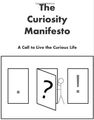
Doug also recently published The Curiosity Manifesto, an inspiring book about having the willingness to explore avenues and ideas that may make us uncomfortable but, in the end, will make us better.
Doug pulls from a great amount of psychological research to show how we all tend to close our minds to learning. He then provides some tips on how we can break through those mind blocks and open ourselves up to everything the world has to teach us.
Doug’s book fully embodies the essence of the Habitude of curiosity!
Rather than just accepting that some things are uninteresting, Doug pushes us to be proactive in taking an interest in new things. He prompts us to ask questions of the world around us instead of simply accepting things as they are. He begs us to embrace learning as a way of life.
Perhaps the best part of the book is the passion with which Doug writes. It practically bleeds through the page! You can see, as he tells each story and asks each question, that he desperately longs for his readers to become more passionate about learning. And that’s something I can get behind!
Angela Maiers
.
Blog
.
<span class='date ' tip=''><i class='icon-time'></i> Jul 16, 2015 09:14am</span>
|
|
Image credit: atibodyphoto via freedigitalphotos.net
A simple yet powerful way to let students know they matter is by using what I call the 2-5-2 method on a daily basis:
Ask all teachers to greet each student by name as they enter the class, and then make a positive remark about several students in the first two minutes of class.
Commend at least five students in each class period for their contributions to the discussion.
Finally, reserve two minutes at the end of each class to reflect on what everyone learned that day.
As the inspiring late educator Rita Pierson said, "kids don’t learn from people they don’t like."
Value your students. Demand they be the best they can be.
Show them that you are willing to be a champion for them.
You can read more about the ideas behind the 2-5-2 method in "Secure Their Hearts or You Don’t Have a Shot at Their Brains," my column in the Huffington Post.
Angela Maiers
.
Blog
.
<span class='date ' tip=''><i class='icon-time'></i> Jul 16, 2015 09:13am</span>
|