Blogs
|
Today’s question for the Q: Skills for Success authors: How can we help students remember and be able to use words from the Academic Word List?
Cheryl Zimmerman responds.
We are no longer taking questions. Thank you to everyone who contacted us!
Look out for more responses by the Q authors in the coming weeks, or check out the answers that we’ve posted already in our Questions for Q authors playlist.
Related articles
#qskills - Is it better to create your own materials or use existing materials?
#qskills - How do I manage disruptive behaviour in class?
#qskills - How can I help students that have a hard time learning the language?
#qskills - How would you answer Krashen’s assertion that teaching EAP is a "waste of time"?
#qskills - What can I do to improve my relationship with difficult students who do not like to study English?
#qskills - Could you recommend useful tips for teaching writing skills?
#qskills - How can I teach a class where there is a huge gap in language proficiency among the students?
#qskills - When should L1 be used in class?
#qskills - Why are the four skills normally divided into listening & speaking and reading & writing?
#qskills - How can I get my students to use smart devices in the classroom?
#qskills - Do you have any advice for teaching technical English?
#qskills - How do I motivate my students to speak English instead of their native language in class?
Filed under: Adults / Young Adults, Skills Tagged: Academic Word List, Adult Learners, AWL, Behaviour, Cheryl Boyd Zimmerman, EAP, English for Academic Purposes, English Language, Language learning, Q Skills for Success, Questions for Q authors
Oxford University Press ELT blog
.
Blog
.
<span class='date ' tip=''><i class='icon-time'></i> Jul 23, 2015 09:26am</span>
|
|
I have recently been exploring MentorMob and have blogged about it. It's been getting a lot of press lately on Twitter and is one of the better sites to come around for education in a long time. At it's heart I'd say MM is a site for curating the web but there is much more to it then just that.
Whats to like:
Playlists - This is what MentorMob is all about, the creation of playlists. These playlists are created by entering a URL of a site. A thumbnail gets added as well as summary, skill level, and type of site it is (article or video).
Skill Level - This is great for educators as they can set their playlists to beginner, intermediate, or advanced. This is an ideal way to build up a skill or teach a unit in a systematic way.
Community - A great way to see other playlists that are being created, what needs help on, and how to collaborate w/ others.
Sharing - A finished list can be shared w/ others via a link and even embedded and best of all is what a finished playlist looks like.
Moderation - A user can set their playlist to public/private to control who can view it. Also, they can set it so others can only view it or edit it as well, and more...
A finished playlist is where MentorMob really shines and separates it from other web curators. A person can go through a playlist step by step and check off what they know. After they have learned a certain skill, completed a successful unit etc, they can move on to the next.
Below is my sample playlist for 21st Century Learning...
Create your own Playlist on MentorMob!
Finally, there is something known as MentorMob Pro account which is ideal for educators. Where educators can build their playlist and bulk upload students/users in seconds. Also, a pro account has access to real-time graphs which show exactly which playlist they are learning and on which step they are on.
I highly highly recommend checking out MentorMob by clicking here!!!!
This is a guest post by David Kaluper. Ed Tech blogger, consultant, professional development and tech integration specialist with 14+ yrs in K-12 schools. This article was originally posted here.
This post originally appeared on Free Technology for Schools www.freetechforschools.com
Jonny Liddell
.
Blog
.
<span class='date ' tip=''><i class='icon-time'></i> Jul 23, 2015 09:26am</span>
|
|
Kenna Bourke, Oxford Discover co-author, shares some creative ideas for using technology to help parents support their children’s learning.
Four times a year, I get an email that contains a mysterious thing called a report card. This is a school report on the progress of a six-year-old (name changed for privacy!) who’s not my child, but who’s very important to me. It goes on for several pages, and looks like this:
Great! But I don’t know what Mimosa is reading or how I can help turn her into a full-time genius! What stories is she reading? Does she like them? What’s she learning in science? I’d really like to know!
Do you want one simple way to help parents support your classroom teaching in the home?
Use technology.
Like teachers, parents are busy people. They might only look at a school website a few times a year, but many of them have social media accounts, which they look at daily. How about creating a closed page for your class on Facebook, or whichever social network is popular in your country?
Here are a few ideas for using this as a tool to help parents feel more involved and excited about what’s happening in your class:
1. Try sharing a short biography of an author that the child and family can research
For example, Who is Michael Rosen? What’s he written? When was he born? What’s his daughter’s name? What do you think about the poem ‘A Dangerous Raisin?’
From Oxford Discover Student’s Book 3
2. Advertise your projects
Explain what you’re going to do so your students can prepare. Or post the results of the projects once they’re done so the parents can see them.
For example, How many subtraction problems can you think of at home? In what contexts do we use subtraction every day? What’s a funny subtraction problem you can ask your friends?
From Oxford Discover Student’s Book 2
3. Share the week’s lesson theme so it can be discussed at home
For example, Oxford Discover begins each new unit with a Big Question: How do we have fun? What makes birds special? How do numbers help us? Great dinnertime conversation ideas!
4. Preview a reading text so children can discuss their prior knowledge of the subject with their family
You could do this by sharing a simple three-line synopsis of what you’ll be reading in class. Provide some questions for parents to discuss with their children.
For example, What do you know about symmetry? What symmetrical objects can you find at home? What’s the most beautiful example of symmetry you can think of?
5. Follow up on reading texts or topics that have captured the students’ imaginations by posting links to sites that contain further information
For example, in Oxford Discover, you’ll find a fiction reading about a whistling language. That language also really exists! There are schools on the island of La Gomera that have made this ancient language — silbo gomero — a compulsory school subject.
From Oxford Discover Student’s Book 6
6. Post a picture that relates to your lesson to stimulate discussion
This is really fun! Provide some sample questions, too.
For example, What’s going on with these cars? Why can’t you see through their windows? Where do you think the picture was taken? Who invented wheels? What would life be like if we didn’t have cars?
Photo © Kenna Bourke
7. Include links to free parent support sites
Oxford Parents gives parents simple, effective advice on supporting their children’s classroom language learning at home.
Would you like practical tips on developing a strong school-home link and developing 21st Century skills in your children? Visit our site on Teaching 21st Century skills with confidence for free video tips, activity ideas and teaching tools.Filed under: Skills, Young Learners Tagged: Big Questions, Kenna Bourke, Oxford Discover, Oxford Parents, Parent support, Parental involvement, Project work, Projects, Reading skills, School-home connection, Technology
Oxford University Press ELT blog
.
Blog
.
<span class='date ' tip=''><i class='icon-time'></i> Jul 23, 2015 09:26am</span>
|
|
This is a guest post by Dubier, an international school teacher in Sweden. It was originally posted here.
Many times when you work at a school as a teacher, you will usually also be a mentor for a couple of students in a class.. It is usually quite stressful to keep up with the administrative tasks you have as a mentor.Therefore is useful to use a tool to facilitate your work. The app I would recommend is Teacher assistant pro. It is available for iphone, ipad and Mac. It will also come out for Android. Teacher assistant pro allows you to keep track of your students in a very efficient way. I use it to keep track of my mentor students’ behavior. I like it very much when you can pre-install certain behaviors and with a few quick keystrokes, you have entered a particular student’s behavior. You can also add parents phone numbers and e-mail addresses and then, through the app, you can either call the parent or send a quick email. You can also sort the behaviors by color labels and points Isn’t that great? However, what I miss about this app is the sync ability to sync between iPhone and iPad or Mac. But otherwise, this app is the one I use the most in my role as a mentor.
Note to readers. This is about a paid app so is not free technology but I have allowed it because there is a free lite version. This is not an endorsement of this product by Free Tech for Schools. If we ever get paid to endorse products we will tell you.
This post originally appeared on Free Technology for Schools www.freetechforschools.com
Jonny Liddell
.
Blog
.
<span class='date ' tip=''><i class='icon-time'></i> Jul 23, 2015 09:26am</span>
|
|
Kate Read, co-author of the new Kindergarten series, Show and Tell, offers some practical tips for strengthening the school-home link.
We all know that most learning goes on outside the classroom. So it follows that learning English shouldn’t be limited to the classroom. Indeed, learning any language can be enhanced by bringing it into the home - after all, the home is where language begins for the young child.
There are a number of easy ways to do this but, first of all, you’ve got to have the parents on board. They can help with learning English, even if they aren’t confident about their own level of English.
There are many ways of doing this:
Send home regular letters (or even informal emails or texts) about the topic you are covering. Include ideas for home activities. Oxford Parents give parents simple, effective advice on supporting their children’s classroom language learning at home.
Invite parents for informal chats at regular intervals.
Give parents simple guidance documents that outline when and where it is helpful to use English at home. Encourage them to foster a positive and fun attitude when using English. Give them advice on when it is not helpful - such as when the children are tired or distracted. Here’s a video tip and free conversation card to help you do this.
1. The child as teacher
It is very empowering for a child to take on the role of the teacher. The child can ‘teach’ simple words or phrases to the family. You can systematically give them words or expressions to take home. You can also give the children tasks to do at home - teaching or telling specific things to specific people. A favourite activity is for the child to teach the whole family to sing a song in English. You can help with this by making the song or backing tracks available. Children will enjoy this process and it will do wonders for consolidation. As you already know, there’s nothing like having to teach something to make you learn it!
2. The child as performer
Allow the child to take some work home to share with the family. (Courses like Show and Tell offer special ‘take-home’ projects.) At its simplest, this can be songs to sing or chants to repeat at appropriate times. It can also be retelling a story to the people at home - or even performing it with simple puppets. In the digital age, and if you have permission to do this, sharing a video of things that they have performed at school is a great way of building confidence and consolidating knowledge. When children use the language to give a performance, they take ownership of the language.
3. Making an English space
It’s really useful for children to have reminders of language learned. This helps them to keep it active. Home is a great place for putting up posters, pictures and even single word images or text. Depending on the child’s level of literacy, these can be labelled either by the child or by you. You can also suggest having an English space in the home where the child can keep English books, English games and even English toys. Creating a physical environment where English is a feature provides children with a ‘real’ place for English in their home lives - this facilitates further integration of the language.
4. Making games in English
You can create some simple games to play at home. Provide outlines of games that can be used over and over and provide updates of words/lexical sets that can be used with the games. The games can be very basic with repeated questions and answers, such as hiding things and saying "Where’s the…?" (You would need to supply the names of the objects to look for.) It could be a game to play with picture or word cards, such as concentration/pairs, or "Which card did I take away?" As the child advances, activities could include could be slightly more complex board games for counting and vocabulary.
5. Books with audio
Bedtime reading is always a very special time for the parent and child. For parents who are not confident reading in English, you can recommend books with audio so that they can look and listen with the child. Some people like using stories that the children already know in their own language, making the most of the child’s familiarity with the content. Finally, if you are using simple stories in class that have audio, such as the stories on the MultiROM in Show and Tell, send them home with the children so that they can ‘read’ it with their families.
Encouraging children and their families to do any of the above activities is very simple. The most important thing is to instil the idea of a partnership between school and home. This partnership requires clear and simple communication and lots of enthusiasm. Remember, in the immortal words of Dorothy from The Wizard of Oz: There’s no place like home, there’s no place like home, there’s no place like home …
Do you have any ideas of great ways to use English at home? Share them with us in the comments section below.
Would you like more practical tips on strengthening the school-home link, and teaching 21st Century skills in your Kindergarten children? Visit our site on Teaching 21st Century skills with confidence for free video tips, activity ideas and teaching tools.Filed under: Pre-school Children, Skills Tagged: 21st Century skills, Critical thinking, EFL, ELT, How to teach critical thinking, Kate Read, Kindergarten, Oxford Parents, Parental involvement, Parental support, School-home connection, Show and Tell, Young Learners
Oxford University Press ELT blog
.
Blog
.
<span class='date ' tip=''><i class='icon-time'></i> Jul 23, 2015 09:25am</span>
|
|
Zondle is a great piece of free technology which I wrote about a while ago. They are starting an interesting crowd-funding campaign to develop resources for the common core. If you are interested, read below.
zondlescape 036
The zondle crowd-funding campaign launches tomorrow!
Dear zondle friend,
As
you almost certainly have seen by now (we can’t contain our
excitement!), tomorrow we are launching our first ever crowd-funding
campaign to enable us to develop zondle content especially for our
community of users in the US: zondle Common Core.
Why is this worth supporting?
You will have helped zondle to continue helping our 260,000 community members worldwide who have played 25 million questions in zondle games to support teaching, learning and assessment!
Every pledge will be rewarded!
Depending on your contribution, we'll send you a certificate, give a
school of your choosing free access to the final Common Core content,
send you some zondle stickers, temporary tattoos or zondle t-shirts, or
even develop a version of the zondle Mobile app branded for a school of
your choosing!
Every dollar raised will be paid to teachers,
paying them to create Common Core questions for students to play in zondle games (zondle will pay for all development costs)!
A FREE zondle Common Core pack will be donated to a school
on behalf of anyone who has pledged $25!
The complete set of zondle Common Core packs will be donated for FREE
to 20 of the most disadvantaged school districts across the US (if you would like to nominate a school district, please email Ben Barton)!
I'm interested. What should I do now?
Our campaign begins TOMORROW (May 9th) on Indiegogo!
Please click here to read all about our campaign.
Please forward this email to anyone who you think might be interested in helping.
Thanks as ever for your fantastic support!
Ben, Doug and Wayne
ZONDLE
PS If you would like to be one of the teachers paid to create (at $1 per question) or to proof-read (at $0.25 per question) zondle Common Core Math or ELA content, please email Ben Barton.
This post originally appeared on Free Technology for Schools www.freetechforschools.com
Jonny Liddell
.
Blog
.
<span class='date ' tip=''><i class='icon-time'></i> Jul 23, 2015 09:25am</span>
|
|
19 Pencils is a site that I (David) briefly reviewed a few months back and listed as one of my Top 100 Sites of 2011. Through some collaboration I've decided to revisit this site and check out all the "bells and whistles" 19 Pencils has to offer. After giving it a thorough run through my first impression is, WOW. This site has it all, and Kelly Tenkley of iLearn Technology said it best when she said, "This is a fantastically easy site to use!"
The first thing a teacher will notice when logging in are the abundance of tools that can be found in the online dashboard. This is the "control center" for the educator where they can create: quizzes, a class website, track student progress and more. All this is done in a very user friendly visually appealing way.
Quizzes - are offered as a multiple choice type question w/ one or more answers. This is very easy to do and is built around a "flash card" style system. Also, a teacher can track student progress on a quiz in the "my class" tab.Class Website - Another great feature is the ability to create a class website which displays assignments, pre-approved websites (in an innovative thumbnail view w/ a summary), or quizzes. Also, a teacher can embed a badge/link into their own website for easy navigation to their educational 19 Pencil's portal.Playground - This is a unique and sleek place where students can collaborate w/ their teacher in a chat window while still being logged into their "class view".What makes 19 Pencils so great is that everything is being "housed" inside of 19 Pencils. What this means is that any website that a teacher decided to put up on their class pages is inside a frame w/ 19 pencils border and tools surrounding it. Also, this site is being filtered which is ideal for CIPPA and COPPA compliance. Finally, a user can search through 19 Pencils for other educational content to share and collaborate on.I highly highly recommend checking out 19 Pencils by clicking here!!!
This was original posted on Technology Tidbits by David Kaluper Ed Tech blogger, consultant, professional development and tech integration specialist with 14+ yrs in K-12 schools.
Free Technology for Schools has not received any payment from 19 Pencils, however they are a paid advertiser of David's blog.This post originally appeared on Free Technology for Schools www.freetechforschools.com
Jonny Liddell
.
Blog
.
<span class='date ' tip=''><i class='icon-time'></i> Jul 23, 2015 09:25am</span>
|
|
Ahead of the ELT Journal debate at IATEFL 2014 in Harrogate, Graham Hall, editor of ELT Journal, presents an introduction to the motion of the debate.
The ongoing expansion of English language teaching for Primary age learners and teenagers has been a notable feature of ELT in recent years. In many countries, English is now compulsory in primary as well as secondary education, whilst English for Pre-school learners is also increasingly common. Some estimates suggest that up to 80 per cent of English language teaching globally is directed, in diverse contexts, at students in Primary or Secondary schools. As the exact cut-off point between Primary and Secondary education varies around the world, let’s assume for this blog that we’re referring to teaching children of pre- and/or post-11 years old).
As both parents and educational authorities seek to increase younger learners’ English language skills, we can’t assume that an earlier start to learning English is automatically better. The advisability of an early start to learning English can be affected by a number of factors, ranging from the availability of suitably skilled teachers and appropriate resources to concerns about the possible implications for the teaching and learning of other languages, and from the development of suitable classroom practices and methodologies to the relationship between a child’s first language literacy skills and their English language development.
So, it’s perhaps time to step back and take a little time to reflect on the extent to which the expansion of Primary ELT is, in fact, straightforwardly ‘beneficial’. If we, the ELT profession, teach millions of Primary age children English around the world, does this automatically lead to advantages, both for individuals and societies more generally, or is it possible that Primary ELT brings with it significant problems and difficulties? Does, in fact, Primary ELT do more harm than good?
There are perhaps 3 key reasons for the growth of Primary ELT. Firstly, there is the widespread assumption that ‘the earlier a language is learned, the better’; in other words, younger children are (or are more likely to be) more successful language learners. Secondly, the expansion of Primary ELT is a response to the increasing demand for English, which results from globalization; governments and policy-makers around the world would like an English-speaking workforce, which they see as leading to economic success. And finally, parents would like their children to benefit from learning English.
Yet, although age clearly influences language learning in some way, the exact nature of this relationship is rather less clear than is popularly imagined - the actual evidence in favour of younger learners’ superiority in L2 learning is rather inconsistent, especially in non-immersion situations, where encounters with English might be limited to a few hours a week in the classroom. And we might also worry about a top-down ‘rush for English’ in which policy is not thoroughly thought through and issues such as teacher training and education, and classroom methodologies and materials for teaching Primary ELT, become problematic. Is a gap developing between policy and practice, and between our goal of how Primary ELT ‘should be’, and the realities of often under-resourced classroom life?
These issues will be discussed and debated in more detail in the ELT Journal debate, held at the IATEFL Conference in Harrogate (UK) on Thursday 3rd April (11.30-12.45 BST). There, Fiona Copland (Aston University, UK) will propose the motion: ‘This house believes that Primary ELT does more harm than good’; Janet Enever (Umea University, Sweden) will oppose the motion.
For more information about the conference and to access the debate online visit Harrogate online. You can also follow us on Twitter as we live-tweet highlights from the debate and other IATEFL speaker sessions.
Graham Hall is editor of ELT Journal and works at Northumbria University in the UK, where he teaches on Northumbria’s MA in Applied Linguistics for TESOL and MA TESOL programmes.Filed under: IATEFL, Pre-school Children, Teenagers, Young Learners Tagged: Children, ELT Journal, ELTJ Debate, IATEFL, Language learning, Primary and Secondary methodology, Primary ELT, Teenagers, Young Learners
Oxford University Press ELT blog
.
Blog
.
<span class='date ' tip=''><i class='icon-time'></i> Jul 23, 2015 09:25am</span>
|
|
This is taken from an interesting infographic courtesy of Dyeseka from Open Colleges. Some food for thought!
1. More Homework Means More Learning
Researchers have found that the connection between more homework and greater learning is tenuous at best. This is especially true for grade school and middle school students. In an effort to redesign the student workload, many districts around the US have begun prohibiting homework on weekends, holidays, and even week nights.
2. More Money Means Better Schools
Although school spending has increased over the past several decades, neither graduation rates nor test scores have budged from their relatively dismal standings. Since 1970, the National Assessment of Educational Progress (NAEP) has been administered yearly to a representative sample of US students, and the scores have not correlated positively with the boost in expenditure and the rise of technology over time.
3. The Myth of Insurmountable Problems
Many policy makers are quick to blame society for underperformance in schools. But the belief that education can’t help is dangerous. Reforms that focus on the incentives of public schools lead to educational gains, and accountability and choice have often been shown to deflate the significance of social problems like poverty.
4. Test Scores Are Related To Economic Competitiveness
Consider Japan, whose current economy flags while its students continue to ace assessment tests. Or Finland, New Zealand, and Sweden, each of which produces at least as many research engineers as the US per 1,000 full time employees. Quality education can prevail in an economically challenged nation. There’s no doubt about it.
5. Schools Alone Can Close The Achievement Gap
The achievement gap is already apparent in students on their first day of kindergarten, due to a number of factors including economic background, educational background (how educated are the student’s parents?), nutritional intake, genetics, and parental guidance. Because of this contingency, researchers have argued that it reflects poor reasoning and poor policy to believe that school reform alone could ever close the gap.
6. Private and Charter Schools Are Educating Kids Better
NAEP scores of private and charter school students are no higher than those of public school students. Studies suggest that the "boons" of private schools may amount to nothing more than the exposure to other students with educated parents and affluent backgrounds.
7. Teachers Are Clueless About The Content They Are Teaching
Twenty-eight states require secondary-level instructors to have majored in the subject area they plan to teach. All candidates must pass content exams before completing their program or being certified to teach. Twelve states require elementary school teachers to have earned a content degree, and nineteen require middle school teachers to do the same.
8. The "Teacher-Proof Myth"
There are no teacher-proof solutions. None to be legislated, none to be bought, and none to be accessed virtually. The human task of helping a student cannot be replaced by automated learning models, nor by one all-purpose instructional method arising from trial and error. More trust must be placed in our teachers.
9. Our Teachers Work Less And Get Paid More
According to an OECD report, US teachers spend between 1,050 and 1,100 hours per year teaching - much more than in almost every country. Argentina and Chile are also high on the list. Despite high spending on education, teacher salaries across the world are far lower than those earned by other workers with higher education credentials.
10. Unions Defend Poor Teachers
Between 2006 and 2010, 245 teachers resigned or were dismissed in the US. This is because the unions have made an effort to monitor underperforming teachers in school districts across the nation. If students in one classroom are performing worse than students in another, it makes little sense to blame the teacher before considering other factors.
11. Student Achievement Has Been Deteriorating For Decades:
Contrary to popular belief, today’s students perform about as well as their parents in terms of standardized assessment tests and high school graduation rates. There is simply no hard evidence for the statement that student performance has been declining for decades. These are myths put forward by teachers’ unions and education policy makers.
12. Teachers Are Solely Responsible For Learning
Learning is an interactive process. Teachers are not the only people in the classroom who have valuable knowledge to share or responsibility to shoulder. Students, too, can teach each other and benefit from working together. A teacher is a facilitator, first and foremost.
13. The Disadvantaged Don’t Have The Same Capacity To Learn
There is no evidence that students from disadvantaged communities have a lower capacity to learn than students from privileged backgrounds. Economically challenged students may perform worse on assessments; experience anxiety and lack of control, which lead to underachievement; react negatively to authority; skip multiple classes on a regular basis; and abandon formal learning - but none of this is due to lower educational capacity.
14. Schools Don’t Matter
Intellectuals and politicians alike have claimed that education can’t save disadvantaged youth, and that the problem lies in socioeconomic policy and reform. However, since the instatement of acts like No Child Left Behind, schools have been instrumental in giving underprivileged students a chance to escape poverty. Education is power for the impoverished.
15. Small Classes Would Produce Big Improvements
Although research has highlighted the perks of reduced class sizes, especially in college settings, there is little evidence that it benefits students on a wide enough scale to make a difference. Considering the financial challenges of breaking students up into smaller groups, hiring more teachers, and investing in more resources, reduced class size should not be looked upon as a means of "saving" education.
16. Teacher Preparation Matters Little For Student Achievement
Although Teach for America has produced some excellent teachers with little to no training, the National Bureau of Economic Research has shown that beginning teachers with more extensive clinical training (like internships or certification programs) produce higher student achievement gains and retain their positions longer than teachers with less preparation.
17. Most Teachers Don’t Care:
If student performance is low, it doesn’t mean that teachers don’t care. Teachers become teachers precisely because they do care. But it is not an easy job. Educators face many challenges every day - say, with a particularly disruptive child or a time-crunch due to a school assembly - and do their best to help students succeed despite these difficulties.
18. Credentials And Experience Don’t Matter. Only Content Knowledge Does
It benefits every teacher to be an expert in his or her subject field, but experience is key. If instructors don’t know how to engage and audience and relate their knowledge to others, their expertise will be as good as useless in a classroom setting. Credentials and experience count.
When educators teach the same subjects and grade levels consistently, especially during their first five years of teaching, it behooves them - and their students - to be not only experts in their field but to have experience relating their subject to others. Experienced teachers are more organized, strategy-driven, and creative in the classroom.
Cited From: http://www.opencolleges.edu.au/informed/features/18-myths-people-believe-about-education/#ixzz2SpoIr8wb
This post originally appeared on Free Technology for Schools www.freetechforschools.com
Jonny Liddell
.
Blog
.
<span class='date ' tip=''><i class='icon-time'></i> Jul 23, 2015 09:24am</span>
|
|
We’re helping to solve your EFL teaching problems by answering your questions every two weeks. This week, Stacey Hughes responds to Raef Sobh Azab’s blog comment about whether to focus on general English or EAP for low-level university students.
Raef wrote:
I teach English to university students at the English Department in a non-native English speaking country. My students lack the basic skills of the language. Their levels are beginner and/or elementary at best. My question is: what is the best and the most suitable choice for them? Is it general English because of its language input and real life context or EAP which is badly needed for their academic studies?"
Raef has posed a fundamental question, and I suspect that at the heart of it lies the distinction between General English (GE) and English for Academic Purposes (EAP). For one thing, where each is traditionally taught is different: EAP being taught primarily in university settings in pre-sessional or in-sessional courses. EAP is also different in its aims, which are to prepare students for not only the culture of academic study but also for the topics they will encounter and the types of tasks they will have to do. The GE or EAP question is similar to the GE or Business English (BE) question posed by BE teachers. Can and should students learn more specialist language before they have learned generic language?
The answer, I feel, lies in the purpose for learning English. If a student needs EAP, why would we spend time teaching them GE?
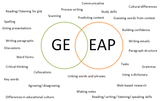
Though there are certainly important differences between GE and EAP, I wonder if, at lower levels at least, these differences are really that marked. Look at the words and phrases below. Where would you place each in the Venn Diagram below?
Did you find that the majority of the above could fit easily into either category? Did you find yourself saying, "It depends"?
I would hazard that, to some degree, all of the tasks, skills and activities listed above are features of both GE and EAP. What might differ is the degree to which each is taught. So, for example, a GE student might give a short presentation about cultural differences. The aims of the task might be to showcase the student’s fluency, accuracy and pronunciation. An EAP student might give a similar presentation on the differences in educational culture between his country and another. The aim may be slightly different, which would be reflected in the marking of the presentation. This student might be marked on body language, eye contact, clarity of visuals and how well the student was able to present ideas clearly, in addition to his fluency, accuracy and pronunciation.
Similarly, in writing tasks, both the GE and EAP student would be asked to write a paragraph or email and would be assessed on similar things - format, grammar, linking, topic sentences, vocabulary choice, etc. However, the EAP student might also be assessed on how well she links ideas together (text cohesion) and whether or not her ideas follow a logical progression (text coherence).
So, if we consider the aims of the activity or task, the focus changes slightly, but the task remains effectively the same. This suggests that EAP can be taught at a low level, and arguably should be in the scenario that Raef mentions above. If his students have little time to reach a certain level of proficiency, then keeping in mind the academic rationale for tasks and activities will help students build the skills they will need as their language level increases.
In his question, Raef mentions "real-life context" as a difference between GE and EAP, and it is in this topical aspect that we might find a split. Traditionally, EAP topics have tended to centre around academic subjects and be more "weighty" or serious, while GE topics have tended to be more generic and "lighter". Choice of topic has dictated which vocabulary students learn, with EAP vocabulary being more formal and ‘academic’. However, at lower levels, this distinction is not as great as at higher levels.
Looking through a couple of low level EAP course books, I see vocabulary being taught that would happily sit in a GE course book - apartment, big, friendly, library, mathematics, parents, teach, weather - as well as some vocabulary that is possibly more EAP specific - brain, gestures, poetry, organisation, research, survey. None of these ‘EAP’ words are greatly more difficult to learn than the ‘GE’ words.
The topics in these course books are not that different either, in that they are common topics that are accessible to lower-level students. Even so, there is one distinct difference: they have a more academic context - listening activities may be a short lecture, podcast or talk show involving an "expert", and readings similarly present an authoritative "voice". This sows the seeds for students thinking about source credibility and the need to question information while still studying the vocabulary for describing personality or communicating their reasons for their choice of holiday destination.
What about grammar? Grammar can be taught as usual, but within an academic context. Compare: Caroline studies hard at the university versus Robert plays tennis at the sports club. Each sentence shows good use of the present tense, though sentence A is possibly more "EAP".
My feeling is that EAP is a suitable choice for Raef’s low-level academic students and may be a more efficient choice given their ultimate need for academic English.
Invitation to share your ideas
Do you have anything to add on the subject of whether teaching EAP to low-level students is appropriate? We’d love to hear from you! You can respond directly to this blog by leaving a comment below.
Please keep your challenges coming. The best way to let us know is by leaving a comment below or on the EFLproblems blog post. We will respond to your challenges in a blog every two weeks.Filed under: Adults / Young Adults, Business & English for Specific Purposes, Professional Development Tagged: #EFLproblems, Academic English, EAP, EFL, English for Academic Purposes, Further education, General English, Higher education, Low level learners, Professional Development, Stacey Hughes, Teaching lower levels, Teaching problems
Oxford University Press ELT blog
.
Blog
.
<span class='date ' tip=''><i class='icon-time'></i> Jul 23, 2015 09:24am</span>
|