Blogs
|
We’re helping to solve your EFL teaching problems by answering your questions every two weeks. This week, Verissimo Toste responds to Ageliki Asteri’s Facebook comment about motivating Intermediate students.
Ageliki wrote:
How can I motivate a teen advanced level student to do better as this level is demanding to achieve a certificate and the students is ok with his intermediate plateau?"
This is probably a situation familiar to many teachers and my first consideration is to question why the student is satisfied with their intermediate level. If a student is in a class at upper-intermediate to advanced level, it is because that student has goals he or she wants to achieve. Tapping into these goals, and into that motivation, will enable teachers to help these students.
Set goals
I would suggest that first we need to make such students aware of what they still need to achieve. This could be in the form of informal quizzes or simple self-awareness. From this awareness, students should be encouraged to set goals for both language and skills development. Depending on the age of the students, I would make the goals short term so that students can feel they are progressing. This should give them confidence to set new goals and work to achieve them.
Focus on using the language
Students may feel they know the language, even about the language, but can they use it to communicate real information about themselves and their world? While expanding their knowledge of language, including revision of what they have already learned, encourage them to use it. It is one thing to be able to understand the present perfect, even to manipulate the different forms, but it is quite another to be able to use it to talk about life experiences and achievements.
Whenever I ask my students to talk about what they feel they have achieved in their lives, even those who are able to communicate this, do so without using the present perfect tense. They are usually surprised when I tell them and make an added effort to use it next time. Writing tasks in which they share their work, or freer speaking activities – like discussions, simulations, or debates – challenge students to use the language they have learned. Encourage students to be both more fluent and more accurate when using the language.
Challenge them to be better
I set up a class library in a class of about 25 Intermediate students with the aim of providing them with more contact with English through extensive reading. I did not test their reading, but often discussed how they were enjoying their books. They seemed very satisfied. I could have left it at that but I knew the readers series I was using was accompanied by a series of quizzes to test reading level. I told my students about this and asked if they wanted to take the quiz to see what their reading level was. They all agreed. I gave them the quiz, but before returning their scores, I asked each to write in their notebooks what mark they would be satisfied with as a percentage.
19 students out of the 25 received marks below what they expected. They were all high marks and, in general, they were very good readers. However, the quizzes showed them they were not really understanding (and enjoying) as much as they could. Equally important, they were not taking advantage of their reading to learn more.
This simple activity was enough for those students to come out of their intermediate complacency and work to improve.
Encourage independent learning
Many times students simply rely on the opinion of the teacher for how well they are doing. Too many times this attitude also includes passing the responsibility to the teacher for the whole class. However, it is important to encourage students to become independent learners.
Develop in your students the capacity to monitor their own language. Did they say what they wanted to say? Or did they avoid certain topics because they didn’t have the language? Encourage them to notice the kinds of mistakes they may be making. Are they mistakes they could correct themselves, but have left it for the teacher to do so?
As I have mentioned before, challenge them to be accurate, as well as fluent. Help them notice the difference between the English they use and the English of more advanced learners. At times, give them work that is well above their level. If students are studying for an exam, give them a mock exam at the beginning of the year. Let them see what they will be working towards in their English classes.
Invitation to share your ideas
Do you have anything to add on the subject of motivating Intermediate students? We’d love to hear from you! You can respond directly to this blog by leaving a comment below.
Please keep your challenges coming. The best way to let us know is by leaving a comment below or on the EFLproblems blog post. We will respond to your challenges in a blog every two weeks.Filed under: Adults / Young Adults, Professional Development, Teenagers Tagged: #EFLproblems, EFL, Fluency, Goal setting, Intermediate students, Language learning, Learner autonomy, Learning goals, Motivation, Professional Development, Teaching problems, Verissimo Toste
Oxford University Press ELT blog
.
Blog
.
<span class='date ' tip=''><i class='icon-time'></i> Jul 23, 2015 09:28am</span>
|
|
Simple booklet is an outstanding website for creating high quality web leaflets and sliders. I have been using the free version although there is a paid version and also a teacher account for $10 which includes 30 free student accounts. I have found the free version to be perfect for my needs so far.
Simple booklet integrates extremely well with a Google Account or Google apps account and when you go to sign up it gives you the option of logging in with either. You can also use a Facebook or Yahoo account or create a separate account. Once you have logged in, you are creating booklets with a couple of clicks. There are a range of format options and the editor is simple to use.
This is an exceptional tool for learning and students can quickly become producers of detailed well presented content. Teachers could also use of this to produce high quality revision materials and the school marketing team could use make excellent use of it for putting rich media on websites and across social networks. The integration with Google apps makes the integration of this piece of technology even easier.
Rather than carry on talking about it, it is probably more useful for you to see it in action so I am going to create this post in Simple Booklet (after I have proofread it first) and then I will embed it below. Below the embedded booklet, I will write the time taken to create the booklet from logging in to completion.
simplebooklet.com
6 minutes and 12 seconds. It is quite a basic booklet but I think it demonstrates the usefulness of this tool.
This post originally appeared on Free Technology for Schools www.freetechforschools.com
Jonny Liddell
.
Blog
.
<span class='date ' tip=''><i class='icon-time'></i> Jul 23, 2015 09:28am</span>
|
|
Diana Lea is editor of the Oxford Learner’s Dictionary of Academic English (OLDAE), published in January this year. In this article, she looks at what academic vocabulary is and how it differs from general English vocabulary. Diana will be speaking about the OLDAE at IATEFL 2014 on Wednesday 2nd April.
Is academic vocabulary fundamentally different from general English vocabulary? In creating the Oxford Learner’s Dictionary of Academic English (OLDAE), we were compelled to think very carefully about this question in order to decide what should and should not be covered in such a dictionary. Fortunately, other researchers had already put in a lot of work in this area. Our starting point was the Academic Word List (AWL) (Coxhead, 2000), which will be familiar to most teachers of EAP: 570 word families that will account for roughly 10% of most written academic texts. But these words are all included - and marked - in learners’ dictionaries already. What more is needed?
A word list is a useful tool for setting targets and monitoring progress, as students can tick off words that they ‘know’ - but it does not actually teach. What does it mean to ‘know’ a word?
In the first instance, obviously, you need to know what it means. For some words this will be relatively easy, because they carry roughly the same meaning in most contexts, for example achieve. Other words have a number of different meanings; many of these may be related to each other, but used in slightly different ways (e.g. capital). Yet other words have a quite specific meaning in a particular area of study: consider the use of the words variable and significant in the context of statistics. It is fair to say that academic writing generally takes a more precise and nuanced approach to meaning than much of the speech and writing that we encounter day to day. To understand academic vocabulary in context, students will benefit from an account of these words that is based on genuine academic usage, not general usage. That means a corpus of academic English.
The 85-million-word Oxford Corpus of Academic English contains undergraduate textbooks and academic journals drawn from a range of disciplines across the four main subject areas of physical sciences, life sciences, social sciences, and humanities. Analysis of this corpus enabled lexicographers to give a precise and nuanced account of the meaning and use of words in academic writing. For there is more to knowing a word than just knowing what it means: if students are to use a word correctly and effectively in their writing, they need to know how it behaves in context and how it combines with other words. As one teacher we interviewed said of her own students, ‘They know many words in isolation, but usage they find difficult.’
A complete account of a word in a learner’s dictionary of academic English needs to cover its meaning - or meanings - its grammar, any prepositions or grammatical structures it commonly combines with, any peculiarities of usage in particular disciplines, useful synonyms, and - for the most important words - lists of collocations in different grammatical relations. And all these points need to be supported by example sentences that are clear, illustrate the points well, and are based on authentic academic texts.
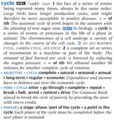
The entry for cycle only includes the meanings that are important in academic writing. This enables the academic meanings to be treated in more detail.
A more precise meaning that is particular to biology is identified in a ‘HELP’ note.
Cross-references indicate entries for compound words with their own precise definitions.
The example sentences show genuine academic usage, based on the texts in the Oxford Corpus of Academic English.
Complementation patterns with prepositions or other words are clearly signposted before the examples that illustrate them.
Collocations and common phrases are shown and exemplified in a special section of the entry.
Academic vocabulary is the vocabulary needed to write clear, appropriate academic texts. It includes, on the one hand, a lot of ordinary general vocabulary - but transposed to an academic context. At the other extreme, there is specialist subject vocabulary. This differs between different academic disciplines and can be highly technical; typically, students will need to learn these words as part of their subject studies, whether or not they are also learners of English. In between these two extremes is the ‘general academic’ or ‘subtechnical’ vocabulary represented by the AWL. The OLDAE covers the AWL, plus all the general vocabulary needed for defining it, plus the synonyms, opposites and collocates of all these words.
A word list is a useful starting point but a dictionary sets the words in context and enables students to use them effectively in their own writing.
Reference
Coxhead, A. (2000). ‘A New Academic Word List’, TESOL Quarterly, 34(2): 213-238. See also http://www.victoria.ac.nz/lals/resources/academicwordlist/
Related articles
#IATEFL - Adult Learners: helping them clear the next hurdle
#IATEFL - Teaching and learning EAP: "What is EAP and how can I teach it?"
Filed under: Business & English for Specific Purposes, Dictionaries & Reference, IATEFL Tagged: Academic English, Academic Word List, Authentic texts, AWL, Corpus, Diana Lea, Dictionaries, EAP, English for Academic Purposes, IATEFL, OLDAE, Oxford Corpus of Academic English, Oxford Learner's Dictionary of Academic English
Oxford University Press ELT blog
.
Blog
.
<span class='date ' tip=''><i class='icon-time'></i> Jul 23, 2015 09:28am</span>
|
|
This is a guest post by Dubier, an international school teacher in Sweden. Originally posted at http://iteachwithit.wordpress.com/2013/05/04/the-use-of-it/
I have been lucky to work at a school that has given me the opportunity to use IT products to develop my teaching. My school has contributed an iMac and an Apple TV . I have a private iPad and Macbook pro that I use as well. As I wrote in my documentation of My flip a few months ago, the iMac was only used when students did not have access to the internet at home. They used it to listen to audio files and also to watch the vodcasts. The beauty of having an Apple TV in the classroom is that you can easily connect it to a projector which in turn is connected wirelessly to the iMac. This was awfully handy if there were more in the class who had not had the internet at home or something else had happened so that they could not see the vodcasts. They could then sit together in front of the projector screen and take notes, while the others were working with the exercises that they needed to finish. Obviously this was not optimal and doesn’t exactly follow the Flip concept, but as a teacher it is important to be flexible and be prepared for all kinds of obstacles that can get in the way. More info about apple tv you can find at http://www.apple.com/se/appletv/airplay/
I have also used the ipad to connect to Apple TV many times. I used it the most as whiteboard. It happens some times that the students have the same questions and I have to explain the same thing for several students during the same lesson. Instead of wasting time explaining to every student separately, I connect the ipad to the projector through the Apple TV and answered the questions immediately. A small mini-review you might say. The Whiteboard app that I use is Doceri (http://doceri.com). Try it out and tell me later what you think. There are many different apps available but Doceri is the app I think is most comfortable to write with.
This post originally appeared on Free Technology for Schools www.freetechforschools.com
Jonny Liddell
.
Blog
.
<span class='date ' tip=''><i class='icon-time'></i> Jul 23, 2015 09:27am</span>
|
|
Rachel Appleby, co-author of two levels of the new International Express (published in January 2014), looks at how to help adult learners to maintain momentum when learning a language. Rachel will be presenting on this topic at IATEFL 2014 on Wednesday 2nd April.
Over the years, I’ve made significant efforts to learn Hungarian, and have done reasonably well; however, I can now "do" what I need to do with the language, and I’m very aware that I’m forgetting it, even though I still live in Budapest. I also go through phases of learning Spanish, and try to do a little everyday, such as reading an article I’ve come across that interests me, or putting Spanish radio on while I’m cooking. OK, so I might be keeping the little Spanish I have alive, but I’d be kidding myself if I thought that I was making any real progress in doing these things.
Many students I’ve come across tell me similar stories, but they also have other difficulties: time is always the number one hurdle; in addition, some think learning a language is all about doing grammar exercises, which of course they find boring; many claim to be able to learn long lists of words, but then resent their efforts when they find they can’t really use them in conversation.
Adults learning a language today characteristically stop and then re-start learning, each time with renewed enthusiasm, yet we all have busy lives! Does this sound like you too? Somehow we expect to make progress, often with minimal effort. Some people claim they are able to keep a language going by reading, or watching films, - perhaps even by having the occasional conversation with a native speaker in that language. But, in fact, all too often we’ve reached a plateau, or perhaps our language use is even getting worse.
So what can we do to help our students? I do actually realise that I need to engage my brain and be very focused on what I want to learn if I’m going to make any progress at all, so extensive listening while chopping onions isn’t really going to do the job! But how can we translate this into the classroom? How can we really get students involved, and ensure they make progress?
Well, I think we need to be very aware of the difficulties our students are facing, as well as what they’re aiming for; in fact the more we know about them, the better we’ll be at helping them. Adult learners bring a wealth of experiences to class, and in most cases are eager to share those, and have a chance to express their opinions. But they need to be motivated and engaged. So we need to ensure that we give them the scope and range of topics to be fully involved. But we also need to focus on language, and create opportunities to help them understand and relate to new language, and make sure that they practise the language in a meaningful way.
In my session at IATEFL Harrogate we’re going find out what it is that makes learning difficult and perhaps prevents learners from getting over the next hurdle. We’ll then be looking at topics and task-types from the new edition of International Express that will engage the learners, provide them with relevant language, and ultimately enable them to communicate effectively and make progress in areas that matter to them.
As a start, why not jot down in the comments box below what it is that makes it difficult for YOU, or YOUR learners, to get over the next language hurdle. I’d be really interested to find out, and - you never know - we just might have a solution for you! Let me know!
Related articles
#IATEFL - What exactly is ‘academic vocabulary’?
#IATEFL - Teaching and learning EAP: "What is EAP and how can I teach it?"
Filed under: Adults / Young Adults, IATEFL Tagged: Adult Learners, Engagement, IATEFL, International Express, Language learning, Motivation, Rachel Appleby
Oxford University Press ELT blog
.
Blog
.
<span class='date ' tip=''><i class='icon-time'></i> Jul 23, 2015 09:27am</span>
|
|
The Answer Pad is a website/iPad solution I've blogged about before that is great for student assessment. This is done by having teacher's use the website/interface to create students and classes and then let the students take a test/quiz on their iPad. The teachers would then get instant real-time results.
However, that's just one great feature of The Answer Pad as I was lucky to receive a demo on their latest update called, Go Interactive. Go Interactive allows students to use their iPad to respond/answer teacher's questions. Basically, it turns an iPad into an interactive clicker device, where teachers get instant results. What makes this such a useful feature is the way teachers can assess student's learning by some of the handy ways in which they can respond to a question, such as: yes/no, T/F, text, thumbs up/down, etc etc.
This is great for students who are shy and don't want to raise their hands to ask a question. Now, all they have to do is type in a question on their iPad and a teacher will see who asked it. Also, this is a great tool to engage students and Guided Learning. This could be a great tool to use when watching a class video or reading a class story and wanting to get instant feedback. I can even see this being used as a back channel chat.
Some other great features w/ Go Interactive is the ability to use it to answer any type of question for any subject such as: Spelling, Geography (there is a map template that can be drawn on), Math (interact graph paper to draw/plot data), drawing, etc etc.
I highly recommend checking out The Answer Pad by clicking here!!!
Below is a screen shot of The Answer Pad & Go Interactive in action, the left side of the screen is the teacher window and the right side window would be student's iPad....
This was originally posted on Technology Tidbits by David Kaluper, Ed Tech blogger, consultant, professional development and tech integration specialist with 14+ yrs in K-12 schools.
This post originally appeared on Free Technology for Schools www.freetechforschools.com
Jonny Liddell
.
Blog
.
<span class='date ' tip=''><i class='icon-time'></i> Jul 23, 2015 09:27am</span>
|
|
Keith Layfield, lead editor on the Business Result series, introduces his upcoming webinar on 17th April entitled "Making the most of the Business Result Online Interactive Workbook".
Have you used the Business Result Online Interactive Workbook, and are you getting the most out of it? Are you interested in using online resources to provide self-study material, supplementary classroom material, or a more interactive blended learning package?
My upcoming webinar is suitable for any teacher of Business Result. I will be providing practical help and ideas for using the Online Interactive Workbook, whether for self-study, classroom material, or for blended learning.
The webinar will provide an overview of the following:
Online practice and other resources
Business Result Online Interactive Workbook is a motivating self-study item that supports and develops themes from the Student’s Book. Each unit offers a series of interactive exercises practising the main sections of each unit - Working with words, Language at work, and Business communication - which are marked automatically and added to each student’s gradebook.
The interactive exercises also develop a number of skills: email writing and extended reading, plus there are video activities and discussion forum topics to encourage free writing practice. And there are extensive student resources - unit glossaries, sample emails, class audio - plus a unit test for each unit in the Student’s Book.
In the webinar, we’ll explore how you can make the most of these features, inside and outside class.
Gradebook and communication tools
I’ll also be exploring the automatic gradebook, which gives students and teachers instant access to grades. It saves time on marking and enables teachers to quickly track progress of all students.
Each unit of the Online Interactive Workbook has its own discussion topic related to the theme of the unit. This encourages communicative and collaborative learning, as students (and teachers) are able to read and reply to discussion topics. During the webinar, we’ll look at how to get the most out of this, and we’ll also focus on the ‘chat’ functionality, which enables students and teachers to communicate outside class.
The Online Interactive Workbook also allows teachers to add, create, and manage their own content. Teachers can add their own tests, create their own discussions, assign due dates for activities to be completed, add new activities, and many other things using a number of teacher tools.
So as you can see, the Business Result Online Interactive Workbook provides teachers and students with an exciting range of resources and tools to choose from! I look forward to exploring all of this with you in more detail during the webinar.Filed under: Business & English for Specific Purposes, Multimedia & Digital Tagged: Business communication skills, Business English, Business Result, Digital Learning, elearning, Keith Layfield, Online Interactive Workbook, Online resources, Self-study material, Web tools, Webinar
Oxford University Press ELT blog
.
Blog
.
<span class='date ' tip=''><i class='icon-time'></i> Jul 23, 2015 09:27am</span>
|
|
Dan Taylor in the Google in Education Summit group on Google posted about this excellent update to Google Drive. See below
Save time with right-click sharing from your Google Drive folder
For those looking to share files more quickly, listen up. You can now share with others directly from the Google Drive folder on your Mac or PC. To share a file while inside your Google Drive folder, simply right click the file, select "Google Drive" and then click "Share." This new feature is rolling out over the next few days.
If you aren’t already using Drive for your desktop, check it out: http://goo.gl/vGnhG
This post originally appeared on Free Technology for Schools www.freetechforschools.com
Jonny Liddell
.
Blog
.
<span class='date ' tip=''><i class='icon-time'></i> Jul 23, 2015 09:27am</span>
|
|
Edward de Chazal, author of many EAP titles, including the forthcoming English for Academic Purposes, part of the Oxford Handbooks for Language Teachers series, presents an imagined conversation about what EAP is and how we teach it. Edward will be presenting on this topic at IATEFL 2014 on Friday 4th April.
I keep hearing a lot about EAP these days, but - how can I put this? - I’m not really sure what it is. It means different things to different people, doesn’t it?
"I know how you feel. I’ve been teaching EAP for a few years now and I’m still trying to make sense of it. There’s so much going on. And it seems different when you start working somewhere new."
You can say that about any English language teaching context. So much to learn.
"Sure - but think how much you know already. Start with that. Think of your own knowledge of English. All that teaching experience. And your own education - how many qualifications have you done since you left school? How many training sessions and presentations have you attended?"
I see what you’re getting at. Yes, I know I know a lot, and I’m always learning something new. But - going back to EAP - what do I need to know? What is my role as an EAP teacher?
"Roles - there are lots of them. OK. Let’s start by looking at where we are in EAP today. One way of looking at it is that the field of EAP is a research-informed practice."
What does that mean?
"First and foremost it’s a practice - we’re all practising teachers - and the work we do is vital for the academic success of thousands of students worldwide."
OK, great, and what about the ‘research-informed’ dimension?
"And what we do is informed by all the work that has been going on for, well, about 50 years. There are lot of influences on EAP."
Like what?
"Well, there are major influences like genre analysis and corpus linguistics, but also other theories of teaching and learning, like approaches to teaching writing, study skills, and critical EAP."
What’s that?
"OK. At the heart of EAP is critical thinking. In EAP we’re all critical thinkers - teachers and students."
But what does this mean in practice?
"There are different approaches to critical thinking. With ‘critical EAP’, nothing is off-limits - we can critique pretty much anything and everything."
Like what?
"OK, let’s start with a text. As language teachers we’re always bringing in texts into the classroom - maybe up-to-date texts like newspaper articles that we’ve just come across, or photocopied texts from various sources, or simply the texts in the coursebooks we’re using."
OK, so students have to read lots of texts. What next?
"Well, in many English language teaching contexts the focus of the lesson would then be the text. So, you’d do some work on the text - tasks like working out meanings in the text, language work."
Of course - isn’t that the point?
"It’s necessary, but it’s not the whole story. We can encourage critical thinking by doing tasks like identifying the author’s stance, any weaknesses in the text, bias, assumptions, those sorts of things."
Sounds good.
"A critical EAP approach goes beyond the boundaries of the text."
How do you mean?
"In a critical EAP approach, we can encourage our students to ask questions like ‘Why have you selected this particular text?’ ‘Isn’t this text written from a Western perspective - it’s published in Oxford?’ and ‘How are the issues in the text relevant to me?’ Questions like these can be really interesting. We can encourage our students to reflect on these ideas and challenge what’s in the text and its wider context."
Hmm, certainly food for thought. Yes, as you said, there’s so much going on in EAP. I can see now that I’m going to get a lot out of learning all about it.
"I do. Arguably, one of the greatest influences on EAP is the wider context of English language teaching - we know a lot about that. There’s a lot to learn, but never forget how much you know already."
Related articles
#IATEFL - What exactly is ‘academic vocabulary’?
#IATEFL - Adult Learners: helping them clear the next hurdle
Filed under: Business & English for Specific Purposes, IATEFL Tagged: Authentic texts, Critical thinking, EAP, Edward De Chazal, English for Academic Purposes, IATEFL, Methodology, Oxford Handbooks for Language Teachers, Research-informed practice, Teacher Development, Teaching EAP
Oxford University Press ELT blog
.
Blog
.
<span class='date ' tip=''><i class='icon-time'></i> Jul 23, 2015 09:27am</span>
|
|
Read on to find out about this exciting new innovative Summercamp from BoomWriter..."This summer, students across New England will have an opportunity to come together online to write, edit and publish their own books inspired by Diary of a Wimpy Kid author and Massachusetts resident Jeff Kinney. Boston public broadcaster WGBH and the digital education company BoomWriter Media have teamed up to launch the BoomWriter Storytellers Camp to help middle school students maintain and improve writing skills during summer vacation. Through the collaboration, WGBH and BoomWriter Media are offering four separate one-week, online, curriculum-based and educator-supported camps that foster creativity and expressive writing.""We are excited to work in association with WGBH," said Chris Twyman, co-founder andCEO of BoomWriter Media. "They are the best of public broadcasting and are in the hearts ofchildren everywhere. Together, we can inspire a love of writing, storytelling and learning,while also facilitating critical thought and creativity for a new generation of learners. The BoomWriter platform provides 21 century students with a means of self-expression through writing that is both accessible and familiar and provides teachers with the tools for success."The new BoomWriter Storytellers Camp builds on BoomWriter’s existing web-based platformand provides students with daily lessons and workshops before challenging campers with adaily writing assignment. On the first day of the camp, participating campers are presentedwith a prompt, or ‘story start,’ written by Kinney.The prompt serves as the first chapter of a collaboratively written novel. After reading theprompt, campers individually write the next chapter. After writing, teachers and trainedcounselors review the campers’ writing and provide interactive feedback. When the dailywriting period ends, campers are given the opportunity to read select and approvedsubmissions from other campers and vote on their favorite additions to the story. Thesubmission with the most votes is accepted as the next chapter of the novel and serves asthe next day’s writing prompt.For more information and registration click here!!!
This is a guest post by David Kaluper. Ed Tech blogger, consultant, professional development and tech integration specialist with 14+ yrs in K-12 schools.
This post originally appeared on Free Technology for Schools www.freetechforschools.com
Jonny Liddell
.
Blog
.
<span class='date ' tip=''><i class='icon-time'></i> Jul 23, 2015 09:27am</span>
|