Blogs
|
The Professional Development team here at OUP is helping to solve your EFL teaching problems by answering your questions every two weeks right here on our blog.
Recently, we’ve posted the following blogs in response to teachers’ questions:
#EFLproblems - Teaching the over 50s
#EFLproblems - Teaching Monolingual Classes
#EFLproblems - Learners noticing and correcting their own mistakes
#EFLproblems - Learning English Beyond the Exams
#EFLproblems - Motivating Young Learners
#EFLproblems - Teaching Writing in the age of WhatsApp
#EFLproblems - Cell phones in the adult classroom: interruption or resource?
Each of these blogs was followed by a live Facebook chat with a member of the Professional Development team to discuss the topic further. Dozens of teachers have taken part in these chats to help them better understand how to deal with the issues we’ve addressed. Be sure to like our Facebook page to be reminded of upcoming live chats.
If you are facing a teaching challenge that you would like us to write about, please leave a comment on the EFLproblems blog post. You can also let us know on Twitter using the hashtag #EFLproblems or on our Facebook page.
We would also like to take this opportunity to point you towards some of the great resources we have available for teachers.
Social Media
You can follow OUP ELT on Twitter, Facebook, Google+, YouTube, and, of course, here on our blog. If you are new to any of these platforms, these instructions will help get you started.
If you use an RSS reader, subscribe to our blog to stay up to date with the English language teaching articles we post several times a week.
Professional Development Webinars
Did you know that OUP runs free webinars every week? If you’ve never attended a webinar, it’s definitely worth a try. All webinar attendees receive a certificate of attendance, a PDF of the slides, and a link to the webinar recording. Even if you can’t attend the webinar at the time it’s happening, signing up will give you access to the recorded webinar. If you miss any webinars, you can catch up with the webinar resources archive.
Oxford Teachers’ Club
With the Oxford Teachers’ Club, you can get free access to over 18,000 trusted EFL and ESL resources, lesson plans, worksheets, and activities, which you can download to support your English language teaching.
Finally, a big thank you to everyone who has submitted a question for us. Keep them coming, so we can continue learning and developing together.Filed under: Professional Development Tagged: #EFLproblems, EFL, ELT, English as a Foreign Language, English Language Teaching, Oxford Teachers' Club, Problems, Professional Development, Teaching problems
Oxford University Press ELT blog
.
Blog
.
<span class='date ' tip=''><i class='icon-time'></i> Jul 23, 2015 09:36am</span>
|
|
There are various website valuation tools which help website owners or potential buyers as they are much easier to calculate value because you know how much visitors you get to your website and how much money you make from it so you can do some calculation to come up with price.
1. MCJOnline
This one of the best tools out there because it returns much more information than just website worth. You can see number of backlinks, how many pages are indexed by major search engines, how many times your website is mentioned on social networks and how much visitors these website get. This is great tool which will help you to research your competitors if you are dealing with search engine optimization and internet marketing in general. This is a paid website valuation tool.
2. Websitestatschecker
Whenever one gets his/her website’s price info, then he/she is very keen to know the procedure by which that price is calculated. The bad thing is that most of the tools don’t tell you the procedure by which they calculated the price. Don’t worry now as Websitestatschecker is not like the crowd. The highly accurate price is calculated of your website and the factors considered while valuating are also shown.
3. Webutation
This website ranks well because it works fast, has a nice design and gives somewhere accurate information. Its feature is the social buzz which shows information from social networks so you can see what other people have to say about this website. Developers have done a great job to optimize this website and it loads very fast on any web browser. It is free as well as paid.
Exemplarr
.
Blog
.
<span class='date ' tip=''><i class='icon-time'></i> Jul 23, 2015 09:36am</span>
|
|
My first year as a flipped teacher, or a "flipper," has come to a close. And, I’m reminded more and more every day …as I am teaching summer school in a traditional lecture environment… why I decided to embrace the flipped classroom strategy, and why I won’t go back to the sage on the stage method. […]
The post Reflections from my Flipped Classroom appeared first on Teaching with Technology.
Bethany J Fink
.
Blog
.
<span class='date ' tip=''><i class='icon-time'></i> Jul 23, 2015 09:36am</span>
|
|
Image courtesy of Alessandro Valli via Flickr
Sean Dowling, an Educational Technology Coordinator, looks at using Edmodo as an alternative to blogs for running web-based English language courses.
In my previous post, I discussed how blogs could be used to design, deliver and manage a complete English course. However, using blogs for this purpose has a number of potential weaknesses.
First, blogging platforms don’t have in built assessment tools. Second, while the comment/reply feature of blogs does allow for some interaction between course participants, it can get a little unstructured if there are a lot of learning activities. Finally, student privacy is a concern. Fortunately, there are some free, web-based learning management systems (LMS) that help with these problems. One such LMS is Claco; however, my favourite, which I have been using for about four years, is Edmodo.
Edmodo allows teachers to set up private, online learning environments for their students. On my blog, I posted the following learning module:
Figure 1: Learning Module
If the lesson was being done in face-to-face mode, the topic could be introduced with a general discussion about recycling before starting the reading activity. This could have been done on the blog using the comment/reply feature of the blog; however, as there are a lot of learning activities, these replies may become quite disorganized. I use the different Edmodo tools to break up the learning activities and allow for more interaction between participants.
Notes and Polls
I use these to get students thinking about the theme and start a conversation. I like the fact that the students aren’t just selecting an answer for the poll but also making comments. Notes and polls (and quizzes and assignments) can either be sent to the whole class, groups or to individual students.
Figure 2: Note and replies
Figure 3: Polling question and replies
Notes can also be used to give students more information, for example to introduce a grammar point.
Figure 4: Note with information about grammar
Students can also post if they have a question or need to discuss something.
Figure 5: Student note with helpful information
Quizzes
After reading and listening activities, students may need to do a comprehension quiz. The Edmodo quiz tool allows quizzes to be easily set up and offers features such as different question types, time limit, randomisation, and can be linked to the grade book.
Figure 6: Quiz tool
Assignments
After writing activities or projects, students may need to submit work for grading. The Edmodo assignment tool allows assignments to be easily set up and linked to the grade book.
Figure 7: Assignment tool
Grade Book
All assignments and quizzes can be linked to the grade book. Other nice features include the ability to award badges to students and exporting the grade book to a spreadsheet tool such as Excel. Students can also see their grades.
Figure 8: Grade Book
The above tools will help you make your online lesson more interactive. But Edmodo also has some other helpful tools. The Group tool allows you to group students into smaller working groups. Subscription and notification tools allow class participants to keep up to date with all new learning activities. The Planner tool allows you to highlight important dates and deadlines for your students. And the Library tool allows you to store and share all course related documents.
While the above examples demonstrate how Edmodo can be used in a fully online English class, I have also used it extensively with my face-to-face students. My daughter’s teacher (year 6) also uses Edmodo with her classes, but as a supplement to regular classroom learning. My daughter will go to her Edmodo class when she is at home to check for homework, deadlines and other learning materials. It allows me, as a parent, to see how she is progressing.Filed under: Multimedia & Digital, Professional Development Tagged: Blended Learning, Bringing Technology into the Classroom, Connected Educators, Edmodo, EdTech, EFL, elearning, ESL, Learning Management System, Sean Dowling, Web tools
Oxford University Press ELT blog
.
Blog
.
<span class='date ' tip=''><i class='icon-time'></i> Jul 23, 2015 09:35am</span>
|
|
Ecommerce Forums help one to connect with experienced, like-minded store owners and ecommerce professionals online, all over. Forums are placed on websites to create a way of communication between others members that share the same interest. Some websites are completely forum based meaning there are no other pages other than the forums itself, this has become a great Idea among many developers, but in this case you need to attract a large community of members to your website that are willing to learn and share optics of each other’s interest. Forums mean nothing if you don’t have traffic or members, and having the proper forum design matching your website is a must. It also includes various online store owners to share knowledge and help each other grow their businesses.
An Ecommerce Forum on any website is an interaction platform that allows the sellers and viewers of the website to communicate with other sellers, buyers and viewers. Depending on the focus of commerce, the forum may be moderated differently (as per business). For example, if a store is about selling computer hardware, then the forum is likely to be geared towards topics involving computer hardware and very limited amount of posts would be geared towards other things. Topics that involve unrelated things are commonly referred to as Off Topic and are commonly given a separate section in the forum at a less visible place. The Ecommerce Forum is a powerful way to attract and keep visitors and buyers to an online store as they enable interaction among the visitors and in this way attract them to revisit the website in the future. Today, almost all established online stores will have some kind of discussion forums although the exact implementations of the Ecommerce Forums may differ depending on the tools used to setup the forums.
Benefits of Ecommerce Forums:
* Anyone can purchase his products or services online through e-commerce.
* Gain New Customers with Search Engine Visibility.
* Locate the Product or Services Quicker on e-commerce based online shopping portal.
* Customers can purchase his products or services online on lower price than retailer /shop.
* Ecommerce Forums reduce the travel time and cost as well.
* Provide Comparison Shopping
* Ecommerce Forums enable Deals, Bargains, Coupons, and Group Buying, etc.
* It creates online markets for niche products.
You can now easily put an Ecommerce Forum on your website for free. There are several websites who provide this service and have no charges at all. You will need to sign up on that website and get the forum from there for your website.
Exemplarr
.
Blog
.
<span class='date ' tip=''><i class='icon-time'></i> Jul 23, 2015 09:35am</span>
|
|
Every teacher knows what the rest of the world seems to misunderstand: TEACHERS DO NOT TAKE THE SUMMER "OFF." While not every teacher teaches summer school, or even gets paid during the summer months, teachers can rarely ever turn off their brains when it comes to preparing for classroom and curriculum … If you’re like […]
The post Use Google Forms to Organize your Summer PD appeared first on Teaching with Technology.
Bethany J Fink
.
Blog
.
<span class='date ' tip=''><i class='icon-time'></i> Jul 23, 2015 09:35am</span>
|
|
Gabby Pritchard, co-author of the new kindergarten series, Show and Tell, offers some practical tips for making the most of creative craft activities in the very young learner English classroom.
Craft activities are a fun and effective way of bringing a new language alive for young learners. They provide a great opportunity for children to use natural language in a real situation for a real purpose. They also help children develop a whole range of skills, including listening and speaking skills, visual literacy skills, social skills and motor skills, as well as encouraging them to think creatively and work cooperatively. Furthermore, children feel a real sense of achievement in completing and talking about the finished product.
Careful planning is key to ensuring your children are able to make the most effective use of new language while working on their craft activity.
Here are six easy ways to make sure your children are developing their language skills as well as enjoying their craft projects:
1. Put language at the center
When choosing a craft project, ensure it springs naturally from the topic your class is studying. Consider carefully how new and review language patterns, as well as vocabulary, can be used. For example, if the language is prepositions of place and the children are making a model of a house with furniture, focus initially on vocabulary. Use known question forms such as What’s this? Is it a…? to prompt answers. Then, as the children place the furniture in rooms, ask Where is the…? prompting the children to answer with full sentences: It’s next to the bed. Extend this by playing a language game with the class when the project is complete. In this case it could be a guessing game in which they take turns to describe where something is without naming it. Finally, the children can describe their finished work.
2. Begin at the end
Always begin by showing and talking about finished examples of the crafts. They illustrate the purpose of the activity clearly, and provide models for the children to work from. If the initial task involves making items that contribute to a bigger project, such as making animals for a farm, discuss how the children will contribute individually and also work together to finish the project. At this point, teach any new words they might need.
3. Lead by example
Before the children begin their projects, demonstrate the process in simple stages. Include the children by asking them to name the materials you are using and discuss what the next stages should be. Invite children to come and act as helpers, modelling instructions and polite behavior with them.
4. Teach the language of instruction
Be consistent with the instructions you use and build upon this throughout the year. Teach and encourage the children to use some new instructions each time they work on a new project. The language of instruction is very useful in a wide range of situations and the children will soon use these new words and phrases quite naturally in class.
5. Work together
Organize some activities that require the children to work in pairs or small groups. For example, ask children to work in pairs to grow a plant. They can choose and plant seeds together and then track the development of the plant by taking photos or drawing pictures. The children can also present their finished project to the rest of the class together.
Arrange the classroom so that children work in small groups at tables so they share equipment. Encourage them to use polite language as they work. Prompt them to transfer this language to other situations during the day, such as when preparing for snack time or tidying up.
6. Celebrate!
Arrange for the children to present their work at assemblies and to parents through class displays. Invite parents into school to admire their children’s work or have the children take craft projects home so they can talk to their families in English about their work.
Take a look at the craft activities at the end of each unit of Show and Tell. You will find plenty of ideas to try, from ‘feely’ pictures and sunny day balloons to a class picnic display, or even a whole model neighborhood.
But most of all, have lots of fun and get messy!Filed under: Pre-school Children, Professional Development, Skills Tagged: 21st Century skills, Classroom activities, Communication skills, Crafts, Creativity, EFL, ELT, Gabby Pritchard, Kindergarten, Language learning, Pre-school children, Projects, Show and Tell, Speaking, Speaking in English
Oxford University Press ELT blog
.
Blog
.
<span class='date ' tip=''><i class='icon-time'></i> Jul 23, 2015 09:35am</span>
|
|
Hello, friends! I am so excited to bring you a guest post by Marcus Gollahon about the wonderful tool that is Chalkup. Have you had experience with Chalkup in your classroom? Be sure to let us know in the comments. Without further adieu, check out… Great Website to Host Your Flipped Classroom - Chalkup.co As […]
The post How to Use Chalkup in Your Classroom appeared first on Teaching with Technology.
Bethany J Fink
.
Blog
.
<span class='date ' tip=''><i class='icon-time'></i> Jul 23, 2015 09:34am</span>
|
|
Charles Vilina and Kathleen Kampa, authors of the new Young Learners series, Oxford Discover, share teaching ideas on an important 21st Century skill: creativity.
Creativity is intelligence having fun." Albert Einstein
We’re very happy to be sharing our thoughts and ideas about creativity with you, because it is such a natural and motivating skill to develop in our young learners. Creative activities are fun and engaging for our students. They take learning far beyond the simple tasks of understanding and memorizing. In fact, it is the highest order thinking skill, as Bloom’s Revised Taxonomy illustrates below:
Creativity is an essential skill (along with critical thinking, collaboration, and communication) that students need in order to be successful in the 21st Century. Creative students are better at making changes, solving new problems, expressing themselves through the arts, and more.
How important is creativity?
In one of his TED talks, education scholar Sir Ken Robinson says:
Creativity now is as important in education as literacy. We should treat it with the same status."
Creativity is a natural ability that is found in every young learner. Unfortunately, traditional classrooms don’t always value creativity, and sometimes even hold it back. Our role as teachers is to nurture creativity at every opportunity.
Consider the following:
Creativity develops when students are able to analyze the information they’ve learned, make new connections with that information, come up with new ideas, and evaluate their choices.
To nurture creativity, students need the freedom to offer ideas and express themselves without judgment. In a creative classroom, all contributions from students are welcomed.
Creativity requires the courage to make mistakes. Sir Ken Robinson states, "If you’re not prepared to be wrong, you’ll never come up with anything original."
Creativity and innovation go hand-in-hand. David Hughes, founder of Decision Labs and professor at UNC Chapel Hill, feels that innovation is essential for our global economy.
What are the qualities of a creative classroom?
Teachers and students ask open-ended questions that encourage curiosity and creativity.
Students brainstorm as many ideas as possible without fear of being judged or being wrong. Students then go on to choose the best ideas and improve upon them.
Students demonstrate creativity not only individually, but with partners and in small groups. Ideas are generated and assessed collaboratively.
Students lead the learning and work together to complete projects. These projects help students take the information they have learned and present it in new and creative ways.
How can you nuture creativity in your classroom?
Let’s look at some specific ways to nurture creativity in your classroom, starting with one of the building blocks of language learning:
Phonics
Learning about letter shapes and names can be creative! When your young learners are introduced to letters, try this activity to build their creativity. Write the letters one by one on the board and ask the following questions:
Can you make the letter _(b)_ with your fingers? With your hands? With your whole body? With a partner?
When you first do this task, you might model how students could do this. Think out loud. Let’s see. Letter b is round and straight. How about like this? Or like this? Then your students are ready to try their own ideas.
Words
Vocabulary words can be taught in many creative ways. For example, verbs such as walk, tiptoe, and skate can be learned more deeply by inviting students to move in creative ways. Questions might include:
Show me what it’s like to walk in deep snow. Show me how you might walk on hot sand.
Imagine that you’re tiptoeing past a sleeping polar bear.
We’re on a frozen lake in Antarctica. Let’s skate with the penguins!
As you can see, creativity and imagination are closely related.
Other words such as nouns and adjectives can be presented creatively through facial expressions and body language, through movement, and even through dramatic skits.
Grammar
Grammar is often considered to be a logical and unimaginative part of English. However, grammar can be very creative as it is expressed in songs, poetry, and storytelling. Look for opportunities to build creative skills along with grammar skills.
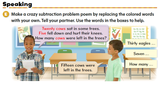
Here’s a fun and creative way to teach not only grammar and speaking skills, but math as well! It’s taken from Oxford Discover Student Book 2, Unit 8:
The above activity combines the logical thinking from math with the imaginative thinking from poetry. Students have a great time substituting the animals and numbers in the poem with their own creative ideas, while at the same time presenting a logical math problem.
Big Questions
Oxford Discover offers an inquiry-based approach to learning that allows students to consider big questions with many answers. Students are allowed to come up with their own additional questions. This process is creative as well as motivating for students.
Consider this Big Question from Oxford Discover Student Book 3: How do people have fun?
Students explore the many ways that people have fun around the world. The discussion may turn to the subject of celebrations. Students may explore the following questions:
What is a celebration?
What are some ways that people celebrate around the world?
What do people celebrate in your area? How do they celebrate?
What is needed to make a celebration successful?
As students explore these questions and find answers, they process the information by analyzing and evaluating what they have learned. Finally, they should be given an opportunity to create.
One suggestion is to get students working together to plan a celebration. They must determine:
What are we celebrating?
What is our celebration called?
Who is invited?
How will we celebrate?
What will we need to prepare?
As students plan, they also create. Students might create a poster, gather materials for their celebration, or even write a short play. Finally, they share what they have planned with the rest of the class.
In summary
A creative classroom is a joyful and motivating place where children feel empowered to learn, where all ideas are welcomed, and where learning is deep and meaningful. Children who are allowed to be creative are better learners, and they are more aware of their own learning styles. Creativity is a lifelong skill that our students will take with them into their adult lives to solve problems and help build a better world.
We’d like to conclude with a powerful quote from Robert Fisher in his IATEFL address entitled, "Expanding Minds: Developing Creative Thinking in Young Learners":
What promotes creativity is a questioning classroom where teachers and pupils value diversity, ask unusual and challenging questions; make new connections; represent ideas in different ways - visually, physically and verbally; try fresh approaches and solutions to problems; and critically evaluate new ideas and actions."
Thank you, and happy teaching!
Would you like more practical tips on developing 21st Century skills in your children? Visit our site on Teaching 21st Century skills with confidence for free video tips, activity ideas and teaching tools.
Sign up for a free webinar with Charles Vilina and Natasha Buccianti on How to use creativity in the classroom on 18 and 20 March 2014.Filed under: Professional Development, Skills, Young Learners Tagged: 21st Century skills, Charles Vilina, Creativity, EFL, ELT, English words, Grammar, Inquiry-based learning, Kathleen Kampa, Oxford Discover, Phonics, Speaking skills, Young Learners
Oxford University Press ELT blog
.
Blog
.
<span class='date ' tip=''><i class='icon-time'></i> Jul 23, 2015 09:33am</span>
|
|
Teachers, have you joined Twitter? If you, like my own momma, haven’t joined Twitter yet, please jump on the bandwagon! It’s free! It’s easy to use! It’s an AMAZING resource for teachers! If you’ve read my blog before then you know I was originally anti-Twitter. If you would have asked me two years ago why […]
The post How to Expand Your Summer Learning with Twitter appeared first on Teaching with Technology.
Bethany J Fink
.
Blog
.
<span class='date ' tip=''><i class='icon-time'></i> Jul 23, 2015 09:33am</span>
|