Blogs
|
Meeting Registration: Rebranding Digital Citizenship - Video Conferencing, Web Conferencing, Meeting and Webcast Service. Produce your own high quality online meetings, with video conferencing, web conferencing, video meetings, registration service, surveys, PayPal Integration and more. Try it free for two weeks!
Source: www.instantpresenter.com
See on Scoop.it - FootprintDigital
Mr Kirsch's ICT Class Blog
.
Blog
.
<span class='date ' tip=''><i class='icon-time'></i> Jul 23, 2015 11:16am</span>
|
|
Commencement Is history. Academic life takes on a different rhythm. End of semester revisiting of goals. Planning for fall semester courses. Reflection, rejuvenation, redirection.
One of the first academic professional development efforts I’ll engage in this summer is in reworking my Experimental Social Psychology course, PSY303. I need to somehow incorporate into it lessons learned from Diederik Stapel.
I also want to transform it into a major introduction to international/global applications. Any suggestions from readers of this blog would be most welcome.
Filed under: Carroll Reflections, Commencement, Curious David, Ethics, Fraud, Graduation, Higher Education Tagged: Commencement, Diederik Stapel, Higher Education, Social Psychology
David Simpson
.
Blog
.
<span class='date ' tip=''><i class='icon-time'></i> Jul 23, 2015 11:15am</span>
|
|
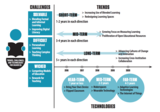
The New MediaConsortium Horizon report for HE 2015 is now out. As always it makes interesting reading. This post summarises the key issues that are likely to have an impact on Education in one, three and five years. In terms of trends in the short term, the focus is on increased use of blended learning and redesigning learning spaces. The latter reminds me of the SKG project, which lists seven ways to technology-enhance learning spaces. In the medium term it is about focusing on measurable learning, I think learning analytics might have an important role to play in this respect. And also the proliferation of Open Educational Resources (OER) and I would add Massive Open Online Courses (MOOCs) and in particular the implications for formal educational offerings. Advanced cultures of change and innovation as cited as important in the longer term, along with increased cross-institutional collaboration. Bring your own devices and the flipped classroom are cited as important within one year, makerspaces and wearable technologies in three years, and adaptive learning technologies and the Internet of things in five years. A number of challenges are listed: blending formal and informal learning, improving digital literacy skills, personalised learning, teaching complex thinking, competing models of education, and rewards for teaching.
e4Innovation
.
Blog
.
<span class='date ' tip=''><i class='icon-time'></i> Jul 23, 2015 11:15am</span>
|
|
Not sure what to blog about? Check out these 11 free resources that will help you overcome writer’s block.
Source: www.impactbnd.com
See on Scoop.it - InformationCommunication (ICT)
Mr Kirsch's ICT Class Blog
.
Blog
.
<span class='date ' tip=''><i class='icon-time'></i> Jul 23, 2015 11:15am</span>
|
|
I consider myself a connected educator. However, I’m still blown away by what that means in today’s world.
Earlier today, in Texas I GHO’ed with a cool lady in Tennessee and Voxered with a cool principal in Minnesota. Then, I helped a student get their bearing via Twitter while I talked to my wife about my day.
None of it was planned and it all happened with little effort!
Miracle 1
I was in a meeting today when the topic of Google Hangouts came up. Some questions were bandied about and I thought about Googling them. But my leaders at work Linda ( @LindaMac65) and Tracie ( @TracieGCain) have been pushing me to model, model, model what I expect.
So I put a call out on Twitter:
and within minutes… Who comes to my rescue but the venerable (I’m not sure I know what that word means) and sassy Samantha Bates (@sjsbates) from Tennessee with…
and she did and we chatted and she answer questions and it was cool!
Miracle 2
A while later, I had a question about a Twitter chat format that might mix a GHO and Tweeting… so I Tweeted the venerable (still not sure what that means) and crazy energetic Brad Gustafson ( @GustafsonBrad) in Minnesota about his TouchCast based show. So I used the Voxer app to send him a voice message that would hang in the ether until he was ready to hear it.
Within two hours he sends back four crazed, but, as always, genius messages with details. He then voxes me back and continues throwing out gamification this and edit video that… It was more than I asked for and I loved it!
THEN…
Miracle 3
I get home and one of my college government students needs help navigating our college’s new LMS. So we tweet back and forth and… BAM!… she’s all hooked up and ready to roll.
Ten years ago, none of this could have happened or it could have happened with tremendous effort.
I love being a connected educator and I hope to bring so many more over to the dark side in my new position as Digital Learning Consultant at ESC Region 11.
Mwa-ha-ha-ha!!!
(Cue Jackson’s Thriller Music)
Filed under: In The Classroom, Technology Tagged: classroom technology, connected educator, ed tech, edtech, education technology, technology, Twitter, twitter chat, twitter chats, voxer
Thrasymakos
.
Blog
.
<span class='date ' tip=''><i class='icon-time'></i> Jul 23, 2015 11:15am</span>
|
|
Whispered Words of Wisdom from My Mom at Her Memorial Service
Saturday, May 17, 2014
Sun City, Arizona
Good Morning! I am David Simpson, Pat’s oldest (perhaps Prodigal ) son sometimes called "David D." by her. A Professor of Psychology for the past 35 years, I am wont to speak for 50 minutes or to twitter for 140 characters, but here, as she would wish, I shall be uncharacteristically brief.
My mother was a life-long Teacher. She taught me how to read. As soon as I learned how to read, I tried to teach Baby Bruce. Even today I love reading and teaching.
Mom taught me about life and about death and how to pray the 18th century Children’s prayer (personalized version):
Now I lay me down to sleep
I pray the Lord my soul to keep
If I should die before I wake
I pray the Lord my soul to take
God bless Mommie and Daddy and Grandpa and Grandma
Connie Sue and David and Brucie and Queenie
And EVERY BODY!!!!! Amen
My mother was both simple and complex. She was a lady —prim and proper. She was good-humored, reflective, energetic, slim and vivacious. She loved children and music and clowns and cows and rainbows and especially took pride in her own children— respecting, accepting, treasuring, and nourishing their differences. Mom was a worrier—especially about the well-being of her guests. I do not doubt that she is worried right now about this service and that the guests feel welcome.
Mom leaves me with these whispered words of wisdom:
Don’t worry about doing THE Right Thing, but do A right thing.
Live, Love, Learn, and ——Give.
Be Good (for Goodness’ Sake).
Be Nice to your Brother and Sister.
Be Patient.
Be Kind
Be Giving.
Be Forgiving.
Be of Good Cheer.
Be You.
Be—-
and
Let it Be.
Obituary: Patricia Ann Stover (Simpson) Swinger
(Thanks to Sister Connie Sue and Brother Bruce for writing this).
February 2, 1924-April 18, 2014/ Sun City, AZ
Born in Robinson, Illinois to Nelson T. and Beulah Copley Stover, she had two siblings: Robert Nelson Stover and James Copley Stover. Her summers were spent at Interlochen, a world-renown music school/camp where she studied a number of instruments, including flute, piano, and organ. Her life centered around her family, her faith, and her music—not necessarily in that order.
After graduating from Robinson High School, she attended Oberlin College in Ohio where she met and later married Frank C. Simpson of Cleveland, OH. Frank was in the United States Navy, and soon after they were married June 30, 1945, she moved to FL to be close to him. Three children were born to them: Connie Sue (born in 1946), David Durell (born in 1949), and Bruce Copley (born in 1953). Pat was a stay-at-home-mom until Bruce entered kindergarten; she then began a teaching career in Ohio, and completed her student teaching and her Bachelor’s Degree through Kent State University in Ohio before returning to the Buffalo area to teach at The Park School for a number of years.
Frank’s job with General Electric and later with several steel companies in Niles, OH, and N. Tonawanda, NY, led to numerous family moves, and when Bruce was to enter the 9th grade, the Frank, Pat, and Bruce finally settled in Williamsville, NY near Buffalo, NY. Pat was involved in church music, church activities, teaching activities, and, of course, school activities of Bruce as he moved through high school. Frank died in New York in 2001.
In the meantime, Pat had moved to Sun City, AZ where she renewed acquaintance with Paul Swinger whom she married in 1994. Ironically, they had attended all twelve years of school together in Robinson, IL. Small world….Paul’s family consisted of two daughters- Vicki (and Leon) Midgett and Paula (and Randy) Britt, and their daughters and grandchildren.
Throughout her life, Pat maintained her interest in music, specifically the organ and the piano. She continued to take lessons throughout her life and was the organist and director of several choirs as well as mastering the hand bells of Paul’s church in Sun City. She traveled to various churches in Europe as a result of her membership in the American Guild of Organists, which regularly traveled overseas; she was able to play the European church organs of composers such as Bach, Handel, Beethoven, etc. She and Paul did extensive traveling after they married: Hawaii, Alaska, and Europe were some of their adventures. Pat continued with her music playing at Royal Oaks and elsewhere until macular degeneration curtailed that activity.
After she moved to Royal Oaks in Sun City, she took up golf and made many friends through that activity. She continued to golf throughout her life-and was quite good at it, too, and modestly had trophies to prove it. Part of an octogenarian golf team, she will be missed by her golfing buddies.
In February, Pat celebrated her 90th birthday with all three of her children and her friends in attendance. On April 18, 2014, she died peacefully at home in the company of family members. Services will be held in Bellevue Heights Baptist Church at 11:00 am the morning of May 17, 2014; and interment will be next to husband Paul Swinger (who died in 2008) in the columbarium of Bellevue Heights Baptist Church, a church where she was active in church activities from volunteering for the annual Rose Festival to serving on various church committees and participating in Bible studies and activities involving numerous churches in the Sun City area.
In addition to her children Connie Sue (and Keith), David (and Debbie) and Bruce (Kai) and many special friends, Pat will be missed by her grandchildren Andrew (and Misty Bowman and their two boys Nicholas and Daniel) of Hinwil, Switzerland; Blaise Connor Simpson of Frederick, MD; and Lisa (and Christopher Miller and their son Bryan) of Bucyrus, OH.
Filed under: Curious David, Mothers Tagged: Best Teachers
David Simpson
.
Blog
.
<span class='date ' tip=''><i class='icon-time'></i> Jul 23, 2015 11:15am</span>
|
|
Change is going to happen. The sometimes slow but always certain current of change has momentum…tremendous momentum. But it is dumb and unrefined momentum…like an undeniable ocean current. Yes, ocean currents can pull you out to a formless sea, but they can also be used to navigate to incredible destinations.
If we accept that change WILL happen (whether we like it or not), then the next question must be "How can I manage the change & make it work for me and my students?".
The good news is that we do have a choice in HOW the change happens. We can hasten it or redirect its energy to some degree.
We can’t stop it, but, in the same way that NASA uses the gravitational pull of planets to "slingshot" satellites to deep space, we can use the tug of inevitable change to move us in directions that are beneficial to one degree or another.
The certainty hidden or embedded in uncertainty is your free will.
The world is becoming more connect & it will require adult learners in the future to think quickly, access & mold (with purpose) information for a variety of student audiences. These adults are 5, 10, & 15 years old right now. These adults are sitting in your classroom waiting for you to choose to either make a conscious effort to use the momentum of change for their benefit or for yours or both.
There are adults in the future who are, themselves, reacting to change & making important decisions based on what you are showing them today in your classroom.
If they were to come back to you and ask for advise, of course you’d do your best to help.
The trick in being a teacher is to see the questions their adult selves will ask & address them in the here and now.
Change is happening and you can’t stop it…so use it to help you, your students, & our future:
1) Begin with relationships
2) Respect your students by challenging them
3) Assume the best
4) Use technology in meaningful ways (you may not live in a tech world…but they either are or will)
5)Take the ceiling off your thinking…don’t assume a final product for your students…assume & support quality work & thinking that will lead to a fabulous product
6) the person who does the work is doing the learningFiled under: In The Classroom Tagged: :), challenges, classroom, classroom management, classroom tech, classroom technology, cute kittens, inspiration, inspire, management, relationships, students, teacher, tech, technology, thrasymachus, thrasymakos, uncertainty
Thrasymakos
.
Blog
.
<span class='date ' tip=''><i class='icon-time'></i> Jul 23, 2015 11:14am</span>
|
|
I am currently working on the Create C Chapter of my new book - Learning Design: a practical approach. One section describes ways in which learners can generate content. The table below lists the different approaches that can be adopted. Am I missing anything?
Technique
Description
Annotation
The learners annotate a resource and then summarise the key points
Collective aggregation
The learners work in teams to collectively aggregate a set of resources around a particular topic. They can aggregate these on a group blog, a wiki or a Google doc. They add the link along with a brief description of the resource and why it is useful/relevant.
Crossword puzzle
This consists of a series of clues around a set of concepts. The learners are asked to complete the crossword. For example, ‘a type of pedagogical approach’ with 14 letters is constructivism, or the Spanish word for apple with 7 letters is ‘manzana’.
Mind mapping
Learners use a mind map to visualise a particular topic and associated ideas, either individually or in groups.
Posters
Learners are asked to create a poster on a particular topic. Peers can then provide comments and feedback.
Scavenger hunt
Learners are divided into teams, they are given a list of resources to find (for example they might be asked to find a resource on ‘constructivist learning’, or a resource describing how a wiki can be used to promote collaborative learning or a resource on the implications for learning). The team that collates all the items on the list first wins.
Snowball
This enables learners to organise groups of ideas on a concept and assign them to themes. Patterns and relationships in the groups can also be observed. One slip of paper (or ‘post-its’) is used per idea generated or possible solution offered. A meeting is set up of up to 5 people. The slips of paper are viewed and then grouped ‘like with like’. Duplicates can be created if the idea/solution is relevant to more than one group. Patterns and relationships in the groups are observed.
e4Innovation
.
Blog
.
<span class='date ' tip=''><i class='icon-time'></i> Jul 23, 2015 11:14am</span>
|
|
Erin F. Christian G.
Reyna G.
Campbell M.
Jadon M.
Kaleb R.Jared J.Isaih S.Chase R.Hunter S.
Laramie D.
Xander D.Elizabeth P.
Sydney M.
Peris K.
Tavian S.
Emelia S
Jacey K.
Maddie J.
Lexi H
Carlie H.Josh S.Kuna M.
Shalynn S.
Anna B.
Malik P.
Mr Kirsch's ICT Class Blog
.
Blog
.
<span class='date ' tip=''><i class='icon-time'></i> Jul 23, 2015 11:14am</span>
|
|
When I initially arrived at Carroll with my "ABD" degree (All But Dissertation) in 1978 it made much sense to me and to my chair, Dr. Ralph Parsons, to teach what I had specialized in during graduate school at The Ohio State University.
David, Ralph, and Virginia Briefly Reunited February 1, 2014
My introduction to the field of social psychology had come while I was an undergraduate at Oberlin College, and I hoped to give back to my Carroll students the excitement that I felt at that time of actually being a social psychologist.
At Oberlin my academic adviser, Ralph Turner, was a self-described "arm-chair" social psychologist—i.e not at a researcher—interested in creating dithering devices to facilitate learning that would cascade within and outside the classroom. As an adviser and professor Ralph Turner was kind to and patient with me. He was a role model of a dynamic teacher and a voracious reader who regularly wrote book reviews and who played a leadership role in Division 2 (Teaching of Psychology). He encouraged my intellectual curiosity and accepted me as I was, unformed and uninformed but eager to learn. He introduced me to the idea that psychological principles of persuasion and attitude change could be used to make the world a better place—or a worse place if applications of these same social psychological principles and findings failed to be guided by ethics.
These were my most (in)formative years especially, perhaps, because I was taking all my classes "credit/no entry" (that is, ungraded). This freedom from being graded allowed me to read voraciously, to be exposed first hand to social justice and war/peace issues, and to read and reflect upon works such as Postman and Weingartner’s Teaching as a Subversive Activity. I was also at that time inspired by APA President George Miller’s 1969 address advocating that we should give psychology away.
While a perennial graduate student at Ohio State I was surrounded by students who already were far better scientists than I was or would ever become and who subsequently have made major contributions to the field. Once again I was heavily influenced by personal relationships formed with a few key faculty—in particular by my academic adviser, mentor, and friend Tom Ostrom and more indirectly but in many positive ways, by the teachings by example of Tony Greenwald. Both of them, in their kind but brutally candid way convinced me that my calling most likely would be in teaching rather than in conducting creative, seminal, path-breaking research. And here I am thirty-some years later!
It pleases me that a number of Carroll students have chosen to pursue advanced graduate degrees in social psychology (e.g. Mark Klinger, Pam Propsom, Deana Julka, Darcy Reich, Jenny Welbourne, Cathy Carnot-Bond ) or in related disciplines (e.g. Mike Schwerin). Some of them have developed enviable scholarly reputations. But my goal in my experimental social psychology class is not so much as to be a pipeline to graduate schools in social psychology as to attempt to provide a capstone-like experience in their developed abilities of thinking about research.
I’m at a point of giving serious consideration to changing what I teach and how I teach my experimental social psychology course—if I continue to teach it. Two or my colleagues have a professional identity with my discipline, and I’m sure that they could step in. One possibility is to teach it entirely based upon readings (e.g. classic studies and recently published articles). Such a change in format might allow for more extensive, daily discussion and the potential development of student research ideas resulting from such discussion. This possibility would work best, however, if the class were small. There are years, though when I’ve had up to 35 students.
A second possibility is to teach it from a much more global, international perspective. A third possibility is to dramatically introduce hands-on Internet-based resources and experiences—drawing upon my recent interest in developing Web 2.0 learning tool. A good start in identifying some such resources has already been made by Scott Plous in his development of the Social Psychology Network and is reflected in the work of Jonathon Mueller in developing teaching resources for social psychology. And, of course, I could draw more upon the expertise of former students who are active experimental social psychologists. (Are you interest in some good students directed to you? Let’s connect!)
I welcome input from students and former students concerning which directions I should explore. How best should I proceed to give social psychology away?
Filed under: Carroll Reflections, Carroll University, Curious David, Oberlin, Psychology, social psychology Tagged: Social Psychology
David Simpson
.
Blog
.
<span class='date ' tip=''><i class='icon-time'></i> Jul 23, 2015 11:14am</span>
|