Blogs
|
Google continues to amaze me. Their stuff isn’t usually flashy, but it IS always useful.
Dallas Google Leadership Symposium
I was shown a cool new (for me) combination of Chrome Add-Ons that are super simple on the surface, but, because of their simplicity, can be used in a variety of ways by students, teachers, and administrators.
Filed under: In The Classroom, Technology Tagged: annotate, annotating, annotation, chrome, classroom tech, classroom technology, clearly, docs, google, group activity
Thrasymakos
.
Blog
.
<span class='date ' tip=''><i class='icon-time'></i> Jul 23, 2015 11:09am</span>
|
|
This is a story our local news station did on our #digcit unit: #Twitter Story: PHMS’ by @ICTPHMS #Vimeo http://vimeo.com/63169764 #Vimeo #SM
Keloland Twitter Story: PHMS from Mr. Kirsch on Vimeo.
Mr Kirsch's ICT Class Blog
.
Blog
.
<span class='date ' tip=''><i class='icon-time'></i> Jul 23, 2015 11:09am</span>
|
|
DO I HAVE A DEAL DECAL FOR YOU! I just discovered several hundred decals that I must have obtained from our Alumni Office (when it was called that) when my students and I used to do surveys of Carroll COLLEGE alumni. I consider these priceless memorabilia but I am willing to give them to any former Carroll student who wants one and is willing to share with me one "Carroll Moment"—a brief reflection (positive or negative) on this blog and who also will send to me a snail mail address (send it to my Carroll email address) so that I can in turn send you a decal! I’d love hearing from you. Send me a photo from your Carroll days, and I’ll send you two decals. Offer good until I run out.
Here are some "facts" about Carroll today.
Hope that you can share with me a Carroll Moment. Keep those Facebook, Twitter, and Linkin messages coming. It is fun to stay in touch!
David, Ralph, and Virginia
Filed under: alumni, Carroll College Waukesha, Carroll University, Curious David Tagged: Carroll Alumni, Carroll University, Commencement, Curious David
David Simpson
.
Blog
.
<span class='date ' tip=''><i class='icon-time'></i> Jul 23, 2015 11:09am</span>
|
|
Image from http://tinyurl.com/kzq3psu
I have just taken over leading the DiTE (Diversity in Teacher Education) project at Bath Spa University. In this post I will summarise the main focus of the project.
There is a major policy debate nationally - and indeed internationally - about the efficacy of different approaches to teacher education in the light of the challenges of preparing teachers for twenty-first Century schools., and in particular the binary opposition of university-led versus school-led approaches to the training of teachers.
The project consists of four phases:
The first phase is producing a picture of the landscape of teacher training and in particular the different routes. It will cover dimensions such as the: duration, level, cost, location and leadership of the provision and the demographic characteristics of the tutors and students involved in the different routes to Qualified Teacher Status (QTS).
The second phase will involve in-depth exploration of the characteristics of a sample of different types of provision in terms of their aims, structure, qualifications and, most crucially, the student experience. The sample will include HEI-led partnerships offering BA(QTS) and PGCE courses.
School-Centred ITT schemes, Teach First provision, School Direct and School Direct Salaried routes and the Troops to Teachers programme, and also perhaps those following the Assessment Only route to QTS including unqualified teachers recruited directly to Academies or Free Schools.
The third phase will entail specifying and measuring any differential outcomes and effects of the different training routes studied in Phase 2. An attempt will also be made to determine different rates of employment and whether teachers trained on different routes have differential effects on pupils’ learning outcomes.
The fourth phase will focus on dissemination and recommendations to policy makers. It will contribute to a broader understanding of processes of professional formation in teaching (and potentially allow comparisons with other professions).
e4Innovation
.
Blog
.
<span class='date ' tip=''><i class='icon-time'></i> Jul 23, 2015 11:09am</span>
|
|
I was blessed with a demeanor that helped me quickly create fairly strong bonds with my high school seniors. Despite my dry sense of humor, students could always tell that I cared about them whether I intended on communicating that fact or not.
One sure fired way to build relationships was to use humor as a teaching strategy. Later in my teaching career, I would try to use humor in the classroom to some degree (as this post on humor attests to). Our year would usually start off with self demeaning humor to let them know that I wasn’t too full of myself.
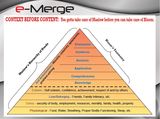
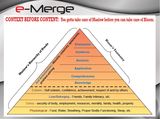
At first, though, I relied too much on what I knew and not enough on learning about my students early in my career. I knew how to use Socratice questioning effectively and how to challenge my students thinking in a few other ways, but I over emphasized the surgical use of questioning strategies before I developed strong social bonds. Few realize that questions, while they do make people think deeply, also look like attacks to those not used to them. As we moved through the semester, I often to teach my students the lesson that thinking deeply means to think about thinking. Students though, year after year, saw open ended questions as arenas to showcase their failure to grapple with them (or rather their lack of being exposed, in some cases, to questions like the ones I was throwing out). The lesson I learned? You gotta take care of Maslow’s before you take care of Bloom’s.
I have become a relationships first person. Since those days, I’ve come to see that if you don’t package what you’re selling correctly…ain’t nobody gonna buy your product.
I was goofing around with my children at a local Barnes & Noble a couple months ago. They found the "Thomas the Train" table in the children’s section, so I stole a few moments to peruse the newest offerings.
I came across Emotional Intelligence, a decade old book that I had heard about but never read. I decided to purchase it in CD format and have since finished listening to it as I commuted to my new job. As far as emphasizing relationships is concerned, I’m not sure I learned too much that I hadn’t figured out or experienced in my 10 years of teaching high school government. However, "the why" of what I do that the book illuminated was astounding!
One of my favorite lines in his book, Emotional Intelligence, Daniel Goleman recounts an explanation a neuroscientist at the Center for Neural Science at NYU, Joseph LeDoux, gave Mr. Goleman concerning the relationship between the emotional (amygdala) parts of the brain and the rational (hippocampus) parts of the brain:
The hippocampus is crucial in recognizing a face as that of your cousin. But it is the amygdala that adds you don’t really like her.
While I’m certainly no neuroscientist, I can compare my personal experience to what I’ve read in chapter 2 (Anotomy of an Emotional Hijacking) of Emotional Intelligence and see some very distinct lines of symmetry between the two.
The lower levels of our brain, the book continues, developed first, as far as evolution is concerned. Emotion came about as unthinking short cuts to action. The hippocampus and neocortext are the thinking parts of the brain that developed later and allow us to be the complex creatures that we are.
Everything we learn, Mr. Goleman states in his book, gets stamped to varying degrees with the "flavor" of the emotional environment via the amygdala.
We recognize failure as debilitating if other’s reaction to our shortcomings (especially early in our lives) overshadow our attempt to learn from that failure. If a student or friend fails and we support them in that failure, however, the supportive emotional flavor of the moment stamps our shortcoming as a step on our way to self actualization. If educators (and many do) redefine "failure" as an open invitation to continue the learning the first few weeks of school, then students will be more willing to "fail".
Once I learned to work on relationships, I found that I could ask deep and probing questions of my students. Because of the safer environment AND because I announced that the most important questions in life are often "unanswerable" student’s felt secure that the only task I was asking them to perform was to support their answers. The answers weren’t the point…the process was.
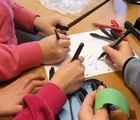
This kid spent an inordinate amount of time preparing for a couple dozen failures. When his contraption worked on the fourth attempt he was thrilled! However, his success lasted mere moments…but his struggle to learn began the moment he was introduced to rube goldberg machines and likely continued far after his "success". The true success here was the fact that his parents and teachers taught him that "failure" isn’t really a stopping point.
Just as we need steps on stairs to ascent a building, failures can be thought of as mini stopping points on our climb to success.
Plato once wrote "Be kind, for everyone is fighting a mighty struggle." What he meant was that we are all fighting demons and the strongest demon is ourselves. We really don’t need help from others to give that phantasm a voice. We are our own worst enemy in our struggle to become self actualized. To be told that we "failed" in such a way that we no longer want to try…now we’re fighting two fronts in our battle to become who we were meant to be.
Our perception of reality flows first through our senses, then the amygdala, and then the rest of the brain. Everything gets stamped by emotion first and reason second. It does not mean that emotion is superior to reason in every case, but it does mean that we must consider emotional environments before we consider reason.
Humor, creativity, and innovation have a common ground…they challenge the status quo. Being challenged to be innovative and creative can also be fun… again, as I outline in this post.Filed under: In The Classroom, Political Philosophy Tagged: amygdala, emotional intellignece, hippocampus, neocortex, plat, rube goldberg machine
Thrasymakos
.
Blog
.
<span class='date ' tip=''><i class='icon-time'></i> Jul 23, 2015 11:08am</span>
|
|
Don’t know how to partake in a twitter chat? Follow the embed screencast and learn how.
Mr Kirsch's ICT Class Blog
.
Blog
.
<span class='date ' tip=''><i class='icon-time'></i> Jul 23, 2015 11:08am</span>
|
|
My 3rd grade son, Charlie, found a way to screen-cast on iOS devices. This is what he showed me. Follow instructions at your own risk. Not advocating these actions. Just impressed that he figured this out on his own. He may ground at a later date if this crashes his iPad. It’s worked well so far!
Filed under: In The Classroom, Technology Tagged: classroom technology, ed tech, edtech, education technology, iRec, screencast, screencast ipad, screencast iphone, screencasting, screencasting ipad, screencasting iphone
Thrasymakos
.
Blog
.
<span class='date ' tip=''><i class='icon-time'></i> Jul 23, 2015 11:08am</span>
|
|
Students quoted reflections on their Social Media Profiles verse their "hard copy" resumes.
[View the story "Social Media may be more important than your Resume." on Storify]
Mr Kirsch's ICT Class Blog
.
Blog
.
<span class='date ' tip=''><i class='icon-time'></i> Jul 23, 2015 11:08am</span>
|
|
Image Bild: CC BY-NC-SA Some rights reserved by Opedagogen
Nice blog post today by Alastair Creelman on collaboration. He begins by arguing that ‘Learning involves collaboration and interaction…’ He points to a guide that has been published, which describes the following facets of collaboration:
Collaborative writing
Shared workspace
Curate
Plan
News gathering
Screencasting
Network
E-meetings
Research
The guide describes tools that can be used to enable each of these; for example Google Drive for collaborative writing or Twitter for networking. A very useful and practical guide!
e4Innovation
.
Blog
.
<span class='date ' tip=''><i class='icon-time'></i> Jul 23, 2015 11:08am</span>
|
|
This post is password protected. You must visit the website and enter the password to continue reading.Filed under: Camtasia Studio, Curious David, Screencasting Tagged: Screenflow
David Simpson
.
Blog
.
<span class='date ' tip=''><i class='icon-time'></i> Jul 23, 2015 11:08am</span>
|