Blogs
|
Google doesn’t really care that they’re completely undermining Microsoft Suite by giving away cool resources like Word or Power Point "wanna-be’s".
Yes, I just used a term from 1999.
But that term was in quotes which means I was being ironic.
Why?
Google form is now anything other than a "wanna-be" program with the new update.
Forms has been blown open by the demi-gods (or is it demagogues) at Google. You can now personalize your forms, tests, quizzes, and surveys like never before! It’s such a simple switch that will be making so many educators very, very happy.
Here’s a goofy tutorial.
Filed under: In The Classroom, Technology Tagged: classroom tech, classroom technology, drive, forms update, google, google drive, google form update, google forms, google forms update, google quizzes, google test, google tests, google update, polls, survey, surveys, thrasymachus, thrasymakos
Thrasymakos
.
Blog
.
<span class='date ' tip=''><i class='icon-time'></i> Jul 23, 2015 11:14am</span>
|
|
This thought piece has been slightly revised from a blog piece I wrote a number of years ago for the Milwaukee Journal Sentinel under the name "Curious David" when I was a community educational blogger for them.
I’m nervous and excited. Time to take off my invisibility cloak. Tomorrow (Tuesday, September 2, 2008 at 8:00 a.m.) I meet in person for the first time with my 20 first-year students. What an immense responsibility to be their first professor!
We’re going to explore "21rst century" learning tools such as blogs, wikis, podcasts, social networks, virtual worlds, and YouTube. The idea for this course emerged from my experiences writing this "Curious David" blog column. Last year’s opportunity to write for "JSonline" was transformative for me as I learned from elementary and secondary school teachers, high school students, virtual school advocates, retired faculty and readers about innovations, challenges and successes they faced promoting learning.
In this first-year seminar we shall focus on some of the 25 free learning tools described by educator Jane Hart. [Here is an updated list I would draw upon were I to teach this course again.] As we examine these learning tools we hope to answer questions such as these:
To what degree can these web tools truly enhance student learning?
To what degree are they just "cool" tools?
Could they be used to develop critical thinking?
Do they improve or degrade communication skills?
Might they be applied to fostering cross-cultural or international understanding?
Might they strengthen or weaken writing skills?
What are their weaknesses or dangers?
Should they complement or replace 20th century learning skills/tools?
How can one evaluate their effectiveness?
[It seems to me it should be possible to produce an evidence-based paper like this to address the questions above.]
My intent is to assist students in the transition from high school to college—and to investigate Web 2.0 learning tools which might be useful across classes and in the workplace. I want to involve them in educational experiences that will develop and enhance abilities in reading, writing, reflecting, presenting, thinking, and producing. Writing exercises will include short in-class and out-of-class reaction papers, journals, blogs/wikis, and exams. Presentations will be both formal and informal; individual and in small groups. Collaboration will be both with fellow students and with me.
Still Curious,
David
Filed under: App Generation, Blogging, Curious David, Jane Hart's Top 100 Learning Tools Tagged: app generation, Global/International, Higher Education, Top 100 Learning Tools, Web 2.0 Learning Tools
David Simpson
.
Blog
.
<span class='date ' tip=''><i class='icon-time'></i> Jul 23, 2015 11:14am</span>
|
|
Check out Edutopia’s collection of articles, videos, and other resources on internet safety, cyberbullying, digital responsibility, and media and digital literacy.
Source: www.edutopia.org
See on Scoop.it - FootprintDigital
Mr Kirsch's ICT Class Blog
.
Blog
.
<span class='date ' tip=''><i class='icon-time'></i> Jul 23, 2015 11:14am</span>
|
|
I’m pretty sure that, like many of you, I was gamifying stuff before it was a "thing". If I got bored teaching the same thing in the same way year after year, I couldn’t imagine what my poor students were going through. So "tricking" things up was and is an innate tendency for me simply because I don’t want to spread the evils of boredom.
Most concepts in government are fairly dry and, unfortunately, lend themselves to said boredom. If I can pull in a controversial topic, example, or game to teach a lesson, I’ll do it in a heart beat.
The Topic
One of those "dry" topics is separation of powers and checks and balances. I was taught these concepts through the awesome power of diagrams and scribbled arrows on a chalk board…or is it chalk bored?
To teach separation of powers, I tried to think of a way to play a game that would stay true to the idea. A government divided so that action would be difficult in the best of times. A series of rules that would only allow for action if most Americans (or at least their representatives) were in agreement (for the most part). A way to play a game so that if a tyrannical person or mob arose there would be several ways to "slow their roll" as my students used to say. A game that had internal and external pressures… then it hit me one day as my wife (@HCooper815) and her friend were whooping me and my pal in Cranium.
At School
The next chance I got, I took the Cranium game to school. I divided my 20+ students into three groups of 7, 8, or 9.
In each group of , let’s say, I had them elect one chief executive. With the other 8, 3 were to become judges and the other 5 were Congress (Bam! Three branches).
Cranium cards are divided into four sets. Creative Cat, Word Worm, Data Head, and Star Performer.
I would then list Articles I, II, and III on the board with associated Federalist Papers that dealt with those particular branches.
Article I (I write some quotes from Federalist 52 on the board) establishes Congress and outlines what they can do in section 8 and lots and lots of "no’s" in section 9. The founders saw this branch as the most problematic which is probably why they mention it first and alot the most ink to it (and yes, it’s also the closest to that tumultuous sea of insanity know as "the people").
Since Congress is full of brains that are supposed to think clearly, the two categories in Cranium that deals with information and sifting of information, Data Head and Word Worm, were theirs. So if the die came up those two colors the elected speaker of the house would debate the possible answers with his Congress and come up with an answer.
The president, of course, could veto Congress’ answer and suggest his own. Then Congress could override his vetoed answer with a 2/3 vote.
Congress could also impeach the remove the president if he did not live up to his duties.
Article II deals with the president. Federalist 70 addresses the "energetic executive". Since the president is so full of energy, why not make him address the other two categories: Star Performer and Creative Cat. Any time the die landed on these two "active" categories the president had to perform for his or her nation. Then Congress was tasked with the responsibility of guessing the silent clues, horribly drawn out illustrations, sculptures, songs, or hums.
Let’s say the president isn’t good at singing, though. The president can go to Congress and ask for a declaration of war on another group in the room (which keeps them on their toes). If Congress agrees, then the president declares war, names the team, and the president of that "nation" has to address the Star Performer or Creative Cat activity. If they get it wrong, the original team gets to move on the board. If they get it right, they get to move.
Article III addresses the Supreme Court. I would write a quote or brief summary of Federalist 78 on the board. Since I’ve printed out the rules, the Supreme Court has to make sure their nation follows the rules or face getting sanctioned by the State of Nature (me). They also have a rubric in front of them and give grades to the participants. As the State of Nature, I support no nation in particular. So if one group moves a piece to their advantage and the judges in the other nations don’t notice…who am I to tell? Judges have to be on their toes constantly watching their own group as well as the others. If a president from the other team has to close their eyes and draw on the board then the judges of the other two teams are asked to make sure that chief executive doesn’t cheat by opening his eyes.
Further, if a team is successful the "energetic" executive has to move his nation’s piece along the board. It is the judge’s task to make sure that the piece is moved before the president sits down. If he sits down, then their turn is over and they can no longer move that piece.
Each round, it seemed, students were adding to the rules using their textbook to find passages from the U.S. Constitution to mess with the other teams. It was leading horses to water and enticing them to drink at its finest!
Fin
I had a handout somewhere… but alas I cannot find it. The second I do, I’ll post it as an attachment so you can see exactly what my students saw. But you get the general idea of the scope of the game.
This game was great fun and it ingrained in the students, via their role playing tasks, at least 1/3 of the checks and balances and separation of powers, but it was usually much more successful than that. When students are calling each other out using phrases like "Nuh uh, Article I section 9 states…" or "Yeah, Federalists 70 said…" then you know something was done right…
Coop out… (drops mic).Filed under: Government/Civics, In The Classroom Tagged: activities, checks and balances, civics, classroom activities, classroom games, cooper, cranium, games, gamification, government, humanities, lesson plans, separation of powers, social studies, thrasymachus, thrasymakos
Thrasymakos
.
Blog
.
<span class='date ' tip=''><i class='icon-time'></i> Jul 23, 2015 11:13am</span>
|
|
Commencement 2014 was a month ago. I have already begun preparations for teaching in the Fall (how the years have flown by since February, 1978 when I taught my first class here).
From time to time I disconnect and disengage from my seemingly always being online and from focusing on productivity. Try it —-you may discover that you are more addicted than you think. Can you enjoy the twittering of the birds without thinking about this wonderful Twitter guide?:)
It is easier to so do during the summer, since I opt NOT to teach or to commit myself to grant work during that time. As author Naomi S. Baron acknowledges in her thoughtful book Always On: Language in an Online and Mobile World, one needs to be alert to the personal, cognitive, and social consequences of "24/7″ connectivity.
Is Google making us "stoopid" (sic) or smarter? How can I ever find time to explore, evaluate, merge into my teaching the 2000 + learning tools which Jane Hart has alerted us to? I resolve these questions by stepping back, engaging in intense physical activity, reading widely, playing, and consulting the Newf!
Filed under: Carroll Reflections, Curious David, Jane Hart's Top 100 Learning Tools, technology tools Tagged: Reducing Internet Distractions, Self-Discipline, Technology Learning Tools, Turning Off the Internet, Unplugging from Internet
David Simpson
.
Blog
.
<span class='date ' tip=''><i class='icon-time'></i> Jul 23, 2015 11:13am</span>
|
|
While a strong resume is still a huge asset, it’s not the only thing that employers are looking for. With social media in the mix, recruiters feel they can get to a know who a candidate is by look…
Source: www.business2community.com
See on Scoop.it - InformationCommunication (ICT)
Reflection Questions: Post #7 post by Friday, November 21, 2014 @5pm.
1) What do you think about the infographic? Do agree or disagree? Whether you agree or disagree explain why. (Think about your own "Digital Footprint").
2) Do you think Social Media currently is and will be in the future a method for employers to check incoming employees (i.e., resume)?
Mr Kirsch's ICT Class Blog
.
Blog
.
<span class='date ' tip=''><i class='icon-time'></i> Jul 23, 2015 11:13am</span>
|
|
Christine Smallwood has a thoughtful review in the June 9 & 16 2014 New Yorker "Ghosts in the Stacks" of Phyllis Rose’s The Shelf: From LEQ to LES.
Smallwood raises some issues about reading of considerable interest to me:
how we choose books today has been dramatically changed by technology (our preferences and reading habits are monitored and curated
what scholars read and how they read has changed (a distinction is made between close reading and surface reading)
I was appropriately admonished by her last paragraph:
And what about the books right in front of you that were published, even purchased, but, for all you know, might as well not have existed? My own bookshelves are filled with books I haven’t read, and books I read so long ago that they look at me like strangers. Can you have FOMO about your own life?…The alphabet is great, but there is nothing quite as arbitrary as one’s own past choices. Reading more books begins at home."
Timeout on buying new books to read until I review what is filling my home office bookshelves. This is also a wonderful opportunity to use my LibrarianPro app.
Hmm—32 books in shelf # 1 beginning with father-in-law’s 1927 copy of the Best Known Works of Edgar Allan Poe and ending with Philip Tetlock’s Expert Political Judgment. How delightful!
Filed under: Books, Reading Tagged: Reading
David Simpson
.
Blog
.
<span class='date ' tip=''><i class='icon-time'></i> Jul 23, 2015 11:12am</span>
|
|
Conole career trajectory from Grainne Conole
On Monday I am giving a talk as part of International women’s day. The focus is on my career trajectory. It is interesting now and again to stop and reflect on your career, the key trigger points and the reasons for changing direction. Like many people I have had more than one career. I started life as an Inorganic Chemistry lecturer, having completed a PhD in X-Ray Crystallography. I stumbled across Authorware Professional, a tool for creating multimedia resources and I was hooked! Then when the web emerged I created one of the first Chemistry websites for my students. In the mid-nineties I moved into a central role and set up the Learning and Teaching Innovation and Development unit, to help teachers make better use of technologies and be more innovative in their teaching. I broke from Chemistry finally in 99 when I went to Bristol to head up the Institute of Learning and Research Technology. Whilst I was there we grew from 30 to 80 people, through funding primarily from JISC. I took up a chair in Post Compulsory Education and Training at Southampton in 2002, moved to the OU in 2006, then Leicester in 2011. And now of course I have just started at Bath Spa.
I was awarded an HEA National Teaching Fellowship in 2012, the application required me to articulate the impact I have had on students, teachers and the international community. I structured my application around 4 phases of technology development: multimedia resources, the Internet, Learning Design, and social and participatory media. A copy of my applicant with more details on this is available here. I feel very privileged to be working in this area, and being part of a fantastic international community of peers.
Digital technologies have so much to offer to enhance the learning experiences, but there are still significant challenges; new approaches to design can help, as can effective use of Open Educational Resources and Massive Open Online Courses. We cannot even begin to envisage what the educational landscape will be like in the future, all we can be sure of is that it will continue to change and evolve and technologies will continue to have a significant impact on learning and teaching.
e4Innovation
.
Blog
.
<span class='date ' tip=''><i class='icon-time'></i> Jul 23, 2015 11:11am</span>
|
|
Robin the Newf knows about FLOW.
In an interesting article entitled "The What, Why, When, and How of Teaching the Science of Subjective Well-Being" in the April 2014 issue of the journal Teaching of Psychology Ed Diener and Christi Napa Scollon point out that in the past few years there have been over 10,00 publications per year on the topic of happiness. Anyone interested in teaching a course about Subjective Well-Being (I myself developed and taught such a course once for Freshmen) might find this article especially useful. It includes sample discussion questions, sample syllabus topics, exercises for enhancing well-being, and scholarly references. Here are webpages describing related work of two scholars I admire Richard Davidson and Sonja Lyubormirsky.
Some relatively recent "SWB" research is summarized in this Happify link.
Below are some germane videos I have come across that made me laugh, smile, or think and that I might use were I to teach such a course again.
Enjoy.
Filed under: Happiness, Psychology Tagged: Happiness, Psychology, Research Seminar, Subjective Well-Being (SWB), TED
David Simpson
.
Blog
.
<span class='date ' tip=''><i class='icon-time'></i> Jul 23, 2015 11:11am</span>
|
|
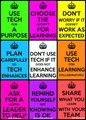
If you haven’t noticed, whilst I love technology and its propensity to enhance learning, for me it always has to be purposeful. I’ve written at some length about it previously but I thought a handy…
Source: ictevangelist.com
See on Scoop.it - Educational News and Web Tools
Mr Kirsch's ICT Class Blog
.
Blog
.
<span class='date ' tip=''><i class='icon-time'></i> Jul 23, 2015 11:11am</span>
|