Blogs
|
1) Earth Day concerns should be unifying every day concerns .
2) We must do more than merely virtually explore the wonders of our precious planet.
3) Preserving, savoring, celebrating, protecting, and nurturing Mother Earth should be a super-ordinate, cross national,unifying effort of international concern.
4) We are all earthlings.
5) There is much to learn.
6) Mother Earth is fragile and the Pale Blue Dot is tiny in the cosmic scheme of things.
7) So much beauty must be shared, preserved, protected and passed on.
Filed under: Curious David, Environmental Protection, Global Education, social psychology, technology tools, Unifying Global Causes Tagged: abroad, Earth Day Reminder, global, Higher Education, superordinate goals, Unifying Global Concerns
David Simpson
.
Blog
.
<span class='date ' tip=''><i class='icon-time'></i> Jul 23, 2015 11:19am</span>
|
|
Thrasymachus:What a freaking genius idea! Love it!!!
Originally posted on Adjusting Course:
Podcast Format
Each week we’ll feature two guest hosts that participate in a digital duel. The podcast focuses on pedagogy, innovation, and educational technology. Our purpose is to engage practitioners in a FUN and interactive experience comprised of dialogue and reflection around a single guiding question. The show is uptempo and fast-paced. If you blink you just might miss it, but that’s by design. Here’s why…
Creativity is often cultivated by constraints. The time restrictions of the podcast require succinct communication, and participants will certainly need to be creative to share their "take" in 30 seconds or less. After all, if you can’t explain something to somebody in 30 seconds or less you may not understand the issue as well as you think!
Viewers are asked to vote for the most compelling response each week, and add any comments/questions on Twitter using the hashtag #30SecondTake.
Voting
The best part about the podcast is that…
View original 229 more wordsFiled under: In The Classroom
Thrasymakos
.
Blog
.
<span class='date ' tip=''><i class='icon-time'></i> Jul 23, 2015 11:19am</span>
|
|
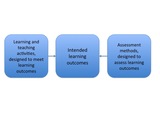
So I am making progress on my new Learning Design book, albeit slow… I have been working on the Consider C chapter, i.e. looking at the reflective and assessment aspects of learning. A central tenet of importance is Bigg’s concept of constructive alignment, i.e. ensuring that the assessment elements cover all of the intended learning outcomes. A draft of the chapter is available on slideshare, comments very well. Would still like to find some more practical assessment strategies/designs, any suggestions very welcome!
e4Innovation
.
Blog
.
<span class='date ' tip=''><i class='icon-time'></i> Jul 23, 2015 11:19am</span>
|
|
You do not have sufficient freedom levels to view this video.
Robin the Newf is a guest collaborator tonight. Because of her presence (at my feet) I’ve been ruminating tonight about canine companions. My father-in-law, Walter G. Schmidt, also loved dogs. In fact his love of dogs was extolled in his eulogy given by the Reverend Charles Valenti-Heine:
…"And that world, for Walter, included his beloved Canines. Lucy, Canis, Oaf, Chaucer, Trollope, and Freud, the last named because Walter was told that the companionship of a good dog was of greater worth to people than any other therapy! The one time I remember Walter speaking in church was when Trollope died, and he stood up during joys and concerns to opine: ‘If there is a place in heaven for Presbyterians, then surely there is a place for greyhounds.’
To which I add, amen!
Rudyard Kipling warned us of how dogs can capture your heart!
Do dogs match their owners in physical appearance? in personality? There is an interesting body of research dealing with these questions. Here is one citation. Here is another entire article (Download Roy). Under what circumstances does pet ownership reduce stress? increase it? Why in the world did I spend $250 tonight on pet treats? Perhaps I still am affected by my first reading of Argos‘ blind enduring faith. Robin, the patient gentle giant, knows.
These might be questions to give my Introductory Psychology students to encourage them to conduct a scholarly literature review. Perhaps in the process I’ll teach them about Evernote, Diigo, Delicious, Zotero, and Google Scholar and have them help me compare the strengths and weaknesses of these tools in addition to comparing the kinds (and quality) of answers they get using Internet search engines versus library data bases.
Here is some anecdotal evidence provided by one of my playful students that owners like me (though there is a debate between Robin and me as to who is the owner) may start looking like their dogs!
Trivia question from Robin:
What was the name of the Newf who accompanied Lewis and Clark?
Answer is here if you fail to find out—and even if you do.
Filed under: Curious David, Dogs, Jane Hart's Top 100 Learning Tools, Robin_the_Newf Tagged: Dogs, Education, Humor, literature reviews, teaching, Technology Learning Tools
David Simpson
.
Blog
.
<span class='date ' tip=''><i class='icon-time'></i> Jul 23, 2015 11:18am</span>
|
|
Humor as a high form of seriousness: Playing with possibility.
"Serious things cannot be understood without laughable things" - Plato’s Laws Books VII (10th paragraph from bottom)
Each of our classrooms harbor near infinite versions of the future. As we build relationships with and guide our students, that future takes on a more and more concrete tangibility. Every effort we make, one way or another, affects our students’ abilities to hone their skill set so they can change the world that we’re ALL inching toward. The more our students explore/play with meaning, the more they adopt and adapt skills they carry forward. It’s a fair assumption that the more "out of the box" thinkers we help develop today the better our collective tomorrow will be.
Permanent questions like "What is Justice?", "Who am I and what is my purpose?", and "What are morals/ethics and which should I follow?" (and so many more) are the toughest, but most important questions to find answers to. They do not, however, have readily available answers. Since our kids will be walking into a future full of doubt and shifting sands of Truth…we need to prepare them for this future as completely as possible. But, how do you prepare for a task that has no answers?
Such a serious topic…I know. Questions without answers that will challenge our kids and our culture like no other time in history.
There is a saving grace hidden in all this seriousness, though! Questions without readily available answers, under the right circumstances, allow for the observer to "play with meaning" as Plato once alluded to in his writings. When a child who has grown up with dogs sees a horse for the first time, they might label the horse a "Big Dog". Our minds try to make sense out of seemingly random/discrepant facts or sensory inputs. When confronted with something new we try to put it into a previously existing mental category. This requires "play" since there is no correct or immediate answer.
I’m not suggesting that humor become the only vehicle for your classroom. What I am suggesting, though, is that "high humor" can be an enjoyable way for your students to challenge themselves. There is a process and a product to humor…and that’s what we’re going to explore.
There are mental and physical health benefit as well! A humorous environment helps build people’s emotional intelligence, advertising cognitive and physical ability (makes you likeable or attractive), promotes social bonding, may help boost your health, and allows you to sharpen your wits in a fun way.
How humor can be intellectually challenging
Humor can be powerful because it acts as a virtual shortcut to the Truth of the matter. Being a short cut, it must also be an abstraction. So comedy is Truth in its evaporated form. We can still see how it participates with Truth, but see that it isn’t the complete Truth.
As Plato and Aristotle stated a couple thousand years ago, both comedy and tragedy (the humorous and the serious) utilize two or more competing frames of reference. Those two frames of reference or paradigms refuse to give in to each other. As we try to reconcile them our mind stresses and we have to make sense of a fluid situation. This forces our mind to align things that may not mix very well. Think of a mental version of trying to put together two strong magnet’s positive poles. We get close to victory, but never fully win.
When there are two elements within a context, as stated above, we try to reconcile them. Look at the image below:
There are two competing frames of reference: the "health drink" and the mom playing with her kids (advertising NyQuil). Put them together and you get comedy because neither frame of reference gives in to the other. The most obvious possibility (that mom is evacuating into a glass for you to drink) is the most solid conclusion we come to based on sensory input…but, upon reflection, is also the answer that’s furthest from the likely truth! When we unite our senses we get one answer, but when we divide what we’re seeing into its components we know the senses are wrong. The mind necessarily swings between possibilities.
So there are now three elements, the two serious ads and the mind’s attempt to create a unity out of two things that resist that unity.
Tragedy/seriousness also participate in this movements, so to speak, using two frames of references in an attempt to create a unity. The difference between a tragic scenario and a humorous one is….a threat! Tragic circumstances add a perceived threat to this equation as seen below.
We all know dinosaurs are extinct. None of us expects to be chased by an impossibility. In the video above, a tragic/serious response was elicited. The two frames of references were 1) a normal day 2) an absurd situation. The "victims" participated in a tragic reaction because they consolidated the two frames of reference with the adhesive of a threat. We laughed because we consolidated the two frames of reference as a complete non threat.
"High humor", as I’m calling it, requires students to understand the serious aspect of a topic (ancient Roman history) and twist that seriousness into a funny version of itself (a meme for example).
The meme to the left is funny because, again, the two competing frames of reference refuse to give in to each other. Julius Caesar WAS stabbed in the back by his friend (tragic…in a sense). He’s also listening to you complain about your friend "stabbing" you in the back at work or in a relationship. Both interpretations exist at the exact same time which keeps the mind from settling on one interpretation. We move from one definition of "stabbing in the back" and then back to the other and back again, like a comedy pendulum that never stops. Add the fact that, at least for us, this is within a non threatening context…and voila…high humor.
If we have a fresh "wound" where a friend has betrayed us recently, then this stops being funny because we settle on Caesar’s serious paradigm.
Further, a modicum of knowledge of history and maybe Shakespearean drama are needed to really "get" this High Humor joke. In other words, an educated mind appreciates this more than an uneducated mind. If the observer has no idea about Julius Caesar then this image not only becomes "not funny", but absurd (ie. does not have meaning).
The Classroom Humor Checklist (for my friends that like checklists):
Competing frame of reference #1 (your classroom unit, topic, learning objective)
Competing frame of reference #2 (the paradigm that extends or challenges #1)
Nonthreatening situation to the audience (it’s ok if characters are threatened within the meme/video/essay as long as that threat does not extend to the audience…more on this in a second)
Obviously, this is not an exhaustive definition/system of humor since the topic can be highly subjective, but it is thorough enough and fairly formulaic that it can be adapted into most classroom situations.
In The Classroom
Combining nearly any tech tool, your "serious" content area, a humorous "twist" on the topic in a nonthreatening manner can elicit excitement in your students as they learn. When I refer to the "twist" this can be a funny twist or another serious twist that is irreconcilable with the first frame of reference. Remember, the humor comes in when two points of views are valid and refuse to give in to each other as your mind moves between them (and there is no perceived threat).
Here are a few ideas:
Not creative? Here’s a random activity generator. Even if you don’t like the options you can adapt it to for your classroom needs. The formula is "Do x as y." Example, explain a chemical equation as a love story. So, you could type & print several activities and place them in a container and then type & print several topics pertinent to your current unit. Have students randomly pick one topic and one activity or have them offer their own! I’ve done it with high school seniors and they LOVED it!
Science - Periodic Table of Elements Dating Site Using Padlet
Social Studies - History Tweets
Texas History - Texas Revolution Party Invitation To Kill Sam Houston Using Smore
English ELA - Memes Galore! From Mrs. Orman’s Classroom Blog
Math Memes - Lots of Math & Science Memes and Puns Here
Any Class
Play "reductio ad absurdum" - Reduce a given topic to its most fundamental element (The HR diagram is a chart that plots characteristics of stars based on size and brightness)…so stars are some degree of hot and bright. Then (and this is my addition) add a twist. Anthropomorphize the stars (give them human characteristics based on the reduction). So have stars tell "yo momma jokes" that remain true to the HR diagram. Have planets "house shopping" for home stars based on the HR diagram. Etc.
Fake iPhone Texts
Fake Tweets
"You think, I do" multiple examples (think of using this with complex characters, historical figures, community leaders, math misconceptions). Imagine a "You think, I do" with Native Americans or Presidents or (switch it up) what foreigners thought about the U.S. during the civil war! Here’s the website to use and more examples.
"Thinks he means, he actually means" is another possible way to convey comedy in the classroom. The formula here is a statement and then, again, two frames of reference. Replace the quote above with Hitler saying "Of course I won’t invade Poland" and then a "What the Allies think he means" and "What he actually means".
Some e-cards - Make funny captions to fake e-cards (careful with this one…leans towards adult)
Caution
First, humor being poked at someone or some group in particular can be horribly damaging. Because humor, in this sense, becomes a weapon it is a threat to the subject. While I disagreed with my college professors that sarcasm shouldn’t be used in the classroom, I can see what they feared.
Subjectifying a student or group dehumanizes them and strips them of their "value". Further, they are treated in the same manner you might treat an inanimate object or animal. We take what is the highest in us (our humanity) and we subtract it from a person or group. Comedy used in this manner becomes tragedy because of the threat component I mentioned above.
Second, you need courage for comedy. When you are placing two competing frames of reference close together they must resist each other to force the mind to struggle. If your two frames are too related…there is no contrast and, thus, no comedy (a bear in the woods is what we expect, whereas a bear riding a laser Lincoln is not expected).
Bear Bear Riding Lincoln Chainsaw Polar Bear
Fighting Lincoln
Place the frames of reference too far apart that they don’t relate to each other and there is no comedy because the context is lost as in the example below…
* I will continue to add resources to this blog as time permits…Filed under: In The Classroom
Thrasymakos
.
Blog
.
<span class='date ' tip=''><i class='icon-time'></i> Jul 23, 2015 11:18am</span>
|
|
How you choose to utilize student blogs is up to you. Nevertheless, choosing to integrate blogging into your classroom to support existing curriculum is fundamental to a new millenium approach to education.
Learn more:
- http://gustmees.wordpress.com/2013/06/01/what-you-should-know-about-blogging/
- http://gustmees.wordpress.com/2013/10/14/practice-using-blogs-for-home-work-to-get-ict-skills-and-creativity/
- https://globaleducationandsocialmedia.wordpress.com/2014/07/02/put-your-title-in-here/
Source: gettingsmart.com
See on Scoop.it - InformationCommunication (ICT)
Mr Kirsch's ICT Class Blog
.
Blog
.
<span class='date ' tip=''><i class='icon-time'></i> Jul 23, 2015 11:18am</span>
|
|
Now that I’ve returned to writing this blog with some regularity, I’ve begun to have a sense of the directions I hope to take it—or it to take me. My present thoughts are to write more regularly.
I have just finished rereading Janet Majure’s wonderful Teach Yourself Visually WordPress, and have benefited much from studying online WordPress instructional resources. Consequently, I feel I now have an ability to master and manage this WordPress.com blogging software. Once the semester ends I’ll have a summer free to think, read, write, and reflect before my teaching obligations of year # 36 at Carroll resume.
I’m thinking that one distinct thread of writing I want to explore will deal with technology applications to higher education. Another will have the theme of "David in Carroll Land" (perhaps co-authored with invited students, alumni, or other members of the Carroll family). A third will deal with whatever comes to mind (as has been in the past). Some of my most creative bursts of ideas are engendered after a long summer’s day of manual labor cutting grass, chain-sawing, and being engaged in other outdoor physical or recreational activity.
A fourth focus will deal with contemporary or local issues, and a fifth will just be intended to provoke thinking.
I welcome any reader feedback about these new directions. Am I being too ambitious? Will I have any readers? Is this a positive direction to go—or is it, in fact, directionless?
Blogs post topics that I’ve been considering writing about in the near future include:
How can students best be served by academic advising?
My last lecture (things I would finally say)
Thank you, Diederik Stapel, for the lessons you taught me by your dishonesty.
Global Education
My most (in)formative learning experiences
Lessons learned from Robin the Newf
(Oh) Dear Carroll Alumni
On Immortality
Time
How technology can distance/enable/empower/enslave us
Reaching out, reaching within
The man who loves dogs students dogs
Loss of innocence
Labyrinths
The psychology of … (curiosity, religion)
Why I don’t give a Twit
Where do writing ideas come from?
What I wanna be when I grow up?
Distinguishing Science from Pseudo Science
Language—Leaving no Rosetta stone unturned
Which of these would readers like to see and, hopefully, discuss? I welcome your input, encouragement, or evidence that i have a readership.
Filed under: Blogging, Carroll Reflections, Curious David Tagged: blogging, Research Seminar, Top 100 Learning Tools
David Simpson
.
Blog
.
<span class='date ' tip=''><i class='icon-time'></i> Jul 23, 2015 11:18am</span>
|
|
Thrasymachus:Great resource! Wish I had this available for my government.
Originally posted on Engage Their Minds - Great Minds DON'T Think Alike!:
There aren’t a lot of opportunities in a standard curriculum for students to think philosophically. Hopefully, teachers still find ways to give them time for such discussions. In the past, I’ve written about the Kids Philosophy Slam and Teaching Children Philosophy as resources for integrating philosophy into the classroom. Both of those offer ways for students for K-12 to become philosophers.
8-Bit Philosophy would be better for older students - middle school and above. The topics are a little "heady" for elementary. However, I think tweens and teens would really enjoy the fun graphics in these short videos, and they would definitely spark some interesting conversations. There are currently 7 episodes available. Each one is between 2-4 minutes long. The subjects range from, "Do humans operate like computers?" to "Can we be certain of anything?" (After watching the latter, I’m only certain that we can’t!)
As always, preview any videos before showing them…
View original 25 more wordsFiled under: In The Classroom
Thrasymakos
.
Blog
.
<span class='date ' tip=''><i class='icon-time'></i> Jul 23, 2015 11:18am</span>
|
|
Esta tarde voy a dar una charla en español, aquí es mi transcripción. Mis dispositivas estan aquí.
Slide 1
Gracias por la invitación . Voy a tratar dar esta charla en español, pero algunos pueden estar en Inglés .
Slide 2
Soy irlandés , pero vivo en Inglaterra. Tengo un doctorado en Química y comencé a trabajar en e-learning hace más de veinte años . Tengo dos hijas , tienen quince y diecinueve años. Soy un catedrática de aprender la innovación en la universidad de Leicester . Tres cosas sobre mí que no están en la red . Odio las alturas , me encanta la país Irán y no me gusta viajar.
Slide 3
Los temas de mi charla son:
Tecnologías o pedagogías disruptivas?
Educación 2020
Un línea de tiempo e-learning
Tecnologías emergentes
Pedagogías
La promesa y la realidad
Diseño de aprendizaje
Slide 4
Así es que las tecnologías disruptivas o pedagogías ? Creo que es los dos . John Naughton en su libro enumera nueve características de Internet . Una es que disruptiva es una característica no una falla. Me gusta esta cita de Einstein . Tenemos que ir más allá de recordar el conocimiento , para permitir a los estudiantes a ser creativos , capaces de resolver problemas . Enlace de lista es un gran video corto por Ken Robinson , argumenta sistema educativo actual no está actualizado y tiene que ser cambiado radicalmente .
Slide 5
Este corto video es un ejemplo de tecnología disruptiva . Es un vídeo de Pearson. Esta sobre el futuro de educación.
Slide 6
Esta figura muestra una línea de tiempo de las intervenciones tecnológicas importantes de los últimos treinta años. Se inicia en los años ochenta con la aparición de herramientas para crear ricas , multimedia interactiva . La red surgió en el 93 , increíble pensar que es sólo 21 años de edad! No podríamos haber imaginado el impacto increíble la red tendría en nuestras vidas y nuestros hijos no pueden imaginar un mundo sin ella . Entonces el concepto de objetos de aprendizaje surgió la idea de crear un recurso y el intercambio y la reutilización . Sistemas de Gestión de Aprendizaje fueron importantes por dos razones . Las primeras instituciones tecnologías realizadas ya no eran innovaciones periféricas sino una parte fundamental del servicio que se ofrece a los estudiantes. En segundo lugar nos dieron un lugar seguro para los profesores para crear recursos y apoyar el aprendizaje en línea . La primera generación de dispositivos móviles era muy diferente de la pequeña y teléfonos inteligentes y las tablas de hoy . La investigación sobre Learning Design surgió a finales de los años noventa , la exploración de nuevos enfoques para apoyar a los maestros en su práctica de diseño . Tecnologías de juego llegaron después. Seguido por el concepto de los recursos educativos abiertos , promovido por organizaciones como la Fundación Hewlett y la UNESCO . Los medios sociales fue el siguiente, en la actualidad hay una variedad de maneras en las que los alumnos pueden comunicarse y colaborar con los demás. Los mundos virtuales eran populares a mediados de los años noventa , pero no son muy evidentes ahora . La segunda generación de dispositivos móviles eran más compacto y más elegante , e incluyó los libros electrónicos . Cursos en Línea Abiertas masivas son ahora una importante tecnología disruptiva , desafiando a los modelos de negocio educativos existentes . Por último , el más reciente tema de interés es ‘ Analytics ‘ de aprendizaje , la capacidad de utilizar los datos de los Sistemas de Gestión de Aprendizaje para entender mejor el aprendizaje del estudiante .
Slide 7
En cuanto a las tecnologías emergentes , los informes anuales Horizon el New Media Consortium son útiles en términos de lo que indica las tecnologías que pueden ser importantes para uno, tres y cinco años. En el plazo de un año enmarcar las listas de informe actual.
En línea , híbrido y el aprendizaje colaborativo
El uso de los medios sociales en el aprendizaje.
En tres años
La sociedad creadora , por ejemplo 3D -printing
Los datos que apoyan el aprendizaje y es decir la evaluación analítica de aprendizaje
En cinco años
Enfoques más ágiles para cambiar
Maneras de ayudar a hacer el aprendizaje en línea más natural y sin fisuras
Slide 8 and 9
La Universidad Abierta del Reino Unido tiene un informe anual denominado innovando pedagogía. En él se enumeran los diez cosas siguientes como importante
MOOCs aprendizaje social
Diseño de aprendizaje informado por analíticas
El aula invertida
Traiga sus propios dispositivos
Aprender a aprender
Evaluación dinámica
Aprendizaje basado en eventos
Aprendizaje a través de la narración de cuentos
Conceptos de umbral
‘Bricolage’ - aprender haciendo
Slide 10
A pesar del enorme potencial de las tecnologías para el aprendizaje , hay una serie de barreras . Por ejemplo :
Los maestros no tienen las alfabetizaciones digitales necesarias
No hay recompensas para la enseñanza
No es competencia de otros proveedores
La dificultad de la innovación de escala
¿Cómo asegurar la inclusión social?
Slide 11
Esta diapositiva muestra cuatro enfoques pedagógicos.
pedagogías asociativas dónde atención se centra en el individuo a través de la asociación y el refuerzo , los ejemplos incluyen e- formación y ejercicios y prácticas
pedagogías constructivistas , donde la atención se centra en la construcción de los conocimientos previos , los ejemplos incluyen el aprendizaje basado en la indagación
pedagogías situacional donde la atención se centra en el aprendizaje en un contexto ya través del diálogo , los ejemplos incluyen juegos de rol y el aprendizaje a través de juegos
pedagogías conectivistas , donde la atención se centra en el aprendizaje en un contexto distribuido con otros , los ejemplos incluyen el aprendizaje reflexivo y dialógica .
Slide 12
Es evidente que existe un enorme potencial para las tecnologías de apoyo al aprendizaje . Las redes sociales ofrecen una variedad de formas en las que los alumnos pueden comunicarse y colaborar . Hay muchos recursos gratuitos y cursos . Sin embargo las tecnologías no están siendo plenamente explotados y hay un montón de ejemplos de mala pedagogía. Los maestros dicen que no tienen tiempo y no tienen las habilidades de alfabetización digital necesarias .
Slide 13
Un grupo de nosotros hemos estado trabajando en una nueva área de investigación , diseño de aprendizaje , que tiene como objetivo hacer frente a esto y ayudar a los maestros a tomar decisiones de diseño más informadas basadas pedagógicamente y hacer un uso adecuado de las tecnologías . Recientemente hemos publicado el documento La ‘ Declaración de Larnaca en Learning Design, que describe nuestro enfoque .
Slide 14 - 16
¿Qué es diseño para el aprendizaje? Hay tres aspectos. En primer lugar se trata de ofrecer a los maestros con la orientación para el diseño. En segundo lugar se trata de visualizar el proceso de diseño. Finalmente se trata de compartir el diseño con los demás y discutirlo.
Slide 17
Entonces, diseño de aprendizaje es sobre pasar de enfoques implícitos basados en la creencia de diseño basado en enfoques explícitos. Y también Alienta la reflexión, las prácticas académicas y promueve el intercambio y la discusión.
Slide 18
He desarrollado los 7Cs de marco Learning Design , que tiene una serie de recursos y actividades para apoyar el diseño . Se inicia con la Conceptualizar C , se trata de crear una visión para el curso . El siguiente es el C C Crear que se trata de articular lo que se crearán recursos (como texto , audio y vídeo) y los recursos libres se utilizará . Los dos siguientes son Cs sobre el fomento de la comunicación y la colaboración . El Considere C se trata de promover la reflexión y ayudar a los alumnos demuestran cómo se han alcanzado los resultados de aprendizaje , es decir, es el elemento de evaluación. El Combine C mira todo el diseño desde diferentes perspectivas , por ejemplo, mirando cómo los estudiantes de tiempo mucho más están gastando en diferentes tipos de actividades . Por último , la Consolidar C se trata de poner el diseño en un contexto de aprendizaje de la vida real y evaluar su eficacia .
Slide 19
Un ejemplo de un recurso asociado con la Conceptualizar C es la actividad Características del curso . Este consiste en un paquete de cartas , que describen los siguientes aspectos del curso : Los tipos de enfoques pedagógicos Los principios de alto nivel Las formas de orientación y apoyo La naturaleza de los contenidos y actividades que los alumnos harán Los tipos de reflexión y demostración ¿Y cómo se facilita la comunicación y la colaboración.
Slide 20
Esto muestra el perfil actividad que es un recurso bajo el Combine C. Los tipos de actividades que el estudiante lo hacen son : De asimilación : leer, escuchar o ver El manejo de la información, tales como la manipulación de datos en una hoja de cálculo La comunicación , por ejemplo en un foro Producción , por ejemplo la creación de un compuesto químico o un modelo arquitectónico. Puesta en práctica, por ejemplo, ejercicios y prácticas o trabajos basados? Adaptación , por ejemplo, el modelado o simulación Evaluación La herramienta puede ser utilizada para indicar la cantidad de tiempo que los estudiantes pasan en cada uno de estos. También puede ser utilizado por los alumnos . Aprendí español hace unos cinco años en línea , los cursos fueron excelentes , buenos recursos - libros y DVDs , pero no había suficiente en la práctica de hablar, y hablar es mi habilidad más débil . Así que hay una relación directa entre las actividades que hacen los estudiantes y su aprendizaje .
Slide 21
La etapa final es el guión gráfico . Esto muestra las listas de las semanas y los temas a continuación, la parte superior . A la izquierda se muestran los resultados del aprendizaje. En el medio están las actividades de los estudiantes lo hacen. Por encima de estos son los recursos que se dedican a . Por ejemplo, en la semana uno que ven un video y leer un documento. A continuación se enumeran las cosas que crean. Así que en la semana uno , escriben un ensayo. En la segunda semana , escriben un blog , en las últimas semanas que hacen una presentación en grupo y escribir un diario de reflexión sobre su aprendizaje . Bajo esta es la evaluación . En la semana uno del profesor proporciona retroalimentación formativa en el ensayo. En la semana dos, compañeros proporcionan comentarios sobre la entrada en el blog . Por último, el profesor proporciona retroalimentación sumativa en la presentación del grupo y el diario reflexivo . La parte final es asegurarse de que se cumplen todos los resultados de aprendizaje . Esta es una foto de un guión gráfico producido durante un taller .
Slide 22
Esta es una foto de un guión gráfico de un taller
Slide 23
En resumen, el siete Cs es un marco conceptual para el diseño. Implica una serie de representaciones conceptuales de un curso. Evaluación de el siete Cs es muy positiva, comentarios de los profesores incluyen:
Nueva forma de pensar
Hace diseño explícito
Hablando de diseños con los demás
Centrarse en las actividades no contenido
Slide 24
Quiero mencionar tres herramientas para el diseño.
El METIS proyecto ILDE
LAMS
The Learning Designer (LDSE)
Slide 25
En el METIS proyecto financiado por la UE , hemos creado una herramienta de diseño de aprendizaje en línea llamado ILDE (Learning Design Marco Integrado ) que se puede utilizar para crear un diseño e implementarlo en un Sistema de Gestión del Aprendizaje . Este es un breve vídeo sobre ILDE en español .
Slide 26
Una herramienta de diseño de aprendizaje temprano era LAMS (Learning Activity Management System). Las características clave incluyen:
Entorno de edición visual para crear secuencias de actividades de aprendizaje
Diagrama de actividades de aprendizaje fluya
Entorno de tiempo real
Slide 27
Finalmente, Diana Laurillard y colegas han creado ‘The Learning Designer’ o El diseñador de aprendizaje (LDSE). Puede ser utilizado para rediseñar los cursos por las instituciones, los equipos de los cursos y los maestros individuales
Slide 28
Entonces, ¿cuál es el futuro de la educación? MOOCs son sin duda un ejemplo de una tecnología de punta, que está desafiando a las instituciones educativas tradicionales y sus modelos de negocio. Necesitamos nuevos enfoques pedagógicos a utilizar realmente los beneficios de las tecnologías. Finalmente creo que estamos viendo una desagregación de la educación. En el aprendiz futuro no pueden hacerlo grados completos, pero puede pagar por:
Los recursos de alta calidad
Itinerarios de aprendizaje guiadas
Alguna forma de apoyo
Acreditación
Slide 29
Estas son algunas de las referencias más relevantes de la charla.
Slide 30
Gracias por su atención, espero que haya encontrado esto útil. Si usted está interesado en esto y quiere saber más Tengo un libro sobre diseño del aprendizaje y actualmente estoy escribiendo un segundo, lo que tendrá un montón de ejemplos prácticos de diseños para apoyar diferentes enfoques pedagógicos. Más información también está disponible en SlideShare, y mi blog.
e4Innovation
.
Blog
.
<span class='date ' tip=''><i class='icon-time'></i> Jul 23, 2015 11:18am</span>
|
|
. . Learning To Become a GOOD Digital Citizen | Digital CitizenShip | How To? Well, there is a lot of different views! WE will explore WHAT could be THE BEST way to teach and to learn about Digital…
Source: gustmees.wordpress.com
Global Collaboration on Digital Citizenship!! It’s an honor to be part of this community of educators & bloggers!
See on Scoop.it - FootprintDigital
Mr Kirsch's ICT Class Blog
.
Blog
.
<span class='date ' tip=''><i class='icon-time'></i> Jul 23, 2015 11:18am</span>
|