Blogs
|
ITES industry observers, especially in the developing-world, would tell you with much conviction how it has evolved from picking up low-hanging fruits and doing low-end jobs to much more of non-core activities of businesses in general—from Aviation to small-time e-commerce providers (some claim almost all industries are either outsourcing or willing to outsource all or some of their non-core activities). Outsourcing companies, both big and small, have now moved to much higher notches—from analytics to finance and more. And within these streams, they are focusing on areas that were earlier no-go zones to outsource.
The industry not only helped thousands find jobs and create large companies, but also led to an integration of these societies with the global economy. This also led to various reforms within the governments of these countries as it helped create related infrastructure and promote the use of modern technologies.
So this has been going on well but a quiet revolution began a few years ago, which helped involve many more people who were otherwise restricted or left out because of internal situations and lack of economic growth in their respective countries. That revolution is Freelance Outsourcing (aka Online Outsourcing, e-lancing). Talent hidden in locations where businesses did not venture due to various reasons, is now out, taking up jobs that would have otherwise never reached them. Elance-oDesk (the two companies have since come together) and many others like guru.com have proved to be a meaningfully genuine model of bringing together individual skills and businesses requiring them. The objective of this blog post is not to describe how it works, as it is so well crafted by these companies themselves. However, it is, suffice to say, that the deal between individual talent and businesses seeking it works like a breeze.
It is here that the outsourcing companies—both BPO and KPO in IT as well as ITES and other spaces—will be faced with a challenge. With time, there will be more and more experienced people working in the organized IT/ITES and the industry at large who will be tempted to explore the freelance outsourcing model to make money and build careers as well as businesses (for there are many independent entrepreneurs emerging in the area of freelance outsourcing already). As freelance outsourcing is still in its nascent stage, the real threat to outsourcing businesses still seems a distance away. But only for now.
India, by the sheer advantage of its IT/ITES base, picked up speed on this front as well along with the Philippines. Russia, Ukraine, and Pakistan have also emerged as important players. Even a country like Bangladesh has made strong strides in this area. In 2014, it was the fourth top earning country on Elance-oDesk (now rebranded as Upwork). Freelancers earned approximately $3 billion between 2009 and 2014 through the two global online staffing platforms.
The interesting question that arises here is how did this happen? What did the governments, industry, education systems or NGOs do to help people get there? Well, there is nothing perceptible that any of these agencies did to cause this trend. All that was needed was a platform for people to meet and exchange ideas around what the business needs were and what an individual could offer. The rest, as they say, is history.
There is great learning here for governments, businesses, academia, and social workers. All that today’s talent, equipped with modern tools of expression, organization, and discovery perhaps needs is an avenue of the kind freelance outsourcing provides. It is a very typical ‘build it and they will come’ case.
For learning strategists, it throws even bigger challenges. Will the old models of learning work in such a scenario (by old, I mean the instructional design trends and all the "e" prefixed solutions of the last two decades)? How do we figure out a mechanism to build more of these resources? How do we ensure that they get to the next level of performance?
Here is a point to ponder: What formal training do people receive to learn how to use Twitter and Facebook?
About the author: S M Nafay Kumail is Director—Learning Strategies at InfoPro Learning Inc. Nafay is co-author of ‘e-Learning an Expression of the Knowledge Economy’ (McGraw-Hill 2002) and a regular commentator on learning, knowledge management, and new media trends.
The post Freelance Outsourcing: A Disruptive Wave for Outsourcing Businesses and a Challenge for Designers of Learning appeared first on .
InfoPro Learning
.
Blog
.
<span class='date ' tip=''><i class='icon-time'></i> Jul 23, 2015 11:24am</span>
|
|
I am currently writing a chapter on policy uptake for OER and MOOCs, drawing in particular on research from the OPAL and POERUP projects. The current version of the chapter has the following conclusion:
As stated at the start of this chapter, OER and MOOCs are challenging traditional educational institutions and their associated business models. OER and MOOCs are an example of what Christensen terms ‘disruptive innovation’ (Christensen 1997). A disruptive innovation is an innovation that helps create a new market and value network, and eventually disrupts an existing market and value network (over a few years or decades), displacing an earlier technology. It is about change, about something new, about the unexpected and about changing mindsets. OER and MOOCs are disruptive in that they are challenging traditional educational institutions, to rethink their business models and to rethink the ways in which they design and deliver courses. It is unclear what the future of OER and MOOCs will be, and whether or not they will have a fundamental impact on the educational landscape. But if they make traditional institutions rethink their values and distinctiveness and what is the learner experience of attending one institution other another then that is for the good. My feeling is that there will be a spectrum of educational offerings from entirely free resources and courses, through to the Oxbridge model of the one to one tutorial. This spectrum will offer learners a variety of possibilities to engage with learning, matched to their individual preferences and needs.
e4Innovation
.
Blog
.
<span class='date ' tip=''><i class='icon-time'></i> Jul 23, 2015 11:23am</span>
|
|
Mr Kirsch's ICT Class Blog
.
Blog
.
<span class='date ' tip=''><i class='icon-time'></i> Jul 23, 2015 11:23am</span>
|
|
I gave a talk at an EPIGEUM Blended Learning meeting today in London. After an introduction by the CE Terry Sweeney, David Lefevre (co-founder and chairman) gave an overview of EPIGEUM, it’s origins and focus of activities. This is an interesting business model for course production and delivery. Courses are designed by a team of experts and take up to a year to develop. Institutions pay a licence fee, which goes towards keeping the courses up to date. Course teams consist of authors, reviews, editors, technical support, etc. A list of current course offerings and people involved can be found here.
Courses consist of a mixture of text, video and interactive material. They can be completed individually or it is possible to include peer to peer activities, tutor-led activities or face-to-face activities.
Building a course consists of four stages
An initial meeting about the curriculum plus comments and feedback to the authors
A one-day workshop with authors, reviews, editors and the technical team to scope out and work up
The teams then begin the process of writing up a paper-based version of the course, which is then reviewed.
Finally the interactive version is created and reviewed, followed by an implementation workshop.
The pedagogical approach is described as ‘rich, engaging and born digital’. The claim is that the courses are built around a proven pedagogically sound structure to form rich coherent learning experiences, interactivity is used as a tool for learning and the materials consist of rich multimedia content.
A new suite of seven blended learning courses is about to be developed. I will be working with Mark Brown and Norm Vaughan to oversee the development. Each course will consist of:
7 hours of interactive online material
30 hours of independent research and reflective activities
15 hours of peer-to-peer activities
A useful presentation providing an overview of the EPIGUEM approach is available on Slideshare.
e4Innovation
.
Blog
.
<span class='date ' tip=''><i class='icon-time'></i> Jul 23, 2015 11:22am</span>
|
|
Student created #infograpic on Internet Safety. This was created during our 8th grade ICT class Internet Safety Unit.
Citation: Teens, kindness and cruelty on social network sites. (n.d.). Retrieved from http://www.pewinternet.org/2011/11/09/teens-kindness-and-cruelty-on-social-network-sites/
Cyber Bullying Statistics. (n.d.). Retrieved from http://www.bullyingstatistics.org/content/cyber-bullying-statistics.html
Teenagers who go online to cheat in school 2012 | U.S. Survey. (n.d.). Retrieved from http://www.statista.com/statistics/234369/teenagers-who-go-online-to-cheat-in-school/
Mr Kirsch's ICT Class Blog
.
Blog
.
<span class='date ' tip=''><i class='icon-time'></i> Jul 23, 2015 11:22am</span>
|
|
This weekend #TxGoo met and, as I usually do when educators I admire get together, I stalked them like cray!
Aimee Bartis tweeted out a curious link to a video concerning "stich.it". I was immediately floored! There are so many potential uses for this tech gift from the gods. Students can make interactive webpage presentations that end in a poll or assessment. Teachers can help students focus their mind on particular articles or passages and then assess using Google Forms or poll everywhere. It’s a very nice canvas to paint upon.
Here’s a "Coop’s Tech Corner" Stich.It I sent to my campuses: http://stich.it/siMTM1MTU=
And the video:
Filed under: In The Classroom, Technology Tagged: classroom tech, ed tech, education technology, it, online resource, presentation, stich, stich.it, technology, web based presentation
Thrasymakos
.
Blog
.
<span class='date ' tip=''><i class='icon-time'></i> Jul 23, 2015 11:21am</span>
|
|
A common theme I’ve encountered in a number of meetings and informal conversations with faculty, staff, students, trustees, and alumni is a growing awareness of the rapidity of change in higher education—in how we teach, in how we learn, in from whom we learn, in where we learn, and even in in what times of the day and night we learn! These concerns are addressed well by the new learning avenues explored by the shared online learning insights of Debbie Morrison on the distinction between the creation of personal learning experiences (PLE’s) and personal learning networks (PLN’s) . I am also increasingly influenced by the "the learning flow" concept advanced by Jane Hart.
Even as I proctor an exam while writing this blog post I am learning online—checking my Twitter account especially for posts by
Julie Lindsay,
Jane Hart,
Michael Sheehan,
Michelle Pacansky-Brock,
"brian@ieducator,"
Richard Byrne,
edutopia,
the GlobalChronicle,
the NYTimesLearningNetwork,
Silvia Tolisano.
Thank you, fellow educators across the world for all you share and how you teach and inspire me. Teaching and learning clearly are not constrained to the classroom.Filed under: Carroll Reflections, Carroll University USA, Curious David, Global Education, Jane Hart's Top 100 Learning Tools, Learning Maps, LucidPress, Movenote, Personal Learning Environments, Personal Learning Tools, technology tools Tagged: Education, Higher Education, Jane Hart, PLE, PLN, Technology Learning Tools, Top 100 Learning Tools, Twitter
David Simpson
.
Blog
.
<span class='date ' tip=''><i class='icon-time'></i> Jul 23, 2015 11:21am</span>
|
|
Ever want to try out blogging with your students, but you weren’t sure how? Well it’s never too early to… Continue reading »
Source: starrsackstein.com
Great article! We utilizing blogs with our students as well! Great communication tool; especially in ICT class.
See on Scoop.it - InformationCommunication (ICT)
Mr Kirsch's ICT Class Blog
.
Blog
.
<span class='date ' tip=''><i class='icon-time'></i> Jul 23, 2015 11:21am</span>
|
|
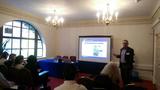
Picture via @epipeum on Twitter
As part of today’s EPIGUEM Blended Learning Meeting, Mark Brown (from Dublin City University) gave a talk on blended learning. Mark will make his slides available on slideshare in due course. The focus was around three questions:
What do we mean by blended learning?
How do we translate the principles of blended learning into practice?
How do we ensure our staff stay at the cutting edge of innovation in blended learning?
He crafted his talk around a metaphor of dance, structuring his talk into three parts: let’s dance, dancing with purpose, and choreographing the best moves. He argued there was an analogy between design and dance, both based around a balance between art/craft and science.
Let’s dance
He argued that the problem is not making up steps but deciding which ones to key, quoting Mikhail Baryshinkovo. He quoted Garrison and Kanuka (2004, pg 96) who state that blended learning is the integration of face-to-face with online learning. He also quoted Vaughan’s definition (2012), which is around fundamentally redesigning for effectiveness, convenience and efficiency. But Mark argued it was important to ensure that blended learning was also about transformation. He quoted Sfard’s work on ‘adaptive blends’, i.e. that no two students are the same and that each have distinctive needs. He also quoted Barbara Means Meta Analysis of Blended Learning, I can’t find the link right not but will add later if I do find it. He argued that we need to be BOLD (Blended On-Line Digital) in our approach, and that we need to re-conceptualise campus-based teaching.
Dancing with purpose
He stated that there were a number of elements that need to be considered when designing blended learning offerings, interactions between teachers-learners, learners-learners, and learner-content, as well as the place, pace and mode of learning. He suggested that there were four key means of learning and that all were important: listening (instructional), sharing (connectivsm), making (constructionism) and doing (constructivism). He identified four ‘spaces’ for learning: on campus/in class, off campus/in class, on campus/out of class and off campus/out of class. He concluded by arguing that we need to blend with purpose for a seamless learning experience.
Choreographing the best moves
In the final section he listed three useful frameworks for effective design and quality assurance of creating blended learning offerings
The quality matters rubric standards
The EADTU E-xcellence Next
The 7Cs of Learning Design framework (yeah!)
He concluded by stating that a transformational learning design culture consists of the following elements:
Making explicit choices
Adopting a principled approach
Winning the hearts and minds of teachers
Providing the design tools for new pedagogies
Giving responsibility for quality back to the teacher
Building distinctive leadership at the programme level.
e4Innovation
.
Blog
.
<span class='date ' tip=''><i class='icon-time'></i> Jul 23, 2015 11:20am</span>
|
|
Models are interesting things.
They both are and are not the thing they represent. So, for example, a model of Jupiter points to but can never be the real Jupiter. A painting, an appropriately colored Styrofoam ball, or a set of mathematical equations can serve as a model of that glorious planet, but in most cases the model fails to be what it aspires to be.
Models, of course, help us manage the unmanageable. They bring down in scale magnificent objects so we can play with them in ways that would be impossible without the model. We splice up reality, magnify it, and study a part to better understand the whole.
As long as we keep in mind that the model is a model…an abstraction of reality, then it serves its purpose.
The great reason, I think, that there are so many passing fancies in education is because educators mistakenly take models as reality. To return to my example, once we get convinced that our Styrofoam ball of Jupiter is so real that it practically IS Jupiter we feel comfortable forgetting about the real Jupiter. Eventually, our model’s flaws are exposed and we become disappointed in "Jupiter" when in fact we should be disappointed in our model.
When we adopt a system in education that seems to be backed up particular data (and most data is particular…that is, it is of a certain group of students in a certain demographic area with certain strengths and weaknesses) and that data is then generalized into a system, we must remember that the system should not be treated as a replacement for our classroom’s reality.
Veteran teachers are always commenting "Wait a couple years and this will be gone."
Agreed!
We recoil from "fads" when we mistake movements like the flipped classroom, genius hour, New Jersey writing project, and so on for reality. Not every kid or teacher or lesson needs to flip their classroom (and I’m not suggesting that flip fans argue this). The circumstances of your classroom should determine which system or combination of systems should be used to best address the needs of your students.
The pendulum swings so often in education because some try to gain money or notoriety from a system and push ONLY that idea. Much of the blame can also be placed at the teacher’s and administrator’s feet as well! Those educators who think that a one size fits all approach to education will ever work will likely and unnecessarily frustrate themselves and their coworkers.
Education (capital E) is the fulfillment of the human condition. We are born both with a nature, but with the ability to negate our nature as well. In that struggle you will find all the glory and blame of what it means to be mortal.
Education is definitional to the identity of each of us as well as our entire race. It alone will finally determine whether we are simple animals or something more.
Filed under: In The Classroom, Political Philosophy Tagged: 20% time, classroom fads, classroom training, ed training, education, education fads, education pendulum, education systems, fads, flipped, flipped classroom, genius hour, google, iPad, iPhone, lesson fads, lesson plans, pendulum, thrasymachus
Thrasymakos
.
Blog
.
<span class='date ' tip=''><i class='icon-time'></i> Jul 23, 2015 11:20am</span>
|