Blogs
|
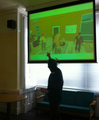
Mark Childs gave a talk on Friday at Leicester. This blog post is a summary of the key points. His talk focused on his research on Virtual Worlds. He provided three examples. The first was the use of SecondLife for disaster management communication. This was in conjunction with Yung-Fang Chen and El Parker in Coventry. It was a conversion of a table-top exercise, where the students take on the roles of different agencies after a natural disaster. One students in pairs travels from office to office in SL and negotiate on behalf of their agencies. The other stays at base. The student found it a complicated environment. Note cards in SL were available with instructions, and the students could walk around the environments and click on different note cards. However, this resulted in cognitive overload, a solution would be to print out the note cards.
Evaluation of the students’ experience elicited the following points. In terms of their avatars, they could play about with them and personalise them. Would it be possible to use the avatars to signify different roles, by using uniforms for example? Interestingly, the participants didn’t identify with the avatars. They were characters as a means of interaction. And they found it difficult to identify with the roles of others in game. ‘In the computer, there is no extra talking.’ It varied as to whether funny avatars were a hindrance or a help. The design of the world was fairly basic and students didn’t experience it as particularly realistic. In essence, it was ‘a fake real world’. They wanted more emotional resonances so it felt tense, time dependent, e.g. actual refugees, collapsed building etc. Finally, engagement was not through the design of world but through motivation to try out things they had learnt.
The second example focussed on learning goals in a BA Media and Communication at Newman College and in particular, a module on media futures. Journal entries related to module themes and student were assessed on two entries related to one theme. Mark was a guest lecturer on the course in support of the theme of identity. Findings, included the value of text as a means of feeling connected, and the value of ‘para-linguistic’ things. There was both a standard lecture space and a sand box. The learners were given tasks of interpreting appearance of avatars and they used voice for presentation, and text for dialogue.
In terms of student interaction, there was little participation - ‘isn’t anyone contributing today? Room seems very quiet.’ The students were asked to build an identity cube and volunteers can then discuss what this means. This is based on Carina Girvan Sleepy Littlething. They were given instructions on creating cubes and had to upload 5 images to add to the cubes faces. The theme was something that represented them and their identity. Mark argued that this gives them a way to focus on what they are doing, reification (thingness). And through this they can then get to their concepts of identity. The creating of the cubes gave the abstraction of identity a solidity, which provided a basis for exploration and it related to Wenger’s notion of reification or thingness. The activity appeared to have energized the students and gave a springboard for their ideas. However, it can lead to distraction, discussion of abstractions still limited, but raises awareness of themes.
The third example was around installation and performance, with the Artist/Performer Herbert Gallery in Coventry in Oct/Nov 2012. In this, three artists who work in design performance acting in virtual worlds and particularly mixed reality. It explores realities within realities, blurring of the real and virtual spaces; or rather a mingling of realities
In the last part of his talk, mark explored some of the definitions and concepts associated with the virtual experience. The defined Virtual Worlds as: ‘synchronous and persistent network of people and programs embodied as avatars and agents facilitated by networked computers using navigable space to engage the user’s belief’. In terms of space: these are navigable consistent spaces with physics. All give rise to mediated presence. Similar to gamespaces ritual spaces theatrical spaces, bounded spaces in which separate rules and conventions exist and which have a heightened semiotic system that requires engagement of belief - fourth places. He finds the ‘Conscious Competence Learning Matrix’ www.cognitivedesignsolutions.com. He referenced Barrett 2002: 35 Cycle of disengagement and Caspi and Balu 2008: 339 Cycle of engagement.
e4Innovation
.
Blog
.
<span class='date ' tip=''><i class='icon-time'></i> Jul 23, 2015 12:18pm</span>
|
|
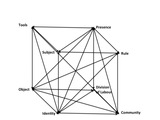
I recently read an article which described a conceptual framework for mediated environments (Childs 2010). The model augments Activity Theory (Cole, Engeström et al. 1997) (subject, objected, Mediating Artefacts, division of labour, community, and rules and conventions), with two aspects of Wenger’s Community of Practice (Wenger 1998) (presence and identity) (Figure 1).
Figure 1
The paper reminded me of the meta-model for learning (Figure 2) we developed about ten years ago (Conole, Dyke et al. 2004). The model consists of three dimensions of learning:
Learning individually or learning sociably
Learning through information or through experience
Non-reflective versus reflection learning.
Figure 2
Non-reflective learning needs unpacking. If I am driving across America, sub-consciously I am learning about American culture. If I am sitting in a bar in Spain, I am improving my Spanish through the conversations going on around me. It is what Jarvis calls ‘pre-conscious’ learning.
The model can be used in two ways. Firstly, as a means of mapping an activity using a particular tool. For example a reflective blog would be individual, experience-based and reflective, whereas a group blog aggregating resources for a course would be social, information based and reflective. Secondly, it can be used to map different pedagogical models. Three examples are illustrated in Figures 3-5.
Figure 3
Figure 4
Figure 5
References
Childs, M. (2010). "A conceptual framework for mediated environments." Educational Researcher 52(2).
Cole, M., Y. Engeström, et al. (1997). Mind, culture, and activity: Seminal papers from the Laboratory of Comparative Human Cognition, Cambridge Univ Pr.
Conole, G., M. Dyke, et al. (2004). "Mapping pedagogy and tools for effective learning design." Computers and Education 43(1-2): 17-33.
Wenger, E. (1998). "Communities of practice: Learning as a social system." Systems thinker 9(5): 1-5.
e4Innovation
.
Blog
.
<span class='date ' tip=''><i class='icon-time'></i> Jul 23, 2015 12:18pm</span>
|
|
One of the sessions I attended at this year’s PELeCON conference was on ‘Digital literacies and work placement’. The first speaker was Nadja Gagsi, who presented on the digital literacy work at Reading University as part of their JISC funded project. They used Beetham and Sharpe’s digital literacy framework. She outlined ten key findings from the project:
Awareness - there was a lack of understanding of digital literacies and their importance for employability.
Reflection and articulation - there was a need to bridge the gap between learning and applying digital skills in a professional context.
The importance of monitoring and assessment.
Tangible outputs - in terms of having something to show/evidence and development of a sense of ownership.
The importance of having a positive online presence.
The need to develop social media skills.
That practitioners need time to develop and practice digital skills.
The importance of continued contact with supervisors and co-workers during placement.
The importance of promoting the digital placement experience.
Developing a maximum digital benefit for work-based learning.
The second speaker was Catherine Cronin who presented on ‘Enacting digital identities’. She quoted Stephen Heppell:
More change will happen in Education in the next ten years, than in the past 100.
She described a number of initiatives including CODER DOJO (a community to help kids develop coding skills), MOOCs and Google+. She argued that there was an inter-dependence between digital literacies, social media and digital identity. She listed Doug Belshaw’s eight aspects of digital literacy (cultural, cognitive, constructed, communicative, conflict, creative, critical and civic). She went on to describe a project in her own institution around a course on developing professional skills, which got the students to think about which tools they were using and how they were using them. She referenced Howard Reingold’s five social media literacies, danah boyd’s work on ‘networked publics’ and Bonnie Stwarts work on academic and networked learning .
e4Innovation
.
Blog
.
<span class='date ' tip=''><i class='icon-time'></i> Jul 23, 2015 12:18pm</span>
|
|
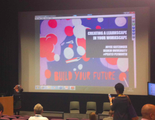
One of this year’s PELeCON conference keynotes was my friend Joyce Seitzinger from Deakin University. This blog post is a summary of her talk, the slides are available online.
She started by stating that winning a place for technology is easy, whereas winning people for technology is hard. The talk gave a nice overview of some new tools and how they can be used, as well as Joyce reflecting on her own use of social media. She referred to Hegarthy and Kelly’s work on staff development models. Other references included ‘The information diet’ by Clay Johnson and ‘Is Google making us stupid?’ by Nicholas Carr. She showed a really nice infographic illustrating social media and how they can be used to support different activities. She agrees with Clay Shirkey’s assertion that it is not information overload, but filter failure. We can harness the power of our distributed social network of peers to act as filters and aggregators for us. She stated that ‘my network is my filter and my lifeline’.
She described three types of interaction, team based, Community of Practice and Networked, which is similar to Dron and Anderson’s concepts of groups, networks and collectives (Dron and Anderson 2007). She also referenced Wenger et al.’s book ‘Digital Habitus’about the stewarding of technologies (Wenger, White et al. 2009).
She when on to describe the Netprax project that she is involved with at Deakin, which is trying to help academics make more effective use of social media. The project is using a range of tools, include Yammer, fb, blogs and Twitter. She also referenced Dave White’s work on digital visitors and digital residents and also Martin Weller’s book ‘The digital scholar’. She argued that becoming a networked learner was an example of a phenomenal experience, i.e. something that fundamentally changes you.
She then shared a number of interesting sites, including: about.me, visual.ly, vizify.com and visualize.me. She finished by quoting from John Naughton’s recent book (Naughton 2012) that we overestimate the short term impact of new technologies and under estimate their long term impact.
References
Dron, J. and T. Anderson (2007). Collectives, networks and groups in social software for e-Learning. Proceedings of World Conference on E-Learning in Corporate, Government, Healthcare, and Higher Education Quebec. Retrieved Feb. 16: 2008.
Naughton, J. (2012). From Gutenberg to Zuckerberg, what you really need to know about the internet.
Wenger, E., N. White, et al. (2009). Digital Habitus - stewarding technology for communities. Portland, OR, CPsquare.
e4Innovation
.
Blog
.
<span class='date ' tip=''><i class='icon-time'></i> Jul 23, 2015 12:17pm</span>
|
|
Donald Taylor, the James Bond of e-learning apparently ;-), gave the closing keynote at this year’s PELeCON conference. The title of his talk was ‘Does learning and development have a future?’ He began by asking us to think about how our roles have changes in the last five years as a result of technology. For me technologies have had a transformative impact on my practice. Blogging is an important way for me to develop or work up ideas or simply summarise interesting things I have seen or read. Some of the things others in the audience suggested included: the increasing importance of social media, the importance of fb, the way in which technologies enable you to have a higher profile as a research and hence have more impact, the importance of blogging, the fact that we are sharing more and the higher expectations or the 24/7 culture.
He argued that a key turning point in terms of technologies was 1990 with the development of the web. He suggested there were three aspects of importance:
Intangible values - the fact that there has been a shift in companies from having a high percentage of tangible assets to a high percentage on intangible assets, i.e. it is no longer physical objects that are of value, but people skills and ideas.
Globalisation - we are now part of an interconnected, distributed worldwide network, there is a shift from a Western perceptive to the increasing importance of China. He argued that MOOCs are an example of this global phenomenon; initiatives such as edX, coursera, the Khan Academy, FutureLearn, Udemy and Pearsons; providing free courses to thousands of people. He suggested that MOOCs are a milestone, indicating change; i.e. that education is being transformed. There has also been a shift from a position where information is power to information being free, what Martin Weller refers to as ‘an ecology of abundance’ (Weller 2011). John Naughton argues that in this world, economy makes no sense and that we need to be thinking in terms of shifting ecologies (Naughton 2012). He referenced the recent report ‘An avalance is coming’ (Barber, Donnelly et al. 2013), which begins with the controversial quote:
Our belief is that deep, radical and urgent transformation is required in higher education as much as it is in school systems. Our fear is that, perhaps as a result of complacency, caution or anxiety, or a combination of all three, the pace of change is too slow and the nature of change too incremental.
He gave some startling statistics in terms of investments in e-learning: $9.1 bn Pearson, $4.7 bn Phoenix University, $32 bn Endorsement of Harward University, $6.5 bn Cambridge University, and $1.9 bn the global market for Learning Management Systems.
He concluded by arguing that despite the potential of technologies to be transformative, there are barriers, in particular, digital inclusion/exclusion and a replication of the old boys network. So the key message for me was - will technologies be transformative or disruptive or both?
References
Barber, M., K. Donnelly, et al. (2013). An avalanche is coming: Higher education and the revolution ahead, http://www.ippr.org/publication/55/10432/an-avalanche-is-coming-higher-education-and-the-revolution-ahead.
Naughton, J. (2012). From Gutenberg to Zuckerberg, what you really need to know about the internet.
Weller, M. (2011). The digital scholar - how technology is changing academic practice. London, Bloomsbury Academic.
e4Innovation
.
Blog
.
<span class='date ' tip=''><i class='icon-time'></i> Jul 23, 2015 12:17pm</span>
|
|
I really enjoyed the PELeCON conference. I liked the format; in terms of the mix of themed sessions, interactive workshops and lots of keynotes. Unfortunately there were less people at the conference this year, which is a shame as it was excellent. It was good to meet up with old friends and to finally meet people I interact with on twitter and flickr, in particular the Irish contingent - Catherine Cronin, Mary Loftus and Pam O’Brien. There were lots of opportunities to chat and network. Great also to finally meet Don Taylor, Steve Bunce and Doug Belshaw (herby known as the bearded one).
Digital literacies seemed to be a recurrent theme across many of the sessions, which was great as it aligned to one of the key themes of my keynote. I’m working up a paper to go alongside my presentation, which is turning into a mini-thesis! Will blog about in due course, but here is a summary of the main themes I covered in the talk.
I began with a quote from Einstein that Joyce Seitzinger had posted on fb:
Education is not the learning of facts, but the training of the mind to think.
I really like this, as I think it should at the forefront of our minds when we are designing learning interventions.
I then described an elearning timeline, highlighting key milestones; from rich multimedia resources in the late eighties through to MOOCs in the last few years. I focused in particular on some of the key characteristics of social and participatory media, such as distributed, networked, open, dynamic, social, complex and participatory. I then summarized some of the findings from the MATEL study which has done an in-depth analysis of emergent technologies across four sectors: schools, tertiary, VET and adult learning. I then described the meta-learning model, I have recently blogged about and showed how it could be used to map different pedagogical approaches. I then shared four examples of how technologies can be used to promote different pedagogical approaches, namely: drill and practice, mobile learning, situative learning, and immersive learning.
I then shared some of my current thinking on the relationship between identity, presence and interaction online. I argued that identity is how you present yourself online and how you interact and communicate with others. I used Mark Childs’ definition of presence as consisting of four aspects: mediated presence ("being there"/immersion), social presence (projection of ourselves, perception of others), copresence (being somewhere with others) and self presence (or embodiment). Finally in terms interaction I drew on Moore’s transactional distance work (Moore 1989)(interaction between learner and teacher, learners and learners, learners and content) and Hillan et al.’ additional dimension (learning and interface) (Hillman, Willis et al. 1994).
The final part of the talk argued that despite the potential of technologies there is a gap between the promise and reality and that teachers need guidance and support to make pedagogically informed design decisions, that make good use of technologies and outlined our work on the 7Cs of Learning Design. I’ve posted my final slides on slideshare.
Conole pe le_con_final from Grainne Conole
References
Hillman, D. C., D. J. Willis, et al. (1994). "Learner-interface interaction in distance education: an extension of contemporary models and strategies for practitioners." The American Journal of Distance Education 8(2): 30-42.
Moore, M. (1989). "Three types of interaction." American Journal of Distance Education 3(2): 1-6.
e4Innovation
.
Blog
.
<span class='date ' tip=''><i class='icon-time'></i> Jul 23, 2015 12:17pm</span>
|
|
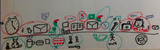
Arianna Mazzeo from the University of Catalonia gave an interesting workshop recently for us at Leicester. The focus was on the ways in which people are using mobile phones these days. She had us working in two groups and asked us to draw a timeline to indicate how we used our phones over the course of a day. In our group we indicated the function used above the line and mapped what we were doing at the time underneath. There was a lot of overlap between the two groups; for example using the phone as an alaram clock in the morning, using it to surf the net, read articles, answer email, check Facebook and use Twitter, but also some differences. One member of our group is going ‘An audio a day challenge’, so uses his phone to take recordings, Others of us are doing something similar in terms of ‘A photo a day challenge’. What was particularly striking to me was a) the fact that neither group mentioned the use of the phone as a erghh phone… and b) the variety of ways in which the phone was being used and how it was an integral part of our lives.
Such an intimate relationship with the phone is a relatively recent phenomenon; arising as a result of the emergence of smart phones, such as the iPhone. The variety of functionality and Apps now available is truly amazing, providing anywhere, anytime access to support a range of daily activities we undertake. I remember years ago being in California with people from Apple. One guy was telling me that we would be able in the future to look up on a device restaurants in the area, along with ratings and then be able to remotely book a table. At the time it seemed like Science Fiction, but of course nowadays we don’t think twice about being able to do such things.
It makes you wonder how we survived before such devices! And I can’t even conceive a time before Google and the Internet. Anyone remember ‘Yellow Pages’? For me the way in which we appropriate technologies goes back to Gibbon’s notion of Affordances; i.e. technologies have key characteristics but these are only realised in relation to an individual and their personal preferences, skills and context. It takes time to appropriate technologies into your daily practice. I was personally reminded of this very recently. I got an iPad in the Autumn. At first I was excited about it and played about downloading various Apps, but after a while I found I was no longer using it and had reverted to using my Mac Air. I was lucky enough to win an iPad Mini (I never win anything!) at the Ascilite conference at the end of November, but just somehow never got round to playing with it much. Five months on, just before I went to Saudi Arabia, I decided to make a concerted effort to give it a go. Whilst waiting in the airport for my flight I downloaded various Apps and in particular iBooks, along with some free books. I found a book I liked and started reading it… Soon I was totally hooked, the interface was nice to read and the size and weight of the device was much better than the iPad, which is just too heavy. Having made the breakthrough with using it to read books, on my return I started downloading lots of other Apps - Feedly for reading blogs I follow, Facebook, Twitter etc. of course, various curation tools, games, reference sites, a full Spanish dictionary, a range of work Apps (such as Office Apps, To Do lists, expenses Apps, etc.), various media tools etc. I can really see the power of the device now. As I said on Facebook this morning ‘Not love at first sight, but definitely a permanent partner now’.
e4Innovation
.
Blog
.
<span class='date ' tip=''><i class='icon-time'></i> Jul 23, 2015 12:17pm</span>
|
|
I gave a keynote in Dammam, Saudi Arabia last week. It was an interesting conference with over 1000 delegates, mainly from across Saudi Arabia. The conference organizers had invited an impressive line up of international speakers. Here are some of the highlights
Jim Cibulka started the conference off with a talk on international collaboration. He referenced Peter Drucker’s work on knowledge workers and argued that we have shifted from a data poor to a data rich context. He argued that there were a number of demands on Higher Education, including: the need to produce more high-quality degrees, the globalization of the workshop and mobility of students, and the need for cost-effective solutions to increase collage access to underserved populations. For the states he listed the following challenges: dwindling government budgetary support for public institutions, decrease in the proportion of young adults earning degrees, policy makers call for accountability, and technological advances challenging traditional modes of delivery (referencing Christiansen’s concept of disruptive technology). He described CAEP and their approach to accreditation, with an emphasis on outcomes and results.
Helen Eccles’ talk was entitled ‘Skills and skills-based courses as a means of enhancing curriculum effectiveness’. She began by outlining the importance of 21st Century skills, in terms of: the increased importance of technologies and globalization, life in increasingly global, international, multi-cultural and inter-connected, importance of information over possession of facts and figures, and the economies of developed countries have shifted from a basis of material goods and services to information and knowledge. She showed a graph illustrating that in terms of jobs there has been a decrease in manual skills and an increase in cognitive skills. She listed the following as examples of 21st Century skills: collaboration, creativity, communication, IT literacy, citizenship, problem-solving, decision making, critical thinking and self-directed learning. These can be categorised as follows: ways of thinking, ways of working, tools for working and living in the world. She then showed how these can be developed in different subject areas, mapping to the learning objectives for the courses.
Eugene Rice focused on the changing role of academics and in particular the move away from research intensive institutions to a focus on student engagement. He cited Boyer’s work on the nature of scholarship, in terms of scholarship of: teaching and learning, integration, engagement and discovery. He suggested that there were three pedagogical innovations face institutions: active, experience-based learning, the power of relational learning through peer learning and learning communities, and technology-enhanced learning.
Beverley Oliver gave an engaging talk on the work they are doing at Deakin University to transform the curriculum, in terms of the development of generic learning outcomes, namely: fundamental skills (such as literacy and numeracy), people skills, thinking skills, and personal skills. Deakin are adopting an evidence-based approach for students to show how they have developed these skills.
e4Innovation
.
Blog
.
<span class='date ' tip=''><i class='icon-time'></i> Jul 23, 2015 12:17pm</span>
|
|
I thought I would share my experience of being in Saudi Arabia recently. Some people on Facebook were deriding me for going, saying going was tantamount to supporting the regime and that we, in the West, should be boy cutting such countries. I disagree for two reasons. Firstly, how can you make a judgment on somewhere you have never been? OK being there for only three days only gave me a bit of an insight into the culture, but at least I now have a better understanding of it. Secondly, why should the people there be deprived of international ideas, particularly the women? People are people, irrespective of the regime and culture in which they live. I found the people lovely, really hospitable and friendly. We were put up in the Sheraton Hotel in Dammam, I had an amazing big room, practically a suite! The food was fantastic and lots of it. I was given an Abaya when I first arrived, it is a requirement to wear one when in public, although Western woman don’t have to cover their hair, which was good. It was very frustrating seeing a lovely outdoor swimming pool and not being able to use it (men only). It felt strange having to wear the Abaya, but I have to say it was surprisingly comfortable and elegant.
There were over 1000 delegates at the conference, mainly from Saudi Arabia. Men and women were segregated; the men in a nice airy room, the women in a dingy room underground. The sessions were video conferenced into the ‘ladies quarter’. I was allowed into the men’s section when I was doing my talk and was then escorted back to the ladies quarter. They were not happy as the cameraman refused to focus on me, instead showing shots of the men in the audience. We were constantly offered food, dates and tea. The organizers couldn’t have been more helpful. I found the people lovely, particularly the women, who were really interested in the talks and were keen to find out more. It was good to have the chance to chat to many of them between sessions. The atmosphere in the two sections of the conference was very different; in the men’s section it was sober, with many falling asleep, whereas the atmosphere was more lively in the ladies quarters, not been seen by the men meant that we were free to move around and chat.
Many of the women were interested in doing Masters and PhDs and I even met one lady who is coming to do a PhD with us in the Autumn and after hearing me talk she wants to focus it around our 7Cs of Learning Design framework, which is great! Also there is a chance that I will get invited back there, would be nice to run some Learning Design workshops.
So on reflection I am very glad I went, I now feel I have more of an understanding of the Saudi culture. It is an interesting country and it is clear that Education is a fundamental priority for them.
e4Innovation
.
Blog
.
<span class='date ' tip=''><i class='icon-time'></i> Jul 23, 2015 12:17pm</span>
|
|
The proposals from eLearning vendors are in and have been thoroughly reviewed and evaluated. Presentations were made. At this point, eLearning project sponsors may be tempted to simply pick an eLearning vendor and get on with the contracting process.
What’s often overlooked? Checking references.
Re-Thinking the Business of Learning Blog
.
Blog
.
<span class='date ' tip=''><i class='icon-time'></i> Jul 23, 2015 12:16pm</span>
|