Blogs
|
Massive Open Online Courses (MOOCs) seem to be the flavour of the month at the moment. Following on from Coursera https://www.coursera.org/ the Open University UK recently announced the launch of Futurelearn http://futurelearn.com/ (Leicester recently signed up) and the most recent addition is a new Australian MOOC platform from the Open University Australia http://theconversation.com/the-aussie-coursera-a-new-homegrown-mooc-platform-arrives-12949
The jury is out on whether or not MOOCs are a good thing. I took part in ‘The great MOOC debate at Ascilite in November. The recordings are available online. Given all the interest in MOOCs I thought it was be useful to collate here some of the articles on MOOCs.
The positives associated with MOOCs are that they are free and hence promote social inclusion to those who can’t afford formal education. UNESCO estimate that there are more than 100 million people who can’t afford formal education. MOOCs also promote connectivist learning, enabling participants to harness the power of social media for learning. The negatives are that many are skeptical about the rational behind MOOCs; arguing that it is more about learning income that learning outcomes and that they are little more than a shop window for institutions - i.e. a marketing tool.
Rita Kopp wrote a nice article on the evaluation of one of the earliest MOOCs on Connectivism She argued that:
Self-directed learning on open online networks is now a possibility as communication and resources can be combined to create learning environments. But is it really? There are some challenges that might prevent learners from having a quality learning experience. This paper raises questions on levels of learner autonomy, presence, and critical literacies required in active connectivist learning.
There is a nice scoopit space on MOOCs. Other articles include:
http://juandoming.sharedby.co/share/8G5rwz
http://suifaijohnmak.wordpress.com/2013/03/18/how-could-cmoocs-be-designed-and-incorporated-under-an-institutional-framework/
http://competence.wordpress.com/2013/03/13/how-moocs-change-the-world-do-they-starting-a-list-of-myths-about-moocs/
http://www.rsc-scotland.org/curriculum/what-is-a-mooc-anyway/
And there are currently two call outs for special issues on MOOCs:
http://www.elearningeuropa.info/mt/node/123696
http://unescochair-elearning.uoc.edu/blog/2012/10/17/merlot-special-issue-massive-open-online-courses-moocs/
e4Innovation
.
Blog
.
<span class='date ' tip=''><i class='icon-time'></i> Jul 23, 2015 12:19pm</span>
|
|
I’m in a POERUP project meeting in Nottingham. We have a packed agenda of things to talk about. I’ll provide a summary of some of the key points in this blog post. Firstly, we began by discussing channels of communication; EDEN, Online Educa and the Media and Learning conferences were all suggested as potential avenues. Ming Nie from Leicester provided an overview of the work she has led on in terms of the country reports, 11 detailed country reports and 15 mini-reports have been collated and an impressive inventory of 300 plus international OER initiatives.
Bieke Schreurs, from OUNL, provided an overview of the methodology we are planning to adopt for 7 in-depth case studies of OER communities. The research questions include:
How are the user networks behind OER initiatives structured?
Do users of the same online community networks’ size and density differ, in terms of: their role in the community, their educational level and their level of digital literacy?
What do users share around the use of digital learning materials?
What kind of activities do they develop within the network?
We are also interested in developing an OER community typology, in terms of what kinds of communities exist around OER initiatives?
Social Network Analysis (SNA) will be used as a means of understanding the nature and dynamics of the communities. Data will be collected via an online survey and a series of interviews. We are interested in three types of stakeholders: community organisers, community members and learners.
e4Innovation
.
Blog
.
<span class='date ' tip=''><i class='icon-time'></i> Jul 23, 2015 12:19pm</span>
|
|
This blog post summarises some of the key findings from the VISCED project on virtual schools and colleges. The report states that these provide important alternative for learners who are not able to participate in face-to-face education. The report defines virtual schools and colleges as
Institutions that teach courses entirely or primarily online.
70 have been identified across 17 countries in Europe. The report summarises 8 case studies:
Bednet in Belgium
InterHigh in Wales
Ensino a Distancia para a Itineráncia in Portugal
iScoil in Ireland
Nettilukio - Otava Folk High School in Finland
Sofia Distans in Sweden
Rigas Talmacibas Vidusskola in Latvia
Wereldschool in the Netherlands
Analysis of the case studies identified the follow success factors:
Usability of the system, which supports students, teachers and others involved
Extent to which a clear e-learning strategy is in place
Appropriateness of recruitment and training policies
Extent to which regular evaluation is in place
Robust and reliable technical infrastructure
Strong leadership skills and competences
Strong emphasis on learning outcomes
Availability of appropriate learning resources
Clarity of the organisational system underpinning the operation of the school or college
e4Innovation
.
Blog
.
<span class='date ' tip=''><i class='icon-time'></i> Jul 23, 2015 12:19pm</span>
|
|
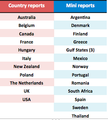
One of the main deliverables to date for our POERUP project is a set of country reports on OER initiatives. The table above shows the countries included. This blog post provides a summary of some of the key findings:
Kuwait General: substantial e-learning and not only from Arab Open University. Schools: none found. HE: e-learning active, no OER found. CPD: Open Knowledge Zone. OA: Kuwait Foundation for the Advancement of Sciences
Qatar: General: Qatar National e-Learning Portal within ICTQatar context.Schools: none found. HE: some e-learning including from non-Qatar providers but no OER.
Oman: General: eOman portal with focus on Knowledge Society. Schools: early e-learning activity, some content being developed. HE: Branch of Arab OU and some other early e-learning.
Thailand: Schools: significant e-learning (not OER): virtual schooling, TV as well as internet. HE: substantial e-learning in HE e.g. at Ramkamhaeng University. HE: OER initiatives at: Sukhothai Thammathirat Open University and Thailand Cyber University consortium (TCU). Chulalongkorn University (part of OCW)
UK: JISC/HEA OER Programme: Overall funding of more than GPB 13 million from 2009 until the Programme ended in 2012. Massive amount of OER covering a variety of subjects released. SCORE: Support Centre for Open Resources in Education. Provided support to OER-related activities, events, and service until closure in July 2012.
France: Digital universities (7 thematic digital universities in 2012, 23,000 resources (video, courses, exercises, MCQ), not all resources are OERs. Other OER initiatives (MOOC ItyPA: first French-speaking MOOC, SILLAGES initiative: multimedia educational contents as OER, preparing students for entrance examination and Exo7: an online math exercises sites for HE students).
Romania: OER in government programme (The Government Programme for 2013-16: support the innovative integration of Web2.0 and OER in education). OER in educational policies (The public policies for ICT integration in the pre-university system: promotion the use of open/free resources; development and sharing of resources by teachers).
Poland: Digital School Programme (Government investment of Euro 13 million
Schools will be computerized and educational materials will be produced and released in CC BY 3.0 licence). No significant OER activities in HE.
Australia: Open government (AusGOAL). Free for Education (FFE) movement. OER for schools: National Digital Learning Resource Network, Scootle. OER for HE: A university consortium to develop an OER protocol; The Australasian Council on Open, Distance and E-learning to promote the uptake of OER; USQ has a formal OER strategy, and joined OCW and OERu,
Netherlands: OER available from both educational institutions as from cultural heritage and public broadcast. National program Wikiwijs (Mainstream OER in all educational sectors). HE uptake of interest caused by MOOCs. Some disciplines strong initiatives (Medical education (HE) and Green education (Sec. ed to university).
Belgium: National (Klascement, Content for special (needs) education). Leuven University (Ariadne, Cultural studies).
Italy: National (Only books with a digital version available are to be adopted. Oilproject (2004): 2200 lessons and 10K students). Regional (Trio Toscane (only free availability, no OER), Several institutional OER projects (HE), Survey 2009 revealed the common problems preventing an uptake of OER (a.o. distrust, no culture of sharing, lack of funding)).
Greece: OER activities through all educational sectors. Several OA repositories and an OA harvester. National (Digital school: all textbooks of all educational sectors (e-books)), No institutional initiatives.
Mexico: National programmes - e-Mexico (Telesecundaria - providing learning materials for 800,000 students and 23,000 teachers. Edusat - Educational Satellite Television Network - 6 tv, 24 audio channels reaches over 10,000 schools with a total of 20,000 receivers). OER in HE- small but growing (Temoa, developed by ITESM: is a specialized search engine that enables the educational community to search a public bilingual catalogue of Open Educational Resources, to find those educational resources and materials that best meet their needs for teaching).
Argentia: National programmes: (Virtual Campus of Public Health available to the public health community - any professional can use it to support his activity and can participate in the virtual classroom, see learning objects, create courses, presentations, or videos (using Moodle Elluminate, MyMLE-Moodle Móvil and eXelearning), and add them to the Campus). OER in HE - Oportunidad Project (Strengthening and sustaining the EU-LA Common Higher Education Area, through a bottom-up approach, by the increasing use of open educational practices and resources (OEP & OER)).
Spain: List of 78 OA initiatives identified (3 modes - Open Access contents on the Internet but authors’ rights honoured, Mixed OA and OER, enabling either the use of copyright, or the use of Creative Commons licenses). OER initiatives using only Creative Commons license. International level (Universia network of 1,1000 Universities located in 15 countries, 10.1 million students, 8 million users and 850,000 university teaching staff, Spain plus Latin American nations. OCW started by Universitat Oberta de Catalunya in 2008, 21 universities now offer OCW in Castillian, but also in Catalan, Galician and English).
Portugal: National programmes: (Portal das Escolas: repository of digital contents for teachers and that offers over a thousand digital educational resources - texts, images, videos or music and blogs. Teachers in public education up to 12th grade can upload educational resources into this repository. OER in HE (Repositório Científico de Acesso Aberto de Portugal - used freely by all the scientific and higher education institutions for hosting their repositories, thus integrating them into a coherent system of scientific metadata open access repositories in the country).
South Africa: OER policies (The Department of Higher Education and Training has included the development of an Open and Distance Learning (ODL) policy framework in its strategic plan for 2010-2014, which will include OER).Teacher education (All educational resources developed through funded projects must be released under a CC licence). Regional cooperation (The Southern African Development Community is developing an ODL policy and strategic plan for sharing learning materials).
Canada: National policy initiatives not possible. Open access policies: Athabasca University, Universities of Ottawa & Toronto/OIS Provincial OER initiatives: BCcampus in British Columbia; Contact North in Ontario. OER initiatives at Athabasca, Manitoba, Thompson Rivers, Royal Roads, Capilano and OCAD Universities. Lack of public funding - a serious threat.
New Zealand: National policy guidance (Government Open Access and Licensing framework (NZGOAL)). Schools sector (OER portals via Wikieducator). Tertiary education (OARINZ: open access research repository (Ako Aotearoa website), OER university - 8 NZ institutions, Otago Polytechnic has an OER policy).
Norway: General: strong development of e-learning. Schools: several initiatives including: Norwegian Broadcasting Corporation, Norwegian Centre for Science Education, Ovttas: for Sami schools. HE: Not much except Universities of Oslo and Stavanger.
Denmark: General: Significant e-learning but little distance learning. Schools: Some major initiatives: EMU - main public portal, Danish Public Broadcasting: "Academy", University of Copenhagen portal for schools. HE: A bit at Aarhus University.
Sweden: General: substantial e-learning and distance learning in HE; and some virtual schools. Schools: a few including: Länkskafferiet, National Library of Sweden Open Access. HE: OERSverige and a similar one for South Sweden universities.
Finland: Long history of e-learning but not massified. Years of good collaboration in EU projects. Schools Initiatives: LeMill, YLE, and Edu.fi. HE: seems to be not much though note Helsinki Metropolia University (AS) in OCW.
Hungary: Strong in Open Access, quite strong in e-learning & distance learning, not in OER. Schools: OER activities in Sulinet. HE: activities under way at U Miskolc and Eötvös Loránd U. Grass-roots activities by students.
US: General: massive deployment of e-L and DL across HE, colleges and schools (NB Re.ViCa, VISCED, Sloan-C, WCET reports). HQ/core of many OER-related organisations. Schools: Free textbook movement is key driver; but only one OER Virtual School? HE: OCW and the MOOCs, but lots more. Business models emerging faster for free/low-cost HE - UNow, UoPeople, Coursera, Ameritas, edX, US HEIs in OER U, WGU use of OER, etc.
More information can be found on the POERUP wiki.
e4Innovation
.
Blog
.
<span class='date ' tip=''><i class='icon-time'></i> Jul 23, 2015 12:19pm</span>
|
|
Institute of Learning Innovation Seminar 5th April 2013,
The Learning Innovation Studio,
103 - 105 Princess Road East, 2 - 3 pm
Virtual worlds in practice and theory
A presentation of three examples of the use of virtual worlds in education and performance
Disaster Management Communication Studies
Digital Cultures
Extract / Insert mixed reality installation
The review of the examples will look at the rationale for the use of virtual worlds, the advantages compared to other media these presented and what lessons were learnt. This will be followed by an examination of what makes Virtual Worlds interesting as a teaching and learning tool, what requirements they make of learners and how they alter the learning experience. This will focus on three specific aspects.
The role of identity
Making sense of space
The role of embodiment
About Mark
Mark Childs is a Senior Research Fellow for Elearning at Coventry University in the UK. Since 1997 he has worked on 40 educational projects mostly involving technology-supported learning; at Coventry and in previous posts at the Universities of Wolverhampton and Warwick, as well as a freelance consultant. In 2010 he was awarded a PhD from the University of Warwick for his thesis on Learners’ Experiences in Virtual Worlds. His main research interest is the user experience of synchronous communication platforms, with his most recent work including virtual teamworking and digital identity, but particularly learning and performance in virtual worlds.
e4Innovation
.
Blog
.
<span class='date ' tip=''><i class='icon-time'></i> Jul 23, 2015 12:18pm</span>
|
|
http://openclipart.org/detail/105295/brain-in-a-jar-by-feraliminal
Was chatting with someone today about why we like text chatting, what it offers over face-to-face interaction or a phone call. I chat a lot both on fb and Skype, with a select set of people (about a dozen). It’s a mixture of personal and professional stuff and there is usually a lot of emoticons and banter involved. I think there is something about the text medium, can’t quite put my finger on it. It’s definitely different from verbal communication. Interesting the way you convey emotions through emoticons, hashtags and putting things in brackets <just saying> <ducks> <looks innocent>
Some people aren’t comfortable doing this. For one thing you certainly need to be able to type fast, otherwise the flow of the conversation doesn’t work. I can get totally lost doing this and then suddenly I emerge finding that I have spent over two hours chatting with someone. My friend was saying that for him chatting like this has enabled him to get to know people much better; he said he feels that people disclose more about themselves in the chat environment. Why is that I wonder? Is it because you feel freer because you aren’t face-to-face? Is it something to do with the anonymity of the medium? Now don’t get me wrong, I am very much a face-to-face sort of person, but I do love interacting with people online. I have found that I have really developed friendships in this way, getting to know professional colleagues on a personal level to the point where I would call them friends. It’s also a great way to spark off new ideas. Indeed this blog post is a direct result of my conversation on fb this morning!
e4Innovation
.
Blog
.
<span class='date ' tip=''><i class='icon-time'></i> Jul 23, 2015 12:18pm</span>
|
|
http://www.flickr.com/photos/redplastic/3749387903/
I’ve been meaning to write about presence for some time, but Mark Childs beat me to it. I agree with a lot of his points, but disagree that immersion and presence are the same thing. Presence is only realised in relation to others, whereas immersion is a personal state/construct. I like Mark’s analogy in terms of being immersed in water; immersion is also an important aspect of ‘flow’.
So what is presence? Some dictionary definitions:
The state or fact of being present; current existence or occurrence.
Immediate proximity in time or space.
Neither of these really captures what I understand by presence. I think it is something more than this. This definition comes closer: ‘the bearing, carriage or air of a person; especially stately or distinguished bearing’.
I am interested in the difference between presence face-to-face and online. In a face-to-face context presence is related to a number of factors. It’s about someone’s aura, their stance. It might be that someone has presence because they are tall, attractive, have a deep voice or it might be related to their intellect. We have all experienced the feeling of being effected by someone, being very aware of them, feeling a connection with them on a sub-conscious level.
In the digital world presence is very different, it is conveyed primarily through text. Presence is channeled through your words and associated emoticons, etc. I often wonder how I am perceived online. What people make of the things I say, the pictures I post. What is my digital personality and how is it different from the way I interact face-to-face. As I said in my previous post I find online interactions liberating and different to the interactions I have with people face to face.
Of course technology plays a part. The affordances of different media enable or disenable certain types of interaction. So facebook is a good medium for sharing multimedia, Twitter requires you to speak in a certain way, with its limit of 140 characters. Virtual worlds provide a bridge to face-to-face interaction, via your avatar. The avatar you choose says something about you. Mine is very much the girl next door, with brown hair, wearing jeans and a t-shirt. Although I must admit I also have very nice wings Don’t know what this avatar says about me. Our digital presence is fragmented across these different media. The collective self is a culmination of these individual utterances. The way I speak on my blog is different to the postings I put on facebook or Twitter. They have different purposes and audiences. So what does ‘presence’ mean in a digital context? I think it is about how you are perceived by others through your interaction with them. Presence only has meaning in relation to others. It’s a social construct. For some people you will have presence, for others you won’t. It is all to do with whether your interactions have meaning for others.
e4Innovation
.
Blog
.
<span class='date ' tip=''><i class='icon-time'></i> Jul 23, 2015 12:18pm</span>
|
|
http://www.flickr.com/photos/jmckible/5883298855/
I have been thinking a lot recently about digital identity and presence online (see earlier posts). Mark Childs has also been writing about presence, in particular, with respect to virtual worlds. I like his definition of presence:
Presence is a combination of mediated presence ("being there" aka immersion) + social presence (projection of ourselves, perception of others) + copresence (being somewhere with others) + self presence (or embodiment).
David Hopkins has blogged today about ‘The Technology of Touch’. I think this takes the immersive experience of technology a stage further. David argues that:
By introducing touch in this way you can bring any substance or texture to the classroom where it would not be possible (or safe) to do so. What does moon rock feel like? What does hard enamel tell you about the integrity of a tooth? What does the surface of a scarf feel like when it’s frozen in liquid nitrogen? How do you spot a possible failure in an engine block when it’s running at 9000 rpm. To experience these things can bring the subject, the science, the learning alive where you would not always be able to?
So haptic technologies enable you to experience the textuality of things you may not be able to access in the physical world; either because it is not available or because it is unsafe to do so. It allows Medical and Dental students to practice and develop their skills in an authentic and textual environment, before unleashing them on the real world.
So, through technologies, we now have a full spectrum of experiences; from the social and connected interaction with others through social media and the power of ‘text-plus’ (i.e. text plus emoticons, hashtags, brackets, etc.), through the ‘virtual physicality’ of Virtual Worlds, and through the touch-based experience of haptic technologies. As a result the boundaries between real and virtual are truly blurred. What do these various digital spaces mean in terms of presence, experience, immersion and identity? And how can they be harnessed to promote different pedagogical approaches?
e4Innovation
.
Blog
.
<span class='date ' tip=''><i class='icon-time'></i> Jul 23, 2015 12:18pm</span>
|
|
Leicester is the fifth institution I have worked at. It is a great place to work and the people in my department (the Institute of Learning Innovation) are fantastic. We have a vibrant community of PhD students and visiting scholars. So I feel very much part of the University of Leicester. However, this sense of community is secondary to the sense of community I feel with my wider network of peers through social media such a Facebook, Twitter, Flickr, the blogosphere and Skype. I love the variety of connections I have across these media, the comments and the banter, the intellectual debate, the serendipitous learning through links others provide or via blog posts. Indeed my last blog post on haptic technologies was prompted by a blog post by David Hopkins, which I came across this morning on Twitter.
These technologies have truly transformed the way I work and even the way I think. Ideas are sparked through the postings of others, comments on my blog help develop my ideas and in turn spark new thoughts. The dynamic and immediate communication is so much more valuable than developing ideas through the torturously slow journal publication route, it can take years for publications to be published and then at best only a hand full of people might read the article and it is highly unlikely than anyone will comment or provide feedback on the piece. Through social media we now have an amazing way of co-constructing knowledge, we feed off each other.
I wonder if any research has been done on how this has changed the nature of research? There is of course the book ‘The Digital Scholar - how technology is transforming scholarly practice’ by Martin Weller, in which he argues that there are three characteristics associated with being a digital scholar: open, networked and distributed.
Cristina Costa’s thesis (The Participatory Web in the context of academic research: landscapes of change and conflict) applied a Bourdieun theoretical lens on the concept of digital scholarship. The thesis focused on the use of participatory media to promote digital scholarship and foster innovative approaches in the communication and dissemination of research. A narrative inquiry methodology was used, along with the use of Bourdieu’s concepts of social capital, habitus, field and violence as a theoretical lens to understand the research findings.
I think we need more research into the nature of digital scholarship and its role in developing research ideas. We need to better understand how social media are influencing our ideas and what are the implications for the taking forward of our research field.
e4Innovation
.
Blog
.
<span class='date ' tip=''><i class='icon-time'></i> Jul 23, 2015 12:18pm</span>
|
|
I recently did a review of the ‘e-Learning and Social Networking Handbook’ (Rennie and Morrison 2012). The book is an excellent introduction to social media and how they can be used to promote different pedagogical approaches. The authors state that the purpose of the book is to provide guidelines for integrating social networking into course design. They classify the tools as follows:
Audiographics
Blogs
e-Books
e-Portfolios
Games and Simulations
Instant Messaging
Mashups
Mobile Learning
Online Forums
Photo Sharing
Podcasts
RSS Feeds
Second Life
Social Bookmarking
Social Networks
Twitter
Video Messaging
Wikis
Video Clips and YouTube
Video Chat
For each tool they then provide: a description of the tool, discuss the educational challenges and the opportunities the tool provides for learning, the strengths of the resource, and potential disadvantages. They conclude with a chapter on the constraints on course design from the perspective of students, teachers and institutions.
References
Rennie, F. and T. Morrison (2012). e-Learning and social networking handbook - resources for higher education. London, Routledge.
e4Innovation
.
Blog
.
<span class='date ' tip=''><i class='icon-time'></i> Jul 23, 2015 12:18pm</span>
|