Blogs
|
I have been blogging for a long, long time now. Yes I go through phases of inactivity but on the whole I post on a fairly regular basis. My motivation for starting came from Martin Weller. I asked his advice about starting a blog. He said post on a fairly regular basis and follow other bloggers with similar interests. Well I can honestly say that blogging has transformed my practice. I blog about a whole range of things; half-baked ideas I am trying to work up, summaries of interesting conference presentations or publications, or updates on project work. I love being part of the blogging community, and find it great when people post comments. Blogging during the writing of my recent book, Designing for Learning in an Open World, was particularly useful. It motivated me to get on with writing chapters. The thought of writing a single authored book was daunting, whereas writing a 500 word seemed more manageable and once done was the start of a chapter. I would love to hear why others blog and what they value about it!
e4Innovation
.
Blog
.
<span class='date ' tip=''><i class='icon-time'></i> Jul 23, 2015 12:25pm</span>
|
|
I have been thinking a little recently about digital identity. What does our online persona say about us? How do others perceive us? In recent years social media has become an important part of both my professional and personal practice. I love interacting and communicating with people online through a variety of channels; my blog, Twitter, fb, Flickr, Skype, etc.
I have connected with people online and then later met them personally and have felt as if I already knew them really well. Other people, I have become closer to through online interactions. It’s great to feel part of a global, distributed community and I love the mix of light hearted, innocent flirting and serious academic discourse.
Now don’t get me wrong, I also love face-to-face interaction and I am lucky to have so many lovely friends and colleagues. But it is interesting to reflect on the difference between my online persona and the real me. There are just a few close friends who know me well who see a different side to me, a world apart from the out going, extravert I appear online. It is funny how online communication has become so important. It is great to get to know people through fb for example, to learn more about their personal lives, their families, the day-to-day mini-crisis we all have.
What theoretical frameworks can we used to describe the way we interact online? I feel things like Communities of Practice and Communities of Inquiry (although great concepts) are too limiting. With Rebecca Galley we recently developed a Community Indicators framework to describe online interaction, which consisted of four dimensions: presence, identity, social cohesion and creative capability.
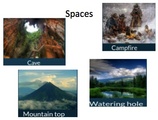
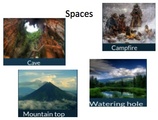
But there is also an interesting framework for describing ‘spaces of learning’ developed by Campbell in the seventies might be useful, which consist of four parts. The first is the cave - where you go to reflect - which for me translates into the quiet me time, when I am on my own or with friends. I used to go hill walking in Scotland a lot, I could easily go a whole day without saying a word, drinking in the solitude and tranquility, comfortable in silent companionship with my partner. The second is the fireplace, where you come together with others to listen to stories, the voice of the expert. This for me translates into interactions with others online building stories and discourse together. The third is the mountaintop, where you disseminate to the world. This translates to announcing, communicating, stating. The final one is the watering hole, where you have serendipitous interactions. This happens all the time in fb and Twitter, you connect with new people through others; you suddenly start chatting with people online and start to get to know them a whole lot better.
I also like Gibson’s notion of affordances and the idea that technologies have certain characteristics or affordances, which are only realised through individuals and their personal preferences. We all co-evolve with technologies, my digital environment is now very different to what it was five or ten years ago, social media have become part of my daily practice. I wonder how this will continue to co-evolve? What will my digital environment look like five years from now? What will the balance of the real and digital ‘me’ be?
e4Innovation
.
Blog
.
<span class='date ' tip=''><i class='icon-time'></i> Jul 23, 2015 12:25pm</span>
|
|
So I thought it would be nice to reflect on the photo a day challenge. Thanks to the lovely Ricardo Torres Kompen for setting the Flickr group up. I am now a month and a half in and totally addicted! I love thinking each day about what picture to post that will represent something about the day. Surprisingly my pictures are not all cats and food! Countryside, people, meetings and technologies also feature…. I have just discovered a nice tool via one of the discussion threads on the Flickr group about a great tool, which enables you to post a picture of the photos in a month. It’s called shuttercal.com, it’s a bit fiddly to use but ‘vale de pene’ as they say in Spanish! The picture shows January 2013. It is amazing to see the variety of pictures and it brings back memories of all the things I was doing in January; travelling - Spain, Greece, Brussels, Portugal, food - nice meals with good friends, weather - snow mainly, work - validation panels and meetings. Also I am enjoying being part of the online community. There are over 50 of us, it is great to see what people are posting and the contrast of posts from Europe with those in Australia. Love the commenting and banter as well. Some people are very talented indeed. I absolutely love David Lynch’s pictures of Dublin. Clearly a city he loves and knows well. He really has an eye for a good picture!
So can’t wait to see the full year! Would be nice to print out as a physical calendar or something…
e4Innovation
.
Blog
.
<span class='date ' tip=''><i class='icon-time'></i> Jul 23, 2015 12:24pm</span>
|
|
Image: http://www.flickr.com/photos/cambodia4kidsorg/267060150/
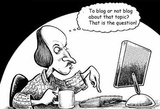
A lot of people say to me they would like to blog but don’t know where to start and how to go about it. As I said before I have been blogging for a long time and find it invaluable in so many ways. So I thought I would list some of the ways blogging works for me.
Make a list of the kinds of things you can blog about. These might include: summaries of key points from a paper you have read or a conference presentation you have attended, notes from a project meeting, key themes emerging from an interview you are transcribing, thoughts triggered from a conversation with someone, new conceptual ideas you are working on, reflections on someone else’s blog post, reflections on a conference you have attended, a description of some teaching materials you are developing or reflections on how a teaching session went, a review of a new tool or site that you have across about or simply reflecting on your own practice and professional development. There are probably lots of other examples but hopefully that is a good start! If you are thinking of starting a blog, my advice? Go for it! And good luck!
e4Innovation
.
Blog
.
<span class='date ' tip=''><i class='icon-time'></i> Jul 23, 2015 12:24pm</span>
|
|
The Internet is wonderful, right? It provides access to a wealth of materials and offers a multitude of ways in which you can connect and interact with others. But is there a darker side to the Internet? My daughter Eleanor made me watch a film last night, called Catfish. It was about a guy who was having interactions with a girl online. He had never met her and decided it was time to. The Film4 review of the film describes it as follows:
Detailing the strange twists and turns of a long-distance relationship forged over the internet between New York filmmaker Nev Schulman and a rural Michigan A sophisticated and thrilling reminder of just how malleable the notion of personality actually is, particularly when poured into the bespoke mould afforded by the internet. Reality? Emotion? Love? In an online playground, they’re as pliable as play-doh.
The photo is of an article I came across in Granada a few months ago. It was about a survey done in Spain looking at the amount of time kids were spending online. It says ‘Why are we not able to disconnect?’ It argued that many kids were spending way too much time online and that this was unhealthy. To what extent is this true? Are we spending too much time online? How real are people’s online persona? Is there a danger that by spending more and more time online we are eroding our real identity and existence?
On the whole my interactions with people online have been great. As I have said before I have got to know people better online and met new people who I later met in real life. However, I have also had some strange encounters. For example there was a guy on fb who suddenly started liking and commenting on every single thing I posted. I began to worry that he was cyber stalking me and thought about de-friending him but didn’t have the heart. So I just ignored him and eventually he stopped. A more sinister encounter was a guy on Google chat. He started saying that he loved me and wanted to marry me. And then said that he wanted to send me a package of money to pass onto a friend, as he couldn’t send the money through normal channels. I won’t go into the details, as it is too complicated. Needless to say I decided there was something very dodgy going on, so I broke off communication with him. I guess a few strange connections are to be expected and we just have to be wary and on the look out for anything odd. And I am not even going to mention my very strange interaction with a girl in Second Life!!
We also need to be careful how we portray ourselves online; too much information can be a bad thing and I know that is a strange thing to say from someone who is generally so open online! Would welcome your comments and any experiences you have had.
e4Innovation
.
Blog
.
<span class='date ' tip=''><i class='icon-time'></i> Jul 23, 2015 12:24pm</span>
|
|
I was recently asked by Panos Vlachopoulos to answer the following questions. Here are my responses would be interested to here other people’s views.
1. What would you consider the top 3 challenges that the Higher Education sector faces in your country?
The top challenge for me is helping teachers make effective use of new technologies. They are confused by the plethora of possibilities and lack the necessary digital literacy skills to harness the affordances of new technologies. In relation to this then designing for learning is the key challenge facing education. Learning design has emerged as a new research field in the last ten years or so to address this.
In general the lack of digital literacy skills is an issue for both learners and teachers. Jenkins lists 11, which he argues are needed to be part of today’s ‘participatory culture’. I would add an additional one on creativity.
For formal educational institutions there is an issue in terms of new emergent business models, which are challenging the standard educational model of formal courses with accreditation. Examples include the peer-to-peer university, the OER University and MOOCs. In a world where resources and expertise are increasingly freely available what is the role for a traditional institution? I think we are beginning to see a disaggregation of learning, so that in the future many learners will opt to pay for particular things rather than take a full course. They may for example pay for high quality resource, which are kitemarked in some way, or they may pay to have a guided learning pathway or some structured form of support. Finally, they may choose to learn through free resources and then pay to be formally accredited.
2. Do you see any value of the OER (Open Educational Resources) movement in trying to address any of the challenges?
Yes I think OER have an important role to play, this is something we explored in the OPAL initiative where we derived a set of practices around the creation and use of OER, which we then translated into guidelines for learners, teachers, institutional managers and policy makers. The guidelines can be used to first benchmark existing OER practice and then create a roadmap and implementation plan for future development.
So those were my answers, Panos has collected a whole set of responses online.
e4Innovation
.
Blog
.
<span class='date ' tip=''><i class='icon-time'></i> Jul 23, 2015 12:24pm</span>
|
|
So it has been bid mania time again, writing proposals for the Lifelong Learning programme. So I thought it would be useful to write down some of my experiences and tips and hints for successful bid writing!
Get a good strong consortium together, which has the necessary expertise to cover the different elements of the bid. Finding the right partners can take a lot of time and legwork. A good place to find potential partners is at conferences. Use conferences as a means of networking and getting to know people, which you can later call on to be bid partners.
Ensure that you like the people you are working with! Sounds trivial but it is not! You will be spending a lot of time with them if the bid is successful and also it is much easier to work through conflicts during the project if you have mutual respect and trust.
Make sure you have a good idea and a clear elevator pitch! If you can explain the idea to someone else in a few sentences and they say ‘that sounds good’ then that is half the battle.
Try to think up a catchy acronym and one, if possible, that is unique
Make sure you have a clear and pragmatic work programme and set of work packages. Always ensure you include: project management, evaluation and dissemination
Show how the project builds on your previous projects and research
Ensure that the budget is realistic and that adequate resources are allocated to the work activities
Spread the management of the work packages across the consortium members
Demonstrate how the project will contribute to knowledge and indicate how it will have impact
Include indicators of success
Have clear evaluation criteria, both for any trials being undertaken and for evaluation of the overall success of the project
Try and be quantitative; for example how many participants will be involved with or affected by the project
Be creative in terms of dissemination; in addition to conferences and publications, show how you will use social media
Make sure the project proposal is well written, structured and that arguments are clearly backed up by relevant research literature (this also shows that you are knowledgeable about the field)
Include clear statements about the expertise of each partner
Make sure you have very clear aims and objectives and ensure that these map to the programme of work
Include clear milestones and deliverables at key points in the project
Make reference to the proposal call and show how your bid meets the criteria set out in the call
Try and do as much as you can in advance, but be realistic; no matter how well prepared you are these things are invariably last minute so make sure you clear your diary as much as possible as the deadline approaches
Get to know your research support office, their involvement is vital, get them in the loop with the bid as early as possible and keep them up to date
e4Innovation
.
Blog
.
<span class='date ' tip=''><i class='icon-time'></i> Jul 23, 2015 12:24pm</span>
|
|
Jim Devine and Deborah Arnold
On the 4th-5th March I attended the Grand Challenge for Digital Jobs conference in Brussels. There were an interesting mix of attendees from both education and the IT industry. The focus was on how to address the issue of increasing e-skills and filling the gaps in IT jobs across Europe. The aim is to build on the conference to create a grand coalition of multiple stakeholders to address these issues and to create a roadmap for taking this forward.
Lészló Ancher argued that there were five key themes or challenges:
Training
Transnational mobility
Accreditation
Awareness raising
Innovative learning and teaching
Richard Straub argued that the need for ICT skills has become pervasive and is a key issue for Europe. In addition, we need to develop Business skills in young people and enable them to become entrepreneurs.
Tapio Koskinen focused on the educational aspects, arguing that we need to make use of the potential of ICT. He highlighted in particular the potential role of games and games design. He estimated that 90% of teachers need to develop a better understanding of ICT and how it can be harnessed for learning. He mentioned the ‘opening up education’ initiative as an important mechanism of achieving this, along with harnessing the power of social and participatory media.
The E-Competence Framework (ECF) was mentioned a lot as an important catalyst and a means of achieving a common dialogue across Europe.
For me the teacher voice was a little lost. I think they are a fundamental stakeholder in all of this. How can we embrace the teacher community? Many teachers feel that their expertise is being undermined by technology and they lack the necessary digital literacy skills to be able to harness the power of technologies. We need to provide them with the tools to do this.
It was good to get the chance to hear the president of the EU commission speak. José Manual Barroso’s talk focused on the issue of the rise of unemployment across Europe and the lack of digital skills. He suggested that there are three key issues: Economic and social time bomb, social exclusion and poverty and the brain drain. He stated that the number of digital jobs is growing by 3% each year and that we do not have people with the skills to do these jobs. How can be address this and bridge the gap? He argued that we need to invest in ICT training in a much more coherent way, by bringing stakeholders from education and the IT industry together.
Richard Burton (the Irish minister for jobs, enterprise and innovation) gave a passionate speech. I particularly liked his concept of the need for the democratization of entrepreneurship. He argued that the IT industry had a poor image, dominated by Geeks, with only 1 in 5 jobs held by woman. He suggested that we need to bring work experience into the curriculum and give students a better idea of what working in the IT industry would be like. He said that Ireland was leading the way on this, and has put an emphasis on the IT sector, with a particular emphasis on conversion courses.
Neelie Kroes (Commissioner for the Digital Agenda) used a metro metaphor, ‘Fill the Gap’. She listed five key issues
Employment
Education and learning
The digital agenda
E-skills
Mobility
Means of tackling this included:
ICT training
New learning approaches
Awareness raising
Mobility
Certification
It was a good conference, lots of food for thought. It will be interesting to see how this is taken forward in the coming months.
e4Innovation
.
Blog
.
<span class='date ' tip=''><i class='icon-time'></i> Jul 23, 2015 12:24pm</span>
|
|
It was good to catch up with Riina Vuorikari earlier this week in Brussels. She gave me a copy of an interesting booklet called ‘Teacher Networks’. It focuses on the ways in which teachers are now harnessing the power of social media. The booklet starts with a quote from Derrick de Kerckhove: ‘It’s all about connected intelligence’. Teacher networks are defined as:
Learning networks technology-supported communities through which learners share knowledge with each other and jointly develop new knowledge.
The ultimate aim is to improve the quality of teaching and enhance the learner experience. The booklet describes the Teachers’ Lifelong Learning Networks (Telnet) project, which aimed to identify the main structures and mechanisms that are effective in sharing practices and encouraging innovation and creativity amongst teachers. Chapter 2 outlines the main trends and drivers for educational change. This includes:
The changing role of the teacher as a result of new technologies. In particular as learning becomes more personalised, the notion of the one-size-fits-all method of teaching is outdated.
Teacher training. Teachers lack the necessary digital literacy skills to harness the potential of new technologies and need support and professional development to develop these. Teachers need to experience a wide range of different learning environments.
Teacher networks. New media provide a mechanism for teachers to network with other teachers globally.
21st Century skills. New skills are needed as a result of the potential of new technologies
The role of schools. We need to think beyond formal education, to learning anywhere, anytime.
Formal and informal learning. With the emergence of innovative technologies, learning is no longer confined to the classroom.
Technology innovation and widespread use of technologies. Social media and tablet technologies provide a plethora of ways in which teachers and learners can communicate and interact.
Data protection, data privacy and trust in networks. Data protection regulates control over how personal data as a commodity is exploited by third parties. Privacy is the right of the individual to be oneself, undisturbed and unobserved.
Five scenarios of the future are described:
eNet European Education Network, with a focus on expansion of the eTwinning initiative
MyNetwork, exploring user-centred social networking
Intelligent agents, adopting a technology-focused approach
Diversified teaching career, shifting to autonomous learning and teachers as mentors
Informal learning camps, promoting bottom-up peer learning.
The booklet is available online, well worth a look.
e4Innovation
.
Blog
.
<span class='date ' tip=''><i class='icon-time'></i> Jul 23, 2015 12:24pm</span>
|
|
So I have just signed up for Martin Weller’s Open Education course. The main reason I wanted to join was to experience being part of this kind of ‘open course’ from a learner’s perspective. I have been involved in a number of MOOCs, but on the delivery side of things. Also ‘openness’ is a topic that I am really interested in and I am involved in a number of research projects to do with Open Educational Resources, Learning Design etc. I am also interested in how more open practices are changing the nature of research and the concept of the digital scholar, which I am sure Martin will cover at some point in the course. It will be interesting to see the extent to which there is participation between those enrolled on the course and the level of interaction. Whether or not I can really invest 16 hours a week to this is perhaps a tad delusional, but we will see.
e4Innovation
.
Blog
.
<span class='date ' tip=''><i class='icon-time'></i> Jul 23, 2015 12:24pm</span>
|