Blogs
|
Last week while I was on the road, in response to the Tweets and two online events for #change11, I received a wonderful email from one of my online friends, Steve Crandall (aka "imaginary friends" which means we have not yet met F2F) which warmed the cockles of my heart…some real life stories about "social artists" which was. One of the core ideas I hoped to chew on this week with the good folks of #change11. (If you are lost about the meaning of #change 11, look here and here.) Steve wrote:
Hi Nancy
I was looking at your video conference on social artistry. The role of the listener/synthesizer is very important. We had one in an inventor’s circle at Bell Labs - of the four of us was one person who rarely offered the new core ideas, but rather would listen to the three of us hash things out for an hour quietly and then say ‘let me see if I understand this" he was enormously broad and connections none of us had imagined would surface giving new directions. He also had rich connections to other people where he served in a similar role. He was far and away the most important guy in our group. I should note that he was older and his background was *extremely* diverse.
It reminded me of an old notion that Bonnie Nardi and I had on the "library gene" — the folks who navigate content for the rest of us. We measured it for music and found they were about as common as numbers people talk about for literature. There was speculation that perhaps this type of person exists to curate social graphs as well as technical graphs — I’m certain they exist. I know one at Pixar who is spectacular. In theory a group leader should have some of these skills - in practice I think they are rare (at least natively perhaps people can learn)
best
Steve
I immediately wrote him back before I headed, yet again, to the airport and asked if I could share his email alnd if he might join us for our second session on friday at 9am PDT. Here’s what he wrote:
Feel free to post Nancy
I don’t know my schedule on Friday - I may be traveling - but I can offer more detail if you like. I’m very interested in this class of person.
Early on in my Bell Labs career I spent some time working with the silicon production people at the Western Electric Allentown PA Works. A dingy place that was built in WWII, but was the leading edge of AT&T’s electronic production at the time. The silicon process was had a lot of black magic and art in it. People roughy understood it, but there was a considerable amount of tuning and local knowledge - small changes often led to expensive disasters. There was a guy who was technically a process manager, but his unconventional habit of walking around and asking everyone deep questions was allowed as he had the respect of people. He would bring together very disparate people (that’s how I got involved - I was giving a talk at Murray HIll in NJ that he visited and he thought I needed to look at something in Allentown - it wasn’t a problem for them, but he wanted to plant seeds and involve people who might be useful in the future. Unofficially he was known as "the major of Allentown". He successfully tied about 25 groups of technologists together. I’m still astounded at his curiosity and connections.
The phrase "connect the dots" means a lot to me. We generally think of it in idea space, but it is clearly present in other areas I think SSTEM only education is a mistake as it focuses too much, bu that is a different subject. I don’t know if you saw it, but here is a general post on this type of person (although it doesn’t get into the social graph navigators and librarian gene people)
http://tingilinde.typepad.com/omenti/2011/08/polymaths-connect-the-dots.html
You know, Steve is a "connect the dots" sorta guy. Yes, a social artist! More on social artists in the next few days as I continue to synthesize what I learned last week from the MOOC Change11.
P.S. Edit on Tuesday — you might enjoy Steve’s second and very thoughtful blog, Omenti.
Nancy White
.
Blog
.
<span class='date ' tip=''><i class='icon-time'></i> Aug 19, 2015 12:24am</span>
|
|
cc Some rights reserved by incognito2020
AK nails it!
Last week I was a virtual attendee at the annual Sloan-C conference. It was fun and educational enough to spend 3 days watching live streamed sessions, and a saturday catching up on some recorded ones. The recorded ones are not as fun since you dont have the twitter stream going :-
via Multilitteratus Incognitus: Campus vs. Online: fighting in the family.
This is what I’m ‘talkin about! And it is not just applicable to webinars but to all synchronous online interactions regardless of the tool. It applies to telephone calls. Providing and/or encouraging text based peer to peer and peer to the world interactions creates opportunities to engage those who would otherwise tune out. Does it distract? It sure can. Does it fracture engagement into smaller cohorts or with those "outside" of the virtual room? You bet. And we can use that as an asset, not a strength.
The risk? The presenter will become irrelevant. And that too may be a good thing. If the presenter cannot skillfully engage, and they become only a conveyance for content… well, maybe they should switch roles and we run a video with a chat channel. I’m only partly kidding. How often have you clicked into a webinar on one of those platforms which makes you send all your comments to a moderator, which has no participate peer to peer chat room and felt like a prisoner with your hands tied? Last night I was talking with the fab Michael Coghlan of Australia (we were talking about flexible learning, natch!) and those were the words he used. "I felt like my hands were tied." Is that any way to have a meeting, to work together or to learn together? NO WAY, BABY! (yes, I’m ranting this morning)
There are SO MANY ways we can use chat streams productively. Here are two sets of tips - one for the "presenter" or leader, and one for participants. This is just a starter. What are YOUR tips? COMMENT PLEASE (and feel free to SHOUT. This feels like a SHOUTING topic!)
A Few Tips for Presenters and Webinar Leaders
Ask great questions and have people answer in the chat room. If there is no chat room in the tool you are using, make one else where or use a hashtag and Twitter. Don’t let the technology stop you. (I did in a webinar last month and I regret it. )
If you can’t track the chat room and present, get someone to help you to recap and weave in the chat with your work. Some people can do this while they are presenting, some need to wait until a designated Q&A time. Both are legitimate approaches but it is worth TELLING the participants what you need to best engage with them instead of feeling over stressed yourself. That does no one any good. Be honest. People will support you when you ask for their help. They will detest you if you simply ignore them!
If the topic is NOT suitable for public sharing via Twitter, say that upfront and ask people to "keep it in the room." Don’t assume people will automagically know this. Transparent ommunication is a great thing!
Keep the chat transcript and or Twitter hashtag aggregation (ask me if you don’t know what this is) and look at it afterwards. If there is more to follow up with, create a blog post or other appropriate mechanism to share that follow up. (Example here) People love it when you show active listening even if it is asynchronous. They are being heard. That is part of being a #socialartist! (First link is explanation, second is Twitter hashtag)
Frustrated that no one is "listening" and they are all chatting? After the event, review your presentation and figure out how to make it more interesting/compelling and DESIGN for participation next time. If you are just delivering content or a performance, record it. Sweet!
A Few Tips for Participants
Find out or ask what the practice/conventions are for chat in the event you are joining. If they don’t know what you are talking about, share some ideas. Don’t be the victim. It’s a waste of time and energy!
If you are a fast typer, be careful not to dominate and squeeze out others. Take a break every now and again. A hog is a hog in text or through speaking!
Ask good questions if the presenter isn’t or is unable to. This helps engage your peers. Again, avoid victimhood!
If Twitter/public interaction is OK and there is no hashtag, suggest a nice short one and get things going. Leadership!
Capture and share Twitter and chat transcripts for the uninitiated. There is often a pile of gems waiting in these artifacts.
Think the presenter could have done better? Walk in their shoes a few times, and if you are great at it, offer to give them coaching. If not, remember the power of compassion…
OK, add your ideas! Let’s liberate webinar participants from listen only confinements.
Nancy White
.
Blog
.
<span class='date ' tip=''><i class='icon-time'></i> Aug 19, 2015 12:23am</span>
|
|
Every time I prepare for a keynote presentation (Title: LEFT AND RIGHT, UP AND DOWN: CONNECTING GROUPS AND NETWORKS) I sit with three big buckets to work on:
What IS the focus (as I have a busy, full brain that can go down ratholes in a nanosecond)
What is the balance of performance, sharing and engagement?
Who is inspiring me right now.
I wanted to share some of my answers as a way of thinking and prepping for my keynote next Thursday in Melbourne at ConVerge, and a subsequent massive set of shorter workshops on facilitating online learning in the following weeks. Thinking out loud with you really helps me. Did you know that? Thank you.
In this first post I’m going to start with the inspiration, because that’s where I feel the need this morning. I seriously don’t want to start in old PPT. I have tons of glorious images. I can DRAW glorious images. So what. Who cares. I want to MOVE people when I’m in Australia and I want to be OF VALUE. So there! Let’s talk inspiration…
Jim Groom - Occupy Education
I love Jim and he drives me crazy. In a good way. Clearly he leads with passion. He follows with conviction and he IS a performer. He blends the three buckets into a nice stew. He also alienates me a itty bit, which is good. I can’t step away. The edginess is something I often lack — authentic edginess. Not performance edginess.
I have seriously considered doing this:
Any other inspiring clips to share with me? As I scanned my YouTube favorites, clearly I have not been keeping track of great keynote presentations. I mean, look, THIS inspires me!
Nancy White
.
Blog
.
<span class='date ' tip=''><i class='icon-time'></i> Aug 19, 2015 12:23am</span>
|
|
David Wilcox captures the amazing and vibrant Jim Diers on asset based community development. Solid, back to basics, folks. Worth a seven minute watch.
Write them down. Talk about them. LIVE THEM!
P.S. Say Happy Birthday to my dear husband Larry who turns 60 today! WOO HOO!
Nancy White
.
Blog
.
<span class='date ' tip=''><i class='icon-time'></i> Aug 19, 2015 12:22am</span>
|
|
(Note: this is a re-do of a post from this week lost due to hardware crash of my host. Sorry for the bad link at http://www.fullcirc.com/2011/12/13/valeries-amazing-thinking-about-social-artists/)
As a followup from my week facilitating Change11, the amazing Valerie blew my mind with her video summary and synthesis of the week. No, it was much more than that. WOW. Take a look if you are interested in this idea of the social artist. Valerie, you ROCK!
Nancy White
.
Blog
.
<span class='date ' tip=''><i class='icon-time'></i> Aug 19, 2015 12:22am</span>
|
|
Today JeffJackson tweeted an embedded link to this YouTube video from the USAID KM Impact Challenge video I did with them earlier this year. I know - I posted this already, but Jeff’s note gave it a twist. And having hung out recently with Alan (aka cogdog) Levine in Tasmania last week, I am attending to his principle that in social media, we ADD value. We don’t just retweet, rebroadcast, etc. Jeff added value.
Here’s his note: "Check out @nancywhite ‘s Full Circle Associates on Communities of Practice (CoPs). Great way to review and consider how you develop your #PLN and #AltProDev." Wow, I had not thought about this from the perspective of a PLN (personal learning network) but it sure does work. Thanks Jeff, for helping me see another perspective. I used the same communities of practice framework the last three weeks in my workshops in Australia about teaching and learning online. We weren’t talking about CoPs, but the framework is useful. (More on that in a subsequent post, currently in edit stage!)
For a refresher, here is the video.
Nancy White discusses various aspects of strengthening CoPs, mechanisms to measure their effectiveness and improve our understanding of how people are participating in CoPs.
To access the two items referred to in the video, please visit:
Promoting and Assessing Value Creation in Communities and Networks: a Conceptual Framework:
http://bevtrayner.com/base/docs/Wenger_Trayner_DeLaat_Value_creation.pdf
The Activity Spidergram
http://www.fullcirc.com/wp/wp-content/uploads/2011/06/SpidergramWorksheet2011.pdf
Nancy White
.
Blog
.
<span class='date ' tip=''><i class='icon-time'></i> Aug 19, 2015 12:22am</span>
|
|
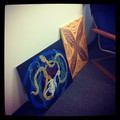
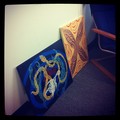
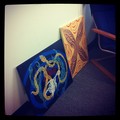
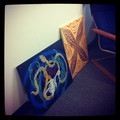
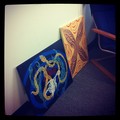
Thanks to Geoff Young (@gsyoung), the vibrant and ever perapatetic host a few weeks ago at Wondonga TAFE, my Christmas presents will soon be moving from Australia to the US.
What I love about these two paintings, beyond their beauty, is that we found them in the student gallery at Wondonga TAFE as part of an Aboriginal show. So not only will our home be blessed by their beauty, but we have the pleasure of directly showing our gratitude to the students by buying them. I can think of no finer way to spend my travel money, and more important, ongoing time and attention than to the beauty of their art. Thank you Geoff for getting them to us and send our deep gratitude to the artists.
Instagram.
I might add a word about Geoff. Not only is he a Tweet-Meister, but he clearly is working social media and open education magic at his TAFE. Way to go, Geoff!
Nancy White
.
Blog
.
<span class='date ' tip=''><i class='icon-time'></i> Aug 19, 2015 12:22am</span>
|
|
I’ve been home just over a week after three great weeks in Australia, which started off with a keynote and workshop at ConVerge11 in Melbourne. (You can access all the session notes here.) The keynote was at 4pm on the first, packed day and I was asked to help encourage people to come to the cocktail reception afterwards. So I took my charge as "drive them to drink!"
Keynote
My goal was to provoke some thought about how we step beyond this idea of "creating communities for learning online" and instead think about connecting for learning — across cohorts, with the outside world, with our sponsoring institutions and with ourselves. After all, we can’t simply keep joining more groups. That does not scale. When we do utilize community approaches, we also need to think about how we make them the best they can be. So I wove in the idea of the social artist (borrowing from Wenger and Houston). I confess, I dumped a LOT on people in an hour. If they didn’t need a drink when we started, I’m sure they did when I finished!
Below are my annotated slides because, as usual, my slides make no sense on their own. First is the Slideshare deck, and below is the PDF handout which is actually easier for reading the annotations.
conVerge 11: Connecting for Learning: Left and right, up and down (annotated)
View more presentations from Nancy White
LEFT AND RIGHT, UP AND DOWN-Annotated PDF
Workshop: Advanced Online Facilitation Practices
Friday afternoon we had a great group for the workshop. Since I dumped a million ideas on everyone the day before, my approach to the workshop was full on participatory. At the last minute I decided to run an online experiment with Google+ at the same time to both capture what we did and to bring in any outside voices from my network who happened to be awake. (Not many… it was Thanksgiving weekend in the US.) 55 comments later… Do read the comments. There is a lot of insight that people contributed and a big thanks to Evan for scribing! (most of the comments under my name are Evan capturing conversation from the room.)
I started by asking people to write their teaching and learning strengths via key words on paper, then share and talk about them with others around them — especially to move away from the people they know. Sort of unmasking the superpowers in the room.
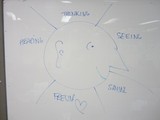
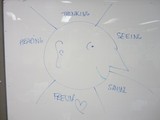
We then went with Dave Gray’s Empathy Mapping exercise to help surface different perspectives. That generated some fantastic insights about our own teaching approaches and what we know or assume about our learners. Somehow someone asked about how to get people in a comfortable place to talk about what they think and I mentioned the Human Spectrogram. Instead of telling, we DID it! By the time we did both of these activities the 50 minutes had disappeared, we were running five minutes late and everyone was coming in for the closing session. Poof! And ConVerge11 was history.
I also have a Tweetdoc of the Tweets I was able to capture Nancy-White-at-Converge11
All in all, it was a great re-entry into my network of teachers and learners in Australia, a well run conference and …as always, when I present, I present from my own edge to deepen my own learning.
Nancy White
.
Blog
.
<span class='date ' tip=''><i class='icon-time'></i> Aug 19, 2015 12:21am</span>
|
|
After posting about my conVerge11 workshop, I realized it might be good to capture the notes out of Google+. So here they are:
Nancy White - Nov 24, 2011 - Public
About to start a small workshop on advanced online facilitation practices in elearning in Melbourne. Our agenda is a short intro activity (tags!), then looking at multiple perspectives through empathy mapping. I’m putting this on G+ in case any one else wants to chime in! Hashtag #conVerge11. If you are doing this at home, google +Dave Gray and "empathy mapping."
- Comment - Hang out - Share
+6
- Tim Bonnemann, Luis Suarez, Hayley De Oliveira and 3 more
1 share - Gabrielle Harrison
55 comments
Greg Bird - Looking fwd to your prezo!
Nov 24, 2011
Gabrielle Harrison - This should be fun
Nov 24, 2011
Nancy White - I have just asked everyone to write one or two words on their badges that describe their strength as a teacher. Online folks, write yours here.
Nov 24, 2011 - Edit
Nancy White - The room is full of talking. (And happy Thanksgiving to my American netfriends!)
Nov 24, 2011 - Edit
Gabrielle Harrison - I’m not a teacher in the true sense, but I guide and coach people
Nov 24, 2011
Mick Pope - enthusiastic
Nov 24, 2011
Jill Koppel - At last! A technology I can engage with…
Nov 24, 2011
Nancy White - We noted that none of the words would NOT apply online. Cool!
Hello, this is Evan and I’m scribing for Nancy White.
Nov 24, 2011 - Edit
Rob Cottingham - Wit. Doodling. Enthusiasm. Finding the funny. Weird but helpful metaphors.
Nov 24, 2011
Nicholas V - Respectful, Humorous, Responsive
Nov 24, 2011
Nancy White - Enthusiastic - online & offline. Make relevant (kick butt!). Understanding motivation.
Nov 24, 2011 - Edit
Lynne Gibb - Great so far Nancy! My two words were Patience and enthusiasm
Nov 24, 2011
michael chalk - Empathy map created by Dave(?): think, see, say, feel, hear. Did anyone catch who created the map?
Nov 24, 2011
Nancy White - Empathy map, (delegating!), engagement - generalised reciprocity, generosity
Nov 24, 2011 - Edit
Nicholas V - Dave Gray and "empathy mapping."
http://davegray.nextslide.com/empathy-map-exercise
Nov 24, 2011
Greg Bird - Michael - Dave Gray (I think)
Nov 24, 2011
Nancy White - What are you thinking/hearing/seeing/feeling/saying about your role as an online educator?
Nov 24, 2011 - Edit
Nancy White - Empathy Mapping - Dave Gray - www.davegrayinfo.com/
Nov 24, 2011 - Edit
Nicholas V - Receptive, facilitative, responsive, stimulating
Nov 24, 2011
Nicholas V - Dave Gray, Empathy Mapping:
http://davegray.nextslide.com/empathy-map-exercise #converge11
Nov 24, 2011
Lynne Gibb - Thinking: Its actually quite hard work but its really exciting
Hearing: Student "I love learnng in my pyjamas at home!"
Sayng: " I will lead you and then I will get out of the way and let you explore and discover on your own. But I will be beside you if you need me."
Seeing: More and more teachers and students havng a go - yay!
Nov 24, 2011
Gabrielle Harrison - I am finding this very hard in this context. Nancy says this is not surprising. I like seeing the lights go on!
Nov 24, 2011
Michelle Hollister - Changing relationship - when you have a light-bulb moment with something finally becoming clear.
Nov 24, 2011
michael chalk - Feeling: often i feel excited and engaged about meeting in a web conferencing space, especially when well-prepared. i try to feel the energy of the room, to add positive energy to the environment, even though it’s a virtual place.
Nov 24, 2011
Nancy White - When relationships change online - conflict is a clever breakthrough technology! Creating the connection - mirroring, conflict, authentic storytelling - talking from experience.
Nov 24, 2011 - Edit
Mick Pope - dare to be loled at
Nov 24, 2011
ian knox - I love !!!! marks. You don’t always have to agree with students
Nov 24, 2011
Nancy White - Are we perfect?! No! Allowing ourselves to learn from our mistakes (online leaves a trail!)… Use empathy map to learn where your strengths are and how you might shift your focus a bit.
Nov 24, 2011 - Edit
Nicholas V - Are you an "invisible" facilitator online or an "in-your-face" one? Not wrong or right either way, but responding to your online class’ comments, reactions and being prepared to switch camps when you need to is important.
Nov 24, 2011
Nicholas V - I like…
Nov 24, 2011
Nancy White - Visual methods express things differently, can show the holes in what you’re trying to communicate.
Nov 24, 2011 - Edit
Cat Manning - Idea/ using map online students
Nov 24, 2011
Nancy White - What do we have in common? What are the "out-liers"?
What are THEY thinking/seeing/hearing/feeling/saying?
Nov 24, 2011 - Edit
Nancy White - "Outliers" = something outside the norm/defined understanding
Nov 24, 2011 - Edit
Nancy White - Ask your students, "what are you thinking/feeling/hearing…?" - building more awareness of what’s going on with the learner and yourself
Nov 24, 2011 - Edit
Nancy White - community of practice approach - who, what, how - build reflective practice in the learner
Nov 24, 2011 - Edit
Nancy White - social artist - using visuals (not just about drawing)
sometimes it’s not best to use the "feeling" word, depending on the context
Nov 24, 2011 - Edit
ian knox - network approach to reframing failure great concept
Nov 24, 2011
Nicholas V - Human Spectrogram:
http://www.kstoolkit.org/Human+Spectrogram
Nov 24, 2011
ian knox - Thanks I was just wondering how to spell it!
Nov 24, 2011
Gabrielle Harrison - excellent example of how to transform a face to face activity into an effective online tool. I want more chocolate though.
Nov 24, 2011
Nancy White - human spectogram
thanks, everyone
Nov 24, 2011 - Edit
Nicholas V - http://www.kstoolkit.org/Human+Spectrogram
Nov 24, 2011
Jill Koppel - Those choccies were good… thanks for all the ideas, Nancy.
Nov 24, 2011
michael chalk - Applause Nancy, thanks! Will definitely use that spectrogram in a web conference.
Nov 24, 2011
Luis Suarez - Whoaahhh! Fantastic exercise, +Nancy White ! Catching up with it after it’s all over now, for sure, but having a blast seeing the flow of how it went, even virtually! I have been wondering about this and how G+ provides perhaps a much better user experience w.r.t. engagement in this type of exercises where folks can convene in almost real-time virtually, just as if they were F2F. What was the experience like, Nancy, to conduct it? Can you share a line or two? Would love to know more… And thanks for starting the thread over here!
Nov 25, 2011
Nancy White - Luis, it figures you would notice this. I ran a 50 minute workshop yesterday at the ConVerge11 conf (#converge11 for interesting tweetflowage) and after probably leaving people dazed and confused with my keynote the day before, I knew I wanted to be both concrete, but to hold space for being, for being the change, for recognizing that our interactions via technology still hold their humanity. And to be USEFUL to the group.
I also knew I wanted to use visual methods, so I settled on the empathy map, picking up on comments on day one about how we talk about designing FOR students, but recognizing we need to design for ourselves, for other teachers, admin, etc. So I thought the mapping and comparing between maps might be interesting.
THEN when I rocked up to the room, I just had this idea to tap my network (even though the time zone was not hot for European frends and all US friends were offline with Thanksgiving. I was hoping some Canadian’s would find it and sure enough, +Rob Cottingham did.. THANKS Rob. I plugged your cartoons. Google+ seemed likely. I quickly could not facilitate and type, so Evan volunteered to scribe. Obviously we did not capture everything, but I could probably go back and create a narrative from the notes when I have a bit of time. But now it is day off in OZ and I am going to enjoy the beauty of Bells Beach and the pleasure of visiting with "imaginary" friends, now well met F2F.
Expand this comment »
Nov 25, 2011 - Edit
Luis Suarez - +Nancy White WOW!! Absolutely fantastic, Nancy! Thanks much for taking the time to detail so nicely what the event was like and how folks were participating and what they got out of it. Fascinating to use the empathy map for such exercise to demonstrate how it is all about a dual lane highway, going both ways! Really sorry the timing was not right with me, I would have wanted to chime in as well. Sounded like lots of good fun!
Have a wonderful weekend and safe travels back home! Speak soon!
Nov 25, 2011
Pauline Wilson - Hi Nancy, I thoroughly enjoyed your presentations at ConVerge. Unfortunately my iPhone was playing up and I couldn’t contribute to this Google+ stream at the time. This was disappointing because I thought it was such a great idea to use this tool. I think Google+ has huge potential in education. Also really enjoyed Ian Knox’s presentation on using Google+ for communicating in a Social Media course. Thanks for "adding me back"! I look forward to following you on Google+
Nov 25, 2011
Junita Lyon - Hi Nancy hope the weather picks up for your visit to prom, you will find Gippsland also beautiful in the rain..Thankyou for your pearls of wisdom.. Great to meet you..Cheers
Nov 25, 2011
Dave Gray - Hi Nancy, cool to see you doing innovative work with empathy mapping!
Nov 25, 2011
Manjit Bhamral - Hi Nancy
All your presentations were great- ver inspiring! Thanks for adding me back on Google+
Nov 25, 2011
Jayne Cravens - I found audiences in Melbourne and all over Eastern Australia very receptive to using the Internet to engage & support volunteers - Western Australia, not so much (still a lot of apprehension). On another note - the Pho in Melbourne is to die for.
Nov 28, 2011
Nancy White - I had Pho last night in Melbourne! Natch! And I have to say, the networks of change and interesting people in Melb are WONDERFUL. #KMLF #CalmintheCity#improv etc..
Nov 28, 2011 - Edit
Alfred Penny - Will be following closely. You have some very interesting things to say. Glad to see here on Google+ as we become new friends.
Dec 3, 2011
Add a comment…
Nancy White
.
Blog
.
<span class='date ' tip=''><i class='icon-time'></i> Aug 19, 2015 12:20am</span>
|
|
Phew! I’ve run workshops in 7 Australian TAFEs in Victoria and Tasmania states in the past three weeks - 3 hours of "intro" in the morning and 3 hours for "advanced" practitioners in the afternoon. Time to debrief!
I had a couple of underlying principles: provide the participants options and agency in the workshops, and to "walk the talk" of engagement rather than simply presenting. At dinner one night just past the mid-point, my host Brad Beach and I were debriefing and he wondered if this approach was recognized or "seen" by the participants (between 20-35 people per session. It led me to wonder about those who also saw me for a keynote, an advanced online facilitation workshop, and 30 or so at KMLF and another 10 in a medical practitioners community of practice workshop. Wow, more than 650 people in 10 days! Reflect, reflect, reflect.
I have been thinking about this and have two somewhat contrary thoughts. One is really a question: does it matter if they explicitly understood my approach? The other is, if we can’t walk our talk, then we can’t keep moving our teaching and learning practices forward.
First, a bit about my approach - I welcome your feedback. Based on some preparation with the workshop sponsors (all TAFEs (Technical and Further Education, sort of like our community colleges in the US but not really…) in Victoria and Tasmania states), we identified 7 "clumps" or areas related to teaching and learning online including:
using a communities of practice lens to help make the social aspects of learning more visible/usable
critically looking if "community" is useful in any particular context
purpose
relationship
engagement and support
activities
monitoring and evaluation
To back this up I prepared a huge slide deck of back up material we could select from depending on what people wanted to hear about. Of course as a whole this heaps too much. In retrospect, too much even for choosing, especially with the diverse groups I had. And it requires spending quite a bit of time "explaining" to even begin to select. So I realized I had to structure some activities to surface what issues people were interested in.
For the morning sessions I used the paired face drawing (for details, see here and here) to both make space for paired introductions and as a metaphor for how we work online with others… being open, trusting, not-knowing, and the power of open turn taking. Plus its unexpected and fun. Then I was going to do the "35″ exercise (which I did not know by this name until a weekend last week with Viv McWaters and Geoff Brown.. credit to Thiagi) but the rooms I was in didn’t have enough space for the circulating needed.
In the smaller groups, we went around the circle sharing names and "what brought you here today." In most cases, each person’s reason prompted a comment from me which sometimes turned into mini conversations so this took up to an hour. I kept a flip chart of these ideas and referred back to it throughout the workshop. But the concept was that even just sharing what we were interested in brought us deep into domain conversations without a presentation or "content" delivered by me.
At this point I asked if people were interested in a short presentation on the communities of practice perspective and some reflections on how it might be useful in designing, doing and evaluating teaching and learning online. (By the way, these few slides were the ONLY slides I ended up using, but you can find the whole, annotated deck at the end of this post.) As the week proceeded, I realized that this design approach was a nice way "in" on these conversations and I built on it, combining with a "design for at LEAST three perspectives" of institution/administration, teacher/facilitator/leader and learner/student. All week long as I heard people’s stories I heard, I felt, a lot of pressure to design for compliance and administrative needs, even while there is a ton of emphasis on the learners. I kept feeling that if we were able to look across these three audiences and across the "community-domain-practice" of the CoP lens, that we’d see a fuller perspective of the online learning offerings and find a fuller way to evaluate the whole, instead of just on completion rates, compliance to government vocational training requirements and student satisfaction surveys. But I’ll write more about that in a future blog post.
After that, we needed to mix things up with a break. In some of the workshops we did Dave Gray’s "empathy map" exercise to expand what we consider about ourselves and the learners. It is a useful, visual way to test if we ARE designing for students.
Other times — both in the morning and afternoon sessions — we did case clinics using various "fishbowl" formats. I think the Samoan Circle variation worked best because we did not fall into the challenging whole circle - everyone wanting to talk problem. The bottom line with these case clinics was that one person with a real problem or opportunity benefited from the experience of the group, everyone saw more clearly that each other was a resource and that this online learning offering is not a solo practice. I could have just thrown up a few slides and said that in 5 minutes, but I think the conversations in the fishbowl were some of the most engaging in all the workshops.
The afternoon workshops were intended for teachers who have been teaching online for some time. To surface both their context and what they wanted to talk about, we first brainstormed some of their major challenges. We picked one and ran a reverse brainstorm in teams of 5. Some of the challenges they picked to design for "100% failure" ranged from the generic "all online learning" to "focusing student engagement." As usual, this activity generates laughter, then good reflective conversations about real issues in their institutions. Sometimes I probed with the "four why’s" approach as it can be easy to sit at the symptom level, rather than get to the underlying or systemic issue. Again, through a conversational format using small and large group issues were surfaced. I like the reverse brainstorm better than a straight up brainstorm as I think it is easy to get stuck both in our ruts and our "that’s the way it always is" attitude. By designing for failure rather than success, we shift our frame far enough that new perceptions can emerge.
The afternoon then also had some sort of fishbowl case clinic. The clinics seem to tap into the knowledge and experience in the room and most people mentioned in the debrief how useful this was. We did a modified fishbowl "Samoan Circle" style where we started with three people in the middle, with one of the people being the person with a challenge or case, one colleague they picked and me. We started by hearing the case person’s story and then asked clarifying questions. Those questions alone can trigger a great deal of insight. Then we’d segue into ideas, followed by the case person reviewing what they heard/learned and planned to do. People said they planned to use this method back at work!
In some of the workshops people had technology questions and we were able to successfully play using Twitter as both a note taking and "tapping into the outside world" experiment. I need to write this up separately as there were many insights. (Ah more time, eh?)
Finally, in all the workshops I asked people to "Pay it forward" by suggesting what they heard in the workshop I should make sure to share with the next group. This was a twist on "what did you learn." You can see what they said in the early slides in the deck annotated below. Sometimes we finished with a round of "just three words" on "your experience of the last three hours." I always love the words - predictable and unpredictable - which come out.
Here is the PDF file of the annotated resources slides…NOT a presentation! FacilitatingOnlineInteractionforLearningAU11
Nancy White
.
Blog
.
<span class='date ' tip=''><i class='icon-time'></i> Aug 19, 2015 12:19am</span>
|