Blogs
|
Choconancy1 posted a photo:
Nancy White
nancyw@fullcirc.com
Nancy White
.
Blog
.
<span class='date ' tip=''><i class='icon-time'></i> Aug 19, 2015 12:28am</span>
|
|
Choconancy1 posted a photo:
Nancy White
.
Blog
.
<span class='date ' tip=''><i class='icon-time'></i> Aug 19, 2015 12:28am</span>
|
|
Choconancy1 posted a photo:
Nancy White
nancyw@fullcirc.com
Nancy White
.
Blog
.
<span class='date ' tip=''><i class='icon-time'></i> Aug 19, 2015 12:27am</span>
|
|
This week I’ve been at the International Fund for Agricultural Development (IFAD) for the Agricultural Knowledge Share Fair. One of my roles was to facilitate a half day graphic facilitation workshop and then share a report to those who did not attend. (disclosure: I facilitated something like 8 sessions and thankfully some of my colleagues are helping me. Sophie Alvarez of CIAT has a great post on the communities of practice clinic that Etienne Wenger and I did together and Pier Andre Pirani is doing a post on the "chat show" we did on the application of social media in international development. Still to write are posts on the session on rural poultry, migration and land use issues for the Masaai in Tanzania, "making agricultural knowledge travel" chat show and… I think that may be it. Mamma Mia!)
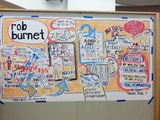
In living up to the "show, don’t tell" adage, there are some beautiful images created by the participants which I can share.
More here: http://www.flickr.com/photos/choconancy/tags/sfrome/
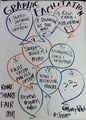
My goal was not to do a drawing class. Instead I wanted to encourage people to experience then joy of the physical act of drawing, then connect that joy to the power of visuals to encourage conversation and their use in a diverse set of group processes.
After we experienced the joy of beautiful colored pens chalk and the liberation of drawing on large scale paper, we reviewed a variety of visual facilitation practices such as mind maps and mandalas, river of life, sketch noting and graphic recording, card sorting and hands on drawing icebreakers. Participants took turns with graphically enhanced flip chart note taking. Finally we did a quick graphic recording so each participant could begin their own graphic facility toolkit. They did amazing work.
What was more amazing was to see enhanced use of visual practices in the following days of the fair, as people applied what they experienced.
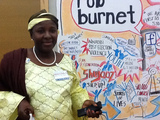
Ironically the next day dawned and the Internet access was out just before Rob Burnet of Well Told Story was to begin his keynote. This was particularly challenging to the Fair team because social reporting was part of the heart and soul of the Fair. So they asked me to graphically record the talk which was fun because one of Rob’s key strategies for reaching Kenyan youth was comics! In the end then wifi was back and the social reporters tweeted about the analog note taking!!
Nancy White
.
Blog
.
<span class='date ' tip=''><i class='icon-time'></i> Aug 19, 2015 12:27am</span>
|
|
October is a month on the road… and one stop is Lyon, France, where I’ll be presenting at the third edition of the fOSSa Conference taking place from October 26 to 28, 2011.
What is fOSSa? From the organizers:
The aim of the fOSSa (Free Open Source Academia Conference) is to reaffirm the underlying values of Open Source software: innovation & research in software development.
While the first edition aimed at providing valuable information on the Open Source model at large, the second edition focused specific key-aspects of FOSS such as development, innovation & research, community management & promotion, public sector, and education. The third edition will address in an open-minded style about
- what tech people are actually doing and innovating?
- which are the upcoming issues & challenges in the open development context?
- how open activities, collaboration and knowledge sharing is beneficial to academia, education & industry?
fOSSa 2011 program includes talks about Education, Online Community Management, New Innovating Development & Contribution Paradigm, Openness and OSS trends.
fOSSa days are open to everyone and registration is free !
more information @ http://fossa.inria.fr
So what am I going to offer? Here is my first draft: Twittering: Frittering or Connecting? The role of transversal connections in online communities and networks.
As humans, we have a long history of working in groups: families, local geographic communities, work teams. Today online technologies allow us to connect broadly using networks of all kinds. We might think of these as deep (groups) and broad (networks). The question is, how do we keep these two forms usefully knitted together? How do the emerging technologies work together as a useful habitat, and when do they actually make things harder? What are the online and offline implications? Lets explore the place of the "transversal!"
I picked up the word "transversal" from Etienne Wenger’s talk a few weeks ago at the Rome Share Fair. It resonated with my observations about the disconnect we seem to experience between high level conversations in a domain and practice, between the breadth of networks and the intimacy of smaller groups. So I grabbed the word and I’m running with it, along with his term "social artist!" Yum. Plus I’ll weave in technology stewardship. So maybe this is about roles, eh?
This week I also have a fabulous case to illustrate many of the ideas I’m thinking of sharing, the #Canlis4Free treasure hunt in Seattle. I took a ton of screen shots and uploaded them today. But does one dare talk about one of the more exclusive Seattle restaurants when in the home of some of France’s finest cooking? Mmmm….
Nancy White
.
Blog
.
<span class='date ' tip=''><i class='icon-time'></i> Aug 19, 2015 12:27am</span>
|
|
And now for a learning experience that aptly contributes to the pleasures of the feast. From the good folks at the Pantry at Delancey, I learned about pie. Most specifically, pie CRUST. Yum.
via Becoming a Pie Ninja - YouTube.
Nancy White
.
Blog
.
<span class='date ' tip=''><i class='icon-time'></i> Aug 19, 2015 12:26am</span>
|
|
Last Monday I was a guest of the Leadership Learning Community for an short online gathering. The description was pretty loose and they expected around 50 people to show up.
Communities, Networks and Engagement: Finding a Place for Action
We have so many online tools at our disposal to theoretically connect and activate engagement with others. But what happens when we say "we’re building an online community" but few engage? When is it worth the work and effort? What are our options? And if we build it, what are some starting points to help us work towards successful engagement?
We were using a GoToWebinar platform, which I’ll admit, I don’t like because it is really a broadcast tool, with no peer to peer interaction and all participant interaction funneled to one person (and there were four of us involved in producing the event, so lots of forwarding, etc.) I decided to abandon a more formal presentation style to try and engage people from the start because after all, this was what the webinar was about! So we started with some polls, and then with my host, Grady McGonagill, we took questions during the presentation and Grady and I diverged into conversation as well. Consequently, I did not get through the material. So I promised to follow up with the slides, resources and answers to any outstanding questions we did not get to. Thus this blog post. Here we go…
Questions
Any tips or recommended resources for facilitating hybrid online/phone focus groups with smaller groups (5-15 max)? Also, any recommendations re: optimal group size for this sort of interaction? If the group is all online - you are lucky. The most challenging groups are mixed online and offline. For facilitating, there are a couple of things to keep in mind. 1) Think multi-modality. Audio alone doesn’t work well for a lot of us to stay engaged. Have a visual element - a shared Google doc or presentation, a wiki/chat room in Meetingwords.com or use the white board in a web meeting tool. Of course, this visual aspect needs to be relevant. I really like pairing chat rooms w/ audio (be it on phone, skype or whatever) where people can talk to each other without having to wait for audio "air time." This does challenge some people who are less comfortable multitasking. You might consider methods like "the clock" both for phone and web meetings (see here and here). 2) Think 7 minute chunks. Break things up alternating content sharing with interacting, visual with audio. Remember, it is hard to pay attention when our bodies are not in the same place. 3) Group size issues are similar to those F2F. Once you get over 5 or 6 it is harder for everyone to have a chance to speak up. With some web tools, you can do break out rooms — just like F2F!
How do you balance "quality control" with network engagement/ participation/ responsibility? I was very intrigued by this question. It is probably helpful to figure out what we mean by quality control. I’ll take a guess and someone chime in if I get it wrong. I’m assuming this is about content — did a member give correct or useful advice. Was the data shared accurate, etc. My experience is that in communities where people care about what they are working with (the "domain") they also care about quality and help weed out the "iffy" stuff. The key is to cultivate habits of critical thinking and useful practices to apply that thinking (which means civility!) If we are talking about "quality people" I’m assuming this means attracting people who know something about the domain. Again, if the learning matters, you will attract good people. It can feel, however, like a leap of faith. One word? LEAP!
We have persons in developing countries as well as in places where the internet is not an issue… this produces a big challenge to overcome to connect the majority of them. How do you engage them? How do you make them feel part of the community (normally they believe and put money, but not always participate). Again, I need to be careful in my interpretation of this question! When we work globally, we have both similarities and differences to account for. First, if there is clarity on shared domain (what the group is interested in an how it is concretely relevant to them today!) you are ahead of the game. Many global communities I’ve been involved with have very broad, generic domains. While no one could disagree with them, they were so broad everyone deprioritized their participation. A big tent may hold many people, but a big tent can also be empty. Consider focusing the domain in a way that carries relevance for people NOW. Then make the tent bigger later. Second, cultural diversity (linguistic, national, professional, gender, etc.) can be harder to detect online, but can trip us up faster. I find making these differences discuss-able little bit by little bit helps. Encourage people to share their ways of working and interacting. Compare and contrast a bit. This helps people find common ground and know when to "cut some slack" for others’ behaviors which they may not — ahem — love themselves! Finally, talk about participation — don’t assume it. Ask for small, doable things from people to build that sense of and experience of engagement. Don’t ask for TOO much — people are busy no matter where they live! Small bites are tasty! (See also the next two questions)
Do you have any recommendations for technology when your community is spread around the world? In my experience where bandwidth and electricity are limiting elements the most effective technology is email based technology. The use of text on mobile phones is the first technology that might unseat email. There are also community rhythm issues when you have people coming from diverse bandwidth contexts. For example, when you have a mix of folks who are "always online and reply quickly to messages AND people who are online once a week or every two weeks, you can get a lot of asymmetry in participation with those on less feeling left out and "late to the party." If this happens to you, encourage the always-on folks to slow down. It’s good practice for us "fast fast fast" people!
What does diversity mean in this discussion? How does class diversity and online access play a role? How do multilingual networks connect and thrive? What hosting platform handles multilingual groups best? Diversity means MANY things and some have different implications than others. Lets start with linguistic diversity. I have used platforms that have multilingual interfaces — and which one will work for you depends on what languages you need. But the user interface is just step one. That helps people get online. But the key is having a) critical mass within each linguistic group for ongoing interaction and b) "bridgers" who help summarize and translate. I’ve blogged a bit about this issue and you can read some of the articles here.
Can you repeat at some point how to access the wiki? I mentioned two wikis. One was my online facilitation resources wiki here. The other is the Knowledge Sharing Toolkit, a collaborative effort to capture a variety of online and offline methods.
CPsquare doesn’t give much on their initial website — any chance you all can give more guidance on how to connect to it? It is hard to get a sense of all the wonderful things that happen around CP2. First, it is important to know it is a membership community. You can see the blog for free, but ya gotta join, ok? For example, there is the quarterly "Foundations of Communities of Practice" online workshop which is a deep dive into CoPs. John Smith, the community steward, told me to mention"help in real time" which is a discussion board for Q&A with fabulous people resources, the month telecon on "shadow the leader" where the community hears about the community leadership practices of one person over the arc of a year (currently Marc Coenders on evolving his evolving business model), the R&D series on student projects where mostly PhD candidates support each other and then when drafts of work are ready, the community offers feedback. For more details, read CP2 blog for news and updates. My shorthand? CP2 is a place to engage with others who care about communities of practice!
Have other questions or thoughts? Chime in with a comment.
Slides:
Communities, Networks and Engagement: Finding a Place for Action
View more presentations from Nancy White
Nancy White
.
Blog
.
<span class='date ' tip=''><i class='icon-time'></i> Aug 19, 2015 12:26am</span>
|
|
Choconancy1 posted a photo:
Nancy White
.
Blog
.
<span class='date ' tip=''><i class='icon-time'></i> Aug 19, 2015 12:25am</span>
|
|
I’m home from another adventure! I’m back from Maastricht, Bonn and Lyon where I’ve been working and playing on various thingamabobbers. In Lyon, I really stepped into a new domain for me, Open Source Software (OSS) development. I was invited by the energetic and creative Stephane Ribas to present at fOSSa2011, a 2.5 day gathering of mostly French and Italian OSS developers and academics, along with a few philosophers and inventors thrown in to spice up the mix.
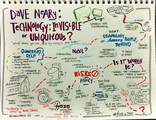
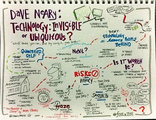
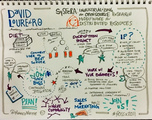
Conceptually, the discourse on Open Source makes a lot of sense to me. I did get lost when they started talking code. So I decided to sketch the sessions where I could understand "enough" to do a little reflection and sense making. It turns out people seemed to really appreciate the notes based on the feedback on Twitter and from people directly. After the organizers scanned the paper images, we gave each of them their own picture. I sense that this is a unique way to know you have been "heard." It also helped me get to know people a bit easier.
My talk was a mish-mosh of ideas that relate to supporting communities of developers and related roles in the OSS space. I talked general, not OSS, but with the intent that the ideas were applicable. Slides are also below. I went out on a limb and had them start with the face co-drawing exercise from Johnnie Moore. I sense it pushed some out of their comfort zones, while others seemed to enjoy it. My goal was both to show another "face" of co-creation and collaboration, AND to break out of the traditional academic presentation mode.
As I reflected on the 2.5 days, there were a ton of amazing ideas, but it was challenging to be sitting and listening in schoolroom set up all day. Just imagine these same people using OpenSpace and what additional space for conversation would be available! Next year the fOSSa theme is "archeology" looking back at the open source software movement. I suggested they do a large graphically captured history wall. YES! I hope I can help contribute to that next year, on site or remotely. In the meantime, I’ve been given a lot to reflect on regarding the politics of OSS, the wonderful side conversations with the wonderful Miguel Cornejo, who I finally got to me F2F, and finally, the enticing possibilities of RepRap machines from Adrian Bowyer! Holiday project?
My thanks to all the organizers, hosts, speakers and presenters. I had a wonderful time, including the great wine tasting meal on Thursday. Pictures here: http://www.flickr.com/photos/choconancy/sets/72157628002081730/
via fOSSa2011 sketchnotes.
fOSSa2011 sketchnotes
And the slides…which make little sense without the talk. Sorry.
fOSSa2011: Five Things About Online Community and Networks
View more presentations from Nancy White
View more presentations from Nancy White
Nancy White
.
Blog
.
<span class='date ' tip=''><i class='icon-time'></i> Aug 19, 2015 12:24am</span>
|
|
Busy day yesterday with #change 11 and then a Google+ Hangout w/ @giuliaforsythe and company via DTLT Today. Episode 71: The Social Artist DTLT Today. Here is the video! More play with the idea of social artists, transversalists and the power of creating our own visuals.
Nancy White
.
Blog
.
<span class='date ' tip=''><i class='icon-time'></i> Aug 19, 2015 12:24am</span>
|