Blogs
|
Joitske Hulsebosch pinned this video on Pinterest and it immediately became inspiration for this weeks (irregular) Monday Video. First, take a look. Just 2 minutes 3 seconds.
via Strange Meeting - YouTube.
Fun to see, and slightly ironic as my work travel schedule is about to, um, take flight. Now I travel to facilitate longer form meetings — 3-5 day things that would be painful online, but I have to say, I wish we were progressing with our telephone and web meeting practices and tools a bit faster. I have been beta testing MeetingBurner (I have a future blog post in draft form) and had such high hopes, but in practical use I’ve run into some problems which I think are fundamental. Is it because I have "weird" online meeting habits or that tools and practices are still stuck in broadcast mode?
Here are a few of the areas that I’ve been working on that have improved my synchronous online meetings… and they seem to be to be both fundamental to healthy meeting practices as much as about technologically mediated meetings.
1. Make the meeting matter. Don’t have a meeting to broadcast information; it should be for meaning making, relationship building, working on challenges or thinking TOGETHER. These all imply active listening and response (a.k.a "conversation") and full on interaction.
2. Be interactive. Don’t bore me PLEASE!!! There is a place for broadcast "webinars" but ONLY ONLY ONLY if the tool enables meaningful participant interaction and the presenter wants to and has the skills to interact. Otherwise send me a link to a video or audio, thankyouverymuch. And by interaction, that does NOT mean just a Q&A tool or the ability to chat with the person controlling the platform (GoToMeeting, I am not your fan.) It means open chat rooms where participants can know who else is participating, chat with them, and if there are a lot of chatters, someone to help weave the chat with what the presenter is doing. (Edit: See this post from EEKim about meaningful conversations at meetings.)
3. There is facility for joint artifact creation. This means joint note taking (a la http://www.meetingwords.com) and, in my personal ideal, a shared whiteboard with good writing tools that everyone can access (whether that permission is turned on or off selectively is again a process question.) I could write tons more about the generative practice of both shared meeting note taking and drawing together. I’ll spare you this morning…
4. Be embodied. There is facilitaty for images or video of the participants. Now I’m not a video fan. I work at home, often at dreadfully early morning hours and you do NOT want to see me. But a picture of me does bring a bit more humanity. And there are times when video is really useful. And times when it is distracting so we need to be smart enough to discern when to use it!
Four is probably enough for one blog post. Where do you stand on online meetings?
Nancy White
.
Blog
.
<span class='date ' tip=''><i class='icon-time'></i> Aug 19, 2015 12:16am</span>
|
|
(Note: this post was scheduled month ago and got hung up. Just found it today!)
Since I got my iPad, one of the apps I’ve been playing with a lot is Evernote. I can prepare and/or take notes, incorporate images, etc from a meeting then send the notes via email to participants, or even make a note public. Here is my preparation note for the Graphic facilitation workshop I led at the Rome Based ShareFair last September, along with one photo from the workshop.
Here is a note snippet from Etienne Wenger’s keynote at the ShareFair. Here are very brief notes from the community case clinics Etienne and I did at the Fair.
I have used this feature mostly for sending private notes to meeting participants as what I do on the iPad is usually pretty rough. I’ve found it pretty speedy and efficient. I can always fix the spelling when I get back to my desktop, as I still make a lot of typos on the iPad’s keyboard. I like the low profile of the iPad vs the wall that even a small netbook creates on a lap or table.
More generally, I need to think about how to best organize my Evernote notes. I’m using it to read articles I’ve saved using Instapaper and ReadLater which make it easy to collect online content to read on the pad when I’m offline. But I tend to collect more than I read. So there are some workflow issues to sort out. I still havent’ figured out my workflow relationship between readitlater and tagging on services like delicious. So many conundrums as I evolve my technology configuration.
What new tool(s) are you playing with?
Nancy White
.
Blog
.
<span class='date ' tip=''><i class='icon-time'></i> Aug 19, 2015 12:16am</span>
|
|
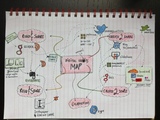
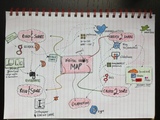
Check out this fabulous post by Geoff Brown, Simplifying my digital habits | Yes and Space.
I have to share the image he created which helps make sense of the configuration. Brilliant. Thanks, Geoff!
Nancy White
.
Blog
.
<span class='date ' tip=''><i class='icon-time'></i> Aug 19, 2015 12:16am</span>
|
|
Just a quick addition to my two posts on facilitation card decks (here and here). This one is for a geocentric exploration of a place. COOL!
The Drift Deck (Analog Edition) is an algorithmic puzzle game used to navigate city streets. A deck of cards is used as instructions that guide you as you drift about the city
via Drift Deck | Near Future Laboratory.
Here is a peek at the cards…
Near Future Laboratory Drift Deck 2008
View more documents from bleeckerj
Nancy White
.
Blog
.
<span class='date ' tip=''><i class='icon-time'></i> Aug 19, 2015 12:16am</span>
|
|
Rob Cottingham is always coming up with cool new stuff. He is the first person I knew to create cartoons about social media. He was one of the first people I graphically recorded "up front" (instead of from the back) at NorthernVoice a few years back (sadly, the video is now gone but you can see the images here). So when he invited me to be his first guest on the Social Speech Podcast, I had to say yes. Here are the deets:
The social web has gone a long way toward changing what it means to be in the audience at a speech - making an audience member less a passive spectator listening to a monologue, and more an active participant in a conversation among peers.
And nobody does that quite like Nancy White - except she doesn’t just rely on digital technology. She’s one of the best group facilitators in the business, working all over the world with everyone from small community groups to Fortune 500 companies. You can see her approach at work in the March of Dimes’ Share Your Story site, which several years on is still one of the examples we cite the most often of how online community can make a real different in people’s lives.
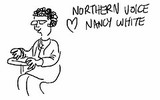
So who better to kick off Episode 1 of the Social Speech podcast? (Graphic: A quick sketch I (Rob) did of Nancy at Northern Voice a few years ago.)
Thanks, Rob!
You can download the podcast on Rob’s site.
Nancy White
.
Blog
.
<span class='date ' tip=''><i class='icon-time'></i> Aug 19, 2015 12:15am</span>
|
|
Via a G+ post I stumbled upon Tim Kitchin’s comment which totally captures why visuals matter to me in group process. I have been taking two paragraphs to day it. Tim boils it down and makes me smile.
Disagreements about words become a cause of demolition. Disagreements about images are an excuse for construction.
via Steal this Brand Too » Blatancy and the Social Object Factory.
Thanks Tim. (By the way, dear readers, the rest of the post is also really interesting!)
Nancy White
.
Blog
.
<span class='date ' tip=''><i class='icon-time'></i> Aug 19, 2015 12:15am</span>
|
|
Alan Levine has a great new video shared via the Flat Classroom Project that took me back to some thinking I did with some pals at the University of Reading’s OdinLab (UK) in 2010. We were pondering how to talk about identity, particularly in the internet era. The OdinLab folks had a project for university students called "This is Me" and I did a remix for Librarians as part of some work I was doing in the US.
I loved that Alan presented his ideas about identity through three "slices" of his public self, and that Alan himself is generous about all sides of his life. (Makes for good friends!) I chuckled at the mention of staying in the homes of people he had met "only" online… my husband has been chuckling at me for this since 1996, inviting in what he called, even way back then, my "imaginary friends." But we all know, you aren’t imaginary!
Take a look at this 13+ minute video. Alan asks some questions that are worth our time. I particularly like the bit at the end when he asks not just about our individual identity, but the "we" — our collective representation and identity online. Cool!
We, Our Digital Selves, and Us - Flat Classroom Project.
Nancy White
.
Blog
.
<span class='date ' tip=''><i class='icon-time'></i> Aug 19, 2015 12:14am</span>
|
|
A gem from Alan Levine. I’m nodding in total agreement. "Nuff said.
"I fully buy into the idea that small acts of regular creativity is not only good practice, but good for the soul. I have no proof, just my own case study."
My case study agrees with your casestudy, Cogdog!
via We Want YOU! (to daily create) (and add more) (please?) - CogDogBlog.
Nancy White
.
Blog
.
<span class='date ' tip=''><i class='icon-time'></i> Aug 19, 2015 12:14am</span>
|
|
Yay! A kindle edition of Digital Habitats: stewarding technology for communities is now available!
As John wrote on the book blog,
It has been a while in coming! People have been asking about an e-book version of Digital Habitats since it was published almost 3 years ago! It seems logical, given that technology is a central theme of the book. Especially when it’s been assigned as reading in a class or workshop and people have scruples about using paper.
Now Digital Habitats is now available in a Kindle edition for $9.99:
http://www.amazon.com/dp/B007P6I7SO
It turns out that all those tables and pictures that make the book a practical handbook made it take a lot longer to put it in an electronic format. And it took us a while to get to it.
Eventually it will be available on other platforms, but we’re starting with Kindle since free Kindle apps are available on Windows, Mac, iPhone, iPad, BlackBerry, Android and Windows Phone 7!
The electronic version goes with the other resources we’ve provided online, such as:
Diagrams and worksheets: http://technologyforcommunities.com/excerpts/
Tool and practice descriptions: http://cpsquare.org/wiki/Technology_for_Communities_project
Chapter 10 "Action Notebook" in an editable Google-Doc format: http://bit.ly/DH-chapter10
Nancy White
.
Blog
.
<span class='date ' tip=''><i class='icon-time'></i> Aug 19, 2015 12:14am</span>
|
|
The Four Fold Practice « Chris Corrigan is a great bit of advice for how to mindfully work and be together. Take a look. Here are a few snippets that I really appreciated:
"None of us are smart enough to have the answers. To co-create something is to benefit from diversity and to stay in the relationship…even when you don’t know where things are going."
"Pay equal attention to work and relationships."
Nancy White
.
Blog
.
<span class='date ' tip=''><i class='icon-time'></i> Aug 19, 2015 12:14am</span>
|