Blogs
|
I did a brief interview with Chris Hutton over at Liter8 Ideas recently, and one of the questions Chris asked was "What have been obstacles that you’ve had to overcome when it relates to your educational journey?" There have been many - as I am sure there have been for you - but one that came to mind immediately was a "tendency to avoid risk."
Now, don’t get me wrong - I’ve done some reasonably adventurous things in my life, and I have also been an entrepreneur for most of my career. So, I am hardly what might typically be thought of as "risk averse." Nonetheless, most adults like to feel safe in learning situations. As a result, I am like most people in that I don’t always embrace discomfort, much less danger, when it comes my personal and professional development. So, that got me thinking: what are some ways to take reasonably safe "risks" that lead to learning?
Here are five that came to mind:
Publish
This may be among the easiest "risks"now available to us. Anyone can start a blog quickly on WordPress.com or Tumblr. Or, any number of blogs, small journals, and other publications are always looking for guest writers. Even a substantial post on Facebook or a LinkedIn group may do the trick. Having to write in a clear, cogent way about a topic or theme you care about is a sure fire way to solidify and deepen your knowledge.
Teach
Teaching takes things just a bit further. Whether you actually stand in front of a classroom, lead a live Webcast or Webinar, or record an instructional video or audio session, you put your knowledge on the line in a way that makes it hard to hide from questions, comments, and yes, criticism. Scary, perhaps, but doable, and now available to pretty much anyone with a Webcam and a YouTube, Mindbites, or WizIQ account (just to name a few options). Or, if you prefer live venues, propose a session for at Rotary Club, a professional or trade association conference, or any of thousands of other places that are continually in search of content.
Perform
Performing and teaching have a lot in common, but I think they deserve separate treatment. While teaching is primarily about instruction, performance is primarily about expression. And let’s face it - expressing yourself in from of others can be downright frightening. But again, it’s entirely doable. Just recently, for example, I was at an open mic night in Charleston, SC, where poets and musicians stood up in front of the room and shared their stuff. This sort of thing happens every night all over the world. If you want to find an open mic night in your area, just check out http://openmikes.org/
Interview
I’ve found that one of the best ways for me to improve my own knowledge is to ask others about their knowledge. The process of preparing for an interview and then engaging in meaningful discussion requires you to do things like repeat, review, formulate questions, and put things in your own words - all activities that contribute to learning. While I haven’t done a lot of it lately, I’ve historically been a big fan of podcasting as a way to get into a rhythm of regular interviewing. If you are interested in that approach, you may want to check out my free mini-guide to podcasting. (I plan to update this soon, but the info in it is still good.)
Sell
This last one may raise an eyebrow or two, but there are few things I have learned more from in my life than having to sell, whether that means selling a product, a service, or - perhaps most difficult - an idea. To sell effectively, you have to learn how to convey ideas and value clearly and concisely. You have to develop an understanding of how others might perceive your offerings. You have to be believable - which almost always means you have to have true command of your material. It’s very true that teaching sells, but it is equally true that selling teaches.
You may have noticed by this point that all of these suggestions are related by a common element: action. In most cases, the avoidance of risk is the avoidance of action. But without action, there is no way to build competence, and if we are not steadily building competence, we will severely limit our learning and growth potential.
So, consider taking one of these suggestions for a spin. While they do involve a bit of risk, the downside for any of them is pretty minimal. The upside could be a significant leap forward in your learning.
Jeff
No related posts.
Jeff Cobb
.
Blog
.
<span class='date ' tip=''><i class='icon-time'></i> Aug 19, 2015 01:37am</span>
|
|
I’ve been a fan of The Great Courses from The Teaching Company for quite some time. In fact, I mentioned to my wife just recently that it would be interesting to put together some sort of discussion group around the courses I’ve taken so far. Then, serendipitously, I received an e-mail from Mission to Learn reader Dan Egbert about a new site he has started to help Great Courses students connect.
TTC University is a fledgling effort, so you won’t find it overflowing with discussion just yet. But hey, that’s why I’m writing this post - you have to start somewhere, and I figured if I am looking for this sort of thing then there are probably readers out there looking for it as well. If you are a Great Courses fan, I encourage you to visit TTC University. It’s free, and from what I have seen so far, it seems to be very nicely done.
If you aren’t familiar with the Great Courses, they are well worth checking out. I recently completed How We Learn, which was excellent, and am currently working my way through Memory and the Human Lifespan and How to Listen to and Understand Great Music.
Are you a Great Courses fan (or not)? Got any favorites? Please comment and share.
Jeff
No related posts.
Jeff Cobb
.
Blog
.
<span class='date ' tip=''><i class='icon-time'></i> Aug 19, 2015 01:36am</span>
|
|
A student at Brigham Young University e-mailed to alert me to an event her Digital Civilization class will be presenting on Wednesday, April 11, 2012, from 7-8:30 PM MDT. The event will feature students delivering TEDx-style presentations on "how to be more engaged in our digital world." You can catch the live stream or tune into the recording later at http://digiciv.byu.edu/.
This seems like a great event - kudos to professors Gideon Burton and Daniel Zappala for making it a part of their class. The class, too, sounds fantastic. Here’s the description:
Western civilization has been greatly influenced by how we produce and share knowledge. Since the development of the printing press in the 15th century, the printed word has dominated religion, philosophy, science, economics, politics, and education. We are now in the midst of the digital revolution, with online media such as blogs, wikis, social networking, and the web shaping our civilization. In this course we will view western civilization through the lens of the digital revolution, learning both what the past has to say about how we produce and share knowledge, and what our experiences with modern technology lead us to discover about the past. Our readings will pair great works of western civilization with current texts and tools, exploring common themes that include the structure of knowledge, principles of openness and participation, authenticity, identity, privacy, and copyright. Students will become fluent with the concepts and tools needed to be lifelong learners and active participants in a world where technological innovations change rapidly.
Be sure to check out Digital Civilization and spread the word.
Jeff
No related posts.
Jeff Cobb
.
Blog
.
<span class='date ' tip=''><i class='icon-time'></i> Aug 19, 2015 01:36am</span>
|
|
I noted in an earlier post that as powerful as deliberate practice can be for mastering particular skills or knowledge, recent research suggests that we eventually run up against the limits of our intellectual capabilities. In particular, the capacity of our working memory seems to have significant impact on what we can ultimately achieve.
So, are there ways to improve our overall intellectual capacity? It was with this question in mind that a handful of recent articles in The New York Times caught my eye.
In the first, Dan Hurley asks Can You Make Yourself Smarter? The answer is not an unequivocal "yes," but the research that has been done so far certainly offers hope. Hurley’s article focuses on "crystallized" intelligence - basically, the stuff we store up over time - versus "fluid" intelligence, which is the domain of working memory. In particular, he discusses the work of psychologists Susanne Jaeggi and Martin Buschkuehl, whose experiments suggest that working memory can indeed be enhanced through certain types of brain training. There are doubters, to be sure, but there are also other studies that seem to support Jaeggi and Buschkuehl’s conclusions.
Of course, as Gretchen Reynolds argues, we already know about one straightforward way to improve brain function: exercise.(I also touch on the power of exercise in earlier posts on improving memory and being a better learner.) In her article How Exercise Could Lead to a Better Brain, Reynolds notes that "scientists in just the past few months have discovered that exercise appears to build a brain that resists physical shrinkage and enhance cognitive flexibility." In particular, exercise seems to promote the formation of new neurons in the hippocampus (a key area for learning and memory) and - just as importantly - helps these neurons form connections with other neurons, an essential step for the neurons actually becoming useful to us.
In an earlier article, How Exercise Can Prime the Brain for Addiction, Reynolds draws on the same research to highlight how people who exercise regularly may have a harder time breaking addictions than those who don’t. But the real headline in this story, in my opinion, is researcher Justin Rhodes’ point that "what the study shows is how profoundly exercise affects learning." Basically, exercise seems to make it harder to forget what we have learned - which may, unfortunately, include learned behavior like an addiction.
Bottom line: The research showing that regular physical exercise can enhance our learning abilities and improve memory continues to mount. At the same time, there is quite a bit of evidence suggesting that exercising the brain through cognitive training may, in fact, have significant impact on working memory.
Given all of the other benefits of regular exercise, it seems like a no-brainer (;-)) to make it a part of your lifelong learning habits. And personally, I’m becoming sold enough on the concept of brain training to at least take it for a spin. How about you?
P.S. - If you enjoy what you read here on Mission to Learn, I’d be grateful if you would consider subscribing to the RSS feed or subscribing by e-mail.
Related posts:
10 Ways to Be a Better Leaner: No. 9 - Mind Your Body
Jeff Cobb
.
Blog
.
<span class='date ' tip=''><i class='icon-time'></i> Aug 19, 2015 01:36am</span>
|
|
For those of you who haven’t yet decided to follow Mission to Learn on Twitter (You know who you are.), here’s a round up of some exquisite links I’ve tweeted lately on the general topic of brain science and the human mind:
A Brief Guide to Neuroscience (The Guardian)
Just what it says it is - a quick run down on one of the trendiest of sciences these days.
What is Working Memory and Why Does it Matter? (National Center for Learning Disabilities)
I mention working memory frequently here on Mission to Learn. This post gives you some of the essentials in the context of learning disabilities.
Matters of the Brain: Why Men and Women Are So Different (Live Science)
It’s not because men’s brains are from Mars and women’s are from Venus. Read this post to get some of the real reasons.
Student’s brain flatlined during classes (Boing Boing)
Well, we’ve all had those kinds of class experiences, eh?
Maintain your brain: The secrets to aging success (Science Daily)
It’s not all about genetics and fate. This brief review of a journal article suggests the path research on brain aging may take.
What Eating Too Much Sugar Does to Your Brain (Psychology Today)
Hint: it’s not good. And when you consider that "the average American consumes 156 pounds of added sugar per year…"
Overeating may harm memory (Andrew Weil)
Remember: you really need to watch what you eat. Dr. Weil explains why.
Good list of Ideas and Resources for Keeping Your Brain Sharp (The New York Times)
A good list that hits on many of the themes I cover regularly here on Mission to Learn. Being an active, conscious, healthy learner pays off.
The brain… it makes you think. Doesn’t it? (The Guardian)
An interesting dialogue between two experts on the unconscious brain.
You brain is not as rational as you may think it is (The Daily Beast)
An article focused on Leonard Mlodinow’s very interesting book Subliminal: How Your Unconscious Mind Rules Your Behavior.
Enjoy - and I hope to see you over on Twitter.
Jeff
Related posts:
The Start-Up of You - A Conversation Worth Catching
Jeff Cobb
.
Blog
.
<span class='date ' tip=''><i class='icon-time'></i> Aug 19, 2015 01:36am</span>
|
|
Often one of the main barriers to solving a problem is an inability to see the problem in a way that is likely to spark solutions. A source I return to again and again to help me with tackling tough problems is James Adams’ Conceptual Blockbusting: A Guide to Better Ideas. Here are six blocks he identifies to perceiving problems and the information that might help us solve them:
1. Seeing What You Expect to See - Stereotyping
Recently I encountered a scene familiar to any parent: I came home to find that the chairs in my living room and dining room had been converted - with the aid of a blanket - into a house by my five-year old. These were no mere chairs in his eyes: they were building materials for an entire fantasy world.
Kids provide a constant reminder of how limited our perspectives on the world often become as we grow older. To a large extent, this isn’t a bad thing: we have to be able to rely on certain preconceptions, assumptions, and even stereotypes about the world around us in order to make sense of things quickly and get through our daily lives. Problems arise, however, when (a) the foundations for our preconceptions are faulty, and/or (b) we operate on autopilot and don’t periodically test our preconceptions. As I argue frequently on Mission to Learn, cultivating consciousness and a propensity to ask questions is essential for effective learning. They are also essential for problem solving - which, after all, is a learning process. If you find yourself facing a tough problem, step back a bit and consider whether any preconceptions or stereotypes you hold may be interfering with your ability to find solutions.
2. Difficulty in Isolating the Problem
Sometimes we know there is a problem, but we’re not sure what it is. If you plant a seed in your garden, for example, the expected outcome is that a plant will grow. If it doesn’t, then you have a problem, but the nature of the problem may not be immediately clear. Was the seed bad? Is the soil too acidic? Did you not water enough? Did a bird or squirrel dig up the seed? Often we jump too quickly to an answer to define the problem - e.g., "The seeds I bought are bad" - and end up investing in unnecessary and sometimes costly solutions - e.g., buying new seeds.
We’d be better served by pulling back, looking at the larger objective - which would seem to be successfully growing a plant - and then investigating and experimenting as needed to determine the real problem. Are there tell-tale scratches and holes around where the seed was planted? Have nearby seeds grown successfully, and what was different about how they were tended? This is a simple example, but a little bit of footwork can go a long way in isolating problems of any size.
3. Defining the Problem Area Too Narrowly
I run into this one all the time in consulting. A prospective client will call up and say something along the lines of "We need you to find a learning management system for us." A key question to ask in this situation, or in any situation where a solution has been proposed but the desired objective is not clear is … wait for it … Why?
Go back to the gardening problem above. I noted that the objective here seems to be growing a plant. But what if the real objective was to get more fresh vegetables into your diet? In that case, growing plants is only one of many options. You might also, for example, consider making a trip to the farmers market a part of your weekly routine. Or maybe join a local CSA. If you don’t have the problem defined correctly in the first place, you will completely miss these options.
To help illustrate how we often perceive the problem area too narrowly, Adams’ uses the classic nine dots puzzle. If you haven’t done this before (or even if you have), try connecting the nine dots below using only four lines and without lifting your finger from the screen. (You can view one popular solution to the nine dots problem here. Adams offers a number of others in his book.)
Nine Dots Puzzle: Draw four lines to connect all the dots
4. Inability to see the problem from various viewpoints
An ability to see a problem from the viewpoint of everyone the problem impacts not only helps with arriving at consensus around the solution, it can also help greatly in conceptualizing the problem and overcoming some of the barriers already noted. Simply put, when we have to step outside of our own viewpoint, we are bound to see the problem differently, possibly define it differently, and develop different options for solving it than we would when relying solely on our own preconceptions and biases.
Adams notes that "The architect must view the design of his buildings from the perspectives of his clients, his builders, suppliers, architectural critics, and others in his profession as well as his own." I like the "architect" metaphor both for the reason Adams suggests and because it implies thoughtfully designing solutions to problems rather than defaulting to knee-jerk options. Next time you are faced with a complex, challenging problem, perhaps think of yourself as a solution architect.
5. Saturation
Many years ago in grad school I spent an inexplicable amount of time studying avant-garde poetry and art. A common refrain across nearly any avant-garde group in any part of the world is "Make it new!" The driving idea behind this refrain is that we tend to lock in on familiar elements of the things around us, and after a while, we begin to ignore them to the point that we can’t really even recall them in any great detail, much less fully appreciate them. Try, for example, to draw the heads side of a penny (or a coin in the currency of your country). Don’t worry about your artistic skills, just focus on details like whether you are able to face Lincoln’s head in the right direction or put the right text on the drawing. Chances are high you will make mistakes and leave some things out. It’s too familiar for your to "see" it clearly.
Avante garde artist know that the way to shake up our saturated minds is to "defamiliarize" things and help us look at them afresh. This results in things like slapping a mustache on the Mona Lisa. (See the image at the beginning of this post.) By doing this, Marcel Duchamp shocked viewers into seeing the iconic Da Vinci painting with fresh eyes. So, the next time you are faced with a perplexing problem, it may be worth asking "How can I slap a mustache on this thing?"
6. Failure to utilize all sensory inputs
Often when attempting to solve a problem the solution is right in front of us, but we fail to perceive it. This may be because we are using the wrong senses. We might be looking, for example, when we should be listening or smelling. If you want some excellent exposure to and practice in using all senses for solving problems, I highly recommend reading Sherlock Holmes. Sir Arthur Conan Doyle’s venerable consulting detective often uses multiple senses in getting to the root of mysteries that flummox everyone else. Take, for example, the story "Silver Blaze" in which (a) the fact that a dog did not bark (hearing), and (b) that spicy food was used to mask the taste opium (taste) factor significantly into Holmes solving the case.
When wrestling with a tough problem or trying to develop ideas, take a moment to consider whether you are taking all sense into account. Sometimes it may help to block off one or more senses - for example, simply closing your eyes - in order to become more aware of what the other senses might reveal. As Adams’ puts it, "Problem-solvers need all the help they can get. They should therefore be careful not to neglect any sensory inputs."
***
So, those are Adams’ six "blocks" (the gloss on each is my own, other than where Adams’ is quoted). I plan to write more about this book over the coming months as part of my own effort to absorb its lessons better - and, I hope, to be of help to you in the process. In the meantime, how have you overcome some of the blocks described here in your problem solving and innovation efforts? Are there other importan blocks you think need to be highlighted? Please comment and share your thoughts.
Jeff
P.S. - Not yet subscribed to Mission to Learn? That’s an easy problem to solve. Just click on subscribe by RSS or subscribe by e-mail.
No related posts.
Jeff Cobb
.
Blog
.
<span class='date ' tip=''><i class='icon-time'></i> Aug 19, 2015 01:35am</span>
|
|
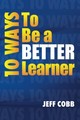
A while back I did a series of posts covering my thoughts on how to be a better learner. I have since developed those into a brief book that I am officially launching today. The print version is available through Amazon and other major distributors, but for the e-version, I decided to sign up with Amazon’s Kindle Direct service so that I could make the download available free for a time. That time is now through Friday of this week, and you can grab the Kindle version at:
10 Ways to Be a Better Learner (Kindle Version)
Note: You don’t have to actually own a Kindle to read the kindle version. There are a variety of options for using Kindle software.
10 Ways to Be a Better Learner is meant to be a quick read that offers solid, practical advice to avid or aspiring lifelong learners. My perspective in writing it was that lifelong learning is more important now than ever, but most of us don’t tend to give a lot of thought to how to be better learners. And most of us have not been all that well prepared by traditional schooling to meet the challenges and opportunities of our hyper-connected, information-overloaded world.
So, I hope you will give it a spin and spread the word to others. If you do read it and find it of value, I’d also be truly grateful if you would consider giving it a brief review on Amazon.com.
And, of course, I welcome your feedback in the comments here.
Jeff
P.S. - I’ll be leading a free Webinar about 10 Ways to Be a Better Learner on Tuesday evening (eastern U.S. time).
P.S.S. - 10 Ways to Be a Better Learner press release
Related posts:
Free Learning 2.0 Report - Updated Version
10 Ways to Be a Better Learner: No. 6 - Practice, Deliberately
10 Ways to Be a Better Learner: No. 7 - Be Accountable
Jeff Cobb
.
Blog
.
<span class='date ' tip=''><i class='icon-time'></i> Aug 19, 2015 01:34am</span>
|
|
As I’ve noted before here on Mission to Learn, I am a fan of the courses that the Teaching Company offers, and one of my particular favorites is How We Learn with Professor Monisha Pasupathi of the University of Utah. Recently I returned to the course to start repeating, reviewing, and reinforcing the great material that Dr. Pasupathi covers. Naturally, one great way to support that process - and to be of help to readers here in the process - is to write about. So, here are five lifelong learning power tips I gleaned from Lecture 14, "Integrating Different Domains of Learning."
If you want to learn well, you should:
1. Space your learning
Repetition is essential to learning, but simply repeating or practicing material over and over again without a break won’t get you very far - at least not when it comes to retaining what you learn for the long haul. There is a significant body of research supporting the idea that it pays to space our learning activities over a period of time. As the course guide indicates, spacing in this way "appears to make it clear to our brains that we can’t lose track of a skill or ability because we will continue to need it." If you want to dig deeper on the topic, I recommend a very good report on spaced learning research by Will Thalheimer, PhD. (And by the way, I am engaging in a bit of spaced learning here by going back and repeating lectures I have listened to before.)
2. Vary the context
There is also evidence that it helps to vary the context in which you study or practice if you want to be able to apply what you learn as flexibly as possible. It is one thing, for example, to develop a great forehand in tennis when a backboard is your opponent. It is quite another to play against a range of other players of varying capabilities, or to play on different types of courts, or in different types of weather . If you really want to become a great tennis player, you need to be able to adapt to all of these variations and many more. The only way to develop this ability is by putting your forehand through its paces in many different contexts.
3. Make it elaborative
"Elaboration" involves drawing associations between new information or experiences and what we already know. As I mentioned in an earlier post on accelerated learning, the use of mnemonics is an elaboration strategy with which most people are familiar. The "method of loci" or "mental walk" in which words, phrases, or other materials are associated with familiar places is a classic mnemonic strategy. Reworking and restating ideas - as I am doing in this post - are also time-honored elaboration methods that support deep processing of new material and lead to much greater retention over time.
4. Make it transfer appropriate
You should practice and review in a ways that corresponds to how you will ultimately use what you learn. I often, for example, will go over scales or other musical materials visually by reading through them in print or on a digital device. I may even visualize myself playing scales or the notes for a song. While this sort of visualization can be very powerful in helping me learn, eventually I have to be able to pick up a guitar and make it produce the right sound. This involves not only knowing the right notes, but also having all of the necessary motor skills and tactile sensitivity needed to perform effectively. If I never pick up a guitar at all, it is hard to argue that I have truly learned my scales.
5. Sleep on it
Sleep is a topic I touch on in the "Mind Your Body" chapter of 10 Ways to Be a Better Learner, and it is a topic I plan to write a lot more about in the near future. Pasupathi highlights sleep as one of the most direct ways you can support learning because "sleep allows your brain to finalize the various neuronal connections you forged through learning and practice." (Course Guidebook, p. 104) Additionally, sleep deprivation may interfere with the development of new neurons in the hippocampus - an area of the brain critical to long-term memory. Finally - and this is my own perspective - it is simply hard to be as attentive or motivated when you are tired, and both attention and motivation play a critical role in how well we learn.
So, there you have it. Thanks for indulging me in a brief session of spaced repetition, review, and elaboration in a transfer-appropriate context. Now I think I’ll go take a nap. (And when I awake, I look forward to reading your comments.)
Jeff
P.S. - Remember that through this Friday (June 8th) 10 Ways to Be a Better Learner is available for free Kindle download. You don’t have to actually own a Kindle to take advantage of this. Kindle software can be run on your computer and a variety of digital devices.
Related posts:
4 Essential Attitudes for Successful Lifelong Learners
10 Last Minute Gifts for Lifelong Learners
10 Gift Ideas for the Lifelong Learners in Your Life
Jeff Cobb
.
Blog
.
<span class='date ' tip=''><i class='icon-time'></i> Aug 19, 2015 01:34am</span>
|
|
I was out on my daily learning walk this morning and the podcast of choice was - as it often is on Monday mornings - Mitch Joel’s Six Pixels of Separation. While most people would consider this to be a marketing podcast, I think the fact that Mitch’s insights tend to range much broader than marketing have contributed greatly his success. Today, as it happens, the topic of learning was central to the podcast.
Specifically, Mitch interviewed Ben Casnocha, co-author, along with LinkedIn founder Reid Hoffman, of The Start-up of You: Adapt to the Future, Invest in Yourself, and Transform Your Career. Right around 25 minutes into the podcast (25:05, to be exact), Mitch and Ben - both of whom are college dropouts - start discussing education and learning. I was struck by the conversation because:
(a) it touches on several of the themes that come up in Shift Ed: A Call to Action for Transforming K-12 Education (my book last year with futurist David Houle) as well as in 10 Ways to Be a Better Learner. (Okay, yes, I probably fall in the "narcissist" camp that Mitch highlights earlier in the conversation.)
(b) I’m finding that this kind of conversation is becoming increasingly common and mainstream.
I sense a growing view - certainly one I share - that education and learning are essentially entrepreneurial activities. We all have to take a certain amount of initiative. We all have to be willing to take a few risks if we want to achieve significant returns that really align with who we are and aspire to be.
As Ben puts it, "Most people have to take education into their own hands." He goes on to add that he’s "not wildly optimistic that we can really reform our institutions to teach entrepreneurial thinking." Rather, he says, "Let’s take it right to the individual … and brainstorm wildly different institutions that we can create…as opposed to try to reform what has so clearly been broken for many years."
Mitch reflects on his own experience with traditional schooling, saying that he eventually came to the conclusion that "I’m not going to let school get in the way of my education.
I’m a passionate reader, I go to events, I’m always trying to learn, I’m always trying to sidle up next to people I think I can learn from. I often say that this podcast is a completely narcissistic act where I get to pen people like you [Ben] against the corner and use you as a sponge to grab information out of.
Ben adds: "Everyone needs to be asking themselves every day "How am I investing in myself today. What am doing to become smarter, better, more connected, wiser" … If you are going to live a long fruitful life and have a long fruitful career, one always needs to be improving oneself… Having a strategy for doing that is really important."
Amen.
As noted above, this conversation starts at around 25:05 and runs for 8 to 10 minutes. I think the whole podcast is worth a listen, but I’d recommend tuning in for this segment of it at a minimum: The Start-Up of You with Ben Casnocha.
Jeff
Related posts:
10 Brain Links Worth Clicking
Jeff Cobb
.
Blog
.
<span class='date ' tip=''><i class='icon-time'></i> Aug 19, 2015 01:34am</span>
|
|
Every year for the past five years my wife and I have dutifully put money into our son’s 529 college savings account. Not long ago, we started doing the same for his younger sister. Our assumptions, of course, are that (a) a college education is valuable, (b) everyone needs one, and (c) it costs a lot of money to get a college-level education.
But what if those assumptions are flawed?
I’m not quite ready to throw in the towel on college or the 529s yet, but it is hard to ignore the mounting criticism of higher education that has emerged over the past several years. While college graduates still tend to do much better economically than non-graduates, it seems clear enough at this point that a college degree is no guarantee of either initial or ongoing employment.
Perhaps more importantly, college is far from a guaranteed way of finding the right path in life, and it’s an awfully expensive way to try. For a lot of people - maybe most - it makes sense to wait, or possibly to never go to college at all. In my opinion, that’s one of the key points Blake Boles makes in the video above (click through if you don’t see it), and it’s one that clearly inspires his new book Better Than College: How to Build a Successful Life Without a Four-Year Degree.
You can read an excerpt from Better Than College on the book web site, and if you happen to be a student or a teenager, you can get the book for free. I also encourage you to check out Blake’s learning community for self-directed learners, Zero Tuition College.
Enjoy, and when you have a minute, let me know what you think. Is college still worth the investment? Are you socking away money for your own higher education or for your kids? Are you worried about whether it will be worth it? What else could you do with $20K?
Jeff
No related posts.
Jeff Cobb
.
Blog
.
<span class='date ' tip=''><i class='icon-time'></i> Aug 19, 2015 01:34am</span>
|